battery AUDI A5 CABRIOLET 2011 Owner's Guide
[x] Cancel search | Manufacturer: AUDI, Model Year: 2011, Model line: A5 CABRIOLET, Model: AUDI A5 CABRIOLET 2011Pages: 364, PDF Size: 86.48 MB
Page 296 of 364
lffll __ C_ h_ e_c _k _i _ n _g ~ a_n _d_ f_il _l_in _ g _________________________________________ _
Battery charging (Maximum charging rate of 30
amps/14.8 Volt )
When charging at /ow voltages (e.g . w ith a trickle charger ), th e
battery cab les do not have to be disconnected first. The batte ry caps
should
not be opened when cha rging a ba ttery .
It is not necessary to remove the battery from the luggage compart
me nt.
Fast charging the battery (charging rate above 14.8
Volts)
For technical reasons do not use a battery cha rger that uses voltage
grea te r t han 14 .8 Vol ts to ch arge yo ur vehicle's ba tte ry .
& WARNING
Charging a battery can be dangerou s.
• Always follow the operating instructions provided by the
battery charger manufacturer when charging your battery .
• Never charge a frozen battery . It may explode be cause of g as
trapped in the ice . Allow a frozen battery to thaw out first.
• Do not reu se batteries which were frozen . The battery h ousing
may have cracked and weakened when the battery froze.
• Charge the battery in a well ventilated area. Keep away from
open flame o r elect rical spark. Do not smoke. Hydrogen gas gener
ated by the battery i s explosive.
• To reduce the danger of e xplosion , never connect or disconnect
c harger cable s while the charger is operating.
• Fast charg ing a battery is dangerous and should only be
attempted by a competent technician with the proper equipment .
• Battery acid that may spill during charging should be wa shed
off with a so lution of warm water and baking soda to neutralize
the acid.
0 Note
N ever use a fast cha rger as a booster to s tart the eng ine. This w ill seri
ously damage sensitive e lectronic components , such as control units,
re lays, ra dio, etc., as well as t he ba ttery cha rger. •
Battery replacement
The new battery must have the same specifications and
dim ensions as the original equipment b atte ry.
Inte lligent e nergy ma nagement in yo ur vehicle is responsib le for
distr ibuting the elect rical energy throughout your vehicle
~ page 24 7. The intelligent energy management sys tem will keep
the eng ine battery charged better then vehicles without this system.
T o m ake s ure the addi tional e lectr ic al energy is available o nce aga in
after you have changed the battery, we recommend that you install
b atter ies of the same type and manuf actur e only ( the same as t hose
installed at the t ime you r vehi cle was delive red) . Specifications are
listed on t he batte ry ho using. Yo ur authorized A udi dealer m ust code
the batte ry in the energy management system to enable yo u to use
the energy managemen t fu nct ions co rrectly after rep lacing the
battery .
If it is not poss ible to use a battery of this type, the new battery must
have the same capa city, volt age (1 2 volts), amperage, const ru ct ion
and plug sealing .
W hen installing t he ba ttery, ma ke s ure t he ign it ion and all electrica l
cons umers are turned off .
0 Note
Make sure the vent ilatio n hose o n the side of t he battery is
connected, otherwise fumes or battery acid can lea k out.
Page 297 of 364
Checking and filling IJl!II
--------------------------------------------=------- =------
<£> For the sake of the environment
Because of the problem of proper disposal of a battery, we recom
mend your authorized Audi dealer change the battery for you.
Batte ries contain sulfuric acid and lead and must always be disposed
of properly in compliance with all environmental regulations.
Disposing of vehicle batter ies improperly is very dangerous to the
environment. •
Windshield/headlight washer
container
Fig. 226 Engine
co mp artmen t: Wind
sh ield and headlight*
washer fluid container
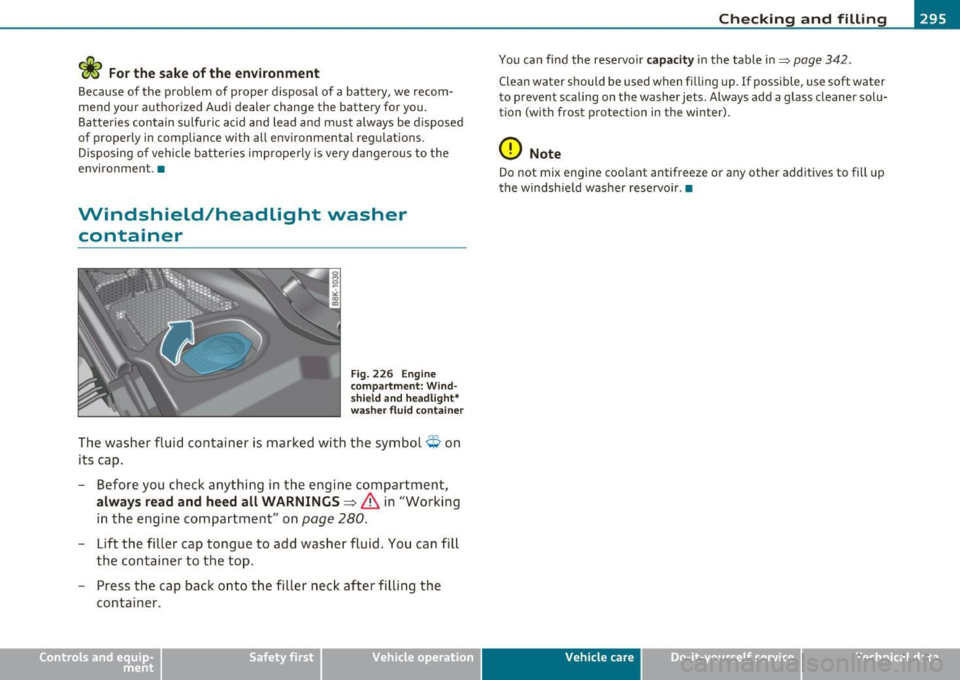
The washer fluid container is marked with the symbol Q on
its cap.
- Before you check anything in the engine compartment,
always read and heed all WARNINGS => & in "Working
in the engine compartme nt" on
page 280 .
-Lift the filler cap tongue to add washer fluid. You can fill
the container to the top.
- Press the cap back onto the filler neck after filling the
container.
Vehicle OP-eration
You can find the reservoir capacity in the table in::::, page 342.
Clean water should be used when filling up. If possible, use soft water
to prevent scaling on the washer jets. Always add a glass cleaner solu
tion (with frost protection in the winter).
0 Note
Do not mix engine coolant antifreeze or any other additives to fill up
the windshie ld washer reservoir .•
Vehicle care Do-it-yourselt service iTechnical data
Page 300 of 364
-~_T_ ir_e_ s_ a_ n_ d_ w_ h_e_ e_ ls _______________________________________________ _
Groove
means the space between two adjacent tread ribs.
Load rating (code)
means the maximum load that a tire is rated to carry for a given infla
tion pressure. You may not find this information on all tires because
it is not required by law.
Maximum load rating
means the load rating fo r a tir e at the maximum permissible inflation
pressure for that tire.
Maximum loaded vehicle weight
means the sum of:
(a) Curb weight
(b) Accessory weight
(c) Vehicle capacity weight, and
(d) Production options weight
Maximum (permissible) inflation pressure
means the maximum cold inflation pressure to which a tire may be
inflated. Also called "maximum inflation pressure."
Normal occupant weight
means 150 lbs. (68 kilograms) times the number of occupants seated
in the vehicle up to the total seating capacity of your vehicle.
Occupant distribution
means distr ibution of occupants in a vehicle .
Outer diameter
means the overall diameter of an inflated new tire.
Overall width
means the linear distance between the exteriors of the sidewalls of
an inflated tire, including elevations due to labeling, decorations, or
protective bands or ribs.
Ply
means a layer of rubber -coated paralle l cords.
Production options weight
means the combined weight of those installed regular production
options weigh ing over 5 lbs. (2.3 kg) in excess of those standard
items which they replace, not previously considered in curb weight or
accessory weight, including heavy duty brakes, ride levelers, heavy
duty battery, and specia l trim .
Radial ply tire
means a pneumatic tire in which the ply cords that extend to the
beads are laid at substantially 90 degrees to the centerline of the
tread .
Recommended inflation pressure
see=> page 297, "Cold tire inflation pressure".
Reinforced tire
means a tire design to operate at higher loads and at higher inflation
pressures than the corresponding standard tire. Reinforced t ires may
be identified as "XL ", "x l", "EXTRA LOAD", or "RF" on the sidewall.
Rim
means a metal support for a tire or a tire and tube assembly upon
wh ich the tire beads are seated .
Rim diameter
means nominal diameter of the bead seat . If you change your wheel
size, you w ill have to purchase new tires to match the new rim diam
eter .
Rim size designation
means rim diameter and width.
Rim width
means nominal distance between rim flanges.
Page 335 of 364
Emergency situations --------------=----Efffll
Emergency situations
General
This chapter is intended for trained emergency crew s and working
personnel who ha ve the necessar y tools and equipment to perform
the se operations . •
Starting by pushing or towing
(D Note
Vehicles with an automatic transmis sion cannot be started by
pushing or towing .•
Starting with jumper cables
If necess ary, the engine can be started by connecting it to
the battery of an other vehicle .
If the engine shou ld fai l to start because of a discharged or weak
battery, t he battery can be co nnecte d to the battery of
another
vehicle, using a pair of jumper cable s to start the engine .
Jumper cables
Use only jumper cables of suffic ient ly large cross section to carry the
sta rter cur ren t safely . Refe r to the manufacture r's specifications.
Use on ly j umper cab les with
insulated te rm ina l clamps w hich are
distinct ly marked :
plus(+) cable in most cases colo red red
minus (-) cable i n most cases colored black.
Safety first
& WARNING
Batterie s contain electricity, acid, and gas . Any of these can cause
very serious or fatal injury . Follow the inst ructions below for safe
handling of your vehicle 's battery .
• Always shield your eyes and avoid leaning over the battery
whenever possible.
• A discharged battery can freeze at temperatures just below
32 °F (0 °C). Before connecting a jumper cable, you must thaw the
frozen battery completely , otherwise it could explode.
• Do not allow battery acid to contact eyes or skin . Flush any
contacted area with water immediately .
• Improper use of a booster battery to start a vehicle may cause
an e xplosion.
• Vehicle batteries generate e xplos ive gases. Keep spa rks, flame
and lighted cigarettes away from batteries.
• Do not try to jump start any vehicle with a low acid level in the
battery.
• The voltage of the booster battery must also h ave a 12 -Volt
rating. The capacity (Ah) of the booster battery should not be
lower than that of the discharged battery. Use of batter ies of
different voltage or sub stantially different "Ah " rating may cau se
an explosion and personal injury.
• Never charge a frozen battery . Ga s trapped in the ice may cause
an e xplosion.
• Never charge or use a battery that has been frozen. The battery
case may have be weakened.
• Use of batteries of different voltage or substantially different
capacity (Ah ) rating may cause an explosion and injury . The
capacity (Ah ) of the booster battery should not be lower than that
of the discharged battery. _..
Vehicle care Do-it-yourself service Technical data
Page 336 of 364
,..,___E_ m_ e_r -=g :.. e_ n_c -=y '-- s_i_t _u _a _ t_ i_ o _ n_ s ____________________________________________ _
& WARN ING (con tin ue d)
• Before you che ck anything in the engine compartment, always
read and heed all WARNINGS~
page 272, "Engine compart
ment ".
0 Note
• App lying a higher vo ltage booster battery will cause expens ive
damage t o sens it ive e lec tron ic compone nts, such as contro l units,
re lays, rad io, etc.
• The re must be no elect rical contact between the veh icles as othe r
w ise current could already start to flow as soon as the pos it ive( +)
t erminals a re connected.
[ i ] Tips
Th e d ischarged ba ttery mus t be p roper ly connec ted to t he veh icle's
electrical system. When jump starting or charging the battery , never
conne ct the negative grou nd ca ble to the ba ttery negative post
because the battery manager system must be ab le to detect the
ba ttery's state of charge. A lways connec t the negat ive g round cable
to the negative ground post of t he battery manager cont rol un it .•
Use of jumper cables
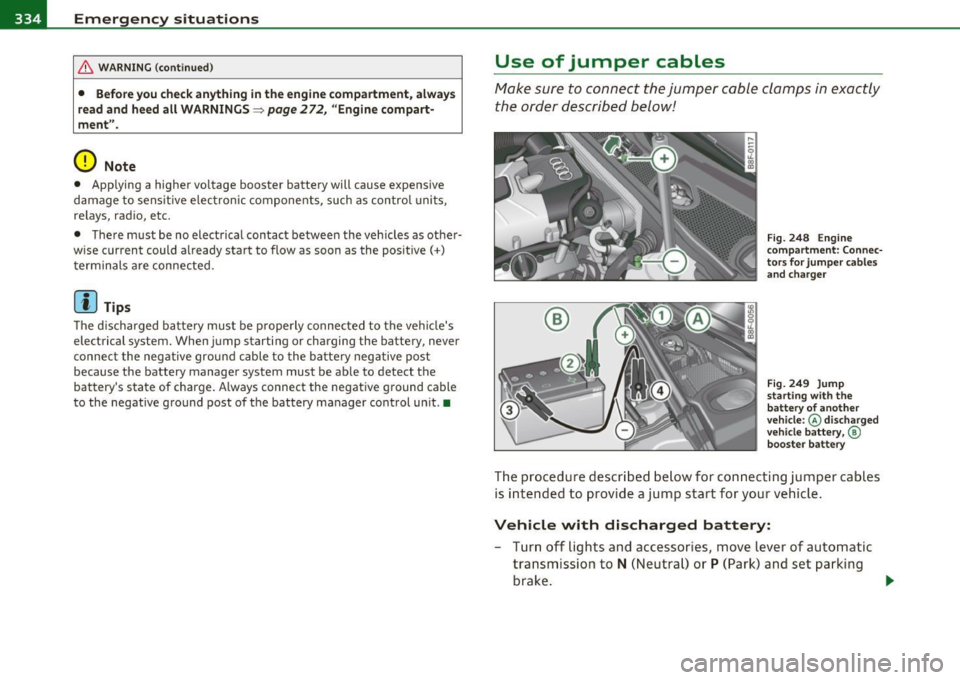
fvf ake sure t o con nect the j umpe r ca ble clam ps i n ex a ctly
the order describ ed belo w!
Fig. 248 Engine
comp artment : Co nnec
t o rs f or jump er cabl es
a nd c harger
Fig . 249 Jump
sta rtin g with the
b at tery of another
ve hicle :@ disc harge d
v ehicle battery ,©
bo oste r battery
The procedure descri bed below for con nec ting ju mper cables
is i nten ded to prov ide a jump start for your veh icle .
Vehicle with discharged battery:
-Turn off lights and accesso ries, move l ever of au to m atic
tra nsmi ssio n to
N (Ne utr al) or P (Park) an d se t parking
bra ke .
~
Page 337 of 364

Emergency situations Ill
-------------=----
Connect POSITIVE (+) to POSITIVE (+) (red)
- Remove the cover above the jump start connectio n.
- Open the red cover o n the positive pole~
page 334,
fig. 248.
1 . Connect one e nd of the pos it ive cable ( red) on the
jump
start bolt~
page 334, fig. 249 (D (Bolts under red cover
= "positive") of the veh ic le to be started @.
2 . Connect the other end to the positive te rminal @ of the
booster ba ttery @.
Connect NEGATIVE(-) to NEGATIVE(-)
(black)
3. Con nect o ne end to the negative ter minal ® of the
boost er batte ry @ .
4. Connect the other end o f the nega tive cab le (black) to the
jump start bolt© (Bolts with hex head = "ne gative") of
the vehicle to be starte d @ .
Starting the engine
- Start the e ngine of t he ve hic le w ith the boos ter ba ttery.
Run the engine at a moderate speed.
- Start eng ine w it h discharged ve hicle bat tery in t he usu al
manner .
- If the engine fai ls to sta rt: do not k eep the s tarter
c ra nki ng for longer tha n 1 0 seco nds. Wait for a bou t
30 se conds and then t ry again.
- With engine ru nni ng, remove jumper cables from bot h
ve hicle s in th e exac t
re verse ord er.
- Close t he red cover on the pos it ive po le.
Safety first
T he battery is vented to the outside to prevent gases from enter ing
t he ve hicl e inter ior. Make su re tha t the ju mper clamps are we ll
connected with the ir
metal parts in full contact with the battery
terminals .
& WARNING
To avoid serious personal injury and damage to the vehicle, heed
all warnings and instructions of the jumper cable manufacturer . If
in doubt, call for road service .
• Jumper cables must be long enough so that the vehicles do not
touch.
• When connecting jumper cables , make sure that they cannot
get caught in any moving part s in the engine compartment .
• Do not bend over the batteries · danger of chemical burns!
• The battery cell locking screws mu st be tightened securely .
• Before you che ck anything in the engine compartment, always
read and heed all WARNINGS=>
page 272, ''Eng ine compart
ment ".
0 Note
Imprope r hoo k-up o f jumpe r cab les can ruin the gene rator.
• Always connect POSITIVE( +) to POSITIVE(+), and NEGATIVE( -)
t o NEG ATI VE( -) ground pos t of the ba tte ry m anag er cont rol unit.
• Check that all sc rew p lugs on the battery cells are screwed in
fi rm ly . If no t, tig hten plugs prio r to con nectin g clamp on neg ative
battery terminal.
• P lease note that the proced ure for connecting a jumper cable as
described above app lies specifically to the case of your vehicle being
jum p st arted. When you a re giving a jump sta rt to anot her vehicle, do
not connect the negative( -) cab le to the negative (-) terminal on the
discharge d batte ry © =>
page 334, fig. 249 . Instea d, sec urely
connect the negative( -) cable to either a solid meta l component t hat
is f irm ly bolted to t he eng ine b lock or to the eng ine b lock itself. If the .,_
Vehicle care Do-it-yourself service Technical data
Page 338 of 364
lffll.,___E_ m_ e_r-=g :.. e_ n_c -=y '-- s_i_t _u _a _ t_ i_ o _ n_ s ____________________________________________ _
battery that is being charged does not vent to the outside, escaping
battery gas could ignite and explode! •
Emergency towing with
commercial tow truck
General hints
Your Audi requires special handling for towing.
The following information is to be used by commercial tow truck
operators who know how to operate their equipment safely.
• Never tow your Audi, towing will cause damage to the engine
and transmission.
• Never wrap the safety chains or winch cables around the brake
lines.
• To prevent unnecessary damage, your Audi must be transported
with a flat bed truck.
• To load the vehicle on to the flat bed, use the towing loop found
in the vehicle tools and attach to the front or rear anchorage
~ page 336 and ~ page 33 7.
& WARNING
A vehicle being towed is not safe for passengers. Never allow
anyone to ride in a vehicle being towed, for any reason. •
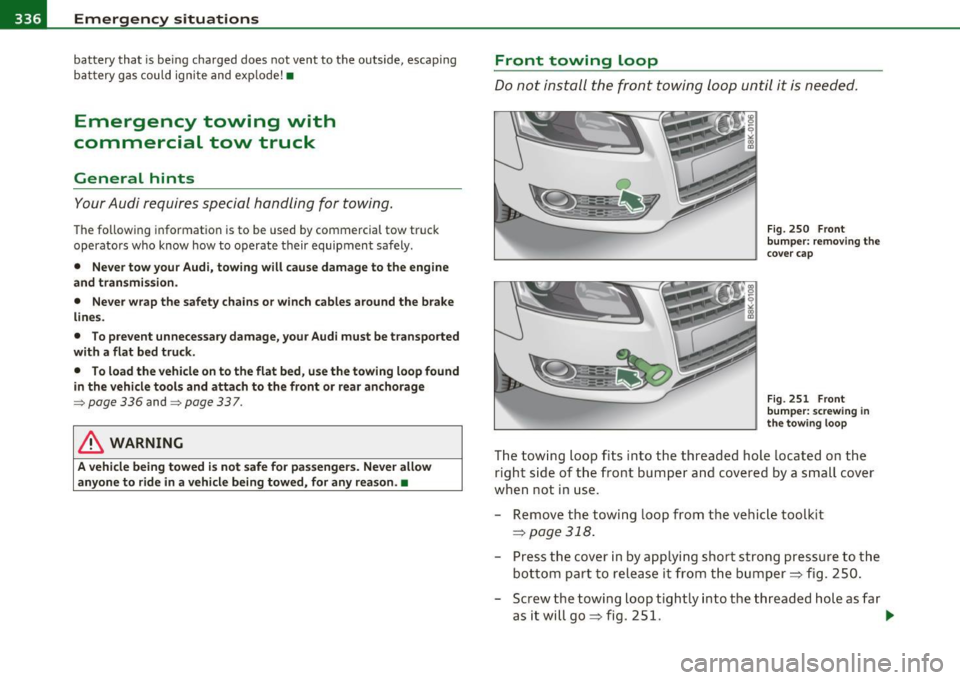
Front towing loop
Do not install the front towing loop until it is needed.
Fig. 250 Front
bumper: removing the
cover cap
Fig. 251 Front
bumper: screwing in
the towing loop
The towing loop fits into the threaded hole located on the
right side of the front bumper and covered by a small cover
when not in use.
- Remove the towing loop from the vehicle toolkit
~page 318.
- Press the cover in by applying short strong pressure to the
bottom part to release it from the bumper~ fig. 250.
- Screw the towing loop tightly into the threaded hole as far
asitwillgo~fig. 251. ..,
Page 342 of 364
___ G_ e_n_ e_r _a _ l_ in_ f_o _r_ m_ a_ t_io _ n _______________________________________________ _
General information
Explanation of technical data
Some of the technical data listed in this manual requires
further explanation.
The technical data for your vehicle is listed in the charts starting on
~ page 342 . This sect ion prov ides genera l information, notes and
restrictions which app ly to this data .•
Veh icle identification
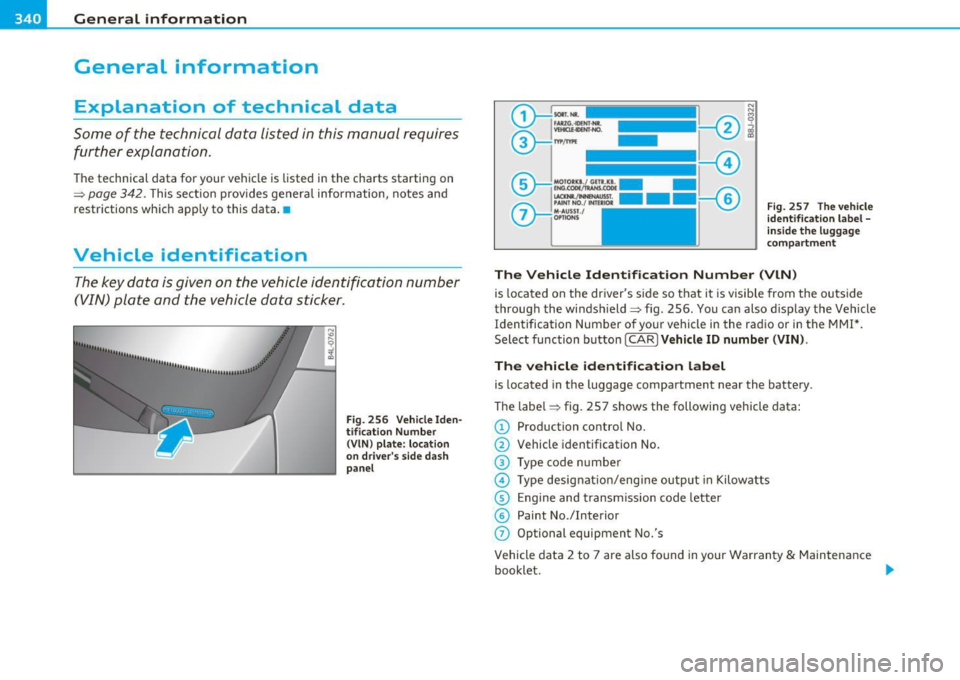
The key data is given on the vehicle identification number
(VIN) plate and the vehicle data sticker.
F ig. 256 V ehicle I den
t ifi ca tion Nu mbe r
(V IN ) pl ate: locat io n
o n d river's s id e d ash
p an el Fi
g. 257 The vehi cle
i d enti ficati on l abel -
in side the l ugga ge
co mpa rtme nt
The Vehicle Id ent ifi cat ion Number (VlN )
is located on the driver's s ide so that it is visible from the outside
throug h the windsh ield ~ fig . 256 . You can also d isp lay the Vehicle
Identification Number of your vehicle in the radio or in the MMI*.
Select function button [ CAR
l Veh icle ID numb er (VIN) .
The vehicle identifica tion label
is located in the luggage compartment near the battery .
The label~ fig . 257 shows the following vehicle data:
© Production control No.
@ Vehicle identification No.
® Type code n umber
@ Type designat io n/eng ine output in Kilow atts
© Engine and transmission code letter
© Paint No./Interior
(j) Optional equipment No.'s
Vehicle data 2 to 7 are also found in your Warranty
& Maintenance
booklet . .,,
Page 351 of 364

___________________________________________ A_ l::.. p _h _a_ b_ e_t _ic _a_ l_ in_ d _ e_x __ _
Auto Lock .. .. ... ..... ... ... ... .. .. .. 42 B
Auto Safety Hotline ... ... ... . .. ..... 185
Auto-Check Control .. ..... ... .... ... .. 27
Automatic belt retractor .......... ... 194
Automatic car wash
See Washing ......... .... .. .... . 261
Automatic climate control . . . . . . . . . 88, 9S
Automatic driving light control ......... 63
Automatic power top ..... .. .. .. .... .. 51
Automatic Shift Lock (ASL) ... .. .. 150, 157
Automatic transmission Automatic Shift Lock (ASL) .... 150, 157
automatic transmission ........ ... 148
Driving ...... ...... .. .. .. .. .. .. . 148
Dynamic shift program ... .... .. ... 151
Emergency release ............. .. . 154
Emergency release for selector lever
(mu ltitron ic®) ............... .. . 161
Fail-safe mode .............. 153, 160
Kick-down ...................... 151
Manual shift program ............. 152
multitronic ® ..................... 154
Selector lever ........... .. .. 149, 156
Shift buttons ....... .. .. .... 153, 160
Steering wheel with tiptronic ® . 153, 160
Automatic wipe/wash system .......... 69
Average speed .. ....... .... .. .. .. .. .. 21
Avoid damaging the vehicle .. .. .. .. .. . 251 Battery
... .. ... ... ................. 290
Charging . .. .. .. .... .. .. ... ... .. . 293
Important warnings when work ing on the
battery ..... ........... ...... .. 291
Jump starting . ........... ........ 333
Low ... .. .. .. .... .... .. ......... 247
Replacing the battery .. .. .. .... ... 294
State of charge ..... .. ... ...... .. 247
Winter operation ..... ..... ....... 290
Working on the battery .... .... .... 291
Battery voltage .. ........... ...... .. . 36
Before driving .. ... .... .. .. .. .. ..... 177
Belt positioner .. .. .... .. ... ... ..... 193
Blended gasoline ................ ... 27 4
Body cavity sealing . ................. 267
Booster seats ... .. ...... .. ......... 229
Brake assist ..................... ... 245
Brake booster . ........ ... .......... 244
Brake fluid
Changing the brake fluid ........... 290
Checking the brake fluid level ..... .. 289
Reservoir .. .. .. .... .... ......... 289
What is the correct brake fluid level? . 289
What should I do if the brake fluid warning light comes on? . ... ... .......... 289
Brake system .. .. .. ..... .... ........ 289
Anti-lock brake system . .. .......... 15
Brake fluid ... .... ............... 289
Brake fluid specifications for refill and
replacement ................... 290
Brake light defective ....... .... ... . 35 Brake pads
.. .. .... ..... .... .... . 251
Electromechanical parking brake .... 110
General information .............. 243
How does moisture or road salt affect the
brakes? ... .... .............. .. 243
Malfunction .............. .... .. .. 30
Warning/indicator lights ....... .. .. 17
Worn brake pads symbol ........... 35
Braking guard
See Audi braking guard ............ 129
Break-in period ... .. .. .............. 250
Brake pads .. ...... ........... .. . 251
Tir es ... .. .. ................. .. . 250
Bulbs ................ .. .... .... .. . 332
C
California Proposition 65 Warning .. ... 281
Battery specific .................. 293
Capacities ......................... 342
Car care .. .... .............. ...... . 260
Interior ............ .. .. .. .. .. .. . 268
Plastic and vinyl .... ............. . 264
Weatherstrips ............ .. .. .. . 266
Care of exterior ... .... .. . .. .. .. .. .. . 260
Cargo area
See Loading the luggage compartment ..
183
Catalytic converter .. ..... ........... 251
Certification ......... .............. 346
Changing a flat tire .. ................ 320
Changing a wheel ...... ...... .... .. . 320
Changing engine oil ... .. .. ......... . 285
Controls and equip
ment Safety first Vehicle operation
Vehicle care Do-it-yourself service Technical data
Page 354 of 364

___ A_l_,_ p _ h_ a _ b_e _ t_ i_c __ a _l _i_n :...::d __ e::..: x:...::...,_ _________________________________________ _
Emergency locking of the doors .. .. ....
47
Emergency operation
Luggage compartment lid .... ... .. .
48
Power top ... .. .. .. ... ... .... .... 57
Emergency release
Sele ctor lever ...................
154
Emergency starting .. .. ............. 333
Emergency towing ..... .. .. ..... .... 336
Emergency u nlocking
Ignition key .. ................. ...
40
Energy management .............. .. 247
Battery power ................ ... 249
Dr iver not ification ......... .... ... 249
Engine
Compartment .. .. ... . .. ... ... . ..
281
Coolant ................ .. .... .. 286
Hood .................. ...... .. 279
Starting ... ............. ...... ..
106
Starting w ith jumper cables ........ 333
Stopping .. .. ... .... ........ .... 1 07
Engine compartment
Safety instructions .. ... ... .... . ..
280
Work ing the eng ine compartment 280
Engine coo lant system
Ma lf u nct ion . . . . . . . . . . . . . . . . . . . . . .
31
Radiator fan ... .... .. . ... ... .. .. 289
Engine coo lant tempe rature
T empera ture gauge ............ .. .. 8
Engine cooling system ...............
286
Adding coolant ... .. .. .. ... ...... 288
Checking coo lant level . ........... 287
Checking the engine coolant level ... 287
Engine data ....... .. ... . .. ... ... ... 342
Engine hood
Closing ............... ... .......
280
How to re lease the hood ........... 279
Engine oil .... ..... ... ... ... .. .. .. . 282
Add ing ......................... 284
Add itives ....................... 284
Changing ............ .... .. ..... 285
Check o il level ....... ... .. .. .. .. . 284
Consumption ............. ....... 284
Oi l co nsumption ............... .. 283
Oi l grades ...................... 282
Specification and viscosity .. .. .. .. . 2 82
Engine oil leve l .. . .. ............... .. 36
Engine oil p ressure
Ma lf u nction . . . . . . . . . . . . . . . . . . . . . .
31
Engine oil se nsor defec tive . .. .. ... .... 36
Engine speed limitatio n ............... 36
Environmen t
B reak -in period .. .... .. .. ... .... .
250
Catalytic converter .... ... ... .. .. . 251
Disposing of your vehicle battery ... . 29 4
Driv ing at high speeds ............ 253
Driv ing to minimi ze po llution and noise ..
252
Fuel ... ............... .. .. .. .. . 27 6
Fuel e co nomy ............ .. .... . 252
Leaks unde r yo ur vehicle .. ... ..... . 280
Letting the vehicle stand and wa rm up . ..
253
Prope r disposa l of dra ined bra ke fluid 290
Pro per disposal of dra ined engine coo la nt
288
Proper disposal of dra ined engine oil 284,
2 85
Recycl ing used eng ine o il ... .. .... . 284
Unleaded fue l ................... 274
What should I do w it h an old battery?
294
Environmental note
Rear window defogger ........ .
92, 100
EPC
See Electronic power contro l . . . . . . . . 13
ES P
See Electronic stabilization program (ESP)
240
Event Data Recorder ( EDR) 240
Exhaust ta il pipes
Cleaning ... .... .... .. .. ...... ..
267
Expans ion tank ..... ................ 28 7
F
Fan ..................... .... ... 9 1, 98
Rad iator ................. ... .... 289
Fastening
Booster seats ...................
229
Convertible child safety seats ...... 228
Infant seats ...... ............... 227
Flat tire
Changing ................. .... ..
320
Floo r mats ............ .. .. .. .. .. .. 182
Fog lights .. ... ........ ...... .. . ... . 64
Folding the rear seat backrests . ... .. .. . 8 4
Foot pedals ................... ... .. 182