oil AUDI A5 CABRIOLET 2011 Owner's Guide
[x] Cancel search | Manufacturer: AUDI, Model Year: 2011, Model line: A5 CABRIOLET, Model: AUDI A5 CABRIOLET 2011Pages: 364, PDF Size: 86.48 MB
Page 288 of 364

___ C_ h_ e_c _k _i _ n _g ~ a_n _d_ f_il _l_in _ g _________________________________________ _
in. WARNING
To reduce the risk of personal injury if you must change the engin e
oil in your vehicle your self:
• Wear eye protection.
• To reduce the ri sk of burns from hot engine oil, let the engine
cool down to the touch.
• When removing the oil drain plug w ith your finger s, stay as far
away as possible. Always keep you r forearm parallel to the ground
to help prevent hot oil from runn ing down your arm .
• Drain the oil into a containe r designed for this purpo se, one
large enough to hold at lea st the total amount of oil in your
engine.
• Engine oil is poisonous . Keep it well out of the reach of chil
dren.
• Continuous contact w ith used eng ine oil is harmful to your
skin. Always protect your skin by washing oil off thoroughly with
soap and water.
0 Note
N ever m ix o il add itives w it h your eng ine oi l. These additives can
damage your engine and adverse ly affect your Audi Limited New
Vehicle Warranty .
ffi For the sake of the environment
• Before chang ing yo ur o il, firs t ma ke s ure you know w here yo u can
proper ly dispose of the used oi l.
• Always dispose of used eng ine o il properly . D o not dump it on
garden soi l, wooded areas, into open streams or down sewage drains.
• Recycle used engine o il by taking it to a used eng ine oil collection
facility in your area, or contact a serv ice stat io n. •
Engine cooling system
Coolant
The engine coo lant performs two functions: i t keeps the
en gine fro m overhe ating and i t protects the engine fr om
fre ezing in th e winter .
The cooling system is sea led and genera lly requ ires little attention .
Th e cool ing sy stem h as been filled at the f actory wit h a permanent
coo lant which does not need to be changed . T he coolant cons ists of a
mixt ure of water an d the manufacturer's glycol -basedcoolant ad di
tive Gl2++ antifreeze w ith anticorros ion addit ives (50% for USA
mode ls; 60% for Canadian models). This mixture both ass ures the
necessary frost protect ion and p rotects meta l components in th e
eng ine's cooling system from co rrosion an d scaling. It also raises the
boiling point of the cool ant.
Do not red uce the concentration of the coolant in the summer by
add ing p la in water. The proportion of coolant additive must be at
least 50 % but not more than 60 %
to maintai n antifreeze protection
and coo ling efficiency. If the coolant frost pro tect io n i s too low, t he
coo lant co uld free ze and damage t he veh icle heating an d eng ine
coo ling system.
For yea r- round drivi ng , antifree ze is added at t he factory for tempe r
atures dow n to:
• - 31°F(- 35°C)USA
• -40°F ( -40°C) Canada .
You can mi x the Gl2+ + coo lant additive wit h other additives (G12 + or
Gl2) . Always check with you r autho rized Aud i dea ler .
in. WARNING
Before you check anything in the engine compartment , always
read and heed all WARNINGS =>
& in "Working in the engine
compartment " on
page 280.
Page 289 of 364

___________________________________________ C_ h _ e_c _k _ i_n -=g .._ a_n _ d_ f_i _ll _i _ n -=g '--- ........ 11'1
0 Note
• Before winter sets in, have the coolant checked to see if the
coolant additive in your vehicle is sufficient to meet the climate
conditions. This is especially important if you live in a region where
the winter is extremely cold. If necessary, increase the proportion of
coo lant additive to 60% .
• When adding coolant additive to your cooling system, remember:
-We recommend using only coolant additive G12++ (check the
label) for your vehicle. This coolant additive is available at autho
r iz ed Audi dealers. Other types of antifreeze can s ignificantly
reduce corrosion protection. The resulting corrosion can cause a
loss of coolant and serious engine damage.
• Do not add any type of radiator leak sealant to your vehicle 's
eng ine coolant. Adding radiator repair fluid may adversely affect the
function and performance of your cooling system and could result in
damage not covered by your New Vehicle Limited Warranty. •
Checking the engine coolant level
The engine coolant level can be checked with a quick
glance.
Fig. 223 Engine
compartment: Coolant
expansion tank
Vehicle OP-eration
Before you check anything in the engine compartment,
always read and heed all WARNINGS=:> & in "Working in
the engine compartment" on
page 280.
-Turn off the ignition.
- Let the engine cool down .
- Place a thick rag over the coolant expansion tank
=:> fi.9. 223 and carefully twist the cap counter -clockwise
=> & .
- Read the engine coolant level in the open coolant expan
sion tank=:> fig. 223. With a cold engine, the coolant level
should be between the "min" and "max" markings. When
the engine is warm, the level may be slightly above the
"max" marking.
The location of the coo lant expansion tank can be seen in the engine
compartment illustration =>
page 281.
To obtain an accurate reading, the engine must be sw itched off.
The expansion tank in your vehicle is equipped with an electric coolant level sensor.
When the coolant level is too low, the warn ing light in the Auto-Check
System =>
page 31 will blink until you add coolant and the level has
been restored to normal. Even though there is an electric coolant
level sensor, we st ill recommend you check the coolant leve l from
t ime to time .
Coolant loss
Coolant loss may indicate a leak in the cooling system . In the event of
coolant loss , the cooling system should be inspected immediately by
your authorized Aud i dealer . It is not enough merely to add coolant .
In a
sealed system, losses can occur only if the boiling point of the
coo lant is exceeded as a result of overheating . .,
Vehicle care Do-it-yourselt service iTechnical data
Page 292 of 364
___ C_ h_ e_c _k _i _ n _g ~ a_n _d_ f_il _l_in _ g _________________________________________ _
The fluid level may drop slightly after some time d ue to the auto
m atic adjus tment o f th e b rake pads. This is no t ca use for alarm.
If the brake flu id level falls considerably below the "MIN" mark, the
brake warning/indicator light ( U.S. models:
BRAKE , Canadian mode ls:
ID ) will come on=> page 17 and=> page 30. Do not contin ue to
operate the vehicle. The complete brake system should be thoro ughly
c he cked by an au thor ized Aud i deale r or q ualified works hop and t he
cause corrected. If the brake fluid level is too low, the brake
w ar ning/ind ic a tor ligh t will illum ina te. Con ta ct a n au thori ze d Audi
dealer
immediately .
rn Tips
The brake fluid reservoir is located underneath t he cover. •
Changing brake fluid
Have the brake fluid cha nged b y an experienced tech ni
c ia n.
Brake fluid absorbs mo isture from the a ir . If the water content in the
bra ke fl uid i s too hig h, cor ros io n in th e bra ke system may res ult afte r
a period of time. The boiling po int of the brake fluid will also decrease
cons iderab ly and decrease brak ing perfo rmance .
Th erefo re, th e brake fl uid must be changed
every two years . Always
use new bra ke fluid w hich conforms to Federal Motor Vehicle Stan
dard "F MVSS 1 16 DO T 4".
The brake flu id reservoir can be diffic ult to reac h, therefore, we
recommend that you have the bra ke fluid c hanged by your author ized
Audi dealer . Your dealer has the correct tools, the right brake flu id
and the know -how to do t his for you .
LJ}. WARNING
• Brake fluid is poisonou s. It mu st be stored only in the closed
original containe r out of the reach of children!
& WARNING (co ntinued )
• Brake failure can result from old or inappropriate brake fluid.
Observe these precaution s:
- Use only brake fluid that meets SAE specification
J 1703 and
conforms to Federal Motor Vehicle Standard 116 . Always check
with your authorized Audi dealer to make sure you are using
the correct brake fluid. The correct type of brake fluid is also indicated on the brake fluid reservo ir.
- The brake flu id must be new . Heavy use of the brakes can
cause a vapor lock if the brake fluid is left in the system too
long. This can seriously affect the efficiency of the brakes as
well as your safety. This could result in an accident.
0 Note
Bra ke fluid will damage the paint of your veh icle.
For the sake of the environment
Because of the prob lem of proper disposal of brake fl uid as well as
t he s pecial tool s required a nd the nece ssary ex pert ise, we recom
mend that you have t he brake f lu id changed by your authorized Audi
de aler. •
Battery
General information
Under normal operat ing con dit ions, the battery in your Aud i does not
need any main tenance . Wit h high outs ide temperatures o r long daily
dr ives we recommend that yo u have the electrolyte level checked by
an a uth orized Audi dealer o r q ua lified wor kshop. The electro lyte lev el
should also be checked each time the battery is charged=> page 293 . .,_
Page 298 of 364

-~_T_ ir_e_ s_ a_ n_ d_ w_ h_e_ e_ ls _______________________________________________ _
Tires and wheels
Tires
General notes
Tires may be the least appreciated and most abused
parts of a motor vehicle.
T ir es may be the least apprec iated and most abused pa rts of a moto r
vehicle. Tires are, however, one of the most important parts of a
veh icle, parti cularly conside ring the comparative ly small patch of
rubber on eac h tire that assu res that all- important co ntact between
you , your ve hicle and the road .
Ma inta in ing t he correct t ire pressu re, making s ure that your veh icle
and i ts tires do not have to carry more weight than they can safely
hand le, avoid ing damage from road ha za rds and reg ula rly inspect ing
tires for damage incl ud ing c uts, s lashes irregular wea r and overall
condi tion are the mos t important th ings that you can do to help avoi d
sudden tire fa ilure includ ing t read separation and blowouts .
Avoiding damage
If you have to drive over a curb or sim ilar obstacle, drive very s lowly
and as close as poss ible at a right angle to the cu rb .
Always keep chemicals including grease, oil , gasoline and bra ke fl uid
o ff the t ires .
Inspect the ti res regularly for damage (cuts, crac ks o r bl ist ers, e tc .).
Remove any foreign bodies embed ded in the trea ds.
Storing tires
M ar k tires when yo u remove t hem to indica te the d irect ion of rota
tion . This ens ures yo u to be able to mo unt them co rrectly whe n you
re insta ll them.
Wh en r emoved, t he wheels or tires s hould be sto red in a c ool, dry and
preferably da rk p lace. Sto
re tires in a ver tica l pos it ion if they a re not mounted on rims, in a
hor izonta l position if they are mo unted on r ims.
New tires
N ew tires have to be bro ken in~ & .
Th e tread dep th of new tires may v ary, ac cor ding to t he type an d
make of t ire and the tread pattern.
Hidden damage
Dama ge to t ires and rims is often not readi ly visible . If yo u notice
unusu al v ib ra tion o r the veh icle pulls to one sid e, t his may i ndicate
that one of the tires has been damaged. The tires must be c hecke d
i m medi ately by an a uthor ized A udi deale r or quali fied w or ksh op .
Unidirectional tires
A u nidirectional tire can be identified by arrows on the sidewall, that
point in the d irect io n the tire is des igned to rotate. Yo u m ust follow
t he s peci fied dire ction of ro tation . T his is nece ssary so th at t hese
tires can develop the ir optimum c haracter istics regarding gr ip, road
noise, we ar and hy dropl aning res istance. For more informa tion
~page 326 .
& WARNING
New tires or tires that are old , worn or damaged cannot provide
maximum control and braking ability.
• New tires tend to be slippery and must also be broken-in. To
reduce the risk of losing control, a collision and serious personal
injuries , drive with special care for the first 350 miles (560 km).
• Driving with worn or damaged tires can lead to loss of control,
sudden tire failure , including a blowout and sudden deflation ,
crashes and serious personal injuries. Have worn or damaged tires
replaced immediately. .,_
Page 309 of 364

________________________________________________ T_ i_ re _ s_ a_ n_d_ w_ h_ e_ e_l _s _ ....... JIII
Unbalanced wh eels must be rebalanced to avoid e xcessive w ear o n
st eeri ng, sus pens ion and tires. A w heel must a lso be re balan ced
w hen a new tire is installed.
Incorrect wheel alignment
Incorrect whee l alignm ent can ca use excessive ti re wea r, impairing
th e safe ty o f the vehicle. If tir es show excessive we ar, ha ve the w heel
alignment checked by a n authorized A udi dealer or qualif ied wo rk
s hop .
All wheel drive
Vehicle s wi th qu att ro ® mus t alw ay s ha ve tires of the sa m e siz e,
construct ion a nd tread type. For details see~
page 246.
& WARNING
Sudden tire failure can lead to loss of control , a crash and serious
personal injury!
• Never drive a vehicle when the tread on any tire is worn down
to the wear indicators.
• Worn tires are a safety hazard, they do not grip well on wet
roads and increase your risk of "hydroplaning " and loss of control.
• Always keep chemicals that can cause tire damage, such as
grease, oil, gasoline and brake fluid away from tires.
• Tires age even if they are not being used and can fail suddenly,
especially at high speeds. Tires that are more than 6 years old can
only be used in an emergency and then with special care and at
lower speeds.
• Never mount used tires on your vehicle if you are not sure of
their "previous history ." Old used tires may have been damaged
even though the damage cannot be seen that can lead to sudden
tire failure and loss of vehicle control. •
Vehicle OP-eration
New tires and replacing tires and wheels
New tires and w heel s hav e to b e brok en in .
Fig. 231 Tire specificat ion codes on the sidewall of a tire
No.
©
®
®
©
©
©
Description
Passenger car tire (where app licable)
Nom inal width of ti re in mil lim eters
Ratio of hei9ht to width (aspect ratio)
Radial
jj Rim diameter code
L oa d index and speed rating
Vehicle care Do-it-yourselt service iTechnical data
Page 315 of 364
Tires and wheels -______________________ Effll
be fitted ove r th e wheel bo lts . These a re available from a uthorized
Au di d eal er s.
& WARNING
Using the wrong snow chains for your vehicle or installing them
incorrectly can increase the risk of loss of control leading to
serious personal injury.
• Snow chains are available in different sizes . Always make sure
to follow the instructions provided by the snow chain manufac
turer.
• When driving with snow chains never drive faster than the
speed permitted for your specific snow chains.
• Always observe local regulations.
0 Note
• Remove snow chains befor e driving on roads not covered w it h
snow to avoid dama gin g tir es and wearing t he snow chai ns dow n
unnece ssaril y.
• Snow chains, which come into direct contact with t he wheel rim,
can scratch o r damag e it. Ther efore, ma ke sure th at th e snow cha ins
are suitably covered. C hec k the pos it io n of the snow cha ins afte r
dr iv in g a few yar ds and correct if ne ce ssa ry . Fo llo w the i nstructions
from t he snow chain ma nufact urer w hen doing so.
[ i ] Tips
W here snow c hains are mandatory on certain roads, this no rmally
a lso a ppl ies to vehicl es wi th a ll w hee l dr ive . •
Safety first
Wheel bolts
Whe el bolts must alway s be tight en ed to th e corre ct
to rqu e.
T he design of wheel bolts is matche d to the fac to ry installed rims. If
differe nt rims ar e fitte d, the cor rec t wheel bolts with the r ight length
and co rrectly s haped bolt hea ds must be used. Th is ensures that
w heel s are fitted s ecur ely and that t he brak e sys te m fun ction s
correctly .
I n certai n circumstances, yo u may not use wheel bolts from a
different veh icle -even if it is th e sam e mode l~
page 345.
& WARNING
Improperly tightened or maintained wheel bolts can become
loose causing loss of control, a collision and serious personal
injury .
• Always keep the wheel bolts and the thread s in the wheel hubs
clean so the wheel bolts can turn easily and be properly tightened.
• Never grease or oil the wheel bolts and the threads in the wheel
hubs. They can become loose while driving if greased or oiled, even
if tightened to the specified torque.
• Only use wheel bolts that belong to the rim being installed.
• Never use different wheels bolts on your vehicle.
• Always maintain the correct tightening torque for the wheel
bolts to reduce the risk of a wheel loss. If the tightening torque of
the wheel bolts is too low , they can loosen and come out when the
vehicle is moving. If the tightening torque is too high, the wheel bolts and threads can be damaged and the wheel can become
loose .
0 Note
The sp eci fied tor qu e for th e wheel bolts i s 90 ft lb ( 120 Nm) wi th a
tole rance of ± 7,4 ft lb( ± 10 Nm). Torque wheel bo lts diagonally. .,_
Vehicle care Technical data
Page 341 of 364

_____________________________________________ E_ m_ e_r-= g ::.. e_ n_c-= y'- s_ i_t _u _a_ t_ i_ o _ n_ s __ _
& WARNING
• To reduce the risk of serious injury and vehicle damage.
-Always lift the vehicle only at the special workshop hoist and
floor jack lift points illustrated=>
page 338, fig. 254 and
=> page 338, fig. 255.
- Failure to lift the vehicle at these points could cause the
vehicle to tilt or fall from a lift if there is a change in vehicle
weight distribution and balance. This might happen, for
example, when heavy components such as the engine block or
transmission are removed .
• When removing heavy components like these, anchor vehicle
to hoist or add corresponding weights to maintain the center of
gravity. Otherwise , the vehicle might tilt or slip off the hoist ,
causing serious personal injury.
0 Note
• B e aw are of the following poi nts b efo re li fting the ve hicl e:
- The vehicle should never be lifted or jacked up from under
neath the engine oil pan, the transmission housing , the front or
rear axle or the body side members . This could lead to serious
damage.
- To avoid damage to the underbody or chassis frame, a rubber
pad must be inserted between the floor jack and the lift points.
- Before driving over a workshop hoist, check that the vehicle
weight does not exceed the permissible lifting capacity of the hoist.
- Before driving over a workshop hoist, ensure that there is
sufficient clearance between the hoist and low parts of the
vehicle. •
Safety first Vehicle care Do-it-yourself service Technical data
Page 343 of 364
________________________________________________ G_e_ n_e_ r _a_ l_i_n _f_ o_ r_m _ a_t_ i_ o _ n __ _
The safety compliance sticker
is your assurance that yo ur new vehicle complies with all applicable
Fede ral Motor Veh icle Safe ty Standards which were i n effect at the
time the vehicle was manufact ured . Yo u can fi nd this sticker on the
left doo r jamb.
It shows the mont h and year of prod uct io n and the
vehicle identification number of your veh icle (perforation) as well as
the Gross Vehicle Weight Rating (GV WR) and the Gross Axle Weight
Rating (GAWR).
The high voltage warning label
is located o n the loc k carrier.
The spark ignition system complies with the
Canadian standard ICES-002. •
Weights
Gross Vehicle Weight Rating
The Gross Vehicle Weight Rating (GVWR), and the Gross Axle Weight
Rating (GAWR) for front and rear are listed on a sticker on the left
door jamb.
T he Gross Vehicle Weight Rating includes the weight of the basic
vehicle pl us f ull f uel tank, oil and coo la nt, plus max im um load, whi ch
includes passenger we ight (150 lbs/68 kg per des ignated seating
position) and luggage weight~& .
Gross Axle Weight Rating
The Gross Axle Weight Ra ting is the maximum lo ad that can be
applied at each axle of the vehicle~&.
Vehicle capacity weight
The vehicle capac ity weight (max . load) is listed either on the driver's
side B -pillar or inside the fuel fille r flap .
Safety first
& WARNING
• The actual Gross Axle Weight Rating at the front and rear axles
s hould not exceed the permis sible weights, and their combination
must not exceed the Gross Vehicle We ight Rating.
• Exceeding permi ssible weight rating s can result in vehicle
damage, accidents and personal injury .
0 Note
• The vehicle capac ity we ight figu res apply when the load is distrib
uted evenly i n the vehicle (passengers and luggage). When trans
porti ng a heavy load i n the l uggage compartment, ca rry the load as
near to the rear axle as possible so that the veh icle's handling is not
impa ired.
• Do not exceed the maximum permiss ible axle loads o r the
maximum gross vehicle weig ht. Always remember that the vehicle's
hand ling will be affecte d by the extra load. Therefore, adjust your
speed a ccording ly .
• Always observe loca l reg ulations. •
Dimensions
The specifications refer to the basic mo de l. Differences may occur
depend ing on the model ty pe a nd options ordered, for exam ple, tir e
sizes .
0 Note
When d riving up steep ramps, on rough roads, over c urbs, etc . it is
impo rtan t to remember th at some parts of yo ur vehicl e, s uch as
spoilers or ex haust system components, may be close to the ground.
B e careful not to d amage them .•
Do-it,yourself service Technical data
Page 344 of 364
___ D_ a_t _a _____________________________________________________ _
Data
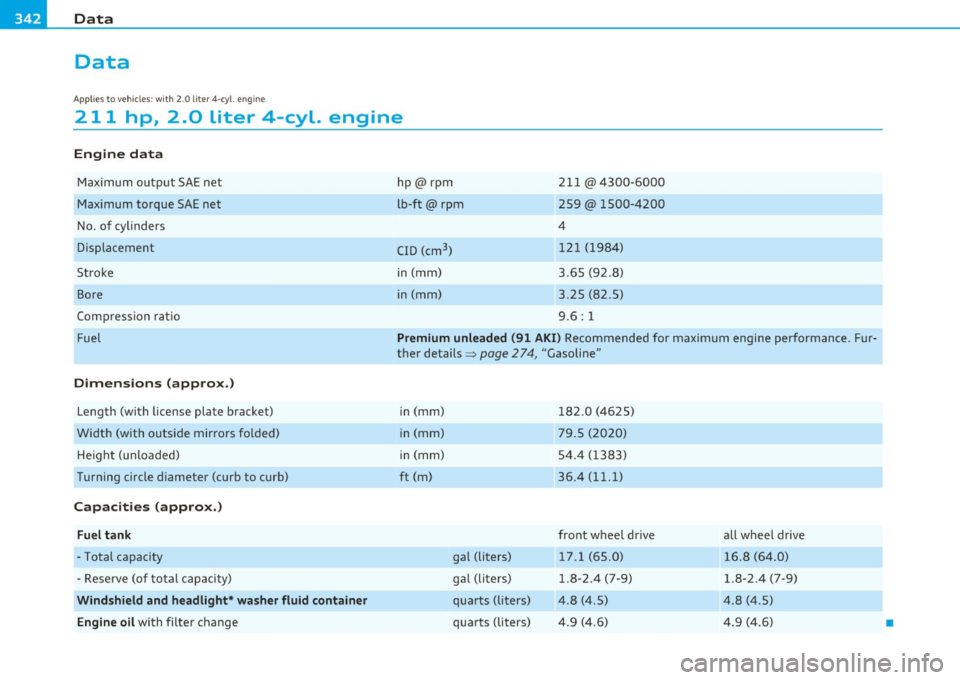
Applie s to ve hicle s: with 2 .0 lit er 4- cyl. engin e
211 hp, 2.0 liter 4-cyl. engine
Engine data
Max imum outpu t SAE net
Max imum torque SAE net
No. of cy linde rs
Displacement
Stroke
Bore
Compression rat io
Fu el
Dimensions (approx .)
Length (with license plate bracket)
Width (with outside mirrors fol ded)
He ight (un loaded)
Turning circle d iameter (curb to curb)
Capacities (approx.)
Fuel tank
- Total capacity
- Reserve (of to tal c apaci ty)
Windshield and headlight * washer fluid container
Engine oil
with filter change hp@rpm
lb-ft@
rpm
C ID (cm
3
)
in (mm)
in (mm) 2
11 @ 4300- 6000
259@ 1500-4200
4
12 1 (198 4)
3.65 (92.8)
3.25 (82.5)
9 .6 : 1
Premium unleaded (91 AKI) R eco mmend ed for maximum engi ne per formanc e. Fur
ther details ~
page 274, "Gasoline"
in (mm)
in (mm)
i n (mm)
ft (m)
gal (Liters)
g al (Liters)
qua rts (liters)
quar ts (lite rs) 182
.0 (4625)
79 .5 (2020)
54.4 (1383)
36.4 (11. 1)
front wheel drive 17.1 (65.0)
1.8 -2.4 ( 7-9)
4.8 (4 .5)
4.9 (4.6) all whee
l drive
16.8 (64 .0)
1.8- 2.4 (7 -9)
4 .8 (4 .5)
4 .9 (4.6)
•
Page 346 of 364

___ C_ o_n_ s _ u_m_ e_ r_ I_ n_ f_o _r_ m_ a_ t_io _ n _____________________________________________ _
• oil changes, and
• cl eaning or re placing t he air fi lter.
W For the sake of the environment
By reg ula rly m ainta ini ng yo ur vehicl e, you h elp ma ke sure th at emis
sion standards are ma inta ined, thus mi nimizi ng adve rse effects o n
t he environmen t.•
Important considerations for you and your
vehicle
T he i ncreasing use of e lec tronics, soph is tica ted f uel inject io n a nd
em ission cont rol systems, and the gene rally increasing tec hnica l
c o m plex ity of to d ay' s automob iles, have ste adily re duced the s cope
of ma intenance and repairs wh ich can be carr ied o ut by vehicle
ow ne rs.
Also, safety and environmental co ncerns p lace very st ric t
limits o n the nature of re pairs and adjust ments to engi ne and trans
mission parts which an owner c an per form .
Ma int ena nce, ad justments and repairs us ually r equire sp ecial tools,
test ing devices an d other e quipme nt available to s pec ia lly trai ne d
wo rks ho p pe rsonn el in order to assure p roper perfor mance, rel i
ability and safety of the vehicle and its many systems.
Impro per m aintenan ce, a djustments an d repair s can im pair the ope r
ation and reliability of your vehicle and even void your vehicle
wa rranty . Therefo re, proo f of se rvicing in accordan ce wi th the ma in
t enance schedule may be a condi tion fo r upholding a possib le
wa rranty cla im made w it hi n the wa rra nty period .
Above all, operat io nal safety can be adversely affected, crea ting
unnecessary risks for you and your passe nge rs.
I f i n do ub t abou t any se rvi cing, have it done by you r authorized Audi
dealer or a ny other pro perly eq uipped and qualified wo rkshop . We
st rong ly ur ge yo u to give you r a uth orized Aud i dea ler the opportun ity
t o pe rfor m all scheduled mainte nance a nd necessary repairs. Yo ur dea
ler has t he facilit ies , original parts a nd trai ned spec ia lists to keep
you r vehicle ru n ning pr operly.
Performing limited maintenance yourself
The follow ing pages des cribe a lim ited nu mber of pro ce dur es which
can be perfo rmed on your vehicle wit h ord ina ry tools, s houl d the need
a ris e a nd tra ined p erson ne l b e unavailable. Before perfo rm ing any o f
these procedures, always thorough ly r ead a ll of the applicab le text
a nd caref ully follow the ins truc tion s given. A lw ays r igoro usly o bserve
t he
WARNINGS prov ided .
Before you check anything in the engine compartment, always read
and heed all WARNINGS=>
& and=> & in "W orkin g in t he engine
compartment" on
page 280.
& WARNING
• Serious personal injury may occur as a result of improperly
performed maintenance, adjustments or repairs.
• Always be extremely careful when working on the vehicle.
Always follow commonly accepted safety practices and general
common sense . Never risk personal injury .
• Do not attempt any of the maintenance, checks or repairs
described on the following pages if you are not fully familiar with
these or other procedures with respect to the vehicle, or are uncer
tain how to proceed.
• Do not do any work without the proper tools and equipment.
Have the necessary work done by your authorized Audi dealer or
another properly equipped and qualified workshop.
• The engine compartment of any motor vehicle is a potentially
hazardous area . Never reach into the area around or touch the
radiator fan. It is temperature controlled and can switch on
suddenly -even when the engine is off and the ignition key has
been removed . The radiator fan switches on automatically when
the coolant reaches a certain temperature and will continue to run until the coolant temperature drops. _,,,