brake AUDI A5 CABRIOLET 2011 Manual PDF
[x] Cancel search | Manufacturer: AUDI, Model Year: 2011, Model line: A5 CABRIOLET, Model: AUDI A5 CABRIOLET 2011Pages: 364, PDF Size: 86.48 MB
Page 291 of 364

___________________________________________ C_;_ h _.:. e_c _k _ i_n -=g ~ a_n _ d_ f_i _ll _i _ n -=g '--.......J-
0 Note
• Coolan t poll utes the environment and co uld cause an engine fire.
Excess coolant w ill be forced out throug h the pressure relief valve in
t he cap w hen the eng ine becomes ho t.
• If, i n an emer gency, only water can be adde d, the correct ratio
between wate r an d an tifree ze=>
page 28 6 must be restored as soon
as possib le.
<£> For the sake of the environment
Dra ined coolant should not be reused. A lways dispose of used coolant
w hile observ ing a ll enviro nmental regula tions. •
Radiator fan
The r adia tor fan switc hes on au tomatic ally by its elf .
Th e radiator fan is dr iven by the e ngine vi a the V-bel t. Th e v iscous
clutch regu lates the speed of the fan accord ing to the temperature of
th e co olan t.
An auxiliary e lectr ic rad iator fan* sw itches on a nd off depend ing o n
coo la nt temperat ure and other vehicle ope rating conditions .
After you sw itch t he engi ne off, the a uxiliary f an can con tinue r unning
for up to 10 minutes -even w ith the ignition off . It can even switch on
a g ain lat er by itse lf=> &, if
• the temperature of the e ngine coola nt rises due to the heat build
up from the eng ine in the engi ne compa rtment, o r
• the engine compartment heats up because the vehicle is parked in
intense s unlight .
& WARNING
• To reduce the risk of personal injury never touch the radiator
fan.
Vehicle OP-eration
& WARNING (continued )
• The auxiliary ele ctric fan is temperature controlled and can
switch on suddenly even when the engine is not running.
• The auxiliary radiator fan switches on automatically when the
engine coolant reaches a certain temperature and will continue to
run until the coolant temperature drops. •
Brake fluid
Checking brake fluid level
The brake flu id level ca n be chec ked wit h a quick gl an ce.
Fig . 224 Engi ne
c ompartm ent : Brake
fluid re se rvoir
B efo re you check anyth ing i n the e ngine compartment ,
always read and heed all WARNINGS~ & in " Workin g in
t h e e ng in e co mpartme nt" on
p age 280.
- Rea d the b rak e fl uid le ve l f ro m t he brak e fluid re serv oir
~ f ig. 224. The br ak e fl uid le vel mus t be be tw ee n the
" M IN " an d "MAX " m ar kin gs.
Th e br ake fl uid re se rvoir is loca ted at th e rear pa rt iti on of the engine
compartment on the left side=>
page 281. .,_
Vehicle care Do-it-yourselt service iTechnical data
Page 292 of 364
___ C_ h_ e_c _k _i _ n _g ~ a_n _d_ f_il _l_in _ g _________________________________________ _
The fluid level may drop slightly after some time d ue to the auto
m atic adjus tment o f th e b rake pads. This is no t ca use for alarm.
If the brake flu id level falls considerably below the "MIN" mark, the
brake warning/indicator light ( U.S. models:
BRAKE , Canadian mode ls:
ID ) will come on=> page 17 and=> page 30. Do not contin ue to
operate the vehicle. The complete brake system should be thoro ughly
c he cked by an au thor ized Aud i deale r or q ualified works hop and t he
cause corrected. If the brake fluid level is too low, the brake
w ar ning/ind ic a tor ligh t will illum ina te. Con ta ct a n au thori ze d Audi
dealer
immediately .
rn Tips
The brake fluid reservoir is located underneath t he cover. •
Changing brake fluid
Have the brake fluid cha nged b y an experienced tech ni
c ia n.
Brake fluid absorbs mo isture from the a ir . If the water content in the
bra ke fl uid i s too hig h, cor ros io n in th e bra ke system may res ult afte r
a period of time. The boiling po int of the brake fluid will also decrease
cons iderab ly and decrease brak ing perfo rmance .
Th erefo re, th e brake fl uid must be changed
every two years . Always
use new bra ke fluid w hich conforms to Federal Motor Vehicle Stan
dard "F MVSS 1 16 DO T 4".
The brake flu id reservoir can be diffic ult to reac h, therefore, we
recommend that you have the bra ke fluid c hanged by your author ized
Audi dealer . Your dealer has the correct tools, the right brake flu id
and the know -how to do t his for you .
LJ}. WARNING
• Brake fluid is poisonou s. It mu st be stored only in the closed
original containe r out of the reach of children!
& WARNING (co ntinued )
• Brake failure can result from old or inappropriate brake fluid.
Observe these precaution s:
- Use only brake fluid that meets SAE specification
J 1703 and
conforms to Federal Motor Vehicle Standard 116 . Always check
with your authorized Audi dealer to make sure you are using
the correct brake fluid. The correct type of brake fluid is also indicated on the brake fluid reservo ir.
- The brake flu id must be new . Heavy use of the brakes can
cause a vapor lock if the brake fluid is left in the system too
long. This can seriously affect the efficiency of the brakes as
well as your safety. This could result in an accident.
0 Note
Bra ke fluid will damage the paint of your veh icle.
For the sake of the environment
Because of the prob lem of proper disposal of brake fl uid as well as
t he s pecial tool s required a nd the nece ssary ex pert ise, we recom
mend that you have t he brake f lu id changed by your authorized Audi
de aler. •
Battery
General information
Under normal operat ing con dit ions, the battery in your Aud i does not
need any main tenance . Wit h high outs ide temperatures o r long daily
dr ives we recommend that yo u have the electrolyte level checked by
an a uth orized Audi dealer o r q ua lified wor kshop. The electro lyte lev el
should also be checked each time the battery is charged=> page 293 . .,_
Page 300 of 364
-~_T_ ir_e_ s_ a_ n_ d_ w_ h_e_ e_ ls _______________________________________________ _
Groove
means the space between two adjacent tread ribs.
Load rating (code)
means the maximum load that a tire is rated to carry for a given infla
tion pressure. You may not find this information on all tires because
it is not required by law.
Maximum load rating
means the load rating fo r a tir e at the maximum permissible inflation
pressure for that tire.
Maximum loaded vehicle weight
means the sum of:
(a) Curb weight
(b) Accessory weight
(c) Vehicle capacity weight, and
(d) Production options weight
Maximum (permissible) inflation pressure
means the maximum cold inflation pressure to which a tire may be
inflated. Also called "maximum inflation pressure."
Normal occupant weight
means 150 lbs. (68 kilograms) times the number of occupants seated
in the vehicle up to the total seating capacity of your vehicle.
Occupant distribution
means distr ibution of occupants in a vehicle .
Outer diameter
means the overall diameter of an inflated new tire.
Overall width
means the linear distance between the exteriors of the sidewalls of
an inflated tire, including elevations due to labeling, decorations, or
protective bands or ribs.
Ply
means a layer of rubber -coated paralle l cords.
Production options weight
means the combined weight of those installed regular production
options weigh ing over 5 lbs. (2.3 kg) in excess of those standard
items which they replace, not previously considered in curb weight or
accessory weight, including heavy duty brakes, ride levelers, heavy
duty battery, and specia l trim .
Radial ply tire
means a pneumatic tire in which the ply cords that extend to the
beads are laid at substantially 90 degrees to the centerline of the
tread .
Recommended inflation pressure
see=> page 297, "Cold tire inflation pressure".
Reinforced tire
means a tire design to operate at higher loads and at higher inflation
pressures than the corresponding standard tire. Reinforced t ires may
be identified as "XL ", "x l", "EXTRA LOAD", or "RF" on the sidewall.
Rim
means a metal support for a tire or a tire and tube assembly upon
wh ich the tire beads are seated .
Rim diameter
means nominal diameter of the bead seat . If you change your wheel
size, you w ill have to purchase new tires to match the new rim diam
eter .
Rim size designation
means rim diameter and width.
Rim width
means nominal distance between rim flanges.
Page 306 of 364
-~_T_ i_ re _ s_ a_n _ d_ w_ h _e_ e_ ls _________________________________________________ _
& WARNING (conti nu ed )
• If the tire i s not flat and you do not ha ve to change a wheel
immediately, drive at reduced speed to the nearest service station
to check the tire pressure and add air as required.
0 Note
Driv ing without valve stem caps can cause damage to the tire valves.
T o preven t this, a lways make sure that fac tory ins talle d valve stem
caps on all wheels are securely mo unted on the valve.
<£> For the sake of the environment
Under inflated t ires will also increase the fuel consumption .•
Tires and vehicle load limits
There are limits to the amo unt of load or weig ht that any vehicle and
any t ire ca n carry. A veh icle th at is overlo ade d w ill n ot handle well and
is more difficult to stop . Overload ing can not on ly lead to loss of
vehicle co ntro l, bu t can also d amage important pa rts of the vehi cle
and can lead to sudden t ire failure, including a b lowo ut and sudden
deflation that can ca use the vehicle to c rash.
Yo ur safety and t hat of your passengers also depends o n mak ing s ure
that load limits are not e xceeded. Vehicle load incl udes eve rybody
and everyth ing in and on the ve hicle. These load limits are tech nically
refer red to as the veh icle's
Gross Vehicle We ight Rating ("GVWR").
T he "GVWR" includes t he weight of the basic vehi cle, all factory
installed accessories, a fu ll tank of fue l, o il, coo la nt and other fluids
plus maxim um load . The maxim um load includes the number of
passenge rs that the vehi cle is intended to car ry ("seating capacity ")
w ith an ass umed we ight of 150 lbs (68 kg) for each pa ssenger at a
designat ed seating position and the tota l w eight of any l uggage in
the vehicle. If you tow a trai le r, the weight o f the t railer hitch and the tongue weight of the
loaded tra ile r must be included as part of the
veh icle lo ad .
T he
Gross Axle Weight Rating ("GAWR ") is the max imum load t hat
can be a pplied at each of the ve hicle's two axles .
Th e Gross Vehicle Weight Rat ing and the Gro ss Axle Weight Ra ting
are listed on the safety compliance s ticker label located on the
dr iver 's s ide B-pillar. Audi h as 4 seat ing pos it ions, 2 in t he fro nt and
2 in the rear for total seating capacity of 4 . Each seating pos it io n has
a seat belt =>
page 189, "Safety belts" .
Th e fa ct t hat there is an upper lim it to your veh icle 's Gross Vehicle
We ight Rating means that the total weight of whatever is being
c arrie d in t he ve hicle (incl uding t he weight o f a trail er hi tch and the
tongue weig ht of the loaded tra iler) is limited . The more passengers
in the veh icle or p assenge rs who are he avier than the st anda rd
we ights assumed mean that less we ight can be carried as luggage.
Th e tire pressure labe l o n yo ur Audi a lso lists the max imum combine d
we ight of alt of the o ccupants and l uggage or o ther cargo that the
vehicle ca n carry . For t he locat ion of the label=>
page 300, fig. 22 7.
& WARNING
Overloading a vehicle can cause loss of vehicle control, a crash or
other accident, serious personal injury, and even death.
• Carrying more weight than your vehicle was de signed to carry
will prevent the vehicle from handling properly and increase the
risk of the loss of vehicle control.
• The brakes on a vehicle that has been overloaded may not be
able to stop the vehicle within a safe di stan ce.
• Tires on a vehicle that has been o verloaded can fail suddenly ,
including a blowout and sudden deflation, causing loss of control
and a crash .
• Always make sure that the total load being transported -
i ncluding the weight of a trailer hitch and the tongue weight of a .,_
Page 309 of 364

________________________________________________ T_ i_ re _ s_ a_ n_d_ w_ h_ e_ e_l _s _ ....... JIII
Unbalanced wh eels must be rebalanced to avoid e xcessive w ear o n
st eeri ng, sus pens ion and tires. A w heel must a lso be re balan ced
w hen a new tire is installed.
Incorrect wheel alignment
Incorrect whee l alignm ent can ca use excessive ti re wea r, impairing
th e safe ty o f the vehicle. If tir es show excessive we ar, ha ve the w heel
alignment checked by a n authorized A udi dealer or qualif ied wo rk
s hop .
All wheel drive
Vehicle s wi th qu att ro ® mus t alw ay s ha ve tires of the sa m e siz e,
construct ion a nd tread type. For details see~
page 246.
& WARNING
Sudden tire failure can lead to loss of control , a crash and serious
personal injury!
• Never drive a vehicle when the tread on any tire is worn down
to the wear indicators.
• Worn tires are a safety hazard, they do not grip well on wet
roads and increase your risk of "hydroplaning " and loss of control.
• Always keep chemicals that can cause tire damage, such as
grease, oil, gasoline and brake fluid away from tires.
• Tires age even if they are not being used and can fail suddenly,
especially at high speeds. Tires that are more than 6 years old can
only be used in an emergency and then with special care and at
lower speeds.
• Never mount used tires on your vehicle if you are not sure of
their "previous history ." Old used tires may have been damaged
even though the damage cannot be seen that can lead to sudden
tire failure and loss of vehicle control. •
Vehicle OP-eration
New tires and replacing tires and wheels
New tires and w heel s hav e to b e brok en in .
Fig. 231 Tire specificat ion codes on the sidewall of a tire
No.
©
®
®
©
©
©
Description
Passenger car tire (where app licable)
Nom inal width of ti re in mil lim eters
Ratio of hei9ht to width (aspect ratio)
Radial
jj Rim diameter code
L oa d index and speed rating
Vehicle care Do-it-yourselt service iTechnical data
Page 312 of 364

-~_T_ i_ re _ s_ a_n _ d_ w_ h _e_ e_ ls _________________________________________________ _
& WARNING (conti nu ed )
• Alway s use tire s, rim s and wheel bolts that meet the specifica
tions of original factory-installed tires or other combinat ions that
have been specifically approved by the vehicle manufacturer .
• Tires age even if they are not being used and can fail suddenly,
especially at high speed s. Tires that are more than 6 years old can
only be used in an emergency and then with special care and at
lower speeds.
• Never mount used tir es on your vehicle if you are not sure of
their "previous history. " Old used t ires m ay have been damaged
even though the damage cannot be seen that can lead to sudden
tire failure and loss of vehicle control.
• All four wheels must be fitted with radial tires of the same
type , size (rolling circumference) and the same tread pattern .
Driving with different tire s reduces vehicle handling and can lead
to a loss of control.
• If the spare tire is not the same as the tires that are mounted
on the vehicle - for example w ith winter tires - only use the spare
tire for a short period of time and drive with extra care. Refit the
normal road wheel as soon as safely possible.
• Never drive fa ster than the maximum speed for which the tires
on your vehicle are rated because ti re s that are driven faster than
their rated speed can fail suddenly.
• Overloading tire s cause heat build-up, sudden tire failure,
including a blowout and sudden deflation and loss of control.
• Temperature grades apply to tires that are properl y inflated
and not over or underinflated.
• For technical reasons it is not always possible to u se wheels
from other veh icles- in some cases not even wheels from the same
vehicle model.
• If you install wheel tr im discs on the vehicle wheels , make sure
that the air flow to the brakes i s not blocked . Reduced airflow to
the brakes can them to overheat, increasing stopping distances
and cau sing a collision.
& W ARNING (continued )
• Run flat ti res may only be used on vehicles that were equipped
with them at the factory. The vehicle must have a chassi s designed
fo r run flat tires and a factory-installed tire pressure monitoring
system* that indicates a loss of tire pressure. Incorrect use of run
flat tires can lead to vehicle damage o r accidents. Check with an
authorized Audi dealer or tire speciali st to see if your vehicle can
be equipped w ith run flat tires . If run flat t ires are used , they must
be installed on all four wheels. Mixing tire types is not permitted.
0 Note
• F or tech nical reasons, it is no t gene rally poss ible to use the wheel
r ims from other vehicles . This ca n hold t rue for w heels of the same
veh icle type .
• If the spare tire is different from the tires th at you have mou nted
on yo ur vehi cle (fo r ex am ple w inte r tir es o r wide profile tires), then
use the spa re t ire for a short period of time on ly and d rive with extra
care . Replace t he f lat tire w ith the tire matching the others on your
veh icle as soon as possible.
• N ever dr ive witho ut the valve s te m c ap. The valves coul d get
damaged .
'£> For the sake of the environment
Dispose of old t ires in accordance with the loca l req uirements.
(]] Tips
Tires with t he ident ification "AO" have been specially matched with
your Audi. We recommend us ing only these ti res beca use they meet
t he highest standa rds rega rding saf ety and dr iv ing c ha racteristics
when used correct ly. You r autho rized Audi dealer w ill gladly provide
you with more info rmation. •
Page 322 of 364

lffl!I.___W __ h_a_ t_ d_ o_ I_ d_o_ n_ o_w _ ? _____________________________________________ _
in. WARNING
• Never use the spare tire if it is damaged or if it is worn down to
the tread wear indicators.
• If the spare tire is more than 6 years old, use it only in an emer
gency and with extreme caution and careful driving.
• The spare tire is intended only for temporary and short-term
use. It should be replaced as soon as possible with the normal
wheel and tire.
• After mounting the compact spare tire, the tire pressure must
be checked as soon as possible. The tire pressure for the compact
spare tire is located on the driver 's side B-pillar
=> page 300,
fig. 227.
• Do not drive faster than 50 mph (80 km/h). You risk having an
accident.
• Avoid full-throttle acceleration, heavy braking, and fast
cornering. You risk having an accident.
• Never drive using more than one spare wheel and tire. You risk
having an accident.
• Normal summer or winter tires must not be mounted on the
compact spare wheel rim.
• For technical reasons, the use of tire chains on the spare tire is not permitted. If it is necessary to drive with tire chains, the spare
wheel must be mounted on the front axle in the event of a flat in
a rear tire. The newly available front wheel must then be installed
in place of the rear wheel with the flat tire. Installing the tire
chain before mounting the wheel and tire is recommended.
• Loose items in the passenger compartment can cause serious
personal injury during hard braking or in an accident.
-Never store the inflatable spare tire or jack and tools in the
passenger compartment.
- Always store all jacking equipment, tools, and the inflatable
spare tire in the luggage compartment.
& WARNING (continued)
-Tighten the knurled retaining screw for the inflatable spare
tire securely. •
Changing a wheel
Before changing a wheel
Observe the following precautions for your own and your
passenger's safety when changing a wheel.
- After you experience a tire failure, pull the car well away
from moving traffic and try to reach level ground before
you stop ~& .
- All passengers should leave the car and move to a safe
location (for instance, behind the guardrail) =>& .
- Engage the parking brake to prevent your vehicle from
rolling unintentionally ~& .
- Move selector lever to position P
~ &.
- If you are towing a trailer: unhitch the trailer from your
vehicle.
- Take the jack~
page 318 and the spare tire~ page 319
out of the luggage compartment.
in. WARNING
You or your passengers could be injured while changing a wheel if
you do not follow these safety precautions:
• If you have a flat tire, move a safe distance off the road. Turn
off the engine, turn the emergency flashers on and use other
warning devices to alert other motorists. ._
Page 323 of 364
What do I do now? Ill
----------------
& WARNING (continued)
• Make sure that passengers wait in a safe place away from the
vehicle and well away from the road and traffic.
• To help prevent the vehicle from moving suddenly and possibly
slipping off the jack, always fully set the parking brake and block
the wheel diagonally opposite the wheel being changed with the
folding chocks or other objects. When one front wheel is lifted off
the ground, placing the Automatic Transmission in "P" (Park) will
not prevent the vehicle from moving.
• Before you change a wheel, be sure the ground is level and
firm. If necessary, use a sturdy board under the jack.
• After installing the inflatable spare tire, make sure that you
replace the flat tire/wheel in its storage area properly and tighten
the knurled retaining screw securely.
0 Note
If you are changing the wheel on a steep incline, use a rock or similar
object to block the opposite wheel to prevent the vehicle from
moving.
[I) Tips
Obey all laws.•
Changing a wheel
When you change a wheel, follow the sequence described
below step-by-step and in exactly that order.
1. Remove the decorative wheel cover*. For more details see
also~
page 322, "Decorative wheel covers" .
2. Loosen the
wheel bolts=> page 323.
Safety first
3. Locate the proper mounting point for the jack and align
the jack below that point~
page 323.
4. Lift the car with the jack~ page 323.
5. Remove the wheel with the flat tire and then install the
spare tire~ page 325.
6. Tighten all wheel bolts lightly.
7.
Lower the vehicle with the jack.
8. Use the wheel bolt wrench and
firmly tighten all wheel
bolts in a crisscross pattern~
page 323.
9. Replace the decorative wheel cover*.
& WARNING
Always read and follow all WARNINGS and information=> & in
"Raising the vehicle" on
page 323 and => page 326. •
After changing a wheel
A wheel change is not complete without the doing the
following.
- Store and secure the wheel you replaced in the spare
wheel well.
- Replace the tools and the jack in their proper location.
- Check the
tire pressure of the spare tire as soon as
possible.
- As soon as possible, have the
tightening torques on all
wheel bolts checked with a torque wrench. The correct
tightening torque is 90 ft lb (120 Nm).
- Have the flat tire
replaced as soon as possible.
Vehicle care Do-it-yourself service Technical data
Page 326 of 364
lffll.,___W_ h_ a_t _ d_ o_ I_d_ o_ n_o _w_ ? ___________________________________________ _
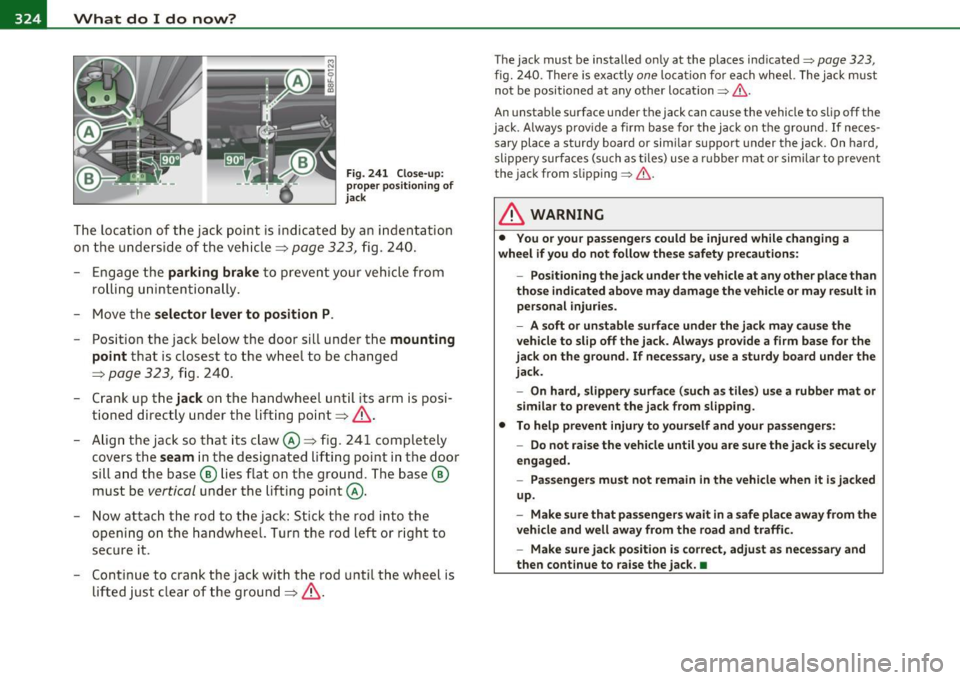
Fig . 241 Close-up :
p rope r pos itioning of
ja ck
The locat ion of t he ja ck p oint is ind icated by a n in dentat ion
on the underside of the vehicle==>
page 323, f ig. 240 .
- E ngag e th e
parking brake to prev ent your vehicl e from
r ol ling un in te ntion ally .
- Move the
selector lever to position P .
- Posit ion the jack below the door sill under t he mounting
po int
that is closest to the w heel to be cha nged
==>
page 323, f ig. 240.
- Crank up the
jack on t he handwh eel u ntil its arm is posi
tioned directly under the lift ing point ~& .
- Align t he jac k so that its claw ©==> fig. 241 completely
covers the
seam in the designated lifti ng point i n the door
sill a nd the base ® lies flat on t he gro und. The base ®
must be
vertical under the lifting point@.
- Now at tac h th e r od to t he jack : St ick the rod i nto t he
o peni ng o n the ha ndwheel. Tur n the rod left or r ight to
secure i t.
- Con tin u e to cra nk t he jac k wit h the rod until th e wh eel is
li ft ed just c lea r o f the gro un d==> & .
The jack must be installed o nly at the places in d icated=> page 323,
fig. 240. There is ex act ly one location fo r each wheel. The ja ck mu st
not be positioned at any other location=> &.
An unstab le s urface under t he jack can cause the veh icle to s lip off the
j a ck. A lways p rov ide a firm base for the ja ck on t he g round.
If nece s
sary place a sturdy boa rd o r sim ilar support under the jac k. On hard,
sl ippery surfaces ( such as til es) u se a r ubber mat or sim ila r to preve nt
the jack from slipping =>& .
& WARNING
• You or your passengers could be injured while changing a
wheel
if you do not follow these safety precautions :
- Pos itioning the jack under the vehicle at any other place than
tho se indicated ab ove may damage the vehicle o r may result in
personal injuries .
- A soft or unstable surface under the jack may cause the
vehicle to sl ip off the jack. Always provide a firm base for the
jack on the ground . If ne ce ss ary , use a sturd y board under the
jack .
- On hard , slippery surface (such a s tiles) use a rubber mat or
similar to prevent the jack from slipp ing .
• To help prevent injury to your self and your passengers :
- Do not raise the vehicle until you are sure the jack is securely
engaged .
- Passengers must not remain in the vehicle when it is jacked
up.
- Make sure that pas sengers wait in a safe pla ce away from the
vehicle and well away from the road and traffic.
- Make sure jack position is correct, adjust as necessary and
then continue to raise the jack . •
Page 327 of 364

What do I do now ? -_______________ __.PfWII
Taking the wheel off/installing the spare
tire
Follow these instructions step-by-step for changing the wheel
F ig. 242 Changing a
wheel: using the
sc rewdriver handle
(w ith the b lade
r emove d) to turn t he
bolts
Fig. 243 Changi ng a
wheel: alignment p in
i nside t he top hole
After you have loosened all wheel bolts and raised the vehicle
off the ground, remove and replace the wheel as follows :
Removing the wheel
- Remove the topmost wheel bolt completely with the
hex agon al sock et in the screwdriver handle (vehicle tool
kit) :=} fig. 242 and set it aside on a
clean surface.
Vehicle OP-eration
-Screw the threaded end of the alignment pin from the
tool kit hand-tight into the empty bolt hole:=} fig. 243.
- Then remove the other wheel bolts as described above .
- Take off the wheel leaving the alignment pin in the bolt
hole.
Putting on the inflatabl e spare tir e
-Push the spare tire over the alignment pin=} 0.
- Screw on the wheel bolts and tighten them slightly using
the hexagonal socket.
- Remove the alignment pin and insert and tighten the
remaining wheel bolt slightly like the rest .
- Turn the jack handle counter-clockwise to lower the
vehicle until the jack is fully released.
- Use the wheel bolt wrench to tighten all wheel bolts firmly :=}
page 323 . Tighten them Tighten them in a crisscross
pattern,
from one bolt to the (approximately) opposite
one, to keep the wheel centered .
- Perform the steps required after changing the wheel :=}
page 321, "After changing a wheel" .
0 Note
When removing or installing the wheel, the rim could hit the brake
rotor and damage the rotor. Work caref ully and have a second person
help you.
W Tips
Never use the hexagonal socket in the handle of the screwdriver to
loosen or tighten the wheel bolts. _.,
Vehicle care Do-it-yourself service iTechnical data