tires AUDI A5 CABRIOLET 2011 Owners Manual
[x] Cancel search | Manufacturer: AUDI, Model Year: 2011, Model line: A5 CABRIOLET, Model: AUDI A5 CABRIOLET 2011Pages: 364, PDF Size: 86.48 MB
Page 28 of 364
Driver information display
On-Board Diagnostics monitors the components of your emission
control system. Each monitored component in your engine system
has been assigned a code. In case of a malfunction, the component
wi ll be identified and the fault stored as a code in the control module
memory .
The MIL light may also illuminate if there is a leak in the on-board fuel
vapor recovery system. If the light illumi nates after a refueling , stop
the vehicle and make sure the fuel filler cap is properly closed
=>
page 276.
In order to make an accurate diagnosis, the stored data can only be
displayed using special diagnostic equipment (generic scan too l for
080).
In order to connect the special diagnostic equipment, push the plug
into the Data Link Connector (DLC). The DLC is located to the right of
the hood release=>
page 25, fig. 20.
Your authorized Audi dea ler or qualified workshop can interpret the
code and perform the necessary repair. •
Electronic speed limiter
Your vehicle may be factory equipped with tires that are rated for a
maximum speed of 130 mph (210 km/h). This is less than the
maximum speed of your veh icle. To reduce the risk of sudden tire
fai lure and loss of control if the vehicle is operated at excessive
speeds, you r ve hicl e also has an electronic speed limite r. The elec
tronic speed limiter prevents your vehicle from going faster than the
t ire speed rating. For more information=>
page 307.
If the eng ine control unit receives faulty veh icle road speed signals,
the Malfunction Indicator Lamp (MIL)
11.... will illuminate. If this
occurs, contact the nearest authorized Audi dealer for assistance .
& WARNING
Always observe the posted speed limits and adjust your speed to
suit prevailing road, traffic and weather conditions. Never drive
your vehicle faster than the maximum speed rating of the tires
installed. •
Speed warning system
Overview
The speed warning system helps you to keep your driving
speed below a set speed limit.
The speed warning system warns if the driver exceeds a previous ly
sto red maximum speed. A warning tone will sound as soon as the
vehicle speed exceeds the set speed by about 3 mph (3 km/h). At the
same time, a warn ing symbol appears in the display. The symbol's
appearance might be different in some models.
Th e speed warning system has
two warning thresholds that function
independently of each other and that have somewhat different
purposes:
Speed warning 1
You can use speed warning 1 to set the maximum speed while you a re
driving . This setting w ill remain in effect until you turn off the igni
tion, assuming that you have not changed or reset the setting .
Th e speed warning symbol
8 (USA models)/ 8 (Canada mode ls) in
the warning 1 display appears when you exceed the maximum speed.
It goes out when the speed falls below the stored maximum speed.
The speed warn ing symbol w ill also go out if the speed
exceeds the
stored maxim um speed by mo re than about 2S mph (40 km/h) for at
least 10 seconds . The stored max imum speed is deleted.
Setting speed warning 1 =>
page 27.
Page 29 of 364
Speed warning 2
Storing warning 2 is recommended if you always want to be reminded
of a certain speed, for example when you are travel ing in a country
that has a genera l maximum speed limit, or if you do not want to
exceed a spec ified speed for winter tires.
The speed warning 2 symbol,
8. (USA mode ls)/ 8, (Canada models)
appears in the display when you exceed the stored speed limit. Unlike
warning 1, it will not go out until the vehicle speed drops below the
sto red speed limit.
Setting speed warning 2
=> page 27 .
00 Tips
Even though your veh icle is equ ipped with a speed warn ing system,
you should sti ll watch the speedometer to make sure you are not
driving faster than the speed limit.•
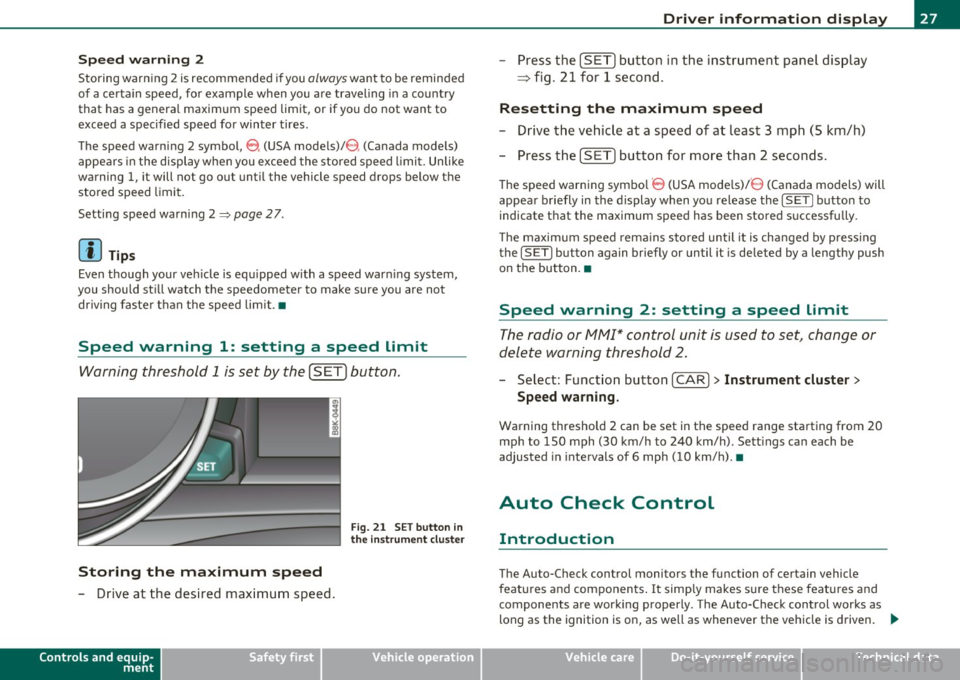
Speed warning 1: setting a speed Limit
Warning threshold 1 is set by the (SET] button.
Storing the maximum speed
-Drive at the desired maximum speed.
Controls and equip
ment Safety first
F
ig . 21 SET button in
t he instru ment cluster
Driver information display
- Press the !SETI button in the instrument panel display
=:> fig. 21 for 1 second.
Resetting the maximum speed
- Drive the vehicle at a speed of at least 3 mph (5 km/h)
- Press the
[SET ] button for more than 2 seconds.
The speed warning symbo l 8 (USA models)/ 0 (Canada models) will
appear briefly in the dis play when you release the
I SET I button to
indicate that the maximum speed has been stored successfu lly.
Th e maximum speed remains stored until it is changed by pressing
the
I SET] button again briefly or until it is deleted by a lengthy push
on the button. •
Speed warning 2: setting a speed Limit
The radio or MM!* control unit is used to set, change or
delete warning threshold 2.
-Select: Function button [CARI> Instrument cluster >
Speed warning.
Warning threshold 2 can be set in the speed range starting from 20
mph to 150 mph (30 km/h to 240 km/h). Sett ings can each be
adjusted in intervals of 6 mph
(10 km/h). •
Auto Check Control
Introduction
The Auto-Check control monitors the function of certain vehicle
features and components . It simp ly makes sure these features and
components are work ing properly. The Auto-Check control works as
long as the ignition is on, as well as whenever the vehicle is driven. ..,
Vehicle care Technical data
Page 187 of 364
________________________________________________ D_ r_ i_ v _i_n ""'g "-- S_a_ f_ e_ l _,,y'-- __
the driver's s ide B-pillar. The tire pressure label lists the recom
mended co ld tire in flatio n press ures fo r th e ve hicle at its max imum
capacity weight and the tires that were on your vehicle at the time it
was manufactured . For recommended tire press ures for normal loa d
conditions, p lease see chapte r=>
page 300. •
Tie-downs
The luggage compartment is equippe d with four tie
do wns to sec ure lu gga ge a nd oth er items.
Use the t ie-downs to sec ure yo ur cargo properly=> page 183,
"Lo ad ing t he lugg age comp artmen t".
In a co llision, the laws of physics mean that even sma ller it ems that
are loose in the vehicle will become heavy missiles that can cause
ser iou s injury. Ite ms i n t he vehi cle pos se ss e ne rgy w hich va ry w it h
vehicle speed and the we ight of the item. Vehicle speed is t he most
s ig nifi ca nt f acto r.
For examp le, in a frontal coll is io n at a speed of 30 mph (48 km/h),
the forces acting on a 1 0-lb (4. 5 kg) object are a bout 20 times t he
normal weig ht o f the item. T his means that t he weight o f the ite m
wou ld s uddenly be a bo ut 200 lbs. (90 kg) . You can imagine the inju
r ies tha t a 200 lbs . (9 0 kg) item fly ing free ly throug h the p ass enge r
compartment cou ld cause i n a collision lik e this .
& WARNING
Weak , damaged or improper straps used to secure item s to tie
downs can fail during hard braking or in a collision and cause
serious personal injury.
• Always use suitable mounting straps and properly secure items
to the tie-downs in the luggage compartment to help prevent
items from shifting or flying forward as dangerous missiles.
• When the rear seat backre st is folded down, always use suit
able mounting straps and properly secure items to the tie-downs
Controls and equip ment Safety first Vehicle operation
& WARNING
(co ntinued )
in the luggage compartment to help prevent items from flying
forward as dangerous missiles into the passenger compartment.
• Never attach a child safety seat tether strap to a tie -down. •
Reporting Safety Defects
Applicable to U.S.A.
If you believe that your vehi cle has a defect
which could cause a crash or could cause injury
or death , you should immediately inform the
National Highway Traffic Safety Administration
(NHTSA) in addition to notifying Audi of
America, Inc.
If NHTSA receives similar complaints, it may
open an investigation, and if it find s that a
safety defe cts exist s in a group of vehicles, it
may o rder a recall and remedy campaign.
However , NHTSA cannot become involved in
individual problems between you, your dealer,
or Audi of America, Inc.
To contact NHTSA, you may call the Vehicle
Safety Hotline toll-free at:
Tel.: 1-888-327-4236 (TTY: 1-800-424-9153)
or write to:
Administrator
Vehicle care Do-it-yourself service Technical data
Page 244 of 364
Intelligent t echnology
---------------------------------------
Electronic differential lock (EDL)
The elec tronic differen tial lock monitors the rotational
speed of the drive wheels.
G en era l not es
The electronic differentia l lock (EDL) helps the ca r to sta rt moving,
accelerate and climb a gradient on surfaces provid ing poor or almost
no grip . W ithout ED L, this would be d iff icu lt, if not impossible.
How the sy stem works
The EDL operates automatically. It mo nitors the rota tional speed of
wheels with the help of the ABS sensors=>
page 245. If a not iceab le
slip is detected at the wheels (e.g. on slippery g round on one side),
the spinn ing wheels are braked and power is transferred to the other
wheels . This is done up to a speed of about 60 mph (100 km/h).
No ises from the brake system signal that wheel sp in is being
controlled.
Driv ing off
When d riving off, always be s ure to keep road conditions in mind as
you accelerate. If one drive wheel spins because it is on a surface with
less grip, apply
plenty of throttle until the car starts to move.
O verheating of bra kes
To prevent the disc b rake of the bra ked wheel from ove rhea ting if
subjected to excessive loads on this wheel, the EDL cuts out tempo
ra rily. The vehicle remains operat io nal and be haves in the same way
as a veh icle without EDL.
As soon as the brake has coo led down, EDL switches on again auto
matically.
Electronic limited slip differential
In vehicles w ith front wheel drive *, an e lectron ic lim ited slip d ifferen
tial engages when driving on curves . The brakes are applied spec ifi
cally to the front wheel that is on the inside of the curve. T his m ini
m izes sliding on the front wheels and enables precise and neutral dr
iv ing t hrouge curves. The electronic lim ited slip differentia l does
no t engage whe n driving in we t cond it io ns or snow.
& WARNING
• Wh en acc elerating on slipp ery s urface s, such a s on ice or snow,
always be careful when depre ssing the accele rator pedal. Even
with the EDL and the electroni c limited slip differential working,
the dr ive wh eels can spin and reduce you r ability to control your
c ar . -Ri sk of cra sh!
• The increased safet y afforded b y EDL and the electronic l imited
slip differ ential d oes not mean th at you can take safety risks .
Alw ay s adapt your d riving st yle to the road c onditions and traffi c
si tuation.
[ i ] Tips
If a fa ult occurs in the ABS, the EDL is also not funct ioning. This is
ind icated by the ABS warn ing light=>
page 15 . •
Anti-Slip Regulation System (ASR)
The Anti-Slip Regulation System prevents the driven
wheels from spinning when the car is a ccelerating.
General notes
T he Anti-Slip Regu lation System (ASR) is in tegrated in the electronic
stabilization program (ESP) . When the veh icle starts up and acceler
a tes, the wheels are preven ted from sp inning by adjust ing the engine
power to match the amount of grip ava ilable from the road surface.
How the system works
ASR performs automatica lly, i.e. without the driver's intervent ion.
With the a id o f the ABS sensors=>
page 245, ASR moni tors the speed
of the driven wheels. If the wheels start to spin, engine torque is
reduced automatically unti l the tires find enough grip to lock onto
the road s urface. The system is active across the entire speed range . .,
Page 245 of 364

Intelligent technology
--------------------------------------------------' "---.L==--
The ASR works in conjunction with the ABS. If a malfunction should
occur in the ABS, the ASR w ill also be out of action.
Activating
The ESP is automatically activated when the engine is started and it
performs a self-test. You can activate a deactivated ASR if required by
pressing the=>
page 240, fig. 213 button. When it is activated, the
message
ESP/ASR on appears briefly in the display .
Deactivating
You can deactivate the ASR if required by pressing the button (for less
than 3 seconds) =>
page 240, fig. 213. With the ASR deactivated , the
ESP check light comes on, see=>
page 14 . The message ASR off
appears in the display as well. The ASR can be deactivated at any
speed .
The ASR should normally be activated a ll the time. Only in certain
exceptional situations when some slip is desirable does it make sense
to deactivate the ASR. Examples:
• when driving with tire chains
• when driving in deep snow or on loose ground and
• when rocking the vehicle loose after it has become stuck .
When the abnormal situation is over, you should activate the ASR again.
& WARNING
The increased safety afforded by ASR does not mean that you can
take safety risks. Always adapt your driving style to the road
conditions and traffic situation.
[I] Tips
To ensu re that the ASR works properly, all four whee ls must be fitted
with ident ical t ires. Any differences in rolling radius of the t ires can
cause the system to reduce eng ine power when this is not desired.
See also=>
page 307, "New tires and replacing tires and wheels". •
Safety first
Braking
General information
What affects braking efficiency?
Operating conditions and driving habits
The brakes on today's automobiles are still subject to wear,
depending la rgely on ope rating conditions and driving habits=>& .
On vehicles that are either driven mostly in stop-and-go city traffic or
are driven hard, the brake pads should be checked by your authorized
Audi dealer more often than specified in the
Warranty & Mainte
nance booklet.
Failure to have your brake pads inspected can result
in reduced brake performance .
On steep slopes, you should use the braking effect of the engine. This
way, you prevent unnecessary wear on the brake system. If you must
use your brakes, do not hold the brakes down continuously. Pump the
brakes at intervals.
Noises may occur when brak ing depending on the speed, braking
force and outside cond itions such as temperatu re and humid ity.
Moisture or road salt
If you are driving faster than 31 mph (50 km/h) and the windshield
wipers are on, the brake pads will briefly touch the brake discs in
regula r interva ls so as to improve reaction time when braking on wet
surfaces. You, the driver, will not not ice anything.
Under certain condit ions, for example, when driving through water or
very heavy rai n, or even after washing your vehicle, the braking effect
can be reduced due to moisture (or in free zing conditions ice) on the
bra ke pads. A few careful brake applications should dry off the brake
pads or remove any ice coatings.
Th e effectiveness of the brakes can be reduced when the vehicle is
dr iven on a salt-covered road and the brakes are not used. H ere too,
you should clean off accumu lated salt coating from brake discs and
pads with a few careful applications of the brake=>&,.
Vehicle care Technical data
Page 248 of 364

Intelligent t echnology
'-----------------------------------------------
Servotronic® - advanced power
steering system
The power steering systems uses the power of the
running engine to allow precise steering with little effort .
The advanced Servotronic® power steering system senses the road
speed and ele ct ronically adjusts power assistance to provide
comfortable and safe steering response exactly matched to the
veh icle speed.
Power steering will not work if the engine is off. As a resu lt, the
steeri ng wheel will be hard to turn.
T he power steeri ng fluid level is checked du ring the sched uled main
tenance services .
0 Note
If there is an electronic malfunction, servotronic will still function
like a conventional power s teer ing system, provid ing a cons tant
steering support force that is no longer proportionate to the vehicle
speed. This is most noticeable when t urning the s teer ing wheel at low
speeds (for example when park ing), -more effort will be required
than us ua l.
• Be aware of the d ifferent than usual steering response and adjust
your stee ring force accord ingly .
• Have the prob lem checked and set right by an Audi dealer as soon
as possib le.
[ i ] Tips
• When the e ngine is running, neve r hold the stee ring whee l turned
all the way to the right or to the left for longer than 15 seconds. The
powe r steering pump wi ll overheat the hydra ulic fluid if yo u keep
holding the steering wheel turned all the way . This is likely to damage
t he power s teer ing system . •
If the power steering system s hou ld fa il entirely, or if the engine
is no t ru nning (fo r examp le, while be ing towed), you will st ill be able
to steer the vehicle. However,
considerably more effort will be
req uired to do so .
• If the power steering system should have a leak, or is not func
tioning prope rly, con tact your au thor ized A udi dealer immedia tely.
• The power steer ing system requires a specia lly formulated
hyd raulic fluid. The power steer ing rese rvoir is the one loc ated
farthest to the rear on the left s ide of the eng ine compartme nt
=>
page 281. The correct fluid leve l in the reservo ir is im port an t fo r
proper functioning of the power steeri ng .•
Applies to veh icles: with A ll Whee l D rive
Driving with your quattro ®
With all wheel drive, all four wheels are driven.
CieneraL information
Wi th all wheel drive, power is d istribu ted to all fou r whee ls. This
happens automatically depending on your dr iv ing style and the road
condi tions a t the t ime. See also=>
page 242, "Ele ct ronic differen tial
lock (EDL)".
W inter tires
When driving in the winter, your vehicle with a ll whee l dr ive has an
adv anta ge, eve n w it h regula r tir es. In w inte r road co nditio ns i t may
be advisable to mount winter tires (or all-season tires) for improved
dr iveabili ty and b raking: t hese tires m ust be moun ted on all four
wheels . See also=> page 311, "Winter t ires".
Tire chains
Where tire chains are mandatory on certa in roads, th is normally also
app lies to veh icles with a ll w heel d rive =>
page 312, "Snow chains". ~
Page 249 of 364
Intelligent technology
--------------------------------------------------' "---.L=.c=--
Repl acing wheel s/tires
Vehicles wi th all wheel drive must a lways have tires of t he same size.
Also avoid tires with different tread depths. For details see page
=> page 307, "New tires and rep lacing tires and wheels".
Off -Road driving?
Your Audi does not have enough ground clearance to be used as an
off-road veh icle . It is therefore best to avo id ro ugh tracks and uneven
terrain as m uch as possible . Also refer to=>
page 251.
& WARNING
Alway s adju st your driving to road and traffi c conditi ons. Do not
let the ex tra safety afforded by all wheel dr ive tempt you into
taking extra risks.
• Although the all wheel dri ve is ve ry effecti ve, always
remember that braking capacity is limited by tire traction. You
should therefore not dri ve at ex cessive speeds on icy or slippery
road surfaces .
• On wet road surfaces , be careful not to drive too fast because
the front wheel s could begin to slide on top of the water (aqua
planing ). If th is should occur, you will have no warning from a
sudden increase in engine speed as with a front-wheel drive
vehicle. Always drive at speeds which are suited to the road cond i
tions -ris k of crash.
n
Controls and equip
ment Safety first Vehicle operation
Energy management
Starting ability is optimized
E
nergy management contr ols th e distributi on of elec
tri cal energy and thus optimizes the availabili ty of elec
tri cal energ y for star ting the engin e.
If a vehicle with a conventiona l energy system is not dr iven for a long
per io d of time, t he battery is di sch arged by idling cur rent consume rs
(e .g. immob il izer) . In certain c ircumstances it can result in there
being insuffic ien t energy av a ilab le to start t he eng ine .
Inte lligent energy management in your ve hicle hand les the d istribu
tion of e lectrical energy . Starting ability is ma rkedly improved and
the l if e of the battery is extended.
Bas ically, energy management consists of
battery d iagnos is, idling
current management
a nd dynamic energy management .
Battery diagnosis
Battery d iagnosis con tinuously dete rmines the st ate o f the batte ry.
Sensors determ ine battery vo ltage, battery current and battery
t empe ra ture. This de termine s the cur rent sta te of cha rge and the
power of the battery.
Idling current management
I d ling current management reduces energy consumption wh ile the
vehicle is s tanding. W ith t he igni tion swi tched off, it con trols the
energy supply to the var io us electrical components. Data from
b att ery diag nosis is considered .
Depend ing on the battery 's state of charge, individual consumers a re
gradually t urned off to p revent excessive discha rge of the battery and
thus main tain start ing capab ility.
Dynamic energy management
Whi le the vehicle is being dr iven , dynamic energy management
dis tributes the energy generated a cco rding to the needs o f th e in di-
Vehicle care Do-it-yourself service Technical data
Page 252 of 364
Driving and environment
Driving and environment
The first 1,000 miles (1,500 km)
and afterwards
New engine
The engine needs to be run-in during the first 1,000 miles
(1,500 km) .
For the first 600 miles (1,000 kilometers):
Do not use full throttle .
- Do not drive at engine speeds that are more than 2/3 of
t h e m aximimum permitted RP M.
- Avoi d high engine speeds .
From 600 to 1,000 miles (1,000 to 1,500
kilometers):
- Spe eds can
gradually be inc reased to th e maximu m
permissib le road o r engin e sp ee d.
During and after break-in period
- Do not rev the engine up to high speeds w hen it is cold.
This applies whet her th e tra nsmission is i n N (N eutral) or
1n gear .
After the break-in period - Do not exceed max imum e ngi ne spee d und er any circu m
s ta nces .
- Upshi ft i nto the next hi gher g ear
befor e reachi ng the red
ar ea at t he end o f th e t achometer scale =>
pag e 8.
Dur ing the first f ew ho urs of d riving, the engine 's interna l frictio n is
higher than later when a ll the mov ing pa rts have been b ro ken in . How
we ll thi s brea k-in p roce ss is do ne depe nds to a considerable exte nt on
the way the veh icle is driven dur ing the first 1,000 m iles ( 1,500 ki lo
me te rs).
0 Note
E xtremely high engine s peeds a re au tom atic ally re duced . H owever,
these rpm limits are program med fo r a n engine we ll run-in, not a new
eng ine .
For the sake of the environment
Do not drive w it h u nnecessari ly h igh eng ine speeds -upsh ifting early
saves fuel, reduces noise and protec ts the env ironment .•
New tires
If y our v ehic le is ru nni ng on new t ires, d rive very ca refu lly for
the firs t 350 miles ( 500 kilome ters) afte r fitt ing .
& WARNING
New tires tend to be slippery and must also be "broken-in ". Be
sure to remember this during the first 350 miles (500 kilome
ters ). Brake gently. Avoid following closely behind other vehicle s
or other situations that might require sudden, hard brak ing. •
Page 254 of 364
Driving and environment
- Never put too much motor oil in your engine=> page 284,
"Adding engine oil~".
- Never try to pus h- or tow-sta rt your vehicle.
The catalytic converter is an efficient "clean-up" dev ice built into the
exhaust system of the vehicle. The catalytic converter burns many of
the pollutants in the exhaust gas before they are released into the
atmosphere.
T he exclusive use of unleaded fuel is c riti cal ly import ant for the life of
the catalytic converter and proper funct io ni ng of the eng ine.
& WARNING
• Do not park or operate the vehicle in areas where the hot
exhaust sy stem may come in conta ct with dry gras s, brush, fuel
spill or other material which can cause a fire.
• Do not apply addit ional undercoat ing or rustproofing on or
near the exhaust manifold , exhau st pipes , catalytic converte r or
heat shield s. During driving, the sub stan ce u sed f or under coating
c ould o ve rheat and cause a fire.
0 Note
• Be aware that just one tank filling with leaded fuel w ill already
ser iously degr ade the performance of the ca talytic co nve rter.
• Do not exceed the correct engine oil level =>
page 284.
• Do not dr ive until the f uel tank becomes com plete ly empty . T he
engine could misfire . Unburned fuel cou ld also get into the ex ha ust
system and t his co ul d cause t he ca talyt ic converter to ove rheat .
• Do not turn off the ignition while the vehicle is moving.
• Do not continue to operate your vehicle u nder these conditions, as
otherwise f uel can reac h the c ata ly tic conve rter. This co uld res ult in
over heat ing of the converter, requir ing its replacement.
• T o ass ure eff icien t operat ion of the Emission Cont rol System: -
Have your vehicle maintained properly and in accordance with
th e se rvice reco mmend ations in your W arran ty
& M ain ten ance
booklet.
- Lack of prope r main ten anc e as well as imp roper use of the
veh icle w ill impair the fu nction of the emission control system and
c o uld l ead to d amage.
~ For the sake of the environment
Even when the Emission Contro l System is operat ing proper ly, the
exhaust gas can have a sulfur-like exhaust gas smell u nder some
operating states. This depends on t he sulfur content of the fue l being
used . Using a different brand of fuel may help , o r fil lin g the tank with
lead-free supe r grade gasoline. •
Operate your vehicle economically
and minimize pollution
General
Yo ur person al sty le of drivi ng will determine the e cono my
of your vehicle, as well as e xhaust and noise levels .
Fuel economy, environmenta l impact, and wear on your engine,
bra kes and tires large ly depe nd on three fa ctors:
• your perso nal driv ing style
• operat ing cond itions
• technical lim itations
If you an ticipa te wh at yo u nee d to do nex t and drive e co nom ically,
you can easily cut your fuel consumption by 10- 15 percent. This
se ct io n w ill give you so me tips on how you ca n he lp the env ironment
and your pocketbook .
9>
Page 258 of 364

Trailer towing
"-------------------------------------------------
Trailer load distribution
Be sure the load in the trailer is held securely in pla ce to prevent it
from shifting forward, backward or s ideways.
Never allow a passenger to ride in a trailer => & in "Driving instruc
tions" on
page 256.
Engine cooling system
Towing a trailer makes the eng ine work harde r. It is important that
the cooling system's performance is up to the additional load. Make
sure that the cooling system has enough fluid.
Tire pressure
When towing a trailer, inflate the tires of your vehicle to the cold tire
pressure listed under "Full load" on the label located either on the
dr iver's side B-pillar (visible when the door is open) or inside the fuel
filler flap . Inflate trailer tires to trailer and tire manufacturers' spec
ifications.
Lights
The headl ight settings should be checked w ith the trailer attached
before driving off. Check to make sure both vehicle and trai ler lights
are working properly.
Safety chains
Be sure trailer safety cha ins are properly connected from the trailer
to the hitch on the vehicle. Leave enough s lack in the chains to permit
turning corners. When you install safety chains, make sure they will
not drag on the road when you are driving.
T he chains should cross under the trailer tongue to p revent it from
dropping in case of separation from the hitch.
Driving instruct!ons
Driving with a trailer always requires extra care and
consideration.
To obtain the best possible handling of vehicle and trailer,
please note the following:
- Do not tow a loaded trailer when your car itself is not
loaded.
- Be especially careful when passing other veh icles .
- Observe speed limits.
- Do not drive at the maximum permissible speed.
- Always apply brakes early.
- Monitor the temperature gauge .
Weight distribution
Towing a loaded trailer w ith an empty car results in a highly unstable
distr ibution of weight. If this cannot be avoided, drive at very low
speeds only to avo id the r isk of losing steer ing control.
A "balanced" rig is easier to operate and control. Th is means that the
tow vehicle should be loaded to the extent possible and permissible,
wh ile keeping the trailer as light as possible under the c ircumstances.
Whenever possible, trans fer some cargo to the luggage compart
ment of the tow vehicle while observing tongue load requirements
and vehicle loading considerations.
Speed
Th e higher the speed, the more difficult it becomes for the driver to
control the r ig . Do not drive at the maximum permiss ible speed.
Reduce your speed even more if load, weather or wind conditions are
unfavorable -part icularly when go ing downhill.
Reduce vehicle speed
immediately i f the trailer shows the slightest
sign of swaying.
Do not try to stop the swaying by accelerating. _,