warning AUDI A5 CABRIOLET 2013 Owners Manual
[x] Cancel search | Manufacturer: AUDI, Model Year: 2013, Model line: A5 CABRIOLET, Model: AUDI A5 CABRIOLET 2013Pages: 290, PDF Size: 72.35 MB
Page 237 of 290
th e f unct ion of the tire pressure monitor
ing system*.
- Always inflate tires to the recommended
and correct tire pressure before driving
off.
- Driving with under inflated tires bend
more, letting them get too hot resu lting
in tread separation, sudden t ire failure
and loss of control.
- Excessive speed and/overloading can
cause heat build-up, sudden tire fail ure
and loss of control.
- If the t ire pressure is too low or too high,
the tires w ill wea r prematurely and the
vehicle will not hand le we ll.
- If the t i re is not flat and you do not have
to change a w heel immed iate ly, dr ive at
reduced speed to the nearest serv ice sta
t ion to check the tire pressure and add
air as requi red.
{Q) Note
Dr iving without va lve stem caps ca n cause
damage to the tire va lves . To preve nt this,
always ma ke s ure t hat facto ry installed
va lve stem caps on all wheels a re secu re ly
mounte d on the va lve.
@ For the sake of the environment
Unde rinflat ed tires will a lso inc reas e the
fue l cons umption .
Tires and vehicle load limits
There are l imits to the amo un t of load or
weight that any vehicle and any tire can carry .
A veh icle that is overloaded w ill not handle
w ell and is more difficult to stop. Overload ing
can not only lead to loss of vehicle contro l,
but c an a lso damage import ant parts of the
ve hicle and can lead to sudden tire failure, in
cluding a blowout and sudden deflation that
can cause the ve hicle to crash .
Your safety and that of your passengers a lso
depends on making sure that load limits are n ot exceeded. Vehicle load includes everybody
and everyth ing in and on the vehicle . Th ese
Tire s an d wheel s 235
load lim its are technically referred to as the
vehicle's
Gross Vehicle Weight Rating
("GVWR").
T he "GVWR" incl udes the weight of the basic
vehicle, a ll factory installed accessories, a f ull
tan k of fuel, oi l, coo lant and other fluids plus
max imum load. The max imum load incl udes
the n umber of passengers t hat the vehicle is
intended to carry ("seat ing capac ity") with an
ass umed we ight of 150 lbs . (68 kg) for eac h
passenger at a designated seating posi tion
and the tota l weight of a ny luggage i n the ve
hicle. If you tow a tra ile r, the we igh t of the
tra iler hi tch and the tongue we igh t of t he
loaded tra iler mus t be included as part of the
vehicle load .
T he
Gro ss Axle Weight Rating (" G AWR ") is
the max imum load th at can be appl ied a t each
of the veh icle's two axles .
T he Gross Vehicle Weight Rat ing and t he
G ross Ax le Weig ht Ra ting are listed on the
sa fe ty comp lian ce sti cke r la bel lo cate d on the
driver's side B-pillar. Audi has
4 seating pos i
tions, 2 in the front an d 2 in the rear fo r total
seating capacity of 4 . Eac h seati ng position
has a seat belt
q page 132, Safety belts.
T he fac t that there is an upper limit to yo ur
vehicle's Gross Vehicle Weight Rating means
that the total weight of whatever is being car ried in the vehicle ( includ ing the weight of a
trailer hitch and the tongue weight of the
loaded tra iler) is lim ited. The more passen
gers in the vehicle or passengers w ho are
heavier than the sta ndard we ights assumed
mea n that less we ight can be ca rried as lug
gage.
T he tire pressure label on your Audi also lists
the max imum combined weight of all of the
occupants and l uggage or other cargo that
the ve hicl e can ca rry . Fo r th e lo cat ion of the
la bel
q fig. 182 .
_&. WARNING
--==
Overloading a vehicle can cause loss o f ve -
h icle cont ro l, a crash or other accide nt, se-
rious pe rsonal in ju ry, and even death. ..,
•
•
Page 240 of 290
238 Tires and w hee ls
wheel alignment checked by an authorized
Audi dealer or qualified workshop.
All wheel dri ve
Vehicles w ith quattro ® must always have tires
of the same size, construction and tread type. F or detai ls see
¢ page 184 .
.8, WARNING
Sudden tire failure can lead to loss of con
trol, a crash and serious personal injury!
- Never drive a veh icle when the tread on
any tire is worn down to the wear indica
tors.
- Worn tires are a safety hazard, they do not grip well on wet roads and increase
your risk of "hydrop lan ing" and loss of
control.
- Always keep chemicals that can cause
tire damage, such as grease, oil, gasoline
and brake fluid away from tires.
- Tires age even if they are not being used
and can fail suddenly, especially at high
speeds. Tires that are more than 6 years
old can only be used in an emergency
and then with special care and at lower
speeds.
- Never mount used tires on your vehicle if
you are not sure of their "previous histo
ry." Old used tires may have been dam
aged even though the damage cannot be
seen that can lead to s udden tire failure
and loss of vehicle control.
New tires and replacing tires and wheels
New tires and wheels have to be broken in .
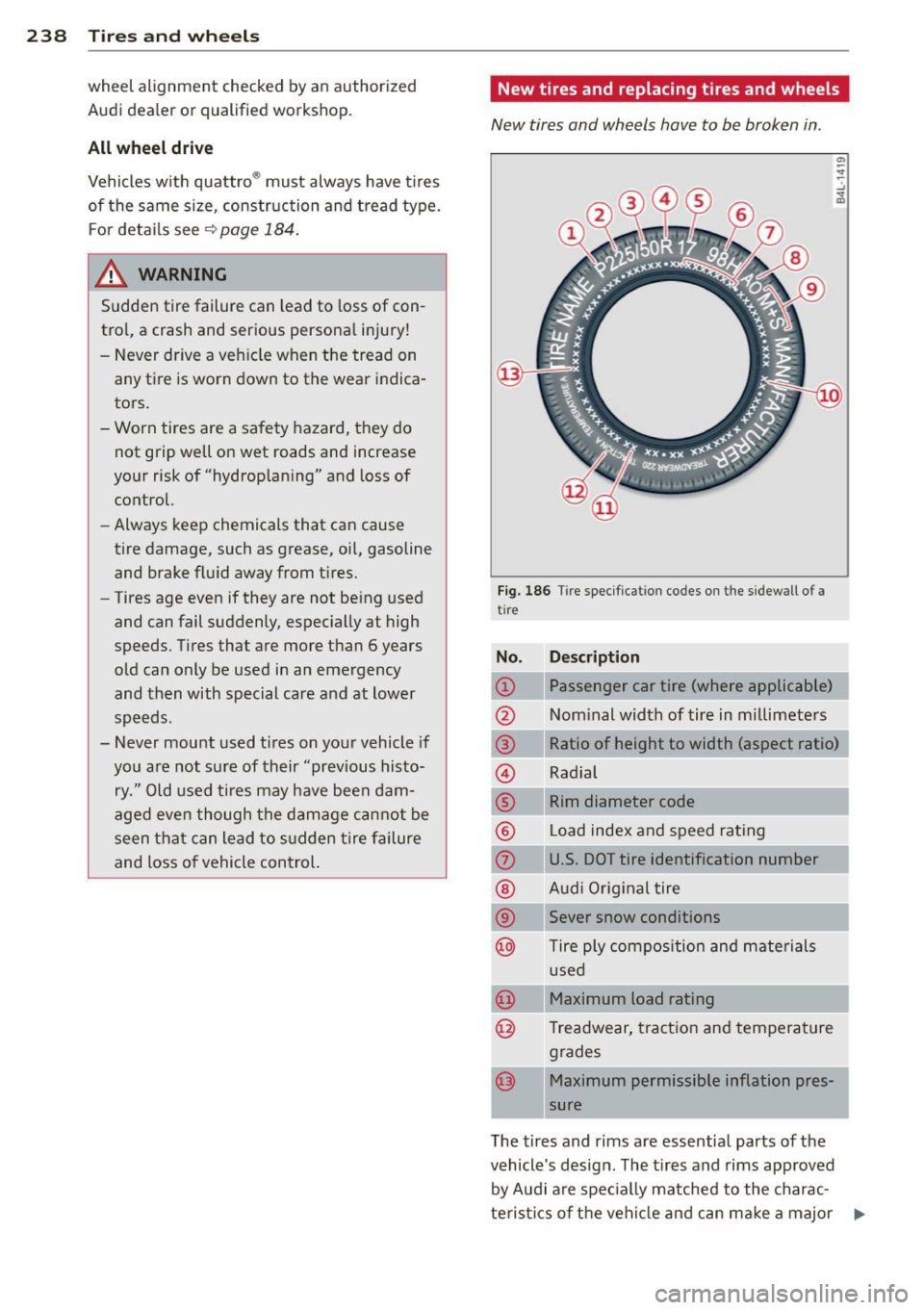
Fig. 186 Tir e specificat ion c odes on t he s idewall o f a
t ire
N o. Descri ption
(!) Passenger car tire (where applicable)
@ Nom inal width of tire in millimeters
@ Ratio of height to width (aspect ratio)
© Radial
® Rim diameter code
@ L oad index and speed rating
(J) U.S. DOT tire identification number
@ Audi Orig inal tire
@ Sever snow conditions
@ Tire ply compos ition and mate rials
used
Maximum load rating
Treadwear, traction and temperature
grades
Maximum permissible inflation pres
sure
T he t ires and rims are essential parts of the
vehicle 's design . The tires and rims approved
by Audi are spec ially matched to the charac
teristics of the vehicle and can make a major .,..
Page 242 of 290

24 0 T ire s and wheel s
H up to 130 mph (210 km/h)
V up to 149 mph (240 km/h)l)
Z over 149 mph (240 km/h)ll
W up to 168 mph (270 km/h)
1l
Y up to 186 mph (298 km/h)ll
Your vehicle is norma lly factory equipped with
tires, which possess excellent driving charac
teristics and give your Audi opt imum driving
comfort. An electronic speed limiter
c::> page 29 w ill normally prevent your vehicle
from go ing faste r than the tire speed rating
¢ & .
U.S . DOT Tire Identification Number (TIN)
and tire manufacture date
This is the t ire's "serial number". It beg ins
with the lette rs "DO T" and indicates that the
tire meets all federal standards. The next two
numbers or letters indica te the p lant where it
was manufactured, and the last four numbers
represent the week and year of manufacture .
F or examp le, the numbers 2212 mean that
the tire was produced in the 22nd week of
2012 . The other numbers are marketing co
des that may or may not be used by the tire
manufacturer . This information is used to con
tact consumers if a tire defect requires a re
call.
Audi Original tire
Tires with the ident ificat ion "AO" or "RO" have
been spec ially matched with your Aud i. We
recommend using only these tires because
they meet the highest standards regard ing
safety and d riving character istics when used
correctly. Yo ur au tho riz ed Audi dealer will
g lad ly provide you with more information.
Tire ply composition and materials used
The number of pl ies ind icates the numbe r of
l ayers of rubber-coated fabric in the t ire. In
general, the g rea ter the numbe r of p lies, the
mo re weig ht a t ire can support. Tire man ufac
turers a lso must indicate the materials in the
ll For tir es w it h a m ax im um spee d ca pabil ity ove r
1 4 9 mp h (2 40 k m/h) , t ire ma nufact urers somet imes
u se the lette rs "ZR. "
tir e, which include stee l, nylon, po lyester, and
others .
Maximum Load Rating
This number ind icates the maximum load in
k ilog rams and po unds t hat can be ca rr ied by
the tire .
Tire quality grading for treadwear ,
traction, and temperature resistance
T read wear, tra ct ion and tempera ture grades
c::>page 241 .
Maximum Permissible Inflation Pressure
This number is the greatest amount of a ir
pressure that should ever be put in the t ire
u nder norma l dr iv ing cond itions .
_& WARNING
- Using incorrect o r unm atc hed tires and/
or wheels or improper tire and wheel
combinat ions can lead to loss of control
'
collis ion and serio us personal i nju ry .
- A lways use t ires, rims and whee l bolts
that meet the specifications of origina l
factory- insta lled tires or other combina
tions that have been specifically ap proved by the vehicle manufacturer.
- Tires age even if they are not being used
and can fai l sudden ly, especially at hig h
speeds. Tires that are more than 6 yea rs
old can only be used in an emergency
and then w it h specia l care and at lower
speeds.
- Never mo unt used tires on your veh icle if
you are not sure of the ir "previo us histo
ry." O ld used tires may have been dam
a ged even thoug h the damage cannot be
seen that can lead to sud den tire fa ilure
and loss of vehicle control.
- All fo ur whee ls must be fitted with r adial
tires of the same type, size (rolling cir
cumference) an d the same tread pattern .
Driving with different tires reduces ..,_
Page 244 of 290
24 2 T ire s and wheel s
Traction
The traction grades, from highest to lowest,
are AA, A, Band
C. T hose grades represent the
tire's ability to stop on wet pavement as measured under controlled conditions on
specified government test surfaces of asphalt
and concrete. A tire marked C may have poor
traction performance
c:> .&. .
Te mp eratu re
The temperature grades are A (the highest),
B, and
C, representing the tire's resistance to
the generation of heat and its ability to dissi
pate heat when tested under con trolled condi
tions on a specified i ndoor laboratory test
wheel.
Sustained high temperature can cause the
material of the tire to degenerate and reduce
tire life, and excessive temperature can lead
to sudden tire failure
c:> ,& .
The grade C corresponds to a level of perform
ance which all passenger car tires must meet under the Federal Motor Veh icle Safety Stand
ard No .
109 . Grades Band A represent h igher
l eve ls of performance on the laboratory test
wheel than the m inimum required by law.
.&_ WARNING
T he traction grade assigned to this t ire is
based on straight-ahead braking traction
tests, and does not include acceleration,
cornering, hydrop laning or peak traction
characteristics.
A WARNING
The temperature grade for this tire is es
tablished for a t ire that is properly inflated
and not overloaded. Excessive speed, un
derinflation, or excessive loading, either
separately or in combination, can cause
heat buildup and possible tire fa ilu re.
-
Winter tires
Winter tires can improve vehicle handling on
snow and ice . At temperatures below 45 °F
(7 °C) we recommend changing to winter
tires.
In some heavy snow areas, local governments
may require true w inter o r "snow" t ires, those
with very deeply cut tread . T hese tires should
o n ly be used in pairs and be installed on a ll
f o ur wheels . Make sure you purchase snow
ti res that are the same size and construction
type as the other tires on yo ur vehicle.
You r vehicle is equipped with al l wheel d rive,
th is will improve traction d uring win ter driv
ing, even with the standard tires. However, we
strong ly recommend that you always equip all
fo ur wheels on your vehicle with correctly fit
ted winter tires or a ll-season tires, when win
ter road cond itions are expected. This also im
proves the veh icle's brak ing performance and
reduces stopping d istances .
Summer tires provide less grip on ice and
snow.
Winter tires (snow tires) must always be fitted on all fo ur whee ls .
Ask your authorized A udi dealer or qualified
workshop for permit ted
w in ter ti re size s. Use
only radial winter tires .
Winter tires lose their effec tivenes s when the
tread is wo rn down to a depth of
0 .157 inch
(4 mm) .
Only d rive w ith w inter t ires under w inte r co n
ditions. S ummer t ires handle bette r when
there is no snow o r ice on the roads and the
temperature is above 45 °F (7 °C) .
If you have a flat ti re, see notes on spare
whee l
c:> page 238 .
Please always remember that winter tires may
have a lower speed rating than the tires origi
nally installed on your vehi cle at the time it
was ma nufactu red. P lease see
c:> page 239,
Speed rating (Letter code)
for a lis ting o f the
speed rating lette r codes and the max imum
speed at which the tires can be driven . ..,.
Page 245 of 290
The speed rating letter code (c::> page 230) is
on the side wall of the tire
c::> page 238.
A WARNING
Winter tires have maximum speed limits
that may be lower than your vehicle's max
imum speed . Always know the maximum
speed before driving off. Never drive faster
than the speed permitted for your specific
winter tires . This will cause damage to the
tires leading to an accident and serious
personal injury to you and your passen
gers.
A WARNING
Driving faster than the maximum speed
for which the winter tires on your vehicle
were designed can cause tire failure in cluding a blowout and sudden deflation,
loss of control, crashes and serious per
sonal injuries . Have worn or damaged tires
replaced immediately.
- Winter tires have maximum speed rating
that may be lower than your vehicle's
maximum speed .
- Never drive faster than the speed for
which the winter or other tires installed
on your vehicle are rated .
A WARNING
Always adjust your driving to the road and
traffic conditions. Never let the good ac
celeration of the winter tires and all wheel
drive tempt you into taking extra risks . Al
ways remember :
- When braking, an all wheel drive vehicle
handles in the same way as a front drive
vehicle.
- Drive carefully and reduce your speed on
icy and slippery roads, even winter tires
cannot help under black ice conditions.
@l For the sake of the environment
Use summer tires when weather condi
tions permit. They are quieter, do not wear
as quickly and reduce fuel consumption.
Tires and wheels 243
Snow chains
Snow chains may be fitted only to the front
wheels , and only to certain tire sizes. Ask your
authorized Audi dealer on which tire sizes
snow chains can be used.
The snow chains must have low-profile links
and must not be thicker than 0.53 inch
(13.S mm) , including the lock.
Remove wheel center covers and trim discs
before putting snow chains on your vehicle
c::> 0 . For safety reasons cover caps must then
be fitted over the wheel bolts. These are avail
able from authorized Audi dealers.
A WARNING
~ Using the wrong snow chains for your vehi
cle or installing them incorrectly can in
crease the risk of loss of control leading to
serious personal injury.
- Snow chains are available in different sizes . Always make sure to follow the in
structions provided by the snow chain
manufacturer.
- When driving with snow chains never
drive faster than the speed permitted for
your specific snow chains .
- Always observe local regulations.
(D Note
- Remove snow chains before driving on
roads not covered with snow to avoid
damaging tires and wearing the snow
chains down unnecessarily.
- Snow chains, which come into direct con
tact with the wheel rim, can scratch or
damage it. Therefore, make sure that the
snow chains are suitably covered. Check
the position of the snow chains after
driving a few yards and correct if neces
sary. Follow the instructions from the
snow chain manufacturer when doing so.
(D Tips
Where snow chains are mandatory on cer
tain roads, this normally also applies to
vehicles with all wheel drive .
•
•
Page 246 of 290
24 4 T ire s and wheel s
Wheel bolts
Wheel bolts must always be tightened to the
correct torque .
The design of wheel bolts is matched to the
factory installed rims. If differen t rims are fit
ted, the correct wheel bolts with the r ight
length and correctly shaped bolt heads must
be used. This ensures that wheels are fitted
secure ly and that the brake system funct ions
correctly .
In ce rtain circumstances, you may not use
wheel bolts from a different vehicle -even if it
i s the same model~
page 2 71.
_& WARNING
Improperly tig htened o r maintained whee l
bolts can become loose ca using loss of
contro l, a co llision and serious persona l in
jury.
- Always keep the wheel bolts and the
threads in the wheel hubs clean so the
wheel bolts can turn easily and be prop
erly t ightened.
- Never grease or oil the wheel bo lts and
the threads in the wheel hubs. They can
become loose while driving if greased or
oiled, even if tightened to the specif ied
torque .
- Only use wheel bolts that belong to the
rim being installed .
- Never use different wheels bolts on your
vehicle .
-Always maintain the correct tighten ing
torque for the wheel bo lts to reduce the
risk of a wheel loss. If the tightening tor
que of the wheel bolts is too low, they
can loosen and com e out when the veh i
cl e is moving. If the tightening torque is
too high, the whee l bolts and threads
can be damaged and the wheel can be
come loose.
@ Note
The spec ified torq ue fo r the wheel bo lts is
90 ft lbs. (120 Nm) wi th a toler ance of
± 7,4 ft lbs. (± 10 Nm). Torque wheel bo lts diagonally. After changing a wheel, the
torque m
ust be checked as soon as possi
ble with a torque wrench -preferably by an
a uthori zed Audi dea ler or q ua lified work
shop .
Low aspect ratio tires
Your Audi is factory -equ ipped w ith low aspect
ratio tires . T hese tires have been thoroughly
tested and been se lected specifically fo r your
model for their superb perfo rmance, road fee l
and hand ling under a variety o f driv ing condi
t ions . As k your authorized A udi dealer for
more details .
T he low aspect ratio of these tires is ind icated
by a numera l of
55 or l ess in the tire's s ize
designation. The numeral represents the ratio
of the tire's sidewa ll height in relation to its
tread width exp ressed in percentage . Conven
tiona l tires have a he ight/w idth ratio of 60 or
more .
The performance of low-a spect-r atio tire s is
pa rt icul arly s ens itive to imp ro per i nfl ation
pressure. It is therefore import ant that low
aspect ratio tires are inflated to the specified pre ssure and that the inflation pressure is
r e gularly checked and maintained . Tire pres
sur es should be checked at l east once a
month and always before a long trip
~ page 233, Checking tire pressure.
What you can do to avoid tire and rim
damage
Low aspect ratio tires can be damaged mo re
easily by impact w it h potholes, c urbs, g ull ies
o r ridges on the road, pa rticul arly if the tire is
u nderinfla ted .
In orde r to minimize the occurrence of impact
damage to t he tires of your vehi cle, we recom
mend tha t you observe the following preca u
tions:
- Always ma inta in recommended inflation
pressu res. Check your tire pressure eve ry
2 ,000 miles (3,000 km) and add air if neces -
sary. ..,.
Page 248 of 290
246 Tires and wheels
wheels on your vehicle to ensure that the re
p lacement or a lternate tires and wheels allow
the TPMS to continue to function properly.
Tire pressure indicator appears
Applies to vehicles: with tire pressure monitoring system
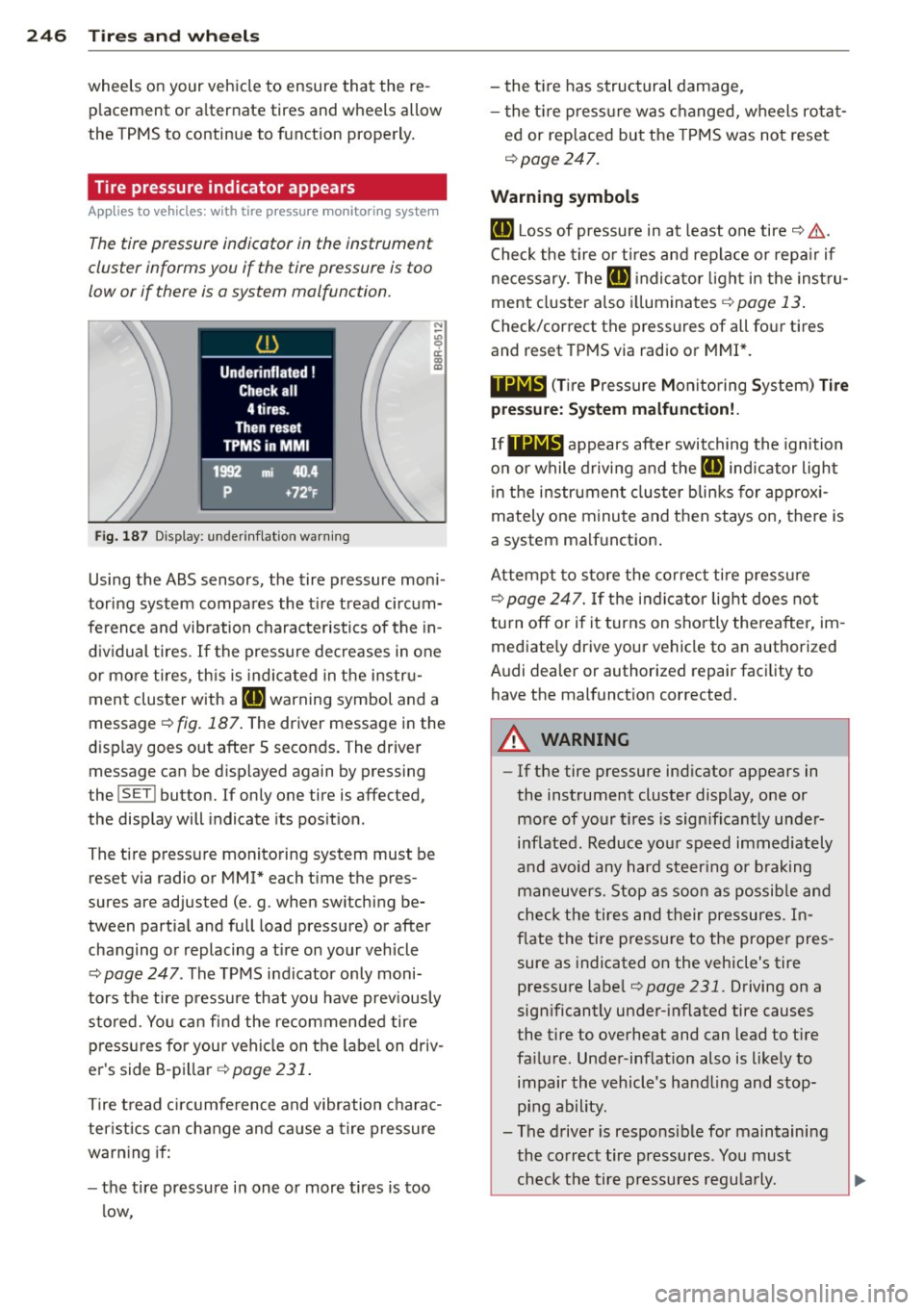
The tire pressure indicator in the instrument
cluster informs you if the tire pressure is too
low or if there is a system malfunction.
Fig. 187 Display: underinflation warning
N :;:; 9 a:
l:l
Using the ABS sensors, the tire pressure moni
tor ing system compares the tire tread circum
ference and vibration characteristics of the in
dividual tires.
If the pressure decreases in one
or mo re tires, this is indicated in the instru
ment cluster with a
[I] warning symbol and a
message
r:!> fig. 187 . The driver message in the
display goes out after S seconds. The driver
message can be displayed again by pressing
the
! SET ! button. If only one tire is affected,
the display will indicate its position.
The tire press ure monitoring system must be
reset via radio or MMI* each time the pres
sures are adjusted (e. g . when switching be
tween partial and full load pressure) or after
changing or replacing a tire on your veh icle
r:!> page 247 . The TPMS indicator only moni
tors the tire pressure that you have prev iously
stored . You can find the recommended tire
pressures for your vehicle on the label on driv
er's side 8-pillar
¢page 231.
Tire tread circumference and vibration charac
ter istics can change and cause a tire pressure
warning if:
- the tire pressure in one or more tires is too
low, - the
tire has structural damage,
- the tire pressure was changed, wheels rotat-
ed or replaced but the TPMS was not reset
c;, page 247.
Warning symbols
[I] Loss of pressure in at least one tire c;, .&,..
Check the tire or tires and replace or repa ir if
necessary. The
[I] indicator light in the instru
ment cluster also illuminates
¢page 13.
Check/correct the pressures of all four tires
and reset TPMS via radio or MMI*.
11Nl~1 (Tir e Pressure Mon itor ing System) Tire
pressure: System malfunction!.
IfllilB appears after switching the ignition
on or while driving and the
[I] indicator light
in the instrument cluster blinks for approx i
mately one minute and then stays on, there is
a system malfunction .
Attempt to store the correct tire pressu re
c;, page 247. If the indicator light does not
turn off or if it turns on shortly thereafter, im
mediate ly driv e your vehicle to an author ized
Audi dealer or authorized repair facility to
have the malfunct ion corrected.
A WARNING
-
- If the tire pressure ind icator appears in
the instrument cluster display, one or
more of your t ires is sign ificantly under
inflated . Reduce yo ur speed immediately
and avoid any hard steering or braking
maneuvers. Stop as soon as possible and
check the tires and their pressures. In
f la te the tire pressure to the prope r pres
sure as indicated on the vehicle's tire
pressure label
r:!> page 231. Driving on a
significantly under-inflated tire causes
the t ire to overheat and can lead to tire
fa ilure . Under -inflation also is likely to
impair the vehicle's handling and stop ping ability.
- The driver is responsible for maintaining
the co rrect tire pressures. You must
check the tire pressures regularly.
Page 250 of 290
248 What do I do now?
What do I do now?
Vehicle tool kit
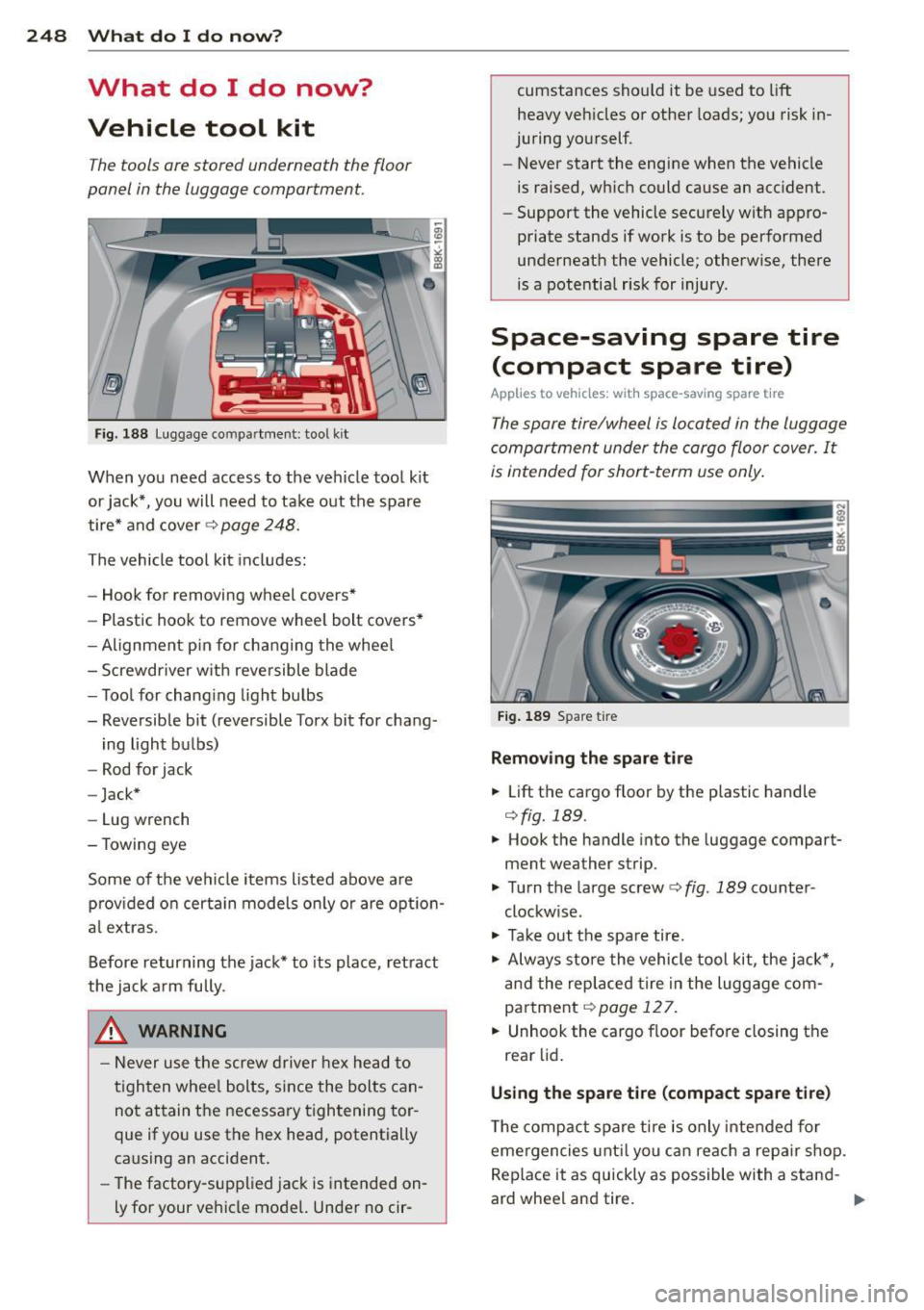
The tools ore stored underneath the floor
panel in the luggage comportment.
Fig. 188 luggage compartment: tool kit
When you need access to the vehicle tool kit
or jack*, you will need to take out the spare
tire* and cover¢
page 248.
The vehicle tool kit includes:
- Hook for removing wheel covers*
- Plastic hook to remove wheel bolt covers*
- Alignment p in for changing the whee l
- Screwdriver w ith reversible blade
- Tool for changing light bulbs
- Reversible bit (reversible Torx bit for chang-
ing light bulbs)
- Rod for jack
- Jack*
- Lug wrench
- Towing eye
Some of the vehicle items listed above are provided on certain models on ly or are opt ion
a l extras.
Before returning the jack* to its place, retract
the jack arm fully.
A WARNING
-
-Never use the screw driver hex head to
tighten wheel bolts, since the bolts can
not attain the necessary tightening tor
que if yo u use the hex head, potentially
causing an accident.
- The factory-supplied jack is intended on
ly for your vehicle model. Under no cir- cumstances should it be
used to lift
heavy veh icles or other loads; you risk in
juring yourself.
- Never start the engine when the vehicle
is raised, which could cause an accident.
- Support the vehicle securely with appro
priate stands if work is to be performed
underneath the vehicle; otherwise, there is a potential risk for injury .
Space-saving spare tire
(compact spare tire)
App lies to vehicles: with space -saving spare t ire
The spare tire/wheel is located in the luggage
comportment under the cargo floor cover. It
is intended for short-term use only.
Fig. 189 Spa re tire
Removing the spare tire
.. Lift the cargo floor by the p lastic handle
¢ fig. 189 .
.. Hook the handle into the luggage compart
ment weather strip .
.. Turn the large screw ¢
fig. 189 counter
clockwise .
.. Take out the spare tire .
.. Always store the vehicle tool kit, the jack*,
and the replaced tire in the luggage com
partment
¢ page 127.
.. Unhook the cargo floor before closing the
rear lid.
Using the spare tire (compact spare tire)
The compact spare t ire is only intended for
emergencies until you can reach a repair shop .
R ep lace it as quickly as possible with a stand-
ard wheel and tire. ..,.
Page 251 of 290
There are some restrictions on the use of the
compact spare tire. The compact spare tire
has been des igned specifically for your type of
ve hicle.
It must not be swapped with a com
pact spare t ire from another type of veh icle.
Snow cha in s
For technica l reasons, the use of snow chains
on the compact spare tire is
not permitted .
If you do have to dr ive with snow chains and a
front tire fails, mou nt the spare whee l w ith
tire instead o f a rea r ti re . Install the snow
chains on the rear tire and use it to replace
the defective front tire.
A WARNING
- Never use the spare tire if it is damaged
o r if it is worn down to the tread wear in
dicators.
- If the spare tire is more than 6 years o ld,
use it only in an emergency and w ith ex
t reme caution and careful driving .
- The spare tire is intended only for tem
porary and short-term use. It should be
replaced as soon as possib le w ith the
normal wheel and t ire.
- After mounting the compact spare tire, the tire pressure must be checked as soo n as poss ible. The tire pressure of the
c ompac t sp are tire must be 4.2 bar; o th
erwise, yo u risk hav ing an accident.
- Do not drive faster than 50 mph (80 km/
h). You risk having an a ccident.
- Avoid fu ll-throttle acce le rat ion, heavy
braking, and fast corner ing. Yo u risk h av
ing an acc iden t.
- Never drive us ing more t han one spa re
whee l and tire. You risk having an acci
dent.
- No rma l su mmer or wi nte r tires m ust not
be mounted on the comp act spare whee l
rim.
- F or technical reasons, t he use of ti re
chains on the spare tire is not permitted .
If it is necessary to drive with tire chains,
the spare whee l must be mounted on the
front axle in the event of a flat in a rear
What do I do now? 249
tire. The newly available front whee l
m ust then be insta lled in place of the
rear whee l w ith the flat tire. Installing
the t ire cha in before mounting the whee l
and tire is recommended .
- Loose items in the passenger compart
ment can cause serious personal injury
during hard bra king or in a n accide nt.
Never store the spa re tire or jack and
too ls in t he passenger compa rtment.
Changing a wheel
Before changing a wheel
Observe the following precautions for your
own and your passenger's safety when chang
ing a wheel .
"' After you experience a t ire failure, p ull the
car we ll away from moving traffic and try to
reach
le vel ground before you stop¢ A.
"' All passengers should lea ve the car and
move to a safe location (for instance, behind
the guardrail) ¢ &, .
"' Engage the
park ing brak e to prevent your
veh icle from rolling unintentionally¢&, .
"' Move the
se lec tor lever to th e P position .
"' If you are towing a t ra iler : unhit ch the trail
er from you r vehicle.
"' Take the
jack ¢ page 248 and the spare tire
c::> page 248 out of the luggage compart
ment .
A WARNING
You or your passengers could be injured
while changing a wheel if you do not fo l-
l ow these safety precaut ions :
- If you have a flat tire, move a safe d is
tance off the road. Turn off the engine,
turn the emergency flashers on and use other warning devices to a le rt other mo
torists.
- Ma ke sure that passenge rs wait in a safe
place away from the vehicle and well
away from the road and traffic.
- To help prevent the vehicle from moving
-
suddenly and possib ly slipping off the ..,. •
•
Page 252 of 290
250 What do I do n ow ?
jack, always fully set the parking brake
and block the wheel diagonally opposite the wheel being changed with the fold
ing chocks or other objects . When one
front wheel is lifted off the ground, plac
ing the Automatic Transmiss ion in "P"
(Park) will
not prevent the vehicle from
moving.
- Before yo u change a wheel, be su re the
ground is leve l and firm. If necessa ry,
use a st urdy board under the jack.
- Always store the vehicle tool kit, the
jack * and the replaced ti re in the l uggage
compartment
r=>page 12 7.
(D Note
If you are chang ing the wheel on a steep
incline, use a rock or s imilar object to
bloc k the opposite wheel to prevent the
veh icle from mov ing.
@ Tips
Obey a ll laws.
Changing a wheel
When you change a wheel, follow these
quence described below step-by-step and in
exactly tha t order .
1. Remove the decorativ e wheel c over* or
the
wheel bol t cap s* . Fo r more details see
a lso
r=> page 250, Decorative wheel cov
ers
or ¢ page 251, Wheels with wheel
bolt caps.
2 . Loosen the wheel bo lts r=> page 251.
3 . Locate the proper mount ing point for the
jack and align the jack below that point
r=> page 252.
4 . Lift the car with the jack r=> page 252.
5. Remove the wheel with th e flat tire and
then i nstall the
spar e tire r=> page 253 .
6. Tighten all wheel bo lts light ly .
7 .
Low er the ve hicle w it h the jack.
8 . Use the wheel bolt wrench an d
firmly
tighte n all whee l bolts in a crisscross pa t
tern
r=> page 251.
9. Replace the decorative wheel c over* or
the
wheel bolt cap s*.
A WARNING
A lways read and follow all WARNINGS and
i nformation
r=> .& in Raising the vehicle on
page 252
and r=> page 254.
After changing a wheel
A wheel change is not complete without the
doing the following.
.. Always store the vehicle tool kit, the jack*,
and the replaced tire in the luggage com
partment
r=> page 127.
.,. Check the tire pressure of the spare tire as
soon as possible .
"' As soon as poss ible, have the
tighteni ng
torqu es
on all wheel bolts checked w ith a
t orque wrenc h. The correct tig hte ning tor
que is
90 ft lbs. (120 Nm).
.,. Have the flat tire
repl aced as soon as possi
b le.
(D Tips
- If
you not ice that the wheel bo lts ar e
corroded and difficult to turn while
changing a tire, they shou ld be rep laced
before you check the tightening torque.
- Dr ive at reduced speed until you have the
tightening torques checked .
Decorative wheel covers
Applies to vehicles: w ith decorative w hee l covers
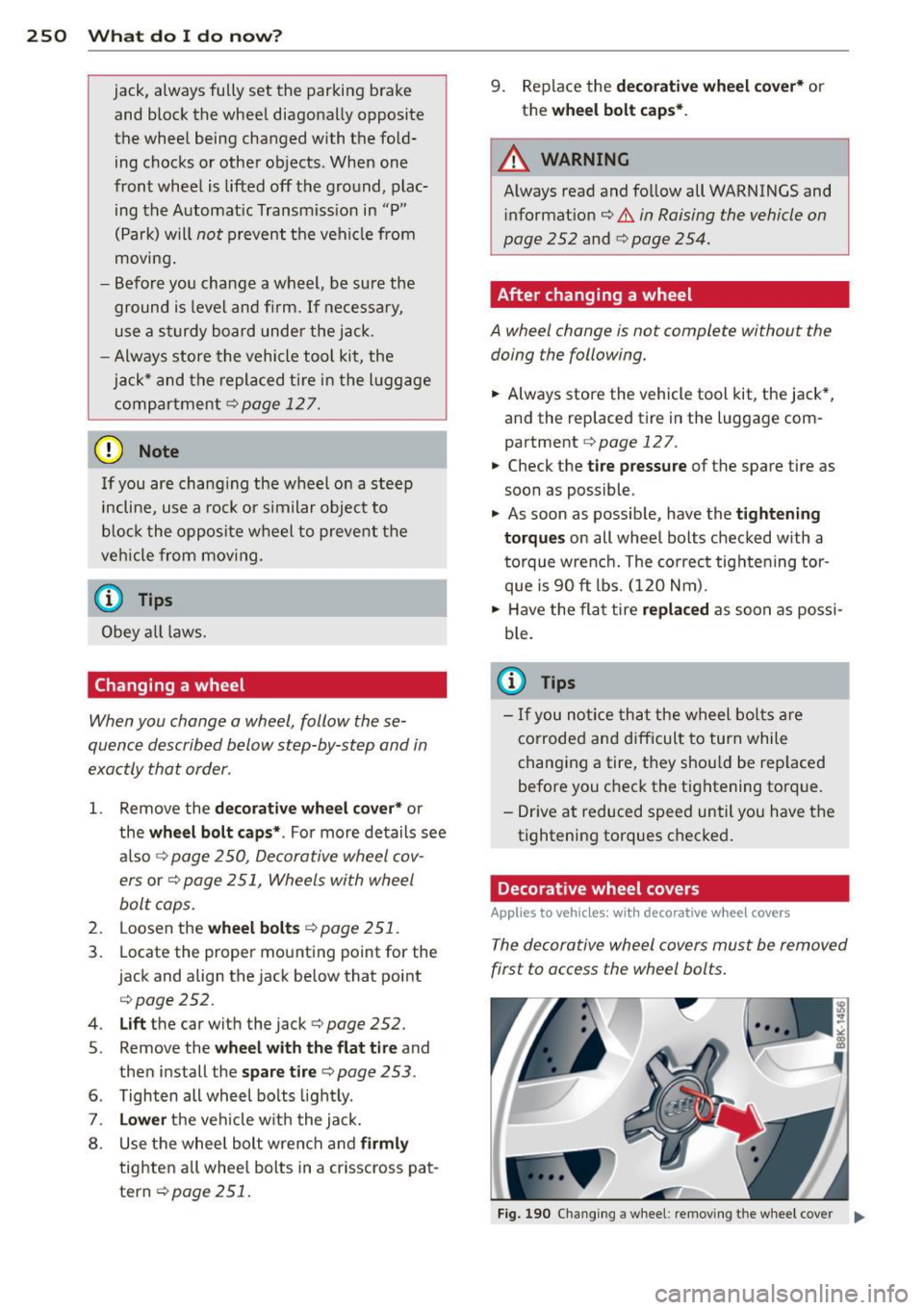
The decorative wheel covers must be removed
first to access the wheel bolts .
Fig. 19 0 Cha nging a whee l: removing t he w heel cove r Ill>