ABS AUDI A5 CABRIOLET 2013 User Guide
[x] Cancel search | Manufacturer: AUDI, Model Year: 2013, Model line: A5 CABRIOLET, Model: AUDI A5 CABRIOLET 2013Pages: 290, PDF Size: 72.35 MB
Page 146 of 290
144 Airbag system
-Never place additiona l items on the seat
that can increase the total weight regis
tered by the weight-sensing mat and can
cause injury in a crash.
Front airbags
Description of front airbags
The airbag system can provide supplemental
protection to properly restrained front seat
occupants.
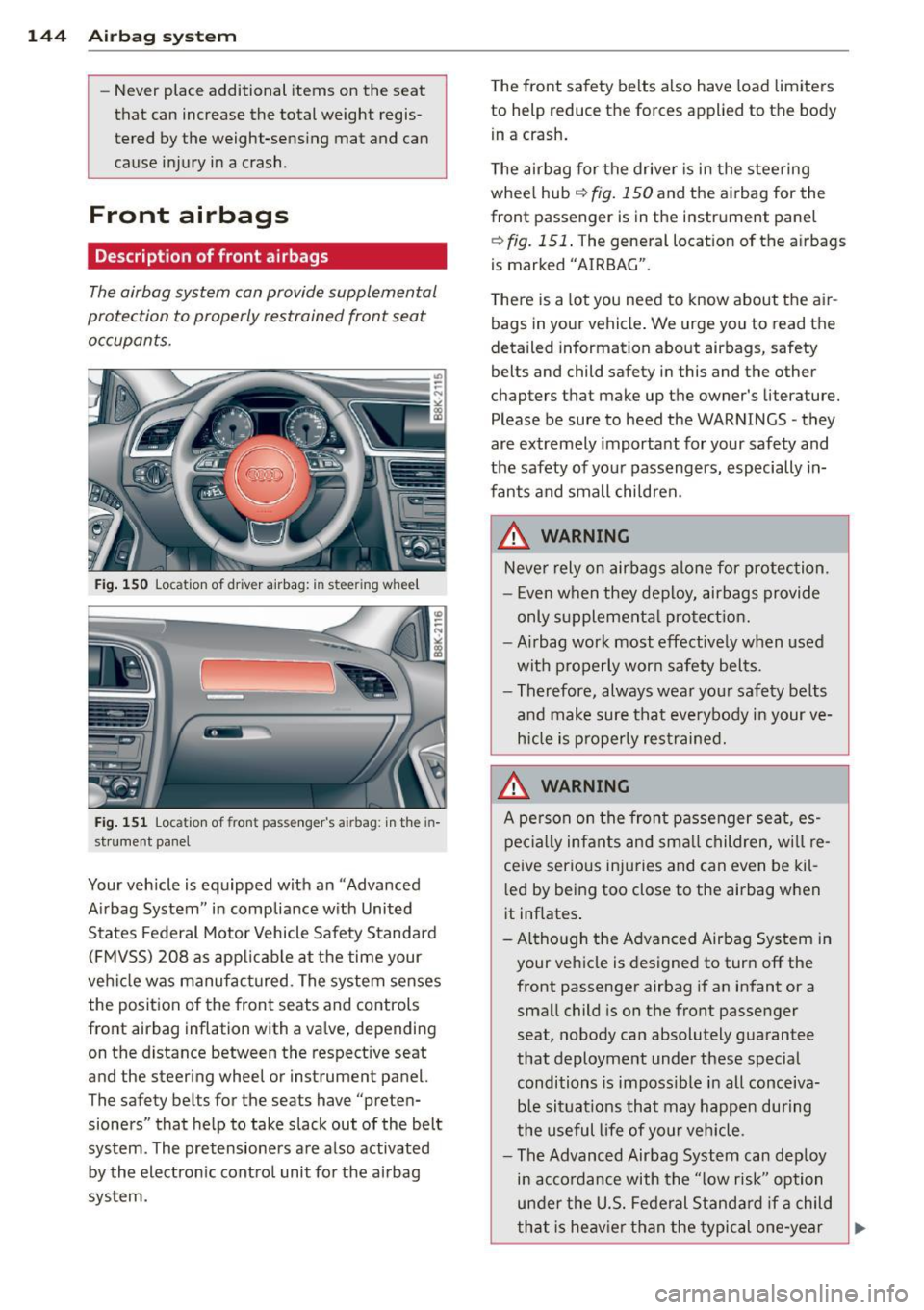
F ig . 150 Location of driver airbag: in steer ing whee l
Fig. 151 Location of front passenger's airbag: in the in
strument panel
Your veh icle is equipped with an "Advanced
A irbag System" in compliance with United
States Federal Motor Vehicle Safety Standard ( FM VSS) 208 as app licab le at the time your
ve hicl e was manufac tured. The system senses
the position of the front seats and controls
front airbag inflation with a valve, depending
on the distance between the respect ive seat
and the steering wheel or instrument panel.
The safety belts for the seats have "preten
sioners" that he lp to take slack out of the belt
system . The pretensioners a re also activated
by the electron ic cont ro l unit for the ai rbag
system. T
he front safety belts also have load limiters
to help reduce the forces applied to the body
i n a crash .
T he airbag for the drive r is in the stee ring
whee l hub¢
fig. 150 and the airbag for the
front passenger is in the instrument panel
~ fig. 151. The general locat ion of the a irbags
is marked "AIRBAG".
T here is a lot you need to know about the ai r
bags in your vehicle. We urge you to read the
detailed information about airbags, safety
belts and child safety in this and the other
chapters that make up the owner's literature.
P lease be sure to heed the WARNINGS -they
are extremely importa nt for your safety and
the safety of your passengers, especially in
fants and small chi ldren.
_&. WARNING
Neve r rely on airbags alone for p rotection.
- Even w hen they deploy, airbags provide
only s upplement al pro te ctio n.
- Airbag work most effect ive ly when used
with p roperly wor n safety bel ts.
- Therefore, always wea r you r safety belts
a nd make sure tha t eve rybody in your ve
h icle is properly res trained.
_&. WARNING
A pe rson on the front passenger seat, es
pe cial ly infa nts and sm all ch ildren, w ill re
ceive serio us inju ries and can even be kil
l ed by being too close to the airbag when
it inflates .
- Although t he Advanced Airbag System in
your veh icle is designed to tur n off the
front passenger airbag if an infant or a
small child is on the front passe nger
seat, nobody can absolutely guarantee
that deployment under these special
conditions is imposs ible in all conceiva
b le sit uat ions that may happen during
the useful life of your vehicle.
- The Advanced Airbag System can dep loy
i n acco rdance with the "low risk" option
unde r the U.S . Feder al Standard if a child
that is heav ie r than the typical one -year
-
.
Page 148 of 290
146 Airbag sys te m
For exa mpl e, the air b ag ma y depl oy if:
- a small child that is heavier than a typical 1
year-o ld child is on the front passenger seat
(regardless of whe ther the child is in one of
the chi ld safety seats listed
¢ page 163),
-a ch ild who has outgrown child rest raints is
on the front passenger seat.
If the front passenger airbag is turned off, the
PA SSENGER AIR BAG OFF light in the cente r
of the instrument panel w ill come on and stay
on.
The front a irbag on the passenger side may
not deploy (the PAS SENGER AIR BAG OFF
light does not illuminate and stay lit) if:
- a small adult or teenager is on the front pas
senger seat
- a passenger who is not sitt ing upright wit h
their back against a non-reclined backrest
with their feet on the veh icle floo r in front
of the seat is on the front passenger seat.
If the front passenger airbag deploys, the Federal Standard requires the airbag to meet
the "low risk" deployment criteria to help re
d uce the risk of inju ry through interaction
with the airbag. " Low risk" deployment occurs
in those crashes that take place at lower de
celerations as defined in the e lectronic control
un it.
¢ page 151
Alw ays re memb er: Even tho ugh you r vehicle
is equipped with Advanced Airbags, the safest
p lace for children is properly restrained on the
back seat . Please be sure to read the impor
tant information in the sect ions that follow
and be sure to heed all of the WARNINGS.
A WARNING
To reduce the risk of injury when an airbag
inf lates, always wear safety belts properly.
- If you are unrestrained, lean ing forward,
sitting sideways or out of position in any
way, your risk of in jury is much higher.
- You w ill also receive serious injuries and
cou ld even be killed if you are up against
the a irbag or too close to it when it in- f
lates - even with an Advanced A irbag
¢page 140.
A WARNING
-A child in a rearward-fac ing ch ild safety
seat installed on the front passenger seat
will be serious ly injured and can be killed if
the front airbag inflates - even with an Ad
vanced A irbag System.
- Although the Advanced Airbag System in your veh icle is designed to turn off the
front airbag when a rearward-facing child restraint has been instal led on the
front passenger seat, nobody can abso
lutely g uarantee that dep loyment is im
possible in all conceivable situations that
may happen during the usefu l life of your
veh icle.
- The inflating airbag will hit the child
safety seat or infant carrier with great
force and will smash the child safety seat
and child aga inst the backrest, center
armrest, door, or roof.
-Always install rearward -facing ch ild re
straints in the back seat.
- If you must install a rearward fac ing
child safety seat on the front passenger
seat because of exceptiona l circumstan
ces and the
PASSENGER AIR BAG OFF
light does not come on and stay on, im
mediately insta ll th e rear-fac ing ch ild
safety seat in a rear seating position and
have the airbag system inspected by your
authorized Audi dealer .
A WARNING
If, in exceptional circumstances, you m ust
insta ll a forward -facing child restraint on
the front passenger's seat:
- Always make sure the forward-facing
seat has been designed and certified by
its manufacturer for use on a front seat
with a passenger front and s ide a irbag.
- Never p ut the forward-facing child re
straint up against or very near the instru- ment panel.
~
Page 157 of 290
dealer is familiar with these requirements
and we recommend that you have your
dealer perform this service for you.
Other things that can affect Advanced
Airbag performance
Changing the vehicle's suspension system can
change the way that the Advanced Airbag Sys
tem performs in a crash. For example, using
tire-r im combinations not approved by Audi,
lowering the vehicle, changing the stiffness of
the suspension, including the springs, suspen
sion struts, shock absorbers etc. can change
the forces that are measured by the airbag sensors and sent to the electronic control
unit. Some suspension changes can, for exam
ple, increase the force levels measured by the
sensors and make the airbag system deploy in
crashes in which it would not deploy if the
changes had not been made . Other kinds of
changes may reduce the force levels meas
ured by the sensors and prevent the airbag
from deploying when it should .
The sensors in the safety belt buckle for the
d river and front passenger seat tell the elec
tronic control module if the safety belt is
latched or not. If the safety belt is being used,
the front airbag will deploy at a slightly high
er rate of vehicle deceleration than if the safe
ty belt is not being used. Therefore, in a par
ticular collision, it is possible that an airbag
will not deploy at a seating position where the safety belt is being used but will inflate at the
position where the safety belt is not being
used. It is important that nothing interfere
with the safety belt buckles so that the sen
sors can send the correct information about
safety belt use to the electronic control unit.
.&_ WARNING
Changing the vehicle 's suspension includ
ing use of unapproved tire-rim combina
tions can change Advanced Airbag per
formance and increase the risk of serious personal injury in a crash.
- Never install suspension components
that do not have the same performance
Airbag system 155
characteristics as the components origi
nally installed on your vehicle .
- Never use tire-rim combinations that
have not been approved by Audi.
.&_ WARNING
= -
Items stored between the safety belt buckle and the center console can cause
the sensors in the buckle to send the
wrong information to the electronic con
trol module and prevent the Advanced Air bag System from working properly.
-Always make sure that nothing can inter-
fere with the safety belt buckles and that
they are not obstructed.
Knee airbags
Description of knee airbags
Applies to vehicles: wit h knee airbags
The knee airbag system can provide supple
mental protection to properly restrained
front seat occupants.
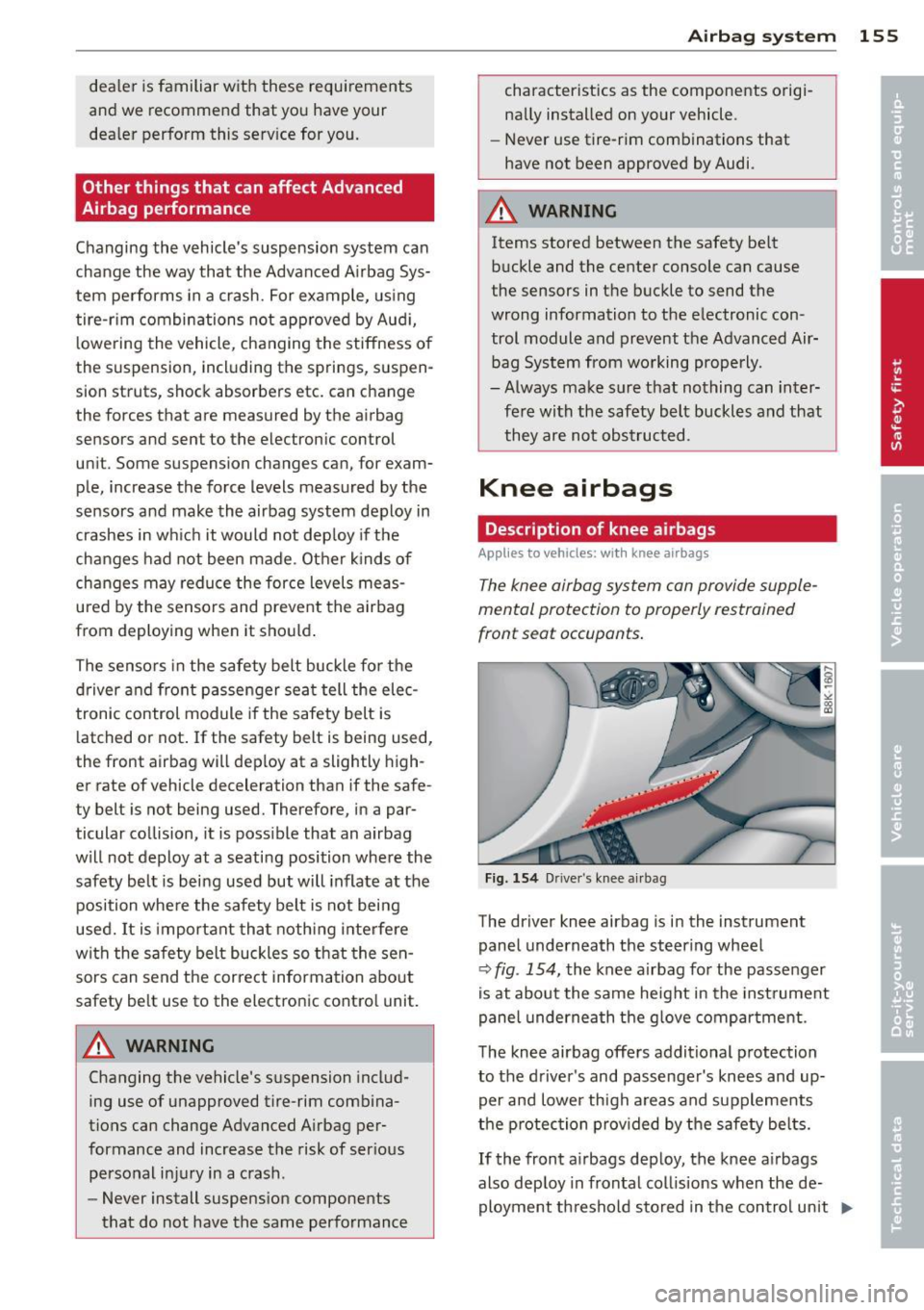
Fig. 154 Driver 's knee airbag
The driver knee airbag is in the instrument
panel underneath the steering wheel
Q fig . 154, the knee airbag for the passenger
is at about the same height in the instrument
panel underneath the glove compartment .
The knee airbag offers additional protection
to the driver's and passenger's knees and up
per and lower thigh areas and supplements
the protection provided by the safety belts.
If the front airbags deploy, the knee airbags
also deploy in frontal collisions when the de ployment threshold stored in the control unit
I),-
Page 182 of 290
180 Intelligent technology
ESC includes and/or works together with the
anti-lock brake system (ABS), brake assist sys
tem, anti-slip regulation (ASR) , e lectronic dif
ferential lock (EDL), dynamic steering" and
e lectronic interaxle differentia l lock* /selective
wheel torque control* . ESC is switched on all
the t ime. I n certa in s ituations whe n you need
l ess t raction, you can switch off ASR by p ress
i ng the bu tto n
[ru ¢ fig. 167 or ¢ fig. 168. Be
sure to sw itch ASR on ag ain when you no lon
ger need less trac tion.
Anti -lock braking system (ABS)
ABS prevents t he wheels from locking up
when braking. The veh icle can still be st eered
even d uring ha rd b rak ing . Apply steady p res
sure to the br ake pedal. Do no t pu mp the ped
a l. A puls ing in t he bra ke peda l ind icates that
the system is he lping yo u to b rake the vehicle .
Brake assist system
The brake assist system can decrease bra king
d ista nce. It increases braking powe r w hen the
d river p resses the brake pedal quickl y in eme r
gency situa tions . You mus t press and ho ld the
brake peda l until the situation is over. In
ve hicles with adaptive cruise contro l", the
brake assist system is more sensit ive if the
d ista nce detected to t he vehicle a head is too
smal l.
Anti-slip regulation (ASR)
ASR reduces engi ne power when the drive
wheels begin to spin and adapts the fo rce to
the road condit ions. This makes it easier to
start, accelerate and drive up hills.
Electronic diffe rential lock (EDL )
The EDL brakes wheels that are spinning and
tra nsfers t he d rive powe r to the other d rive
wheel or whee ls if the vehicle is equipped with
all-wheel drive*. This function is available up
to about 60 mph (100 km/h).
In extreme cases, EDL a utomatica lly switches
off to help keep the bra ke on the braked whee l
from overheating. EDL will switch on aga in au
tomatically when conditions have returned to
normal.
Dynamic steering*
On vehicles wi th dynam ic s teering *, ESC he lps
sta bilize the steer ing in crit ica l sit uat ions.
Electronic interaxle differential lock*/
selective wheel torque control*
T he ele ctroni c in te raxle di fferentia l lock ( fron t
whee l drive) o r th e se lective whee l torque
control (all -whee l drive) operates when driv
ing t hro ugh cu rves. The front wheel on the in
s ide of the c urve or both whee ls on the inside
of the curve are braked selectively as needed .
Th is mi nimizes sliding in the front wheels and
allows for more precise d rivi ng through
cu rves . The a ppl icable syste m may not acti
vate when dr iv ing in wet o r snowy cond itions.
_&. WARNING
- E SC, A BS, ASR, ED L d ynam ic steering *
a nd the elect roni c in ter ax le d ifferenti al
loc k* /se lective whee l torque control *
cannot ove rcome the laws of physics .
This is especia lly important on slippery
or wet r oads. If the systems beg in acting
to stabilize your veh icle, yo u should im
mediately change you r speed to match
the road and t raff ic conditions. Do not
let the increased safety prov ided by
t hese systems temp t you to ta ke r is ks.
Doing so will increase the risk of a lo ss of
veh icle cont ro l, col lision an d ser io us per
sonal injur ies.
- Always adapt your speed to ro ad, traff ic
an d wea ther conditions . The risk of los
ing contro l of t he vehicle increases when
driving too fast, es pec ially through
curves and on slippery or wet roads, and
when dr iv ing too close to vehicles up
a head. ESC, ABS, the brake ass ist sys
t e m, ASR, EDL dynam ic s teer ing* and the
elec tronic inte raxle differe ntia l lock*/se
lective whee l to rque contr ol* cannot p re
vent co lli sion s.
- Always accelerate wi th special care on
eve n smooth s urfaces su ch as those that
'
ar e we t or covered w ith i ce and snow.
T he drive whee ls can spin even w ith
-
these assistance systems that can not ~
Page 183 of 290
always help to reduce the risk of loss of
vehicle control.
(D T ips
- ABS and ASR on ly work correctly when
a ll four wheels are eq uipped with identi
ca l tires . Different tire s izes can lead to a
reduction in eng ine power.
- You may hear noises when the systems
described are working.
- If the indicator light
DJ or r.1:1::1 (U SA
models) ;tiJ (Canada mode ls) appears,
there may be a malfunction
c:> page 19,
c:> page 19.
Switching on/off
ESC turns on automaticolly when you start
the engine.
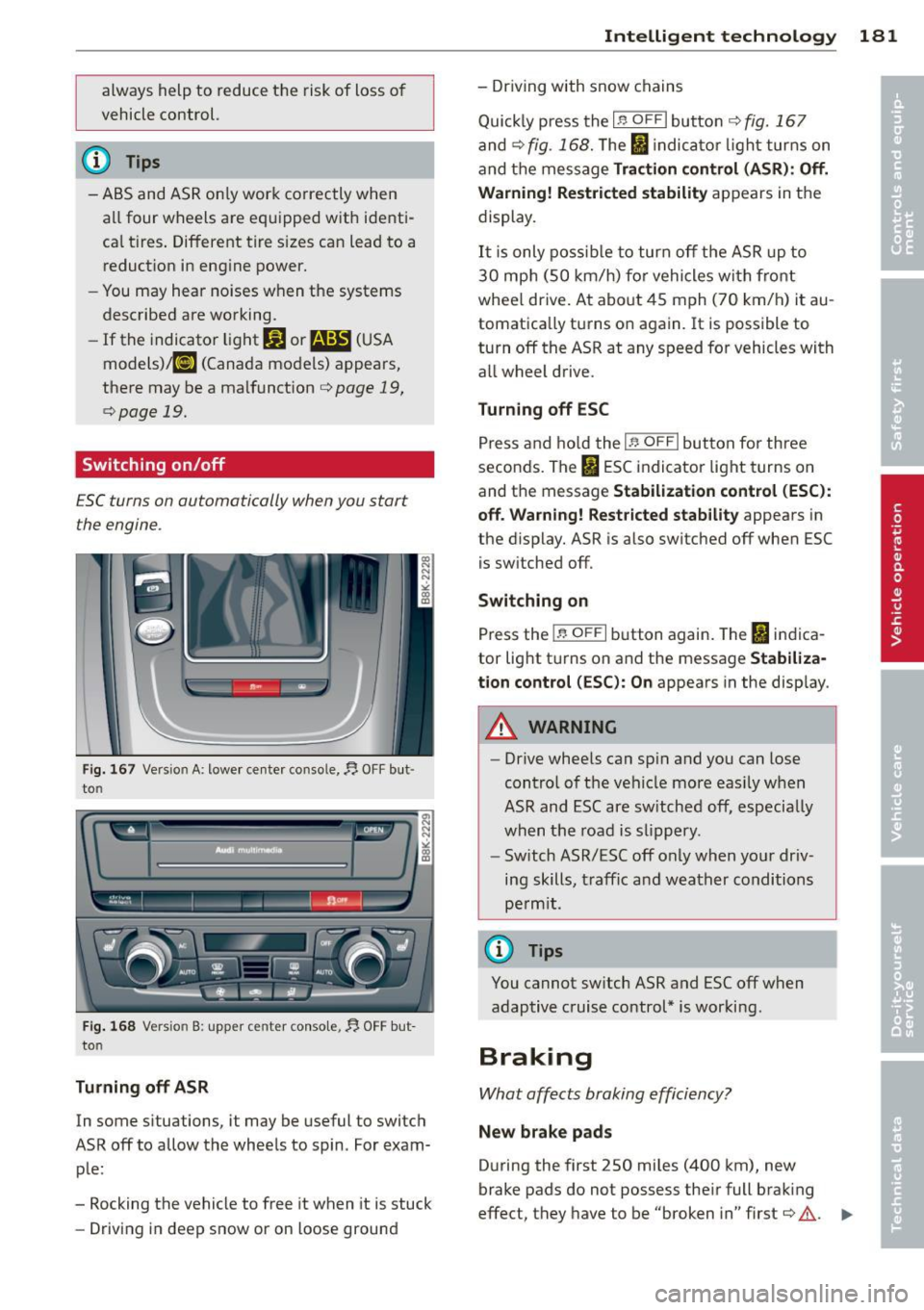
Fi g. 16 7 Version A: lowe r ce nter console,~ OFF but
to n
:.!;::.:-, I I ---- 1- n~I -
l.
~
- o~ -· \)1) 1./ .., l~c~~ ·-WJO -J •-MJTO -~, -
-----....... -... ~ ~ -~
Fi g. 16 8 Versio n 8: upper ce nter conso le,~ OFF but
to n
Tu rning off ASR
In some situations, it may be useful to switch
ASR off to allow the wheels to spin. For exam ple:
- Rocking the vehicle to free it when it is stuck
- Driving in deep snow or on loose ground
Intelligen t technolog y 181
- Driving with snow chains
Quick ly press the
lf3 O FF ! button c:> fig. 167
and c:> fig. 168. The I indica to r li ght turns on
and the message
Trac tion control (ASR ): Off.
Warning! Restri cted stabilit y
appears in the
display.
It i s only poss ib le to turn off the ASR up to
30 mp h (SO km/h) fo r vehicles with front
whee l drive. At about 45 mph (70 km/h) it au
tomatica lly turns on again. It is possible to
turn off the ASR at any speed for vehicles with
all wheel drive.
Turning off ESC
Press and hold the It, O FF I button fo r th ree
seconds. The
fl ESC indicator light t urns on
and the message
Stabil ization cont rol (ES C):
off. Wa rnin g! Restricte d stability
appears in
the d isplay. A5R is also switched off when ESC
is sw itched off.
Switching on
Press the I~ OF FI button again. The fl indica
tor lig ht t urns on and the message
Stabiliza
tion cont rol (ES C): O n
appears in the disp lay.
_.& WARNING
- Drive whee ls can sp in and you can lose
contro l of t he vehicle more eas ily w hen
ASR and ESC are sw itched off, especially
when the road is slipp ery .
- Sw itch A5R/ESC off only when your driv
ing skills, t raffic and weather conditions
pe rm it .
(D Tips
You cannot sw itch ASR and ESC off when
adaptive cruise control* is worki ng.
Braking
What affects braking efficiency?
Ne w brake p ads
During the first 250 miles (400 km), new
-
brake pads do not possess the ir full brak ing
effect, they have to be "broken in" first
c:> .&.. .,.
Page 193 of 290
Trailer towing Driving with a trailer
General information
Your Audi was designed primarily for passen
ger transportation .
If you plan to tow a tra iler, p lease remember
that the addit ional load will affect durab ility,
economy and performance .
T railer towing not on ly places more stress on
the vehicle, it also calls for more concentra
tion from the driver.
F or this reason, a lways fo llow the operating
and driving instructions provided and use
common sense.
Technical requirements
Traile r hitch
Use a weight-carrying hitch conforming to the
gross trailer we ight. The hitch must be suita
b le for your veh icle and trailer and must be
mounted secure ly on t he veh icle's chassis at a
technically sound location . Use only a t railer
h itch w ith a removab le ball moun t. A lways
check with the tr ailer hitch man ufac tur er to
make sure that you are using the correct
hitch.
Do not use a bumper hitch.
T he hitc h must be installed in such a way that
it does not inte rfe re with the impac t-absorb
i ng b umper syst em. No modifica tions should
be made to the vehicle exhaus t and b rake sys
tems . From t ime to time, check that a ll hitch
mo unt ing bolt s remain securely fas tened.
W hen you are not tow ing a trailer, remove the
trai le r hi tch ball moun t. T h is prevents the
hi tch from causing damage sho uld your ve hi
cle be str uck from be hind
¢ &. .
Trailer brakes
If yo ur tra iler is equ ipped w it h a braking sys
tem, check to be su re that it conforms to a ll
r eg ulat io ns.
Trailer towin g 191
The trailer hyd ra ulic bra ke system must not be
direct ly connected to the vehicle's hydraulic
brake system
¢ &. .
Safety chains
Alw ays use s afety chains between your ve hicle
and t he tra ile r.
Trailer lights
Tra ile r lights m ust meet all reg ulations . Be
su re to check w ith your authorized Audi dealer
fo r c orrec t w iri ng, sw itches, and relays.
Mirrors
If you a re unable to see the traffic behind you
u sing the regula r outside m irrors, then you
must insta ll ext ended mir ro rs. It is important
t h at you
always have clea r vis io n to the rear .
.8, WARNING
- If a trailer has elec trica l br ake s plea se
no te th at t hese bra kes are not activat ed
by the fa ctory -fit ted control unit -risk of
accident!
- After removing the t railer hi tch, do no t
s to re it in yo ur vehicle . In case of sudden
brak ing, the hitch could fly fo rward and
in ju re you or yo ur passenge rs .
Operating instructions
Maximum traile r we ight
-
A trai ler for your vehicle is limited to a typical
class 1 or class 2 tra iler.
Trailer load distribution
Be sure the lo ad in the traile r is h eld secure ly
i n p lace to p reven t it from shifting fo rward,
backward or sideways.
Never allow a passenger to ride in a trailer
¢ &. in Driving instru ctions on page 19 2.
Engine cooling system
Towing a t railer ma kes t he engine wor k hard
er . It is impo rta nt that the cooling system's
perfo rman ce is up to the additional load.
Make sure tha t the coo ling sys tem h as enough
f lu id . .,..
•
•
Page 195 of 290
Trailer towing tips
Important to know
Your vehicle hand les different ly when tow ing
a trailer because o f the addit ional weight and
d iffe ren t weight distribution . Safety, perform
ance and economy w ill greatly depend on how
caref ully you load your trailer and operate
your rig.
B efore you actua lly tow your trailer, pr actice
turning, stopp ing and bac king up in an area
away from traffic. Keep practicing until you have become comp lete ly fam iliar with the way
your veh icle-trailer comb ination behaves and
responds.
Backing up is d ifficu lt a nd requires practice .
Backing up with a tra iler genera lly requires
steer ing action opposite to that when backing
up your vehicle without a trailer.
M aintain a g reater distance betwee n your ve
h icle and the one in front o f you . You will need
mo re room to stop. To compensate for the
trailer, you will need a larger than normal
turning radius .
W hen pass ing, remember that yo u cannot ac
celerate as fast as yo u normally wo uld be
cause of the added load. Make sure you have
e nough room to pass . After passing , allow
p lenty o f room fo r your tra iler before chang
in g la nes aga in .
Avoid jerky starts, sharp turns or rap id lane
changes.
(D Tips
- Do n ot tow a tra ile r during the break-in
period of you r vehicle.
- If you tow a trailer, your A udi may re
quire more frequent maintenance due to
t h e ext ra load
o page 269.
Trailer towin g 193
Parking on a slope
Do not park on a slope with a trailer . If it can
not be avoided, do so only after doing the fol lowing:
When parking:
.. App ly the foot brake.
"' Have someone p lace chocks under both the
veh icle and the tra iler wheels .
"' With chocks in place, slowly release t he
bra kes unt il t he whee l chocks absorb the
load .
.. Tur n the whee ls towa rds t he curb .
.,. App ly the parking brake.
.. Move the se lector lever to P.
When restarting after parking:
.. App ly the foot brake .
.,. Sta rt t he engine .
.. Move the se lector lever to D/S .
.. Release the pa rking brake and s low ly pull
out a nd away from the wheel chocks .
.. Stop and have someone retr ieve the wheel
chocks .
(D Tips
If you move the selector leve r of the auto
matic transmission to P befo re a pplying
the parking brake and before bloc king the
whee ls, you may have to use more force
l ater to move the l ever out of the P posi
tion .
•
•
Page 204 of 290
202 Cleaning and protection
Aluminum trim
Use only neutral-pH products to remove spots
and depos its from alum inum s urfaces.
Chrome care products and alkaline cleaners
will attack aluminum surfaces and can dam
age them over time.
A WARNING
Always read and heed all WARNINGS and other information
9 page 194.
Fabrics and fabric coverings
Fabrics and fabric coverings (e.g. seats, door
trim panels, etc .) should be cleaned at regular
intervals with a vacuum cleaner . This removes
surface dirt particles which could become em
bedded in the fabric through use. Steam
cleane rs shou ld not be used, because the
steam tends to push the dirt deeper into the
fabric and lock it there.
Normal cleaning
Generally, we recommend using a soft sponge
or a l int-free m icrofiber cloth to the clean fab
ric. Brushes should only be used for carpets
and floor mats, since other fabric surfaces
could be harmed by brushes.
Normal surface sta ins can be cleaned using a
commercially available foam cleaner. Spread
the foam on the surface of the fabric with a
soft sponge and work it in gently. Do not satu
rate the fabric . Then pat the foam dry using
absorbent, dry cloths (e.g . microfiber cloth)
and vacuum it after it has dried completely.
Cleaning stains
Stains caused by beverages (e.g. coffee, fruit
juice, etc .) can be treated with a mild deter
gent solut ion . App ly the detergent so lution
with a sponge. In the case of stubborn stains,
a detergent paste can be applied directly to
the stain and worked into the fabric. After
wards, use copious amounts of clean water to remove the remaining detergent . Apply the
water with a damp cloth or sponge and pat
the fabric dry with an absorbent, dry cloth. Stains
from choco late or makeup should have
detergent paste rubbed into them. After
wards, remove the soap with water (damp
sponge).
Alcohol can be used to treat stains from
grease, oil, lipstick or a ballpoint pen. Melted
grease or dye must be patted off using ab
sorbent material. It may be necessary to re
treat the areas with detergent paste and wa
ter .
In the case of general soiling of the uphols
tery and cover material, we recommend hir ing
a specialist that has the equipment to clean
the seat covers and other fabric surfaces by
shampooing a nd spray extraction.
A WARNING ,..__
Always read and heed all WARNINGS and
the information
9page 194.
(j) Tips
Open Velcro fasteners on your clothing can
damage the seat cover. Please make sure
that Velcro fasteners are closed .
Plastic parts and instrument panel
Always use a clean cloth moistened in clear
water to clean these areas. For persistent dirt
use an Audi approved
solvent-free plastic
clea ner/protectant.
A WARNING
-Solvents can change the properties of
some p lastics and make it harder for the
a ir bag to deploy.
-
-Never clean the instrument panel or the
surface of airbag modules w ith cleaning
products that conta in solvents.
- Products containing solvents will make the surface of this part porous.
- Serious injuries can resu lt if plastic parts
come loose when the airbag is deployed.
- Always read and heed all WARNINGS and
other information
9 page 194.
Page 206 of 290
204 Cleaning and protec tio n
Cleaning and caring for leather
upholstery and trim
Appl ies to vehicles: with natural leather
Natural leather requires special care and at
tention.
Norm al cleaning
"' Clean soiled areas w ith a slightly mo istened
cotton or woolen cloth.
M ore stub born d irt
"' More stubborn dirt can be removed using a
cloth saturated with a mild soap so lution (2
tablespoons mi ld liquid soap).
"' Never allow the soap solution to saturate
the leather, and make certain that no water
soaks into the seams .
• Wipe off the soap solut ion with a soft, dry
cloth .
Clean ing s pots
"' Remove fresh wa te r-b ase d spots (such as
coffee, tea, ju ices, blood) w ith an absorbent
cloth or paper towel.
"' Remove fresh
grea se or oil-b ase d spot s
(such as b utter, m ayonnaise , chocolate) with
an absorbent cloth or paper towe l, or use
the cleaner from the leather care kit if the
spot has not yet penetrated into the surface
of the leather.
"' Use an oil/grease dissolving spray, if
oil /
gre ase spot s ha ve drie d on.
• Remove spec ific kinds of spots (ballpoint
pen, felt marker, fingernail polish, water
based paint, shoe polish, etc.) with a spot
remove r specifically formulated for leather .
Leather care
"' Every half year use an approved leather care
product (available from your authorized
Audi dealer) to care for the leather .
• Apply the product
very sparingly.
• Wipe it off wi th a damp cloth .
If you have any questions about cleaning and
car ing for the leathe r in your vehicle, it is best
to contact your author ized Audi dealer, who
will be glad to he lp you and te ll yo u about ou r
fu ll range of leather care products, s uch as: -
Leather cleaning and care kit
- Creams to care for colored leather
- Spot
removers for ballpoint pens, shoe pol-
ish, etc.
- Oi l/grease d issolving spray
- New and upcom ing products .
_&. WARNING
-Always read and heed all WARNINGS and
other information
~ page 194.
(D Note
- Never use chemical so lvents (e.g. lighter
fluid, turpentine), waxes, shoe polish or sim ilar products on the leather surfaces
in your Audi .
I
-To avoid damage, have stubborn sta ins
removed by a comme rcial clean ing spe
cialist.
Cleaning Alcantara ® (synthetic suede)
Applies to vehicles: with Alcantara® upholstery
Removing dust and dirt
• Moisten a cloth, squeeze out excess water
and wipe down the seat surfaces.
Removing stains
"' Moisten a cloth with lukewarm water o r
w ith di luted
eth yl (rubbing ) alcohol.
"' Dab at the stain . Start at the outside and
work inwards .
"' Once the sta in is no longe r vis ible, use a
soft dry cloth or tissue to soak up the mois
ture .
Do no t use leather cleaning prod ucts on A l
cantara ®.
You may use a suitab le shampoo for removing
dust and d irt.
Dust and grit in the pores and seams can
scratch and damage the surface. If the car is left standing in the sun for long per iods, the
Alcanta ra ® should be protected aga inst direct
s u nl ight to prevent it from fading. S light color
variations will develop in norma l use and are
not an indication of materia l deterioration . ..,.
Page 224 of 290

222 Check ing and filling
• Read the brake fluid leve l from the brake
fluid reservoir ¢
fig. 179, ¢ fig. 175. The
brake f lu id leve l must be between the "MIN"
and "MAX" markings.
The brake fluid reservoir is located at the rear partition of the engine compartment on the
left side ¢
page 214 .
The fluid level may drop slightly after some
time due to the automatic adjustment of the brake pads . This is not cause for alarm .
I f the brake fluid level falls
considerably be
l ow the "MIN" mark, the brake wa rning/indi
cator light (U .S . mode ls:
1111 , Canadian
models :. ) will come on
¢ page 15. Do not
continue to operate the vehicle. The complete brake system should be thoroughly checked
by an authorized Audi dealer or qualified
workshop and the cause corrected . If the
brake fluid level is too low, the b rake war ning/
i ndicato r light w ill illuminate . Contact an au
thor ized Audi dealer
imm ediately .
@ Tips
The brake f lu id reservoir is located unde r
neath the cove r.
Changing brake fluid
Have the brake fluid changed by an experi
enced technician .
Brake fluid absorbs moisture from the a ir . If
the water content in the brake fluid is too
h igh, corrosion in the brake system may result
after a per iod of t ime . The bo iling po int of the
b rake fluid w ill also decrease considerably and
dec rease braking per formance.
Therefore, the brake flu id must be changed
e ver y two ye ars. A lways use new b rake fluid
which confo rms to Fede ral Motor Vehicle
S tanda rd "FMVSS 116 DO T 4".
The brake flu id reservoir can be difficult to
r each, therefo re , we recommend that yo u
have the brake fl uid changed by yo ur au tho r
i z ed
Audi dealer . Your dealer has the co rrec t tools, the
right brake flu id and t he know -how
to do this for you.
A WARNING
'-
- Brake flu id is poisonous. It must be stor-
ed only in the closed or igina l container
out of the reach of children!
- Brake failure can res ult from o ld or inap
propriate brake f lu id. Observe these pre
cautions:
- Use only brake f luid that meets SA E
spe cifi cat ion
J 17 03 and conforms to
Federa l Motor Vehi cle Standard 1 16.
Always chec k with yo ur authorized A udi
dealer to make sure yo u are using the
correct brake fluid. The cor rect type of
brake flu id is also ind icated on the
brake f lu id reservoir.
- The brake fluid must be new. Heavy use
of the brakes can cause a vapor lock if
the brake fluid is left i n the system too
long . This can se riously affect the effi
c iency of the brakes as well as your
safety . T his could result in an accident.
W Note
Brake fluid will damage the pai nt of you r
vehicle .
@ For the sake of the environment
Because of the prob lem of proper disposal
of brake fluid as well as the spec ial too ls
r equired and the necessary expertise, we
r ecommend that yo u have the brake flu id
changed by yo ur autho rized Aud i dea le r.
Battery
General information
U nder normal operat ing cond itions, the bat
te ry in your Audi does not need any ma inte
nance. With
high outside temperatu res or
long da ily drives we recommend that you have
the e lectrolyte leve l che cked by an autho riz ed
A udi dealer or qu alified workshop. The elec
tro ly t e level should also be checked e ach time
the battery is charged
¢ page 225. ...