ABS AUDI A5 CABRIOLET 2013 Owner's Manual
[x] Cancel search | Manufacturer: AUDI, Model Year: 2013, Model line: A5 CABRIOLET, Model: AUDI A5 CABRIOLET 2013Pages: 290, PDF Size: 72.35 MB
Page 225 of 290
Have the battery checked when you take your
vehicle in for service. Yo u are well advised to
replace a battery that is older than 5 years.
W ith certa in types o f airbag deployment, the
battery is disconnec ted from the vehicle elec
trica l system for safety reasons
c::> &. in Re
pair, care and disposal of the airbags on
page 154.
Di sconn ecting the battery t erminal s
Some vehicle functions (power w indow regu
l ators, for example) are lost if the battery ter
minals are disconnected . These functions have
to be re learned after the battery terminals are
connec ted again. To prevent this, the battery
should only be disconnected from the vehicle
e lectrical system when absolutely necessary
for repairs .
Vehicl es not driven for long p eriod s
If you do not drive your vehicle over a period
of several days or weeks, electrical compo
nents are gradually cu t back or switched off .
This reduces energy consumption and main
tains starting capability over a longer per iod
c::> page 185.
Some of the conven ience functions may not
operate, such as the inter ior lights or the
power seat adjustment. The conven ience
functions will be ava ilable again whe n you
turn on the ignition and sta rt the eng ine.
Winter operation
During the winter months, battery capacity
tends to decrease as temperatures drop . This
i s because more powe r is also consumed while
start ing , and the head lights, rea r window de
fogger, etc., are used more often .
Avo id unnecessary power consumption, par
ticularly in c ity t raffic or when t rave ling on ly
short d istances. Let you r authorized Audi
dea le r che ck t he capacity of the vehicle bat
t ery before w inte r sets in
c::> page 225. A well
cha rged batte ry w ill no t only p revent sta rting
p rob lems when the weathe r is cold, b ut will
a lso last longer.
Checkin g and fillin g 223
(D Tips
If your vehicle is left standing for seve ral
weeks at extremely low temperatures, the
vehicle battery shou ld be removed and
stored where it w ill not freeze. This will
prevent it from be ing damaged and having
to be replaced .
Working on the battery
Be especially careful when working on or near
the battery.
The battery is located in the l uggage compart
ment under the floor. Before you check any
th ing in the luggage compartment,
read and
h eed all WARNINGS
c::> &_ .
Always heed the safety warnings , when work
ing on the vehicle battery or the vehicle e lec
trical system to prevent injury.
The following WARNINGS are very
important when working on the battery:
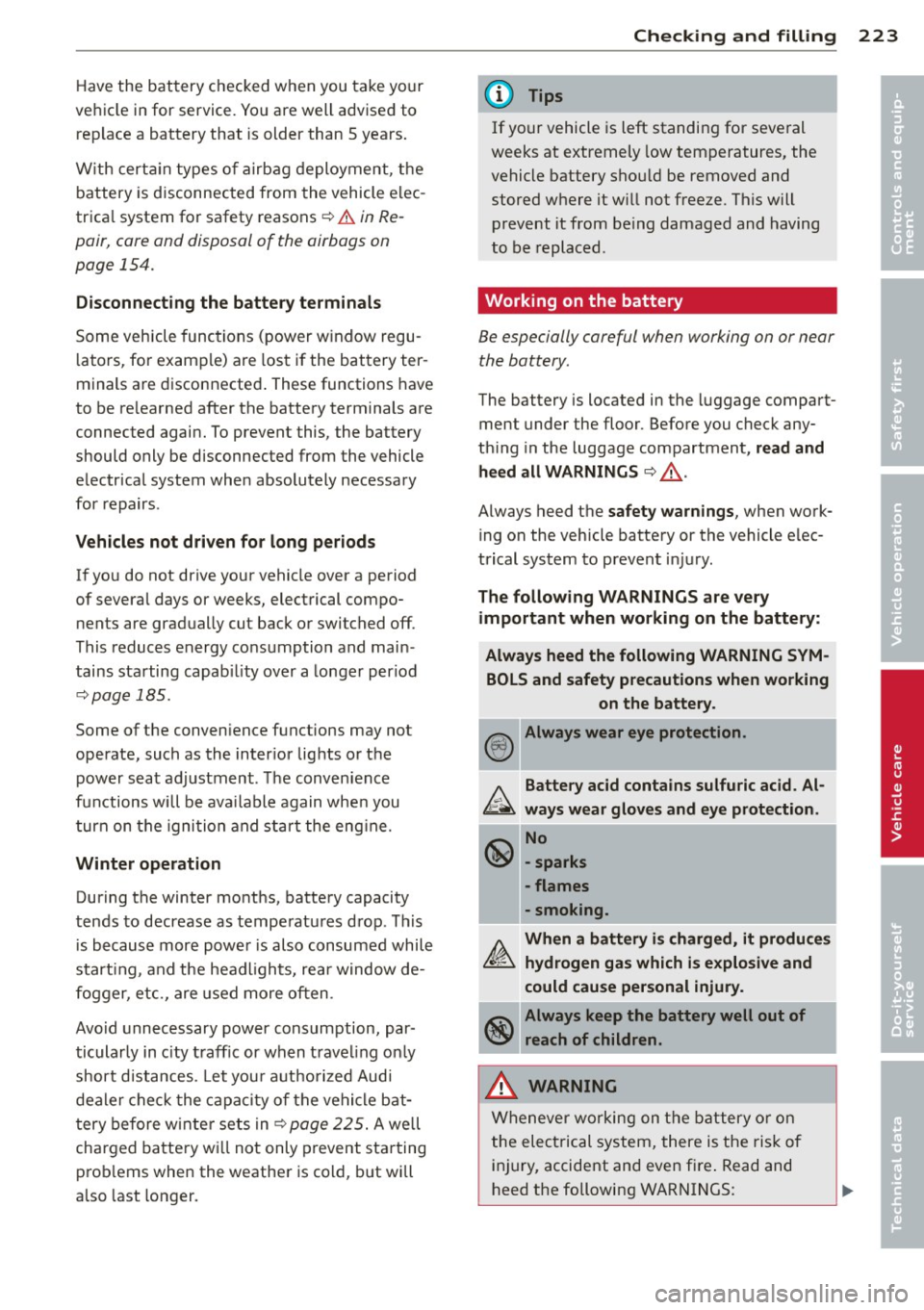
Al ways heed the follo wing WARNING SYM
BOLS and safety precautions when working on the battery.
® Always wear eye protection .
/).. Batte ry acid contains sulfuric acid . Al
~ ways w ear glov es and ey e protection .
IC No
\!!51 -sparks
-flames
- smoking.
A Wh en a battery i s charged , it produces
~ hydrogen g as which i s explosive and
could cau se per sonal injur y.
~ Always keep the battery well out of
'if!:11 reach of children .
_&. WARNING
Whenever working on t he battery o r on
the electrical system, there is the risk of
injury, accident and even fire . Read and
heed the following WARNINGS:
-
•
•
Page 248 of 290
246 Tires and wheels
wheels on your vehicle to ensure that the re
p lacement or a lternate tires and wheels allow
the TPMS to continue to function properly.
Tire pressure indicator appears
Applies to vehicles: with tire pressure monitoring system
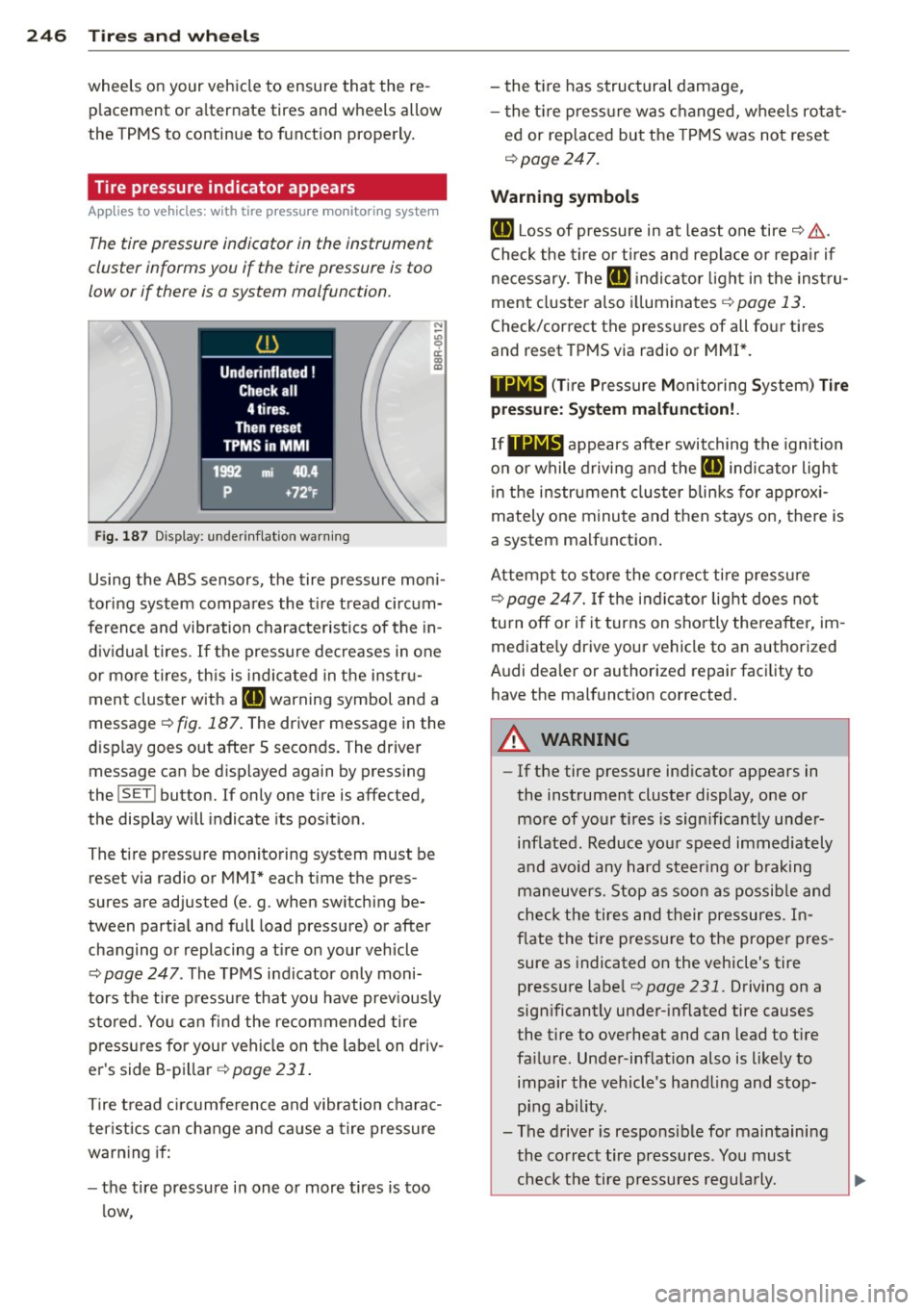
The tire pressure indicator in the instrument
cluster informs you if the tire pressure is too
low or if there is a system malfunction.
Fig. 187 Display: underinflation warning
N :;:; 9 a:
l:l
Using the ABS sensors, the tire pressure moni
tor ing system compares the tire tread circum
ference and vibration characteristics of the in
dividual tires.
If the pressure decreases in one
or mo re tires, this is indicated in the instru
ment cluster with a
[I] warning symbol and a
message
r:!> fig. 187 . The driver message in the
display goes out after S seconds. The driver
message can be displayed again by pressing
the
! SET ! button. If only one tire is affected,
the display will indicate its position.
The tire press ure monitoring system must be
reset via radio or MMI* each time the pres
sures are adjusted (e. g . when switching be
tween partial and full load pressure) or after
changing or replacing a tire on your veh icle
r:!> page 247 . The TPMS indicator only moni
tors the tire pressure that you have prev iously
stored . You can find the recommended tire
pressures for your vehicle on the label on driv
er's side 8-pillar
¢page 231.
Tire tread circumference and vibration charac
ter istics can change and cause a tire pressure
warning if:
- the tire pressure in one or more tires is too
low, - the
tire has structural damage,
- the tire pressure was changed, wheels rotat-
ed or replaced but the TPMS was not reset
c;, page 247.
Warning symbols
[I] Loss of pressure in at least one tire c;, .&,..
Check the tire or tires and replace or repa ir if
necessary. The
[I] indicator light in the instru
ment cluster also illuminates
¢page 13.
Check/correct the pressures of all four tires
and reset TPMS via radio or MMI*.
11Nl~1 (Tir e Pressure Mon itor ing System) Tire
pressure: System malfunction!.
IfllilB appears after switching the ignition
on or while driving and the
[I] indicator light
in the instrument cluster blinks for approx i
mately one minute and then stays on, there is
a system malfunction .
Attempt to store the correct tire pressu re
c;, page 247. If the indicator light does not
turn off or if it turns on shortly thereafter, im
mediate ly driv e your vehicle to an author ized
Audi dealer or authorized repair facility to
have the malfunct ion corrected.
A WARNING
-
- If the tire pressure ind icator appears in
the instrument cluster display, one or
more of your t ires is sign ificantly under
inflated . Reduce yo ur speed immediately
and avoid any hard steering or braking
maneuvers. Stop as soon as possible and
check the tires and their pressures. In
f la te the tire pressure to the prope r pres
sure as indicated on the vehicle's tire
pressure label
r:!> page 231. Driving on a
significantly under-inflated tire causes
the t ire to overheat and can lead to tire
fa ilure . Under -inflation also is likely to
impair the vehicle's handling and stop ping ability.
- The driver is responsible for maintaining
the co rrect tire pressures. You must
check the tire pressures regularly.
Page 249 of 290
-Under certain conditions (such as a spor
ty driving style, winter conditions or un
paved roads), the pressure monitor indi
cator may be delayed.
- Ask your authorized Audi dealer if run
flat tires may be used on your vehicle.
Your vehicle registration becomes invalid
if you use these tires when not permit
ted. Damage to your vehicle or accidents could also result.
(D Tips
- The tire pressure monitoring system
stops working when there is an ESC/ABS
malfunction.
- Using snow chains may result in a system
malfunction .
- The tire pressure monitoring system on
your Audi was developed using tires with the "AO" or "RO" identification on the
tire sidewall ~
page 238. We recom
mend using these tires.
Reset tire pressure monitoring system
Applies to vehicles: with tire pressure monito ring system
If the tire pressure is adjusted, wheels are ro
tated or changed, the
TPMS must be reset via
radio or
MMI*.
~ Before resetting the TPMS, the current pres
sures of all four tires must correspond to
the specified values. Adjust the tire pressure and reset the pressure in the tire pressure
monitoring system according to the load
you are carrying
~ page 231.
~ Turn on the ignition.
~ Select: the ICARI function button> Tire
pressure monitoring
> Store now . Or
~ Select: the ICARI function button > Car sys
tems*
control button > Servicing & checks >
Tire pressure monitoring > Store tire pres
sures.
(D Tips
Do not store the ti re pressure if there a re
snow chains on the tire.
Tires and wheels 24 7
•
•
Page 258 of 290
256 Fuses a nd bulb s
I
I
-No. Consumer
6 Headlight range control sys-
tern/cornering light
7 Headlight (cornering light) Control modules (electro-
mechanical parking brake,
8 shock absorber, quattro sport, trailer hitch), DCDC
converter
9 Adaptive cruise control
10 Shift gate
11 Side assist
1 2 Headlight range control,
parking system
13 Airbag
14 Rear wiper (allroad)
15 Aux
iliary fuse (instrument
panel)
1 6 Auxiliary fuse terminal 15
(engine area)
Fu se pa nel@ (brown)
2
3
4
5
6
7 Brake light sensor
Fuel pump
Clutch sensor
Left seat heating with/w ith
out seat ventilation
ESC
Horn
Front left door (window reg-
8 ulator, central locking, mir
ror, switch, lighting)
Two-door models: rear left
w indow regulator, Four-door
11 models: rear left door (win-
dow regulator, central lock-
ing, switch,
lighting)
12 Rain and light sensor
Fu se p ane l© (red)
3 Lumbar support
4 Dynamic steering
5 Interior lighting (Cabriolet)
Amps
5/7,5
7,5
5
s
5
5
5
5
15
10
40
5
25
5
-
15/30
5
15
30
30
25
30
5
10
35
5
No . Consumer
6
7
8
9
Windshield washer system,
headlight washer system
Vehicle electrical system
control module 1
Vehicle electr ical system
control module
1
Left rear window regulator
motor (Cabriolet)/sunroof
Amps
35
20
30
7,5/20
10 Vehicle e
lectr ical system
30
control module 1
11
Right rear window regulator
7,5/20 (Cabriolet)/sun shade motor
12 Anti-theft alarm warning
system 5
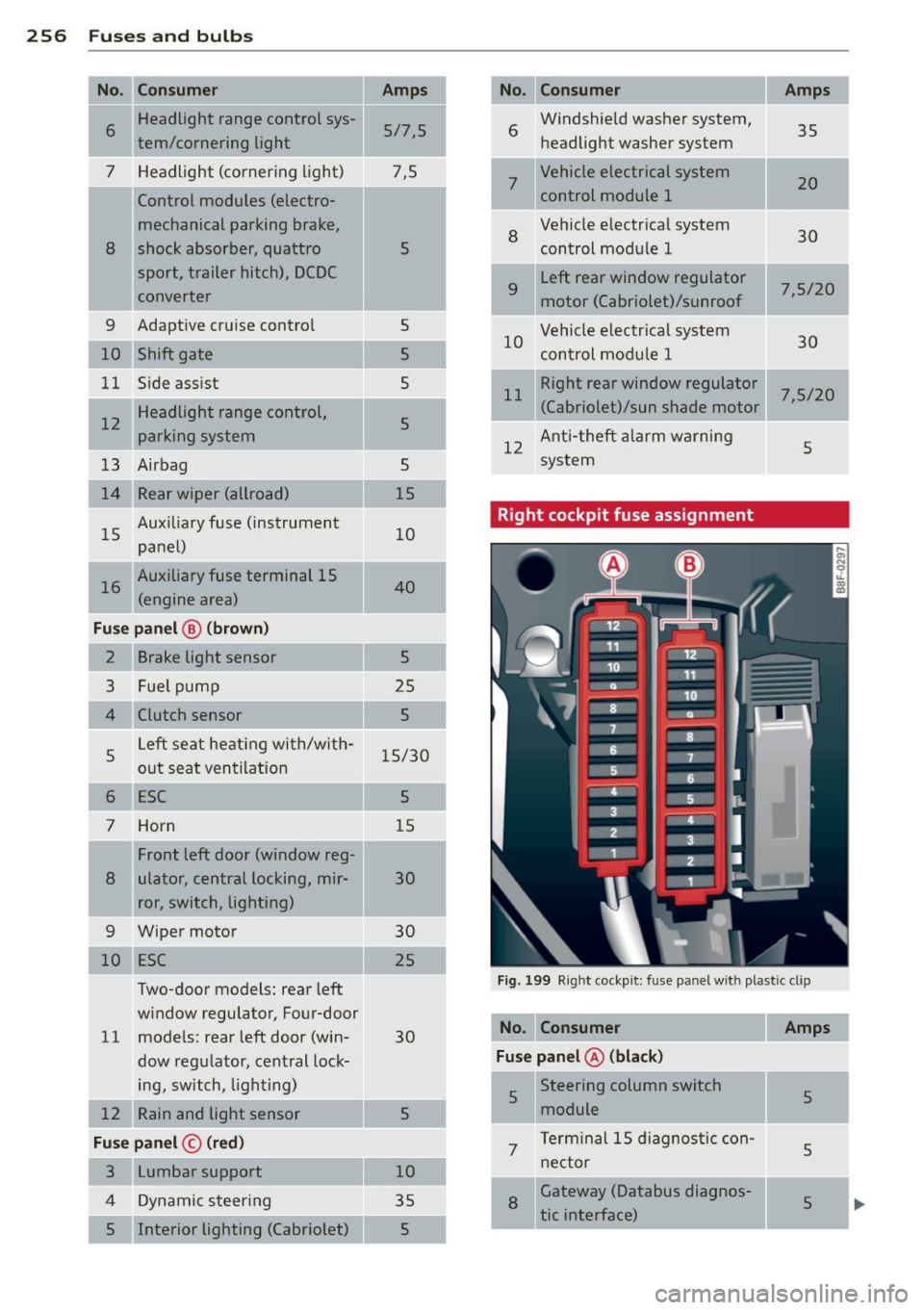
Right cockpit fuse assignment
Fig.
199 Right cockpit: fuse panel wit h plastic cl ip
No . Consume r Amps
F use panel@ (bl ac k)
5 Steering column switch
5
module
.. -.. -
7
Term inal 15 diagnos tic con-
nector
5
8 Gateway (Databus diagnos-
5
tic interface) ...
Page 287 of 290
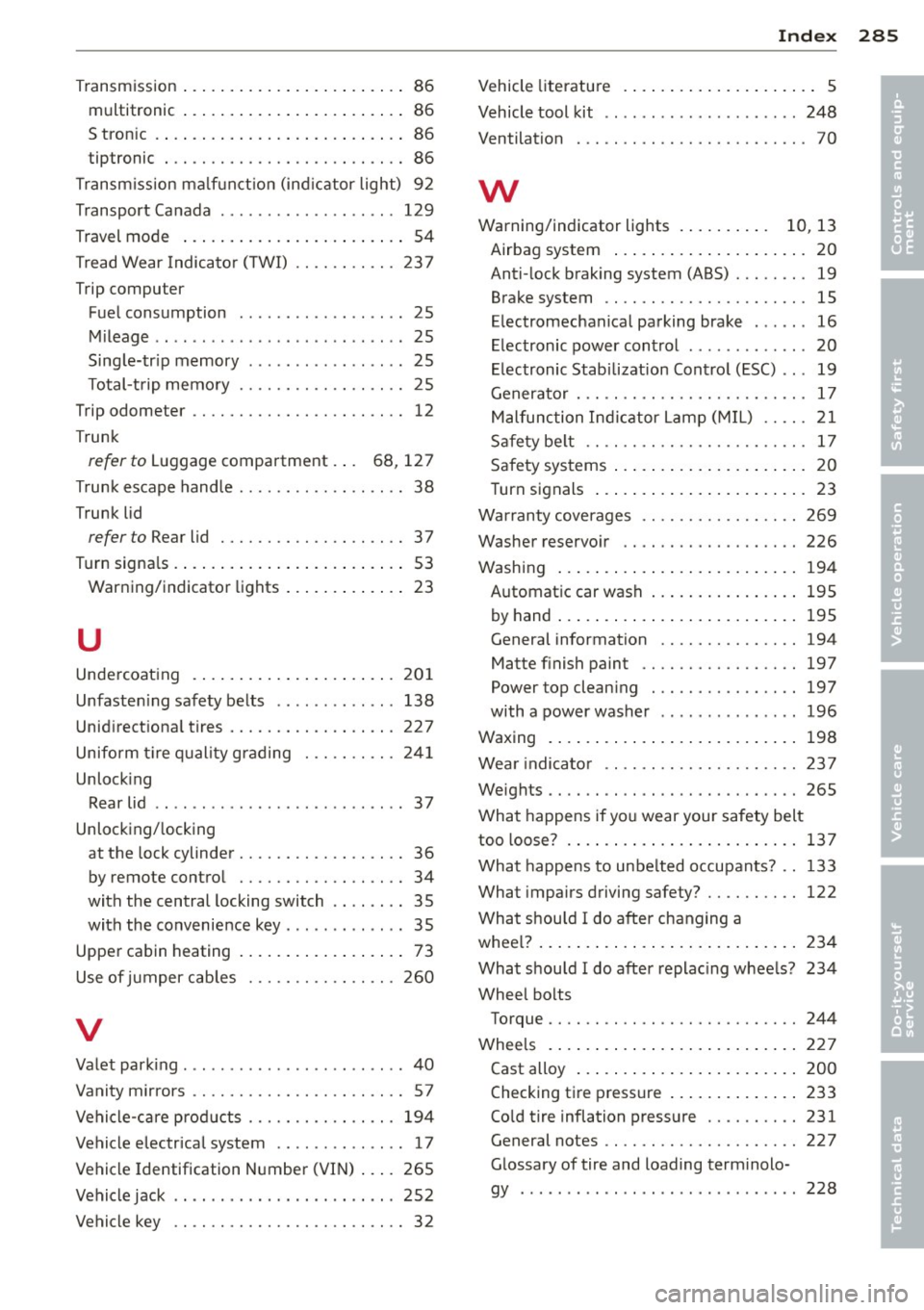
Transmission ... .... .... ... .. .. .. .... 86
multitronic . . . . . . . . . . . . . . . . . . . . . . . . 86
S tron ic . ... .... ...... ... .. .. .. .. .. 86
tiptronic . . . . . . . . . . . . . . . . . . . . . . . . . . 86
Transm iss ion ma lf u nct ion (ind icator light) 92
Transport Canada . . . . . . . . . . . . . . . . . . . 129
Travel mode . . . . . . . . . . . . . . . . . . . . . . . . 54
T read Wear Indica to r (TWI) .. .. .. .. .. . 237
Trip computer Fue l consumption . . . . . . . . . . . . . . . . . . 25
M ileage . ... ... .. .. ...... .. .. .. .. .. 25
Sing le-tr ip memory .......... .... ... 25
Total-t rip memo ry . . . . . . . . . . . . . . . . . . 25
Trip odometer ............. .... .. .... 12
Trunk
refer to L u ggage compartment. . . 68, 127
T runk escape hand le . . . . . . . . . . . . . . . . . . 38
Trunk lid
refer to Rear lid .......... .. .. .. .. .. 37
Turn signa ls . ... .... .... ... .. .. .. .... 53
Warning/indicator lights ... .. .. .. .. .. 23
u
Undercoat ing . .... ..... ... .. .. .. ... 201
Unfasten ing safety belts .... .. .. .. .. . 138
Unid irect iona l tires ......... .. .. .. .. . 227
Uniform t ire q uality grading . .. .. .. .. . 24 1
Unlock ing
Rear lid ...... ................ .... . 37
Unlocking/ locking
at the lock cylinder ........ .. .. .. .. .. 36
by remote contro l . . . . . . . . . . . . . . . . . . 34
with the central locking switch .. .. .. .. 35
with the convenience key ........ .... . 35
Upper cabin heating . . . . . . . . . . . . . . . . . . 73
Use of jumper cab les ....... .. .. .. .. . 260
V
Valet park ing ............... ... ... ... 40
Vanity mirrors ............. .... .. .. .. 57
Ve hicle-c are prod ucts ....... .. .. .. .. . 194
Vehicle e lectrical system . . . . . . . . . . . . . . 17
Vehicle Identification Number (VIN) ... . 26 5
Vehicle jack .. .... ... ..... ..... .. ... 25 2
Vehicle key .. ............. .... .. .... 32
Inde x 285
Vehicle literatu re .... . .. .. ..... ... .. .. 5
Vehicle tool kit .. ... ................ 248
Ventilation . . . . . . . . . . . . . . . . . . . . . . . . . 70
w
Warning/indicator lights . . . . . . . . . . 10, 13
Airbag system . . . . . . . . . . . . . . . . . . . . . 20
Anti- lock braking system (ABS) ... .. .. . 19
Brake system .. .. ................. . 15
E lectromechanical parking brake . ..... 16
El ectronic power control . . . . . . . . . . . . . 20
El ectronic Stab ilization Contro l (E5C) .. . 19
Generator . . . . . . . . . . . . . . . . . . . . . . . . . 17
Malfunction Ind icator Lamp (M IL) .. .. . 21
Sa fety be lt . . . . . . . . . . . . . . . . . . . . . . . . 17
Safety systems . . . . . . . . . . . . . . . . . . . . . 20
Turn signals ....... . .. .. ..... ... .. . 23
Wa rranty coverages ............. .. .. 269
Washer reservo ir ...... ............. 226
Washing ... .. .... .. . .. .. ..... ... .. 194
Automatic car wash .. .. ..... ... .. .. 195
by hand ... .. .. .... . ... ...... ... .. 195
General information ........... .... 194
Matte finish paint ................. 197
Power top clean ing . ... ..... ... .. .. 197
with a power washer ............... 196
Waxing . ... .. .... ... .. .. ..... ... .. 198
Wea r indica to r .. .. ............... .. 237
Weights .. .. .. .. .. .. ............... 26S
Wha t happens if yo u wear your safety belt
too loose? . ....... .. . .. .. ..... ... .. 137
What happe ns to unbe lted occupants? .. 133
What impairs driving safety? ...... .. .. 122
Wha t shou ld I do after changing a
whee l? ... .. .. .... .. . .. .. ..... ... .. 234
What shou ld I do after replac ing whee ls? 234
Wheel bolts Torque ...... .. ...... ............. 244
Whee ls . ... .. .... .. . .. .. ..... ... .. 2 27
Cast alloy ....... ... .. .. ..... ... .. 200
Checking tire pressure ... .... ... .. .. 233
Co ld tire inflation pressure ...... .. .. 231
General notes .. .. ................. 227
G lossary of tire and loading term inolo-
gy .......... ... .. ............... 228
•
•