oil AUDI A5 CABRIOLET 2013 User Guide
[x] Cancel search | Manufacturer: AUDI, Model Year: 2013, Model line: A5 CABRIOLET, Model: AUDI A5 CABRIOLET 2013Pages: 290, PDF Size: 72.35 MB
Page 80 of 290
78 On the road
(D Note
If the engine has been under heavy load
for an extended period, heat builds up in
the engine compartment after the engine
is switched off -there is a risk of damaging
the engine. Allow the engine to run at idle
for about two minutes before switching it
off.
Convenience key
Starting the engine
Appl ies to vehicles: w it h co nve nience key
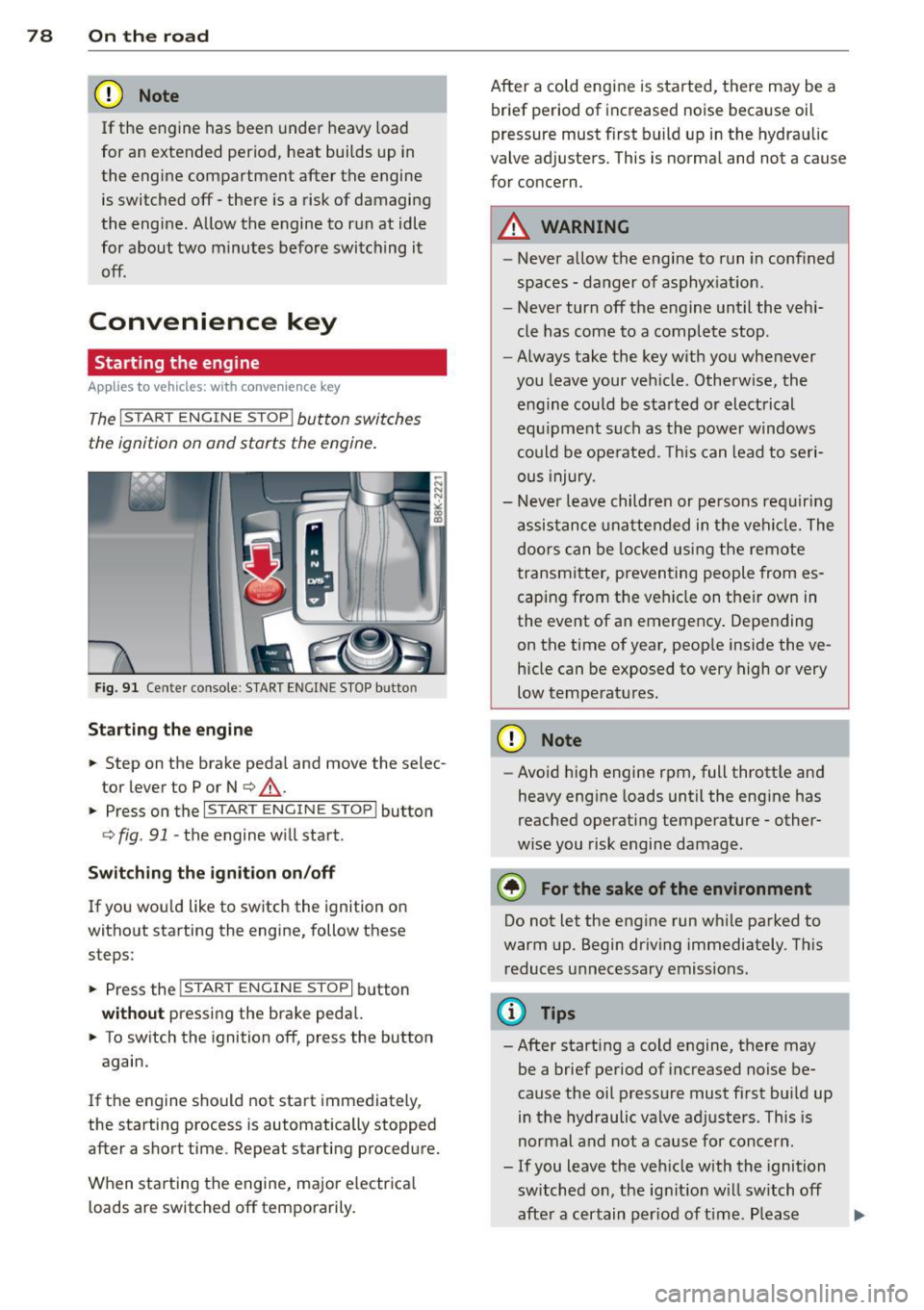
The I STAR T ENGINE S TOP! button switches
the ignition on and starts the engine .
Fig. 91 Cente r conso le: S TART ENGINE S TOP butto n
Starting the engine
.. Step on the brake peda l and move the selec
tor lever to P or N
q &, .
.. Press on the ,..., 1s==T=--= A-=R ==T:-=:E~N ~G-;-,IN ;-;--;:::: E--;: S:-::;T =-::O :;-;: P:;-,I butto n
q fig. 91 -the engine w ill start .
Switch ing the ignition on /off
If yo u wou ld like to switch the ignition on
without starting the engine, follow these
steps:
.. Press the
!S TAR T ENGINE STOP! button
without pressing the brake peda l.
.. To switch the ignition off, press the button
again.
If the engine should not start immediately,
the starting process is automatically stopped after a short time . Repeat starting procedure.
When starting the engine, major e lectr ica l
loads are switched off temporarily. After a cold engine is started, there may be a
brief period of increased noise beca use oil
pressure must first bu ild up in the hydrau lic
valve adjusters. This is normal and not a cause
for concern .
A WARNING
=
-Never allow the engine to run in confined
spaces -danger of asphyx iat ion.
- Never turn off the e ngine until the vehi
cle has come to a complete stop.
- Always take the key with you whenever
you leave your veh icle . Otherw ise, the
engine could be started or electrical
equ ipment such as th e power windows
could be ope rated. Th is can lead to seri
ous injury.
- Never leave children or persons req uiring
a ssis tance u nattended in t he vehi cle. The
doors can be locked usi ng the remote
transmitter, preventing people from es
caping from the veh icle on the ir own in
the event of an emergency . Depending
on the time of year, peop le inside the ve
hicle can be exposed to very high or very
low temperatures.
(D Note
- Avoid high engine rpm, full thrott le and
heavy eng ine loads unt il the eng ine has
reached operating temperature -other
w ise you risk engine damage.
® For the sake of the env ironment
Do not let the engine run wh ile parked to
warm up. Begin dr iving immediately. This
reduces unnecessary emissions .
¢j) Tips
- After starting a co ld engine, there may
be a brief period of increased noise be
cause the oil pressure must fi rst bu ild up
in the hydraulic valve ad justers. This is
normal and not a cause for concern .
- If you leave the veh icle with the ignition
switched on, the ignit ion w ill switch off
afte r a certain per iod of t ime . Please
1JJ1,
Page 84 of 290
82 On the road
Starting off with a trailer
To prevent rolling back unintentionally on an
incline , do the following:
.,. Keep the switch@¢ fig. 92 pulled and de
press the accelerator . The parking brake
stays applied and prevents the vehicle from rolling backward .
.,. You can release the switch @once you are
sure that you a re develop ing enough dr iv ing
f orce at the wheels by dep ress ing the accel
erator.
Depending on the weight of the r ig (veh icle
and tra iler) and the seve rity of the in cli ne , you
may roll backwards as you start . You can pre
vent rolling backwards by holding the parking brake switch @ pulled out and accelerating -
just as you would when starting on a hill with
a conventional hand brake.
Emergency braking
In the event that the conventional brake system
foils or locks.
... In an emergency, pull the switch @
¢
fig. 92 and continue to pu ll it to slow your
vehicle down with the parking brake.
.,. As soon as you release the sw itch @ or ac-
celerate, the braking process stops.
If you pu ll the switch @and ho ld it above a
speed of about 5 mph (8 km/h), the emergen
cy braking function is in iti ated. The vehicle is
braked at al l four wheels by activating the hy
d raul ic brake system . T he brake performance
is simi lar to making an eme rgency stop¢.&. .
In order not to activate the emergency brak ing by mistake, an audible warning tone (buz
zer) sounds when the switc h@ is pulled . As
soon as the switch @is released, or the accel
e rator pedal is dep ressed , emergency b ra ki ng
stops.
.&_ WARNING
Emergency braking sho uld only be used in
an emergency, when the normal foot brake
has failed or the brake pedal is obstructed . Using the par
king brake to pe rform emer
gency braking will s low your veh icle down
as if you had made a full brake application.
The laws of p hysics cannot be suspended
even with ESC and i ts associated compo
nents (ABS, ASR, EDS). In corners and
when road o r weathe r cond itions are bad,
a full brake appl ication can ca use the vehi
cle to s kid or the rear end to break away -
risking an acciden t.
Speed warning system
Overview
The speed warning system helps you to keep
your driving speed below a set speed limit.
T he speed warning system warns if the driver
e xc eeds a previously stored max imum speed .
A warning tone w ill sound as soon as the vehi
cle speed exceeds the set speed by abou t
3 mph (3 km/h) . At the same t ime, a warning
symbol appears in the display . T he symbol's
appea rance might be different in some mod
els .
The speed warn ing system has two warning
t hr esholds that funct io n in dependent ly of
each other and that have somewhat diffe rent
purposes:
Speed wa rning 1
You can use speed warning 1 to se t the maxi
mum speed while you are driving . T his setting
will remai n in effect unt il you turn off the ig ni
t io n, assuming that you have not changed or
r ese t the sett ing.
The . (USA mode ls)
I. (Canada mode ls)
speed warning symbol in the warning 1 dis
play appears when you exceed the maximum
speed .
It goes ou t when the speed falls be low
the stored maximum speed .
T he speed warn ing symbol will also go out if
the speed
exceeds the stored maximum speed
by more than about 25 mph (40 km/h) for at
least 10 seconds. The sto red max imum speed
is de leted . .,..
Page 175 of 290
Activating the convertible locking retractor
Use the convertible locking retractor to se
cure a child restraint .
Always heed the child safety seat manufactur
er's instructions when installing a child re
straint in your vehicle. To activate the conver
tible locking retractor :
"" Place the child restraint on a seat, prefera
bly on the rear seat.
.. Slowly pull the belt
all the way out.
.. Route it around or through the child re
straint belt path¢.&_ .
.. Push the child safety seat down with your
full weight to get the safety belt really tight.
.. Insert the belt tongue into the buckle for
that seating position .
.. Guide the sa fety belt back into the retractor
until the belt lies flat and snug on the child
safety seat .
.. You should hear a "clicking " noise as the
belt winds back into the inertia reel. Test the
convertible locking retractor by pulling on
the belt. You should no longer be able to
pull the belt out of the retractor. The con
v ertible locking retractor is now activated.
.. Make sure that the red release button is fac
ing away from the child restraint so that it
can be unbuckled quickly .
"" Pull on the belt to make sure the safety belt
is properly tight and fastened so that the
seat cannot move forward or sideways more
than one inch (2.5 cm).
A WARNING
Using the wrong child restraint or an im
properly installed child restraint can cause
serious personal injury or death in a crash.
- Always make sure that the safety belt re-
tractor is locked when installing a child safety seat. An unlocked safety belt re
tractor cannot hold the child safety seat in place during normal driving or in a
crash .
- Always buckle the child safety seat firmly
in place even if a child is not sitting in it.
-
Child Safety 173
A loose child safety seat can fly around
during a sudden stop or in a crash.
- Always make sure the seat backrest to
which the child restraint is installed is in
an upright position and securely latched
into place and cannot fold forward . Oth
erwise, the seatback with the child safety
seat attached to it could fly forward in
the event of an accident or other emer
gency situation.
- Always read and heed all WARNINGS
whenever using a child restrained in ave
hicle is being used¢
page 161. Special
precautions apply when installing a child
safety seat on the front passenger seat
¢ page 141, Child restraints on the front
seat -some important things to know .
Deactivating the convertible locking
retractor
T he convertible locking retractor for child re
straints will be deactivated automatically
when the bel t is wound oil the way bock in to
the retractor .
.. Press the red button on the safety belt
buckle. The belt tongue will pop out of the
buckle .
.,. Guide the safety belt all the way back into
its stowed position .
Always let the sa fety belt retract completely
into its stowed position . The safety belt can
now be used as an ordinary safety belt with
out the convertible locking retractor for child
restraints.
If the convertible locking retractor should be
activated inadvertently, the safety belt must be unfastened and guided completely back in
to its stowed position to deactivate this fea
ture.
If the convertible locking retractor is not
deactivated , the safety belt will gradually be-
come tighter and uncomfortable to wear.
11>
•
•
Page 185 of 290
-You should perform braking maneuvers
for the purpose of clean ing the brake
system only if road condit ions permit.
Other road users must not be put at r isk -
you may cause an acc ident!
- Before descending a steep grade, reduce
speed and shift transmiss ion into a lower
gear or lower d riving range . Do not ride
the brakes or hold the pedal down too
long or too often. This cou ld cause the
brakes to get hot and dimin ish braking
effi ciency.
- Do not "r ide the b rakes" by resting your
foot on the pedal when yo u do not intend
to brake. This may cause the b rakes to
overheat, premat ure wear and increased
stopp ing distance .
- Under certain climatic and operating
conditions such as passing through wa
ter, driving in heavy rain or after wash ing
the vehicle, the effect iveness of the
brakes can be reduced. In winter, ice can
accumulate on the brake pads, linings,
discs and d rums . Carefully apply brakes
for a test. Brakes will dry and ice coat ings will be cleaned off afte r a few ca re
f ul brake appl ications.
- Driv ing fo r an ex tended pe riod of time on
salt-covered ro ads w ithout using yo ur
brakes can also affect braking efficiency.
Clean off accumu lated salt coating from
brake discs and pads with a few caref ul
brake applicat ions.
- If you damage the front spoiler, or if you
install a different spoiler, be sure the air
flow to the front brakes is not obstruct
ed. Otherwise the brake system co uld
overheat reducing the effectiveness of
the ent ire brake system.
- Failure of one brake c ircuit will impair
the braking capability resulting in an in
creased stopp ing distance. Avoid driv ing
the vehicle and have it towed to the near
est author ized Audi dealer or qualified
wor kshop.
- Never let the v ehicle roll to a stop w ith
t he engine shu t off.
Int ellig ent technolog y 183
-If the brake booster is not working, for
examp le when towing your vehicle, or
because the brake booster has somehow
been damaged, the brake pedal must be
pressed conside rably harder to make up
for the lack of booster assistance .
Electro-mechanical
power assist, dynamic
steering
The electro-mechanical power assist helps
the driver when steering .
Power steer ing adapts electronically based on
the vehicle speed.
Indicator lights and messages
• Steering defecti ve! Do not d rive vehicle!
If this indicator light turns on and stays on
and t his message appears, the power steer ing
may have failed .
Do
not con tinue dr iv ing . See your author ized
Audi dealer or other qualified repair facility
fo r ass istance.
f-r,ij Dynamic st eering: System fault! You can
continue driving
If the indicator light turns on and the mes
sage appears, the steering may be more diffi
cu lt to move or more sensit ive tha n usual. The
stee ring wheel may a lso be at an angle when
driv ing straight .
Drive slowly to your a uthorized Audi dea ler or
qualified workshop to have the ma lfunction
correc ted .
fifl Dynamic steer ing: in itializing
If this drive r message appea rs and the indica
tor light is flash ing on the instrument panel,
dynamic steer ing * is being rein itia lized. Once
you start the engine after th is is finished, the
steering wheel will be easy to move. Re- init i
al ization might be necessa ry if the steering
wheel was moved ha rd to the left a nd right
wh ile the vehicle was not moving. The display
goes ou t as soon as initialization is comp lete. .,.
•
•
Page 190 of 290
188 Driving and en vironm ent
8_ WARNING
After driving through water, mud, slush,
etc ., the brakes may be slow to take effect
because of wet brake rotors and pads. Dry
the brakes first by braking carefully to re
store the full braking effect.
CD Note
Vehicle components such as the engine,
transmiss ion, suspension or electrical sys
tem can be severely damaged by driving
through wate r.
@ Tips
- Check the depth of the water before dr iv
i ng through it.
- Do not stop the veh icle, dr ive in reverse
or switc h the engine off when driving
t hr ough water.
- Keep in mind that oncoming vehicles
may c reate waves that raise the water
l evel and make it too deep fo r you r vehi
cle to dr ive through safely.
-
- Avoid dr iving thro ugh salt water because
i t can ca use corrosion.
Catalytic converter
It is very important that your emission con
trol system (catalytic converter) is function
ing properly to ensure that your vehicle is run
ning in on environmentally sound manner.
,,. Always use lead-free gasoli ne¢ page 207,
Fuel supply .
,,. Never run the tank down a ll the way to
empty.
,,. Never put too much motor oil in your en-
gine ¢
page 217, "t':::r. Adding engine oil.
,,. Never t ry to push- o r tow-start your veh icle.
The catalytic converter is an effic ient "clean
up" device built into the exhaust system of
the vehicle. The catalytic converter burns
many of the polluta nts in the exhaust gas be
fore they are released into the atmosphe re. The exclusive
use of unleaded f uel is critica lly
important for the life of the catalytic convert
er and proper funct ion ing of the eng ine .
A WARNING
= -
-Do not park or operate the vehicle in
areas where the hot exhaust system may
come in co ntact with dry grass, brush,
fuel spill or other material wh ich can
cause a fire .
- Do not app ly additional undercoating or
r u stp roofing on or nea r the exhaust
manifold, exhaust pipes, cataly tic con
ver ter or heat shields. Dur ing driv ing, the
substance used for under coa ting co uld
overhea t and cause a fire.
CD Note
- Be aware that just o ne tank filling with
leaded fu el w ill already ser io usly de
gr ad e the per form ance o f the catalytic
c onverte r.
- Do not ex ceed t he corre ct engine oil level
r:;!) page 217.
- Do not drive until the fuel tank be co m es
completely emp ty. The engine co uld mis
fire . Unburned fuel could also get in to
the exhaust system and this co uld cause
the cata lytic converter to overheat .
- Do not turn off the igni tion whi le the ve
hicle is mov ing.
- Do not contin ue to ope rate your veh icle
unde r these conditions, as otherwise fuel
can reach the catalyt ic converte r. T his
co uld resu lt in overheating of the con
verter, requir ing its replacement.
- To assure efficient operation of the Emis
sion Control System:
- H ave you r vehicle maintained p rope rly
and in accordance w ith the se rvi ce rec
ommen dat ions in yo ur Warranty &
M ain tenance boo klet.
- L ack of prope r maintenan ce as we ll as
i mprope r use of t he ve hicl e wi ll impair
the func tion of the em ission cont ro l
system and could lea d to damage .
Ill>
Page 192 of 290
190 Driving and en vironm ent
(0 Note
Do not leave engine idling unattended af
ter starting . If warning lights should come
on to indicate improper operation, they
would go unheeded. Extended idling also
produces heat, which could result in
over
heating or other damage to the vehicle or
other property.
Regular maintenance
A badly tuned engine unnecessarily wastes a lot of fuel .
.,. Have your vehicle serv iced at regular inter-
vals.
By having your vehicle regularly serviced by an
author ized Audi dealer he lps to ensure that it
runs properly and economically. The condition
of your vehicle not only affects its safety and
ab il ity to hold its value, it also affects
fu el
con sump tion .
C heck your oil each time you fill your tank.
The amount of oil used is related to engine
l oad and speed.
I t is normal for the oil consumption o f a new
engine to reach its lowest val ue after a certain
mileage has been driven.
You mus t drive yo ur vehicle abo ut 3,000 miles
(5,000 kilometers) be fo re yo u can properly
assess oi l consumption.
This a lso applies to fuel consumption and en
g ine output.
(]) Note
-Have yo ur vehicle maintai ned properly
and in accordance with the service re c
ommendations in your War ran ty
& Mai n
tenance bookle t. Lack of proper mainte
nance as well as imp roper use of the
ve
hicle will impair the function of the
emission control system and could lead
to damage. -
Do not alter or
remove any component of
the Emission Control System unless ap
proved by the manufacturer .
- Do not alter or
remove any device, such
as heat shie lds, switches, ignition w ires,
valves, which are designed to protect
your vehicle's Emission Control System and other important vehicle compo
nents.
Fewer short trips
Fuel consumption will always be relatively
high on short trips .
.,. Try to avoid driv ing short distances w ith a
cold engine.
The engine and cata lytic converter have to
reach their opt imal
oper ating temperature to
reduce fuel consumpt ion and nox ious em is
s ions effectively.
Just after starting, a co ld engine in a mid-size
car on ly achieves a fuel economy of 6-8 m iles
per gallon (30-40 l/100 km). After about a
half a mile, fuel economy climbs to 12 mpg
(20 l/100 km) . After about
2 .5 miles (4 km),
the engine is at its prope r operating tempera
tu re and fuel economy has reached a normal
level. So you can see that yo u should avo id
short trips whenever poss ible.
T he
outside temperatur e is also cr it ical in t his
regard. Your car consumes more fue l in the
winter tha n in the s umme r.
Page 197 of 290
Automatic car wash
The vehicle can be washed in almost any
modern automatic car wash .
The vehicle paint is so durable that the vehicle
can normally be washed without problems in
an automatic car wash. However, the effect on
the paint depends to a large extent on the de
sig n of the fac ility, the filtering of the wash
water, the type of wash and care mater ial , etc.
If the paint has a dull appearance afte r go ing
through the car wash or is scratched, bring
this to the attention of the operator immedi
ately. If necessary, use a different car wash.
The power top does not require special pre
cautions be fore passing through a car wash.
Howe ver, the c ar mu st not be tre ated with
hot w ax after th e was h cy cle !
The wax could
adversely affect the power top and
even dam
age the fabric
over a period of time.
The power top does not have to be washed
ev
ery time you use a car wash. The power top
can be spared if the car wash facility is equip
ped with manually adjustable roof brushes or
rollers .
Before going through a car wash, be sure to
take the usual precaut ions such as clos ing the
windows . Remove antenna if applicable .
If yo u have installed additional accessories on
the vehicle -such as spoilers, etc. -it is best to
ask the car wash operator if these should be
removed .
A WARNING
Always read and heed all WARNINGS and
other information
Q page 194.
(D Note
- Before washing the vehicle in an auto
matic car wash, please make sure to re
tract t he exterior m irrors to prevent
them from being damaged.
- Compare the width of your vehicle with
the width of the tunnel at the fac ility.
Cleaning and protec tion 195
Washing the vehicle by hand
A lot of water is needed when washing a vehi
cle by hand .
.,. Before you start washing, make sure you
have read and understood the WARNINGS
Q & ,
.,. First soak all dried d irt unt il it is soft, then
r inse it off.
.,. As you clean your vehicle , start w it h the
roof and work your way down to the bottom,
using a sponge, a sponge g love or a clean
brush.
.,. Rinse the sponge or the sponge g love often,
flushing it clean each time.
.,. Use specia l car shampoo only for
very per
sistent d irt .
.,. Rinse the car thoroughly w ith water .
.,. Use a chamo is leather to gently w ipe the ex-
ter ior d ry.
Use a separate sponge for cleaning the
wheels, door sills and other regions exposed
to road dirt . In this way, you will not scratch
the pa int with coarse particles imbedded in
the sponge the next time you wash the ca r.
A WARNING ~ -
- Wash your vehicle only when the ignition
is switched off to red uce the risk of a
crash.
-A lways read and heed a ll WARNINGS and
other information
Q page 194.
{(D Note
-Never try to remove dirt, mud or dust if
the surface of the veh icle is dry. Never
use a dry cloth or sponge, since this
cou ld scratch your vehicle's paint or win
dows.
- Never wash your car in bright s unlight .
Drops of water act as magnifying lenses
and may damage yo ur paint .
- When you wash your car in the winter: if
you rinse yo ur vehicle with a hose, be
careful not to aim the stream of water
directly at locks, or at door or hatch
openings -they can freeze shut . •
•
Page 198 of 290
196 Cleaning and protection
-Never use sponges designed to remove
insects, or any kitchen scouring sponges
or similar products. They can damage
your paint finish .
- Never use a dry cloth or sponge to clean
the headlights. Only use wet cloths or
sponges to prevent scratches .
It is best
to use soapy water.
- You should remove debris (such as in
sects) from the headlight lenses on a
regular basis, for example when refuel
ing your vehicle. Never use a dry cloth or
sponge to clean the headlights . Only use
wet cloths or sponges to prevent
scratches.
It is best to use soapy water.
@ For the sake of the environment
Only wash the vehicle in facilities specially
designed for that purpose. This will reduce
the risk of dirty water contaminated with
oil from entering the sewer system. In
some areas, washing vehicles outside of
these facilities is prohibited.
Washing your vehicle with a power
washer
Cleaning the exterior of your car with a high
pressure power washer is safe as long as you
observe a few simple rules.
.. Before using the power washer, make sure
you have read and understood the WARN
INGS¢
A in General information on
page 194 .
• Always follow the operating instructions for
the power washer .
• Make sure that the jet on the spray hose
produces a "fan shaped spray".
• Do
not hold the spray nozzle too close to
soft materials.
Never use a power washer to clean the power
top itself.
Keep a distance from soft materials such as
rubber hoses or insulating material as well as
sensors and camera lenses. When cleaning the vehicle with a power wash
er
always follow the operating instructions.
This applies particularly to the operating pres
sure and the spraying distance. Do not point
the spr ay directly at the seals around the side
windows, around the doors, on the rear lid or on the power top . Likewise, do not point it di
rectly at tires, rubber hoses, insulation mate
rial or sensors
¢page 198. Hold the spray
nozzle at least 1.3 ft (0 .4 m) away from the
vehicle.
Do not use a high-pressure power washer to
remove snow and ice .
Do not use a jet which sprays water in a direct
stream or one that has a rotating jet.
Water temperature should not exceed 140 °F
(60 °().
A WARNING "'--
Never wash tires with a jet that sprays wa -
ter in a direct stream . This could cause in
visible damage to the tires and weaken
them, even if the spray is from a relatively
long distance and for a short time. Dam
aged and weakened tires can fail and cause
accidents and personal injury.
(D Note
- Never use a power washer to clean the
power top itself.
- To avoid damaging your vehicle, always
make sure that there is sufficient dis
tance between the spray head and soft
materials like rubber hoses, plastic parts
and sound-deadening materials as well
as sensors and camera lenses. Never aim
the spray head at the same point for a
long time . This also applies to cleaning
headlights and painted bumpers. Re
member: the closer the nozzle is to the
surface of the material , the greater the
stress on the material.
Page 199 of 290
Caring for vehicles with matte finish
paint
Applies to vehicles: with matte finish paint
Vehicles with matte finish paint require spe
cial care due to the characteristics of the
paint.
Washing b y hand
To avo id damag ing the pa int when wash ing ,
first remove dust and large particles from
your veh icle. Insects , g rease spots and finge r
p rints a re best removed with a
s pecial cleaner
for matt e fini sh paint .
Apply the product using a microfiber cloth . To
avoid damaging the paint su rface, do not use
too muc h press ure.
R inse the vehicle thoroughly w ith water . Clean
the vehicle starting at the top and working to
ward the bottom using a
neu tral shampoo
and a soft mi cro fiber cloth . Stop freque ntly to
rinse the clot h thorough ly.
Clean the wheels and sill panels last . Use a
clea n
sp o nge on these areas.
Rinse the vehicle thoroughly aga in and let it
air dry . If there are any water spots, they can
be removed us ing a
l e ath er cloth .
Clean again with the special cleaner for matte
finish paint
i f nece ssary.
Rem oving stubb orn dirt
B ird d ropping s or tree sap
are best removed
with p lenty of water and a m icrof ib er cloth.
You sho uld r inse off
ga soline r esidue immedi
ately with plenty of water.
A WARNING
- Wash your vehicle only when the ignition
is switched off to reduce the risk of a
crash .
- Always read and heed all WARNINGS and
other information ¢page 194.
(D Note
-Do no t treat vehicle parts painted w ith
matte finish paint using polish ing mate -
Cleaning and protec tion 197
ria ls or hard wax. These p rod ucts could
cause damage to the appearance or sur
face that cannot be repaired .
- Never use protective wax . It can destroy
the matte finish effect.
- Do not place any s tickers or magnetic
signs on vehicle pa rts painted with
matte finish paint. The paint could be
damaged when the stickers or magnets
are removed.
- To prevent paint damage, do not wash
the vehicle i n direct sunlight .
- To prevent damage to the paint surface,
do not use insect remova l sponges,
rough kitchen sponges or sim ilar items.
- Yo u should
remove debris (such as in
sects) from t he headlight lenses on a
regu lar bas is, for example when refuel
ing your veh icle. Only clea n the head
lights us ing a wet cloth or sponge,
neve r
a dry one. Cleaning with soapy wate r is
recommended.
(D Tips
Fo r more informat ion on special clean ing
products desig ned fo r matte f inish paint ,
see your Aud i dea le r.
Power top care
The power top requires special care .
Keep ing your top looking great and mak ing
certain that it lasts a long time depend to a
great extent on prope r use a nd care. Remove
bird dropp ings as soon as poss ible , since the
cor ros ive chemicals in them wi ll cause the
rubber imp regna tion in you r top to swell and
poss ibly allow the fabr ic to leak.
With normal soiling, all you need to do is
cl ea r th e top wi th a soft br ush and clea r wa
te r. A lways b ru sh in the di rection of the fabric
from front to rear.
If the top is very dirty and has spotted areas
cl ean it with a brush using a conve rtible top
cl eaner . Always brush in the d irect ion of t he
f abric from front to rea r. R inse wi th p lenty of
clear water, and allow the top to air-dry .
IJI,-
•
•
Page 200 of 290
198 Cleaning and protection
Chamois are not suitable for drying the top .
Neve r use gasoline, spot remover, benzene,
pa int thinner o r so lvents to remove spots. We
recommend that you only use cleaners espe
cially formu lated for use on convertible tops,
and that you follow the produce use directions
caref ully. Authorized Audi deals can provide
deta iled information.
A WARNING
Always read and heed all WARNINGS and
the information on
¢ page 194.
@ Note
Never use a high-pressure power washer to
clean the power top.
Wind deflector
App lies to vehicles: with wind def lector
Clear the wind deflector with water or, if it is
heav ily soiled, a chemically neutral cleaning
solut ion .
A WARNING
Always read and heed a ll WARNINGS and
the information on¢
page 194.
Sensors and camera lenses
-Remove snow with a hand brush and remove
ice with a de-icing spray that does not con
tain solvents .
- Clean the sensors (adapt ive cruise control*,
parking system*) with a cleaning solution
that does not conta in solvents and a soft
cloth .
@ Note
- If you wash you r vehicle with a pressu re
washer,
- make sure there is enough distance to
sensors in the rear bumper .
- do not clean the camera lenses and the
area around them with the pressure
washer . - Never use warm or hot wate
r to remove
snow or ice from the camera lens . This
cou ld cause the lens to crack.
- Never clean the camera lens with abra
sive products.
Waxing and Polishing
W axin g
A good wax coating protects the vehicle paint
to a large extent against the environmental
factors listed under¢
page 194, Washing and
even against slight scratches.
You can use a liquid car wax to protect your
paint as soon as one week after your vehicle
has been delivered.
Even if you regularly use a
w axin g process in
automatic car washes, we recommend that
you manually apply a coat of wax to give the
paint extra protection, part icularly if water no
longer beads on the clean paint .
Protect plastic body parts with car wax in the
same way as the vehicle
body.
During warm weather dead insects tend to
collect on the front bumper and on the for
ward area of the hood . They are much easier
to remove from pa int that is waxed
often.
Polishing
Polish yo ur vehicle only if the paint has lost its
shine and the gloss cannot be brought back
with wax .
If the polish used does not conta in preserva
tive compounds, the paint must be waxed af
terwards.
A WARNING
A lways read and heed all WARNINGS and
other information ¢
page 194.
(D Note
Do not use car wax on
- matte o r anodized meta l trim
- rubber or rubber-like t rim .