steering wheel AUDI A5 CABRIOLET 2013 Owner's Manual
[x] Cancel search | Manufacturer: AUDI, Model Year: 2013, Model line: A5 CABRIOLET, Model: AUDI A5 CABRIOLET 2013Pages: 290, PDF Size: 72.35 MB
Page 182 of 290
180 Intelligent technology
ESC includes and/or works together with the
anti-lock brake system (ABS), brake assist sys
tem, anti-slip regulation (ASR) , e lectronic dif
ferential lock (EDL), dynamic steering" and
e lectronic interaxle differentia l lock* /selective
wheel torque control* . ESC is switched on all
the t ime. I n certa in s ituations whe n you need
l ess t raction, you can switch off ASR by p ress
i ng the bu tto n
[ru ¢ fig. 167 or ¢ fig. 168. Be
sure to sw itch ASR on ag ain when you no lon
ger need less trac tion.
Anti -lock braking system (ABS)
ABS prevents t he wheels from locking up
when braking. The veh icle can still be st eered
even d uring ha rd b rak ing . Apply steady p res
sure to the br ake pedal. Do no t pu mp the ped
a l. A puls ing in t he bra ke peda l ind icates that
the system is he lping yo u to b rake the vehicle .
Brake assist system
The brake assist system can decrease bra king
d ista nce. It increases braking powe r w hen the
d river p resses the brake pedal quickl y in eme r
gency situa tions . You mus t press and ho ld the
brake peda l until the situation is over. In
ve hicles with adaptive cruise contro l", the
brake assist system is more sensit ive if the
d ista nce detected to t he vehicle a head is too
smal l.
Anti-slip regulation (ASR)
ASR reduces engi ne power when the drive
wheels begin to spin and adapts the fo rce to
the road condit ions. This makes it easier to
start, accelerate and drive up hills.
Electronic diffe rential lock (EDL )
The EDL brakes wheels that are spinning and
tra nsfers t he d rive powe r to the other d rive
wheel or whee ls if the vehicle is equipped with
all-wheel drive*. This function is available up
to about 60 mph (100 km/h).
In extreme cases, EDL a utomatica lly switches
off to help keep the bra ke on the braked whee l
from overheating. EDL will switch on aga in au
tomatically when conditions have returned to
normal.
Dynamic steering*
On vehicles wi th dynam ic s teering *, ESC he lps
sta bilize the steer ing in crit ica l sit uat ions.
Electronic interaxle differential lock*/
selective wheel torque control*
T he ele ctroni c in te raxle di fferentia l lock ( fron t
whee l drive) o r th e se lective whee l torque
control (all -whee l drive) operates when driv
ing t hro ugh cu rves. The front wheel on the in
s ide of the c urve or both whee ls on the inside
of the curve are braked selectively as needed .
Th is mi nimizes sliding in the front wheels and
allows for more precise d rivi ng through
cu rves . The a ppl icable syste m may not acti
vate when dr iv ing in wet o r snowy cond itions.
_&. WARNING
- E SC, A BS, ASR, ED L d ynam ic steering *
a nd the elect roni c in ter ax le d ifferenti al
loc k* /se lective whee l torque control *
cannot ove rcome the laws of physics .
This is especia lly important on slippery
or wet r oads. If the systems beg in acting
to stabilize your veh icle, yo u should im
mediately change you r speed to match
the road and t raff ic conditions. Do not
let the increased safety prov ided by
t hese systems temp t you to ta ke r is ks.
Doing so will increase the risk of a lo ss of
veh icle cont ro l, col lision an d ser io us per
sonal injur ies.
- Always adapt your speed to ro ad, traff ic
an d wea ther conditions . The risk of los
ing contro l of t he vehicle increases when
driving too fast, es pec ially through
curves and on slippery or wet roads, and
when dr iv ing too close to vehicles up
a head. ESC, ABS, the brake ass ist sys
t e m, ASR, EDL dynam ic s teer ing* and the
elec tronic inte raxle differe ntia l lock*/se
lective whee l to rque contr ol* cannot p re
vent co lli sion s.
- Always accelerate wi th special care on
eve n smooth s urfaces su ch as those that
'
ar e we t or covered w ith i ce and snow.
T he drive whee ls can spin even w ith
-
these assistance systems that can not ~
Page 185 of 290
-You should perform braking maneuvers
for the purpose of clean ing the brake
system only if road condit ions permit.
Other road users must not be put at r isk -
you may cause an acc ident!
- Before descending a steep grade, reduce
speed and shift transmiss ion into a lower
gear or lower d riving range . Do not ride
the brakes or hold the pedal down too
long or too often. This cou ld cause the
brakes to get hot and dimin ish braking
effi ciency.
- Do not "r ide the b rakes" by resting your
foot on the pedal when yo u do not intend
to brake. This may cause the b rakes to
overheat, premat ure wear and increased
stopp ing distance .
- Under certain climatic and operating
conditions such as passing through wa
ter, driving in heavy rain or after wash ing
the vehicle, the effect iveness of the
brakes can be reduced. In winter, ice can
accumulate on the brake pads, linings,
discs and d rums . Carefully apply brakes
for a test. Brakes will dry and ice coat ings will be cleaned off afte r a few ca re
f ul brake appl ications.
- Driv ing fo r an ex tended pe riod of time on
salt-covered ro ads w ithout using yo ur
brakes can also affect braking efficiency.
Clean off accumu lated salt coating from
brake discs and pads with a few caref ul
brake applicat ions.
- If you damage the front spoiler, or if you
install a different spoiler, be sure the air
flow to the front brakes is not obstruct
ed. Otherwise the brake system co uld
overheat reducing the effectiveness of
the ent ire brake system.
- Failure of one brake c ircuit will impair
the braking capability resulting in an in
creased stopp ing distance. Avoid driv ing
the vehicle and have it towed to the near
est author ized Audi dealer or qualified
wor kshop.
- Never let the v ehicle roll to a stop w ith
t he engine shu t off.
Int ellig ent technolog y 183
-If the brake booster is not working, for
examp le when towing your vehicle, or
because the brake booster has somehow
been damaged, the brake pedal must be
pressed conside rably harder to make up
for the lack of booster assistance .
Electro-mechanical
power assist, dynamic
steering
The electro-mechanical power assist helps
the driver when steering .
Power steer ing adapts electronically based on
the vehicle speed.
Indicator lights and messages
• Steering defecti ve! Do not d rive vehicle!
If this indicator light turns on and stays on
and t his message appears, the power steer ing
may have failed .
Do
not con tinue dr iv ing . See your author ized
Audi dealer or other qualified repair facility
fo r ass istance.
f-r,ij Dynamic st eering: System fault! You can
continue driving
If the indicator light turns on and the mes
sage appears, the steering may be more diffi
cu lt to move or more sensit ive tha n usual. The
stee ring wheel may a lso be at an angle when
driv ing straight .
Drive slowly to your a uthorized Audi dea ler or
qualified workshop to have the ma lfunction
correc ted .
fifl Dynamic steer ing: in itializing
If this drive r message appea rs and the indica
tor light is flash ing on the instrument panel,
dynamic steer ing * is being rein itia lized. Once
you start the engine after th is is finished, the
steering wheel will be easy to move. Re- init i
al ization might be necessa ry if the steering
wheel was moved ha rd to the left a nd right
wh ile the vehicle was not moving. The display
goes ou t as soon as initialization is comp lete. .,.
•
•
Page 186 of 290
184 Intelligent technology
_& WARNING
Have the dynamic steering* system mal
function repaired as soon as possible by an
authorized Audi dealer or any qualified
workshop -risk of accident!
(D Tips
- If the . or
'-r,ij indicator light only stays
on for a short time, you may continue
driving.
- The dynamic steering* stability systems
are not available in the event of a system
malfunction.
- For additional information on dynamic
steering*, refer to¢
page 107.
Driving with your
quattro®
App lies to vehicles: with all-wheel dr ive
-
With all-wheel drive, all four wheels are driv
en.
General information
With all-wheel drive, power is distributed to
all four wheels. This happens automatically
depending on your driving style and the road
conditions at the time . See also
¢ page 179.
A center differential distributes the driving
power variably to the front and rear axle . It
works together with selective wheel torque control, which activates when driving through
curves
c> page 180. With the sport differen
tial*, power distribution to the rear wheels is
variable and can be adjusted with drive select
c:>page 107.
The all-wheel drive concept is designed for
high engine power . Your vehicle is exception
ally powerful and has excellent driving charac
teristics both under normal driving conditions
and on snow and ice. Always read and follow
safety precautions ¢
&.
Winter tires
When driving in the winter , your vehicle with
all-wheel drive has an advantage, even with
regular tires. In winter road conditions it may be advisable to mount winter tires (or all-sea
son tires) for
improved driveability and brak
ing: these tires must be mounted on all four
wheels. See also ¢ page 242, Winter tires.
Tire chains
Where tire chains are mandatory on certain
roads, this normally also applies to vehicles
with all-wheel drive¢
page 243, Snow
chains .
Replacing wheels/tires
Vehicles with all-wheel drive must always
have tires of the same size. Also avoid tires
with different tread depths. For details see
page
c> page 238, New tires and replacing
tires and wheels.
Off·Road driving?
Your Audi does not have enough ground clear
ance to be used as an off-road vehicle.
It is
therefore best to avoid rough tracks and un
even terrain as much as possible. Also refer to
c:> page 187.
_& WARNING
-Always adjust your driving to road and traf-
fic conditions. Do not let the extra safety
afforded by all-wheel drive tempt you into
taking extra risks .
- Although the all-wheel drive is very ef
fective, always remember that braking
capacity is limited by tire traction. You
should therefore not drive at excessive
speeds on icy or slippery road surfaces.
- On wet road surfaces, be careful not to
drive too fast because the front wheels
could begin to slide on top of the water
(aquaplaning). If this should occur, you
will have no warning from a sudden in
crease in engine speed as with a front
wheel drive vehicle. Always drive at speeds which are suited to the road con
ditions - risk of crash .
Page 230 of 290
228 Tire s and wheel s
-Never mount used tires on yo ur vehicle if
you are not sure of their "previous histo
ry." Old used tires may have been dam
aged even though the damage cannot be
seen that can lead to sudden t ire failure
and loss of vehicle control.
- If you notice unusual vibration or if the
vehicle pulls to one side when driving, al
ways stop as soon as it is safe to do so
and check the wheels and tires for dam
age.
(D Note
Please note that summer and winter tires
are designed for the cond itions that are
Glossary of tire and loading terminology
Accessory weight
means t he comb ined we ight (in excess of
those sta ndard items which may be rep laced)
of au toma tic tra nsmission, power steer ing,
power brakes, power windows, power seats,
radio, and heater, to the extent that th ese
items are availab le as factory -installed equip
ment (whether installed or not) .
Aspect ratio
means t he ratio of the he ight to the w idth of
the tire in percent . Numbers of 55 or lower in
dicate a low sidewall for improved steering re
sponse and better overall handling on dry pavement .
Bead
means the part of the ti re that is made of
steel wires, wrapped or reinforced by ply cords
and that is shaped to fit the rim.
Bead separation
means a b reakdown of the bond between
components in the bead.
Cord
means the strands forming the plies in the
tire . typ
ica l in those seasons . Audi recommends
using winter tires during the winter
months . Low temperatures signif icant ly
decrease the e lasticity of summer tires,
which affects tract ion and brak ing ability.
If summer tires are used in very co ld tem
peratures, cracks ca n form on the tread
bars, res ulting in permanent tire damage
that can cause loud driving no ise and un
balan ced t ires. Audi is not responsible for
th is type of damage .
Cold tire inflation pressure
means the tire p ressu re recommended by t he
vehicle manufacturer fo r a tire of a des igna ted
s iz e that has not bee n driven for more than a
coup le of miles (k ilometers) at low speeds in
t h e three hour period before the tire pressure
is measured or adjusted.
Curb weight
mea ns the we ight of a motor ve hicl e w ith
standard equipment including the max imum
capacity of fuel, oil, and coolant, air condi
tioning and additional weight of optiona l
equipment.
Extra load tire
me ans a t ire design to operate at higher loads
and at h igher inflation pressures than the cor
responding standard tire . Extra load tires may
be identified as "XL", "x l" , "EXTRA LOAD", or
"RF" on the sidewall.
Gross A xle Weight Rating ("GAWR ")
means the lo ad -c a rry ing c apac ity of a s ingle
axle system , measured a t the tire-ground in
terfaces.
Gross Vehicle Weight Rating ("GVWR ")
mea ns the maximum total loaded we ight of
t h e ve hicl e. .,.
Page 239 of 290
and luggag e load c apaci ty of
y our vehicle.
.,. Check the tire sidewall
(c:::> fig . 18 6) to d etermine th e
de sign ated load rating f or a
s p ecific tir e.
Tire service life
The service life of tires depends on a lot of
different things including proper installation
and balan cing , correc t tire pressure and driv
ing style.
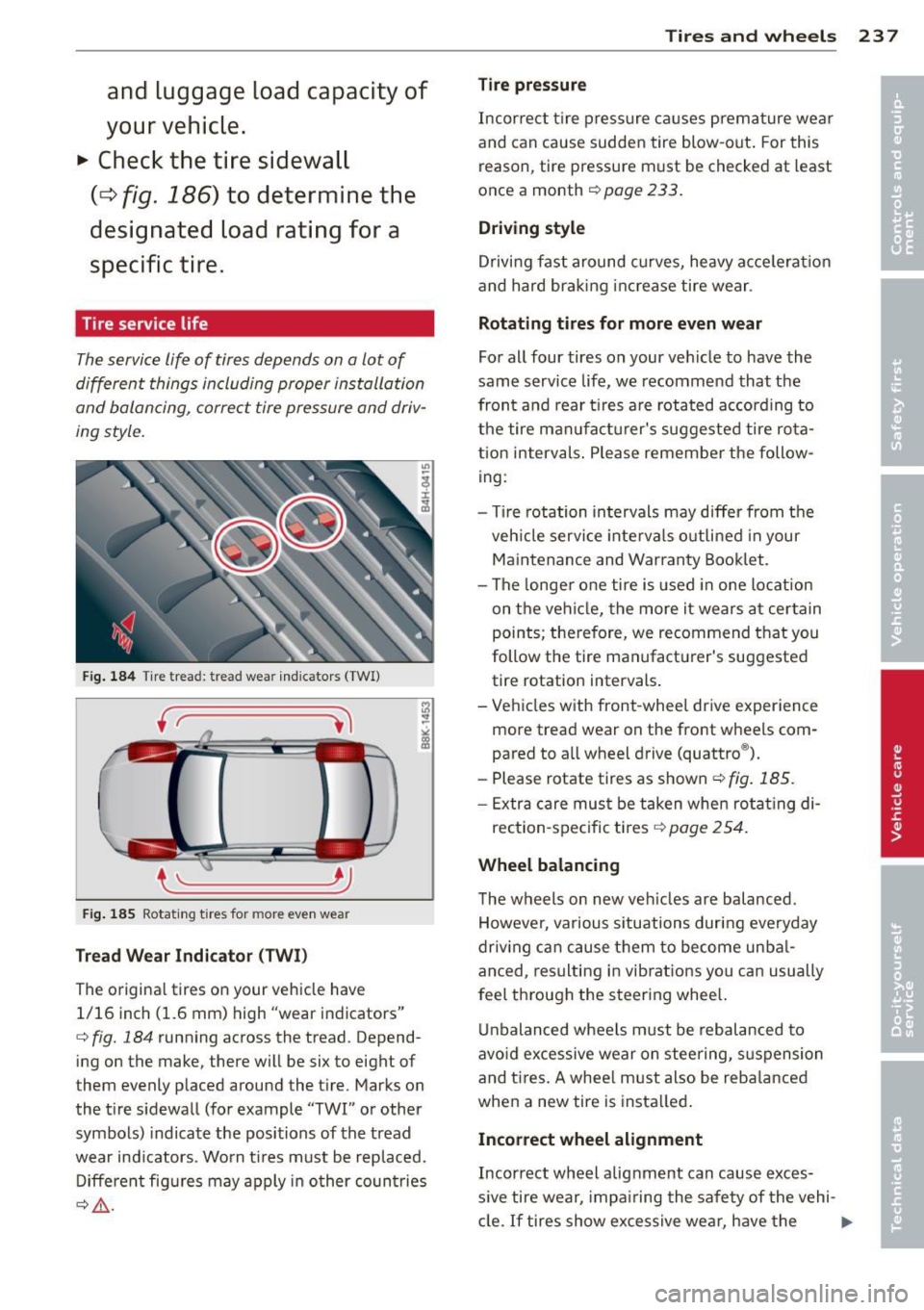
Fi g. 1 84 Tire t rea d: tread we ar ind ic a tors (TWI)
.__ __ __,, ,.)
Fig . 185 Rotat ing t ires for more eve n wea r
Tread Wear Indicator (TWI)
The origina l tires on your vehicle have
1/16 inch (1.6 mm) high "wear indicators"
<=> fig. 184 running across the tread. Depend
ing on the make, there will be six to eight of
t hem evenly p laced around the t ire. Marks on
the t ire s idewall (for example ''TWI " or other
symbols) indicate the positions of the tread
wear ind icators . Worn t ires m ust be replaced.
D ifferen t fig ures may apply in o ther co untries
¢ ,& .
Tires and wheels 23 7
Tire pressure
Incorrect tire press ure c auses prema ture wear
and can cause sudden tire blow-out . For this
reason , tire pressure must be checked at least
once a month
r:!) page 233.
Driving style
Driving fast around c urves, heavy acce le ra ti on
and har d brak ing inc rease tire wear .
Rotating tires for more even w ear
For all four tires on your vehicle to have the
same service life , we recommend that the
front and rear t ires a re rotated a ccording to
the tire man ufactur er's suggested tire ro ta
tion intervals . Please remember the follow
ing:
- Tire rotation in tervals may differ from the
veh icle servi ce inte rv al s o utli ned in your
Ma intenance and Warranty Boo klet.
- The longer one tire is used in one lo cation
on t he veh icle, the more it wears a t cer tain
points ; the re fore, we recommend that you
follow the tire man ufact urer's suggested
tire rotation intervals .
- Vehi cles w ith front-wheel dr ive experience
more tread wear on the front wheels com
pared to a ll wheel drive (quattro ®).
- Please rotate tires as shown¢
fig. 185 .
-Extra care mus t be taken when ro ta ti ng di -
rection -specific tires
q page 2 54.
Wheel balancing
T he w heels on new ve hicles are balanced .
Howeve r, various s ituations duri ng eve ryday
driv ing ca n ca use t hem to become unba l
anced, resulting in vib rat ions you ca n usually
feel through the steer ing whee l.
Un balanced wheels must be rebalanced to
avo id excessive wear on steering, s uspension
and t ires. A whee l m ust also be reba lanced
when a new tire is insta lled .
Incorrect wheel alignment
Incor rect wheel alignment can cause exc es
s ive tire wear, impa iring the safe ty of the vehi-
cle. If tires show excessive wear, have the
)I>-
Page 248 of 290
246 Tires and wheels
wheels on your vehicle to ensure that the re
p lacement or a lternate tires and wheels allow
the TPMS to continue to function properly.
Tire pressure indicator appears
Applies to vehicles: with tire pressure monitoring system
The tire pressure indicator in the instrument
cluster informs you if the tire pressure is too
low or if there is a system malfunction.
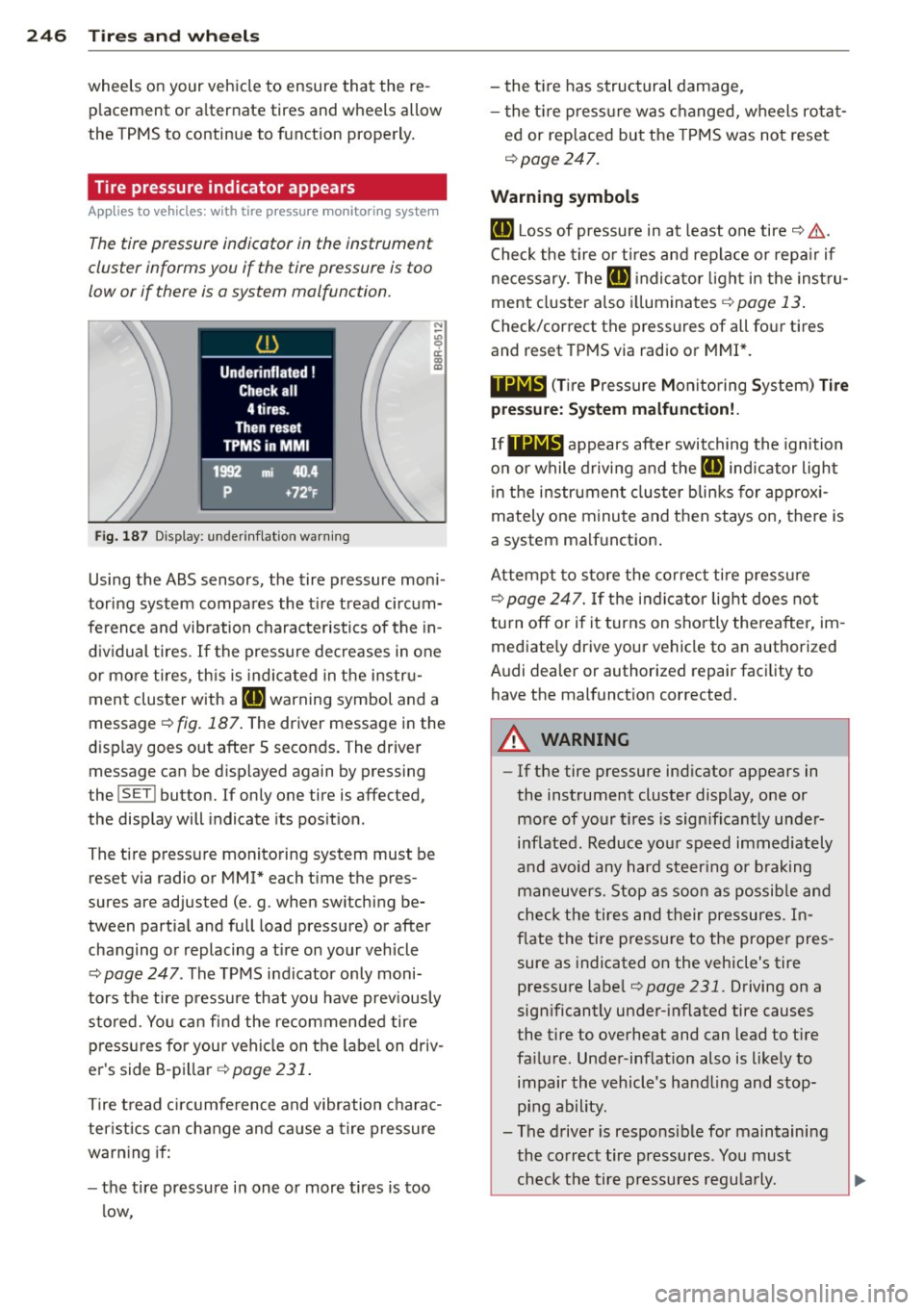
Fig. 187 Display: underinflation warning
N :;:; 9 a:
l:l
Using the ABS sensors, the tire pressure moni
tor ing system compares the tire tread circum
ference and vibration characteristics of the in
dividual tires.
If the pressure decreases in one
or mo re tires, this is indicated in the instru
ment cluster with a
[I] warning symbol and a
message
r:!> fig. 187 . The driver message in the
display goes out after S seconds. The driver
message can be displayed again by pressing
the
! SET ! button. If only one tire is affected,
the display will indicate its position.
The tire press ure monitoring system must be
reset via radio or MMI* each time the pres
sures are adjusted (e. g . when switching be
tween partial and full load pressure) or after
changing or replacing a tire on your veh icle
r:!> page 247 . The TPMS indicator only moni
tors the tire pressure that you have prev iously
stored . You can find the recommended tire
pressures for your vehicle on the label on driv
er's side 8-pillar
¢page 231.
Tire tread circumference and vibration charac
ter istics can change and cause a tire pressure
warning if:
- the tire pressure in one or more tires is too
low, - the
tire has structural damage,
- the tire pressure was changed, wheels rotat-
ed or replaced but the TPMS was not reset
c;, page 247.
Warning symbols
[I] Loss of pressure in at least one tire c;, .&,..
Check the tire or tires and replace or repa ir if
necessary. The
[I] indicator light in the instru
ment cluster also illuminates
¢page 13.
Check/correct the pressures of all four tires
and reset TPMS via radio or MMI*.
11Nl~1 (Tir e Pressure Mon itor ing System) Tire
pressure: System malfunction!.
IfllilB appears after switching the ignition
on or while driving and the
[I] indicator light
in the instrument cluster blinks for approx i
mately one minute and then stays on, there is
a system malfunction .
Attempt to store the correct tire pressu re
c;, page 247. If the indicator light does not
turn off or if it turns on shortly thereafter, im
mediate ly driv e your vehicle to an author ized
Audi dealer or authorized repair facility to
have the malfunct ion corrected.
A WARNING
-
- If the tire pressure ind icator appears in
the instrument cluster display, one or
more of your t ires is sign ificantly under
inflated . Reduce yo ur speed immediately
and avoid any hard steering or braking
maneuvers. Stop as soon as possible and
check the tires and their pressures. In
f la te the tire pressure to the prope r pres
sure as indicated on the vehicle's tire
pressure label
r:!> page 231. Driving on a
significantly under-inflated tire causes
the t ire to overheat and can lead to tire
fa ilure . Under -inflation also is likely to
impair the vehicle's handling and stop ping ability.
- The driver is responsible for maintaining
the co rrect tire pressures. You must
check the tire pressures regularly.
Page 276 of 290
274 Index
A
Accessories . . . . . . . . . . . . . . . . . . . . . . . . 2 71
Active rollover p rotection system ... .. . 130
Retract ing ro llover protection . . . . . . . . 13 1
AC (automatic climate control) ... .. .. .. 71
Adapt ive cruise control . . . . . . . . . . . . . . . . 94
C leaning sensors/camera . ... .. .... . 198
Messag es . .... .. ..... ... .. .. .... . 101
Request for dr iver intervention . . . . . . . . 99
Setting the driving program .. .. .. .. . . 99
Adapt ive dampers .......... .... .... . 107
Adapt ive light ................ ... .... 52
Adaptive Lig ht (defective) ... .. .. .... .. 22
Adding Eng ine coolant ................... .
E ng ine oil . .... .. ..... ... .. .. .... .
Windshield washer fluid ... .. .. .... .
Addit ional accessories
Addit ives 220
21
7
226
271
Eng ine oil .. ............. .. .. .. .. . 217
Ad justab le steering column . ... .. .... .. 75
Adjusting Air dist ribution (automatic climate con -
trol) . .. .. .. ............. .. .. .... .. 72
I ns trument illum inat ion . .. .. .. .. .. .. S5
Steering column .. ..... ... .. .. .... .. 75
Temperature (automatic climate control) 72
A irbag
War ning/ indicato r ligh ts ... .... .... .. 20
A irbag system . . . . . . . . . . . . . . . . . 140, 159
Advanced Airbag System ........ ... . 144
Advanced Airbag System components . 147
Care . .. .. ... ....... ........ ..... . 153
C hil dren . ............... .. .. .. .. . 162
Ch ild restr aints ........... .. .. .. .. . 163
Components (front airbags) .. .... .. . 1 47
Danger of fitting a child safety seat on
the front passenger seat . . . . . . . . . . . . 141
Disposal . .... ........... .. .. .... . 153
Front airbags . . . . . . . . . . . . . . . . 144, 145
H ow do the front airbags work? . . . . . . 149
H ow many airbags does my vehicle
have? .... ................... ... . 147
H ow the Advanced Airbag System com-
po nents work together ............. 148
I mpor tan t safety instructions on the
knee airbag system .. ... .. .. .. .... . 15 7 Important things to know ....
.... . .. 140
Indicator light ... .. ... ..... ... .. .. 151
Knee airbags ... .. ... .. ..... ... .. .. 155
Monitoring .... .. ............. .... 151
PASSENGER AIR BAG OFF light ....... 151
Repairs ......... .. .............. . 153
Safety instructions ..... ....... ... .. 153
S ide a irbags . .. .. .......... ....... 158
We ight-sensing mat ........... .. .. 162
When m ust t he system be inspected? . 151
all-wheel drive .. .. .......... ....... 184
Alloy wheels . ..... .. .... .... ... .. .. 200
All wheel d rive
Winter tires . .. .. .. ........... .. .. 242
Alternator
refer to Generator . . . . . . . . . . . . . . . . . . 17
Anti-freeze
refer to Engine coolant system ....... 219
An ti-lock brak ing system ............. 179
Warning/ind icator lights ..... ... .. .. . 19
An ti-slip regulation ................ . 179
Anti -theft alarm warning system ... .. .. . 31
Anti-theft systems El ectronic immob il iz er .......... .. .. . 37
Armrest .......... .. .............. .. 64
Ashtray . ... .... .. ... .. .. ..... .. . .. . 66
Aste risk
What does it mean when something is ma rked wit h an aster is k? . . . . . . . . . . . . . . 6
Audi braking guard
refer to b rak ing guard ............... 94
Audi drive select .. .. ................ 107
Adaptive dampers ............. .... 107
Description .. ... . ... ... .... ... .. .. 107
Dynam ic steering . ................ . 107
Setting the dr iv ing mode ........... . 108
Spo rt diffe rential .............. .... 10 7
Audi Serv ice Repair Manuals and Litera-
ture .............................. 269
AUTO Automatic climate control . . . . . . . . . . . . 72
Automat ic head lights . . . . . . . . . . . . . . . 52
A ut o Lock . . . . . . . . . . . . . . . . . . . . . . . . . . 31
Automat ic be lt retractor . ....... ... .. 136
Automatic car wash
refer to Washing ... ... ..... ... .. .. 195
Page 284 of 290
28 2 Index .:..:..:..::....::.....:..._ ___________________________ _
Physica
l principles of a frontal collision 133
Polishing .. .. ................ ... ... 198
Pollutant filter (automatic AC system) ... 70
Power seat adjustment . . . . . . . . . . . . . . . . . . . . 62
Power locking system . . . . . . . . . . . . . . . . . 31
E mergency locking ............. ..... 36
Power windows .......... .. .. .... .. 40
Rear lid .. ... ............ .. .. .. .. .. 37
Selective unlock feature ... .. .. .... . . 36
Settings ... ... .. ..... ... .. .. .... .. 36
Power steering
refer to Electro-mechanical power as-
sist . .. .. .. .. . .......... .. .. .... . 183
Power top . . . . . . . . . . . . . . . . . . . . . . . . . . 42
Care and clean ing ... ........ .. .. .. . 197
C losing .. .. ................ ... .... 44
Conven ience opening/closi ng . .. .... .. 44
E mergency operation ................ 47
E rror message . . . . . . . . . . . . . . . . . . . . . 43
General information . ... .. .. ... ... .. 42
Indicator light ... ..... ... .. .. .... .. 43
Malfunction ............. .. .. .. .. .. 43
Opening . .. .. . .......... .. .. .... ..
44
Variab le power top storage bay .. .. .... 45
W ind deflector ................ ..... 46
Power window Convenience opening/closing . .. .... .. 40
Power windows . . . . . . . . . . . . . . . . . . . . . . 39
M alfunct ions . ........... .... .... .. 40
Pregnant women Specia l cons iderations when wearing a
safety be lt .............. .. .. .... . 137
Proper occupant seating positions ..... 122
Proper safety be lt pos ition ... .. .. .. .. . 13 7
Proper seat ing pos ition
Front passenger . . . . . . . . . . . . . . . . . . . 123
Occupants ... ............ .. .. .. .. . 122
Rear passengers .......... .. .. .. .. . 124
Q
Quartz clock . . . . . . . . . . . . . . . . . . . . . . . . 12
quattro ®
refer to all-wheel drive ............. 184
Question What happens to unbe lted occupants? 133
Why safety belts? ................. 132
R
Radiator fan .... .. ... .. ..... .... . .. 221
Rain/light se nsor
Headlights .. .. .. .. ........ ...... .. 52
I n te rmittent (w indshield w ipers) . .. .. . 57
Senso r defective . . . . . . . . . . . . . . . . . . . . 22
Reading lights . . . . . . . . . . . . . . . . . . . . . . . 55
Rear fog lights .... .. .... .... ... .. .. . 52
Rea r lid
E scape handle . .. .. ........... .. .. . 38
Open ing and closing ........... .... . 37
Rear l ight
Defective . . . . . . . . . . . . . . . . . . . . . . . . . 21
Rear view camera Parking mode 1 .. ............. .... 114
Parkingmode2 ................... 115
Rear view m irror ... ... .. ..... ... .. .. . 56
Rear window heat ing ............... .. 72
Recirc ulation mode (automat ic cl imate
control) . . . . . . . . . . . . . . . . . . . . . . . . . . . . 71
Ref uell ing . ..... .. ... .. ..... .... . .. 210
Re lease lever for hood ... ....... ... .. 212
Remote control
HomeLink . .... .. ... .......... .... 117
Remote contro l key . . . . . . . . . . . . . . . . . . . 32
Pe rsonalizing .... .. ... ..... ... .. .. . 32
unlocking/locking .. .... .... ... .. .. . 34
Remote rea r lid re lease . . . . . . . . . . . . . . . 3 7
Repair manuals ..................... 269
Repairs Airbag system ... ... .. ..... .... . .. 153
Replacement key .. ............. .. .. . 32
Replacing bulbs . .. ... .......... .. .. 258
Replacing tires and wheels ... ... .. .. .. 239
Replac ing wiper blades ............... 58
Reporting Safety Defects . . . . . . . . . . . . . 129
Reset button . . . . . . . . . . . . . . . . . . . . . . . . 12
Retractor ... .... .. ............. .... 136
Right hand drive . . . . . . . . . . . . . . . . . . . . . 54
Rims Cast alloy
Rollbar
refer to Active rollover protection sys-200
tem ......... ... .. ............... 130
Page 286 of 290
284 Index
Sound system display . . . . . . . . . . . . . . . . . 24
Sources of information about child re-
straints and their use ......... .. .... . 178
Spare tire .. ................. .. .... . 248
Speedometer . . . . . . . . . . . . . . . . . . . . . . . 12
Speed rating letter code ...... ..... .. . 239
Speed warn ing system ...... .. .. .... .. 82
Sport different ial ........ .. .. .. .. .. . 107
I ndicator lamp . . . . . . . . . . . . . . . . . . . . . 22
START ENGINE STOP button (convenience
key) ...... .. ................ ... ... . 79
STAR T ENGIN E ST OP button (Convenience
key) .. .. .. .. ............. .. .. .. ... . 78
Starting from rest .............. .... .. 81
Starting off with a tra iler .... .. .. .. .. . . 82
Starting the engine . . . . . . . . . . . . . . 75, 78
Steer ing
L ack ing the steer ing . . . . . . . . . . . . . . . . 7 5
also refer to Electro-mechanical power
assist ..... ................ ..... . 183
Steering wheel
Adjusting steering column ... .. .. .. . . 75
I ndicator light . . . . . . . . . . . . . . . . 18, 183
Steps for determining correct load limit . 236
Stopp ing the engine . . . . . . . . . . . . . . 77, 79
Storage ... .... ........... .... .... .. 66
S tronic . .. ................. .. .... .. 86
Selector lever . . . . . . . . . . . . . . . . . . . . . . 86
S tron ic transmission
Emergency release . . . . . . . . . . . . . . . . . . 92
Launch Control Program ... .. .. .... .. 91
Sun visors .... ............ .. .. .. .. .. 57
Symbols
refer to Warni ng/ind icator lights .. .. . . 13
T
Tachometer . . . . . . . . . . . . . . . . . . . . . . . . . 11
Technical modifications .............. 272
The first 1,000 miles (1,500 km) and after-
wards ... .. ... ............ .. .. .. .. . 187
Tie-downs . . . . . . . . . . . . . . . . . . . . . 68, 128
tiptronic . . . . . . . . . . . . . . . . . . . . . . . . . . . 86
Automatic Shift Lock (ASL) . . . . . . . . . . . 87
Driving .. .. ................ ..... .. 88
Emergency mode . . . . . . . . . . . . . . . . . . . 92 Manual
shift program ............ .. . 90
Se lector lever . . . . . . . . . . . . . . . . . . . . . . 86
T ire pressure .... .. ............. .... 233
Tire pressure monitoring system Loss of air pressure . .. ...... ... .. .. 246
Malfunction ... .. ..... ........... . 246
Resetting tire pressures ............ . 247
Tires ....... .... .. ................. 227
Low aspect ratio tires . . . . . . . . . . . . . . . 244
Service life .... .. ... .......... .... 237
Speed rating letter code ...... ... ... 239
Tire manufacturing date ...... ... ... 239
T ire pressure monitoring system . .. .. 245
T ire specifications .. ........... .. .. 239
T read depth ... .. ............. .... 237
Uniform tire quality grading ......... 241
Winter tires ..... ................ . 242
T ires and vehicle load limits ..... .. .. .. 235
Tires and wheels Checking tire pressure .......... .... 233
Cold tire inflation pressure .......... 231
Dimens ions .. .. .. ....... ...... .. .. 238
Genera l notes .. .. .... ...... ... .. .. 227
Glossary of tire and loading terminolo-
gy ....... .. .. .. .. ... ............ 228
New tires and wheels .............. . 238
Replacing ..... .. ............. .... 239
Snow chains ..... ................ . 243
Tires and veh icle load limits ..... .... 235
Wheel bolts . . . . . . . . . . . . . . . . . . . . . . 244
Win ter tires ..... ............. .... 242
Tire service life .... ................ . 23 7
Tool kit ....... ... ................ . 248
Torn or frayed safety belts ........ .... 135
T o uch -up pa int .. .. ... .......... .. .. 199
Towing Front eyelet ... .. ....... ...... .. .. 262
Rear eyelet .. .. .. ............. .. .. 262
T ow t ruck procedures ............. .. 261
TPMS Tire pressure monitoring system ..... 246
T railer towing ..... ................ . 191
Operating instructions .......... .... 191
Technical requirements . . . . . . . . 191, 192
Tips .. .... .... .. ............. .... 193