brake fluid AUDI A5 CABRIOLET 2013 Owners Manual
[x] Cancel search | Manufacturer: AUDI, Model Year: 2013, Model line: A5 CABRIOLET, Model: AUDI A5 CABRIOLET 2013Pages: 290, PDF Size: 72.35 MB
Page 16 of 290
![AUDI A5 CABRIOLET 2013 Owners Manual 14 Instrum ent s and w arn ing /indic ato r light s
Engine cooling system
•
Electromechan ica l park ing brake
r:::;,page 18 ¢page80
Steering column lock
[I]
Tire pressure monitor in](/img/6/57568/w960_57568-15.png "AUDI A5 CABRIOLET 2013 Owners Manual 14 Instrum ent s and w arn ing /indic ato r light s
Engine cooling system
•
Electromechan ica l park ing brake
r:::;,page 18 ¢page80
Steering column lock
[I]
Tire pressure monitor in")
14 Instrum ent s and w arn ing /indic ato r light s
Engine cooling system
•
Electromechan ica l park ing brake
r:::;,page 18 ¢page80
Steering column lock
[I]
Tire pressure monitor ing
r:::;,page 18
system./
¢page246
Ignition lock Tire pressure monitoring system
r:::;,page 18
lliliB r:::;, page 246
USA models:
~
Electronic power cont rol./
Speed warning system ¢page20
r:::;,page 82
-
Canada models :
•
Malfunction indicator Lamp
Speed warning system (MIL)
./
¢ page 21
r:::;,page82
Ad apt ive cru ise control./
111
Engine speed limitation
r:::;,page 21
r:::;,page 96
•
Engine o il level
Yellow indicato r lights r:::;, page 17
Yellow symbols indicate a priority 2 ma lf u nc-
-
•
Engine oi l sensor
tion -Warning!
r:::;, page 21
•
Power top operation
ri1
Battery
r:::;,page43 ¢page 17
Electronic Stabilization Control
-
II II
Tank system
(ESC) ./
¢page 21
r:::;, page 19
I
Electronic Stabilization Control
•
Warm up engine*
(ESC) ./ ¢
page 208
r:::;,page 19
•
Windshield washer fluid level
USA models : ¢page 21
~
Anti-lock braking system (ABS)
defective ./
m
Windshield w ipers
r:::;, page 19 ¢
page 21
Canada models :
!I
Remote control key
[I]
Anti-lock braking sys tem (ABS)
¢page 78
defective ./
--
r:::;,page 19
!!
Battery in remote control key
I
USA models: ¢page33
Safety systems ./
l:J
Defective light bulb warning ' r:::;,page20
¢page 21
Canada models :
El
Safety systems ./
•
Fog lights
¢page20 ¢
page 21
•
Worn brake pads
E
Rear fog light(s) *
¢page20 ¢page 21
Page 17 of 290
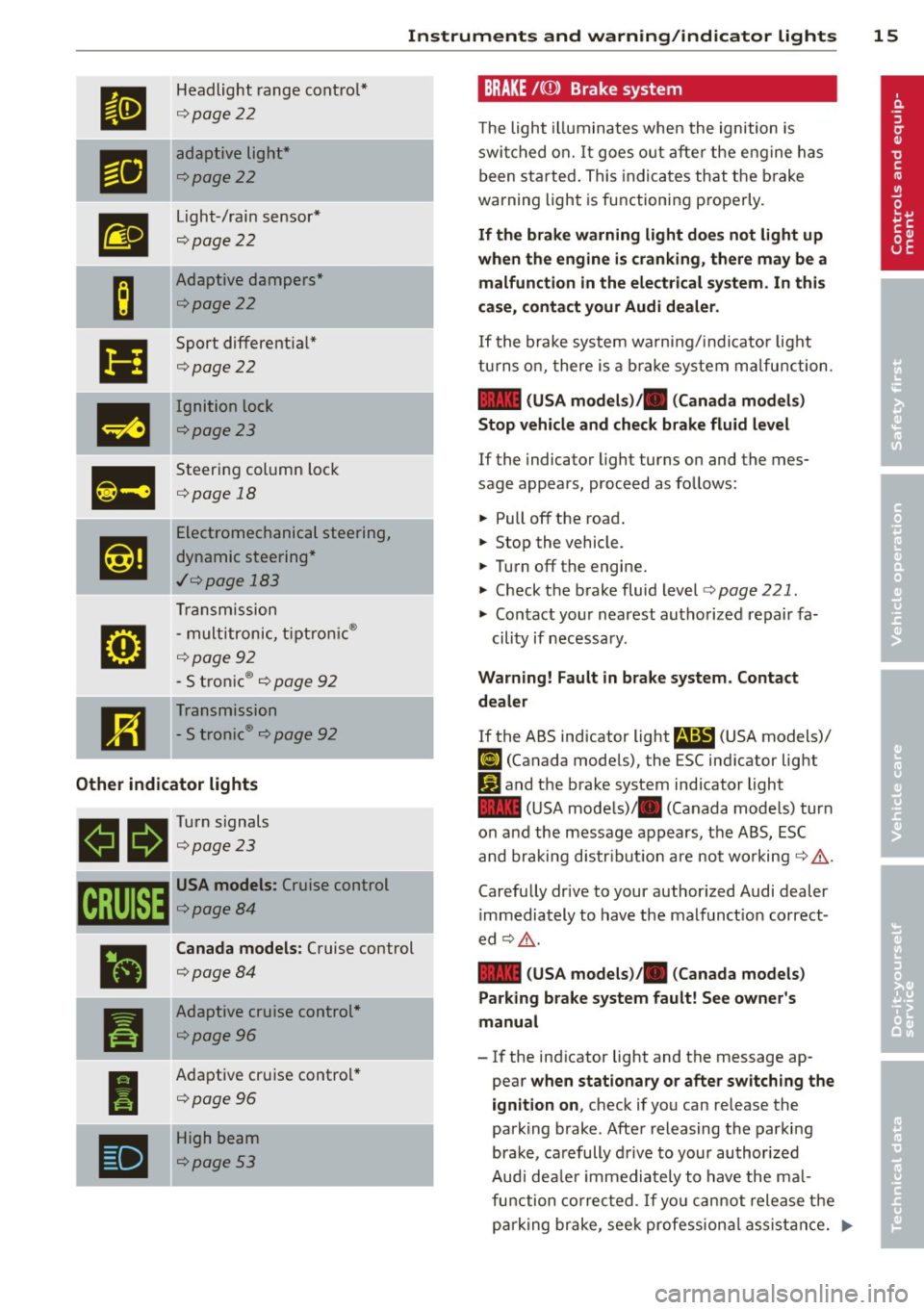
Instrument s and warnin g/indic ator ligh ts 15
II
Headlight range contro l*
¢ page22
Ill
adaptive light *
¢page22
-
m
Light-/rain sensor*
¢page 22
B
Adaptive dampers*
¢page22
ill
Sport differential*
¢page22
II
Ignition lock
¢page23
Ill
Steering column lock
¢page 18
£t·fi
Electromechanical steering,
dynamic steering *
./¢page 183
T ransmission
•
- multitronic, tiptron ic ®
~ page92
- S tro nic ® ¢ page 92
m
Transmission
- S tronic® ¢ page 92
Other indicator light s
1111
Turn signals
ii ¢page23
CRUISE
-
•
I
•
USA models: Cruise control
¢page84
C anada models : Cruise control
¢page84
Adaptive cruise control* ¢page96
Adaptive cru ise control*
¢page96
-High beam
¢page53
BRAKE /((J)) Brake system
T he light illuminates when the ignition is
swi tched on.
It goes out after the engine has
been started. This indicates that the b rake
warning light is functioning p roperly.
If th e brake warning light do es not light up
wh en th e eng ine i s cran king , th ere ma y be a
malfunction in the elect rical sy ste m . In thi s
ca se, cont act your Audi dealer.
If the brake system wa rning/indicator light
tu rns on, there is a brake system ma lfunction.
1111 (USA mod els)/ . (Canada mod els )
Stop v ehicle and ch eck brak e flu id le vel
If the indicator light turns on and the mes
sage appears, proceed as fo llows:
.,. Pull off the road .
.,. Stop the vehicle.
.,. Turn off the engine .
.,. Check the brake fluid level ¢page 221.
.,. Contact your nearest authorized repair fa-
cility if necessary .
Warning! Fault in bra ke system. Contact
d eal er
If the ABS indicator light "1:l!I (USA models)/
(I] (Canada models), the ESC ind icator light
Jj] and the brake system indicator light
1111 (USA models)/ . (Canada models) turn
on and the message appears, the ABS, ESC
and braking d istr ibut ion are not working ¢,&..
Carefully drive to your author ized Audi dealer
immediately to have the malfunct ion correct
ed ¢,&. .
1111 (U SA model s)/. (Canada models)
Par king bra ke system fault! See own er's
manual
- If the indicator light and the message ap-
pear
when statio nary or after switch ing the
ignition on ,
check if you can release the
park ing brake . After releasing the parking
brake, carefully drive to your author ized
Aud i dea le r i mmediately to have the ma l
function corrected. If yo u cannot release the
park ing brake, see k professiona l assistance . .,..
Page 18 of 290
16 Instrum ent s and w arn ing /indic ato r light s
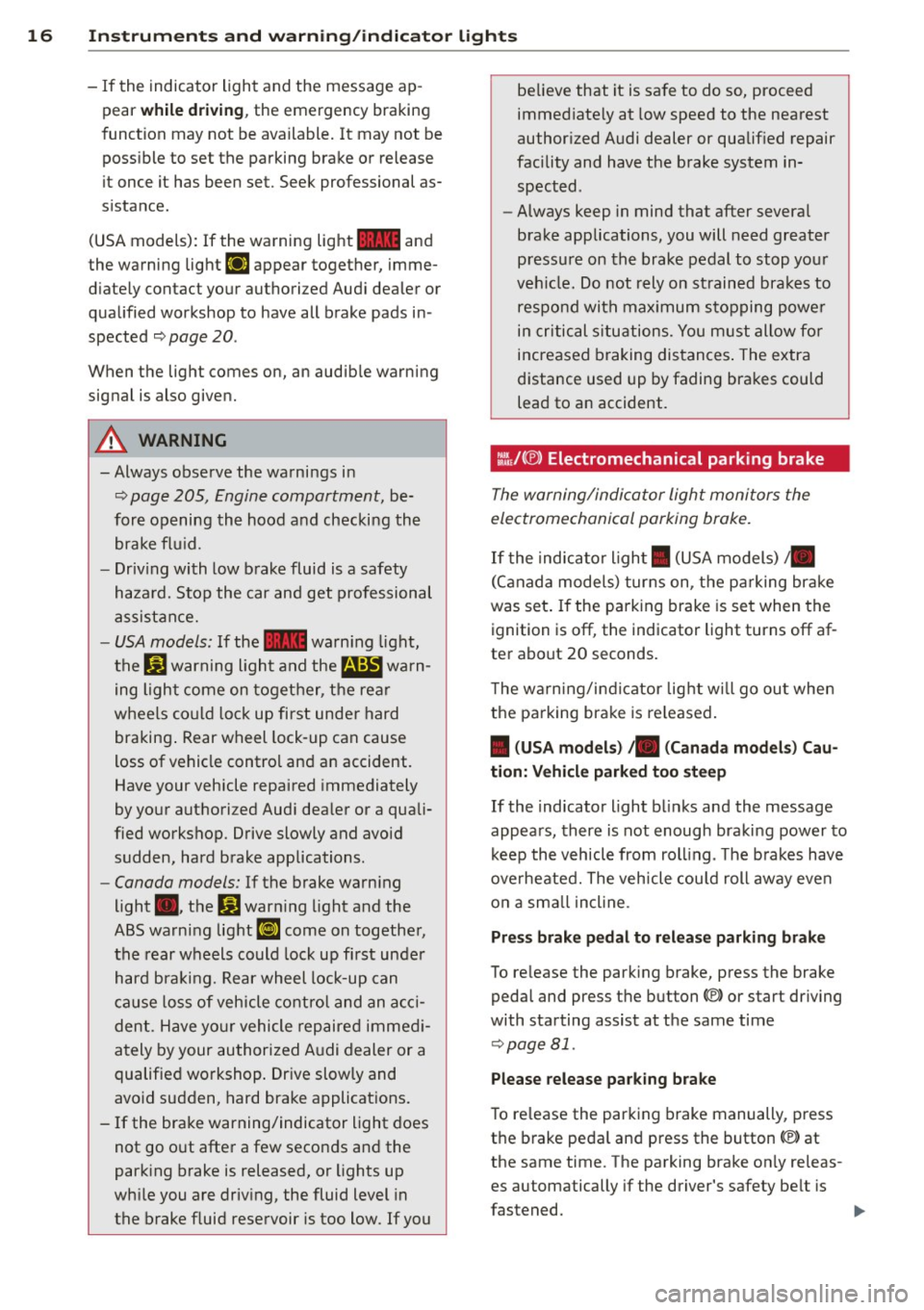
- If the indicator light and the message ap
pear
w hile dri ving , the emergency braking
function may not be available. It may not be
poss ible to set the parking brake or release
it once it has been set. Seek professional as
s istance .
(USA models): If the warning light
1111 and
the warning light
EiJ appear together, imme
diately contact your authorized Audi dealer or
qualified workshop to have all brake pads in
spected
~ page 20 .
When the light comes on, an audible warning
signal is also given.
& WARNING
- Always observe the warnings in
~ page 205, Engine compartment, be
fore opening the hood and checking the brake flu id.
- Driv ing with low b rake fluid is a safety
haza rd. Stop the car and get professional
assistance.
- USA models: If the 1111 warn ing light,
the . warning light and
thee warn
ing light come on together, the rear
wheels co uld lock up fi rst unde r hard
braking . Rear wheel lock -up can cause
loss of vehicle contro l and an accident.
Have your vehicle repaired immediately
by your authorized Audi dea ler or a quali
fied workshop. Drive slowly and avoid
sudden, hard brake applications.
-Canada models: If the brake warn ing
light ., the
DJ warn ing light and the
ABS warning light
liJ come on togethe r,
the rear wheels could lock up fi rst unde r
hard bra king. Rear wheel lock-up can
c ause loss of vehicle control and an a cc i
dent. Have yo ur vehicle repaire d immed i
ately by your authorized A udi dealer or a
qualified wo rkshop . Drive slowly and
avo id sudden, hard brake applicat ions.
- If the brake warning/indicator light does
not go out after a few seconds and the
parking brake is released, or lights up
whi le you are driv ing, the fluid level in
the brake fluid reservoir is too low. If you believe that
it is safe to do so, proceed
immed iate ly at low speed to the nearest
authorized Audi dealer or qualif ied repair
facility and have the brake system in
spected.
- Always keep in mind that after several
brake applications, you will need greater
pressure on the brake pedal to stop your
veh icle. Do not rely on strained brakes to
respond with max imum stopping power
in critical s ituations. You m ust allow fo r
increased braking distances . The extra
d istance used up by fading brakes could
lead to an accident.
· ~fu /C®) Electromechanical parking brake
The warning/indicator light monitors the
electromechanical parking brake.
If the indicator l igh t. (USA models)/ .
(Canada mode ls) turns on, t he p arking br ake
was set . If the parking brake is se t when the
ignition is
off, the indicator light turns off af
ter abo ut 20 seconds .
The wa rn ing/i ndicator lig ht w ill go ou t when
the parking brake is re leased.
• (US A models ) ;a (Canada model s) Cau
t ion: Vehicle parked too steep
If the indicator light b links and the message
appears, there is not enough braking power to
keep the vehicle from roll ing . T he b rakes have
ove rheated. The veh icle cou ld roll away eve n
o n a sm all incline .
Press brake pedal to relea se parking brake
To release the parking brake, press the brake
pedal and press the button(®) or start driving
with starting assist at the same time
~page 81.
Please release parking brake
To re lease the parking brake manually, press
the brake peda l and press the button<®) at
the same time. The parking brake only re leas
es automatically if the driver's safety belt is
fastened. ..,.
Page 184 of 290
182 Intelligent technology
You can compensate for this slightly reduced
braking power by pushing harder on the brake
pedal. Avoid heavy braking loads d uring the
break-in per iod.
Operating condition s and d riv ing hab it s
The brakes on today 's automob iles are st ill
subject to wear, depending largely on operat
ing conditions and driving habits¢.&. . On
vehicles that are either driven mostly in stop
and-go city traffic or are driven hard, the brake pads should be checked by your author
ized Audi dealer more often than specified in
the
Warra nty & Maint enance booklet . Failure
to have your brake pads inspected can result in red uced b rake pe rformance.
On steep slopes, you should use the brak ing
effect of the engine . Th is way, you prevent un
necessa ry wear on the brake system. If you
must use yo ur brakes, do not hold the brakes
down continuously . P u mp the brakes at inter
va ls.
Operating noise
Noises may occur when braking depending on
the speed, braking fo rce and outside condi
tions s uch as temperature and humidity .
Effect of w ater and ro ad s alt
In certain situat ions, for example after driving
through water, in heavy ra in, after overn ight
condensat ion or after washing your car, the
b rak ing effect can be reduced by moistu re or
ice on the bra ke roto rs and b rake pads . The
b rakes must be dried fi rst with a few caref ul
b rake app lications .
At higher speeds and with the w indshield w ip
e rs turned on, the brake pads press agains t
the brake rotors for a short amount of time.
This occurs at regular intervals without the
driver noticing and provides for better brake response time under wet condit ions.
The effectiveness of the brakes can be reduced
when the vehicle is driven on a salt-covered road and the brakes are not used. Likewise,
you clean
off accumulated sa lt coating from brake d
iscs and pads with a few cautio us ap
plications of the brake
Q ,&. .
Corrosion
The re may be a tendency for dirt to bu ild up
o n the brake pads and corros io n to fo rm on
the d iscs if the car is not driven regu la rly or
only for short trips with litt le use of the
brakes.
If the brakes a re not used frequently, o r if cor
rosion has formed on the discs, it is advisable
to clean
off the pads and discs by braking
firmly a few times from a moderately high
speed
c> &. .
Faults in the brak e syst em
If you shou ld no tice a sudden increase in
brake pedal trave l, then one of the two brake
ci rcuits may have fai led
c> &. .
Lo w brake fluid lev el
Malfunctions can occu r in the bra ke system if
the b rake fluid level is too low. The brake f lu id
level is monitored electronically.
Brake booster
The brake booster increases the pressure that
yo u generate with the brake peda l. It works
o n ly when the engine is running .¢
&
Brake lining we ar status
Brake lining wear may be checked by visual in
spect ion of the condition of the brake pads
through the open ings in the wheel. If neces
sary, the wheel may be removed for th is i n
spect io n ¢
page 249, Changing a wheel.
_&. WARNING
- New brake pads don't have the bes t stop
p ing power and m ust be "bro ken-in" dur
ing the initial 100 to 150 miles (150 to
200 kilometers) of normal city driving.
You can compensate for this by pressing
the brake pedal more firmly. Th is also
applies later when new pads are instal led.
Page 196 of 290
194 Cleaning and protection
Cleaning and
protect ion
General information
Regular core preserves vehicle value .
Any automobile is exposed to industrial
fumes, corrosive road salt, etc. A well cared
for Audi can look like new many years after
purchase . Regular and correct care w ill con
tr ibute to maintaining the beauty and value of
your Aud i.
Furth erm ore, goo d car e m ay be a c onditi on
for substantiat ing a warrant y claim shou ld
c orrosion dam age or paint d efe ct s occ ur.
Your author ized Audi dealer has a variety of
d ed ica ted vehicl e-ca re product s and can ad
vise which ones to use for cleaning the exter i
or and inte rior of your vehicle .
Whether you use products recommended by
Aud i or other commercially ava ilable clean ing
agents, please make sure you apply them cor
rectly .
A WARNING
-Cleaning agents may be poisonous. Keep
them out of the reach of children.
- Heed all caut ion labels.
- Always read directions on the container
before using any product . Follow the di
rect ions carefu lly.
- Most chemical cleaners are concentrated
and have to be diluted.
- Use spot removing fluids only in well
ventilated areas.
- Do not use gasoline, kerosene, d iesel
fuel, nail pol ish remover or other volati le
fluids. They may be toxic, flammab le or
haza rdous in other ways. Do not wash,
wax or dry the vehicle with the ignit ion
on or the engine running.
- Do not clean the undersides of chassis,
fenders, wheel covers, etc. without pro
tecting your hands and arms. You may
c u t yourself on sharp-edged metal parts . -
Moisture and ice on brakes may impair
brak ing eff ic iency
c::> page 181. Test the
brakes carefully each time you wash the
veh icle.
@ For the sake of the environment
Select on ly environ mentally friendly clean
i ng products. Leftover cleaning products
should not d isposed of in the househo ld
waste .
Care of exterior
Washing
Frequent washing protects the vehicle .
The best protection against environmental in
fluences is
frequent washing and waxing . How
often this is required depends on:
- How much the veh icle is used
- Where the veh icle is parked (garage, in the
open under trees, etc.)
- The seasona l and weather conditions
- Environmental infl uences
T he longer b ird droppings, insects, tree resin,
road and indus tria l gr ime, ta r, soot, road salt
and other materials remain on the vehicle body, the more lasting their destr uctive ef
fects wi ll be . High temperatures caused by ex
pos ure to intense sun light intens ify the corro
s ive effect, particularly when humid ity is high
as well.
Under certain circumstances,
weekl y washing
may be necessary. Under other cond itions, a
monthly washing and waxing may be ade
quate .
After the winter, the underside of the vehicle
should be thoroughly washed, preferably in a professional car wash.
Vehicles with matte finish paint
c::> poge 197.
A WARNING
-Always read and heed all WARNINGS and
other information
c::> page 194.
Page 203 of 290
A WARNING 1=
- Moisture and ice on brakes may affect
braking efficiency
Q page 181 . Test the
brakes carefully each time you wash the
vehicle .
- Always read and heed all WARNINGS and other information Qpage 194.
Body cavity sealing
The body cavity sealing does no t need to be
checked.
All body cavities which co uld be affected by
corrosion have been thoro ughly protec ted at
the factory.
This sea ling does not require any inspection or
addit iona l treatment. If any wax should seep
out of the cav ity when the ambient tempera
ture is high, it can be removed w it h a plastic
scraper and a suitab le solvent.
A WARNING
So lvents can be dangerous .
- Benzine is flammable and toxic . If you
use benzine for removing the wax, keep
spar ks , flame and light ed c igaret tes
away. Never dump ben zine on t he
ground, in to open s tre ams or dow n sew
age dra ins.
- Be sure to observe all safety and env iro n
me ntal regu lations. Follow all ins truc
t ions on the con tainer .
- Always re ad and hee d all WARN INGS and
ot her informa tion
Q page 194 .
Chassis
Have the undercoating checked for damage
from time to time.
The lower body shell of your Audi is a lso thor
ough ly protected against corrosion .
Any damage to the undercoating caused by road hazards shou ld be repa ired promptly .
Cleaning and protec tion 20 1
A WARNING
Too much undercoating i n the wrong p la
ces can cause a fire .
- Do not apply additional undercoating or
ru stp roof ing o n or near the exhaust
manifold, exhaust pipes, catalytic con
verter or heat shields . While d riving, the
substance used fo r under coating could
over hea t an d cause a fire.
- Always read an d heed a ll WAR NIN GS and
o ther info rmation
c:? page 19 4.
Exhaust tail pipes
Road salt and other co rrosive mater ials w ill
d amage the mate rial in the exhaus t tail pipes
i f they are not cleaned regular ly . Do not clea n
the tail pipes with whee l cleaner, paint polish,
c hr ome polish or other abras ive cleaners .
Clean the tail pipes with car care products
that are suitable for sta inless s teel.
Your a uthorized Audi dea ler can provi de clean
ing products that have been tested and ap
proved for yo ur vehicle.
Care of interior
Infotainment components
The Rad io/MM !* disp lay m ay be cleaned with
a soft cloth and commercially-available "LC D
cleaner". The cloth should be coated lightly
whe n the cleaning sol ution when cleaning the
display.
T he M MI* con trols m ust be cleaned first with
a b rush so that dirt does not enter the unit or
enter between the buttons and the housing.
Then wiping the cont rols with a cloth damp
ened with dish de tergent and water is recom
mended .
(D Note
-To avoid scratching the display, you
should never clean it dry .
- To prevent damage, make sure fluids do
not enter the cont ro ls .
•
•
Page 214 of 290
212 Checking and filling
Checking and filling
Engine hood
Releasing and opening the engine hood
The engine hood is released from inside the
vehicle .
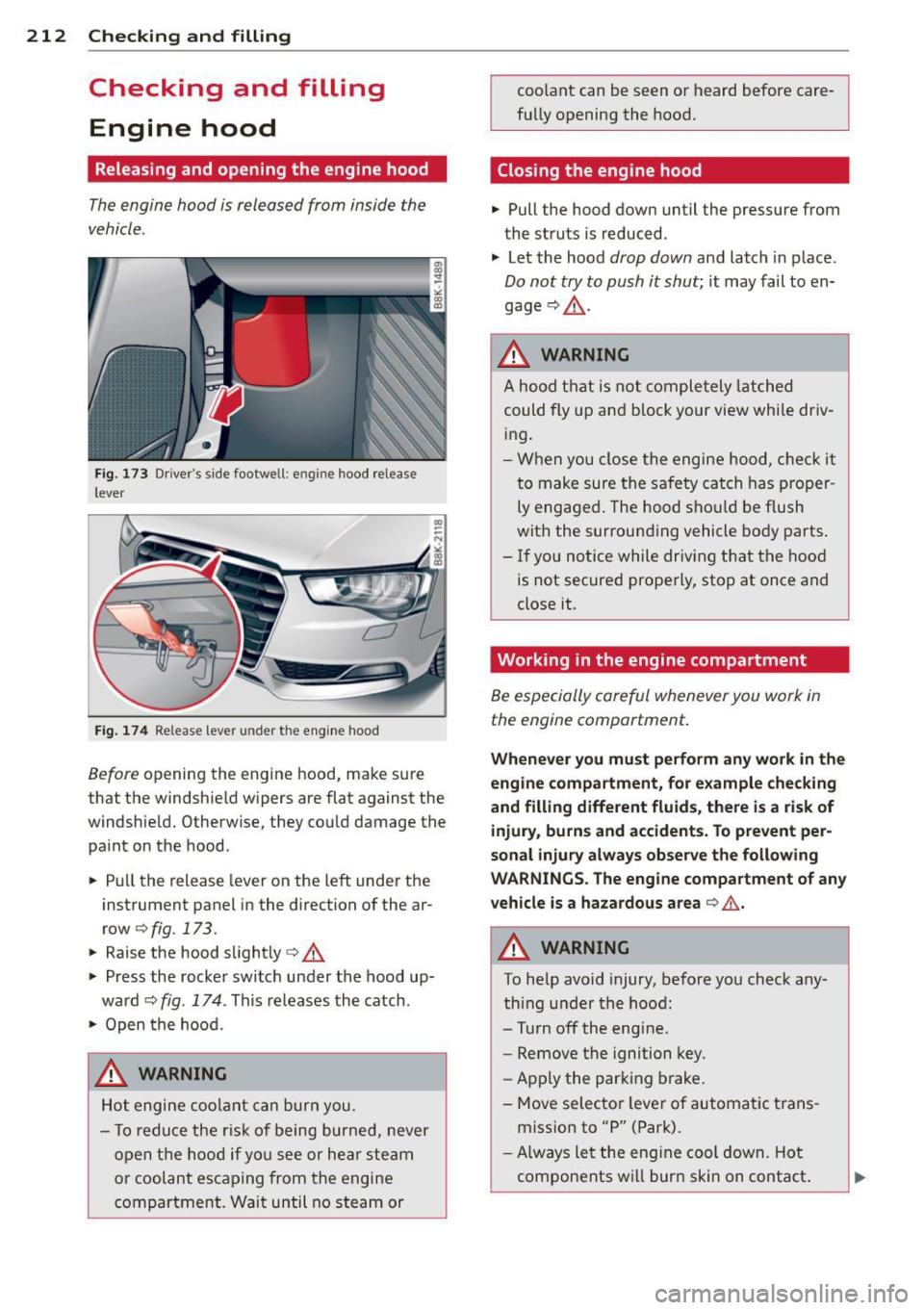
Fig . 173 D river' s side footwe ll: e ngin e hood re lease
lever
F ig. 1 74 Re lease lever u nde r the eng ine hood
Before openin g the engine hood, ma ke s ure
that the windshie ld w ipers are flat against the
windshield. Otherwise, they co uld damage the
pa int on the hood .
... Pull the release lever on the left under the
inst rument panel in the direction of the ar
row
c;, fig . 173.
... Raise t he hood s lightly r::;, &,
... Press the rocke r swi tc h under the hood up
ward
c;, fig . 174 . This re leases the catch .
... Ope n the hood.
A WARNING
Hot engi ne co olan t ca n bur n you .
- T o redu ce the r is k o f being burned, never
op en t he ho od if yo u see or hea r ste am
or cool an t esc aping from the engine
c ompartment. Wait unti l no steam or co
olant can be seen or heard before care
fu lly opening the hood.
Closing the engine hood
... Pull the hood down until the pressure from
the struts is reduced .
... Let the hood
drop down and latch in p lace .
Do not try to push it shut; it may fail to en
gage
r::;, &, .
A WARNING
-
A ho od th at is not co mpletely latched
could fly u p an d block your view while driv
in g.
- Wh en you cl ose the engi ne ho od, ch ec k it
t o make sure the sa fe ty ca tch has prope r
ly engaged . The hood s hould be flush
wit h the surroun ding vehicle body pa rts .
-If you notice while driv in g that t he hood
is not secured prope rly, sto p at once and
close it.
Working in the engine compartment
Be especially ca reful whenever you work in
the engine compartment.
Whenever you must perform any work in the
engine compartment, for example checking
and filling different fluid s, there is a ri sk of
injury , burns and accidents . To prevent per
sonal injury always observe the following
WARNINGS. The engine compartment of any
vehicle is a hazardous area
r::;, ,&. .
A WARNING
-To help avo id injury, before yo u check any-
thing unde r the hoo d:
- Turn off the eng ine.
- Remove the ignition key.
- Ap ply the park ing brake .
- Move selector leve r of automatic t rans -
miss io n to "P" (Par k).
- Alway s le t the eng ine cool d own. Ho t
components w ill bur n skin on contact .
Page 215 of 290
-To reduce the r isk of being burned, never
open the hood if you see or hear steam
or coolant escaping from the engine
compartment . Wait until no steam or
coolant can be seen or heard before ca re
fully opening the hood .
- Keep children away from the engine com
partment.
- Never spill flu ids on hot engine compo
nents. They can cause a fire .
- Never touch the radiator fan. The aux ili
ary e lectr ic fan is temperature controlled
and can switch on suddenly .
- Never open the coolant reservoir cap
when the eng ine is still warm . The cool
ant system is pressur ized and hot coo l
ant could spray out.
- Protect your face, hands and arm from
steam or hot eng ine coolant by placing a
thic k rag over the cap when you open the
coolant reservoir.
- Do not remove the engine cover under
any c ircumstances. Th is increases the
risk of bu rns.
- If wo rk on the fuel system or the electri
cal sys tem is ne cessary:
- Always disconnect the battery.
- Never smoke or work near heaters or
open flames . Fluids in the engine com
partment co uld start a fire.
- Keep an approved fire extinguisher im
mediately ava ilable.
- To avoid electrical s hock and persona l in
jury while the engine is running or being
started, never touch:
- Ignition cables
- Other components of the high voltage
electronic ignition system.
- If you must perform a check or repa ir
with the engine running:
- Fir st, fully apply the parking brake,
move se lector lever of a utomatic trans
mission to "P" (Park).
Checkin g and fillin g 213
-Always use extreme caution to prevent
clothing, jewelry, or long hair from get
ting caught in the radiator fan, V-be lts
or other moving parts, or from contact
i ng hot parts . Tie back hair before
starting, and do not wear clothing that
will hang o r droop into the engine.
- Minimize exposure to em ission and
chemical hazards
9 .&, .
&_ WARNING
Califo rnia Proposition 65 Wa rni ng:
- Engi ne exhaust, some of its const ituents,
and certa in vehicle components contain
or emit chemi cals known to the State of
California to cause cancer and birth de
fects and reproduc tive harm. In addition,
certain fl uids con tained in vehicles and
certain products of component wear con
tain or emit chemica ls known to the
State of California to cause cancer and
birth defects or other reproductive harm.
- Battery posts, terminals and related ac
cessories conta in lead and lead com
pounds, c hemicals known to the State of
California to cause cancer and reproduc
tive harms. Wash hands afte r handling .
(D Note
When adding flu ids, always make sure that
they are poured into the proper conta iner
or f iller opening, otherwise serious dam
age to vehicle systems w ill occur .
@ For the sake of the environment
To detect leaks in time, inspect the vehicle
floor pan from underneath regularly . If
you see spots from oil or other veh icle flu
i ds, have you r vehicle inspected by an au
thori zed Audi dealer. •
•
Page 223 of 290
scalding from hot coo lant by following
these steps.
- Turn
off the engi ne and a llow it to cool
down.
- Protect your face, hands and arms from
escapi ng fl uid and steam by cover ing
the cap with a large, thick rag .
- Turn the cap slowly and very ca refully
i n a cou nte r-clockw ise dir ect ion while
a pply ing lig ht, downwa rd p ress ure on
the top of the cap.
- T o avo id being burned, do no t sp ill an
tifree ze o r coolan t on t he exh aust sys
tem or ho t engine parts . Un der certain
conditions, the ethylene glyco l in en
gine coolant can catch fire .
- Antifree ze is poisono us. Always store an
tifreeze in its or iginal co ntainer and we ll
o ut o f the reac h of children.
- If you drain the coolant , it must be
caught and safely stored in a p roper con
tainer clear ly marked "poison".
(D Note
- Coolant po llutes the env ironment and
could ca use a n engine fire . Excess coo l
ant wi ll be forced out through the pres
sure re lief va lve in the cap when the en
gine becomes hot.
- If, in an emergency, only water can be
added , the correct ratio between water
and antifreeze¢
page 219 must be re
stored as soon as possib le .
@ For the sake of the environment
Drained coolant should not be re used . Al
ways dispose of used c oolant while observ
ing all envir onmental regulations .
Radiator fan
The radiator fan switches on automa tically by
itself
T he radiator fan is driven by the engine via the
V-be lt. The viscous clutch regulates the speed
of the fan according to the temperature of the
coolant .
Checkin g and fillin g 221
An auxiliary electric radiato r fan* sw itches on
and
off depending on coolant temperature
and othe r vehicle ope rat ing con ditions.
After yo u switc h the engi ne off, the aux iliary
f an can con tinue r unning for up to 10 minutes
- even with the ignition off. It can even switch
on again later by itself¢ & , if
- t he temperatu re of the engine coo lant rises
due to the heat b uild -up from the en gine in
the engi ne compartment, or
- the engine compartment heats up be cause
the vehicle is parked in intense sunlight.
A WARNING
- To reduce the risk of personal in jury nev
er touch the radiator fan.
- The a uxiliary electric fan is temperat ure
contro lled and can switch on sud denly
even when the engine is not running.
- The a uxiliary radiator fa n switches on a u
tomatically when the engine coo lant
reaches a certain temperature and will
continue to run until the coo lant temper
ature drops .
Brake fluid
Checking brake fluid level
The brake fluid level can be checked with a
qui ck glance.
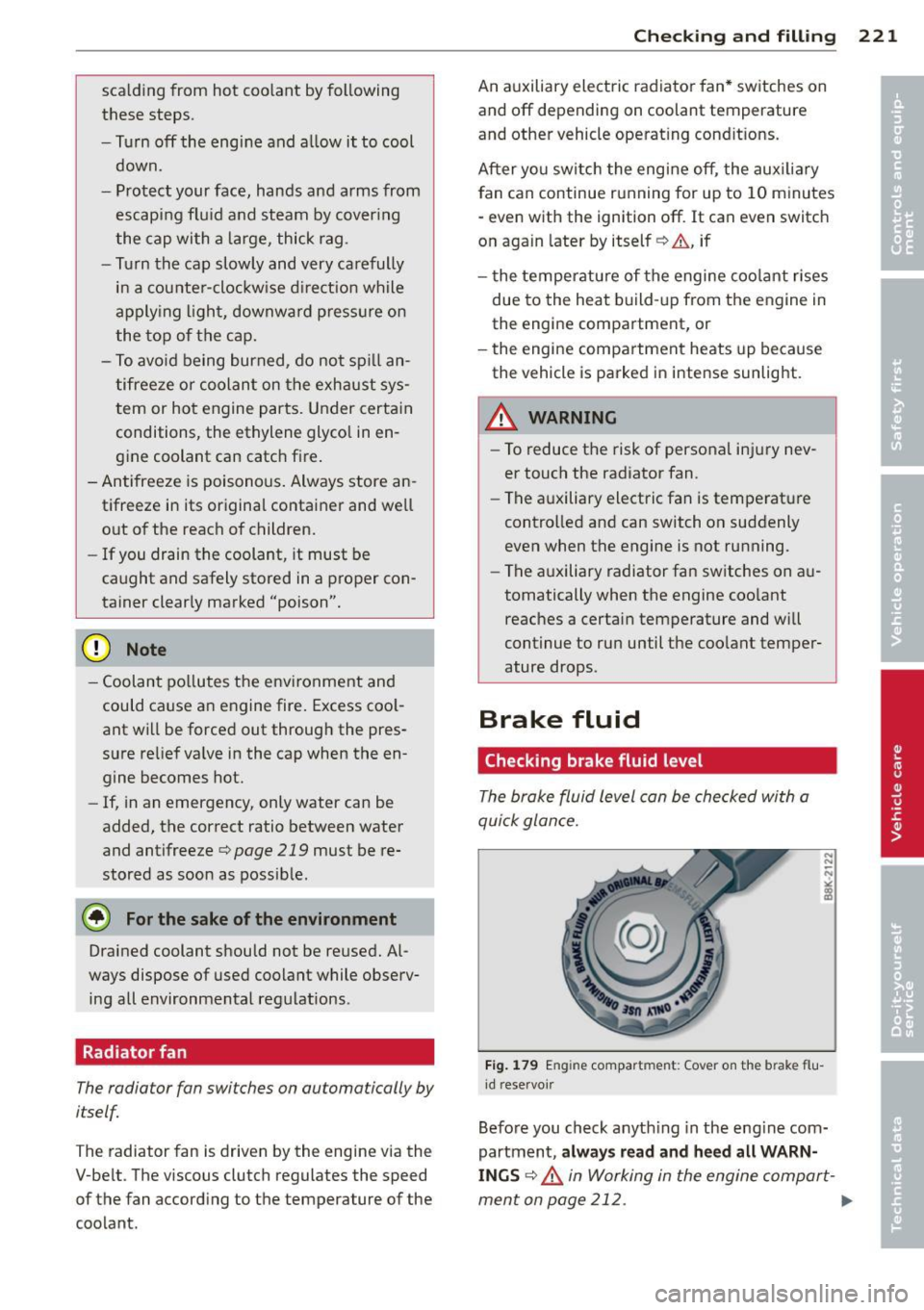
Fig. 17 9 En gin e compar tment: Cover o n the brak e flu
i d reservoi r
Before you check anyth ing in the eng ine com
partment ,
always re ad and heed all WARN
INGS c::> ,& in Working in the engine compar t-
ment on page 212 . .,..
Page 224 of 290

222 Check ing and filling
• Read the brake fluid leve l from the brake
fluid reservoir ¢
fig. 179, ¢ fig. 175. The
brake f lu id leve l must be between the "MIN"
and "MAX" markings.
The brake fluid reservoir is located at the rear partition of the engine compartment on the
left side ¢
page 214 .
The fluid level may drop slightly after some
time due to the automatic adjustment of the brake pads . This is not cause for alarm .
I f the brake fluid level falls
considerably be
l ow the "MIN" mark, the brake wa rning/indi
cator light (U .S . mode ls:
1111 , Canadian
models :. ) will come on
¢ page 15. Do not
continue to operate the vehicle. The complete brake system should be thoroughly checked
by an authorized Audi dealer or qualified
workshop and the cause corrected . If the
brake fluid level is too low, the b rake war ning/
i ndicato r light w ill illuminate . Contact an au
thor ized Audi dealer
imm ediately .
@ Tips
The brake f lu id reservoir is located unde r
neath the cove r.
Changing brake fluid
Have the brake fluid changed by an experi
enced technician .
Brake fluid absorbs moisture from the a ir . If
the water content in the brake fluid is too
h igh, corrosion in the brake system may result
after a per iod of t ime . The bo iling po int of the
b rake fluid w ill also decrease considerably and
dec rease braking per formance.
Therefore, the brake flu id must be changed
e ver y two ye ars. A lways use new b rake fluid
which confo rms to Fede ral Motor Vehicle
S tanda rd "FMVSS 116 DO T 4".
The brake flu id reservoir can be difficult to
r each, therefo re , we recommend that yo u
have the brake fl uid changed by yo ur au tho r
i z ed
Audi dealer . Your dealer has the co rrec t tools, the
right brake flu id and t he know -how
to do this for you.
A WARNING
'-
- Brake flu id is poisonous. It must be stor-
ed only in the closed or igina l container
out of the reach of children!
- Brake failure can res ult from o ld or inap
propriate brake f lu id. Observe these pre
cautions:
- Use only brake f luid that meets SA E
spe cifi cat ion
J 17 03 and conforms to
Federa l Motor Vehi cle Standard 1 16.
Always chec k with yo ur authorized A udi
dealer to make sure yo u are using the
correct brake fluid. The cor rect type of
brake flu id is also ind icated on the
brake f lu id reservoir.
- The brake fluid must be new. Heavy use
of the brakes can cause a vapor lock if
the brake fluid is left i n the system too
long . This can se riously affect the effi
c iency of the brakes as well as your
safety . T his could result in an accident.
W Note
Brake fluid will damage the pai nt of you r
vehicle .
@ For the sake of the environment
Because of the prob lem of proper disposal
of brake fluid as well as the spec ial too ls
r equired and the necessary expertise, we
r ecommend that yo u have the brake flu id
changed by yo ur autho rized Aud i dea le r.
Battery
General information
U nder normal operat ing cond itions, the bat
te ry in your Audi does not need any ma inte
nance. With
high outside temperatu res or
long da ily drives we recommend that you have
the e lectrolyte leve l che cked by an autho riz ed
A udi dealer or qu alified workshop. The elec
tro ly t e level should also be checked e ach time
the battery is charged
¢ page 225. ...