oil change AUDI A5 CABRIOLET 2013 Owners Manual
[x] Cancel search | Manufacturer: AUDI, Model Year: 2013, Model line: A5 CABRIOLET, Model: AUDI A5 CABRIOLET 2013Pages: 290, PDF Size: 72.35 MB
Page 30 of 290
28 Driver in formation d isplay
Fue l economy messages are disp layed when
fuel consumption is increased by certain con
d itions. If you follow these fuel economy mes
sages, you can reduce your vehicle's consump
tion of fuel. The messages appear automati
cally and are on ly displayed in the eff ic iency
program. The fuel economy messages turn off
automatically after a certain pe riod of time .
.,. To turn a fuel economy message off imme-
diately after it appears, press the
I RES ET I
button r:::;, fig . 11 @ , or
.,. Press the function selection switch
r:::;, fig . 11
® ·
(D Tips
- Once you have t urned a fuel economy
message off, it will only appear again af
te r you tu rn the ignition on aga in.
- The fuel economy messages are not dis
played in eve ry instance, but rat her in in
terv als over a period of time.
Service interval display
The service interval display reminds you when
your next service is due.
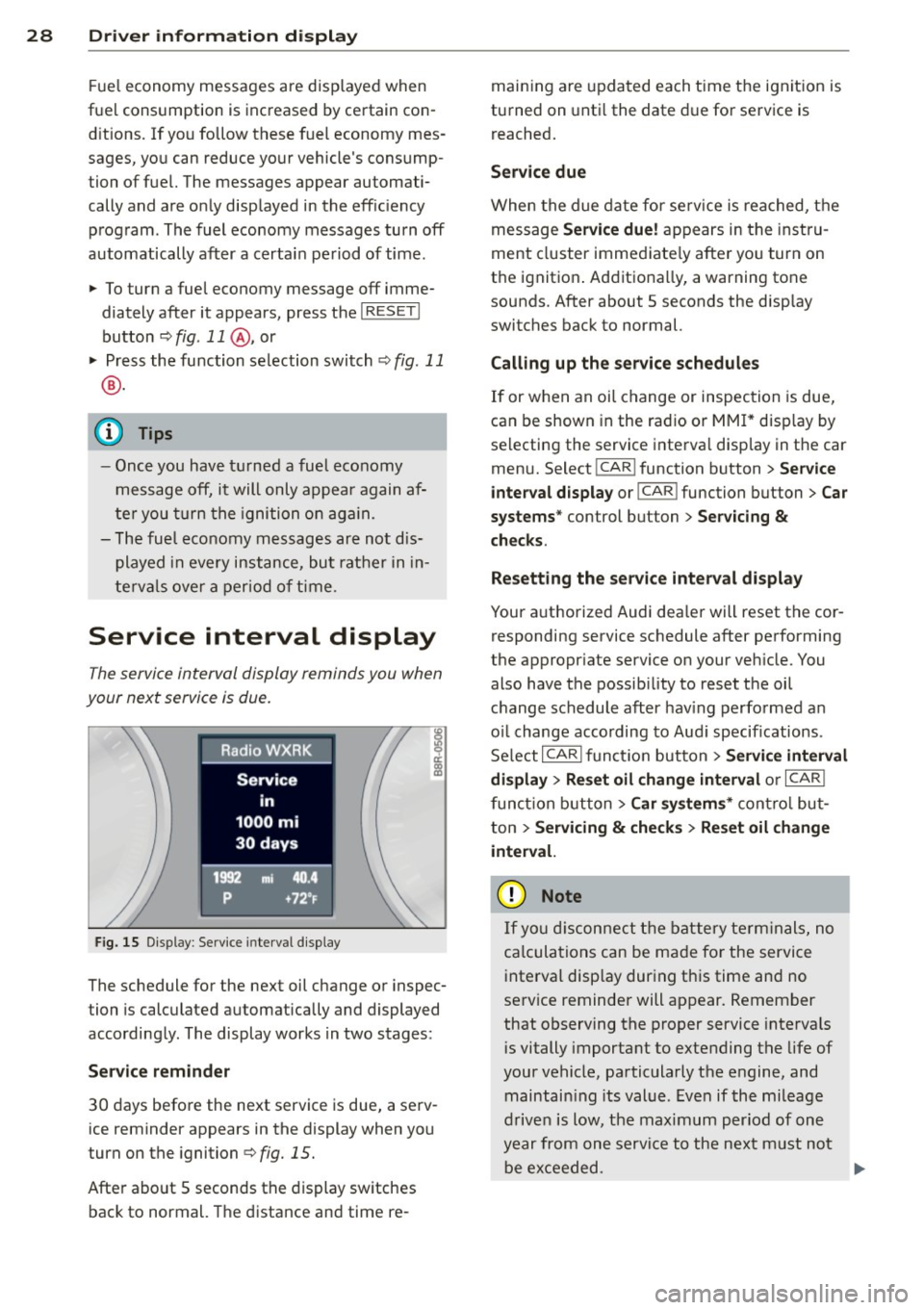
F ig. 15 D is p lay : Serv ice interval d isplay
The schedule for the next oil change or inspec
tion is calculated automatically and displayed
accordingly . The display works in two stages :
Service reminder
30 days before the next service is due, a serv
ice reminder appears in the display when you
turn on the ignition
c:> fig. 15.
Afte r abo ut 5 seconds the display sw itches
back to normal. The distance and time re- main
ing are upda ted each t ime the ignit ion is
turned on unt il the date d ue for service is
reached.
Service due
When the d ue date fo r se rv ice is reached, t he
message
Service due ! appears in the instru
ment cluster immediate ly after yo u turn on
the ignition . Additiona lly, a warning tone
sounds. After about 5 seconds the disp lay
switches back to normal.
Calling up the service schedule s
If or when an oi l change or inspec tion is due,
can be shown in the rad io or
MM I* disp lay by
selecting the service interva l display in the car
menu. Select
! CAR ! function button > Service
inte rval d isplay
or !CAR ! function button> Car
s ystems *
control button > Servicing &
checks .
Resett ing the se rv ice interval display
Your authorized Audi dea ler will reset the cor
responding service schedule after performing
the appropr iate service on your veh icle. You
also have the possib ility to reset the oil
change schedule after hav ing perfo rmed a n
o il change acco rding to Aud i specif ications .
Select
I CAR ! functio n button > Se rvi ce interval
di splay
> Re set oil change int erval or I CAR I
funct ion b utt on > Car sy stem s* cont ro l bu t
ton
> Servicing & check s > Reset oil ch ange
inte rval.
(D Note
If you di sconnect the battery term inals, no
ca lcula tions can be made for the service
i nterva l disp lay dur ing this time an d no
se rvice reminder will appear. Remember
that observing the proper service intervals
i s vitally important to extending the life of
your vehicle, particularly the engine, and maintain ing its value . Even if the mileage
d rive n is low, the maximum period of one
year from one servi ce to the next m ust not
be ex ceeded. .,..
Page 31 of 290

@ Tips
-Do not reset the display between oil
changes, otherwise the display will be in
correct.
- The information in the Service Reminder
remains stored even when the vehicle
battery is disconnected.
On-Board Diagnostic
system (OBD)
Malfunction Indicator Lamp (MIL)
The Malfunction Indicator Lamp (MIL)¢• in
the instrument cluster is part of the On-Board
Diagnostic (OBD II) system .
The warning/indicator light illuminates when
the ignition is switched on and goes out after
the engine starts and the idle has stabilized.
This indicates that the MIL is work ing proper
ly.
If the light does not go out after the engine
is started, or illuminates while you are driv
ing, a ma lfunction may ex ist in the engine sys
tem. If the light illuminates, the catalytic con
verter could be damaged.
Continue driving
with reduced power (avoid
ing sustained high speeds and/or rapid acce l
erat ions) and have the condition corrected.
Contact your author ized Audi dealer .
If the lig ht illuminates, the electronic speed
limiter may also be malfunctioning. For more
information
~ page 29, Electronic speed
limiter .
An improperly closed fuel filler cap may also
cause the MIL light to illuminate
~page 210.
Driver information display 29
On-Board Diagnostics
Fig. 1 6 Locat io n of Data Li nk Co nnector (DLC)
On-Board D iagnostics monitors the compo
nents of your em ission contro l system. Each
monitored component in your engine system
has been ass igned a code. In case of a mal
funct ion, the component will be identified
and the fault stored as a code in the control
module memo ry.
The MIL light may also illuminate if there is a
l eak in the on-board fuel vapor recovery sys
tem. If the light illuminates after a refueling,
stop the vehicle and make sure the fuel filler
cap is properly closed ~page 210.
In order to make an accurate diagnosis, the
stored data can only be disp layed using spe
cial diagnostic equipment (generic scan tool
for OBD).
In order to connect the specia l diagnostic
equipment, p ush the plug into the Data Link
Connector (DL C). The DLC is located to the
rig ht of the hood release
~ fig. 16.
Your authorized Audi dealer or qualified work
shop can interpret the code and perform the
necessary repair.
A WARNING
Do not use the diagnostic connector for
personal use . Incorrect usage can cause
malfunctions , whic h can increase the risk
of a collision!
Electronic speed limiter
Your vehicle may be factory equ ipped with
-
tires that are rated for a maximum speed of .,..
Page 84 of 290
82 On the road
Starting off with a trailer
To prevent rolling back unintentionally on an
incline , do the following:
.,. Keep the switch@¢ fig. 92 pulled and de
press the accelerator . The parking brake
stays applied and prevents the vehicle from rolling backward .
.,. You can release the switch @once you are
sure that you a re develop ing enough dr iv ing
f orce at the wheels by dep ress ing the accel
erator.
Depending on the weight of the r ig (veh icle
and tra iler) and the seve rity of the in cli ne , you
may roll backwards as you start . You can pre
vent rolling backwards by holding the parking brake switch @ pulled out and accelerating -
just as you would when starting on a hill with
a conventional hand brake.
Emergency braking
In the event that the conventional brake system
foils or locks.
... In an emergency, pull the switch @
¢
fig. 92 and continue to pu ll it to slow your
vehicle down with the parking brake.
.,. As soon as you release the sw itch @ or ac-
celerate, the braking process stops.
If you pu ll the switch @and ho ld it above a
speed of about 5 mph (8 km/h), the emergen
cy braking function is in iti ated. The vehicle is
braked at al l four wheels by activating the hy
d raul ic brake system . T he brake performance
is simi lar to making an eme rgency stop¢.&. .
In order not to activate the emergency brak ing by mistake, an audible warning tone (buz
zer) sounds when the switc h@ is pulled . As
soon as the switch @is released, or the accel
e rator pedal is dep ressed , emergency b ra ki ng
stops.
.&_ WARNING
Emergency braking sho uld only be used in
an emergency, when the normal foot brake
has failed or the brake pedal is obstructed . Using the par
king brake to pe rform emer
gency braking will s low your veh icle down
as if you had made a full brake application.
The laws of p hysics cannot be suspended
even with ESC and i ts associated compo
nents (ABS, ASR, EDS). In corners and
when road o r weathe r cond itions are bad,
a full brake appl ication can ca use the vehi
cle to s kid or the rear end to break away -
risking an acciden t.
Speed warning system
Overview
The speed warning system helps you to keep
your driving speed below a set speed limit.
T he speed warning system warns if the driver
e xc eeds a previously stored max imum speed .
A warning tone w ill sound as soon as the vehi
cle speed exceeds the set speed by abou t
3 mph (3 km/h) . At the same t ime, a warning
symbol appears in the display . T he symbol's
appea rance might be different in some mod
els .
The speed warn ing system has two warning
t hr esholds that funct io n in dependent ly of
each other and that have somewhat diffe rent
purposes:
Speed wa rning 1
You can use speed warning 1 to se t the maxi
mum speed while you are driving . T his setting
will remai n in effect unt il you turn off the ig ni
t io n, assuming that you have not changed or
r ese t the sett ing.
The . (USA mode ls)
I. (Canada mode ls)
speed warning symbol in the warning 1 dis
play appears when you exceed the maximum
speed .
It goes ou t when the speed falls be low
the stored maximum speed .
T he speed warn ing symbol will also go out if
the speed
exceeds the stored maximum speed
by more than about 25 mph (40 km/h) for at
least 10 seconds. The sto red max imum speed
is de leted . .,..
Page 204 of 290
202 Cleaning and protection
Aluminum trim
Use only neutral-pH products to remove spots
and depos its from alum inum s urfaces.
Chrome care products and alkaline cleaners
will attack aluminum surfaces and can dam
age them over time.
A WARNING
Always read and heed all WARNINGS and other information
9 page 194.
Fabrics and fabric coverings
Fabrics and fabric coverings (e.g. seats, door
trim panels, etc .) should be cleaned at regular
intervals with a vacuum cleaner . This removes
surface dirt particles which could become em
bedded in the fabric through use. Steam
cleane rs shou ld not be used, because the
steam tends to push the dirt deeper into the
fabric and lock it there.
Normal cleaning
Generally, we recommend using a soft sponge
or a l int-free m icrofiber cloth to the clean fab
ric. Brushes should only be used for carpets
and floor mats, since other fabric surfaces
could be harmed by brushes.
Normal surface sta ins can be cleaned using a
commercially available foam cleaner. Spread
the foam on the surface of the fabric with a
soft sponge and work it in gently. Do not satu
rate the fabric . Then pat the foam dry using
absorbent, dry cloths (e.g . microfiber cloth)
and vacuum it after it has dried completely.
Cleaning stains
Stains caused by beverages (e.g. coffee, fruit
juice, etc .) can be treated with a mild deter
gent solut ion . App ly the detergent so lution
with a sponge. In the case of stubborn stains,
a detergent paste can be applied directly to
the stain and worked into the fabric. After
wards, use copious amounts of clean water to remove the remaining detergent . Apply the
water with a damp cloth or sponge and pat
the fabric dry with an absorbent, dry cloth. Stains
from choco late or makeup should have
detergent paste rubbed into them. After
wards, remove the soap with water (damp
sponge).
Alcohol can be used to treat stains from
grease, oil, lipstick or a ballpoint pen. Melted
grease or dye must be patted off using ab
sorbent material. It may be necessary to re
treat the areas with detergent paste and wa
ter .
In the case of general soiling of the uphols
tery and cover material, we recommend hir ing
a specialist that has the equipment to clean
the seat covers and other fabric surfaces by
shampooing a nd spray extraction.
A WARNING ,..__
Always read and heed all WARNINGS and
the information
9page 194.
(j) Tips
Open Velcro fasteners on your clothing can
damage the seat cover. Please make sure
that Velcro fasteners are closed .
Plastic parts and instrument panel
Always use a clean cloth moistened in clear
water to clean these areas. For persistent dirt
use an Audi approved
solvent-free plastic
clea ner/protectant.
A WARNING
-Solvents can change the properties of
some p lastics and make it harder for the
a ir bag to deploy.
-
-Never clean the instrument panel or the
surface of airbag modules w ith cleaning
products that conta in solvents.
- Products containing solvents will make the surface of this part porous.
- Serious injuries can resu lt if plastic parts
come loose when the airbag is deployed.
- Always read and heed all WARNINGS and
other information
9 page 194.
Page 205 of 290
CD Note
Cleaning agents containing solvents will
attack the material and can change the
way it behaves.
Natural leather
App lies to vehicles: with natura l leather
Audi makes great efforts to maintain the
properties, natural look and feel of interior
leather.
G ene ra l
We offer many different types of leather on
our veh icles. Most are different types of nappa
leather, which has a smooth surface and
comes in various co lors.
The intensity of the color determines the visu
al characteristics and appearance . If the sur
face of the leather has a typical natural look,
then the leather is a nappa leather that has
been left in a relatively natural condition. This
leather offers particularly good comfort and
breathes well. F ine veins, closed grains, insect
b ites, skin folds, and subtle variations in co lor
remain visible. These cha racte ristics demon
strate that the mater ia l is na tural.
Natural nappa leather is not covered by a col
or finish.
It is therefore more sensitive to so il
ing and wear, wh ich is something you need to
consider if ch ild ren, an imals o r othe r factors
m ight prove to be particularly hard on the
l eather .
By contrast, leather types that are cove red by
a co lored finish laye r are more durable. This
h as a posit ive effect on the leather's resist
ance to wear and soiling in daily use . On the
other hand, the typical characteristics of natu
ra l leather are bare ly or not apparent. Howev
er, this does not mean that the leather itself
is of infer ior quality.
Ca re and handling
Because of the exclusive nat ure of the types of
l eather that Audi uses and their unique prop
erties (such as sensitivity to oils, grease, soi l
ing, etc.), you will need to be somewhat care-
Cleaning and protec tion 203
ful with these leathers, and a ce rtain type of
care is required. For example, dark clothing
mater ia ls can disco lor leather seats (especia l
l y if such clothing is damp and was not dyed
correctly). Dust and dirt particles in pores,
folds, and seams can have an abrasive effect
and can damage the leather surface as well as
weaken seams .
The leather should be cleaned regularly as needed . After having been used for a relat ively
long time, your leather seats will acqu ire a
rich aged fin ish. This is a character istic of nat
ural leathe r and a s ign of true quality.
In order to maintain the value of this natural
product over the life of your ve hicle, you
shou ld follow the recommendat ions below:
CD Note
- To keep your leather from b leac hing out,
do not allow it to be exposed to bright
sunlight for long periods of time. If you
have to leave the veh icle parked outside
for long per iods, cover the leather to
protect it from direct exposure to s un
light.
- Sharp objects on clothing, such as zip
pers, rivets or sharp pieces on belts can
leave permanent sc ratches or scrape
marks on the surface of the leather .
{i) Tips
-After each time you clean the leather and
at regular intervals, use a leather preser
vative cream that contains UV-b lockers
and that works into the leather. Th is
cream will nour is h and mo isturize the
leather, helping it to breathe and stay
supple. It also helps to build up a protec
tive coating on the surface .
- Clean the leather every 2 - 3 months,
and clean any areas that get soiled.
- Remove fresh marks made by ballpo int
pens, ink, lipstick, shoe polish, etc. as
soon as poss ible.
- Preserve the color of the leather as need
ed by us ing a special colored leather care
cream to touch up areas of uneven color. •
•
Page 210 of 290
208 Fuel supply and filling your fuel tank
-Anti -knock index must be 87 AKI or higher.
- Blend must contain not more than 15%
MTBE .
Seasonally adjusted gasoline
Many gasoline grades are blended to perform
especially well for winter or summer driving .
During seasonal change-over, we suggest that
you fill up at busy gas stat ions where the sea
sonal adjustment is more likely to be made in
time.
CD Note
- Fuels containing a high percentage of
ethanol such as ESO and E85 may only
be used in vehicles with flex ible fuel en
gines. Using high ethano l fuel in vehicles
not equipped with flexib le fue l eng ines
can cause severe engine damage.
- Methanol fuels which do not mee t these
requirements may cause corrosion and
damage to plastic and rubber compo
nents in the fuel system.
- Do not use fuels that fail to meet the
specified criteria in this chapter.
- If you are unable to determine whether
or not a particular fuel blend meets the
specifications, ask your service station or
its fuel supplier.
- Do not use fuel for which the contents
cannot be identif ied.
- Fuel system damage and performance
problems resulting from the use of fuels
different from those specified are not
the respons ibility of Audi and are not
covered under the New Vehicle or the
Emission Control System Warranties .
- If you experience a loss of fuel economy
or driveab ility and performance prob
le ms due to the use of one of these fuel
blends, we recommend that you switch
to unblended fuel.
Ethanol fuel (B io-ethanol)
App lies to veh icles : w ith flex ible fue l en g in e
You can recognize vehicles with a flexible fuel
engine by looking at the label on the inside of
the fuel filler flap.
Vehicles with flexible fuel engines may be op
erated with bio -ethanol fuels such as E85
(85% ethanol and 15% gasoline) or with un
leaded gasoline (91 AKI/ROZ 95) . The vehicle
may also be operated with a mixture of these
fuels.
Your fuel consumption w ill increase when us
ing bio-ethanol fue ls due to the lower amount
of energy contained per unit volume in etha
nol.
Warming up the flexible fuel engine in
low temperatures
Due to the chemical composition of b io-etha
nol , a certain amount of fuel ends up in the
engine oil when driving short distances in very
low temperatures. This fue l evaporates again
when the engine is warmed up.
II Please warm up engine.
If the driver message appears in the instru
ment cluster display, drive with a warm en
gine to reduce the o il level.
CD Note
- Never fill with methanol o r with a higher
percentage of b io-ethanol than 85%
(E85). A higher percentage of bio-etha
nol in the fuel can cause damage to the
engine or to the fue l system.
- If you use only E85, it is recommended
to fill the fuel tank complete ly with un
leaded premium grade gaso line every
5,000 miles.
- If you experience starting, rough id le or
hesitation driveability problems, fill the
fue l tank comp letely with unleaded pre
m ium grade gasoline and dr ive it nor
mally until the gasoline is used. See your
authorized Audi dealer if the problem
persists .
Page 217 of 290
Modern eng ine lubrication has taken a quan
tum leap in the last few years . Many synt hetic
oils ava ilable today provide better engine lu
brication that can outlast traditional petrole
um-based o ils, making them a smart choice
for use throughout the life of your Audi.
Whether you use synthetic or petroleum based engine oil, the oil that you use must
conform to Audi's oil quality standard
VW 502 00 to help keep your vehicle's engine running smoothly and help prevent the for
mat ion of harmfu l deposits, sometimes called
"sludge", that ove r time can lead to expensive
r epairs.
At the t ime of pri nting, engine o ils available in
the U.S . and Canada that meet the exacting
specifications of Audi oi l standard VW 502 00
are synthetic engine oils. This does not mean, h owever, that every synthetic engine oil w ill
meet Audi oil standard VW 502 00. So always
be sure that you use an approved oi l.
To help preve nt the format ion of harmful de
posits use only oi l with the fo llowing spec ifi
cations printed on the oil container:
Audi oil standard VW 502 00
O il conta iner labels may carry the specif ica
tion s ingly or in comb inat ion w ith other des ig
nations and oil qua lity standards.
Viscos ity
Engine oi ls are graded according to their vis
cosity. The proper v iscosity grade oi l for your
engine depends on cl imactic or seasonal con
d itions where you dr ive. You can use oil with a
viscosity grade of SAE SW40 across all tem
pe rature ranges for normal d riving conditions .
However, if eng ine oi l viscosity grade SAE
SW40 is not avai lab le, you can also use viscos
ity grade SAE SW-30 or SAE OW-40 as long as
it meets Audi o il quality standard VW 502 00
specifications.
Because engine oil that meets the Audi oil
standard may not be available everywhere
when you need it, we st rongly recomme nd
that you always carry with you a n ext ra quart
Checkin g and fillin g 215
(li ter) of oil that exp ress ly con forms to the
VW 502 00 specificatio n, in case you have to
top
off the o il while on the road.
Only if the level of the o il is at or be low the
minimum mark -and no oi l that expressly
confo rms to Audi oil standard VW 502 00
spec ifications is available -may you top
off
with a h igh quality engine o il, preferab ly syn
thet ic-based, that meets ACEA A3 or API SM
spec ifications, but even then, only in v iscosity
grades SAE SW-40, SA E SW-30, o r SAE
OW- 40. However, dur ing the entire time be
tween o il cha nge inte rva ls, never top
off with
more than a tota l of 0. 5 q t/liter engine o il
that does not con form to A udi oil specification
vw 502 00.
Fo r more information abo ut eng ine oi l tha t
has been approved for your veh icle, ple ase
contac t eit h er yo ur autho rized Aud i dea le r or
Audi C ustomer Re lations at 1 (800) 822 -2834
or visit our web site at www .a u diusa.com or
www.aud icanada.ca. Here you w ill also find a
current list of oils (manufacturers, brand
names etc.) that conform to Audi oil standard
vw 502 00.
Changing the engine oil
T he eng ine oi l and o il f ilter m ust be changed
according to the mileage (kilometers) and
time intervals specified i n your ve hicle's War
ranty
& Maintenance booklet. Do not exceed
these interva ls - harmful deposits from old
engine oil can reduce engine performance and
can lead to expensive engine repairs.
Changi ng the oil at the recommended inter
vals is so very important beca use the lubricat
ing propert ies of oil decrease gradually during
norma l veh icle use. If you a re not sure when
yo u have your o il cha nged, ask your author
ized Audi Se rv ice Adv isor.
Under some circumstances the engine oil
shou ld eve n be changed more frequent ly.
Change oil more often if you dr ive most ly
sho rt distances, operate the ve hicle in dusty
areas o r most ly under stop-and -go traff ic con-
di tions, o r when you use your vehi cle where .,..
•
•
Page 218 of 290

216 Check ing and filling
temperatures stay below freezing point for
long periods.
Detergent addit ives in the o il w il l make fresh
oil look dark after the eng ine has been run
ning for a short time . This is norma l and is not
a reason to change the oi l more often than
recommended.
D am age or m alfunc tions du e to lack of
m ainten ance
It
is essential that you change your oil at the
recommended in tervals using only engine o il
that complies with Audi oi l standard
VW 502 00. Your Limited New Vehicle War
ranty does not cover damage or malfunctions
due to fail ure to fo llow recommended mainte
nance and use requ irements as set forth in
the Audi Owner's Manual and Warranty
&
Maintenance book let . Your dealer will have to
deny warranty coverage unless you present to
the dea ler proof in the form of Service or Re
pa ir Orders that all scheduled ma intenance
was performed in a t imely manner.
Eng ine oil consumption
The engine in your vehicle depends on an ade
quate amount of oil to lubricate and cool all
of its moving parts.
In order to provide effective lubrication and
cool ing of internal engine components, a ll in
ternal combustion eng ines consume a certa in
amount of oil. O il consumption varies from
engine to engine and may change significantly
over the life of the engine. Typica lly, engines
with a specif ied break-in period (see
¢
page 187) consume more oil during the
break-in period than they consume after oil
consumption has stabilized.
Under norma l conditions, the rate of oil con
sumption depends on the quality and viscosity
of the oil, the RPM (revolutions per minute) at
which the engine is operated, the ambient
temperature and road condit ions . Further fac
tors are the amount of oil d ilution from water
condensat ion or fuel residue and the ox ida
tion level of the oi l. As any engine is subject to wear as mi
leage builds up, the oil consump
tion may increase over time until replacement
of worn components may become necessary.
With a ll these variab les coming into play, no
standard rate of oil consumption can be es
tablished or specified. There is no alternative
to regu lar and frequent check ing of the o il lev
el, see
Note .
If
the yellow engine oil leve l warning symbo l
I! in the instrument cluster lights up, you
shou ld check the oil leve l as soon as possib le
¢
page 217. Top off the oil at your earliest
convenience ¢
page 217.
A WARNING '"---
Before you check anythi ng in the engine
compartment, always read and heed all
WARNINGS¢
A in Working in the engine
compartment on page 212.
(D Note
Driving w ith an insufficient o il level is like
ly to cause severe damage to the engine .
(D Tips
-The oil pressu re warn ing display . is
not an indic ator of the oil l evel. Do not
r el y on it . In stea d, check th e oil l eve l in
y our engin e at regular inter val s, pref
erably ea ch time you r efu el, and alwa ys
before go ing on a long trip .
-If you have t he impression yo ur engine
consumes excessive amoun ts of o il, we
recommend that you consu lt an author
ized Aud i dea ler to have the cause of
your concern properly diagnosed. Keep in m ind that the accurate measu rement of
oil consumption requ ires great care and
may take some time. An authorized Aud i
dealer has instructions about how to
measu re oil consumption accurately.
-
Page 220 of 290
218 Check ing and filling
@ For the sake of the environment
- Under no circumstances can the oil come
in contact with the sewage network or
the soil.
- Observe and follow legal regu lations
when disposing of empty oil containers.
Changing the engine oil
We recommend thot hove your oil changed by
an authorized Audi dealer or a qualified serv
ice station.
Before you check anything in the engine com
partment,
a lways r ea d and heed all WARN
ING S ¢ & in Working in the engine compart
ment on page 212.
The engine oil must be changed according to
the intervals specified in your Warranty
&
Maintenance book let. This is very important
because the lubricating properties of oil di
minish gradually during normal vehicle use .
Under some circ umstances the engine oi l
should be changed more frequently . Change
oil more often if you drive mostly short dis
tances, operate the vehicle in dusty areas or under predominantly stop-and -go traffic con
d itions, or have your veh icle where tempera
tures remain below freez ing fo r extended pe
riods.
Detergent addit ives in the o il w ill make fresh
oil look dark after the eng ine has been run
n ing fo r a short time. This is norma l and is not
a reason to change the oil mo re often than
recommended.
Because of the problem of proper disposal ,
a long w ith the special tools and necessary ex
pertise required, we strong ly recommend that
you have your o il changed by an authorized
Audi de ale r or a qualified service station.
If you cho ose t o c han ge your oil yours elf ,
please note the following important informa
tion :
A WARNING
To reduce the risk of personal injury if you
must change the eng ine oil in your vehicle
yourself:
- Wear eye protect ion.
- To reduce the risk of burns from hot en- gine oil, let the engine cool down to the
touch.
- When removing the o il dra in plug with
your fingers, stay as far away as possible. Always keep your forearm parallel to the
ground to help prevent hot oil from run
n ing down you r arm.
- Dra in the oil into a container designed
for this purpose, one large enough to hold at least the tota l amount of oil in
your engine.
- Engine oil is poisonous. Keep it we ll out
of the rea ch of childre n.
- Continuous contact with used eng ine o il
is harmfu l to your sk in. Always protect
your skin by washing oil off tho ro ughly
with soap and wate r.
@ Note
Neve r mix oil additives with your engine
oi l. These additives can damage your en
g ine and adversely affec t you r A ud i L imit
ed New Veh icle War ranty.
@ For the sake of the environment
- Before changing your oil, first make su re
you know where you can prope rly dispose
o f the used oil.
- Always dispose of used eng ine oi l proper
ly. Do not dump it on garden soil, wood
ed areas, into open streams o r down
sewage drains.
- Recycle used engi ne oil by taking it to a
used engine oil collection facility in you r
area, or contact a service station.
Page 221 of 290
Engine cooling system
Coolant
The engine coolant performs two functions: it
keeps the engine from overheating and it pro
te cts the engine from freezing in the winter .
The cooling system is sealed and generally re
qu ires little attention .
The cooling system has been filled at the fac
tory with a permanent coolant which does not need to be changed. The coolant consists of a
mixture of water and the manufacturer's gly
col-based coolant additive G 13 antifreeze with
anticor ros ion add itives (50% for USA mode ls;
60% for Canadian mode ls). This mixtu re both
assures the ne cessa ry frost prote cti on and
p rotec ts metal components in the engine's
coo ling system from cor ros io n an d scaling. It
a lso raises the boiling point of the coolant.
D o not red uce the con cent ration o f th e coo l
ant in the summe r by adding plain water .
The
proportion of coolant additive must be at least 50% but not more than 60%
to ma in
tain antifreeze protection and cooling efficien
cy. If the coolant frost protect ion is too low,
the coolant cou ld freeze and damage the veh i
cle heating and eng ine cooling system .
For yea r-round driving, antifreeze is added at
the factory for temperatures down to:
- -3 1 °F (-35°C)USA
- -4 0 ° F ( - 40 °C) Canada.
A WARNING
Before yo u check any thing in the engine
compartment, always read and hee d all
W AR NIN GS
¢ .&. in Working in the engine
compartment on page 212.
(D Note
- Before win ter se ts in, have the coolan t
checked to see if t he coolant ad dit ive i n
your vehicle is suffic ient to meet the cli
mate cond itions . T hi s is especially imp or
tant if you live in a regi on whe re the w in
te r is e xtremely cold. If necessary, in -
Checking and fillin g 219
crease the propo rtion of coo lant add itive
to 60%.
- When adding coolant additive to yo ur
coolin g system , remembe r:
- We reco mmend us ing o nly coola nt ad
d itive G12++ or G13 for your vehicle .
This coolan t ad ditive is availab le at a u
thor ized Audi dealers. O ther types of
ant ifree ze can s ignific antly red uce cor
rosion pro tec tion . The result ing corro
sion can ca use a loss o f coolan t and se
rio us en gine damage.
- D o not add any ty pe of rad iator leak seal
ant to yo ur vehicle 's engine coolan t.
Adding radiator repair fl uid may adverse
ly affect the function and performance of
your cooling system and co uld resu lt in
damage not covered by you r New Ve hicle
Limited War ran ty.
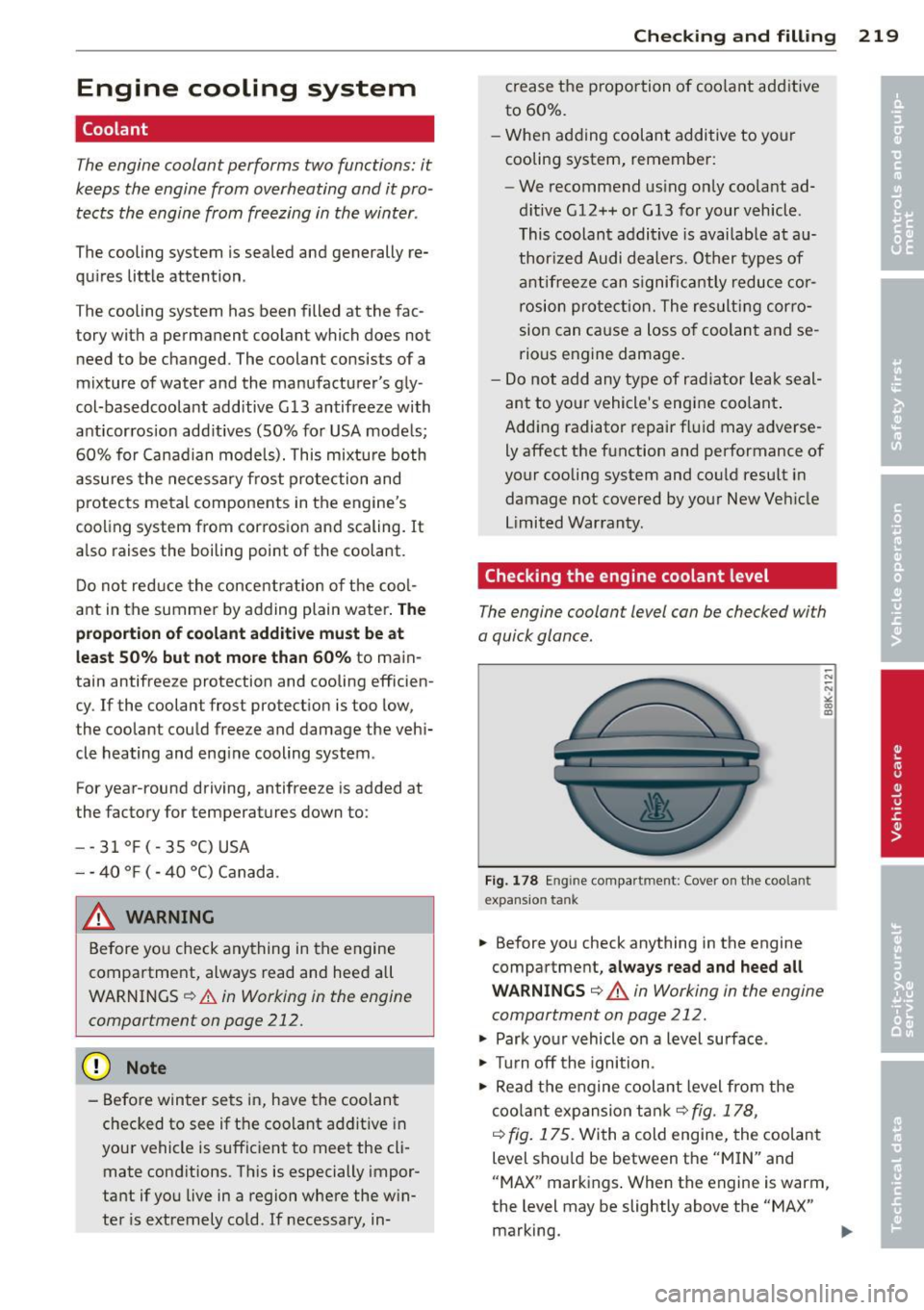
Checking the engine coolant level
The engine coolant level can be checked with
a quick glance.
Fig . 1 78 Eng in e co mpa rtm ent : Cover o n the coo la nt
expans io n t an k
-... ;;; ,; a, m
.. Before yo u check anything in the engine
compartment,
always read and heed all
WARNINGS ¢ & in Working in the engine
compartment on page 212 .
"' Park yo ur vehicle on a lev el su rface .
"' Turn off the ignition .
"' Read t he e ngine coolant level from the
coo lant expan sio n ta nk ¢
fig. 178 ,
¢ fig. 175. With a cold engine, the coolant
level sho uld be between the "MIN " and
"MAX" markings . When the engine is warm,
the level may be slightly above the "MAX"
marking.
Iii>