tire size AUDI A5 CABRIOLET 2013 Owners Manual
[x] Cancel search | Manufacturer: AUDI, Model Year: 2013, Model line: A5 CABRIOLET, Model: AUDI A5 CABRIOLET 2013Pages: 290, PDF Size: 72.35 MB
Page 134 of 290
13 2 Safety belts
Safety belts
General notes
Always wear safety belts!
Wearing safety belts correctly saves lives!
This chapter explains why safety be lts are nec
essary, how they work and how to adjust and
wear them correctly .
.. Read a ll the information that fo llows and
heed all of the instruct ions and WARNINGS.
A WARNING
Not wearing safety belts or wearing them
improperly increases the risk of ser ious
personal in jury and death .
- Safety belts are the sing le most effective
means avai lab le to reduce the risk of se
r ious injury and dea th in a utomob ile acci
dents. For your protection and that of
yo ur passenge rs, always co rrectly wear
safety belts when the vehicle is moving.
- P regnant women, injured, or physically
im paired perso ns mu st also use safety
bel ts. Lik e all veh icle occup ants, they are
more like ly to be ser iously injured if they
do not wea r safety be lts . The best way to
protect a fetus is to protect the mother -
throughout the entire pregnancy.
Number of seats
Your Audi has a total of four seating positions: two in the front and two in the rear. Each seat
ing position has a safety belt .
A WARNING
Not wearing safety belts or weari ng them
improp erly increases th e risk of ser ious
pe rsonal i njury and dea th.
- N ever st rap more than one pe rson, in
cl uding small ch ild ren, into any belt.
It is
e speci ally dange rous to pla ce a safety
belt over a child s itting on yo ur lap.
- N ever le t mo re people ride in the ve hicl e
than there are s afe ty be lts avail able. -
Be s ure everyone riding in the vehicle is
properly restrained w ith a separate safe
ty belt or child restra int.
Safety belt warning light
Your vehicle hos o warning system for the
driver and (on USA models only) front seat
passenger to remind you about the impor
tance of buckling-up .
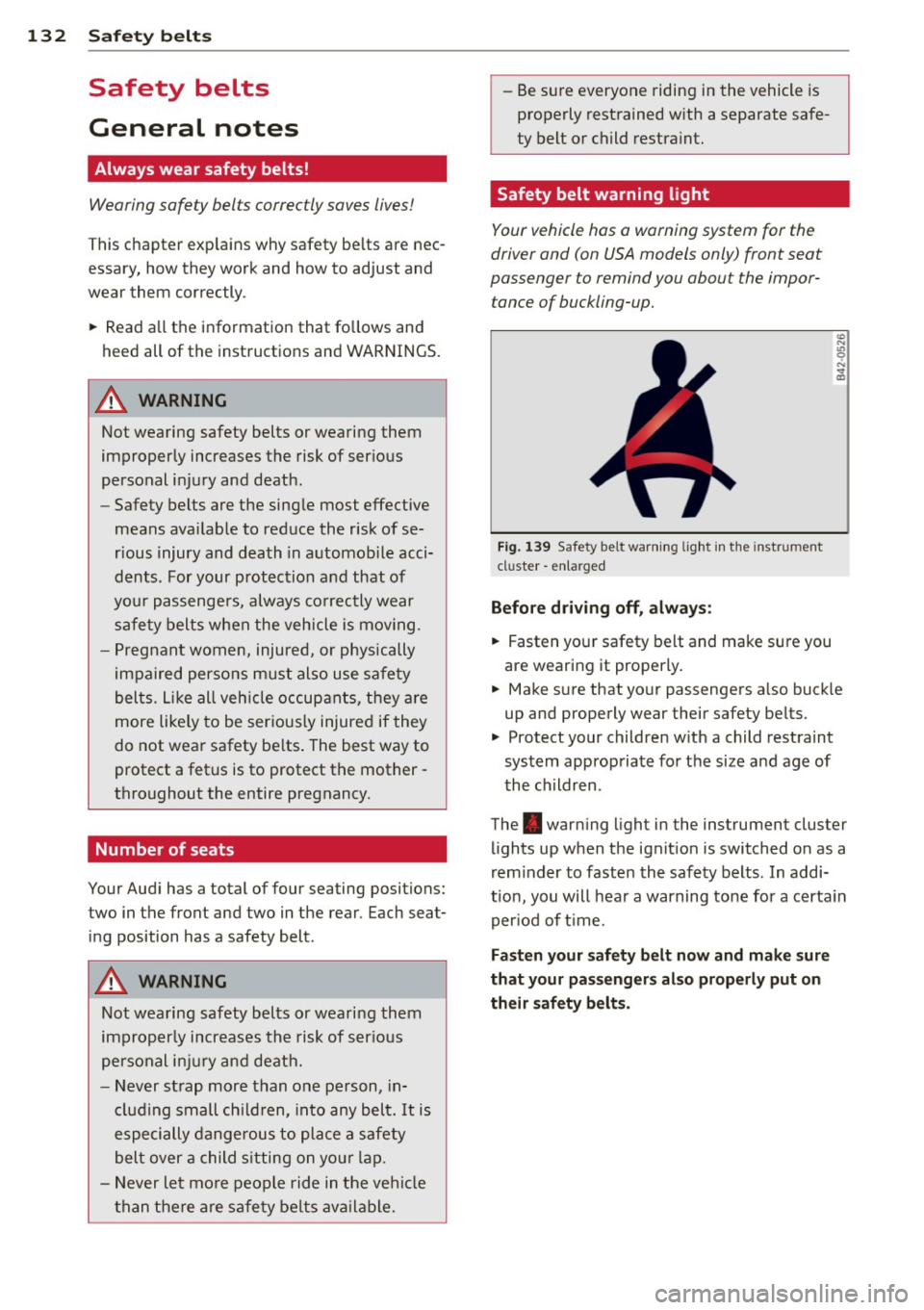
Fi g. 139 Safety belt warni ng lig ht in the instrument
cluster -en larged
Before driving off, always :
.. Fasten you r safety belt and make sure you
are wearing it properly .
.. Make s ure that yo ur passengers a lso buck le
up and properly wear their safety be lts.
.. Protect your children w ith a child rest raint
system approp riate fo r the size and age of
t he children.
The . war ning light in the instrument cluster
lights up when the ignit ion is switched on as a
rem inder to faste n the safety belts. In addi
t ion, you will hea r a warning tone for a certa in
per iod of t ime.
Fasten your safety b elt now and make sure
that your pas sengers also properly put on
their safety belts.
Page 186 of 290
184 Intelligent technology
_& WARNING
Have the dynamic steering* system mal
function repaired as soon as possible by an
authorized Audi dealer or any qualified
workshop -risk of accident!
(D Tips
- If the . or
'-r,ij indicator light only stays
on for a short time, you may continue
driving.
- The dynamic steering* stability systems
are not available in the event of a system
malfunction.
- For additional information on dynamic
steering*, refer to¢
page 107.
Driving with your
quattro®
App lies to vehicles: with all-wheel dr ive
-
With all-wheel drive, all four wheels are driv
en.
General information
With all-wheel drive, power is distributed to
all four wheels. This happens automatically
depending on your driving style and the road
conditions at the time . See also
¢ page 179.
A center differential distributes the driving
power variably to the front and rear axle . It
works together with selective wheel torque control, which activates when driving through
curves
c> page 180. With the sport differen
tial*, power distribution to the rear wheels is
variable and can be adjusted with drive select
c:>page 107.
The all-wheel drive concept is designed for
high engine power . Your vehicle is exception
ally powerful and has excellent driving charac
teristics both under normal driving conditions
and on snow and ice. Always read and follow
safety precautions ¢
&.
Winter tires
When driving in the winter , your vehicle with
all-wheel drive has an advantage, even with
regular tires. In winter road conditions it may be advisable to mount winter tires (or all-sea
son tires) for
improved driveability and brak
ing: these tires must be mounted on all four
wheels. See also ¢ page 242, Winter tires.
Tire chains
Where tire chains are mandatory on certain
roads, this normally also applies to vehicles
with all-wheel drive¢
page 243, Snow
chains .
Replacing wheels/tires
Vehicles with all-wheel drive must always
have tires of the same size. Also avoid tires
with different tread depths. For details see
page
c> page 238, New tires and replacing
tires and wheels.
Off·Road driving?
Your Audi does not have enough ground clear
ance to be used as an off-road vehicle.
It is
therefore best to avoid rough tracks and un
even terrain as much as possible. Also refer to
c:> page 187.
_& WARNING
-Always adjust your driving to road and traf-
fic conditions. Do not let the extra safety
afforded by all-wheel drive tempt you into
taking extra risks .
- Although the all-wheel drive is very ef
fective, always remember that braking
capacity is limited by tire traction. You
should therefore not drive at excessive
speeds on icy or slippery road surfaces.
- On wet road surfaces, be careful not to
drive too fast because the front wheels
could begin to slide on top of the water
(aquaplaning). If this should occur, you
will have no warning from a sudden in
crease in engine speed as with a front
wheel drive vehicle. Always drive at speeds which are suited to the road con
ditions - risk of crash .
Page 231 of 290
Groove
means the space between two adjacent tread
ribs.
Load rating (code)
means the maximum load that a tire is rated
to carry for a given inflation pressure. You
may not find this information on all tires be
cause it is no t req uired by law.
Maximum load rating
means the load rating for a t ire at the max i
mum permissible inflation pressure for that
tire.
Maximum loaded vehicle weight
means the sum of:
(a) Curb weight
(b) Accessory weight
(c) Vehicle capacity weight, and
(d) Production options weight
Maximum (permissible) inflation pressure
means the maximum cold inflation pressure
to which a tire may be inflated. Also called "maximum inflation pressure."
Normal occupant weight
means 150 lbs. (68 kilograms) times the
number of occupants seated in the vehicle up
to the total seating capacity of your vehicle.
Occupant distribution
means distribution of occupants in a vehicle.
Outer diameter
means the overa ll diamete r of an inflated new
tire.
Overall width
means the linear distance between the exteri
ors of the sidewalls of an inflated tire, includ
in g elevations due to labeling, decorations, or
protective bands or ribs.
Ply
means a layer of rubber-coated parallel cords.
Tires and wheels 229
Production options weight
means the combined weight of those installed
regular production options we ighing over 5
lbs. (2.3 kg) in excess of those standard items
which they replace, not previously considered
in curb weight or accessory weight, including
heavy duty brakes, ride levelers, heavy duty
battery, and special trim.
Radial ply tire
means a pneumatic tire in wh ich the ply cords
that extend to the beads are laid at substan
tia lly 90 degrees to the center line of the
tread .
Recommended inflation pressure
see¢ page 228, Cold tire inflation pressure.
Reinforced tire
means a t ire design to operate at higher loads
and at h igher inflation pressures than the cor
re sp onding standard tire. Reinforced tires
may be identified as "XL", "xl", "EXTRA LOAD",
or "RF" on the sidewa ll.
Rim
means a metal support for a tire or a tire and
tube assembly upon which the tire beads are
seated.
Rim diameter
means nom inal d iameter of the bead seat. If
you change your wheel s ize, you will have to
purchase new tires to match the new rim di
ameter.
Rim size designation
means r im diameter and width .
Rim width
means nominal distance between rim flanges .
Sidewall
means that portion of a tire between the
tread and bead.
•
•
Page 233 of 290
Tires and wheels 231
Occupant loading and distribution for vehicle normal load for various designated seating
capacities
Designated seating capacity,
number of occupants Vehicle normal load, number Occupant distribution in a nor-
of occupants
_____ mally loaded vehicle
4 2 2 in front
Cold tire inflation pressure
Tire pressure affects the overall handling, performance and safety of a vehicle.
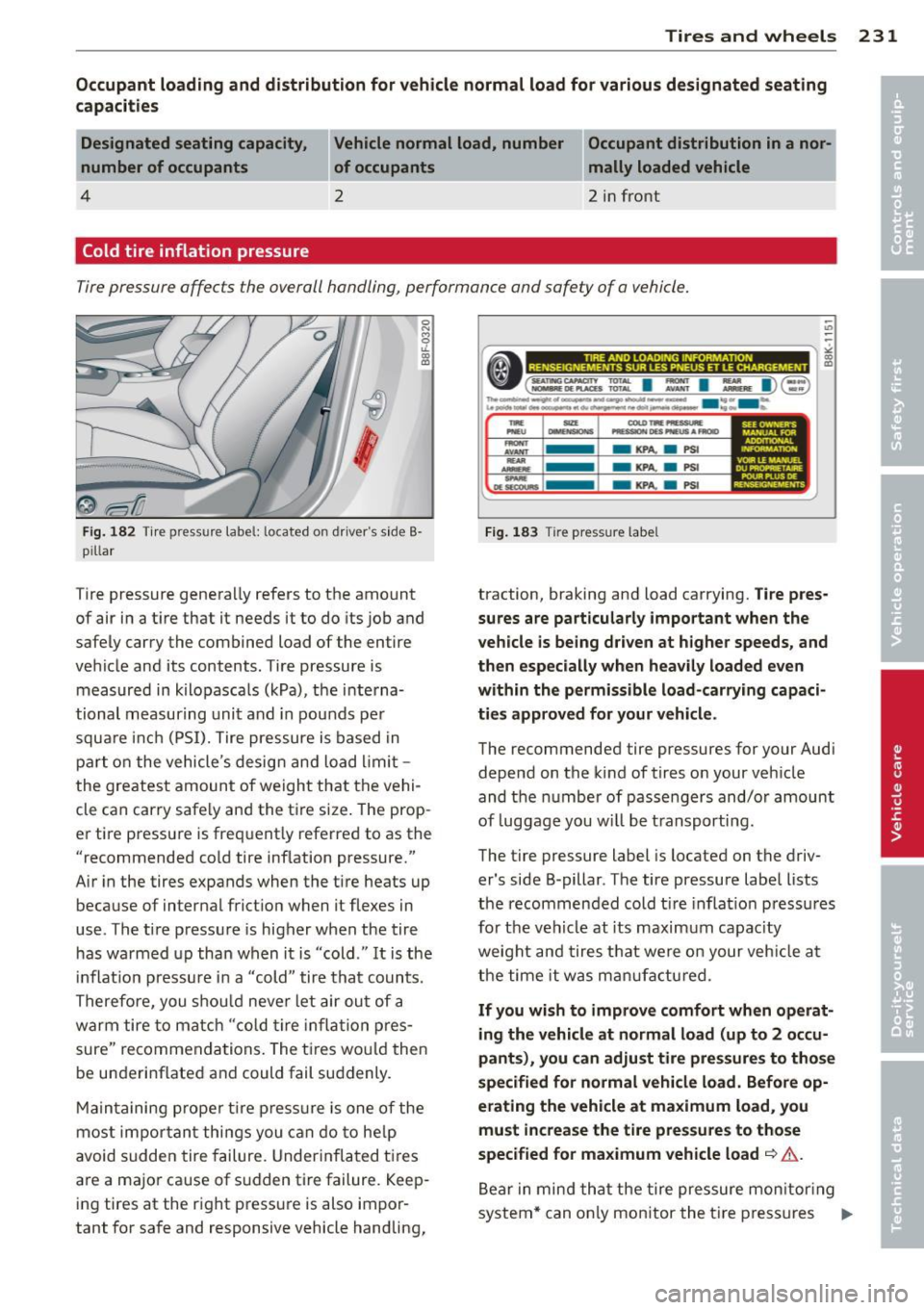
Fig. 182 Tir e pressure labe l: located on driver 's s ide B·
p ill ar
Tire pressure generally refers to the amount
of air in a tire that it needs it to do its job and
safely carry the combined load of the entire
vehicle and its contents . Tire pressure is
measured in kilopasca ls (kPa), the interna
tional measuring unit and in pounds pe r
squa re inch (PSI). Tire pressure is based in
part on the vehicle's design and load limit -
the greatest amount of weight that the vehi
cle can carry safe ly and the t ire size . The prop
er tire pressure is frequent ly referred to as the
"recommended cold tire inflation pressure."
Air in the tires expands when the tire heats up
because of internal friction when it flexes in
use . The tire pressure is higher when the tire
has warmed up than when it is "cold ."
It is the
in flat ion pressure i n a "cold " tire that counts.
Therefore, you shou ld neve r let air out of a
warm tire to match "cold tire inflat ion pres
sure" recommendations. The tires would then
be underinflated and could fail suddenly.
Maintaining proper tir e pressure is one of the
most impor tant things you can do to help
avoid sudden tire failure. Underinflated tires
are a ma jor cause of s udden tire failure . Keep
ing tires at the right pressure is also impor
tant for safe and responsive vehicle handling,
-tD
-
---------------------.. ,;
•(==.: I :::; I :,,. I)@ gi n. ............ .,_____, .... -.ito._.. ____ .... _ ...
&..p0idit,101111-~--.,...,....-- ..... ~ .... ..
-··-.....
-
-Dlst<:OURS
- KPA.. a PSI
- KPA.. a PSI
- KPA.. a PSI
Fig. 183 Tire pressure labe l
traction, braking and load carrying. Tire pres
sures are particularly important when the
vehicle is being driven at higher speeds, and
then especially when heavily loaded even
within the permissible load-carrying capaci
ties approved for your vehicle.
The recommended tire pressures for your Audi
depend on the kind of tires on your ve hicle
and the number of passengers and/o r amount
of luggage you w ill be transporti ng.
The tire pressure label is located on the driv
er's side B -pillar . The tire pressure labe l lists
the recommended cold tire inflat io n pressures
for the vehicle at its maximum capacity
weight and tires that were on your veh icle at
t he time it was manufactured.
If you wish to improve comfort when operat
ing the vehicle at normal load (up to 2 occu
pants), you can adjust tire pressures to those
specified for normal vehicle load. Before op
erating the vehicle at maximum load, you
must increase the tire pressures to those
specified for maximum vehicle load
¢ &.
Bear in mind that the tire pressure monitoring
system * can only monitor the tire pressures
II>
Page 234 of 290
232 Tires and wheels
you have stored. The system does not recog
nize the load condition of your vehicle.
The effectiveness of the tire pressure monito r
ing system* will be impaired if you store nor
mal load pressures but then operate the vehi
cle at its maximum load¢.&. .
See the illustration¢
fig. 182 for the location
of the label on driver's side 8-pillar (color of
the actua l label and exact location on the ve
hicle wi ll vary slightly) .
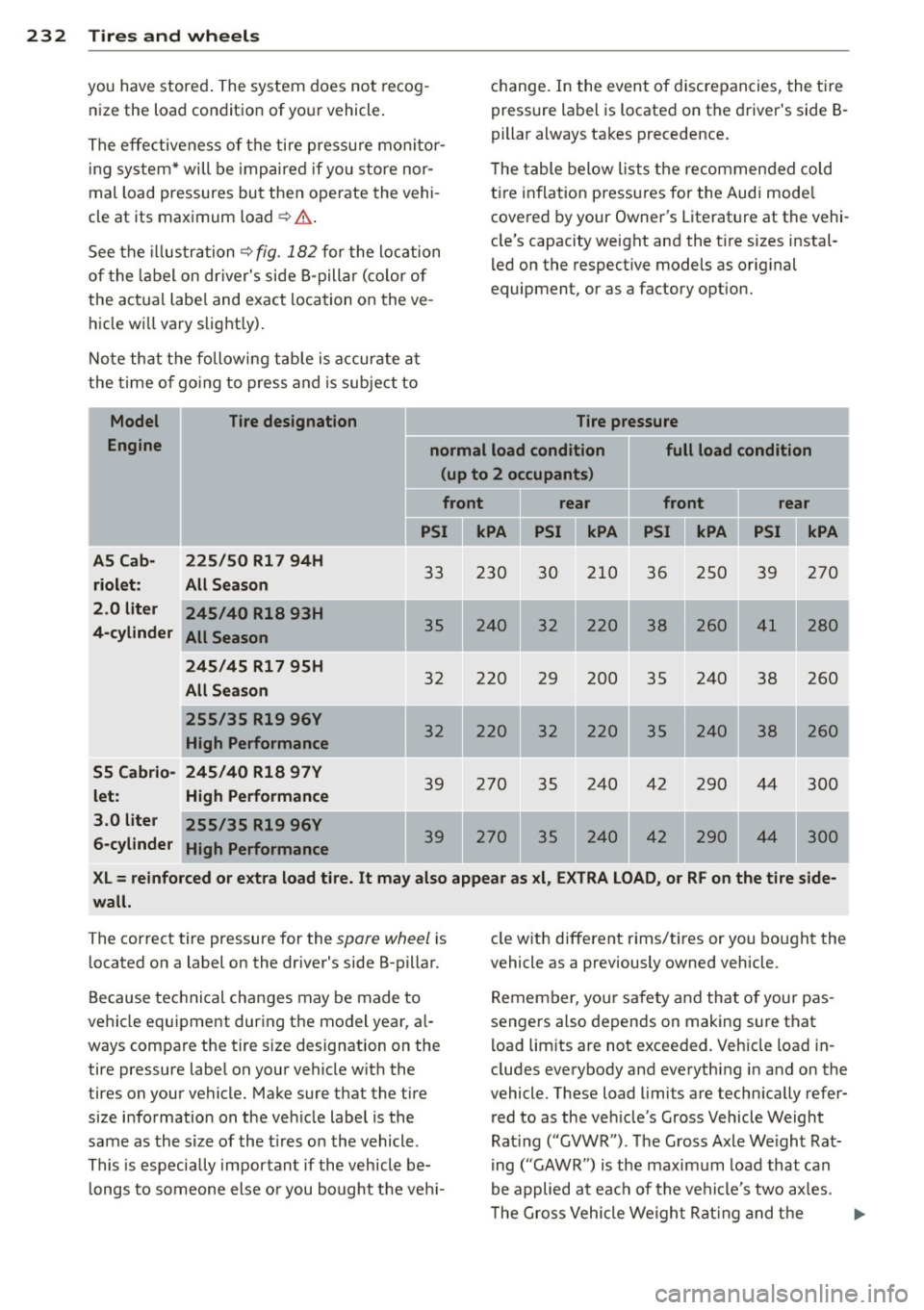
Note that the following table is accurate at
the time of going to press and is subject to
Model Tire designation
change. In the event of discrepancies, the tir e
pressure label is located on the driver's side 8-
pillar always takes precedence.
T he table below lists the recommended cold
ti re inflation pressu res for the Audi mode l
covered by your Owner's Literature at the vehi
cle's capacity weight and the t ire sizes instal
l ed on the respective models as original
equipment, or as a factory option.
Tire pressure
Engine normal load condition full load condition
(up to 2 occupants)
front rear front rear
AS Cab- 225/50 Rl 7 94H
riolet: All Season
2.0 liter 24S/40 R18 93H
4-cylinder All Season
245/45 Rl 7 95H
All Season
255/35 R19 96V High Performance
55 Cabrio- 245/40 R18 97V
let: High Performance
3.0 liter
6-cylinder 255/35 R19 96V
High Performance PSI kPA PSI
33 230
30
35 240 32
32 220 29
32 220 32
39 270
35
39 270 35
kPA PSI kPA PSI kPA
210 36 250 39 270
220 38 260 41 280
200 35 240 38 260
'
220 35 240 38 260
I
240 42 290 44
300
.
240 42 290 44 300
I
XL= reinforced or extra load tire. It may also appear as xl, EXTRA LOAD, or RF on the tire side
wall.
The correct tire pressure for the spare wheel i s
located on a label on the driver's side 8-pillar.
Because technical changes may be made to
ve hicle equipment during the model year, al
ways compare the tire size designation on the
tire pressure labe l on your vehicle w ith the
tires on your vehicle. Make sure that the tire
size information on the veh icle label is the
same as the size of the tires on the vehicle.
This is especially important if the vehicle be
lo ngs to someone else or you bought the veh i- cle
with different rims/tires or you bought the
vehicle as a previously owned vehicle.
Remember, your safety and that of your pas
sengers also depends on making sure that
l oad lim its are not exceeded. Vehicle load in
cludes everybody and everything in and on the
vehicle. These load limits are techn ically refer
red to as the veh icle's Gross Vehicle Weight
Rating ("GVWR"). The Gross Axle Weight Rat
ing ("GAWR") is the maximum load that can
be applied at eac h of the vehicle's two axles .
T he Gross Vehicle Weight Rating and the .,.
Page 240 of 290
238 Tires and w hee ls
wheel alignment checked by an authorized
Audi dealer or qualified workshop.
All wheel dri ve
Vehicles w ith quattro ® must always have tires
of the same size, construction and tread type. F or detai ls see
¢ page 184 .
.8, WARNING
Sudden tire failure can lead to loss of con
trol, a crash and serious personal injury!
- Never drive a veh icle when the tread on
any tire is worn down to the wear indica
tors.
- Worn tires are a safety hazard, they do not grip well on wet roads and increase
your risk of "hydrop lan ing" and loss of
control.
- Always keep chemicals that can cause
tire damage, such as grease, oil, gasoline
and brake fluid away from tires.
- Tires age even if they are not being used
and can fail suddenly, especially at high
speeds. Tires that are more than 6 years
old can only be used in an emergency
and then with special care and at lower
speeds.
- Never mount used tires on your vehicle if
you are not sure of their "previous histo
ry." Old used tires may have been dam
aged even though the damage cannot be
seen that can lead to s udden tire failure
and loss of vehicle control.
New tires and replacing tires and wheels
New tires and wheels have to be broken in .
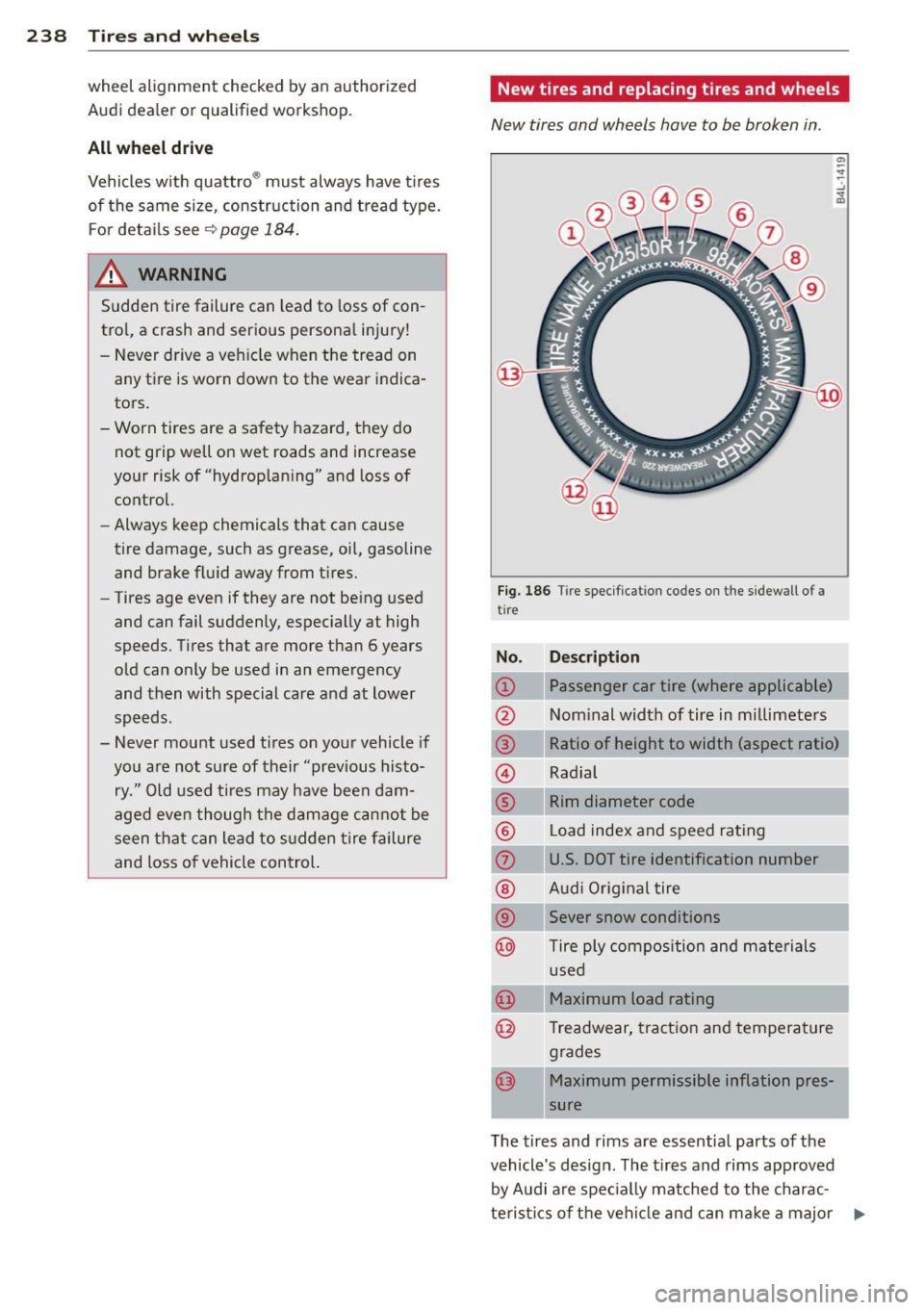
Fig. 186 Tir e specificat ion c odes on t he s idewall o f a
t ire
N o. Descri ption
(!) Passenger car tire (where applicable)
@ Nom inal width of tire in millimeters
@ Ratio of height to width (aspect ratio)
© Radial
® Rim diameter code
@ L oad index and speed rating
(J) U.S. DOT tire identification number
@ Audi Orig inal tire
@ Sever snow conditions
@ Tire ply compos ition and mate rials
used
Maximum load rating
Treadwear, traction and temperature
grades
Maximum permissible inflation pres
sure
T he t ires and rims are essential parts of the
vehicle 's design . The tires and rims approved
by Audi are spec ially matched to the charac
teristics of the vehicle and can make a major .,..
Page 242 of 290

24 0 T ire s and wheel s
H up to 130 mph (210 km/h)
V up to 149 mph (240 km/h)l)
Z over 149 mph (240 km/h)ll
W up to 168 mph (270 km/h)
1l
Y up to 186 mph (298 km/h)ll
Your vehicle is norma lly factory equipped with
tires, which possess excellent driving charac
teristics and give your Audi opt imum driving
comfort. An electronic speed limiter
c::> page 29 w ill normally prevent your vehicle
from go ing faste r than the tire speed rating
¢ & .
U.S . DOT Tire Identification Number (TIN)
and tire manufacture date
This is the t ire's "serial number". It beg ins
with the lette rs "DO T" and indicates that the
tire meets all federal standards. The next two
numbers or letters indica te the p lant where it
was manufactured, and the last four numbers
represent the week and year of manufacture .
F or examp le, the numbers 2212 mean that
the tire was produced in the 22nd week of
2012 . The other numbers are marketing co
des that may or may not be used by the tire
manufacturer . This information is used to con
tact consumers if a tire defect requires a re
call.
Audi Original tire
Tires with the ident ificat ion "AO" or "RO" have
been spec ially matched with your Aud i. We
recommend using only these tires because
they meet the highest standards regard ing
safety and d riving character istics when used
correctly. Yo ur au tho riz ed Audi dealer will
g lad ly provide you with more information.
Tire ply composition and materials used
The number of pl ies ind icates the numbe r of
l ayers of rubber-coated fabric in the t ire. In
general, the g rea ter the numbe r of p lies, the
mo re weig ht a t ire can support. Tire man ufac
turers a lso must indicate the materials in the
ll For tir es w it h a m ax im um spee d ca pabil ity ove r
1 4 9 mp h (2 40 k m/h) , t ire ma nufact urers somet imes
u se the lette rs "ZR. "
tir e, which include stee l, nylon, po lyester, and
others .
Maximum Load Rating
This number ind icates the maximum load in
k ilog rams and po unds t hat can be ca rr ied by
the tire .
Tire quality grading for treadwear ,
traction, and temperature resistance
T read wear, tra ct ion and tempera ture grades
c::>page 241 .
Maximum Permissible Inflation Pressure
This number is the greatest amount of a ir
pressure that should ever be put in the t ire
u nder norma l dr iv ing cond itions .
_& WARNING
- Using incorrect o r unm atc hed tires and/
or wheels or improper tire and wheel
combinat ions can lead to loss of control
'
collis ion and serio us personal i nju ry .
- A lways use t ires, rims and whee l bolts
that meet the specifications of origina l
factory- insta lled tires or other combina
tions that have been specifically ap proved by the vehicle manufacturer.
- Tires age even if they are not being used
and can fai l sudden ly, especially at hig h
speeds. Tires that are more than 6 yea rs
old can only be used in an emergency
and then w it h specia l care and at lower
speeds.
- Never mo unt used tires on your veh icle if
you are not sure of the ir "previo us histo
ry." O ld used tires may have been dam
a ged even thoug h the damage cannot be
seen that can lead to sud den tire fa ilure
and loss of vehicle control.
- All fo ur whee ls must be fitted with r adial
tires of the same type, size (rolling cir
cumference) an d the same tread pattern .
Driving with different tires reduces ..,_
Page 244 of 290
24 2 T ire s and wheel s
Traction
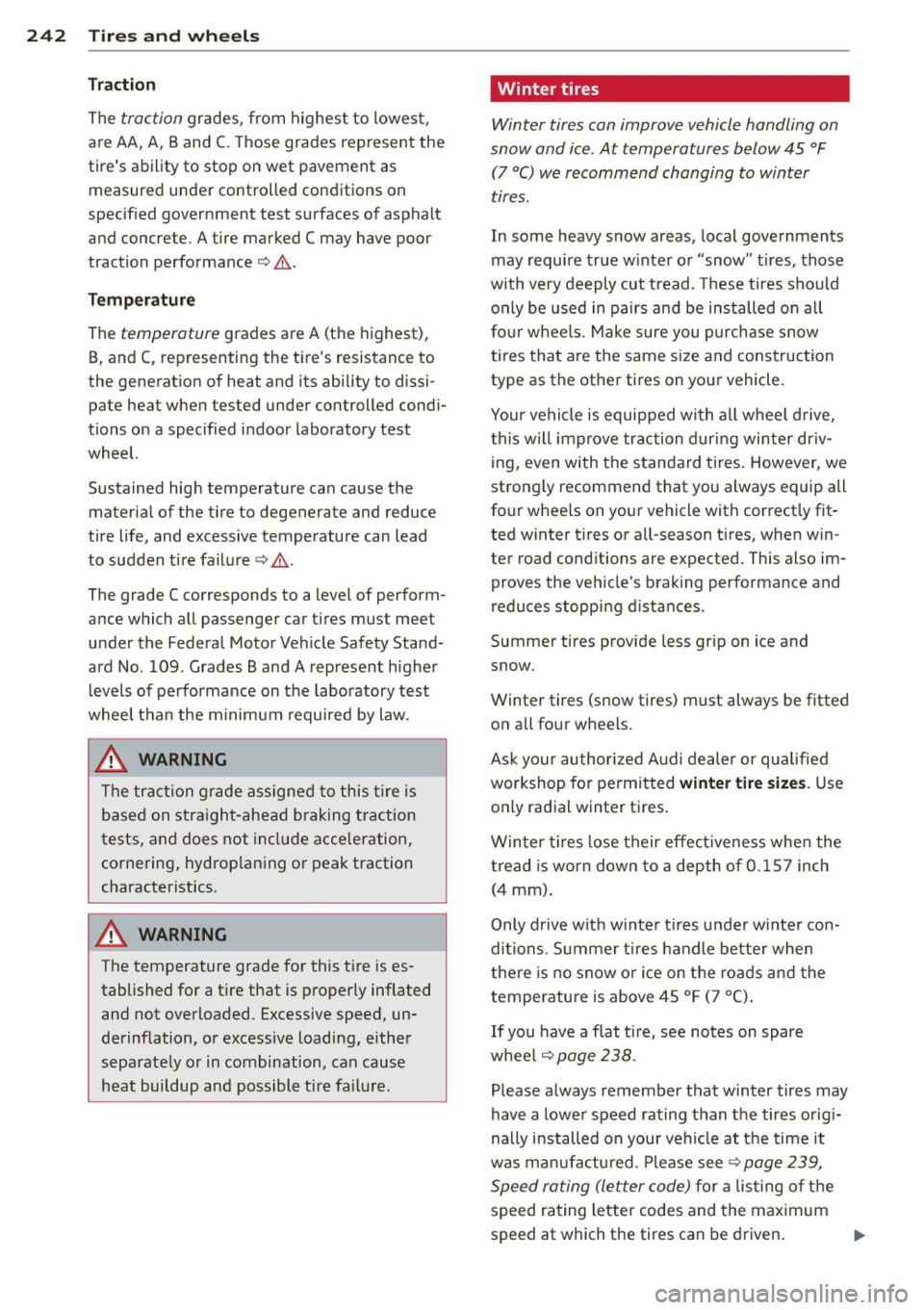
The traction grades, from highest to lowest,
are AA, A, Band
C. T hose grades represent the
tire's ability to stop on wet pavement as measured under controlled conditions on
specified government test surfaces of asphalt
and concrete. A tire marked C may have poor
traction performance
c:> .&. .
Te mp eratu re
The temperature grades are A (the highest),
B, and
C, representing the tire's resistance to
the generation of heat and its ability to dissi
pate heat when tested under con trolled condi
tions on a specified i ndoor laboratory test
wheel.
Sustained high temperature can cause the
material of the tire to degenerate and reduce
tire life, and excessive temperature can lead
to sudden tire failure
c:> ,& .
The grade C corresponds to a level of perform
ance which all passenger car tires must meet under the Federal Motor Veh icle Safety Stand
ard No .
109 . Grades Band A represent h igher
l eve ls of performance on the laboratory test
wheel than the m inimum required by law.
.&_ WARNING
T he traction grade assigned to this t ire is
based on straight-ahead braking traction
tests, and does not include acceleration,
cornering, hydrop laning or peak traction
characteristics.
A WARNING
The temperature grade for this tire is es
tablished for a t ire that is properly inflated
and not overloaded. Excessive speed, un
derinflation, or excessive loading, either
separately or in combination, can cause
heat buildup and possible tire fa ilu re.
-
Winter tires
Winter tires can improve vehicle handling on
snow and ice . At temperatures below 45 °F
(7 °C) we recommend changing to winter
tires.
In some heavy snow areas, local governments
may require true w inter o r "snow" t ires, those
with very deeply cut tread . T hese tires should
o n ly be used in pairs and be installed on a ll
f o ur wheels . Make sure you purchase snow
ti res that are the same size and construction
type as the other tires on yo ur vehicle.
You r vehicle is equipped with al l wheel d rive,
th is will improve traction d uring win ter driv
ing, even with the standard tires. However, we
strong ly recommend that you always equip all
fo ur wheels on your vehicle with correctly fit
ted winter tires or a ll-season tires, when win
ter road cond itions are expected. This also im
proves the veh icle's brak ing performance and
reduces stopping d istances .
Summer tires provide less grip on ice and
snow.
Winter tires (snow tires) must always be fitted on all fo ur whee ls .
Ask your authorized A udi dealer or qualified
workshop for permit ted
w in ter ti re size s. Use
only radial winter tires .
Winter tires lose their effec tivenes s when the
tread is wo rn down to a depth of
0 .157 inch
(4 mm) .
Only d rive w ith w inter t ires under w inte r co n
ditions. S ummer t ires handle bette r when
there is no snow o r ice on the roads and the
temperature is above 45 °F (7 °C) .
If you have a flat ti re, see notes on spare
whee l
c:> page 238 .
Please always remember that winter tires may
have a lower speed rating than the tires origi
nally installed on your vehi cle at the time it
was ma nufactu red. P lease see
c:> page 239,
Speed rating (Letter code)
for a lis ting o f the
speed rating lette r codes and the max imum
speed at which the tires can be driven . ..,.
Page 245 of 290
The speed rating letter code (c::> page 230) is
on the side wall of the tire
c::> page 238.
A WARNING
Winter tires have maximum speed limits
that may be lower than your vehicle's max
imum speed . Always know the maximum
speed before driving off. Never drive faster
than the speed permitted for your specific
winter tires . This will cause damage to the
tires leading to an accident and serious
personal injury to you and your passen
gers.
A WARNING
Driving faster than the maximum speed
for which the winter tires on your vehicle
were designed can cause tire failure in cluding a blowout and sudden deflation,
loss of control, crashes and serious per
sonal injuries . Have worn or damaged tires
replaced immediately.
- Winter tires have maximum speed rating
that may be lower than your vehicle's
maximum speed .
- Never drive faster than the speed for
which the winter or other tires installed
on your vehicle are rated .
A WARNING
Always adjust your driving to the road and
traffic conditions. Never let the good ac
celeration of the winter tires and all wheel
drive tempt you into taking extra risks . Al
ways remember :
- When braking, an all wheel drive vehicle
handles in the same way as a front drive
vehicle.
- Drive carefully and reduce your speed on
icy and slippery roads, even winter tires
cannot help under black ice conditions.
@l For the sake of the environment
Use summer tires when weather condi
tions permit. They are quieter, do not wear
as quickly and reduce fuel consumption.
Tires and wheels 243
Snow chains
Snow chains may be fitted only to the front
wheels , and only to certain tire sizes. Ask your
authorized Audi dealer on which tire sizes
snow chains can be used.
The snow chains must have low-profile links
and must not be thicker than 0.53 inch
(13.S mm) , including the lock.
Remove wheel center covers and trim discs
before putting snow chains on your vehicle
c::> 0 . For safety reasons cover caps must then
be fitted over the wheel bolts. These are avail
able from authorized Audi dealers.
A WARNING
~ Using the wrong snow chains for your vehi
cle or installing them incorrectly can in
crease the risk of loss of control leading to
serious personal injury.
- Snow chains are available in different sizes . Always make sure to follow the in
structions provided by the snow chain
manufacturer.
- When driving with snow chains never
drive faster than the speed permitted for
your specific snow chains .
- Always observe local regulations.
(D Note
- Remove snow chains before driving on
roads not covered with snow to avoid
damaging tires and wearing the snow
chains down unnecessarily.
- Snow chains, which come into direct con
tact with the wheel rim, can scratch or
damage it. Therefore, make sure that the
snow chains are suitably covered. Check
the position of the snow chains after
driving a few yards and correct if neces
sary. Follow the instructions from the
snow chain manufacturer when doing so.
(D Tips
Where snow chains are mandatory on cer
tain roads, this normally also applies to
vehicles with all wheel drive .
•
•
Page 247 of 290
-Drive carefully on roads with potholes, deep
gullies or ridges. The impact from driving
thro ugh or over such obstacles can damage
your tires. Impact with a curb may also cause damage to your tires.
- After any impact, immediately inspect your
tires or have them inspected by the nearest
authorized Aud i dealer. Replace a damaged
t ire as soon as possible .
- Inspect your t ires every 2,000 miles (3,000
km) for damage and wear . Damage is not al
ways easy to see . Damage can lead to loss of
air and underinflation, wh ich could eventu
ally cause ti re fail ure. If you be lieve that a
t ire may have been damaged , replace the
t ir e as soon as possible.
- These tires may wea r more q uick ly than oth
ers.
- Please also remember that, wh ile these t ires
deliver respons ive handling, they may ride
less comfortably and make mo re noise than
othe r choices .
Reduced performance in winter /cold
season condit ions
All t ires are des igned for certa in pu rposes.
The low aspect ratio, ultra high pe rformance
tires originally installed o n your vehicle are in
tended for max imum dry and wet road per
formance and handling . They are not suitable
for cold, snowy or icy weather condit ions. If
you dr ive under those circumstances, you
should equip your veh icle with all-season or
winter t ires, which offer better traction under
those cond itions . We suggest you use the re c
ommended snow or all-season tires specified
for your ve hicl e, or their equ ivalent .
Refer to~
page 242 for more deta iled info r
mat ion regarding win ter t ires.
Tire pressure
monitoring system
U) General notes
Ap plies to vehicles: with tire pressure monitoring system
Each t ire , includ ing the spare (if provided),
should be che cked mo nth ly when cold and in-
Tire s an d wheel s 245
flated to the inflation pressure recommended
by the vehicle man ufact urer on the vehicle
placard or tire inflat ion pressure labe l. (If your
vehicle has tires of a different size than the
s ize indicated o n the vehicle placard or tire in
flat ion pressure labe l, you shou ld determine
the proper t ire inflation pressu re for those
tires) .
As an added safety feature, your veh icle has
been equipped with a tire pressure monitoring
system ( TPMS) that illum inates a low tire
pr essure te lltale when one o r more of you r
tir es is s ignificant ly unde r-inflated. Acco rding
ly, when the low tire pressure tell tale illumi
nates, you shou ld stop and check you r tires as
soon as possib le, and inflate them to the
proper pressure . Driving on a significant ly un
der- inflated t ire causes the tire to overheat
and can lead to tire fa ilure. Under-inflation al
so reduces fuel effic iency and tire tread life,
and may affect the vehicle's hand ling and
stopp ing abil ity .
Please note that the TPMS is not a substit ute
for proper tire ma intenance, and it is the driv
er 's respons ibility to maintain correct tire
pressure, even if under-inflation has not
reached the level to tr igger illuminat ion of the
T PMS low ti re p ressu re tellta le.
Your vehicle has also been equipped with a
T PMS ma lfunction ind icator to ind icate when
the system is not operating p rope rly . T he
T PMS ma lfun ction indicator is comb ined w ith
the low tire pressure te lltale . Whe n the sys
tem detects a malfunc tion, the telltale will
flash for approximate ly one mi nute and then
remain continuously i lluminated. T his se
quence will continue upon subsequent vehicle
start-ups as long as the malfunct ion exists .
When the malfunction indicato r is illum inat
ed, the system may not be ab le to detect or
s ignal low tire pressure as intended. TPMS
malfu nctions may occur for a var iety of rea
sons, including the installation of replace
ment or a lternate tires or wheels on the vehi
cle that p revent the TPMS from functioning
properly. Always check the TPMS malfunction
t e llt ale after rep laci ng one or more tires o r ..,.
•
•