airbag AUDI A5 CABRIOLET 2014 User Guide
[x] Cancel search | Manufacturer: AUDI, Model Year: 2014, Model line: A5 CABRIOLET, Model: AUDI A5 CABRIOLET 2014Pages: 286, PDF Size: 70.4 MB
Page 125 of 286
~ Always keep both feet in the footwell so
that you are in control of the vehicle at all
times .
F or detai led information on how to adjust the
driver's seat, see
c:;, page 61.
A WARNING
Drivers who are unbelted, out of position
or too close to the airbag can be ser iously
injured by an airbag as it unfolds. To help
reduce the risk of serious personal injury :
- Always adjust the dr iver's seat and the
steering wheel so that there are at least
10 inches (25 cm) between your breast
bone and the steering wheel.
- Always hold the steering wheel o n the
outside of the steering wheel rim with
your hands at the 9 o'clock and 3 o'clock posit ions to he lp red uce the risk of pe r
sonal in jury if the drive r's airbag inflates.
- Never hold the steer ing whee l at the
1 2 o'clock posit ion or w it h your hands at
other pos it ions inside the steering wheel
rim or on the stee ring wheel h ub. Hold
ing the steering wheel the wrong way
can cause serious injuries to the hands,
arms and head i f the driver 's airbag de
ploys.
- Pointing the steering whee l toward your
face decreases the ab ility o f the supp le
menta l dr iver's airbag to protect you in a
co llision.
- Always s it in an upright position and nev
er lean against or place any part of your
body too close to the a rea where the air
bags are located.
- Before driv ing, a lways ad just the front
seats and head restra ints prope rly and
make s ure that all passengers are prop
er ly restrained.
- Never adjust the seats while the vehicle
is moving . Your seat may move unexpect
edly and you could lose control of the ve
hicle.
- Never drive with the backrest recl ined o r
t il ted far ba ck! T he farther the ba ck rests
are t ilted back, the greate r the ris k of in-
Dr iving S afel y 123
jury due to incorrect pos itioning of the
safety belt and improper seating posi
tion.
- Ch ildren must a lways ride in ch ild safety
seats
c:;, page 161. Special precaut ions
apply when installing a child safety seat
on the front passenger seat
c:;, page 140.
Proper seating position for the front
passenger
The proper front passenger seating position
is important for safe, relaxed driving.
For your own safety and to reduce the risk of
injury in the event of an accident, we recom
mend that you adjust the seat for the front
passenger to the following position:
~ Move the front passenger seat back as far as
possible . There must be a m inimum of
1 0 i nches (25 cm) between the breastbone
and the ins trument panel
c:;, &, .
~ Adjust t he a ngle of the seatbac k so that it is
in an upr igh t position and yo ur ba ck comes
in full contact wit h it whenever the vehicle is
moving.
~ Applies to vehicles with adjustab le head re
straints: Adjust the head restraint so the up
per edge is as even as possible wit h the top
of your head. If that is not possib le, try to
adjust the head restraint so that it is as
close to this pos it ion as poss ible.
~ Keep both feet flat on the floor in front of
t he fron t passenger seat .
~ Fasten and we ar safe ty be lts cor re ctly
c:;, page 135.
For detailed information on how to adj ust the
fron t passenger's seat, see
c:;, page 60.
A WARNING
-
Front seat passengers w ho are un belted,
out of posi tion or too close to the airbag
can be ser iously injured or killed by the air
bag as it unfolds. To help reduce the risk of
serious personal injury:
•
•
Page 126 of 286
124 Driving Safely
-Passengers must always sit in an upright
position and never lean against or place
any part of their body too close to the
area where the airbags are located.
- Passengers who are unbelted, out of po
sition or too close to the airbag can be
seriously injured by an airbag as it un
folds with great force in the blink of an
eye.
- Always make sure that there are at least
10 inches (25 cm) between the front
passenger's breastbone and the instru
ment panel.
- Each passenger must always sit on a seat
of their own and properly fasten and
wear the safety belt belonging to that
seat.
- Before driving, always adjust the front
passenger seat and head restraint prop
erly.
- Always keep your feet on the floor in
front of the seat. Never rest them on the
seat, instrument panel, out of the win
dow, etc. The airbag system and safety
belt will not be able to protect you prop
erly and can even increase the risk of in
jury in a crash.
- Never drive with the backrest reclined or
tilted far back! The farther the backrests
are tilted back, the greater the risk of in
jury due to incorrect positioning of the
safety belt and improper seating posi
tion.
- Children must always ride in child safety
seats
c::> page 161 . Special precautions
apply when installing a child safety seat
on the front passenger seat<=:>
page 140.
Proper seating positions for passengers
in rear seats
Rear seat passengers must sit upright with
both feet on the floor consistent with their
physical size and be properly restrained
whenever the vehicle is in use.
To reduce the risk of injury caused by an incor
rect seating position in the event of a sudden
braking maneuver or an accident, your pas -sengers on the
rear bench seat must always
observe the following:
" Make sure that the seatback is securely
latched in the upright position <=:>
page 67.
"Keep both feet flat in the footwell in front of
the rear seat.
" Fasten and wear safety belts properly
<=:>
page 135 .
"Make sure that children are always properly
restrained in a child restraint that is appro
priate for their size and age ¢
page 161.
,&. WARNING
Passengers who are improperly seated on
the rear seat can be seriously injured in a
crash.
- Each passenger must always sit on a seat
of their own and properly fasten and
wear the safety belt belonging to that
seat .
- Safety belts only offer maximum protec
tion when the seatback is securely latch
ed in the upright position and the safety
belts are properly positioned on the body. By not sitting upright, a rear seat
passenger increases the risk of personal
injury from improperly positioned safety
belts!
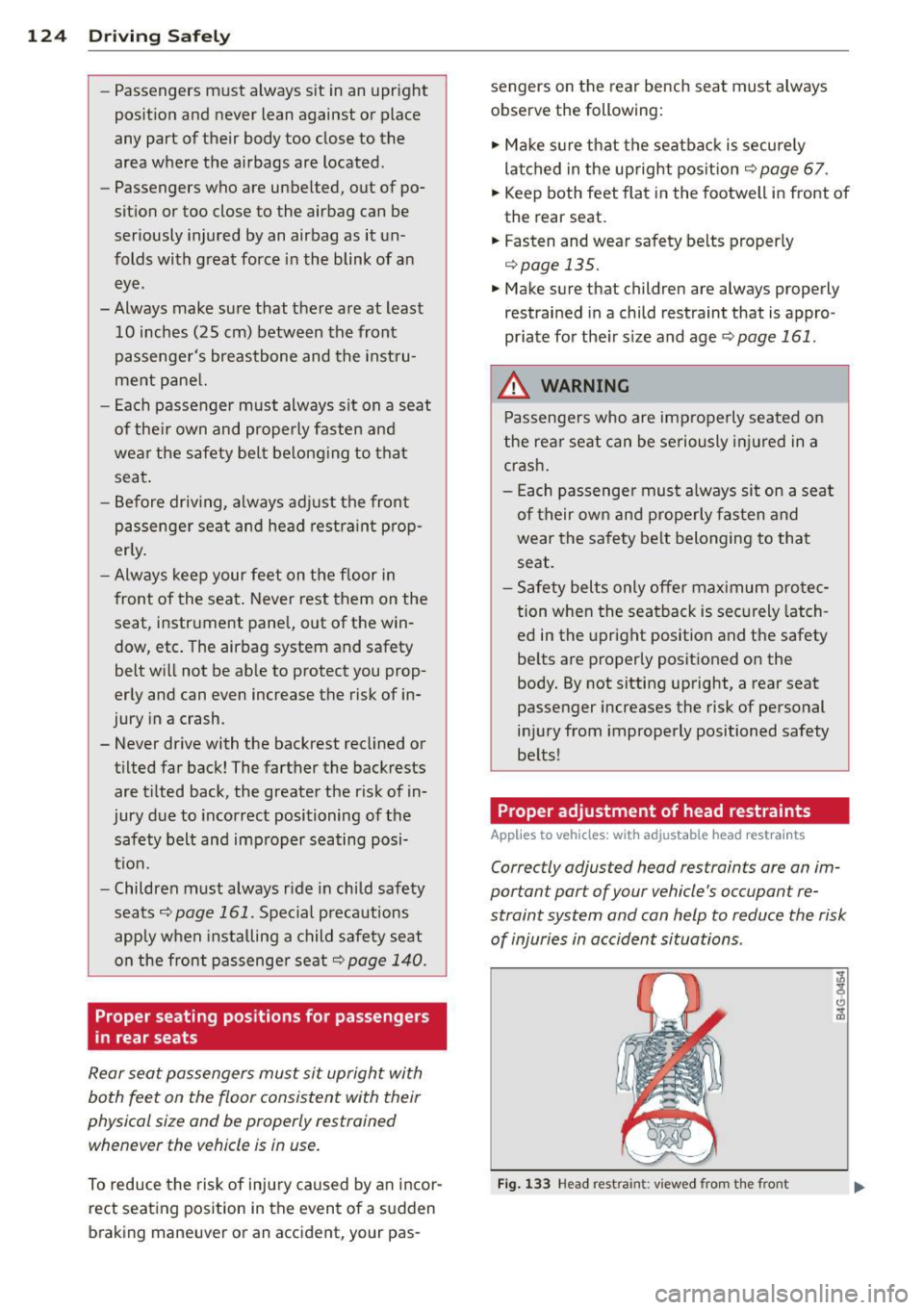
Proper adjustment of head restraints
-
App lies to vehicles: with adjustable head restraints
Correctly adjusted head restrain ts are an im
portant part of your vehicle 's occupant re
straint system and can help to reduce the risk
of injuries in accident situations .
Fig. 133 Head restra int: v iewed from the front
Page 128 of 286
126 Driving Saf ely
Driver and passenger
side footwell
Important safety instructions
Appl ies to vehicles: with knee airbags
A WARNING
Always make sure that the knee a irbag can
inflate without interference . Objects be
tween yourself and the airbag can increase
the risk of injury in an acc ident by inte rfer
ing w ith the way the a irbag deploys or by
being p ushed into you as the airbag de
ploys .
- No persons (ch ildren) or animals should
ride in the footwell in front of the pas
senger seat. If the airbag deploys, this
can res ult in serious or fata l injuries .
- No objects of any k ind sho uld be carried
in the footwe ll area in front of the driv
er's or passenger's seat . Bulky objects
(shopping bags, for example) can ham
per or prevent proper deployment of the
airbag . Small objects can be thrown
through the vehicle if the airbag deploys
and injure you o r your passengers .
Pedal area
Pedals
The pedals must always be free to move and
must never be interfered with by a floor mat
or any other object.
M ake sure tha t all pedals move freely witho ut
i nte rfe rence and that nothing prevents them
from retu rning to the ir origina l posi tions.
Only use floo r mats that leave the peda l area
free and can be secured wit h floor mat fasten
e rs.
If a b rake circuit fails, increased b rake pedal
trave l is required to bring the vehicle to a full
stop.
A WARNING
Pedals that cannot move free ly can cause
l oss of veh icle control and increase the risk
of ser ious injury .
- Never p lace any objects in the drive r's
footwell . An object cou ld get into the
pedal area and inte rfe re with pedal func
tion . In case of sudde n brak ing o r an ac
cident, yo u wo uld not be a ble to brake or
acceler ate !
- Always ma ke s ure that no thing can fall
or move into the driver's footwel l.
Floor mats on the driver side
Always use floor mats that can be securely
attached to the floor mat fast eners and do
not interfere with the free movement of the
pedals.
.. Make s ure that the floor mats are prope rly
secured and canno t move and in terfere with
t he peda ls
£:=? &, .
Use on ly f loor mats that leave the pedal area
u nobst ructed and that are firmly secu red so
t h at t hey cannot slip o ut of position . You ca n
obta in suitab le floor mats from yo ur autho r
ized Audi dea ler .
Floor mat fastene rs are insta lled in your Audi.
Floor mats used in your vehicle must be at
tached to these fastene rs. Prope rly securing
the floor mats will prevent them from sliding
i nto posi tions that cou ld interfere with the
peda ls o r impa ir safe ope rat io n of yo ur vehicle
i n othe r ways.
A WARNING
Pedals that cannot move free ly can result
in a loss of vehicle control and inc rease the
risk of ser ious persona l injury .
- Always make sure that floor mats are properly secu red.
- Never p lace or ins tall floor mats o r othe r
floor coverings in the vehicle that cannot
be properly secured in p lace to prevent
them from slipping and interfer ing with
lill>
Page 136 of 286
134 Safety belts
with the vehicle interior has all the energy
they had just before the crash.
Never rely on airbags alone for protection.
Even when they deploy, airbags provide only
additional protection. Airbags are not sup
posed to deploy in all kinds of accidents. Al
though your Audi is equipped with airbags, all
vehicle occupants, including the driver, must
wear safety belts correctly in order to mini
mize the risk of severe injury or death in a
crash.
Remember too, that airbags will deploy only
once and that your safety belts are always
there to offer protection in those accidents in
which airbags are not supposed to deploy or when they have already deployed . Unbelted
occupants can also be thrown out of the vehi
cle where even more severe or fatal injuries
can occur.
It is also important for the rear passengers to
wear safety belts correctly. Unbelted passen
gers in the rear seats endanger not only them
selves but also the driver and other passen
gers~
fig. 143. In a frontal collision they will
be thrown forward violently, where they can
hit and injure the driver and/or front seat pas
senger.
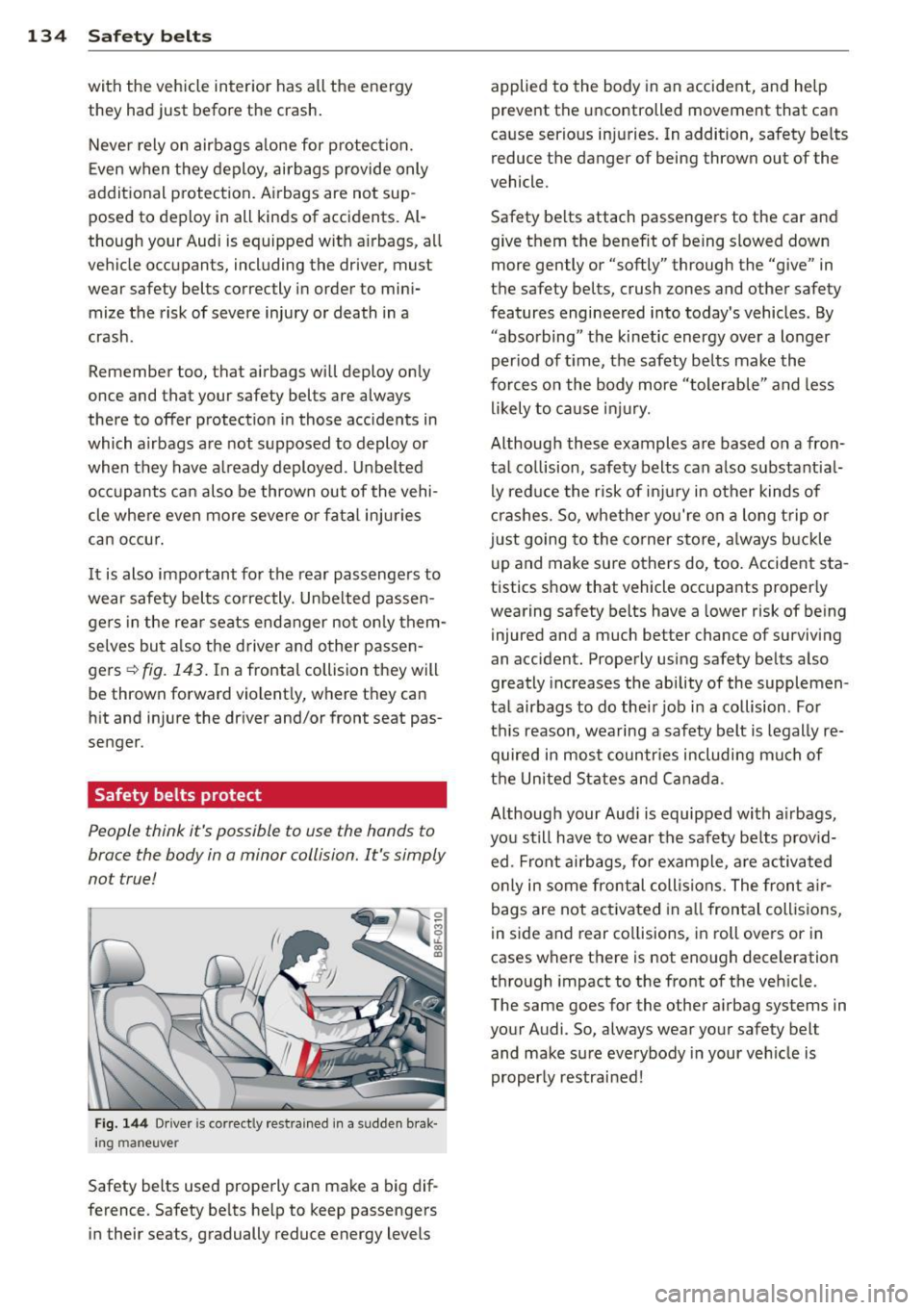
Safety belts protect
People think it's possible to use the hands to
brace the body in a minor collision. It's simply
not true!
Fig. 144 Driver is correctly restra ined in a sudden brak·
ing maneuve r
Safety belts used properly can make a big dif
ference . Safety belts help to keep passengers
in their seats, gradually reduce energy levels applied to the body in an accident, and help
prevent
the uncon trolled movement that can
ca use serious injuries. In addition, safety belts
reduce the danger of being thrown out of the
vehicle .
Safety belts attach passengers to the car and
give them the benefit of being slowed down
more gently or "softly" through the "give" in
the safety belts, crush zones and other safety
features engineered into today's vehicles. By
"abso rbing" the kinetic energy over a longer
period of time, the safety belts make the
forces on the body more "tolerable " and less
likely to cause injury .
Although these examples are based on a fron
tal collision, safety belts can also substantial ly reduce the risk of injury in other kinds of
crashes. So, whether you're on a long trip or
just going to the corner store, always buckle
up and make sure others do, too. Accident sta
tistics show that vehicle occupants properly
wearing safety belts have a lower risk of being
injured and a much better chance of surviving
an accident. Properly using safety belts also
greatly increases the ability of the supplemen
tal airbags to do their job in a collision. For
this reason, wearing a safety belt is legally re
quired in most countries including much of
the United States and Canada .
Although your Audi is equipped with airbags,
you still have to wear the safety belts provid
ed. Front airbags, for example, are activated
only in some frontal collisions. The front air
bags are not activated in all frontal collisions,
in side and rear collisions, in roll overs or in
cases where there is not eno ugh deceleration
through impact to the front of the vehicle.
The same goes for the other airbag systems in
your Audi. So, always wear your safety belt
and make sure everybody in your vehicle is
properly restrained!
Page 140 of 286
138 Safet y belt s
A WARNING
Improperly positioned safety belts can
cause serious personal injury in an acci
dent .
- Expectant mothers must always wear the
lap portion of the safety belt as low as
poss ible across the pelv is and be low the
rounding of the abdome n.
- Always read and heed all WARNINGS and
other important information
Q &. in Fas
tening safety belts on page 136.
Unfastening safety belts
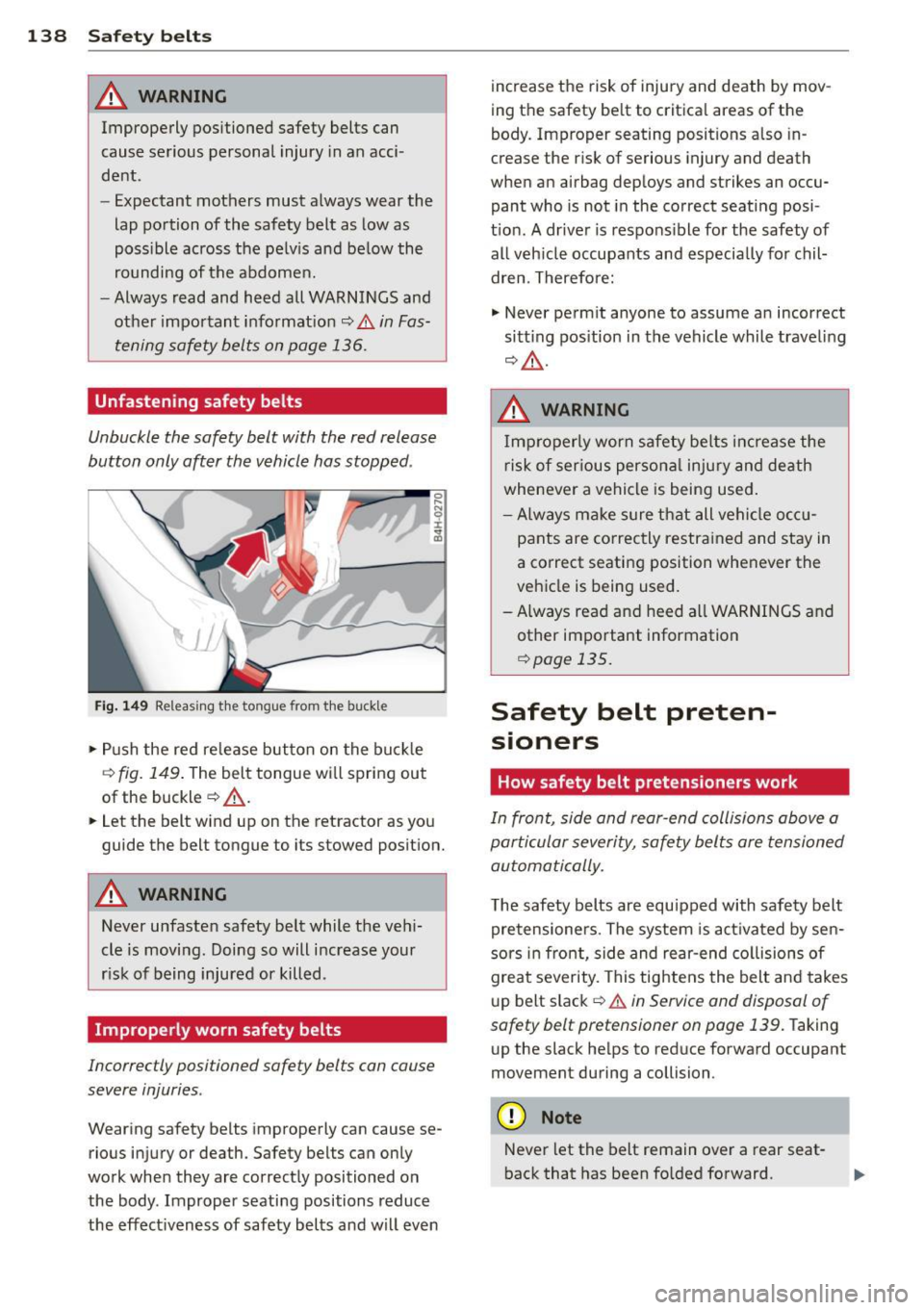
Unbuckle the safety belt with the red release
button only after the vehicle has stopped .
'lJJ
Fig. 149 Relea sing the to ngue from t he buckle
.. Push the red re lease but ton on the buck le
Q fig. 149 . The belt tongue wi ll spring out
of the buckle
Q .&_ .
.. Let the belt wind up on the retractor as you
guide the belt tongue to its stowed position.
A WARNING
Never unfasten safety belt while the veh i
cle is moving. Doing so will increase your
r isk of being injured or killed .
Improperly worn safety belts
Incorrectly positioned safety belts can cause
severe injuries .
Wearing safety belts improperly can cause se
rious injury or death. Safety belts can only
work when they are correctly positioned on the body . Improper seating positions reduce
the effectiveness of safety belts and wi ll
even
increase the risk of injury and death by mov
ing the safety be lt to critica l areas of the
body. Improper seating positions also in
crease the r isk of serious injury and death
when an airbag deploys and strikes an occu pant who is not in the correct seating posi
t ion. A driver is responsible for the safety of
all veh icle occupants and especially for chil
dren. Therefore:
.,. Never perm it anyone to assume an incorrect
sitt ing pos ition in the vehicle while traveling
Q A .
A WARNING
Improperly worn safety be lts inc rease the
risk of ser ious persona l inju ry and death
whenever a vehicle is being used.
- Always ma ke sure that all vehi cle o cc u
pants are correctly restra ined and stay in
a correct seating position whenever the
vehicle is being used.
- A lways read and heed all WARNINGS and
other important information
Q page 135.
Safety belt preten-
• s1oners
How safety belt pretensioners work
In front, side and rear-end collisions above a
particular severity, safety belts are tensioned
automatically.
The safety belts are equipped with safety belt
pretensioners. The system is activated by sen
sors in front, s ide and rear-end collisions of
great severity. This tightens the belt and takes
up belt slack
Q .&. in Service and disposal of
safety belt pretensioner on page 139.
Taking
up the slack he lps to reduce fo rward occupant
movement during a collision .
(D Note
Never let the belt remain over a rear seat
back that has been fo lded forward.
Page 141 of 286
@ Tips
The safety belt pretensioner can only be
activated once .
- In mino r frontal and side collisions, in
rear-end collisions and in accidents in
volving very little impact force, the safe
ty belt pretens ioner are not activated .
- When the safety be lt pretensioners are
activated, a fine dust is released. This is
norma l and is not caused by a fire in the
vehicle.
- The relevant safety requirements must
be observed when the vehicle or compo
nents of the system are scrapped . An au
thorized Audi dealer or qua lified work
shop is fam iliar with these regulations
and will be p leased to pass on the infor
mation to you.
- Be sure to observe all safety, environ
mental and othe r regula tions if the vehi
cle or individ ual pa rts of the system, par
ticularly the sa fety belt or airbag, are to
be disposed. We recommend you have
your a uthorized Audi dea ler perform this
serv ice for you .
Service and disposal of safety belt
pretension er
The safety belt pretensioners are pa rts of the
safety belts on you r Audi . Installing, remov
i n g, servicing or repa iring of belt prete nsion
ers can damage the safety be lt system and
p revent it from work ing correct ly in a colli
sion.
There are some impor tant thi ngs you have to
know to make sure that the effectiveness of
the system will not be impaired and that dis
carded components do not cause injury or po l
l ute the env ironment.
A WARNING
Improper care, servicing and repair proce
dures can increase the risk of personal in
jury and death by preventing a safety belt pretens ione r from act ivat ing when needed
or act ivat ing it unexpectedly:
Sa fety belts 139
- The belt pretensioner system can be act i
vated only once. If be lt pretensioners
have been activated, the system m ust be
replaced.
- Never repair, adjust, or change any parts
of the safety be lt system.
- Safety belt systems incl uding safety belt
pretens ioners cannot be repaired. Spe
cial procedures are required for removal, installation and d isposal of th is system .
- For any work on the safety belt system,
we strongly recommend that you see
your author ized Audi dealer or qualif ied
technician who has an Audi approved re pa ir manua l, train ing and spe cial eq uip
ment necess ary.
@ For the sake of the environment
Undeployed airbag modules and p reten
sioners might be classified as Perchlorate Materia l - specia l handli ng may apply, see
www .dtsc.c a.gov/h azardouswaste/per
ch lor ate. When the veh icle or parts o f the
restraint system including airbag modules
safety be lts with pretensioners are scrap
ped, a ll applicable laws and regulations
must be observed. Your authorized A udi
dealer is familiar with these requirements
and we recommend that you have your
dealer perform th is service fo r you.
•
•
Page 142 of 286
140 Airbag system
Airbag system
Important things to know
Importance of wearing safety belts and
sitting properly
Airbags are only supplemental restraints. For
airbags to do their job , occupants must al
ways properly wear their safety belts and be
in a proper seating position.
F or your safety and the safety of your passen
gers, before driving off, always:
• Adjust the driver's seat and steering wheel
properly ¢
page 122,
• Adjust the front passenger's seat properly
r=; page 61,
• Wear safety be lts properly ¢ page 135,
• Always properly use the proper child re-
straint to protect children ¢
page 161.
In a collision airbags must inflate within the
blink of an eye and with considerable force.
The supplemental airbags can cause injuries if
the dr iver or the front seat passenger is not
seated properly . Therefore in order to help the
a ir bag to do its job, it is important, both as a
d river and as a passenger to sit prope rly at all
times.
By keeping room between your body and the
steering wheel and the front of the passenger
compartment, the airbag can inflate fully and
comp letely and provide supplemental protec
tion in ce rtain frontal collisions
¢page 122,
Proper occupant seating positions.
F or details
on the operation of the seat adjustment con
t rols ¢
page 61.
It's especially important that children are
properly restrained ¢
page 161.
There is a lot that the driver and the passen
ge rs can and must do to help the individua l
safety features installed in your A udi work to
gether as a system.
Proper seating pos ition is important so that
the front airbag on the driver side can do its
job. If yo u have a physical impa irment or con- dition that
prevents you from sitting properly
on the driver seat with the safety belt properly
fastened and reaching the pedals , spec ial
modif ications to your vehicle may be necessa
ry.
Contact your a uthorized Audi dealer, or call
Audi C ustomer Relations at 1-800-822-2834 .
When the airbag sys tem dep loys , a gas gener
ator will f ill the airbags, break open the pad
ded covers, and inflate between the steering
whee l and the driver and between the instru
ment pane l and the front passenger. The air
bags will deflate immediately after deploy
ment so that the front occupants can see
th rough the windshield aga in without inter
ruption .
All of this takes place in the blink of an eye, so
fast that many people don't even realize that
the a irbags have deployed . The airbags also
inflate with a great deal of force and nothing
shou ld be in their way when they deploy.
Front airbags in comb ination with prope rly
worn safety belts slow down and limit the oc
cupant's forward movement. Together they
help to prevent the driver and front seat pas
senger from hitting parts of the inside the ve
hicle while reducing the forces acting on the
occupant dur ing the crash. In this way they
help to reduce the risk of injury to the head
and upper body in the crash . A irbags do not
protect the arms or the lower parts of the
body.
Both front a irbags w ill not inflate in all fronta l
collisions . The triggering of the airbag system
depends on the vehicle deceleration rate
caused by the collision and registered by the
electron ic control unit. If this rate is below
the reference value programmed into the con
trol unit, the airbags will not be triggered ,
even though the car may be bad ly damaged as
a result of the co llision . Vehicle damage, re
pair costs or even the lack of veh icle damage
is no t necessarily an indication of whether an
airbag should inflate or not .
It is not possib le to define a range of vehicle
speeds that w ill cover every possib le kind and .,.
Page 143 of 286
angle of impact that will always trigger the
airbags, since the circumstances will vary con
siderably between one collision and another.
Important factors include, for example, the nature (hard or soft) of the object which the
car hits, the angle of impact, vehicle speed,
etc. The front airbags will also not inflate in
side or rear collisions, or in ro ll-overs .
Alwa ys rem ember : Airbags will deploy only
once, and only in certa in kinds of collisions .
Your safety belts are always there to offer pro
tection in those s ituations in which airbags
are not supposed to deploy , or when they have
a lready deployed ; fo r example , when yo ur ve
h icle strikes or is struck by another after the
first collision .
This is just one of the reasons why an a irbag is
a supplementary restra int and is not a s ubst i
tute for a safety belt . The airbag system
works most effectively when used with the
safety belts. Therefore, always properly wear
your safety belts
¢ page 132.
A WARNING
Sitting too close to the steer ing wheel or
instrument panel will decrease the effec
tiveness of the airbags and will increase
the risk of pe rsonal injury in a co llision .
- Never sit closer than
10 inches (25 cm)
to the stee ring wheel or instrument pan
el.
- If you cannot sit more than
10 i nches
(25 cm) from the steer ing whee l, investi
gate whether adaptive equipment may
be available to help you reach the pedals
and increase your seating dis tance from
the steering wheel.
- If you are unrestrained, lean ing fo rward,
sitting sideways or out of position in any
way, yo ur risk of inj ury is much highe r.
- You w il l also receive serio us inju ries and
cou ld even be killed if you are up against
the airbag or too close to it when it in
flates -even with an Advanced Airbag.
- To reduce the r isk o f injury when an air
bag inflates, a lways wear safety belts
proper ly ¢
page 135, Safety belts .
Airbag system 141
-Always make certain that chi ld ren age 12
or younger a lways ride in the rear seat. If
children are not properly restrained, they may be severe ly inju red or killed when an
airbag inf lates .
- Never let ch ildren ride unrestra ined or
improperly restrained in the vehicle . Ad
just the front seats prope rly.
- Never ride with the backrest reclined.
- Always sit as far as possible from the
steer ing whee l or the instrument pane l
¢page 122.
-Always sit upright with your back against
the backrest of your seat.
- Never p lace your feet on the instrument
panel or on the seat. Always keep both
feet on the f loor in front of the seat to
he lp prevent serio us in juries to the legs
a nd h ips if the airbag inflates.
- Never recline the front passenger 's seat
to tra nsport objects. Items can a lso
move i nto the area of the s ide a irbag or
the front a irbag du ring bra king or in a
sud den maneuve r. Obje cts ne ar the air
bags can become projectiles and cause
injury when an airbag inflates.
_&. WARNING ~
A irbags that have de ployed in a crash must
be replaced.
- Use on ly original equipment airbags ap
proved by Audi and installed by a trai ned
technician who has the necessary too ls
and d iagnost ic equipment to properly re
place any airbag in your vehicle and as
sure system effectiveness in a crash .
- Never perm it salvaged or recycled air
bags to be installed in your vehicle .
Child restraints on the front seat - some
important things to know
.,. Be su re to read t he importa nt information
and head the WARNINGS fo r important de
tails about children and Advanced Airbags
¢ page 161. ..,.
•
•
Page 144 of 286
142 Airbag system
Even though your vehicle is equipped with an
Advanced Airbag System, make certain that
all chi ldren, especially those 12 years and
younger, a lways ride in the back seat properly
restrained for their age and size. The airbag
on the passenger side makes the front seat a potentially dangerous place for a ch ild to ride.
The front seat is not the safest place for a
child in a forward-facing child safety seat. It
can be a very dangerous place for an infant or
a child in a rearward-facing seat.
The Advanced Airbag System in your veh icle
has been certified to comply with the Requ ire
ments of United States Federal Motor Vehicle
Safety Standard 208 as applicable at the time
your vehicle was manufactured.
The Standard requires the front a irbag on the
passenger side to be turned off ("sup
pressed") if a child up to about one year of
age restrained in one of the rear-facing or for
ward -facing infant restraints listed in Federal
Motor Vehicle Safety Standard 208 with which
the Advanced Airbag System in your vehicle
was certified has been installed on the front passenger seat . For a listing of the child re
strai nts that we re used to certify compliance
with the US Safety Standard
r=v page 163.
The PASSENGER AIR BAG OFF light in the in
strument panel te lls you when the front Ad
vanced A irbag on the passenger side has been
turned off by the e lectronic control unit.
Each t ime you turn on the ignition, the
PAS
SENGER AIR BAG OFF
light will come on for a
few seconds and:
- will stay on if the front passenger seat is not
occupied,
- will stay on if there is a small child or child restraint on the front passenger seat,
- wi ll go off if the front passenger seat is oc
cupied by an adult as registered by the
weight-sensing mat
r=v page 150, Monitor
ing the Advanced Airbag System .
The PASSENGER AIR BAG OFF light comes on
when the control un it detects a total weight
on the front passenger seat that requires the
front airbag to be turned off.
If the total weight on the front passenge r
seat is more than that of a typica l 1 year -old
chi ld but less than the weight of a small
adult, the front airbag on the passenger side
can deploy (the
PASSENGER AIR BAG OFF
light does not come on). If the PASSENGER
AIR BAG OFF
light does not come on, the
front airbag on the passenger side has not
been turned off by the electronic con trol unit
and can deploy if the control unit senses an
impact that meets the cond itions stored in its
memory .
For example, the airbag may deploy if:
-a small ch ild that is heav ier than a typical 1
year-old ch ild is on the front passenger seat
( re gard less of whether the child is in one of
the child safety seats listed
r=v page 163), or
- a child who has outgrown ch ild restraints is
on the front passenger seat.
If the front passenger airbag is turned off, the
PASSENGER AIR BAG OFF light comes on in
the instrument cluster and stays on.
The front airbag on the passenger s ide may
not deploy (the PASSENGER AIR BAG OFF
light does not illum inate and stay lit) even if a
small adult or teenager, or a passenger who is
not sitt ing upright with their back against a
non-reclined backrest with their feet on the
vehicle floor in front of the seat is on the front
passenger seat
r=v page 122, Proper seating
position for the driver.
If the front passenger airbag deploys, the
Federal Standard requires the airbag to meet
the "low risk" deployment criteria to reduce
the risk of injury t hroug h interaction with the
airbag. "Low risk" deployment occurs in those
crashes that take place at lower dece lerat ions
as defined in the electronic control unit
r=v page 151, PASSENGER AIR BAG OFF light .
Always remember, a child safety seat or infant
carr ier installed on the front seat may be
struck and knocked out of posit ion by the rap
idly inflat ing passenger's airbag in a frontal
collision . The air bag could greatly reduce the
effectiveness of the ch ild restraint and even
seriously injure the child during inflation .
Page 145 of 286

For this reason, and because the back seat is
the safest place for children - when properly restrained according to their age and size - we
strongly recommend that children always sit in the back seat
Q page 161, Child Safety.
A WARNING
-
A child in a rearward-facing child safety seat installed on the front passenger seat
w ill be seriously injured and can be k illed if
the front a irbag inflates - even with an Ad
vanced Airbag System.
- T he inflating a irbag w ill hit the child
safety seat or infant carrier w ith great
force and w ill smash the ch ild safety sea t
and child against the backrest, cente r
armrest, door or roof .
- Always install rear -facing child safety
seats on the rear seat.
- If you mus t inst all a rearward facing
child safety seat on the front passenger
seat beca use of exceptional circumstan
ces and the
PASSENGER AIR BAG OFF
light does not come on and stay on , im
med iately install the rear-facing child
safety seat in a rear seating posit ion and
have the a irbag system inspected by your
authorized Aud i dealer .
- Forward-fac ing ch ild safety seats instal
led on the front passenger's seat may in
terfe re with the deployment of the air
bag and cause se rious personal injury to
the ch ild.
A WARNING
If, in exceptional c irc umstances, you mus t
install a forwa rd-facing child restra int on
the front passenger's seat:
- Alw ays make sure the forw ard -fac ing
sea t has been des igned and certified by
its manufacturer for use on a front seat
with a passenger front and side airbag.
- Never put the forward -facing child re
straint up aga inst or very near the instru
ment pane l.
- Always move the passenger seat into its
rearmost position in the seat's fore and
A irbag system 143
aft ad justment range, as far away from
the airbag as possible before installing
the forward-fac ing ch ild restraint. The
backrest must be adj usted to an upright
position .
- Make sure that the
PASSENGER AIR BAG
OFF
li ght comes on and stays on all the
time wheneve r the ignit ion is switched
on.
A WARNING
T o reduce the risk of ser ious injury, make
su re that the
PASSENGER AIR BAG OFF
light w ill be displayed whenever a child re
straint is installed on the front passenger
seat and the ignition is switched on.
- If the
PASSENGER AIR BAG OFF light
does not s tay on, per form the checks de
scribed
Q page 150, Monitoring the Ad
vanced Airbag System.
- Take the chi ld restraint off the front pas
senger seat and install it properly at one
of the rear seat positions if the
PASSEN
GER AIR BAG Off light does not stay on.
- Have the airbag system inspected by
your author ized Audi dealer immed iate
ly .
-Always carefu lly follow instr uctions from
child restraint manufacturers when in
stall ing ch ild restra ints .
A WARNING
If, in except iona l circumstances, you must
install a forward or rearward-facing child
restra int on the front passenger's seat :
- Improper instal lation of ch ild restraints
can reduce their effectiveness o r even
prevent them from providing any protec
tion.
- An improper ly installed ch ild restra int
can interfere with the airbag as it de
ploys and seriously i njure o r even kill the
child -even with an Advanced Airbag
System.
- Always carefu lly follow the manufact ur
er 's ins tructions p rov ided with the ch ild
safety seat or carrier . •
•