flat tire AUDI A5 CABRIOLET 2014 Owner's Manual
[x] Cancel search | Manufacturer: AUDI, Model Year: 2014, Model line: A5 CABRIOLET, Model: AUDI A5 CABRIOLET 2014Pages: 286, PDF Size: 70.4 MB
Page 242 of 286

24 0 T ire s and wheel s
In o rder to minimize the occurrence o f impact
damage to the tires of your vehicle, we recom mend that you observe the following precau
tions :
- Always maintain recommended inflation
pressures. Check your tire pressure every
2,000 miles (3,000 km) and add a ir if neces
sary.
- Drive carefu lly on roads with potholes, deep
gullies or ridges. The impact from driving
through or over such obstacles can damage
your tires. Impact with a curb may also cause damage to your tires.
- After any impact, immediately inspect your
tires or have them inspected by the nearest
authorized Aud i dealer . Replace a damaged
t ire as soon as possible .
- Inspect your t ires every 2,000 miles (3,000
km) for damage and wear . Damage is not al
ways easy to see. Damage can lead to loss of
air and underinflation, wh ic h could event u
ally cause t ire fail ure.
If you be lieve that a
ti re may have been damaged, replace the
tire as soon as possible.
- These tires may wea r more qui ck ly than oth
ers.
- Please a lso remembe r that, whi le these t ires
deliver responsive handling, they may ride
less comfortably and make more noise than
other choices.
R educed p erf ormance in winter /cold
s ea son condit ions
A ll tires are designed for certain purposes .
The low aspect ratio, ultra high performance
tires originally installed on your vehicle are in
tended for max imum dry and wet road per
f ormance and handling . They are not suitable
for cold, snowy or icy weather cond it ions.
If
you dr ive under those circumstances, you
should equip your vehicle with all-season or
winter tires, which offe r better traction under
those cond it ions . We suggest you use the rec
ommended snow or a ll-season tires specified
for your vehicle, or their equiva lent .
Refe r to ~
page 237 for mo re deta iled infor
mat ion regarding w inter tires.
Tire pressure
monitoring system
ill General notes
Applies to veh icles: w ith tire pressure monito ring system
Each tire, incl uding the spare (if provided),
sho uld be checked monthly when co ld and in
flated to the inf lation pressure recommended
by the veh icle manufacturer on the veh icle
placard or tire inflation pressure label. (If your
vehicle has tires of a different size than the
s ize indicated on the vehicle placard or tire in
flat io n pressu re label, you shou ld dete rmine
the p roper t ire infla tion p ressure fo r those
t ir es) .
As an added safety feature, your veh icle has
been equipped with a tire pressure mon itoring
system ( TPM S) that illum inates a low ti re
pressure te lltale whe n one or more o f you r
tires is significant ly under -inflated . Acco rding
ly, when the low tire pressure te lltale i llumi
nates, you shou ld stop and check your tires as
soon as possib le, and inflate them to the
proper pressure. Driving on a sign ificantly u n
der- inflated t ire causes the tire to overheat
and can lead to tire fa ilure . Under -inflation al
so reduces fuel eff ic iency and tire tread life,
and may affect the vehicle 's hand ling and
stopp ing ability.
Please note that the TPMS is not a substitute
for proper tire ma intenance, and it is the driv
er's respo nsibility to maintain co rrect tire
pressure, even if under -inflation has not
reached the leve l to tr igger illuminat ion of the
T PMS low tire p ressu re tellta le .
You r vehicle has also been equipped with a
T PMS ma lf u nction indicator to ind icate when
the sys tem is not operating properly . T he
T PMS ma lfunction indicator is combined with
the low tire pressure te lltale. Whe n the sys
tem detects a malfunction, the telltale will
flash for approximately one min ute and then
rema in con tinuously illum inated . T hi s se
quence will continue upon subsequent vehicle
start-ups as long as t he malfunct ion exists . .,.
Page 243 of 286

When the malfunction indicator is illuminat
ed, the system may not be able to detect or
signal low tire pressure as intended. TPMS
malfunctions may occur for a variety of rea
sons, including the installation of replace
ment or alternate tires or whee ls on the veh i
cle that prevent the TPMS from funct io ni ng
p roperly . Always check the T PMS malfunct ion
tellta le afte r replacing one o r more t ires or
wheels on your veh icle to ensure that the re
p lacemen t or a lternate tires and wheels allow
the TPMS to continue to function properly .
Tire pressure indicator appears
Applies to vehicles: with tire pressure monitoring system
The tire pressure indicator in the instrument
cluster informs you if the tire pressure is too
low or if there is a system malfunction.
Fig. 187 Display: underinflatio n warning
Using the ABS sensors, the tire pressure moni
toring system compares the t ire tread circum
ference and vibration characteristics of the in
d iv idual tires . If the pressure decreases in one
or mo re tires, th is is indica ted in the instru
ment clus ter with a
RE wa rning symbol and a
message¢
fig. 187 . The driver message in the
disp lay goes out after 5 seconds . The driver
message can be displayed again by pressing
the
! SET ! button. If only one tire is affected,
the display will indicate its pos ition.
The ti re pressu re monitoring system must be
reset via radio or MMI* each time the pres
sures are adjusted (e.g . when switching be
tween partia l and full load pressure) or after
changing or replacing a t ire on your vehicle
¢
page 242 . The TPMS indicator only moni
tors the tire pressure that you have prev iously
Tire s an d wheel s 241
stored . You can find the recommended t ire
pressures for yo ur vehicle on the label on driv
er's side 8-pillar ¢
page 226.
T ire tread circum ference and vibration charac
teristics can change and cause a tire pressure
warning if:
- t he t ire p ress ure in one or more tires is too
low,
- t he t ire has s tructural damage,
- the t ire pressure was changed, wheels rotat-
ed or replaced but the TPMS was not reset
¢ page 242.
Warning symbo ls
RE Loss of pressure in at least one tire c> & .
Check the tire or tires and replace or repa ir if
necessary. The
RE ind icator light in the instru
ment cluster a lso illuminates
c::!;> page 13.
Check/correct the press ures of all fou r tires
and reset TPMS via radio or MMI*.
Ill (T ir e Pre ssure Monitor ing System) Tire
press ure: Syst em malfun ction!.
If II! appears after switching the ignition on
o r while dr iv ing and the
RE i ndicator light in
the instr ume nt cluster blinks for app rox i
mately o ne minute and t hen stays o n, there is
a system malf unct ion.
Attempt to store the co rrect tire pressure
¢ page 242 . If the ind icator light does not
tu rn off o r if it turns on sho rtly the reafter, im
med iate ly dr ive your vehicle to a n author ized
Audi dealer or au thorized repair faci lity to
have the malfunc tion corrected .
A WARNING
-=
-If the tire pressure indicator appears in
the instrument cluster display, one or
more of your t ires is significant ly under
inflated. Reduce your speed immediately
and avoid any hard steer ing or b raking
maneuvers. Stop as soon as possib le and
check the tires and their pressures. In
flate the tire p ressure to the prope r pres
sure as indica ted on the vehicle's tire
pressu re labe l
¢page 226. Driving on a
significantly under-inflated tire causes
•
•
Page 244 of 286

24 2 T ire s and wheel s
the tire to overheat and can lead to tire
failure. Under-inflation also is likely to
impair the vehicle's handling and stop
ping ability .
- The driver is responsible for ma inta ining
the correct tire pressures. You must
check the t ire pressures regularly .
- Under certain cond itions (such as a spor
ty driving style, winter condit ions or un
paved roads), the pressure monitor ind i
cator may be de layed .
-Ask your author ized Audi dealer if run
flat tires may be used on your veh icle.
Your vehicle registrat ion becomes invalid
if you use these tires when not permit
ted. Damage to your veh icle or acc idents
cou ld also resu lt.
@ Tips
- The tire pressure monitoring system
stops working when there is an ESC/ABS
malfunction.
- Using snow chains may resul t in a system
malfunction.
- The tire pressure monitoring system on
you r Audi was developed using t ires with
the "AO" or "RO" identification on the
tire sidewall¢
page 233 . We recom
mend using these t ires .
Reset tire pressure monitoring system
Applies to vehicles: with tire pressure monitoring system
If the tire pressure is adjusted, wheels are ro
tated or changed, the TPMS must be reset via
radio or MMI*.
11> Before resett ing the TPMS, the cu rrent pres
sures of all fou r tires m ust correspond to
the specified val ues . Adjust the tire pressure
and reset the pressure i n the tire press ure
monitoring system according to the load
you are carry ing
¢ page 226.
11> Turn on the ignition .
11> Select : the ICAR I function button > Tire pre s
sure monitoring
> Stor e now . Or
i,. Se lect : the ICA RI function button > Ca r sys
tem s*
control button > Servicing & check s >
Tire pre ssure m onito ring > St or e tire pre s
s ure s.
@ Tips
Do not store the tire pressure if there are
snow chains on the tire .
Page 246 of 286

24 4 What do I do no w?
There are some restrictions on the use of the
compact spare tire. The compact spare tire
has been des igned specifically for your type of
vehicle.
It must not be swapped with a com
pact spare tire from another type of vehicle.
Sno w cha in s
For technical reasons, the use of snow chains
on the compact spare tire is
n ot permitted .
If you do have to dr ive with snow cha ins and a
front tire fails, mount the spare wheel w ith
tire instead of a rear tire. Install the snow
chains on the rear tire and use it to rep lace
the defective front tire.
A WARNING
- Never use the spare tire if it is damaged
or if it is worn down to the tread wear in
dicators.
- If the spare tire is more than 6 years o ld,
use it only in an emergency and w ith ex
t reme caution and careful driving.
- The spare tire is intended only for tem
porary and short-term use. It should be
replaced as soon as possib le w ith the
normal wheel and t ire.
- After mounting the compact spare tire, the tire pressu re must be checked as
soon as poss ible. The tire pressure of the
c ompac t spare tire must be 4.2 bar; oth
erwise, you risk hav ing an accident.
- Do not drive faster than 50 mph (80 km/
h). You risk having an acc ident.
- Avoid full-throttle acce le rat ion, heavy
braking, and fast corner ing . Yo u risk hav
ing an acc iden t.
- Never drive us ing more than one spare
wheel and tire. You risk having an acci
dent.
- No rma l summer or winte r tires m ust not
be mounted on the compact spare whee l
rim.
- F or te chni cal reasons, the use of ti re
chains on the spare tire is not permitte d.
If it is necessary to drive with tire chains,
the spare whee l must be mounted on the
front axle in the event o f a f lat in a rear tire. The new
ly available front wheel
must then be installed in place of the
rear whee l with the flat tire. Installing
the t ire cha in before mounting the whee l
and tire is recommended .
- Loose items in the passenger compart
ment can cause serious personal injury
during hard brak ing or in an accident.
Never store the spa re tire or jack and
too ls in the passenger compa rtment.
Changing a wheel
Before changing a wheel
Observe the following precautions for your
own and your passenger's safety when chang
ing a wheel .
"'After you expe rience a tire failure, pull the
car we ll away from moving traffic and try to
reach
le vel ground before you stop ¢ ,&.
"'All passengers should leave the car and
move to a safe location (for instance, behind
the guardrail)¢ &,.
"' Engage the
parking brake to p revent your
veh icle from rolling unintentionally¢&, .
"' Move the
selec tor lever to the P positi on.
"'I f you are towing a t railer : unhitch t he trai l
er from you r vehicle.
"' Take the
jack ¢ page 243 and the spare tire
¢ page 243 out of the luggage compart
ment .
A WARNING
=
You or your passengers could be injured
while changing a wheel if you do not fo l
l ow these safety precaut ions :
- If you have a flat tire, move a safe dis
tance off the road . Turn off the engine ,
turn the eme rgency flashers on and use
other warning devices to a le rt other mo
torists.
- Make sure that passengers wait in a safe
place away from th e vehicle and well
away from the road and traffi c.
- To help prevent the vehicle from moving
-
suddenly a nd possib ly slipping off the ..,_
Page 247 of 286
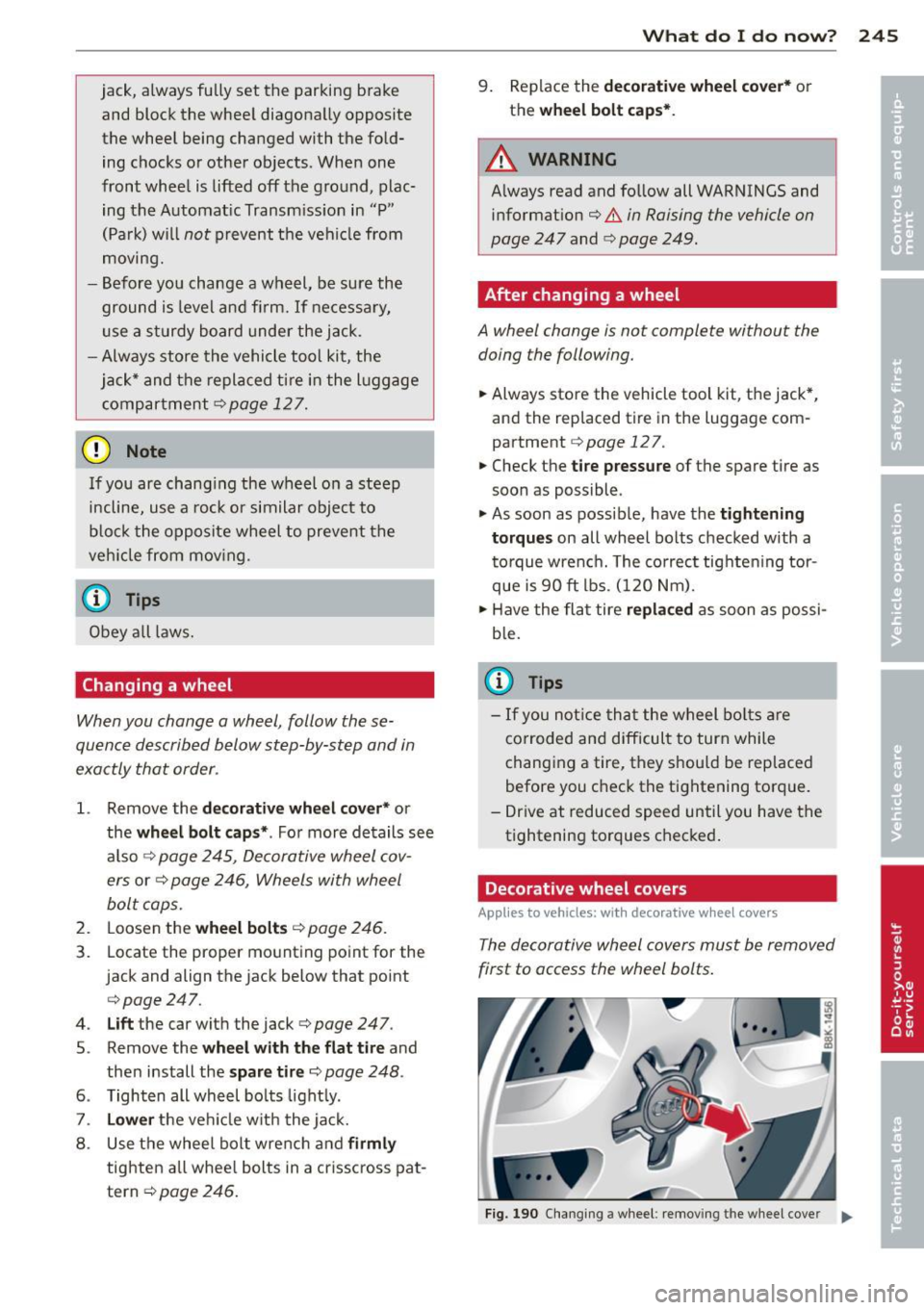
jack, always fully set the parking brake
and block the wheel diagonally opposite
the wheel being changed with the fold
ing chocks o r other objects. When one
front wheel is lifted off the ground, plac
ing the Automat ic Transm iss ion in "P"
(Park) wi ll
not prevent the vehicle from
moving.
- Before you change a wheel, be sure the
ground is level and firm. If necessary,
use a st urdy board under the jack.
- Always store the vehicle tool kit, the
jack* and the repla ced ti re in the l uggage
compartment
¢ page 12 7.
(D Note
If you are chang ing the wheel on a steep
incline, use a rock or similar object to
block the opposite wheel to prevent the
ve hicl e from mov ing.
(l) Tips
Obey a ll laws.
Changing a wheel
When you change a wheel, follow these
quence described below step-by-step and in
exactly tha t order .
1. Remove the dec orative whe el co ver* or
the
wh eel b olt cap s* . Fo r mor e details see
a lso
¢ page 245, Decorative wheel cov
ers
or¢ page 246, Wheels with wheel
bolt caps.
2 . Loosen the wheel bo lts ¢ page 246.
3. Locate the proper mounting po int for the
jack and align the jack below that point
c::> page247.
4. Lift the car with the jack c::> page 247 .
5. Remove the wheel with th e flat tire and
then install the
s pare tir e c::> page 248 .
6. Tighten all wh eel bo lts light ly .
7.
Low er the ve hicle wit h the ja ck.
8. Use the wheel bolt wrenc h and
firmly
tighten a ll whee l bolts in a cr isscross pa t
tern ¢
page 246.
What do I do now ? 245
9. Replace the decorative wheel co ver* or
the
wheel bolt caps*.
A WARNING
Always read and fo llow all WARNINGS and
i n format ion
c::> .&. in Raising the vehicle on
page 247
and c::> page 249.
After changing a wheel
A wheel change is not complete without the
doing the following.
.,. Always store the vehicle tool kit, the jack*,
and the replaced tire in the luggage com
partment
c::> page 12 7 .
.,. Check the tire pressu re of the spare tire as
soon as possible .
.,. As soon as poss ib le, have the
t ightening
torqu es
on all wheel bolts checked with a
t orque wrench. The co rrect tighte ning tor
que is
90 ft lbs. (120 Nm).
.,. Have the fla t tire
repl ace d as soon as possi
b le.
(D Tips
- If you not ice tha t the wheel bo lts a re
c orroded and difficult to turn while
chang ing a tire, they shou ld be replaced
before you c heck the tightening torque.
- Drive at reduced speed until you have the tightening torques checked .
Decorative wheel covers
Applies to vehicles: wit h deco rat ive w hee l covers
The decorative wheel covers must be removed
first to access the wheel bolts .
Fig. 19 0 C ha ngi ng a w heel : re moving the w hee l cove r ...
Page 251 of 286

Tires with unidirectional tread design
Tires with unidirectional tread design must be
mounted with their tread pattern pointed in the right direction.
Using a sp are t ire w ith a tread p attern
int ended fo r use in a specific dir ection
When us ing a spare tire w ith a tread pattern
in tended for use in a specific direction, please
note the following:
- The direction of rotation is marked by an
a r
ro w o n th e side o f th e tire .
-If the spare t ire has to be installed in the in
correct direction, use the spare tire only
temporarily since the ti re will not be able to
achieve its optimum performance character
i st ics with rega rd to aquaplaning, noise and
wear.
- We recommend that you pay particular at
tent ion to this fact du ring wet weathe r and
that you adjust your speed to match road conditions.
- Replace the fla t tire w ith a new one and
have it installed on your veh icle as soon as
possib le to restore the handling advantages
of a unid irectiona l tire .
Notes on wheel changing
Please read the information c:> page 233, New
tires and replacing tires and wheels
i f you are
going to use a spare t ire which is different
from the tires on your veh icle.
After you change a tire :
-Check the tir e p re ss ure on the spare imme
di ately after in st a ll at ion.
- Have th e wheel b olt ti ghtenin g torqu e
ch ecked with a t orque wrench as soon as
possible by your autho riz ed Audi dealer o r
qu alified work shop .
- With ste el a nd all oy wh eel rims , the wheel
bolts are correc tly tighten ed at a torque of
90 ft lb s. (120 Nm ).
- If yo u n otice that the wheel bolt s are cor
r oded a nd d ifficult to tu rn whil e changi ng
a t ire, the y should be replaced be fore you
chec k the t igh tening to rque. What do I do now? 249
- Repla ce the flat ti re w ith a new one and
h av e it i nsta lled on you r veh icle as s oon as
po ssible. Remount the whe el cov er.
Un til th en, d riv e with extr a care and at re
duc ed sp eeds.
A WARNING
-
- If you are going to equ ip your vehicle
with tires or rims which differ from those
which were factory installed, then be
sure to read the information
c:> page 233,
New tires and replacing tires and
wheels.
- Always make sure the damaged wheel or
even a flat tire and the jack and tool kit
are properly secured in the luggage com
pa rtment and are not loose in the pas
senger compartment.
- In an accident or sudden maneuver they
could fly forward, injuring anyone in the
veh icle.
- Always sto re damaged wheel, jack and
too ls se curely in the luggage compa rt
ment. Otherwise, in an accident or su d
den maneuver they could f ly forward,
causing injury to passengers in the vehi
cle.
([) Note
Do not use comme rcially ava ilab le tire
sea lants. Otherwise, the e lectrica l compo
nents of the tire pressure monitoring sys
tem* wi ll no longer work properly and the
sensor for the tire pressure monitoring
system* will have to be replaced by quali
fied workshop. •
•
Page 272 of 286
270 Index
Automatic climate control Air vents ... ............... .. .... ..
71
Operation . . . . . . . . . . . . . . . . . . . . . . . . . 70
Setup . .. ............... .. .. .... .. 72
Automatic power top ................. 42
Automatic Shift Lock (ASL) . . . . . . . . . . . .
86
Automatic transm ission . . . . . . . . . . . . . . . 85
Automatic Shift Lock (ASL) . . . . . . . . . . . 86
Driving .. .. ............. .. .. .. ... . 87
Emergency mode . . . . . . . . . . . . . . . . . . . 91
Emergency release . . . . . . . . . . . . . . . . . . 91
Kick-down . . . . . . . . . . . . . . . . . . . . . . . . . 90
Manual shift program ..... .. .. .. .. . . 89
Removal lock (ignition key) ... .. .. .. . . 74
Selector lever . . . . . . . . . . . . . . . . . . . . . .
85
Automatic wipers . . . . . . . . . . . . . . . . . . . . 56
Auto Safety Hotline ............ .... . 129
Average speed . . . . . . . . . . . . . . . . . . . . . . . 25
Avoid damaging the vehicle . . . . . . . . . . . 187
B
Battery . . . . . . . . . . . . . . . . . . . . . . . 17,217
Battery locat ion inside the luggage com-
partment ................. .. .... .
217
Charging ... .................. ... . 219
Important warn ings when working on
the battery . . . . . . . . . . . . . . . . . . . . . . .
217
Jump starting .............. .. .. .. . 255
Low . .. .. .. ... .......... .. .. .. .. . 185
Replacing the battery ........... .. . 220
State of charge ............ ... .... .
185
Winter operation .......... ... .... . 217
Working on the battery ............. 217
Before driving ............. .. .. .. .. . 121
Belt positioner .. .. ..... ..... .. .. .. . 135
Bio-ethanol (Fue l) ............ .. .... . 202
Blended gasoline .......... .. .. .. .. . 201
Blower (automatic climate control) . . . . . . 71
Booster seats .............. ... .... . 169
Brake fluid
Changing the brake fluid ........ ....
216
Check ing the brake fluid level . .. ..... 216
Reservoir .... ........... .. .. .. .. . 216
What is the correct brake fluid leve l? .. 216
What should I do if the brake fluid warn-
ing light comes on? ........ ..... .. .
216
Brake system .... .. ............. .... 216
Anti- lock braking system ............. 19
Brake assist system ................ 179
Brake fluid .... .. ............. .... 216
Brake fluid specifications for refill and re-
placement ...... ................ .
216
Brake light defective . . . . . . . . . . . . . . . . 21
Brake power assist unit ............. 182
Brakes .. .. .. .. . .............. .. .. 182
Ceramic brakes . .. ... .......... .. .. 182
Electromechanical parking brake ...... 79
Warning/indicator lights .......... .. . 15
Worn brake pads symbol . . . . . . . . . . . . . 20
Braking
Emerg ency braking funct ion ... .. .. .. .
81
braking guard . . . . . . . . . . . . . . . . . . . . . . . 93
Messages ........ ............... . 100
Settings ........ .. .............. . 100
Break-in period . . . . . . . . . . . . . . . . . . . . . 187
Tires . .. .. .. .. .. ............. .. .. 187
Bu lbs ..... ..... .. ............. .... 253
C
Californ ia Proposition 65 Warn ing . .... 207
Batte ry specific .. ... .......... .. .. 218
Capac1t1es ........ .. .............. . 262
Carbon parts
Cleaning . . . . . . . . . . . . . . . . . . . .
197,198
Care ... .. .. .. .. .. ............. .. .. 195
Cargo area
refer to Luggage compartment. .. 67, 127
Catalytic converter ................. . 188
Center armrest . . . . . . . . . . . . . . . . . . . . . . 63
Central locking ...................... 31
Central locking switch ............... 35
Convenience key .. .. ..... ........ .. . 35
Remote control key . . . . . . . . . . . . . . . . . 34
Ceramic brake rotors New brake pads .. ............. ....
182
Certification . ..... ................. 267
Changi ng a flat tire ................. . 244
Changing a wheel .. ............. .... 244
Changi ng engine oil ............. ....
212
Checking
Engine coolant level ................
213
Checking tire pressure ........... .... 228
Page 273 of 286

Child restraints
Dang er of using chi ld rest raints in th e
front seat . . . . . . . . . . . . . . . . . . . . . . . .
141
Where can I get addit ional information
about child restra ints and their use? . .
178
Child restra int system anchors ... .. .. . 175
Ch ild safety .. ................ ... ... 16 1
Convertible locking retractor . . . . . . . . . 17 1
Important safety instr uctions fo r using
ch ild safety seats ......... .. .. .. .. .
164
Important things to know when dr iv ing
with chi ld ren .... ..... ... .. .. .. ...
16 1
Instal ling a chi ld restraint using the
LATCH system ............ .... .. .. .
177
Lower anchorages ........ .. .. .. .. . 176
Mounti ng and releasing the anchorage
hook .. .. ... ............. ...... ..
177
Ch ild safety seats ... .... ... .. .. .. ... 167
Booster seats ............ .... .. ... 169
Convertible c hild seats .... .. .. .. .. . 168
Convertible locking retracto r . . . . . . . . . 171
Danger of us ing ch ild restra ints in the
front seat . . . . . . . . . . . . . . . . . . . . . . . .
141
H ow do I proper ly install a child safety
· h' l 7 164 se at in my ve 1c e ......... .. .. .. .. .
I nfant sea ts ............. .. .. .. .. .
167
Ins tal ling .. .... .. .... ... .. .. .. ... 17 1
LA TCH system .. .. ..... ... .. .. .. ... 177
Safety inst ructions ..... ... .. .. .... . 164
Unused safety belts on the rear seat . . 166
Cigare tte lig hte r . . . . . . . . . . . . . . . . . . . . . 65
C lea ning .................... ... ... 195
Climate controls . . . . . . . . . . . . . . . . . . . . . 69
Climate con trol sys tem
Automatic recircula tion . . . . . . . . . . . . . .
72
Supp lementary hea ter . . . . . . . . . . . . . . . 72
synchron izing ... ...... ... .. .. .. .... 7 2
C lock ..... ... ...... ............. ... 12
Closing
Power windows .......... .. .. .. .. ..
39
C losing/opening
at t he lock cylinder ..... ... .. .. .. .. ..
36
by remote contro l . . . . . . . . . . . . . . . . . . 34
with the central locking switch .. .. .. .. 35
with the convenience key ... .. .. .. .. .. 35
Cold ti re in flat ion pressure ... .. .. .. .. . 22 6
Com ing home .............. ... ... ... 52 Inde
x 271
Compact spa re tire .... .. ..... ... .. .. 2 4 3
also refer to Spare tire ... .... ... .. .. 243
Compass in the m irror ............... . 58
Compliance ... .. .. ................. 267
Cons umer Information . . . . . . . . . . 129, 264
Contacting NHTSA . .. ... ....... .... . 129
Controls
Cleaning .. .. .. .. .................
197
Convenience key
Ind icator lights .. .. . ... .... ... .. .. .
78
Starting engine (S TART E NGINE STOP
button) ... .. .. .. .. .. .. ...... ... .. .
77
Stopping the eng ine (START ENGINE
STOP button) . . . . . . . . . . . . . . . . . . . . . .
78
Switching on ignition .............. .. 77
unlocking/lock ing .. . .. .... ... ... .. . 35
Convenience opening/clos ing
Co nve rtib le child safety se ats
Convertib le locking retractor .. ... .. .. . 40
168
Activating . . . . . . . . . . . . . . . . . . . . . . . . 173
Deact ivating . .. .... ... ....... ..... 173
U sing to secu re a child safety seat 1.71, 173
Coolant system .. .. ................. 213
Cooling mode (automat ic climate control) 70
Cooling System Expansion tank ... .. ...............
213
Cornering light .. .. ................. . Sl
C ruise cont ro l
Changi ng speed ..... .. ..... ... .. .. .
8 3
Presett ing your speed .. ..... ... .. .. . 84
Switching off . ..... . .. .. ..... ... .. . 84
Switching on . .. .. ................. . 83
Cruising range . . . . . . . . . . . . . . . . . . . . . . . 25
(upholder ........ .. ..... ........... 66
D
Data recorder
Date d isp lay 179
. . .. .... .. .. ...... ... .. . 12
Daytime runn ing lights . . . . . . . . . . . . 51, 52
Decla rat ion of compliance
Adaptive cruise control ........... ..
267
Audi s ide ass ist ...... ............. 267
Cell phone package .. .. .. .. ... ... .. 267
Co nvenience key .................. . 267
Electronic immob ilizer ......... .... . 267
•
•
Page 275 of 286

Checking the engine coolant leve l .. ... 213
Radiator fan ................. .. ... 215
Engin e coolant temperature
Temperature gauge ................. 10
Eng ine hood
Closing .. ..... ........... ...... .. 206
How to release the hood ............ 206
Eng ine oil . .. ............. .... .. ... 208
Adding ... . ............. .... .. .. . 211
Additives . .. ............. .... .. ... 211
Changing ...................... .. 212
Check oil level .................. .. 211
Consumption ............ .... .. ... 211
I ndicator light ................. 17,21
Oil consumption .......... .... .. ... 210
Oil grades .. ................. .. ... 208
Pressure malfunction ........... ..... 17
Sensor defective . . . . . . . . . . . . . . . . . . . . 21
Specification and viscosity .. .. .. .. .. . 208
Engine speed limitation ............... 21
Env ironment
Break- in period ... .. ... ... .. .. .. .. . 187
Catalytic converter . .......... ... .. . 188
Disposing of your vehicle battery .. .. . 220
Driving at high speeds .............. 189
Driving to minimize pollution and noise 189
Fuel . .... .. .. ................ .... 204
Fu el economy ................ .. ... 189
Leaks under your vehicle ... .. .. .. .. . 206
Letting the vehicle stand and warm up. 190
Proper disposal of drained brake fluid . 216
Proper disposal of drained engine cool -
ant . .. .. .. .. .... ........ .... ... . 214
Proper disposal of drained engine
oil ...... .. ................. 211,212
Recycling used engine oil ... .. .. .. .. . 211
Unleaded fuel ..................... 201
What should I do with an old battery? . 220
EPC
refer to Electronic power control . . . . . . 20
Ethyl alcohol (Fuel) .................. 202
Ev ent Data Recorder (EDR) . . . . . . . . . . . . 179
Exhaust tail pipes
C leaning . .. ............. .... .. ... 197
Expansion tank ............ .... .. ... 213
Exterior lighting . . . . . . . . . . . . . . . . . . . . . 51
Index 273
Exterior mirrors
Adjusting . . . . . . . . . . . . . . . . . . . . . . . . . 54
Dimming ... ... .. .. ................ 55
Heating ... .. .. .. ................. . 54
F
Fan
Radiator 215
Fastening Booster seats .. .. .. .............. . 169
Convertible child safety seats ....... . 168
Infant seats ..... ................. 167
Flat tire Changing ... .. ...... ............. 244
flexible fuel ........................ 202
Floor mats ... ..... .. ............... 126
Fog lights/rear fog lig ht(s) . . . . . . . . . . . . . 51
Folding the rear seats ............ .. .. . 67
Foot pedals . .. .. .. .. . .............. 126
For the sake of the environment Gasoline fumes and the environment .. 204
Letting the engine warm up . . . . . . 74, 77
Refueling . .. .. .. .. .. ........... .. 204
Saving fuel by early upsh ifting ..... .. . 11
Front airbags Description . . . . . . . . . . . . . . . . . . . . . . . 144
How they work . . . . . . . . . . . . . . . . . . . . 149
Frontal collisions and the laws of physics 133
Front passenger's door emergency locking 36
Front seats Adjusting ....... .. ............... 123
Child restraints in the front seat ...... 141
Upper cabin heating ............ .. .. . 72
Fuel Additives ............... .......... 201
Blended gasoline .................. 201
Consumption .. .. .... ......... .. .. . 25
Filler neck . .. .. .. .. ............... 203
Fuel gauge . . . . . . . . . . . . . . . . . . . . . . . . 12
Gasoline ... ... .... ............... 201
Gasoline additives . ............... . 203
Low fue l level symbol . . . . . . . . . . . . . . . 21
Octane rating .. .. ................. 201
Recommendation . .. ........... .... 201
Refuelling ... .. .. .. . .. ... .... ..... 204
Reserve ................ ........... 12
Tank capac ity .. .. .. .............. . 262
•
•
Page 281 of 286

------------------------------~I~ n~ d~ e~x~ 279
START ENGINE STOP button (Convenience
key) ...... .. .. ................ ..... 77
Starting from rest . . . . . . . . . . . . . . . . . . . . 80
Starting off with a trailer .... .. .. .. .. .. 81
Starting the engine . . . . . . . . . . . . . . 74, 77
Steer ing
Lacking the steer ing . . . . . . . . . . . . . . . . 7 4
also refer to Electro-mechanical power
assist . .. .. .... ............. .. .. . 184
Steering wheel Adjust ing steering column . .. .. .. .. .. 74
Indicator light . . . . . . . . . . . . . . . . 18, 184
Steps for determining correct load limit . 231
Stopping the engine . . . . . . . . . . . . . . 76, 78
Storage . .. ... ...... ............. ... 65
S tronic ..... .. ................ ..... 85
Selector lever . . . . . . . . . . . . . . . . . . . . . . 85
S tronic transmission
Emergency release .................. 91
L aunch Contro l Program ............. 90
Sun visors . . . . . . . . . . . . . . . . . . . . . . . . . . 56
Symbols
refer to Warning/indicator lights .. .. .. 13
T
Tachometer . . . . . . . . . . . . . . . . . . . . . . . . . 11
Ta il lights
C leaning ... .... ........... .. .. .. .
Technical mod ifications
Textiles 196
267
C leaning ... .. ............. .. .. ... 198
The first 1,000 miles (1,500 km) and after-
wards ..... .. .. ................ .... 187
Tie-downs . . . . . . . . . . . . . . . . . . . . . 67, 128
tiptronic . . . . . . . . . . . . . . . . . . . . . . . . . . . 85
Automatic Shift Lock (ASL) . . . . . . . . . . . 86
Driving ... . .... ............. .. .. .. 87
Emergency mode ... ...... .. .. .. .. .. 91
Manual shift program . . . . . . . . . . . . . . . 89
Selector lever . . . . . . . . . . . . . . . . . . . . . . 85
Tire pressure .............. .... .. ... 228
T ire pressure monitoring system
L oss of air pressu re ................ 241
Malfunction ................ ... ... 241
Resetting tire pressures ....... ... .. . 242 T
ires .............................. 222
Low aspect ratio tires .............. . 239
Serv ice life . ... .. .. ............... 232
Speed rating letter code ............ 234
Tire manufacturing date ............ 234
Tire pressure monitoring system ..... 240
Tire specifications .. . .... .. .... .... 234
Tread depth ...... ...... .......... 232
Uniform tire quality grading ..... .. .. 236
Winter tires . .. .. .... ........... .. 237
Tires and vehicle load limits ........... 230
Tires and wheels Checking tire pressure ............. .
Cold tire inflation pressure ...... .. . .
Dimensions
. . .. .. .................
General notes .. .. .. ... ....... .... .
Glossary of tire and loading terminolo-
gy .......... ... .. .............. .
New tires and wheels ........... .. . .
Replacing ..... ...... ............ .
Snow cha ins . .. .. .. . ............. .
Tires and vehicle load limits ........ .
Wheel bolts
Winter tires
T ire service life
Tool kit
..... .. ...............
Torn or frayed safety belts
Towing 228
226
233
222
223
233
234
238
230
239
237
232
243
135
Front eyelet ... .. .... ............. 258
Rear eyelet .. .. .. ................. 258
Tow truck procedures .............. . 257
TPMS Tire pressure monitoring system ..... 241
Trailer towing ... .. ................. 192
Operating instructions .......... .... 192
Technical requirements . . . . . . . . 192, 193
Tips ......... ... .. ..... .......... 194
Transmission . ... .. .. ................ 85
Transmission malfunction (in dicato r light) 91
Transport Canada .. ................. 129
Travel mode . . . . . . . . . . . . . . . . . . . . . . . . 53
Tread Wear Indicator (TWI) ........... 232
Trip computer Fuel consumption . . . . . . . . . . . . . . . . . . 25
Mileage ... .. .. .. .. . .. .... ........ . 25
Single-trip memory ................. 25
Total-trip memory ..... ....... .... .. 25
•
•