radio AUDI A5 CABRIOLET 2014 Owner's Guide
[x] Cancel search | Manufacturer: AUDI, Model Year: 2014, Model line: A5 CABRIOLET, Model: AUDI A5 CABRIOLET 2014Pages: 286, PDF Size: 70.4 MB
Page 213 of 286

Checking the engine oil level
Fig . 176 MMI Disp lay: Oil l eve l ind icator
Re ad oil le vel
.,. Park your vehicle so that it is horizonta lly
level.
.,. Shut the engine off when it is at operating
temperature .
.,. Switch only the ignition back on .
.,. Wait approx . two minutes .
.,. Select: Function button
ICARI > Oil l evel. Or
.,. Se lect: Funct ion button
ICARI > C ar sys-
tem s*
cont rol button > S ervicing & ch e ck s >
Oil level.
.,. Read the oil leve l in the MMI* Display
c::> fig . 176 . Add engine oi l if the bar o f the
oi l level ind icator is near "min"
c::> page 211
Depending on the way the veh icle is driven
and the operating conditions, oil consumption
can be up to a 1/2 quart per 600 miles (0 .5
li
ter per 1,000 km) . Consumption may be high
er within the first 3,000 m iles (S,000 km).
@ Tips
The oil level indicator in the MMI* Disp lay
is only an information display.
If the oi l
level is too low, a min imum oil warning ap
pears in the instrument cluster. Add oil
c::> page 211 . If the hood has been opened,
the current oil level is shown in the instru
ment cluster the next time the ign ition is
sw itched on.
Checkin g and fillin g 211
~ Adding engine oil
Fig. 177 Eng in e compart men t: Cove r on the oil filler
n eck
.,. Before yo u check anything in the engine
compa rtment,
alwa ys rea d and h eed all
WARNING S c::> .&. in Working in the engine
compartment on page 206 .
.,. Shut the engine off.
.,. Unscrew the cap~ to the engine oi l filling
hole
c::> fig. 177, c::> page 208, fig. 175 .
.,. Carefully top off with 0.5 quarts (0.5 liters)
of the appropriate oil
c::> page 208.
"' Check the oil level again after two minutes
c::> page 211, Checking the engine oil level .
"'Top off the o il aga in, if necessary .
"' Screw the cap back on the filling hole .
_&. WARNING
- While topping off, the oil must not come
in contact with hot e ngine parts -fir e
hazard!
- The oil filler cap must be properly se
cured to prevent oil from being sprayed
on the hot engine and exhaust system
when the engine is runn ing -fire hazard!
- If your skin has come in contact with the
engine o il, you must subsequently
cleanse it thoroughly.
(D Note
- Check the oil level using the radio or
M MI*. If the message
Plea se redu ce oil
le vel
appears, contact yo ur authorized
Audi dealer or qua lified workshop to
have excess oil extracted if necessary .
-Audi does not recommend the u se of o il
additiv es. They m ay damage the engine .,.
Page 225 of 286

-Never mount used tires on yo ur vehicle if
yo u are not sure of their "previous histo
ry." Old used tires may have been dam
aged even though the damage cannot be
seen that can lead to sudden tire failure
and loss of vehicle control.
- If you notice unusual vibration or if the
vehicle pulls to one side when d riving, al
ways stop as soon as it is safe to do so
and check the wheels and tires for dam
age .
(D Note
-Please note that summer and winter
tires are designed for the cond itions that
are typ ic al in those seasons. Aud i recom
mends using w inter t ires du ring the win-
Glossary of tire and loading terminology
Accessory weight
means the comb ined weight (in excess of
those standard items which may be replaced)
of automatic tra nsmission, power steering,
power brakes, power windows, power seats,
radio, and heater, to the extent that these
items are availab le as factory-installed equip
ment (whether installed or not) .
Aspect ratio
means the ratio of the height to the width of
the tire in percent . Numbers of 55 or lower in
d icate a low sidewall for improved steering re
sponse and better overall handling on dry
pavement .
Bead
means the pa rt of the ti re that is made of
steel wires, wrapped or reinforced by ply cords
and that is shaped to fit the rim.
Bead s eparation
means a b reakdown of the bond between
components in the bead.
Cord
means the strands forming the plies in the
tire.
Tire s an d wheel s 223
ter months . Low temperatu res signifi
cantly decrease the elastic ity of summer
t ires, which affects traction and braking
ability. If summer tires are used in very
co ld temperatures, cracks can form on
the tread bars, res ulting in permanent
ti re damage that can cause loud drivi ng
noise and unbalanced tires. Aud i is not
responsib le for this type of damage.
- Burn ished, polished or chromed rims
must not be used in winter weather. Th e
surfa ce of the rims does not have suffi
c ien t cor rosion pro te cti on for this and
c o ul d be pe rmanen tly damaged by road
salt or similar substances. This damage
is not covered by warranty.
Cold tir e inflation pressure
me ans the t ire press ure re commended by the
vehicle manufacturer fo r a tire o f a des igna ted
size that has not bee n driven for more than a
couple of miles (k ilomete rs) at low speeds in
the three hour pe riod before the tire p ress ure
is measured or adjusted.
Curb weight
means the weight o f a motor vehicle with
standard equipment including the maximum
capacity of fuel, o il, and coolant, air cond i
tion ing and additional weight of optiona l
equipment.
E xtra load tire
means a tire design to operate at higher loads
and at higher inflation pressures than the cor
responding standard tire. Extra load tires may
be identified as "XL", "xl", "EXTRA LOAD", or
"RF" on the sidewall.
Gross Axle Weight Rating ("GAWR")
means the load-carrying capacity of a single
axle system, measured at the tire-ground in-
ter~ces .
~
•
•
Page 243 of 286

When the malfunction indicator is illuminat
ed, the system may not be able to detect or
signal low tire pressure as intended. TPMS
malfunctions may occur for a variety of rea
sons, including the installation of replace
ment or alternate tires or whee ls on the veh i
cle that prevent the TPMS from funct io ni ng
p roperly . Always check the T PMS malfunct ion
tellta le afte r replacing one o r more t ires or
wheels on your veh icle to ensure that the re
p lacemen t or a lternate tires and wheels allow
the TPMS to continue to function properly .
Tire pressure indicator appears
Applies to vehicles: with tire pressure monitoring system
The tire pressure indicator in the instrument
cluster informs you if the tire pressure is too
low or if there is a system malfunction.
Fig. 187 Display: underinflatio n warning
Using the ABS sensors, the tire pressure moni
toring system compares the t ire tread circum
ference and vibration characteristics of the in
d iv idual tires . If the pressure decreases in one
or mo re tires, th is is indica ted in the instru
ment clus ter with a
RE wa rning symbol and a
message¢
fig. 187 . The driver message in the
disp lay goes out after 5 seconds . The driver
message can be displayed again by pressing
the
! SET ! button. If only one tire is affected,
the display will indicate its pos ition.
The ti re pressu re monitoring system must be
reset via radio or MMI* each time the pres
sures are adjusted (e.g . when switching be
tween partia l and full load pressure) or after
changing or replacing a t ire on your vehicle
¢
page 242 . The TPMS indicator only moni
tors the tire pressure that you have prev iously
Tire s an d wheel s 241
stored . You can find the recommended t ire
pressures for yo ur vehicle on the label on driv
er's side 8-pillar ¢
page 226.
T ire tread circum ference and vibration charac
teristics can change and cause a tire pressure
warning if:
- t he t ire p ress ure in one or more tires is too
low,
- t he t ire has s tructural damage,
- the t ire pressure was changed, wheels rotat-
ed or replaced but the TPMS was not reset
¢ page 242.
Warning symbo ls
RE Loss of pressure in at least one tire c> & .
Check the tire or tires and replace or repa ir if
necessary. The
RE ind icator light in the instru
ment cluster a lso illuminates
c::!;> page 13.
Check/correct the press ures of all fou r tires
and reset TPMS via radio or MMI*.
Ill (T ir e Pre ssure Monitor ing System) Tire
press ure: Syst em malfun ction!.
If II! appears after switching the ignition on
o r while dr iv ing and the
RE i ndicator light in
the instr ume nt cluster blinks for app rox i
mately o ne minute and t hen stays o n, there is
a system malf unct ion.
Attempt to store the co rrect tire pressure
¢ page 242 . If the ind icator light does not
tu rn off o r if it turns on sho rtly the reafter, im
med iate ly dr ive your vehicle to a n author ized
Audi dealer or au thorized repair faci lity to
have the malfunc tion corrected .
A WARNING
-=
-If the tire pressure indicator appears in
the instrument cluster display, one or
more of your t ires is significant ly under
inflated. Reduce your speed immediately
and avoid any hard steer ing or b raking
maneuvers. Stop as soon as possib le and
check the tires and their pressures. In
flate the tire p ressure to the prope r pres
sure as indica ted on the vehicle's tire
pressu re labe l
¢page 226. Driving on a
significantly under-inflated tire causes
•
•
Page 244 of 286

24 2 T ire s and wheel s
the tire to overheat and can lead to tire
failure. Under-inflation also is likely to
impair the vehicle's handling and stop
ping ability .
- The driver is responsible for ma inta ining
the correct tire pressures. You must
check the t ire pressures regularly .
- Under certain cond itions (such as a spor
ty driving style, winter condit ions or un
paved roads), the pressure monitor ind i
cator may be de layed .
-Ask your author ized Audi dealer if run
flat tires may be used on your veh icle.
Your vehicle registrat ion becomes invalid
if you use these tires when not permit
ted. Damage to your veh icle or acc idents
cou ld also resu lt.
@ Tips
- The tire pressure monitoring system
stops working when there is an ESC/ABS
malfunction.
- Using snow chains may resul t in a system
malfunction.
- The tire pressure monitoring system on
you r Audi was developed using t ires with
the "AO" or "RO" identification on the
tire sidewall¢
page 233 . We recom
mend using these t ires .
Reset tire pressure monitoring system
Applies to vehicles: with tire pressure monitoring system
If the tire pressure is adjusted, wheels are ro
tated or changed, the TPMS must be reset via
radio or MMI*.
11> Before resett ing the TPMS, the cu rrent pres
sures of all fou r tires m ust correspond to
the specified val ues . Adjust the tire pressure
and reset the pressure i n the tire press ure
monitoring system according to the load
you are carry ing
¢ page 226.
11> Turn on the ignition .
11> Select : the ICAR I function button > Tire pre s
sure monitoring
> Stor e now . Or
i,. Se lect : the ICA RI function button > Ca r sys
tem s*
control button > Servicing & check s >
Tire pre ssure m onito ring > St or e tire pre s
s ure s.
@ Tips
Do not store the tire pressure if there are
snow chains on the tire .
Page 254 of 286

252 Fuses and bulbs
Right cockpit fuse assignment
Fi g. 199 Right cockpit: f use pane l w it h plastic clip
Fuse panel @ (black )
No. Consumer Amps
5 Steering col
umn switch
5
modu le
7
Terminal 15 d iagnostic con-
nec tor 5
8
Gateway (Databus d
iagnos -
5
tic interface)
9 S u pplemen tary heate r 5
Fuse panel @ (brown )
No. Consumer
Amps
1 CD/DVD p laye r 5
2 Wi·Fi 5
3
M MI/Radio 5/20
4 Instrume nt cluster
5
5
Gateway (ins trumen t cluster
5 contro l modu le)
6 Igni tion lock
5
7 Light switch
5
8
Climate contro l system 40
blowe r
9 Steering column lock 5
No . Consumer
10 C
limate control system
11 T
erm inal 30 diagnosti c con-
n ectar
12 Steer
ing column switch
module
Right luggage compartment fuse
assignment Amps
10
10
5
F ig . 2 00 Right lu ggage compartment: fu se pane l w it h
plast ic clip
Fuse panel @ (black)
No . Consumer Amps
2 Rear window heater (Ca b
rio-
30
let)
3 Power
top latch (Cabriolet)
30
4 Power top hyd ra ulics ( Cab-
so rio let)
Fuse panel @ (black)
No. Consumer Amps
Luggage compartmen t lid
1 control mod
ule (a llroad)/
30/10
Power top contro l modu le
(Cabriolet)
2 Re
tra ctable rear spoiler
10
( R S 5 Coupe)
Page 255 of 286
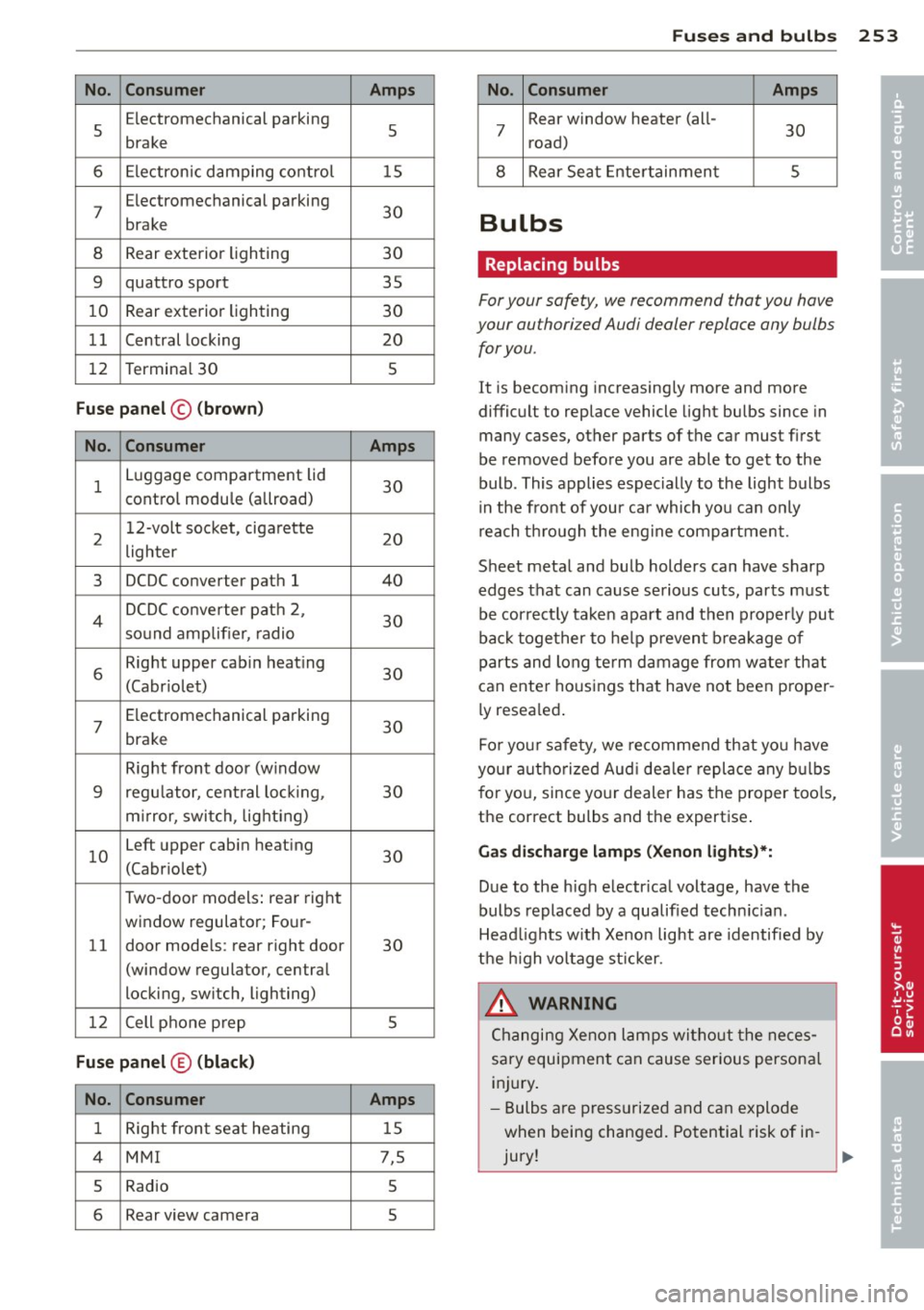
No. Consumer
5 Electromechanical
parking
brake
6 Electronic damping control
7
Electromechanical parking
brake
8 Rear exterior lighting
9 quattro sport
10 Rear
exterior lighting
1 1 Central locking
12 Termina
l 30
Fu se pa nel © (brown )
No. Con sumer
1 Luggage compartment lid
control module (allroad)
2 1
2-volt socket, cigarette
lighter
3 DCDC
converter path 1
4 DCDC converter path 2,
so und amplifier, radio
6
Right upper cabin heat ing
(Cabr iolet)
7
Electromechanical parking
brake
Right front door (w indow
9 regu lator, central lock ing,
m irror, swit ch, lig hting)
10 Left upper
cabin heating
(Cabriolet)
Two -door models: rear right
window regulator; Four-
11 door mode
ls: rear right door
(window regulator, central
locking, sw itch, lighting)
12 Cell phone prep
Fu se panel © (black )
No. Consumer
1 Right front seat heating
4
MMI
5 Radio
6 Rear view camera
Amp s
5
15
30
30
35
30
20 5
Amp s
30
20
40
30
30
30
30
30
30
5
Amps
15
7,5
5
5
Fu ses and bulb s 253
No. Consumer Amps
7
Rear window heater (all-
30
road)
8 Rear Seat Entertainment 5
Bulbs
Replacing bulbs
For your safety, we recommend that you hove
your authorized Audi dealer replace any bulbs
for you .
It is becoming increasingly more and more
difficult to replace vehicle light bulbs since in
many cases, other parts of the car must first
be removed before you are able to get to the
bulb. This applies especially to the light bulbs
in the front of your car which you can only
reach through the engine compartment.
Sheet metal and bulb holders can have sharp
edges that can cause serious cuts, parts must
be correct ly take n apa rt and then p roperly put
bac k together to he lp p revent breakage of
parts and long te rm damage from water that
can enter housings that have not been p roper
ly re sea led .
Fo r you r safety, we re commend that you have
your autho rized Audi de aler replace any b ulbs
f or you, since your dealer has the proper too ls,
the correct bulbs and the expertise.
Gas disc har ge la mp s (Xenon l ig hts)*:
Due to the high electr ical voltage, have the
bulbs replaced by a qualified techn ic ian .
Head lights w ith Xenon light are identified by
the h igh vol tage sticker.
_&. WARNING
Changing Xenon lamps without the neces
sary equipment can cause serious persona l
injury .
- Bulbs are pressurized and can explode
when being changed. Potential risk of in
jury!
-
•
•
Page 257 of 286

Emergency situations
General
This chapter is intended for trained emer
gency crews and working personnel who have the necessary tools and equipment to
perform these operations.
Starting by pushing or
towing
(D Note
Vehicles with an automatic transmission
cannot be started by pushing or towing.
Starting with jumper
cables
If necessary, the engine can be started by
connecting it to the battery of another vehi
cle.
If the engine should fail to start because of a
discharged or weak battery, the battery can be
connected to the battery of
another vehicle,
using a
pair of jumper cables to start the en
gine.
Jumper cables
Use only jumper cables of sufficiently
largecross section to carry the starter current
safely. Refer to the manufacturer's specifica
tions.
Use only jumper cables with
insulated termi
nal clamps which are distinctly marked:
plus(+) cable in most cases colored red
minus(-) cable
in most cases colored black .
A WARNING
Batteries contain electricity, acid, and gas.
Any of these can cause very serious or fatal
injury. Follow the instructions below for
safe handling of your vehicle's battery.
- Always shield your eyes and avoid lean
ing over the battery whenever possible.
Emergency situations 255
-A discharged battery can freeze at tem
peratures just below 32 °F (0 °C). Before
connecting a jumper cable, you must
thaw the frozen battery completely, oth
erwise it could explode.
- Do not allow battery acid to contact eyes
or skin . Flush any contacted area with
water immediately .
- Improper use of a booster battery to
start a vehicle may cause an explosion.
- Vehicle batteries generate explosive gas
es. Keep sparks, flame and lighted ciga
rettes away from batteries.
- Do not try to jump start any vehicle with
a low acid level in the battery.
- The voltage of the booster battery must
also have a 12-Volt rating. The capacity
(Ah) of the booster battery should not be
lower than that of the discharged bat
tery. Use of batteries of different voltage
or substantially different "Ah" rating
may cause an explosion and personal in
jury.
- Never charge a frozen battery. Gas trap
ped in the ice may cause an explosion.
- Never charge or use a battery that has
been frozen. The battery case may have
be weakened.
- Use of batteries of different voltage or
substantially different capacity (Ah) rat
ing may cause an explosion and injury.
The ca pa city (Ah) of the booster battery
should not be lower than that of the dis
charged battery.
- Before you check anything in the engine
compartment, always read and heed all
WARNINGS¢
page 206.
(D Note
- Applying a higher voltage booster bat
tery will cause expensive damage to sen
sitive electronic components, such as
control units, relays, radio, etc.
- There must be no electrical contact be tween the vehicles as otherwise current
could already start to flow as soon as the
positive(+) terminals are connected. ..,. •
•
Page 263 of 286
Technical Data
Vehicle identification
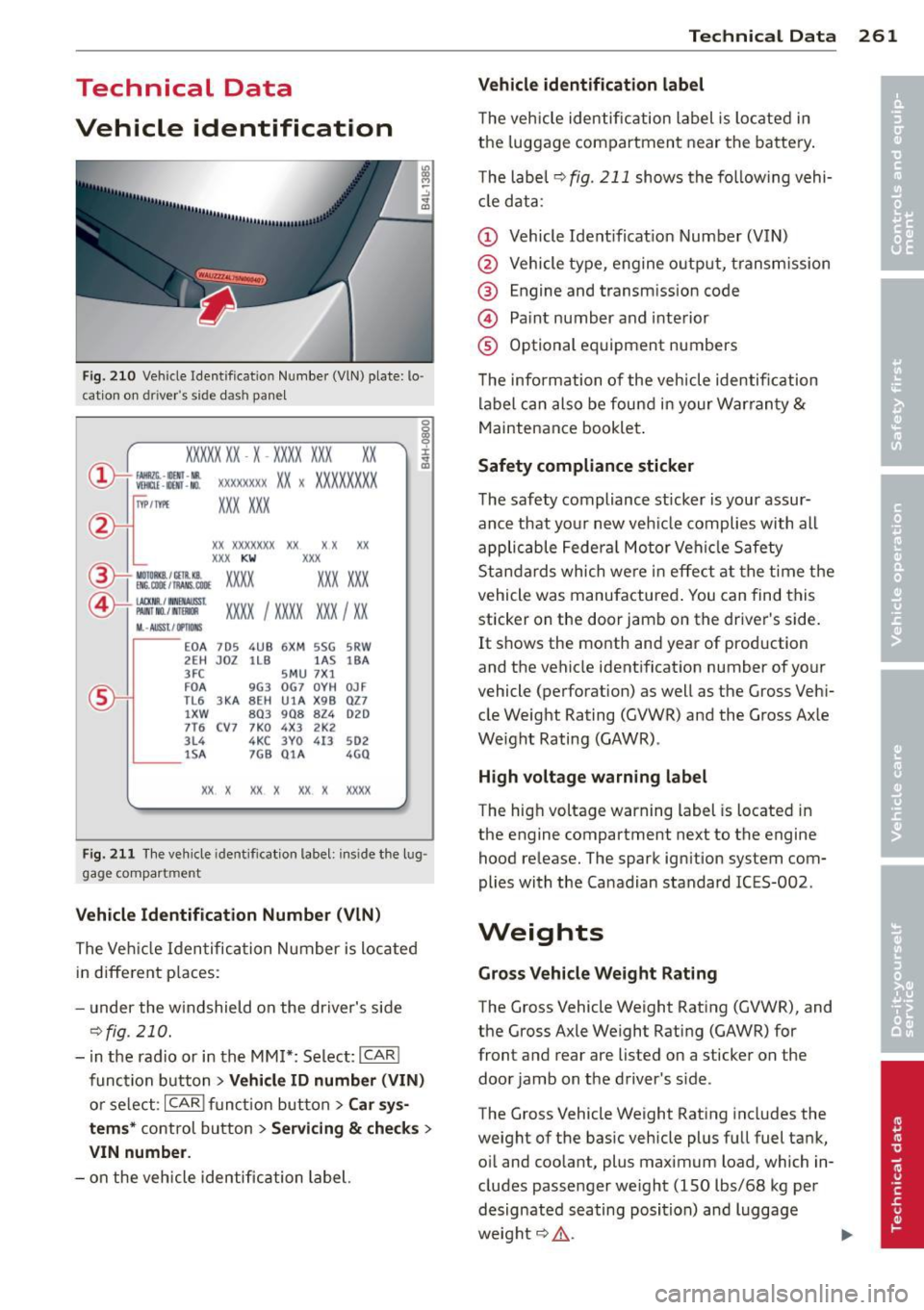
F ig. 210 Veh ide Identificat ion Number (VlN) plate: lo ·
c ation on d river 's s ide das h pane l
XXXXX XX · X -XXXX XXX
~ fAllftlli. -llllll · NR. ~ W!ru -IIOO -NO.
xx
XXXX XXXX XX X XXXXXXXX
XXX XXX
IYP /TYPE
XX XXXXXXX XX X X XX
XXX KW XXX
®i ~W.::·f :l~~ XXXX XXX XXX
©+ ::rw= xxxx I xxxx XXX I xx
M. · AUSSt I IJ'IIDIIS
~--
EOA 7D 5 4UB 6XM SSG SRW
2E H JDZ 1LB lA S 1BA
3FC SMU 7X l
FD A 9G3 OG7 OYH OJF
TL6 3 KA 8EH UlA X98 027
lXW 803 908 824
D2D
7T6 CV7 7KO 4X3 2K2
3L4 4KC 3YO 413
50 2
1S A 7GB QlA 4GO
XX. X XX X XX X XXXX
Fig. 211
The vehicle identification label: ins ide the lu g·
ga ge compar tmen t
Vehicle Identification Number (VlN)
The Veh icle Iden tifica tion Number is located
in different p laces :
- under the windshield on the driver's side
9fig.
210.
- in the radio or in the MM!*: Select: ICARI
function button > Vehicle ID number (VIN)
or select: I CAR I function button> Car sys
tems*
control button > Servicing & checks >
VIN number .
-on the vehicle identification label. Technical Data 261
Vehicle identification label
The
vehicle identification label is located in
the luggage compartment near the battery.
T he label 9fig.
211 shows the follow ing vehi
cle data :
(D Vehicle Identificat ion Number (VIN)
@ Vehicle type, engine output, transm ission
@ Engine and transmission code
© Paint number and interior
® Optional equipment numbers
T he information of the vehicle identification
label can also be found in your Warranty
&
Maintenance booklet.
Safety compliance sticker
The safety compliance sticker is your assur
ance that your new vehicle complies with all
applicable Federal Motor Vehicle Safety
Standards which were in effect at the time the
vehicle was manufactured . You can find this
sticker on the door jamb on the driver's side.
It shows the month and year of production
and the vehicle identification number of your
vehicle (perforation) as well as the Gross Vehi
cle Weight Rating (GVWR) and the Gross Ax le
Weight Rating (GAWR) .
High voltage warning label
The high voltage warning label is located in
the engine compartment next to the engine hood release. The spark ign ition system com
plies with the Canadian standard ICES-002 .
Weights
Gross Vehicle Weight Rating
The Gross Vehicle Weight Rating (GVWR), and
the Gross Axle Weight Rating (GAWR) for
front and rear are listed on a sticker on the
door jamb on the driver's s ide .
The Gross Vehicle Weight Rating includes the
weight of the basic vehicle plus full fuel tank,
oil and coo lan t, plus maximum load , which in
cludes passenger we ight (150 lbs/68 kg per
designated seating position) and luggage
weight
9 ,&. .
Page 269 of 286

Technical Modifications
Our guidelines must be complied with when technical modifications are made .
Always consult an authorized Aud i dealer be
fore starting work on any modifications.
This will he lp ensure that vehicle function,
performance and safety are not impaired
¢ .&. .
Attempting to work on electronic components
and the software used with them can cause
malfunctions. Beca use of the way electronic
components are interconnected with each
other, such malfunctions can also have an ad
verse affect on other systems that are not di
rectly involved . Th is means that you r isk both
a substantial reduction in the operational
safety of you r vehicle and an inc reased wea r of
vehi cle parts¢ _&..
Author ized Audi dealers w ill perform th is
wo rk in a professiona l and competent ma nner
or, in spec ial cases, refer you to a p rofessional
company that specializes in such mod ifi ca
tions .
_& WARNING t= -
Improper repairs and modifications can
change the way vehicle systems wo rk and
cause se rious personal injury.
0 Note
If emergency repairs must be perfo rmed
elsewhere, have the ve hicle examined by
an authorized A udi dealer as soon as possi
ble.
Con sumer In formation 267
Declaration of
Compliance, Telecom
munications and
Electronic Systems
Radio Frequency Devices and Radiocommuni
cation Equipment User Manual Notice.
The manufact urer is not responsib le for any
radio or TV interference caused by unauthor
ized modifications to this equipment.
Device s
The following devices each comply wi th FCC
Part 15 .19, FCC Part 15.2 1 and RSS -Gen Iss ue
1:
- Adaptive cr uise con trol*
- Conven ience key*
- Side assist*
- Cell phone package*
- Electron ic immobilizer
- Homelink universa l remote control *
- Remote control key
FCC Part 15.19
Th is device complies with part 15 of the FCC
Ru les . Operation is subject to the fo llow ing
t wo conditions:
(1) This device may not cause harmful i nter
ference, and
(2) this device must accept any interference
received, including interference that may
cause undes ired operation .
FCC Part 15 .21
CAUTION:
Changes or mod ificat ions no t expressly ap
proved by the pa rty responsible fo r compli
ance could void the user's aut hority to operate
the eq uipment .
RSS-Gen Issue 1
Operation is sub ject to the fo llow ing two con
di tions :
(1) this device may not ca use inte rference,
and
•
•