belt AUDI A5 CABRIOLET 2015 User Guide
[x] Cancel search | Manufacturer: AUDI, Model Year: 2015, Model line: A5 CABRIOLET, Model: AUDI A5 CABRIOLET 2015Pages: 268, PDF Size: 66.88 MB
Page 87 of 268

M N
ci u.. co ,...., \!) 1.1"1
N 1.1"1 ,....,
At speeds above about 1 mph (2 km/h) the Auto
matic Shift Lock is automatically deactivated in
the N position.
A time delay element prevents the selector lever
from locking when it is moved through the N po
sition (going from R to D/S). The locking element
will lock the se lector lever if the lever is left in N
(Neutral) for more than approximate ly 2 seconds,
without the brake pedal being pressed.
Release button
The release button on the selector lever prevents
the lever from being accidentally shifted into cer
tain positions. Depending on the direction of the
shift, the selector lever locks at different posi
tions. The positions are highlighted in the illus
tration
c> fig . 97.
Ignition key safety interlock
The key cannot be removed from the ignition un
l ess the se lector lever is in the P park posit ion.
When the ignit ion key is removed, the selector
lever will be locked in the P position.
Driving the automatic transmission
Applies to vehicles: with m ultit ron ic/S tronic/t iptronic
F ig . 98 S hift gate on t he center conso le: selector lever w ith
re lease button
Starting the engine
~ The selector lever must be in P or N.
Starting off
~ Press and ho ld the brake pedal.
~ Press and hold the release button in the selec
tor lever handle, select the des ired selector lev
er posit ion such as D/S and release the button.
Automatic transmission
~ Wait briefly until the transmission has shifted
(you will fee l a slight movement).
~ Remove your foot from the brake pedal and ac
celerate.
Stopping temporarily
~ Keep the vehicle stationary using the braking
pedal, for example at traffic lights.
~ Do not press the accelerator peda l when doing
this.
~ To prevent the vehicle from rolling when you
start driving, set the parking brake when stop
p in g on steep inclines
c> .&_.
~ The parking brake will release automat ically
and the vehicle will start mov ing once you press
t he acce lerator pedal.
Stopping/parking
If the selector lever is not in the P position when
you open the dr iver's door, the vehicle could roll.
The message
Transmission: Car may roll! Shift
to park!
appea rs.
~ Press and hold the brake pedal until the vehicle
has come to a complete stop .
~ Apply the parking brake c:;. page 78, Parking .
~ Select the P selector lever posit ion c> .&_ .
Stopping on an incline
~ Always press the brake pedal to hold the vehi
cle in place and prevent it from "rolling back"
c:;. .&_ . Do not try to prevent the veh icle from
"rolling back" when a gear is engaged by in
creasing the engine speed
c> 0 .
Starting on an incline
~ Activate the parking brake.
~ With the driving gear selected, press the accel
erator pedal carefully. The parking brake w ill re
lease automat ically if your seat belt is fastened .
Under certain circumstances, such as driving in
the mounta ins, it may be useful to sw itch tempo
r ar ily to the manual shift program in order to ad
just the gears to the dr iv ing conditions by hand
c>page 87.
On slopes, activate the parking brake first and
then move the selector lever to the P position .
85
Page 88 of 268
Automatic transmission
This prevents too much stress from being placed
on the locking mechanism.
Vehicles with multitronic transmission: Your vehi
cle is equipped with
hill hold assist allowing you
to start while on an incline. The system is activat
ed when the brake pedal is pressed down and
held
for a few seconds. The brake pressure will
hold for
a momen t after the brake pedal loosens
t o preven t the vehicle from rolling backwards
while starting up .
A WARNING
- The vehicle can also roll when the engine is
stopped .
- Unintended vehicle movement can cause se rious injury .
- Never leave your vehicle with the engine
running while in gear.
If you must leave your
vehicle when the engine is running, activate
the parking brake and move the selector lev
er to
P.
-Power is still transmitted to the wheels
when the engine is running at idle. To pre
vent the vehicle from "creeping", you must
keep your foot on the brake when the engine
is running and the selector lever is in 0/5 or
R or "tiptronic" mode is selected.
- Do not press the accelerator pedal when changing the selector lever position while
the vehicle is stationary and the engine is
running .
- Never shift into R or P while driving.
- Before driving down a steep slope, reduce
your speed and shift into a lower gear with
"tiptronic".
- Do not ride the brakes or press the brake
pedal too often or too long when driving
down a hill. Constant braking causes the
brakes to overheat and substantially re
duces braking performance, increases brak
ing distance or causes complete failure of
the brake system .
- To prevent the vehicle from rolling back
when stopping on inclines, always hold it in
place with the brake pedal or parking brake.
- Never hold the vehicle on an incline with a
slipping clutch. The clutch opens automati-
86
cally when it becomes too hot from the
overload. An indicator lamo
[ O ] illuminates
and a driver message appears
¢ page 88
when the clutch is overloaded.
- If the engine must remain running, never
have any driving position engaged when
checking under the hood . Make sure these
lector lever has securely engaged and is
locked in P with the parking brake set
¢ page 195. Otherwise, any increase in en
gine speed may set the vehicle in motion,
even with the parking brake applied.
(D Note
- 5 tronic- and tiptronic transmission: When
stopping on an incline, do not try to hold
the vehicle in place by pressing the accelera
tor pedal while a driving gear is selected.
This can cause the transmission to overheat
and can damage it. Activate the parking
brake or press the brake pedal to prevent
the vehicle from rolling.
- 5 tronic- and tiptronic transmission: Allow
ing the vehicle to roll when the engine is
stopped and the selector lever is in N will
damage the transmission because it is not
lubricated under those circumstances .
(D Tips
For safety reasons, the parking brake is re
leased automatically only when the driver's
safety belt is engaged in the buckle .
· Hill descent control
App lies to vehicles: wit h mult itronic/S tronic/tiptronic
The hill descent control system assists the driver
when driving down declines.
Hill descent control is activated when the selec
tor lever is in 0/5 and you press the brake pedal.
The transmission automatically selects a gear
that is suitable for the incline. Hill descent con
trol tries to maintain the speed achieved at the
time of braking, within physical and technical
limitations.
It may still be necessary to adjust the
speed with the brakes. .,.
Page 115 of 268
Driving safety
Basics
Safe driving habits
Please remember -safety first!
This chapter contains important information,
tips, instructions and warnings that you need to
read and observe for your own safety, the safety
of your passengers and others . We have summar
ized here what you need to know about safety
belts, airbags , chi ld restraints as well as child
safety. Your safety is for us
priority number 1. Al
ways observe the informat ion and warn ings in
this section - for your own safety as well as that
of your passengers .
The information in this section app lies to all
model ve rsions of your vehicle . Some of the fea
tures described in this sections may be standard
equipment on some models, or may be optional
eq uipment on others .
If you are not sure, ask
your authorized Audi dealer.
A WARNING
- Always make sure that you follow the in
struct ions and heed the WARNINGS in this
Manual. It is in your interest and in the in
terest of your passengers.
- Always keep the complete Owne r's Litera
ture in your Aud i when you lend or sell your
vehicle so that this important info rmation
will always be ava ilable to the driver and
passenge rs.
-
- Always keep the Owner's literature handy so
that you can find it easily if you have ques
tions.
Safety equipment
The safety features are part of the occupant re
straint system and work together to help reduce
the risk of injury in a wide variety of accident sit
uations.
M
6 Your safety and the safety of your passenge rs
~ should not be left to chance. Advances in tec h-,...., \!) 1.1'1
N 1.1'1 ,....,
nology have made a var iety of fea tures available
to help reduce the r isk o f injury in an accident.
Dr ivin g s afet y
The following is a list of just a few of the sa fety
features in your A udi:
- sophisticated s afety be lts fo r drive r and a ll pas-
senger seat ing pos itions,
- be lt fo rce limi ters for the front seats,
- belt pretensioners for the seats,
- head restra ints for each seating posit ion,
- front airbags,
- side airbags in the front seats,
- special LATCH anchorages for child rest raints,
- ad justab le steer ing column.
These ind iv idual safety features, can wo rk to
gether as a system to he lp p rotect you and you r
passengers in a w ide range of accidents . T hese
f ea tures cannot work as a system if they are not
always cor rect ly adjusted and correctly used .
Safet y is eve rybod y's res pon sibilit y!
Important things to do before driving
Safety is everybody 's job! Vehicle and occupant
safety always depends on the informed and care
f1,1l driver .
For you r safety and the safety of your passen
gers,
b efore driv ing alway s:
.,. Make sure that all lights and signals are operat
ing correctly .
.,. Make sure that the tire pressure is co rrect .
.,. Make s ure that all w indows are clean and afford
good vis ibility to the outs ide.
.,. Sec ure all luggage and other items caref ully
qpage 64.
.,. Make s ure that nothing can interfere with the
pedals.
.,. Adjust front seat, head restraint and mirrors
correctly for your height .
.,. Instruct passengers to adjust the head re
straints according to the ir height .
.,. Make su re to use the r ight child restraint cor
rectly to protect ch ildren
q page 152, Child
safety.
.,. Si t properly in your seat and ma ke s ure that
your passengers do the same
q page 59, Seats
and storage. .,.
113
Page 116 of 268
Driving safet y
• Fasten your safety belt and wear it properly . Al
so instruct your passengers to fasten the ir
safety belts properly ¢
page 124.
What impairs driving safety?
Safe driving is directly related to the condition of
the vehicle, the driver as well as the driver 's abili
ty to concentrate on the rood without being dis
tracted .
The driver is responsible for the safety of the ve
hicle and all of its occupants. If your ability to
drive is impaired, safety risks for everybody in the
veh icle increase and you also become a hazard to
everyone else on the road ¢,&. .Therefore:
• Do not let yourself be distracted by passengers
or by using a cellular telephone .
• NEVER drive when your driv ing ability is im
paired (by medicat ions, alcohol, drugs, etc .).
• Observe all traffic laws, rules of the road and
speed limits and plain common sense .
• ALWAYS adjust your speed to road, t raff ic and
weather cond itions .
• Take frequent breaks on long trips . Do not dr ive
f or more than two hours at a stretch.
• Do NOT drive when you are tired, under pres
sure or when you are stressed.
A WARNING
Impaired driving safety increases the risk of
ser ious personal injury and death whenever a
vehicle is being used.
114
.
Correct passenger
seating positions
Proper seating position for the driver
The proper driver seating position is important
for safe, relaxed driving.
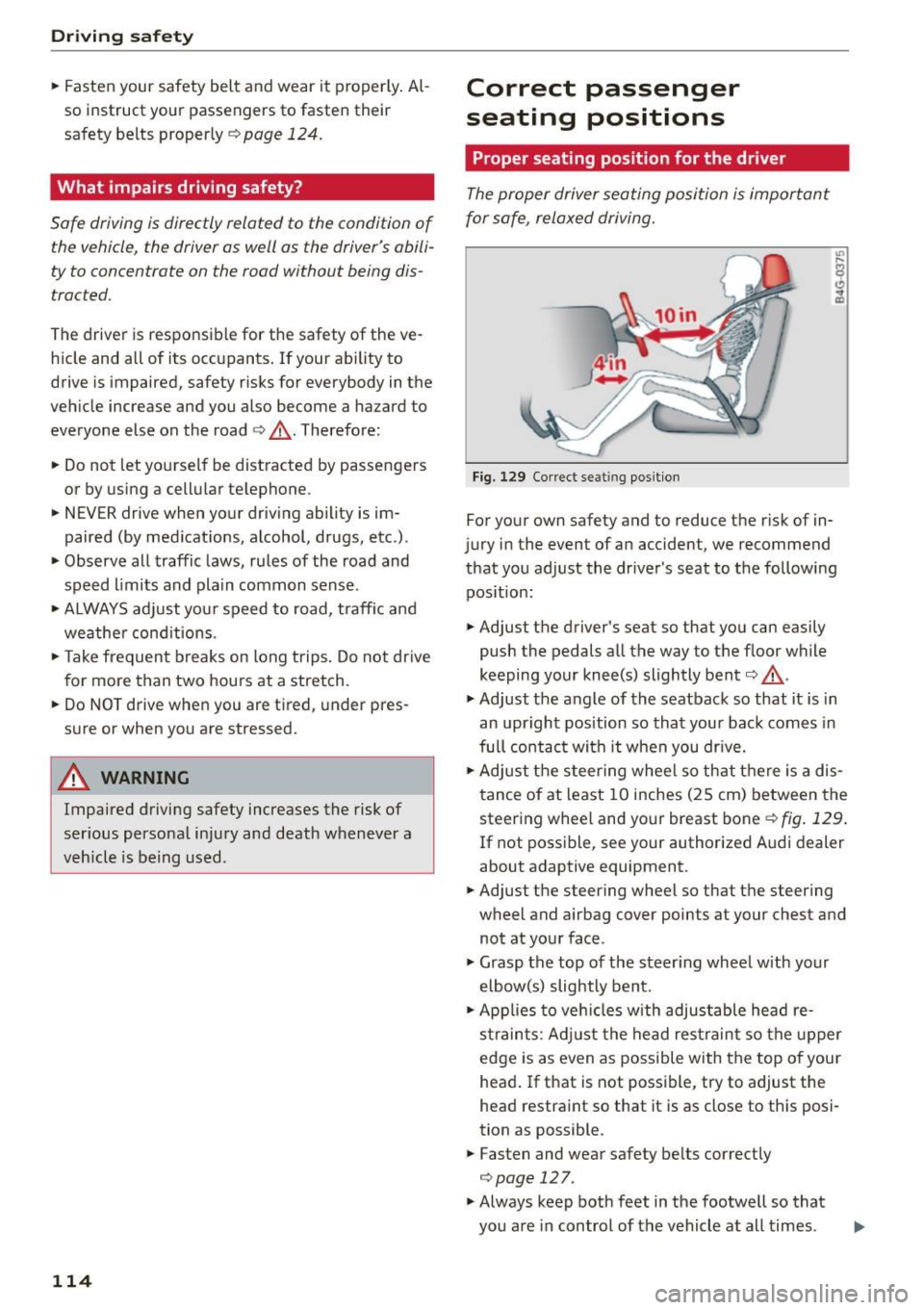
Fig. 129 Co rrect seat ing posit ion
For your own safety and to reduce the risk of in
jury in the event of an accident, we recommend
that you adjust the driver's seat to the following pos ition:
• Adjust the driver 's seat so that you can easily
push the pedals all the way to the floor while
keeping your knee(s) slightly bent¢,&..
• Adjust the angle of the seatback so that it is in
an upright position so that your back comes in
full contact with it when you dr ive.
• Ad just the steering wheel so th at there is a dis
tance of at least 10 inches (25 cm) between the
steering whee l and your breast bone¢
fig. 129 .
If not possible, see your authorized A udi dealer
about adaptive equipment.
• Adjust the steering wheel so that the steering
wheel and airbag cover points at your chest and
not at your face.
• Grasp the top of the steer ing wheel with your
elbow(s) slightly bent.
• App lies to veh icles with adjustable head re
straints: Adjust the head res traint so the upper
edge is as even as possible with the top of your
head . If that is not possible, try to adjust the
head restraint so that it is as close to this posi
tion as possible.
• Fasten and wear safety belts correctly
¢page 127.
• Always keep both feet in the footwell so that
you are in control of the vehicle at all times .
Page 117 of 268
M N
ci u.. co ,...., \!) ..,.,
N ..,., ,....,
For detailed information on how to adjust the
driver's seat, see
¢ page 60.
A WARNING
Drivers who are unbelted, out of position or
too close to the airbag can be seriously in
jured by an airbag as it unfolds. To help re
duce the risk of serious personal injury:
- Always adjust the driver's seat and the
steering wheel so that there are at least
10 inches (25 cm) between your breastbone
and the steering wheel.
- Always hold the steering wheel on the out
side of the steering wheel rim with your
hands at the 9 o'clock and 3 o'clock posi
tions to help reduce the risk of personal in
jury if the driver's airbag inflates.
- Never hold the steering wheel at the
12 o'clock position or with your hands at
other positions inside the steering wheel
rim or on the steering wheel hub. Holding
the steering wheel the wrong way can cause
serious injuries to the hands, arms and head
if the driver's airbag deploys.
- Pointing the steering wheel toward your
face decreases the ability of the supplemen
tal driver's airbag to protect you in a colli
sion.
- Always sit in an upright position and never lean against or place any part of your body
too close to the area where the airbags are located .
- Before driving, always adjust the front seats
and head restraints properly and make sure
that all passengers are properly restrained.
- Never adjust the seats while the vehicle is
moving . Your seat may move unexpectedly
and you could lose control of the vehicle.
- Never drive with the backrest reclined or
tilted far back! The farther the backrests are
tilted back, the greater the risk of injury due
to incorrect positioning of the safety belt
and improper seating position.
- Children must always ride in child safety
seats
¢page 152. Special precautions ap
ply when installing a child safety seat on the
front passenger seat¢
page 132.
Driving safety
Proper seating position for the front
passenger
The proper front passenger seating position is
important for safe, relaxed driving.
For your own safety and to reduce the risk of in
jury in the event of an accident, we recommend
that you adjust the seat for the front passenger
to the following position:
.,. Move the front passenger seat back as far as
possible . There must be a minimum of 10 in
ches (25 cm) between the breastbone and the
instrument panel¢.&, .
.,. Adjust the angle of the seatback so that it is in
an upright position and your back comes in full
contact with it whenever the vehicle is moving.
.,. Applies to vehicles with adjustable head re
straints: Adjust the head restraint so the upper
edge is as even as possible with the top of your
head . If that is not possible, try to adjust the
head restraint so that it is as close to this posi
tion as possible .
.,. Keep both feet flat on the floor in front of the
front passenger seat.
.,. Fasten and wear safety belts correctly
c:> page 127.
For detailed information on how to adjust the
front passenger's seat, see ¢
page 59.
A WARNING ~
Front seat passengers who are unbelted, out
of position or too close to the airbag can be
seriously injured or killed by the airbag as it unfolds. To help reduce the risk of serious per
sonal injury:
- Passengers must always sit in an upright po
sition and never lean against or place any
part of their body too close to the area
where the airbags are located.
- Passengers who are unbelted, out of posi
tion or too close to the airbag can be seri
ously injured by an airbag as it unfolds with
great force in the blink of an eye.
- Always make sure that there are at least 10 inches (25 cm) between the front passen
ger's breastbone and the instrument panel.
115
Page 118 of 268
Driving safet y
-Each passenger must always sit on a seat of
their own and properly fasten and wear the
safety belt belonging to that seat.
- Before driving, a lways adjust the front pas
senger seat and head restraint properly.
- Always keep your feet on the floor in front
of the seat. Never rest them on the seat, in
strument pane l, out of the window, etc . The
airbag system and safety belt will not be
able to protect you properly and can even in
c reas e the risk of injury in a crash.
- Never dr ive with the backrest recl ined or
t ilted far back! The farther the backrests are
t il te d back, the greater the r isk of injury due
to incorrect pos itioni ng of the safety bel t
and improper se ating posi tion.
- Children m ust always ride i n child safety
seats ¢
page 152. Special preca utions ap
ply when installing a ch ild safety sea t on the
front passenger seat ¢
page 132.
Proper seating positions for passengers in
rear seats
Rear seat passengers must sit upright with both
feet on the floor consistent with their physical
size and b e properly r estrained wh enever the ve
hicle i s in use.
To reduce the risk of injury caused by an incorrect
seating position in the event of a sudden braking maneuver or an accident, your passengers on the
rear bench seat must always observe the follow
ing:
"' Make sure that the seatback is securely latched
in the upright pos ition
¢ page 66 .
"' Keep both feet flat in the footwell in front of
the rear seat.
"' Faste n and wear safety belts prope rly
¢ page 127.
"' Make sure that ch ildren are always properly re
stra ined in a chi ld restraint that is appropria te
f o r their size and age ¢
page 15 2.
A WARNING
Passengers who a re improperly seated on the
rear se-at can be se riously i njured in a crash .
116
-Each passenger must always sit on a seat o f
their own and proper ly fasten and wea r the
safety belt belong ing to that seat.
- Safety belts only offer maximum protection
when the seatback is securely latched in the
upright pos ition and the safety belts are
properly positioned on the body. By not sit
ting upr ight , a rear seat passenger increases
the risk of pe rsonal injury from imprope rly
posi tioned safety belts!
Proper adjustment of head restraints
Applies to vehicles: with adjustable head restraints
Correctly adjusted head restraints are an impor
tant part of your vehicle's occupant restraint sys
tem and can help to redu ce the risk of injuries in
accident si tua tions.
F ig . 1 30 Head res tra in t: v iewed from th e fro nt
T he head restraints must be correctly adjusted to
achieve t he best protection.
"' Adjust the head restraints so the upper edge is
as even as possib le with the top of your head. If
that is not poss ible, try to ad just the head re
straint so that i t is as close to this position as
possible
c> fig . 130.
Adjust ing head restraints c> page 62.
A WARNING
All seats are equipped with head restraints.
Driving w ithout head rest raints or with head
restra ints that a re not properly adjusted in
creases the risk of serio us or fatal nec k inju ry
d ramatically. To help reduce the r isk of injury:
- Always drive with the head restra ints in
place and properly a djusted.
-
Page 119 of 268
M N
ci u.. co ,...., \!) ..,.,
N ..,., ,....,
-Every person in the vehicle must have a
properly adj usted head restra int.
- Always make sure each person in the vehicle
properly ad justs their head restraint. Adjust
the head restraints so the upper edge is as
even as possib le w ith the top of your head.
If that is not possib le, try to adjust the head
restraint so that it is as close to this position
as possib le.
- Never attempt to adjust head rest raint
wh ile driving. If you have driven off and
must adjust the dr iver head rest for any rea
son, first stop the veh icle safely before at
tempting to ad just the head rest raint.
- Children must always be properly restrained
in a ch ild restraint that is appropriate fo r
their age and size
q poge 152.
Examples of improper seating positions
The occupant restraint system con only reduce
the risk of injury if vehicle occupants ore properly
seated.
Improper seating posit ions can cause serious in
jury o r death . Safety be lts can only work when
they are prope rly positioned on the body. Im
p roper seating posit ions reduce the effectiveness
of safety belts and wi ll even increase the risk of
in ju ry and death by moving the safety belt to cr it
ical areas of the body. Improper seating positions
also increase the risk of serious injury and death
when an airbag deploys a nd strikes an occupant
who is not in the proper seating position . A driver
i s responsible for the safety of all vehicle occu
pants and especia lly for children. Therefore:
.. Never allow anyone to assume an incorrect
seat ing pos it ion when the veh icle is being used
~ & -
The follow ing bulletins list only some sample po
sitions that will increase the risk of ser ious injury
and death . Our hope is that these examples w ill
make you mor e aware of seat ing pos itions that
are dangerous.
The refore, whene ver the vehicle is moving:
- never stand up in the vehicle
- never stand on the seats
Dr ivin g s afet y
-neve r kneel on the seats
- neve r ride w it h the seatback reclined
- never lie down on the rear seat
- never lean up against the instrument panel
- never s it on the edge of the seat
- never s it sideways
- never lean out the window
- never put your feet out the window
- neve r put your feet on the instr ument pane l
- neve r rest your feet on the seat cush ion or back
of the seat
- never ride in the footwell
- never ride in the cargo area
A WARNING
Imp roper seating posit ions increase the risk
of ser ious personal in ju ry and death whenever
a veh icle is being used.
- Always make sure that all vehicle occupants
stay in a prope r seating position and are
properly rest rained whenever the vehicle is
be ing used.
Driver's and front
passenger's footwell
Important safety instructions
App lies to vehicles : wit h knee airbags
A WARNING ,-.=-
Always make sure that the knee airbag can in-
flate w ithout interference. Objects between
yourself and the airbag can increase the risk
of injury in an accident by interfering with the
way the airbag deploys or by be ing pushed in
to you as the ai rbag deploys .
- No persons (children) or animals shou ld ride
in the footwell in front of the passenger
seat. If the airbag deploys, th is can result in
serious or fatal injur ies.
- No objects of any kind should be ca rried in
the footwell area in front of the driver's or passenger's seat. Bu lky objects (shopping
bags, for example) can hamper or prevent
p roper deployment o f the a irbag . Small ob
jects can be thrown through the vehicle if
117
Page 124 of 268

Driving safet y
-the safety belts wit h be lt te nsioners
- the wind shie ld frame
- the rollover sensors
The active rollover protection system provides
addit ional safety in the event of a rollover. W ith in
m ill iseconds, sensors deploy two rollbars located
behind the headrests in the rear seats ¢
fig. 133.
The rollbars, reinforced windshield frame and
belt tens ioners help protect front and rear pas
sengers in the event of a rollover .
The rollover protection system functions when
the power top is both open and closed.
A WARNING
-
Do not use the area beh ind the rear seat
headrests
9fig . 132 as a storage a rea . Th is is
t he a rea whe re the rollbars dep loy. If the ro ll
over pro tect ion system is triggered, objects
placed there can be pro pelled th roug h the
ve
hicle and make it more difficult for the roll
bars to deploy . This increases the risk for seri
ous or life-threaten ing injur ies.
When is rollover protection deployed?
Rollover protection deploys in a collision or roll
over.
Depending on the coll is ion, sensors throughou t
the vehicle and the control mod ule tr igger the
rollover system to deploy.
For safety reasons, ro llover protect ion a lso de
p loys during front, side and rear coll is ions above
a certa in leve l of severi ty .
Retracting rollover protection
F ig . 13 4 Dep loyed roltba r wit h re lease loop .
122
Fig . 13 5 Deployed rollbar w it h power top frame facing up
ward.
If the rollover p rotection has tr iggered but the
vehicle was not involved in an accident, you can
retract the rollover protection yourself in an
emergency. Drive to your authorized Audi dealer
or qualified repair facility immed iate ly to have
the malfunct ion corrected.
With the power top open
.. Pull the loop upward in the direction of the ar
row and hold it in place
9 fig. 134.
.. Slide the rollbar down .
.,.. Release the loop just before the ro llbar reaches
its end position by approximately 1-2 in . (3-5
cm).
.,.. Press t he rollbar down unt il i t stops.
.. Ma ke s ure the rollbar is secure be fore releasing
it .
.. Close the cover @¢
fig. 135.
.. Repeat t he proced ure on the other ro llbar.
With the power top closed
.,.. Sw itch the ignit io n on.
.. Press the conver tible switch to adjus t the co n
ver tible frame until it is vertical ¢
fig. 135 .
.. Pull the loop upward in the direction of the ar
row and hold it in place
9 fig. 134.
.,. Slide the rollbar down .
.. Release the loop ju st before the rollbar reaches
its end position (3-5 cm) .
.,.. Press the rollbar down unt il it stops .
.. Ma ke su re the rollbar is secu re before releasing
i t .
.,.. Clo se the cover @¢
fig. 135 .
.. Repeat the procedure on the other ro llba r .
.. Yo u can now close the power top again .
Page 126 of 268
Safety belt s
Safety belts
General information
Always wear safety belts!
Wearing safety belts correctly saves lives!
This chapter explain s why safety be lts are neces
sary, how they work and how to adjust and wear
them correctly.
.. Read all the information that fo llows and heed
all of the instructions and WARNINGS.
&_ WARNING
Not wearing safety belts or wearing them im
properly increases the risk of serious personal
injury and death.
- Safety belts are the single most effective
means available to reduce the risk of serious
injury and death in automobile accidents.
For your protection and that of your passen
gers, always correct ly wear safety belts
when the vehicle is moving.
- Pregnant women, injured, or physically im
paired persons must also use safety belts.
L ik e all veh icle occupants, they are more
likely to be seriously injured if they do not
wear safety be lts . The best way to protect a
fetus is to protect the mother - throughout
the ent ire pregnancy.
Number of seats
Your Audi has a total of four seating positions:
two in the front and two in the rear. Each seating
position has a safety belt .
&_ WARNING
Not wearing safety belts or wearing them im
properly increases the risk of serious personal
injury and death.
- Never strap more than one person, includ
ing small ch ildren, into any belt. It is espe
cially dangerous to place a safety belt over a
child sitting on your lap.
- Never let more people ride in the vehicle
than there are safety belts available.
124
-Be sure everyone riding in the vehicle is
properly restrained with a separate safety
belt or child restraint.
Safety belt warning light
Your vehicle has a warning system for the driver
and (on USA models only) front seat passenger
to remind you about the importance of buckling
up .
Fig. 136 Safety belt warning light in the instrument cl us
ter -enlarged
Before driving off, always:
.. Fas ten your safety belt and make sure you are
wearing it properly.
(0
"'
"' 0 N
and properly wear the ir safety belts .
.. Protect your children w ith a child restraint sys
tem appropriate for the siz e and age of the chil
dren.
The . warn ing light in the instrument cluster
lights up when the ign it ion is switched on as a re
minder to fasten the safety be lts. In addit io n,
you w ill hear a warning tone for a certain period
of time.
Fasten your safety belt now and make sure that
your passengers also properly put on their safe
ty belts.
Page 127 of 268
M N
ci LL co
rl I.O
"' N
"' rl
Why use safety belts?
Frontal collisions and the law of physics
Frontal crashes create very strong forces for peo
ple riding in vehicles .
Fig. 137 Unbelted occupants in a ve hicle heading for a wall
Fig . 138 The vehicle cras hes into th e wall
CD
~ ±
cle and the passengers possess energy which var ies with vehicle speed and body weight . Engi
neers call this energy "kinetic energy."
The higher the speed of the vehicle and the
greater the vehicle's weight, the more energy
that has to be "absorbed" in the crash.
Vehicle speed is the most significant factor. If the
speed doubles from 15 to 30 mph (25 to 50 km/
h) , the energy increases 4 times!
Because the passengers of this vehicle are not us
ing safety belts~
fig. 13 7, they will keep moving
at the same speed the vehicle was moving just
before the crash, until something stops them -
here, the wall ~
fig. 138.
The same principles apply to people sitting in a
vehicle that is involved in a frontal collision. Even
at city speeds of 20 to 30 mph (30 to 50 km/h),
the forces acting on the body can reach one ton
Safety belts
(2,000 lbs. or 1,000 kg) or more. At greater
speeds, these forces are even higher .
People who do not use safety belts are also not
attached to their vehicle. In a frontal collision
they will also keep moving forward at the speed
their vehicle was travelling just before the crash.
Of course, the laws of physics don't just apply to
frontal collisions, they determine what happens
in all kinds of accidents and collisions.
What happens to occupants not wearing
safety belts?
In crashes unbelted occupants cannot stop themselves from flying forward and being in
jured or killed . Always wear your safety belts!
Fig. 139 A driver not wea ring a safe ty belt is viol en tl y
thrown forwa rd
Fig. 140 A rear passenger not wear ing a safety belt w ill fly
fo rward and strike t he dr ive r
Unbelted occupants are not able to resist the tre
mendous forces of impact by holding tight or
bracing themselves . Without the benefit of safe
ty restraint systems, the unrestrained occupant
will slam violently into the steering wheel, in
strument panel, w indshield, or whatever else is
i n the way~
fig. 139 . This impact with the veh i
cle inter ior has all the energy they had just before
the crash. .,.
125