belt AUDI A5 CABRIOLET 2015 Workshop Manual
[x] Cancel search | Manufacturer: AUDI, Model Year: 2015, Model line: A5 CABRIOLET, Model: AUDI A5 CABRIOLET 2015Pages: 268, PDF Size: 66.88 MB
Page 165 of 268
M N
ci u.. co ,...., \!) 1.1'1
N 1.1'1 ,....,
-The inflating airbag will hit the child safety
seat or infant carrier with great force and
will smash the child safety seat and child against the backrest, center armrest, door
or roof.
- Always be especially careful if you must in
stall a rearward facing child safety seat on
the front passenger seat in exceptional cir cumstances.
-A tight tether strap on a rearward-facing child restraint attached to the front passen
ger seat can put too much pressure on the
weight-mat in the seat and register a heavi
er weight in the Advanced Airbag System .
The heavier weight registered can make the
system work as though an adult were on the
seat and deploy the Advanced Airbag when
it must be suppressed causing serious or
even fatal injury to the child.
- Make sure that the
PASSENGER AIR BAG
OFF
light comes on and stays on all the time
whenever the ignition is switched on.
- If the PASSENGER AIR BAG OFF light does
not come on and stay on, immediately in
stall the rearward-facing child safety seat in
a rear seating position and have the airbag
system inspected by your authorized Audi
dealer.
Activating the convertible locking retractor
Use the convertible locking retractor to secure a
child restraint.
Alw ays heed the child s afety seat manufacturer 's
instructions when installing a child restraint in
your vehicle . To activate the convertible locking
retractor:
.. Place the child restraint on a seat, preferably on
the rear seat.
.. Slowly pull the belt
all the way out .
.. Route it around or through the child restraint
belt path ~,& .
.. Push the child safety seat down with your full
weight to get the safety belt really tight.
.. Insert the belt tongue into the buckle for that
seating position.
Child safety
.. Guide the safety belt back into the retractor un
til the belt lies flat and snug on the child safety
seat.
.. You should hear a "clicking" noise as the belt
winds back into the inertia reel. Test the con
vertible locking retractor by pulling on the belt .
You should no longer be able to pull the belt
out of the retractor. The convertible locking re
tractor is now activated .
.. Make sure that the red release button is facing
away from the child restraint so that it can be
unbuckled quickly.
.. Pull on the belt to make sure the safety belt is
properly tight and fastened so that the seat
cannot move forward or sideways more than
one inch (2.S cm).
A WARNING
Using the wrong child restraint or an improp
erly installed child restraint can cause serious
personal injury or death in a crash.
- Always make sure that the safety belt re
tractor is locked when installing a child safe
ty seat. An unlocked safety belt retractor
cannot hold the child safety seat in place
during normal driving or in a crash.
- Always buckle the child safety seat firmly in
place even if a child is not sitting in it. A
loose child safety seat can fly around during
a sudden stop or in a crash.
- Always make sure the seat backrest to which
the child restraint is installed is in an up
right position and securely latched into
place and cannot fold forward. Otherwise,
the seatback with the child safety seat at
tached to it could fly forward in the event of
an accident or other emergency situation .
- Always read and heed all WARNINGS when
ever using a child restrained in a vehicle is
being used
Qpage 152. Special precautions
apply when installing a child safety seat on
the front passenger seat~
page 133, Child
restraints on the front seat -some impor
tant things to know.
163
Page 166 of 268
Child safety
Deactivating the convertible locking
retractor
The convertible locking retractor for child re
straints will be deactivated automatically when the belt is wound all the way back into the re
tractor .
.. Press the red button on the safety belt buckle.
The belt tongue will pop out of the buckle .
.. Guide the safety belt all the way back into its
stowed position.
Always let the safety belt retract completely into its stowed position . The safety belt can now be
used as an ordinary safety belt without the con
vertible locking retractor for child restraints.
If the convertible locking retractor should be ac
tivated inadvertently, the safety belt must be un
fastened and guided completely back into its
stowed position to deactivate this feature. If the
convertible locking retractor is not deactivated,
the safety belt will gradually become tighter and
uncomfortable to wear.
A WARNING
Improperly installed child safety seats in
crease the risk of serious personal injury and
death in a collision.
-
- Never unfasten the safety belt to deactivate
the convertible locking retractor for child re
straints while the vehicle is moving. You
would not be restrained and could be seri
ously injured in an accident.
- Always read and heed all WARNINGS when
ever using a child restrained in a vehicle is
being used
¢ page 152. Special precautions
apply when installing a child safety seat on
the front passenger seat¢
page 133, Child
restraints on the front seat -some impor
tant things to know.
164
Page 168 of 268
Child safety
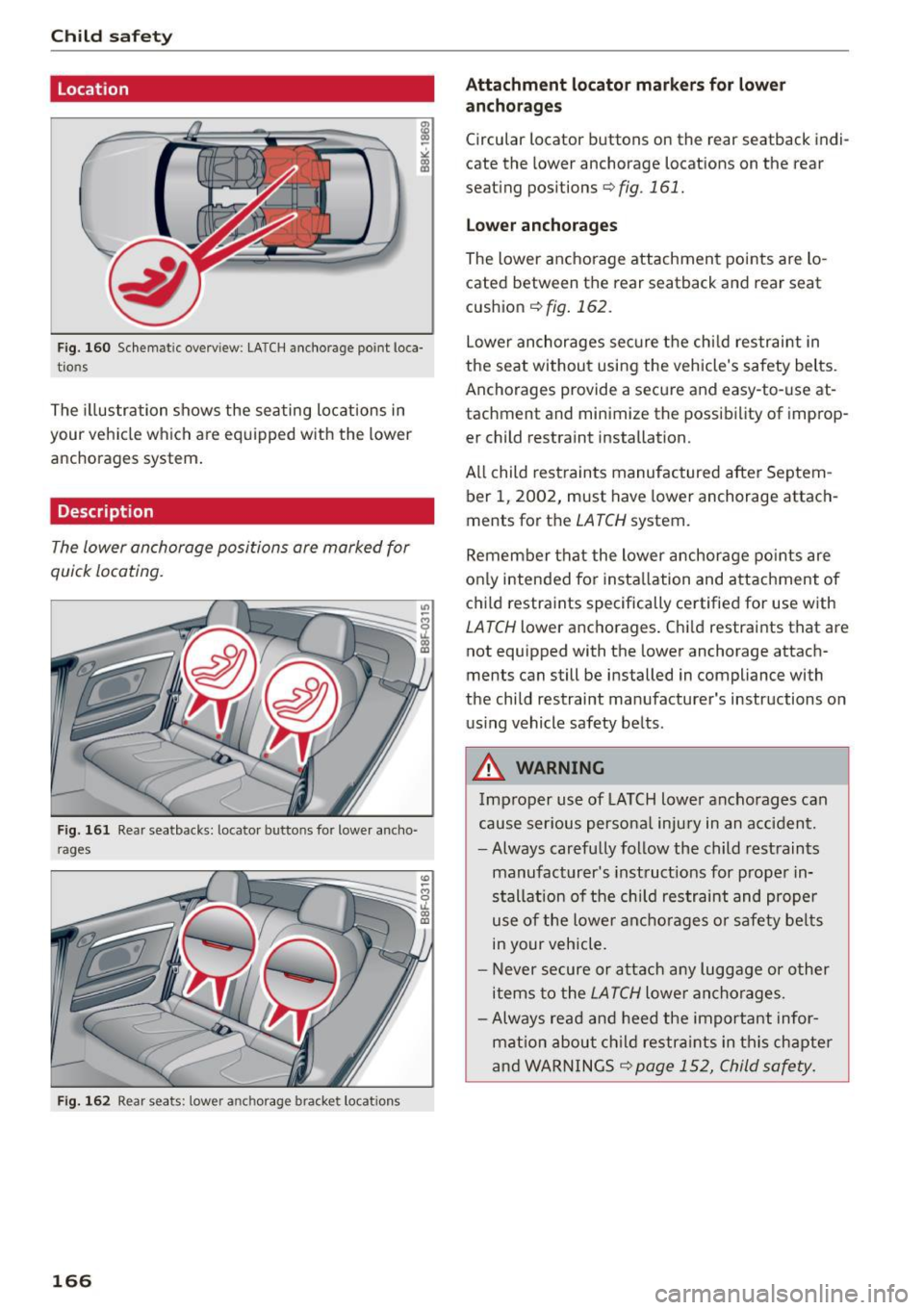
Location
F ig. 160 Sc hem atic overv iew: LATCH anc ho rage po int loca
tio ns
The illustra tion shows the seating locations in
your veh icle wh ich a re eq uipped w it h t he lower
anchorages system .
Description
The lower anchorage positions are marked for
quick locating.
F ig . 161 Rea r seatbacks: locato r bu tto ns fo r lowe r ancho
r ages
F ig. 16 2 Rear s eats : lower a nch ora ge brack et locat io ns
166
Attachment locato r markers for lower
anchorage s
Circular locator buttons on the rear seatback indi
cate the lower an chorage loc ations on the rear
sea ting pos itions
¢ fig . 161.
Lower anchorages
The lower anchorage attachmen t points are lo
cated between the rear seatback and rear seat
cushion
Q fig . 162 .
Lower anchorages sec ure t he chi ld restraint in
the seat without using the vehicle's safety belts .
Anchorages provide a secure and easy-to -u se at
tachment and minimize the possibility of improp
er child restr aint installation.
A ll child rest rain ts manufactured afte r Septem
ber 1 , 2002, must have lowe r anchorage attach
ments for the
LATCH system.
Remem ber that the lower anchorage po ints are
o nl y intended fo r insta llation and attachment of
ch ild restraints specifically ce rtified for use w ith
LATCH lower anchorages . Chi ld restraints that are
not equipped w ith the lower anchorage attach
ments can still be installed in compliance with
the chi ld restraint manufacturer 's instructions o n
us ing vehicle safety belts .
_&. WARNING
Imp ro per use of LA TCH lowe r ancho rages can
cause ser ious perso na l inju ry in an accident.
- Always carefully follow the child rest raints
manufactur er's instruct ions for prope r in
stallat ion of the child restraint and proper
use o f the lower an chorages or s afety be lts
in your vehicle.
- Never secure or a ttach any luggage or other
items to the
LATCH lower ancho rages.
- Always read and heed the impo rtant infor
mat io n about ch ild restra ints in th is chapte r
a nd WAR NINGS
Q page 152, Child safety.
Page 169 of 268
M N
ci u.. co ...... \!) ..,.,
N ..,., ......
Installing a child restraint with LATCH
lower anchorages
Whenever you install a child restraint always fol
low the child restraint manufacturer's instruc tions.
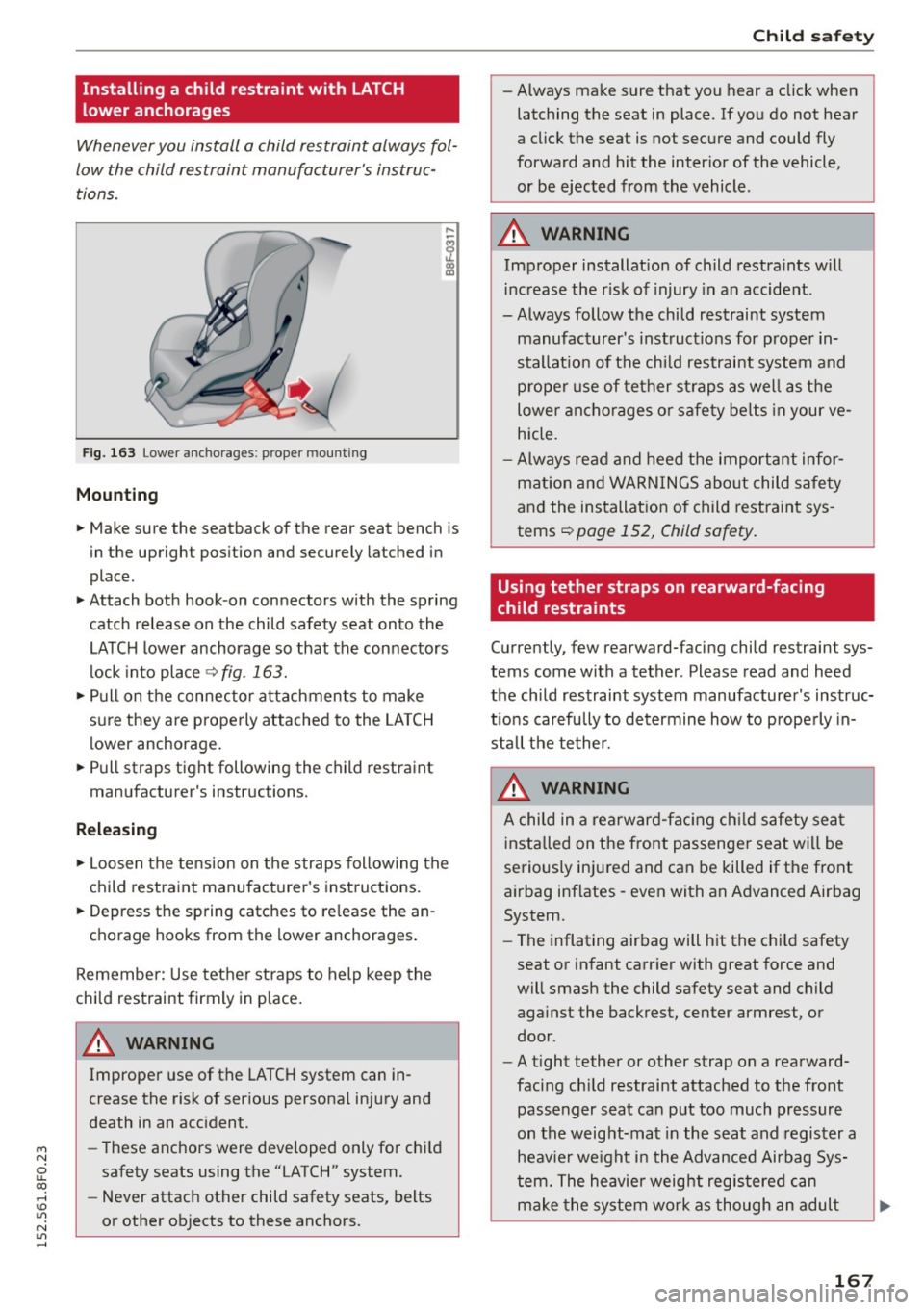
Fig. 163 Lowe r anch orages : proper mounting
Mounting
~ Make sure the seatback of the rear seat bench is
in the upright position and securely latched in
place.
~ Attach both hook-on connectors with the spring catch release on the child safety seat onto the
LATCH lower anchorage so that the connectors
lock into place
Qfig . 163.
~Pullon the connector attachments to make
sure they are properly attached to the LATCH
lower anchorage.
~ Pull straps tight following the child restraint
manufacturer's instructions.
Releasing
~ Loosen the tension on the straps following the
child restraint manufacturer's instructions.
~ Depress the spring catches to release the an
chorage hooks from the lower anchorages.
Remember: Use tether straps to help keep the
child restraint firmly in place.
A WARNING
Improper use of the LATCH system can in
crease the risk of serious personal injury and
death in an accident.
-
- These anchors were developed only for child
safety seats using the "LATCH" system.
- Never attach other child safety seats, belts
or other objects to these anchors.
Child safety
-Always make sure that you hear a click when
latching the seat in place. If you do not hear
a click the seat is not secure and could fly
forward and hit the interior of the vehicle,
or be ejected from the vehicle .
A WARNING '"---
Improper installation of child restraints will
increase the risk of injury in an accident.
- Always follow the child restraint system manufacturer's instructions for proper in
stallation of the child restraint system and proper use of tether straps as well as the
lower anchorages or safety belts in your ve
hicle.
- Always read and heed the important infor
mation and WARNINGS about child safety
and the installation of child restraint sys
tems
Q page 152, Child safety.
Using tether straps on rearward-facing
child restraints
Currently, few rearward-facing child restraint sys
tems come with a tether . Please read and heed
the child restraint system manufacturer's instruc
tions carefully to determine how to properly in
stall the tether.
A WARNING
A child in a rearward-facing child safety seat
installed on the front passenger seat will be
seriously injured and can be killed if the front
airbag inflates - even with an Advanced Airbag
System.
- The inflating airbag will hit the child safety
seat or infant carrier with great force and
will smash the child safety seat and child against the backrest, center armrest, or
door .
- A tight tether or other strap on a rearward
facing child restraint attached to the front
passenger seat can put too much pressure
on the weight-mat in the seat and register a
heavier weight in the Advanced Airbag Sys
tem. The heavier weight registered can
make the system work as though an adult
167
Page 170 of 268
Child safety
were on the seat and dep loy the Advanced
Airbag when it must be suppressed causing
serious or even fatal in jury to the child.
- If you must install a rearward facing child
safety seat on the front passenge r seat be
ca use of excepti onal c ircumstances and the
PASSENGER AIR BAG OFF light does not
co me on an d stay on, imm ediately ins tall
the rearwar d-fac ing ch ild saf ety sea t in a
re ar se ati ng posi tion a nd have the airbag
s y stem inspe cted by your author ized Audi
dealer .
Additional information
Sources of information about child
restraints and their use
There are a n umbe r of sources of additional infor
ma tion about c hild restra int selec tion, inst alla
t ion and use:
NHTSA adv ises that t he best child safety seat is
the one t hat fits your chi ld and fits in you r vehi
cle, a nd t hat yo u will use co rrect ly a nd con sis
t en tly.
Try befo re you buy!
U.S National Highway Traffic Safety Administra
tion
Te l.: 1 -888 -32 7-4236 ( TTY : 1-800 -424 -9153)
www .nhtsa .gov
National SAFE KIDS Campa ign
Tel.: (202) 662-0600
www .safekids .org
Safety BeltSafe U.S. A
Tel.: (800) 745-SAFE (English)
Te l.: (800) 747-SA NO (Spanish)
www .carseat.org
Transport Canada Info rmation Cent re
Tel.: 1-800-333-0371 or call 1-613-998-8616 if
you are in t he Ottawa area
http ://www.tc.gc.ca/eng/roadsafety/me nu.htm
Aud i Customer Relations
Tel.: (800) 822-2834
168
Page 171 of 268
M N
ci u.. co ,...., \!) 1.1'1
N 1.1'1 ,....,
Smart Technology Notice about data
recorded by the Event
Data Recorder and
vehicle control modules
Event Data Recorder
This vehicle is equipped with an Event Data Re
corder (EDR). The main purpose of an EDR is to
record, in certain crash or near crash-like situa
tions, such as an a irbag deployment or hitting a
road obstacle, data that will assist in understand
ing how a vehicle 's systems performed. The EDR
is designed to record data related to vehicle dy
namics and safety systems for a short period of
time, typically 30 seconds or less . The EDR in this
vehicle is designed to record such data as:
- How various systems in your vehicle were oper
ating;
- Whether or not the driver and passenger safety
belts were buckled/fastened;
- How far (if at all) the driver was depressing the
accelerator and/or brake pedal; and,
- How fast the vehicle was traveling.
These data can he lp provide a better understand
ing of the circumstances in which crashes and in
juries occur. NOTE: EDR data are recorded by your
vehicle only if a non-trivial crash situation occurs;
no data are recorded by the EDR under normal
driving conditions and no personal data (e .g .,
name, gender , age, and crash location) are re
corded. However, other parties, such as law en
forcement, could combine the EDR data with the
type of personally identifying data routinely ac
quired during a crash investigation .
To read data recorded by an EDR, special equip
ment is requ ired, and access to the vehicle or the
E DR is needed. In addition to the vehicle manu
facturer, other parties, such as law enforcement,
that have the special equipment , can read the in
formation if they have access to the vehicle or the
EDR .
Some state laws restrict the retr ieval or down
l oading of data stored by EDRs installed in a vehi
cle for the express purpose of retrieving data af-
Smart Technology
ter an accident or crash event without the own
er's consent.
A udi will not access the EDR and/or similar data
o r give it to others -
- unless the vehicle owner (or lessee if the vehi
cle has been leased) agrees; or
- upon the official request by the police; or
- upon the order of a court of law or a govern-
ment agency; or
- for the defense of a lawsuit through the judicial
discovery process.
- Audi may also use the data for research about
veh icle operation and safety performance or
provide the data to a th ird party for research
purposes without identifying the spec ific vehi
cle or information about the ident ity of its own
er or lessee and only after the recorded vehicle
data has been accessed.
Vehicle control modules
Your vehicle is also equ ipped with a number of
electron ic control modules for various vehicle
systems, such as eng ine management, emission
control, airbags, and safety belts.
These electronic control modules record data
during normal vehicle operation that may be
needed by trained technicians for diagnostic and
repair purposes. The recording capability of these
modules is lim ited to data (no sound is reco rded) .
Only a small amount of data is actua lly recorded
over a very limited period of time, or stored when
a system fau lt is detected by a contro l module.
Some of the data stored may relate to vehicle
speed, direction, or braking, as well as restraint
system use and performance in the event of a
crash . Stored data can also only be read and
downloaded w ith specia l equipment that is di
rectly connected to the vehicl e.
(D Tips
Your vehicle may be equipped with Audi con
nect. Your use of certain Audi connect fea
tures requires wireless serv ices that are pro
v id ed by a third party wire less telecommuni
cations provider. For details regarding how in
formation obtained through Audi connect is
collected, processed, transmitted, used, and ..,.
169
Page 188 of 268
Care and cleaning
Component Situation Solution
P ower top
Deposits Clean water, power top cleaning product, if necessary.
Clean with the grain of the fabric using a soft brush and al-
low to air dry.
Wind d efle ct or Deposits Water, mild soap solut
ion, if necessaryal
D ec orativ e parts / Deposits Mild soap solution al, a clean ing solution suitable for stain-
t rim less stee l, if necessary
Car bon p art s Deposits clean the same way as painted parts <=>page 184, Car
washes
P aint Paint damage Refer to the pa int number on the vehicle data label, repa ir
with touch up pa int <=>
page 245
Spilled fuel Rinse with water immediately
S urface rust Rust remover, then protect with hard wax; for quest ions,
refer to an authorized A udi dealer.
Corrosion Have it removed by an authorized Audi dealer.
Wate r no longer Protect w ith hard wax (at least twice per year)
beads on the surface
of clean paint
No sh ine even though Treat with suitab le polish; then apply pa int protectant if
pa int has been pro- the polish that was used does not contain any protectan t
tected/paint looks
poor
Deposits such as in- Dampen w ith water immediately and remove with a micro-
sects, bird dropp ings, fiber cloth
tree sap and road salt
Grease-based con-Remove immediate ly with a mild soap solution a) and a
taminants such as soft cloth
cosmetics or sunblock
al Mild soap solution: maximum two tablespoons of neutral soap in 1 quar t (1 liter ) of water
Internal cle ani ng
Component Situation Solution
Window s
Deposits Glass cleaner, then wipe dry
Dec orati ve part s/ Deposits Mild soap solutional
t rim
Pl as tic part s
Deposi ts Damp clo1th
Heavier deposits Mild soap solution al, detergent-free plastic cleaning solu-
tion, if necessary
Di spl ays Deposits Soft cloth with LCD cleaner
Controls Deposits Soft brush, then a soft cloth w ith a mi ld soap solutional
Safet y belt s Deposits Mild soap solution a>, allow to dry before letting them re -
tract
186
Page 190 of 268

Care and cleaning
- Never use gasoline, spot remove r, ben
zene, paint thinner or other solvents to
remove .
-Door wind ows
-Remove snow and ice on w indows and ex-
terior mirrors w ith a plastic scraper. To
avoid scratches, move the scraper only in
one direction and not back and fo rth .
- Never remove snow or ice from door w in
dows and m irrors using warm or hot water
because this could cause cracks to fo rm.
- To avoid damage to the rear window de
fogge r, do not apply any stic kers on the
heating w ires on the inside of the w indow.
- Decorat ive parts /trim
- Never use chrome care or cleaning prod-
ucts.
-Pa int
- To reduce the risk of scratches, the veh icle
must be free of d irt and dust before pol
ishing or waxing .
- To prevent paint damage, do not polish or
wax the veh icle in direct sunlight .
-To reduce the risk of paint damage, do not
polish away rust spots.
- Remove cosmet ics and sunscreen immedi
ately- these could damage the paint.
- Di spla ys
- To avoid scratches, do not use dry cleaning
methods on displays.
- Controls
- Make sure that no fluids enter the con-
tro ls, because this cou ld cause damage.
- Safet y belt s
- Do not remove the safety be lts to clean
them.
- Never clean safety belts or the ir compo
nents chemically or with corrosive fluids
or so lvents and never allow sharp objects
to come into contact w ith the safety belts.
Th is could cause damage to the belt web
bing.
- If there is damage to the webbing, the
connect ions, the retractors or the buckles,
have them replaced by an au thori zed deal
er.
- Textile s/artificial leather /Alcantar a
188
- Never treat artificial leather/A lcantara
with leather care products, solvents, floor
polish, shoe polish, spot remove or similar
products.
- Have a specialist remove stubborn stains
to prevent damage.
- Never use steam cleaners, brushes, hard
sponges, etc . when cleaning.
- Do not turn on the seat heating* to dry the seat.
- Objects with sharp edges such as zippe rs,
rivets on clothing or be lts can cause dam
age to the surface.
- Open hook and loop fasteners, for exam ple on clothing, can damage seat covers .
Make sure hook and loop fasteners are
closed.
- Natu ral leather
- Neve r treat leather w ith solvents, floor
polish, shoe polish, spot remover or simi
lar p rodu cts.
- Objects w ith sharp edges such as zippe rs,
rivets on clothing or be lts can cause dam
age to the surface.
- Never use steam cleaners, brushes, hard
sponges, etc. when cleaning .
- Do not turn on the seat heating* to dry the seat .
- To help prevent the leather from fad ing,
do not leave the vehicle in d irect sunlight
for long periods of time.
If leaving the ve
h icl e parked for long periods of t ime, yo u
should cover the leathe r to protect it from
d irect sunlight.
(D Tips
- Insects are easier to remove from paint that
has been fresh ly waxed.
- Regular waxing can prevent rust spots from
forming.
Placing your vehicle out
of service
If you wo uld like to take yo ur vehicle out of serv
ice for a longer time, contact your authorized
Audi dealer or qualified repair facility . They will
advise you of important measures ., such as ..,.
Page 198 of 268

Checking and Filling
compartment. Wait until no steam or cool
ant can be seen or heard before carefully
opening the hood.
- Keep children away from the engine com
partment.
- Never spill fluids on hot engine compo
nents. They can cause a fire.
- Never touch the radiator fan. The auxiliary
electric fan is temperature controlled and
can switch on suddenly.
- Never open the coolant reservoir cap when
the engine is still warm . The coolant system
is pressurized and hot coolant could spray
out .
- Protect your face, hands and arm from
steam or hot engine coolant by placing a
thick rag over the cap when you open the coolant reservoir .
- Do not remove the engine cover under any
circumstances . This increases the risk of
burns .
- If work on the fuel system or the electrical
system is necessary :
= Always disconnect the battery.
- Never smoke or work near heaters or open
flames. Fluids in the engine compartment
could start a fire.
- Keep an approved fire extinguisher imme
diately available.
- To avoid electrical shock and personal injury
while the engine is running or being started,
never touch:
- Ignition cables
- Other components of the high voltage
electronic ignition system.
- If you must perform a check or repair with
the engine running:
- First, fully apply the parking brake, move
selector lever of automatic transmission
to "P" (Park) .
- Always use extreme caution to prevent
clothing, jewelry, or long hair from getting
196
caught in the radiator fan, V-belts or other
moving parts, or from contacting hot
parts. Tie back hair before starting, and do
not wear clothing that will hang or droop
into the engine.
- Minimize exposure to emission and chemi
cal hazards
¢ A .
A WARNING
California Proposition 65 Warning:
- Engine exhaust, some of its constituents,
and certain vehicle components contain or
emit chemicals known to the State of Cali
fornia to cause cancer and birth defects and
reproductive harm. In addition, certain flu
ids contained in vehicles and certain prod
ucts of component wear contain or emit
chemicals known to the State of California
to cause cancer and birth defects or other
reproductive harm.
- Battery posts, terminals and related acces
sories contain lead and lead compounds,
chemicals known to the State of California
to cause cancer and reproductive harms.
Wash hands after handling.
([) Note
When adding fluids, always make sure that
they are poured into the proper container or
filler opening, otherwise serious damage to
vehicle systems will occur.
@ For the sake of the environment
To detect leaks in time, inspect the vehicle
floor pan from underneath regularly. If you
see spots from oil or other vehicle fluids, have
your vehicle inspected by an authorized Audi dealer .
Page 254 of 268

Index
A
A/C (automatic climate control) . . . . . . . . . . 69
Accessories . . . . . . . . . . . . . . . . . . . . . . . . . . 250
Active lane assist
Cleaning the camera area . . . . . . . . . . . . . 185
Active ro llover protection system . . . . . . . . 121
Retracting rollover protection . . . . . . . . . . 122
Adapt ive cruise control . . . . . . . . . . . . . . . . . . 90
Clean ing the sensor . . . . . . . . . . . . . . . . . . 185
Messages . . . . . . . . . . . . . . . . . . . . . . . . . . . 97
Request for driver intervention . . . . . . . . . . 95
Setting the driving program . . . . . . . . . . . . 95
Adapt ive dampers . . . . . . . . . . . . . . . . . . . . . 103
Adaptive light . . . . . . . . . . . . . . . . . . . . . . . . . SO
Adapt ive Light (defective) . . . . . . . . . . . . . . . 21
Adding Engine coolant .. .......... .... ... .. .
Engine oil .. ... ............... ... .. .
W indshield washer fluid ....... .. .. .. .
Additional accessories
Additives Engine oil ...... .............. ... .. .
Adjustable steer ing column ...... .. .. .. . .
Adjusting 202
199
208
250
199 73
Air distribu tion (automa tic climate control) 70
Instrument illum inat ion . . . . . . . . . . . . . . . 53
Steer ing column . . . . . . . . . . . . . . . . . . . . . . 73
Temperature (automatic climate control) . 70
Airbag . . . . . . . . . . . . . . . . . . . . . . . . . . . . . . 132
Warning/indicator lights . . . . . . . . . . . . . . . 19
Airbag system . . . . . . . . . . . . . . . . . . . . . . . . 150
Advanced Airbag-System . . . . . . . . . . . . . . 136
Advanced Airbag System components . . . 138
Care. . . . . . . . . . . . . . . . . . . . . . . . . . . . . . . 145
Children . . . . . . . . . . . . . . . . . . . . . . . . . . . 153
Child restraints . . . . . . . . . . . . . . . . . . . . . . 154
Components (front airbags) . . . . . . . . . . . 138
Danger of fitting a child safety seat on the
front passenger seat . . . . . . . . . . . . . . . . . 133
Disposal . . . . . . . . . . . . . . . . . . . . . . . . . . . 145
Fr ont airbags . . . . . . . . . . . . . . . . . . . 136, 13 7
How do the front airbags work? . . . . . . . . 140
How many airbags does my vehicle have? 138
How the Advanced Airbag System compo-
nents work together . . . . . . . . . . . . . . . . . 140
Important inform ation . . . . . . . . . . . . . . . 132
252
Important safety instructions on the knee
airbag system . . . . . . . . . . . . . . . . . . . . . . . 148
Ind icator light . . . . . . . . . . . . . . . . . . . . . . 142
Knee airbags. . . . . . . . . . . . . . . . . . . . . . . . 146
Monitoring . . . . . . . . . . . . . . . . . . . . . . . . . 142
PASSENGER AIR BAG O FF light . . . . . . . . . 142
Repairs . . . . . . . . . . . . . . . . . . . . . . . . . . . . 145
Safety instructions . . . . . . . . . . . . . . . . . . . 144
Side a irbags . . . . . . . . . . . . . . . . . . . . . . . . 148
Weight-sensing mat . . . . . . . . . . . . . . . . . 153
When must the system be inspected? . . . 142
all-wheel drive .......... .......... ... 174
All season tires . . . . . . . . . . . . . . . . . . . . . . . 224
Alternator
refer to Generator . . . . . . . . . . . . . . . . . . . . 16
Anti -freeze
refer to Engine coolant system . . . . . . . . . 200
Anti- lock braking system
Warning/indicator lights . . . . . . . . . . . . 18, 19
Anti- Lock Braking System . . . . . . . . . . . . . . 170
Anti-slip regulation Warning/indicator lights . . . . . . . . . . . . . . . 18
Anti-Slip Regulation . . . . . . . . . . . . . . . . . . . 170
Ant i-theft alarm system . . . . . . . . . . . . . . . . . 29
Anti -theft systems
Electronic immob ilizer . . . . . . . . . . . . . . . . . 35
Armrest . . . . . . . . . . . . . . . . . . . . . . . . . . . . . . 62
Ashtray . . . . . . . . . . . . . . . . . . . . . . . . . . . . . . 64
Audi braking guard
refer to braking guard . . . . . . . . . . . . . . . . . 90
Audi drive select . . . . . . . . . . . . . . . . . . . . . . 103
Adaptive dampers . . . . . . . . . . . . . . . . . . . 103
Descrip tion . . . . . . . . . . . . . . . . . . . . . . . . . 103
Dynam ic steering . . . . . . . . . . . . . . . . . . . . 103
Setting the driving mode . . . . . . . . . . . . . . 104
Sport d ifferential . . . . . . . . . . . . . . . . . . . . 103
Audi Service Repai r Manuals and Lite ratu re 248
AUTO Automatic climate control . . . . . . . . . . . . . . 70
Automatic headlights . . . . . . . . . . . . . . . . . 50
Automat ic belt retractor . . . . . . . . . . . . . . . 128
Automatic climate control Air vents . . . . . . . . . . . . . . . . . . . . . . . . . . . . 70
Operation . . . . . . . . . . . . . . . . . . . . . . . . . . . 69
Setup . . . . . . . . . . . . . . . . . . . . . . . . . . . . . . 71
Automatic power top . . . . . . . . . . . . . . . . . . . 42
Automat ic Shift Lock (ASL) . . . . . . . . . . . . . . 84