engine coolant AUDI A5 CABRIOLET 2015 User Guide
[x] Cancel search | Manufacturer: AUDI, Model Year: 2015, Model line: A5 CABRIOLET, Model: AUDI A5 CABRIOLET 2015Pages: 268, PDF Size: 66.88 MB
Page 202 of 268
Checking and F ill in g
@ For the sake of the environment
- Under no circumstances can the oil come in
contact with the sewage network or the soil.
- Observe and fo llow lega l regu lations when
disposing of empty oil containers .
Changing the engine oil
We recommend that hove your oil changed by on
authorized Audi dealer or a qualified service sta
tion.
Before you check anything in the engine compa rt
ment,
alway s read and heed all WARNINGS ¢ .&.
in Working in the engine comportment on
page 195.
The engine oil must be changed according to the
i n terva ls specified in yo ur Warranty
& Mainte
nance booklet . This is very important because the
lubricat ing propert ies of o il diminish gradua lly
during normal vehicle use.
Under some circ umstances the engine oi l sho uld
be changed more frequent ly . Change oil more of
ten if you drive most ly short distances, operate
the vehicle in dusty areas or under predom inantly
stop-and-go traffic condit ions, or have your vehi
cle where temperatures rema in below freezi ng
for extended periods.
Detergent addit ives in the o il w ill make fresh oil
look dark after the engine has been running for a
short time. This is normal and is not a reason to
cha nge the oil mo re often than recommended .
Because of the problem of proper disposa l, along
with the special tools and necessary expertise re
qu ired, we stro ngly recommend that you have
your oil changed by an autho rized
Aud i deale r or
a qualif ied se rvice stat ion.
If you choose to change your o il yourself, please
note the fo llowing important information :
A WARNING
To reduce the ris k of persona l inju ry if yo u
must c han ge the engine oil in your ve hicle
yo urself:
- Wea r eye p rotection .
200
-
-To reduce t he risk of burns from hot engine
oil, let the engine coo l down to the touch.
- W hen removing the o il drain p lug with your
fingers, stay as far away as possib le. Always
keep your forearm parallel to the ground to
he lp prevent hot oi l from running down your
arm .
- Dra in the oil into a c ontainer designed for
this purpose, one la rge enough to hold at
least the tota l amount of oil in your engine.
- Engine oil is poisonous. Keep it we ll out of
the reach of chi ld ren .
- Continuous contact w it h used eng ine oi l is
ha rmf ul to your skin. Always protect you r
skin by washi ng oil off tho roughly wi th soap
a nd wate r.
(D Note
Never mix oil additives with your engine oil.
These additives can damage your e ngine and
adverse ly affect your Audi Limited New Vehi
cle Warranty.
@ For the sake of the environment
- Before changi ng your oil, first make su re
you know where you ca n prope rly dispose of
the used oil.
- Always dispose of used eng ine oil properly.
Do not d ump it on garden so il, wooded
areas, in to op en st reams o r down sewage
drai ns.
- Recycle used engi ne oil by taking it to a used
eng ine oi l collect ion fac ility in yo ur area, o r
c ontact a service station.
Cooling system
Coolant '
The engine coolant performs two functions: it
keeps the engine from overheating and it pro
tects the engine from freezing in the winter.
The cooling system is sealed and genera lly re
q u ires little attention.
The cooli ng sys tem has been filled at the f actory
wi th a permanent coolan t which does not need to
be changed. The coolant consists of a mixtu re of
jll,,
Page 203 of 268

M N
ci u.. co ,...., \!) 1.1"1
N 1.1"1 ,....,
specially conditio ned water an d the manu fa ctu r
er's glycol-basedcoolant additive Gl3 antifreeze
with anticorrosion additives (50% for USA mod
els; 60% for Canadian models). This m ixture both
assures the necessary frost protection and pro
tects meta l components in the engine's cooling
system from corrosion and scal ing . It also raises
the boiling point of the coolant.
Do not reduce the concentration of the coolant in
the summer by adding plain water .
The p ropor
tion of coolant addit ive must be at l east 50 %
but n ot mor e th an 60 %
to maintain antifreeze
protection and cooling efficiency. If the coolant
frost protection is too low, the coolant cou ld
freeze and damage the vehicle heating and en
gine cooling system.
F or yea r-round driving, antifreeze is added at the
factory fo r temperatures dow n to:
- -31°F(-35°C)USA
- -40 °F ( - 40 °C) Canada.
If you must add coo lant, use a mixture of water
and coolant addit ive. Mixing the coolant additive
with distilled water is recommended.
A WARNING
Before you check anything in the engine com
partment, always read and heed all WARN
INGS
¢ &. in Working in the engine compart
ment on page 195.
(D Note
- Before winter sets in, have the coolant
checked to see if the coolant addit ive in your
vehicle is suffic ient to meet the cli mate con
dit ions. This is especially important if you
li ve in a region where the win ter is extreme
l y co ld. If ne cessary, i ncrease the proport ion
of coo lant add itive to 60%.
- When adding coolant a ddit ive to you r cool
i ng system, remember:
- We recommend using only coolant addi
tive Gl2++ or Gl3 for your ve hicle. This
coolant additive is ava ilable at authorized
Audi dea lers. Other types of ant ifreeze can
significant ly reduce co rrosion protection.
Checking and Fillin g
The resulting corrosion can ca use a loss o f
coolant and serious engine damage.
- Do not add any type of rad iator le ak sealan t
to your vehicle's engine coolant. Adding ra
diator repai r fluid may adverse ly affect the
function and performance of your cooling
system and could result in damage not cov
ered by your New Vehicle Lim ited Warranty.
Checking the engine coolant level
The engine coolant level can be checked with a
quick glance.
Fi g. 175 Engine compartment: Cover on the coolant ex
pa nsion tank
.. Before you check anything in the engine com
partment,
alwa ys re ad and heed all WARN
INGS ¢ A in Working in the engine compart
ment on page 195.
.. Park your vehicle on a level su rface.
.. Tu rn off the ignition .
.. Read the engine coolant level from the coolant
expansion tank
¢fig . 175, ¢page 197,
fig . 172 .
With a cold engine, the coolant leve l
should be between the "M IN" and "MAX" mark
ings. When the eng ine is warm, the level may
be slightly above the "MAX" marking.
The location of the coo lant expansion tank can be
seen in the engine compartment illustration
¢page 197.
To obtain an a ccur ate reading, the engine m ust
be switched off.
T he expansion tank in yo ur veh icle is eq uipped
with an electric coo lant level senso r.
When the coolant leve l is too low, the wa rn ing
light in the Auto-Check System¢
page 17 will
201
Page 204 of 268

Checking and F ill in g
blink until you add coo lant and the level has been
restored to normal. Even though there is an e lec
tr ic coo lant level sensor, we still recommend you
check the coo lant level from t ime to time.
Coolant los s
Coolant loss may indicate a leak in t he cooling
system. In the event of coolant loss, the cooling
system should be inspected immediately by your
authorized Audi dealer. It is not enough merely
to add coolant.
I n a
s e a led system, losses can occur only if the
boiling point of the coo lant is exceeded as a re
sult of overheating.
A WARNING
The cooling system is under pressure and can
get very hot. Reduce the risk of scalding from
hot coolant by following these steps .
- Turn off the engine and allow it to coo l
down .
- Protect your face, hands and arms from es
caping fluid and steam by covering the cap
with a large, thick rag .
-Turn the cap slowly and very carefully in a
counter-clockw ise d irection while applying
light, downward pressure on the top of the
cap.
- To avoid being burned, do not spill ant i
freeze or coolant on the exhaust system or hot eng ine parts . Under ce rtain conditions,
the ethy lene g lycol in engine coolant can
catch fire.
{il) Note
Do not add any type of rad iator leak sealant
to your veh icle's engine coolant . Adding radia
to r repair f lu id may adverse ly affect the func
tion and performance of your cooling system
and could resu lt in damage not covered by
your New Vehicle Limited Warranty.
Adding coolant
Be very careful when adding engine coolant .
Before you check anything in the engine compart
ment,
alway s re ad an d heed all WARN ING S
202
¢ A in Working in the engine compartment on
page 195.
Req uirement: There must be a res idual amo unt
of coo lant in the expans ion tank
~CD-
.,,. Turn off the engine .
.,,. Let the engine cool down.
.,,. Place a thick rag ove r the coolant expansion
tank ¢
page 201, fig. 175 and car efull y turn
the cap counter-clockwise
~ .&_ .
.,,. Add coo lant mixed in the correct ratio
~ page 200, Coolant up to the MAX marking .
.,,. Make sure that the flu id level remains stab le.
Add more coolant if necessa ry .
.,,. Twist the cap on aga in
tightly .
Replacement engine coo lant must conform to ex
act specifications ¢
page 200, Coolan t.
We recommend using only coo lant additive Gl2 +
+ , Gl3
or in an emergency Gl2+. Do not use a
different additive. In an emergency use plain wa
ter unt il you can get the correct additive and can
restore the correct ratio. This should be done as
soon as possible .
If you have lost a considerab le amount of cool
ant, then you should add cold antifree ze and cold
water only when the engine is cold.
Always use
new engine coo lant when refilling.
Do not fil l coolant above the "MAX " mark. Excess
coolant will be forced out through the pressure
relief valve in the cap when the engine becomes
hot.
A WARNING
- The cooling system is under pressure and
can get very hot. Reduce the risk of scalding
from hot coolant by following these steps.
- Turn off the eng ine and allow it to coo l
down.
- Protect you r face, hands and arms from
escaping fluid and steam by covering the
cap with a large, thick rag .
- Turn the cap s low ly and ve ry carefully in a
counter-clockw ise direction wh ile app ly ing
li ght, downward p ressu re on the top o f
the cap. ..,,.
Page 205 of 268

M N
ci LL co
rl I.O
"' N
"' rl
-To avoid being burned, do not spi ll anti
freeze or coolant on the exhaust system or hot engine parts. Under certain condi
tions, the ethylene glycol in engine cool ant can catch fire.
- Antifreeze is poisonous. Always store anti
freeze in its original conta iner and well out
of the reach of ch ildren .
-If you drain the coolant, it must be caught
and safely stored in a proper container
clearly marked "poison" .
(D Note
-Do not add coolant if the expansion tank is
empty . Air could enter the cooling system
and damage the eng ine .
If this is the case,
do not continue driving. Seek profess ional
ass istance.
- Coolant pollutes the env ironment and could
cause an eng ine fire . Excess coolant will be
fo rced out through the pressure relief valve
i n the cap when the eng ine becomes hot.
- If, i n an emergency , only water can be add
ed, the correct ratio between wa ter and an
tifreeze
~ page 200 must be restored as
soon as possib le .
@) For the sake of the environment
Drained coolant should not be reused. Always
dispose o f used coolant while observ ing all
environmental regulations .
Radiator fan
The radiator fan switches on automatically by it
self.
The radiator fan is driven by the engine via the V
be lt . The viscous clu tch regulates the speed of
the fan ac cording to the temperature of the cool
ant.
An auxiliary e lectr ic rad iator fan* switches on and
off depend ing on coolant temperat ure and othe r
veh icle operati ng conditions.
Afte r you switch the engine off, the auxiliary fan
can continue runn ing for up to 10 minutes -even
Ch eck in g and Fillin g
with the ignition off . It can even switch on again
later by itself¢& , if
- the temperatu re of the engine coo lant rises due
to the heat build- up from the engine in the en
gine compartment, or
- the engine compartment heats up because the
veh icle is parked in intense sun light .
A WARNING
-To reduce the risk of persona l injury never
touch the radiator fan .
- The auxiliary electric fan is temperature con trolled and can switch on suddenly even
when the engine is not running.
- The a uxiliary radiator fan sw itches on auto
matica lly when the engine coolant reaches a
certain temperature and will continue to run
until the coolant temperature drops.
Brake fluid
Checking brake fluid level
The brake fluid level can be checked with a quick
glance .
Fig. 17 6 Engine compar tment : Cove r on the b rake fl uid
r e servoir
Before you check anyth ing in the engine compart
ment,
al way s read and h eed all WARNIN GS
¢ _.& in Working in the engine compartment on
page 195 .
.,. Read the brake fluid level from the b rake fluid
reservoir ¢
fig. 176, ¢ page 197, fig . 172 . The
brake fluid level must be between the
"MIN "
and "MAX " markings.
20 3
Page 210 of 268

Checking and Fill in g
th e e nergy management functions correctly after
replacing the battery.
If i t is not poss ible to use a battery of this type,
the new battery must have the same capacity,
voltage (12-vo lts), amperage, construct ion and
p lug sealing.
When insta lling the battery, make sure the igni
tion and all elec trical consumers are t urned off.
CD Note
Make sure the ventilation hose on the s ide of
t he batte ry is connected, otherwise fumes or
bat tery ac id can leak out.
@ For the sake of the environment
Because of the problem of proper d isposa l of
a battery, we recommend your author ized
Audi dea le r change the battery for yo u. Ba t
teries contain su lfuric acid and lead and must
always be disposed of properly in compliance
w ith all environmenta l reg ulations. D isposing
of vehicle batteries improperly is very danger
ous to the environment.
Windshield/headlight* washer container
Fig. 178 Engine co mpa rtment : Cove r on th e w in d shiel d
an d h ead ligh t• was her fl uid container
The washer fluid containe r is marked with the
symbol
O on its cap ¢ fig . 178 , ¢page 197,
fig . 172 .
.,. Before you check anyth ing in the eng ine com
partment , alw ays re ad and he ed all WARN·
I NGS
¢ ,& in Working in the engine comport
ment on page 195 .
208
.,. Lift the filler cap tongue to add washer fluid.
Yo u can fill the container to the top.
.,. Press the cap back onto the filler neck after fill-
ing the container .
You can find the reservoir ca p acit y in the table in
~ page 246.
Clean water should be used when filling up. If
possible, use soft water to prevent scaling on the
washer jets . Always add a g lass cleaner solution
(with frost protection in the winter) .
CD Note
Do not mix engine coolant antifreeze or any
other additives to fill up the windsh ield wash
er reservoir.
Page 223 of 268
M N
ci u.. co ,...., \!) 1.1'1
N 1.1'1 ,....,
Wheels
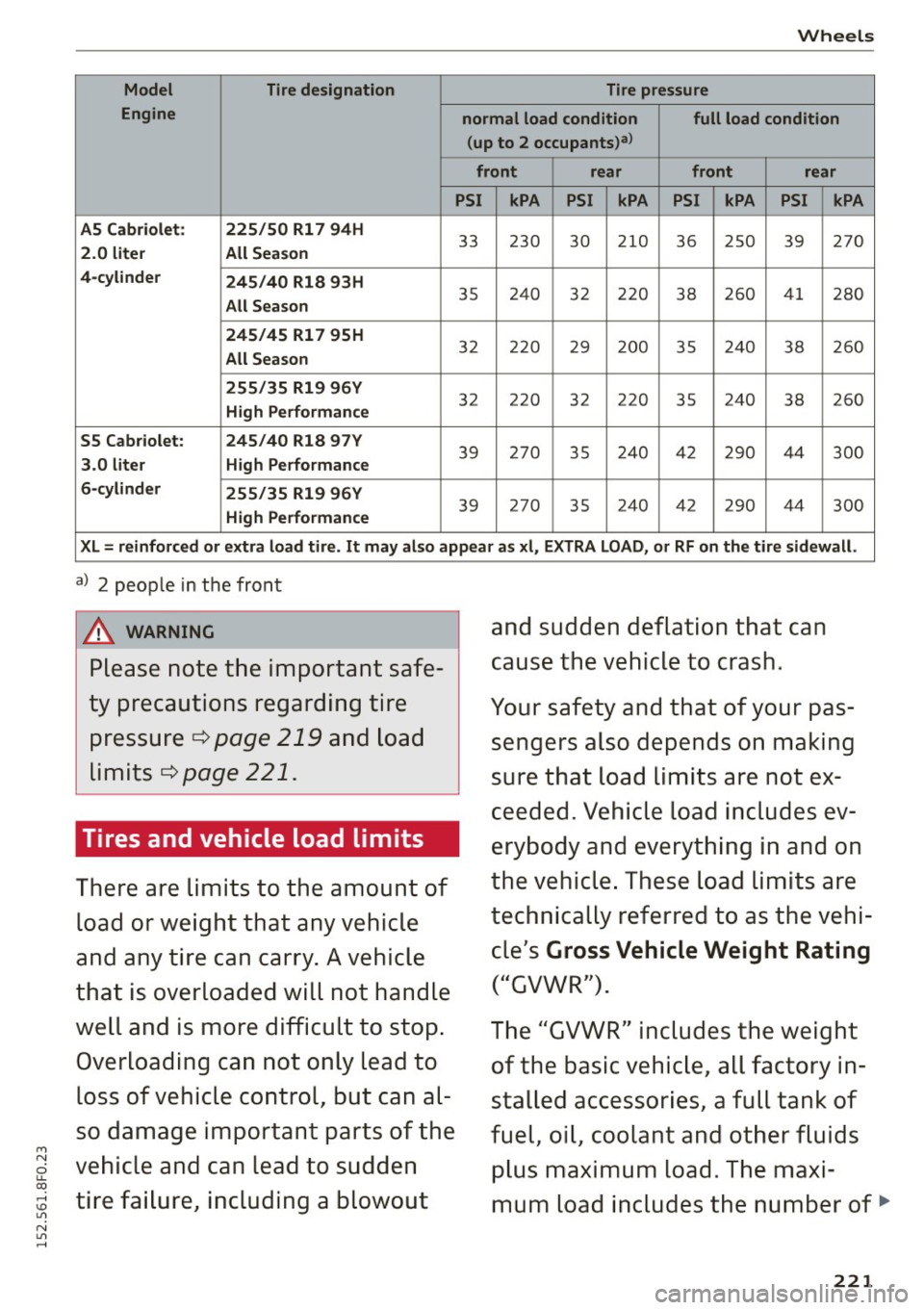
Model Tire designation Tire pressure
Engine normal load condition full load condition
(up to 2 occupants)a)
front rear front rear
PSI kPA PSI kPA PSI kPA PSI kPA
AS Cabriolet: 225/50 Rl 7 94H
33 230 30 210 36 250 39 270 2.0 liter All Season
4-cylinder 245/40 Rl8 93H
All Season
35 240 32 220 38 260 41 280
245/45 Rl7 95H 32 220 29 200
35 240
38 260
All Season
255/35 Rl9 96Y
32 220 32 220 35 240
38 260 High Performance
SS Cabriolet: 245/40 Rl8 97V
39 270 35 240 42 290 44 300 3.0 liter High Performance
6-cylinder
255/35 Rl9 96V
High Performance
39 270
35 240 42 290 44 300
XL= reinforced or extra load tire. It may also appear as xl, EXTRA LOAD, or RF on the tire sidewall.
a) 2 people
in the front
A WARNING
Please note the important safe
ty precautions regarding tire pressure ¢
page 219 and load
limits
¢ page 221.
Tires and vehicle load limits
There are limits to the amount of
load or weight that any vehicle
and any tire can carry. A vehicle
that is overloaded will not handle
well and is more difficult to stop. Overloading can not only lead to
loss of vehicle control, but can al
so damage important parts of the
vehicle and can lead to sudden
tire failure, including a blowout and
sudden deflation that can
cause the vehicle to crash.
Your safety and that of your pas sengers also depends on making
sure that load limits are not ex
ceeded. Vehicle load includes ev
erybody and everything in and on
the vehicle. These load limits are
technically referred to as the vehi cle's
Gross Vehicle Weight Rating
("GVWR").
The "GVWR" includes the weight of the basic vehicle, all factory in
stalled accessories, a full tank of
fuel, oil, coolant and other fluids plus maximum load. The maxi
mum load includes the number of
1111-
221
Page 247 of 268

M N
ci LL co
rl I.O
"' N
"' rl
Technical data
Vehicle identification
F ig. 206 Ve hicle Identificat io n Number (VlN) plate: loca·
t io n on d river 's s id e dash pane l
XXXXX XX -X -XXXX XXX XX
CD+ ~t :1:: xxxxxxxx xx x xx xxx xxx
T VP /fffl XXX XXX
XX XXXXXXX XX X X xx
XXX KW XXX
®i ~:J·f lfils~~ XXXX XXX XXX
®-+ ~N:a=i~ l xxxx ; xxxx xxx ; xx
II.· AUSS, I OPTIONS
,__ __
E0 A 7D5
2EH J0Z
3FC
F0A
TL6 3KA
lX W
7T6 CV 7
3L4
lSA 4UB
6XM 5SG
llB l AS
S M U 7Xl
9G3 OG7 OYH
8E H UlA X 98
803 908 824
7KO 4X3 2K2
4KC 3YO 413
7GB 01 A
5RW
18A
0JF
Q Z7
020
502
4GO
XX . X XX X XX X XXXX
Fig. 207 T he veh icle identi fica tion label: ins ide the l ug·
ga ge compart men t
Vehicle Identification Number (VlN )
The Veh icle Iden tifica tion Number is located in
d iffe rent p laces:
- under the w indshield on the dr iver's side
c> fig . 206.
-in the radio or in the MM I*: Select : I CARI func
t ion button
> V ehicle ID numb er (VIN ) or se·
Leet :
I CARI funct ion button > Car sy stem s* con
tro l bu tton >
Servicing & checks > VIN num
ber .
-on the vehicle identification la bel.
Technical d ata
Vehicle id entification label
T he veh icle identification label is lo cated in the
lu ggage compartment near the battery.
T he labe l c>
fig. 207 shows the fo llowing vehicle
da ta:
(D Vehicle Ident ificat ion Number (VIN)
@ Vehicle type, engine o utp ut, transmission
® Engine and transm iss ion code
@ Pa int number and interior
® Optional equipment numbers
T he information of the veh icle identification label
c a n a lso be fo und in you r W arranty
& Mai nte
nance booklet.
Safety compliance sticker
T he safety compliance sticker is you r assurance
that your new vehi cle complies w ith all applicable
Federa l Mo tor Vehi cle Safety Sta ndards which
were in effec t at the time the vehicle w as m anu
fac tured. Yo u can find this sticker on the door
jamb on the driver 's side. It shows the month and
year of production and the vehicle identification number of your vehicle (perforation) as we ll as
the Gross Veh icle Weight Rating (GVWR) and the
Gross Axle Weight Rating (GAWR).
H igh vo ltage warning lab el
The hig h voltage warning label is located in the
engine compartment ne xt to the eng ine hood re
lease. The spark ign ition system complies with
the Canadian standard ICES-002 .
Weights
Gross Vehicle Weight Rating
The Gross Vehicle Weight Rat ing (GVWR), and
the Gross Axle Weight Rating (GAWR) for front
and rear are listed on a st icker on the door jamb
on the dr iver's side.
T he Gross Vehicle Weight Rat ing includes the
weight of the basic vehicle plus fu ll fuel tank, oil
and coolant, p lus maxim um load, which includes
passenger weigh t (150 lbs/68 kg per designated
seat ing pos ition) and luggage we ight
c> .&, . ..,,.
245
Page 251 of 268
M N
ci u.. co ,...., \!) 1.1'1
N 1.1'1 ,....,
today's automobiles, have steadily reduced the
scope of maintenance and repairs which can be
carried out by vehicle owners .
Also , s afety a nd
en viro nm enta l
concerns place very strict limits
on the nature of repairs and adjustments to en
g ine and transmission parts which an owner can
perform.
Maintenance, adjustments and repa irs usua lly re
qu ire spec ial tools, testing devices and other
equ ipment available to specially trained work
shop perso nnel in order to assure proper per
formance, reliab ility and safety of the vehicle and
its many systems.
Improper ma intenance, adjustments and repairs
can impair the operation and reliability of your
vehicle and even void your vehicle warranty .
Therefore, proof of se rv icing in accordance with
the m aintenance schedule may be a condi tion for
upho ld ing a possib le warranty cla im made w ith in
the warranty period .
Above all, operational safety can be adversely af
fected, creating unnecessary r isks fo r you and
your passengers.
I f in doubt about any servicing, have it done by
your author ized Audi dealer or any prope rly
equ ipped and qua lified workshop. We st rongly
urge you to give your authorized Audi dealer the
opport unity to perform all sched uled mainte
nance and necessary repairs. Your dealer has the
fac ilities, origina l parts and trained specia lists to
keep yo ur vehicle runn ing properly.
P e rforming lim it e d ma inten anc e y ours elf
The fo llowing pages describe a limited number of
proced ures which can be performed on yo ur vehi
cle with ordinary tools, should the need arise and
trained personne l be unavailable. Before per
forming any of these procedures, always thor
oughly read all of the applicable text and careful
ly follow the instructions g iven . Always rigorously
observe the
W ARNINGS prov ided .
Before you check an ything in the engine com
partm ent, always r ead and h eed all WARNING S
c:> .&. and c:> .&. in Working in the engine comport
ment on page 195.
C o nsum er information
A WARNING
- Ser ious personal injury may occur as a result
of improperly performed maintenance, ad
justments or repairs.
- Always be extremely careful when work ing
on the vehicle. Always follow commonly ac
cepted safety practices and general com mon sense. Never ris k personal injury.
- Do not attempt any of the maintenance,
checks or repairs descr ibed on the following
pages if you are not fully familia r wi th these
or other procedures w ith respect to the vehi
cle, or a re unce rtain how to proceed .
- Do not do any work without the proper tools
a nd eq uipment. Have the necessary work
done by your authorized Audi dealer or any
properly equipped and qualified workshop.
- The engine compa rtment o f any motor vehi
cle is a potentially hazardous area. Neve r
reach into the area around or touch the radi
ator fan. It is temperature controlled and
can switch on suddenly - even when the en
g ine is off and the ign ition key has been re
moved. The rad iator fan switches on auto
mat ically when the coo lant reaches a certain
temperature and will continue to run unt il
the coolant temperature d rops.
- Always remove the ign ition key befo re any
one gets under the vehicle.
- Always support your veh icle with safety
stands if it is necessary to work underneath
the vehicle. The jack supplied w ith the vehi
cle is no t adequ ate for this purpose and
could collapse caus ing serious personal in
jury.
- If you m ust wor k underneath t he vehicle
with the wheels on the ground, a lways make
sure the vehicle is on level ground, that the
wheels are a lways secure ly blocked and that
the engine cannot be started.
- Always make sure the transmission se lector
lever (automatic transmiss ion) is in "P"
(Park position) and the park brake is firmly
applied.
249
Page 254 of 268

Index
A
A/C (automatic climate control) . . . . . . . . . . 69
Accessories . . . . . . . . . . . . . . . . . . . . . . . . . . 250
Active lane assist
Cleaning the camera area . . . . . . . . . . . . . 185
Active ro llover protection system . . . . . . . . 121
Retracting rollover protection . . . . . . . . . . 122
Adapt ive cruise control . . . . . . . . . . . . . . . . . . 90
Clean ing the sensor . . . . . . . . . . . . . . . . . . 185
Messages . . . . . . . . . . . . . . . . . . . . . . . . . . . 97
Request for driver intervention . . . . . . . . . . 95
Setting the driving program . . . . . . . . . . . . 95
Adapt ive dampers . . . . . . . . . . . . . . . . . . . . . 103
Adaptive light . . . . . . . . . . . . . . . . . . . . . . . . . SO
Adapt ive Light (defective) . . . . . . . . . . . . . . . 21
Adding Engine coolant .. .......... .... ... .. .
Engine oil .. ... ............... ... .. .
W indshield washer fluid ....... .. .. .. .
Additional accessories
Additives Engine oil ...... .............. ... .. .
Adjustable steer ing column ...... .. .. .. . .
Adjusting 202
199
208
250
199 73
Air distribu tion (automa tic climate control) 70
Instrument illum inat ion . . . . . . . . . . . . . . . 53
Steer ing column . . . . . . . . . . . . . . . . . . . . . . 73
Temperature (automatic climate control) . 70
Airbag . . . . . . . . . . . . . . . . . . . . . . . . . . . . . . 132
Warning/indicator lights . . . . . . . . . . . . . . . 19
Airbag system . . . . . . . . . . . . . . . . . . . . . . . . 150
Advanced Airbag-System . . . . . . . . . . . . . . 136
Advanced Airbag System components . . . 138
Care. . . . . . . . . . . . . . . . . . . . . . . . . . . . . . . 145
Children . . . . . . . . . . . . . . . . . . . . . . . . . . . 153
Child restraints . . . . . . . . . . . . . . . . . . . . . . 154
Components (front airbags) . . . . . . . . . . . 138
Danger of fitting a child safety seat on the
front passenger seat . . . . . . . . . . . . . . . . . 133
Disposal . . . . . . . . . . . . . . . . . . . . . . . . . . . 145
Fr ont airbags . . . . . . . . . . . . . . . . . . . 136, 13 7
How do the front airbags work? . . . . . . . . 140
How many airbags does my vehicle have? 138
How the Advanced Airbag System compo-
nents work together . . . . . . . . . . . . . . . . . 140
Important inform ation . . . . . . . . . . . . . . . 132
252
Important safety instructions on the knee
airbag system . . . . . . . . . . . . . . . . . . . . . . . 148
Ind icator light . . . . . . . . . . . . . . . . . . . . . . 142
Knee airbags. . . . . . . . . . . . . . . . . . . . . . . . 146
Monitoring . . . . . . . . . . . . . . . . . . . . . . . . . 142
PASSENGER AIR BAG O FF light . . . . . . . . . 142
Repairs . . . . . . . . . . . . . . . . . . . . . . . . . . . . 145
Safety instructions . . . . . . . . . . . . . . . . . . . 144
Side a irbags . . . . . . . . . . . . . . . . . . . . . . . . 148
Weight-sensing mat . . . . . . . . . . . . . . . . . 153
When must the system be inspected? . . . 142
all-wheel drive .......... .......... ... 174
All season tires . . . . . . . . . . . . . . . . . . . . . . . 224
Alternator
refer to Generator . . . . . . . . . . . . . . . . . . . . 16
Anti -freeze
refer to Engine coolant system . . . . . . . . . 200
Anti- lock braking system
Warning/indicator lights . . . . . . . . . . . . 18, 19
Anti- Lock Braking System . . . . . . . . . . . . . . 170
Anti-slip regulation Warning/indicator lights . . . . . . . . . . . . . . . 18
Anti-Slip Regulation . . . . . . . . . . . . . . . . . . . 170
Ant i-theft alarm system . . . . . . . . . . . . . . . . . 29
Anti -theft systems
Electronic immob ilizer . . . . . . . . . . . . . . . . . 35
Armrest . . . . . . . . . . . . . . . . . . . . . . . . . . . . . . 62
Ashtray . . . . . . . . . . . . . . . . . . . . . . . . . . . . . . 64
Audi braking guard
refer to braking guard . . . . . . . . . . . . . . . . . 90
Audi drive select . . . . . . . . . . . . . . . . . . . . . . 103
Adaptive dampers . . . . . . . . . . . . . . . . . . . 103
Descrip tion . . . . . . . . . . . . . . . . . . . . . . . . . 103
Dynam ic steering . . . . . . . . . . . . . . . . . . . . 103
Setting the driving mode . . . . . . . . . . . . . . 104
Sport d ifferential . . . . . . . . . . . . . . . . . . . . 103
Audi Service Repai r Manuals and Lite ratu re 248
AUTO Automatic climate control . . . . . . . . . . . . . . 70
Automatic headlights . . . . . . . . . . . . . . . . . 50
Automat ic belt retractor . . . . . . . . . . . . . . . 128
Automatic climate control Air vents . . . . . . . . . . . . . . . . . . . . . . . . . . . . 70
Operation . . . . . . . . . . . . . . . . . . . . . . . . . . . 69
Setup . . . . . . . . . . . . . . . . . . . . . . . . . . . . . . 71
Automatic power top . . . . . . . . . . . . . . . . . . . 42
Automat ic Shift Lock (ASL) . . . . . . . . . . . . . . 84
Page 255 of 268

M N
ci u.. co
Automatic transmission . . . . . . . . . . . . . . . . . 83
Automatic Shift Lock (ASL) . . . . . . . . . . . . . 84
Driving . . . . . . . . . . . . . . . . . . . . . . . . . . . . . 85
Emergency mode . . . . . . . . . . . . . . . . . . . . . 88
Emergency release . . . . . . . . . . . . . . . . . . . . 89
Kick-down . . . . . . . . . . . . . . . . . . . . . . . . . . . 87
Manual shift program . . . . . . . . . . . . . . . . . 87
Removal lock (ignition key) . . . . . . . . . . . . . 73
Selector lev er . . . . . . . . . . . . . . . . . . . . . . . . 83
Automatic wipers . . . . . . . . . . . . . . . . . . . . . . S5
Auto Safety Hotline . . . . . . . . . . . . . . . . . . . 120
Average speed . . . . . . . . . . . . . . . . . . . . . . . . . 24
Avoid damaging the vehicle . . . . . . . . . . . . . 177
B
Battery . . . . . . . . . . . . . . . . . . . . . . . . . . . . . . 16
Battery location inside the luggage compart-
ment .... .. ................. .. ..... 205
Charge level . . . . . . . . . . . . . . . . . . . . . . . . 175
Charging . . . . . . . . . . . . . . . . . . . . . . . . . . . 206
Energy management . . . . . . . . . . . . . . . . . 17 5
Important warnings when working on the
battery . . . . . . . . . . . . . . . . . . . . . . . . . . . . 205
Jump starting . . . . . . . . . . . . . . . . . . . . . . . 240
Replacing the battery . . . . . . . . . . . . . . . . 207
Working on the battery . . . . . . . . . . . . . . . 205
Before driving . . . . . . . . . . . . . . . . . . . . . . . . 113
Belt positioner . . . . . . . . . . . . . . . . . . . . . . . 127
Belt tension ers . . . . . . . . . . . . . . . . . . . . . . . 130
Bio -ethanol (Fuel) . . . . . . . . . . . . . . . . . . . . . 191
Blended gasoline . . . . . . . . . . . . . . . . . . . . . 190
Blower (automatic climate control) . . . . . . . . 70
Booster seats . . . . . . . . . . . . . . . . . . . . . . . . 160
B rake fluid
Changing the brake fluid . . . . . . . . . . . . . . 204
Checking the brake fluid level . . . . . . . . . . 203
Brake system
Anti-lock braking system . . . . . . . . . . . . . . . 19
Brake fluid spec ifications for refill and re
placement . . . . . . . . . . . . . . . . . . . . . . . . . 204
Brake light defective . . . . . . . . . . . . . . . . . . 21
Brake power assist unit ............... 172
Brakes... .. ................. .. .... . 172
Ceramic brakes . . . . . . . . . . . . . . . . . . . . . . 172
Elect romech anical parking brake . . . . . . . . 77
; Warning/indicator lights . . . . . . . . . . . . . . . 15
~ Worn brake pads symbol . . . . . . . . . . . . . . . 20 ,....,
Index
Braking
Brake assist . . . . . . . . . . . . . . . . . . . . . . . . 170
Emergency brak ing funct ion . . . . . . . . . . . . 79
braking gua rd . . . . . . . . . . . . . . . . . . . . . . . . . 90
Messages . . . . . . . . . . . . . . . . . . . . . . . . . . . 97
Settings . . . . . . . . . . . . . . . . . . . . . . . . . . . . 97
Break-in period Brak e pads . . . . . . . . . . . . . . . . . . . . . . . . . 172
Tires . . . . . . . . . . . . . . . . . . . . . . . . . . . . . . 177
Breaking in . . . . . . . . . . . . . . . . . . . . . . . . . . 177
New tires 216
Bulbs . . . . . . . . . . . . . . . . . . . . . . . . . . . . . . . 239
C
California Proposition 65 Warning . . . . . . . 196
Battery specific . . . . . . . . . . . . . . . . . . . . . 206
Capacities . . . . . . . . . . . . . . . . . . . . . . . . . . . 246
Engine oil . . . . . . . . . . . . . . . . . . . . . . . . . . 197
Care . . . . . . . . . . . . . . . . . . . . . . . . . . . . . . . . 184
Cargo area
refer to Luggag e compartment ...... 65, 118
Catalytic converter . . . . . . . . . . . . . . . . . . . . 178
Center armrest . . . . . . . . . . . . . . . . . . . . . . . . 62
Central locking . . . . . . . . . . . . . . . . . . . . . . . . 29
Central locking switch . . . . . . . . . . . . . . . . . 33
Convenience key . . . . . . . . . . . . . . . . . . . . . . 32
Remote control key . . . . . . . . . . . . . . . . . . . 32
Cerami c brake rotors
New brake pads . . . . . . . . . . . . . . . . . . . . . 172
Certification . . . . . . . . . . . . . . . . . . . . . . . . . 251
Changi ng engine oil . . . . . . . . . . . . . . . . . . . 200
Checking Engin e coolant level. . . . . . . . . . . . . . . . . . 201
Child restraints Danger of using child restraints in the front
seat . . . . . . . . . . . . . . . . . . . . . . . . . . . . . . . 133
Where can I get additional informat ion
about child restraints and their use? . . . . 168
Child restraint system anchors . . . . . . . . . . 16S
Child safety . . . . . . . . . . . . . . . . . . . . . . . . . . 1S2
Important sa fety instructions for using child
safety seats . . . . . . . . . . . . . . . . . . . . . . . . 155
Installing a c hild restraint using the LATCH
system . . . . . . . . . . . . . . . . . . . . . . . . . . . . 167
253