steering wheel AUDI A5 CABRIOLET 2015 User Guide
[x] Cancel search | Manufacturer: AUDI, Model Year: 2015, Model line: A5 CABRIOLET, Model: AUDI A5 CABRIOLET 2015Pages: 268, PDF Size: 66.88 MB
Page 117 of 268
M N
ci u.. co ,...., \!) ..,.,
N ..,., ,....,
For detailed information on how to adjust the
driver's seat, see
¢ page 60.
A WARNING
Drivers who are unbelted, out of position or
too close to the airbag can be seriously in
jured by an airbag as it unfolds. To help re
duce the risk of serious personal injury:
- Always adjust the driver's seat and the
steering wheel so that there are at least
10 inches (25 cm) between your breastbone
and the steering wheel.
- Always hold the steering wheel on the out
side of the steering wheel rim with your
hands at the 9 o'clock and 3 o'clock posi
tions to help reduce the risk of personal in
jury if the driver's airbag inflates.
- Never hold the steering wheel at the
12 o'clock position or with your hands at
other positions inside the steering wheel
rim or on the steering wheel hub. Holding
the steering wheel the wrong way can cause
serious injuries to the hands, arms and head
if the driver's airbag deploys.
- Pointing the steering wheel toward your
face decreases the ability of the supplemen
tal driver's airbag to protect you in a colli
sion.
- Always sit in an upright position and never lean against or place any part of your body
too close to the area where the airbags are located .
- Before driving, always adjust the front seats
and head restraints properly and make sure
that all passengers are properly restrained.
- Never adjust the seats while the vehicle is
moving . Your seat may move unexpectedly
and you could lose control of the vehicle.
- Never drive with the backrest reclined or
tilted far back! The farther the backrests are
tilted back, the greater the risk of injury due
to incorrect positioning of the safety belt
and improper seating position.
- Children must always ride in child safety
seats
¢page 152. Special precautions ap
ply when installing a child safety seat on the
front passenger seat¢
page 132.
Driving safety
Proper seating position for the front
passenger
The proper front passenger seating position is
important for safe, relaxed driving.
For your own safety and to reduce the risk of in
jury in the event of an accident, we recommend
that you adjust the seat for the front passenger
to the following position:
.,. Move the front passenger seat back as far as
possible . There must be a minimum of 10 in
ches (25 cm) between the breastbone and the
instrument panel¢.&, .
.,. Adjust the angle of the seatback so that it is in
an upright position and your back comes in full
contact with it whenever the vehicle is moving.
.,. Applies to vehicles with adjustable head re
straints: Adjust the head restraint so the upper
edge is as even as possible with the top of your
head . If that is not possible, try to adjust the
head restraint so that it is as close to this posi
tion as possible .
.,. Keep both feet flat on the floor in front of the
front passenger seat.
.,. Fasten and wear safety belts correctly
c:> page 127.
For detailed information on how to adjust the
front passenger's seat, see ¢
page 59.
A WARNING ~
Front seat passengers who are unbelted, out
of position or too close to the airbag can be
seriously injured or killed by the airbag as it unfolds. To help reduce the risk of serious per
sonal injury:
- Passengers must always sit in an upright po
sition and never lean against or place any
part of their body too close to the area
where the airbags are located.
- Passengers who are unbelted, out of posi
tion or too close to the airbag can be seri
ously injured by an airbag as it unfolds with
great force in the blink of an eye.
- Always make sure that there are at least 10 inches (25 cm) between the front passen
ger's breastbone and the instrument panel.
115
Page 127 of 268
M N
ci LL co
rl I.O
"' N
"' rl
Why use safety belts?
Frontal collisions and the law of physics
Frontal crashes create very strong forces for peo
ple riding in vehicles .
Fig. 137 Unbelted occupants in a ve hicle heading for a wall
Fig . 138 The vehicle cras hes into th e wall
CD
~ ±
cle and the passengers possess energy which var ies with vehicle speed and body weight . Engi
neers call this energy "kinetic energy."
The higher the speed of the vehicle and the
greater the vehicle's weight, the more energy
that has to be "absorbed" in the crash.
Vehicle speed is the most significant factor. If the
speed doubles from 15 to 30 mph (25 to 50 km/
h) , the energy increases 4 times!
Because the passengers of this vehicle are not us
ing safety belts~
fig. 13 7, they will keep moving
at the same speed the vehicle was moving just
before the crash, until something stops them -
here, the wall ~
fig. 138.
The same principles apply to people sitting in a
vehicle that is involved in a frontal collision. Even
at city speeds of 20 to 30 mph (30 to 50 km/h),
the forces acting on the body can reach one ton
Safety belts
(2,000 lbs. or 1,000 kg) or more. At greater
speeds, these forces are even higher .
People who do not use safety belts are also not
attached to their vehicle. In a frontal collision
they will also keep moving forward at the speed
their vehicle was travelling just before the crash.
Of course, the laws of physics don't just apply to
frontal collisions, they determine what happens
in all kinds of accidents and collisions.
What happens to occupants not wearing
safety belts?
In crashes unbelted occupants cannot stop themselves from flying forward and being in
jured or killed . Always wear your safety belts!
Fig. 139 A driver not wea ring a safe ty belt is viol en tl y
thrown forwa rd
Fig. 140 A rear passenger not wear ing a safety belt w ill fly
fo rward and strike t he dr ive r
Unbelted occupants are not able to resist the tre
mendous forces of impact by holding tight or
bracing themselves . Without the benefit of safe
ty restraint systems, the unrestrained occupant
will slam violently into the steering wheel, in
strument panel, w indshield, or whatever else is
i n the way~
fig. 139 . This impact with the veh i
cle inter ior has all the energy they had just before
the crash. .,.
125
Page 134 of 268
Airbag system
Airbag system
Important information
Importance of wearing safety belts and
sitting properly
Airbags are only supplemental restraints . For
airbags to do their job, occupants must always
properly wear their safety belts and be in a prop er seating position.
For your safety and the safety of your passen
gers, befo re driving off, always:
"' Adjust the driver's seat and steering wheel
properly
Q page 114,
"' Adjust the front passenger's seat properly
Qpage 60,
"'Wear safety be lts properly C? page 126,
"'Always properly use the proper child restraint
to protect children
Qpage 152.
In a coll is ion airbags must inflate within the blink
of an eye and with considerab le force. The sup
p lemental airbags can cause injuries if the driver
or the front seat passenger is not seated proper•
Ly. Therefore in order to help the airbag to do its
job, it is important, both as a driver and as a pas
senger to sit properly at all times.
By keeping room between your body and the
steering whee l and the front of the passenger
compartment, the airbag can inflate fully and
completely and provide supplemental protection
in certain frontal collisions
c> page 114, Correct
passenger seating positions.
Fo r details on the
operation of the seat adjustment controls
c>page 60.
It's especially important that children are proper
ly restrained
Qpage 152.
There is a lot that the driver and the passengers
can and must do to help the individual safety fea
tures installed in your Audi work together as a
system .
Proper seat ing position is important so that the
front airbag on the driver side can do its job. If
you have a phys ical impairment or condition that
prevents you from sitt ing properly on the dr iver
seat with the safety be lt properly fastened and
132
reaching the pedals, specia l modifications to your
vehicle may be necessary.
Contact your authorized Audi deale r, or call Audi
Customer Relat ions at 1-800-822-2834.
When the airbag system dep loys , a gas generator
will fill the airbags, break open the padded cov
ers, and inflate between the steering wheel and
the driver and between the instrument panel and
the front passenger. The airbags wi ll deflate im
mediate ly after deployment so that the front oc
cupants can see through the w indshield again
without interruption.
All o f this takes place in the blink o f an eye, so
fast that many people don't even realize that the
airbags have dep loyed . The airbags also inflate
with a great deal of force and nothing should be
in their way when they deploy. Front a irbags in
combination with properly worn safety belts slow
down and lim it the occupant's forwa rd move
ment . Together they he lp to prevent the driver
and front seat passenge r from hitting parts of
the insid e the veh icle wh ile reduc ing the forces
acting on the occupant dur ing the crash. In this
way they help to reduce the risk o f injury to the
head and upper body in the crash. Airbags do not
protect the arms or the lower parts of the body.
Both front airbags will not inflate in all fronta l
collisions . The triggering of the airbag system de
pends on the vehicle deceleration rate caused by
the collis ion and registered by the electronic con
trol unit. If this rate is below the reference value
programmed into the control unit, the airbags
will not be triggered, even though the car may be
badly damaged as a result of the coll is ion . Vehi
cle damage, repair costs or even the lack of vehi
cle damage is not necessar ily an indication of
whether an airbag should inflate or not.
It is not possible to define a range of vehicle
speeds that w ill cover every possible kind and an
gle of impact that will always trigger the air bags,
since the circumstances will vary conside rably be
tween one collision and another. Impo rtant fac
tors include, for example, the nature (hard or
soft) of the object which the car hits, the angle of
impact, vehicle speed, etc . The front airbags will
IJ>-
Page 135 of 268
M N
ci u.. co ,...., \!) 1.1'1
N 1.1'1 ,....,
also not inflate in side or rear co llisions, or in roll
overs .
Alwa ys rememb er: Airbag s wi ll deploy on ly once,
and on ly in cer tain kinds of collisions. Your safety
b e lts a re a lways there to offer protection in those
situations in which airbags are not supposed to
deploy, or when they have already deployed; for
examp le, when your vehicle str ikes or is struck by
another after the first collision .
This is just one of the reasons why an airbag is a
supp lementary restraint and is not a substitute
for a safety belt. The airbag system works most
effectively when used w ith the safety belts.
Therefore, always properly wear your safety belts
c::>page 124.
A WARNING
Sitting too close to the steer ing whee l o r in
strument panel will decrease the effect ive
ness of the airbags and will increase the risk
o f persona l injury in a coll is ion .
- Never sit closer than 10 inches (25 cm) to
the steering wheel or instrument panel.
- If you cannot sit more than 10 inches
(25 cm) from the steer ing whee l, investi
gate whethe r adaptive equipment may be
available to help yo u reach the peda ls and
increase your seating distance from the
steering wheel.
- If you are unrestrained, lean ing forward, sit
ting s ideways or out of position in any way,
your risk of in jury is much higher.
- You will also receive serio us injuries and
cou ld even be killed if you are up against the
airbag or too close to it when it inflates -
even with an Advanced Airbag.
- To reduce the r isk of injury when an airbag
inflates, always wear safety belts properly
<=> page 12 7, Safety belts .
- Always make certain that children age 12 or
younger always r ide in the rear seat. If chil
dren are not properly restrained, they may
be severely injured or killed when an airbag
inflates .
- Never let children ride unrestrained or im
properly restrained in the veh icle. Adjust the
front seats properly.
-
Airbag syste m
- Never ride with the back rest reclined .
- Always sit as far as possible from the steer -
ing wheel o r the instrument panel
c::> page 114.
- Always sit up right with your back against
the backrest of your seat.
- Never p lace your feet on the instrument
panel or on the seat. Always keep both feet
on the floor in front of the seat to help pre
vent serious injur ies to the legs and hips if
the airbag inflates.
- Never recline the front passenger's seat to transport objects. Items can also move into
the area of the side airbag or the front air
bag d uring braking or in a sudden maneu
ver. Objects near the airbags can become
p rojectiles and ca use in jury when an airbag
inflates.
A WARNING
A irbags tha t have deployed i n a crash mus t be
r eplaced.
- Use o nly orig inal equipment airbags ap
p rove d by Aud i an d in stalled by a trained
technici an who has the ne cessary too ls and
diagnostic equipment to properly rep lace
any airbag in yo ur vehicle and assu re system
effectiveness in a crash.
- Never permit salvaged or recycled airbags to
be installed in you r vehicle .
Child restraints on the front seat - some
important things to know
.,. Be su re to read the important information and
head the WARNI NGS for important details
about ch ild ren and Advanced Airbags
c::> page 152.
Even though your veh icle is equipped wit h an Ad
vanced Airbag System, make certain that a ll chil
dren, especially those 12 years a nd you nger, a l
ways ride in the bac k seat properly restrained fo r
the ir age and size. The airbag on the passenger
s ide makes the front seat a potent ia lly dangerous
place for a child to ride. The front seat is not the
sa fest p lace for a child in a forward-facing ch ild ..,.
133
Page 138 of 268
Airb ag syst em
Front airbags
Description of front airbags
The airbag system can provide supplemental
protection to properly restrained front seat occu
pants .
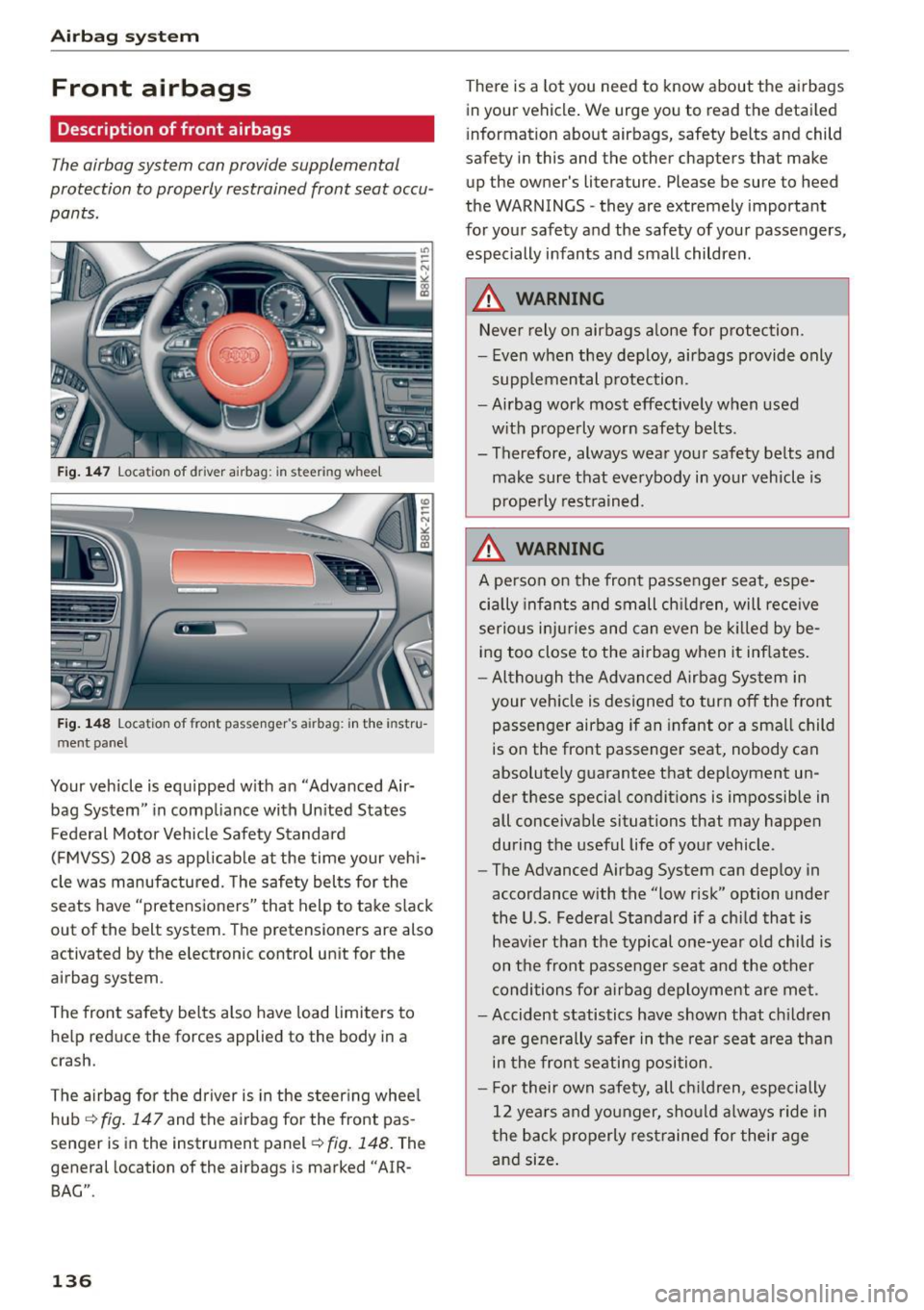
Fig. 147 Location of driver airbag : in steering whee l
Fig. 148 Location of front passenger's airbag: in the instru
ment panel
Your vehicle is equ ipped with an "Advanced Air
bag System" in compliance with Un ited States
Federal Motor Vehicle Safety Standard
(FMVSS) 208 as applicab le at the time your veh i
cle was manufactured. The safety belts for the
seats have "pretensioners" that help to take s lack
out of the belt system . The pretensioners are also
activated by the electronic control unit for the
airbag system .
The front safety belts a lso have load limiters to
help reduce the forces applied to the body in a
crash.
The airbag for the driver is in the steer ing wheel
hub ¢
fig. 147 and the airbag for the front pas
senger is in the instrument panel¢
fig. 148. The
general location of the airbags is marked "AIR
BAG".
1 36
There is a lot you need to know about the airbags
in your vehicle . We urge you to read the detailed
i nformation about airbags, safety belts and child
safety in this and the other chapters that make
up the owner's literature. Please be sure to heed
the WARNINGS -they are extremely important
for your safety and the safety of your passengers, especially infants and small children .
,&_ WARNING -
Never rely on airbags alone for protection.
- Even when they deploy, airbags provide only supp lemental protection.
- Airbag work most effectively when used with properly worn safety belts .
- Therefore, always wear your safety be lts and
make sure that everybody in your vehicle is
properly restrained.
,&_ WARNING
A person on the front passenger seat, espe
cially infants and small ch ild ren, will rece ive
serious i njuries and can even be killed by be
ing too close to the airbag when it inf lates .
- Although the Advanced Airbag System in your vehicle is designed to turn off the front passenger airbag if an infant or a sma ll child
is on the front passenger seat, nobody can
absolutely guarantee that deployment un
der these special condit ions is impossible in
all conceivable situations that may happen
during the useful life of your vehicle .
- The Advanced Airbag System can dep loy in
accordance with the "low risk" option under
the U .S. Federal Standard if a chi ld that is
heav ier than the typical one-year old child is
on the front passenger seat and the other
conditions for airbag deployment are met.
- Accident statistics have shown that ch ildren
are generally safer in the rear seat area than
in the front seating position .
- For their own safety, all children, especially
12 years and younger, sho uld a lways ride in
the back properly restrained for their age
and size .
-
Page 141 of 268

M N
ci u.. co ,...., \!) 1.1'1
N 1.1'1 ,....,
detail below . Because the front passenger seat
contains important parts of the Advanced Airbag
System, yo u must take care to prevent it from be
ing damaged. Damage to the seat may prevent
the Advanced Airbag for the front passenger seat
from do ing its job in a crash .
The front Ad vanced Airb ag S ystem con sis ts
of the following :
-Crash sensors in the front of the veh icle that
measure veh icle acceleration/deceleration to
provide information to the Advanced Airbag
System about the severity of the crash .
- An electronic control unit, with integrated
crash sensors for front and side impacts . The
control unit "decides" whether to fire the front
airbags based on the information received from
the crash sensors . T he control un it also "de
cides" whether the safety be lt pretensioners
sho uld be activated.
- An Advanced Airbag with gas generator and
control valve for the driver inside the steering
whee l hub.
- An Advanced Airbag with gas generator and
control valve inside the instrument panel for
t h e front passenger.
- A weig ht-sensing mat under the upholstery
padding of the front passenger seat cushion
that meas ures the tota l weight on the seat. The
information registered is sent cont in uous ly to
the e lectronic control unit to regulate dep loy
ment of the front Advanced Airbag on the pas
senger side.
- An airbag monitoring system and indicator
light in the instrument cluster
¢ page 142.
-A sensor in each front seat registers the dis
tance between the respect ive seat and the
steering wheel or instrument panel. The infor
mation registered is sent cont inuously to the
elect ron ic cont ro l unit to regulate deployment
of the front Advanced Airbags.
- T he
PASSENGER AIR BAG OFF light comes on
and stays on in the center of the i nstrument
pane l¢
page 142, fig . 150 and tells you when
the front Advanced Ai rbag on the passenger
side has been turned
off .
-A sensor below the safety belt la tch fo r the
front seat passenge r to measure the tension on
Airbag syste m
the sa fe ty belt. The tens ion on the safety be lt
and the weight registe red by the weight -sens
ing mat help the control unit "decide" whether
the front a irbag for the front passenger seat
should be turned
off or not¢ page 133, Child
restraints on the front seat- some important things to know.
- A sensor in the safety belt latch for the driver
and for the front seat passenger that senses
whether that safety belt is latched or not and
transm its this informat ion to the elect ro nic
cont ro l unit.
A WARNING
D amage to the fron t passenger seat can pre
vent the fron t air bag from working prope rly.
- Imp roper repai r or d isassembly of the front
passenger and driver sea t will prevent the
Advanced Airbag System from functioning properly .
- Repairs to the front passenge r seat must be
performed by qualified and p roperly trained
workshop personne l.
- Never remove the front passenger or driver seat from the vehicle .
- Never remove the upho lstery from the front
passenger seat.
- Never d isassemble o r remove par ts from the
seat or disconnect w ires from it.
- Never carry sh arp objects in yo ur po ckets or
p la ce them on t he seat.
If the weight-sens
ing mat in the passenger seat is punctu red
it cannot work properly .
- Never carry things on yo ur lap or carry ob
jects on the passenger seat. S uch items can
increase the we ight registe red by the
weight-sensing mat and send the wrong in
formation to the a irbag control unit.
- Never store items under the front passenger
seat . Parts of the Advanced Airbag System
under the passenger seat could be dam
aged, p reventing them and the airbag sys
tem from wo rking prope rly.
- Never p lace seat covers or rep lacement up
holstery that have not been specifically ap
p roved by Aud i on the front seats.
- Seat cove rs can prevent the Advanced Air
bag Sys tem from recogniz ing child
1 39
Page 147 of 268
M N
ci u.. co ,...., \!) 1.1"1
N 1.1"1 ,....,
@ Tips
If the weight-sensing mat in the front passen
ger seat detects an empty seat, the front air
bag on the passenger side will be turned off,
and
PASSENGER AIR BAG OFF will stay on.
Repair, care and disposal of the airbags
Parts of the airbag system are installed at many
different places on your Audi. Installing, remov ing , servicing or repairing a part in an area of the
vehicle can damage a part of an airbag system and prevent that system from working properly in a collision.
There are some important things you have to know to make sure that the effectiveness of the
system will not be impaired and that discarded
components do not cause injury or pollute the
environment.
A WARNING
-
Improper care, servicing and repair proce
dures can increase the risk of personal injury
and death by preventing an airbag from de
ploying when needed or deploying an airbag
unexpectedly:
- Never cover, obstruct, or change the steer
ing wheel horn pad or airbag cover or the in
strument panel or modify them in any way .
- Never attach any objects such as cup holders
or telephone mountings to the surfaces cov
ering the airbag units .
- For cleaning the horn pad or instrument panel, use only a soft, dry cloth or one mois
tened with plain water. Solvents or cleaners could damage the airbag cover or change
the stiffness or strength of the material so
that the airbag cannot deploy and protect
properly.
- Never repair, adjust, or change any parts of
the airbag system.
- All work on the steering wheel, instrument
panel, front seats or electrical system (in
cluding the installation of audio equipment,
cellular telephones and CB radios, etc.)
must be performed by a qualified technician
Airbag system
who has the training and special equipment
necessary.
- For any work on the airbag system, we
strongly recommend that you see your au
thorized Audi dealer or qualified workshop.
- Never modify the front bumper or parts of
the vehicle body.
- Always make sure that the side airbag can
inflate without interference:
- Never install seat covers or replacement
upholstery over the front seatbacks that
have not been specifically approved by
Audi .
- Never use additional seat cushions that
cover the areas where the side airbags in
flate.
- Damage to the original seat covers or to
the seam in the area of the side airbag
module must always be repaired immedi
ately by an authorized Audi dealer.
- The airbag system can be activated only
once. After an airbag has inflated, it must
be replaced by an authorized Audi dealer or
qualified technician who has the technical
information, training and special equipment
necessary.
- The airbag system can be deployed only
once . After an airbag has been deployed, it
must be replaced with new replacement
parts designed and approved especially for
your Audi model version. Replacement of complete airbag systems or airbag components must be performed by qualified work
shops only. Make sure that any airbag serv
ice action is entered in your Audi Warranty
&
Maintenance booklet under AIRBAG RE
PLACEMENT RECORD.
- In accidents when an airbag is deployed, the
vehicle battery separates the alternator and
the starter from the vehicle electrical sys tem for safety reasons with a pyrotechnic
circuit interrupter .
- Work on the pyrotechnic circuit interrupt
er must only be performed by a qualified
dealer -risk of an accident!
- If the vehicle or the circuit interrupter is
scrapped, all applicable safety precautions
must be followed.
145
Page 155 of 268

M N
ci u.. co ,...., \!) er,
N er, ,....,
exceptional circumstances and the PASSEN
GER AIR BAG OFF
light does not come on
and stay on, immediately install the rear
ward-facing child safety seat in a rear seat
ing position and have the airbag system in
spected immediately by your authorized
Audi dealer.
A WARNING
If, in exceptional circumstances, you must in
stall a forward-facing child restraint on the
front passenger's seat:
- Always make sure the forward-facing seat
has been designed and certified by its man
ufacturer for use on a front seat with a pas
senger front and side airbag.
- Always follow the manufacturer's instruc
tions provided with the child safety seat or carrier.
- Always
move the passenger seat into its
rearmost position in the seat's fore and aft
adjustment range, as far away from the air
bag as possible before installing the child
restraint. The backrest must be adjusted to
an upright position.
- Always make sure that the
PASSENGER AIR
BAG OFF
light comes on and stays on all the
time whenever the ignition is switched on.
Always replace child restraints that were in
stalled in a vehicle during a crash. Damage to
a child restraint that is not visible could cause
it to fail in another collision situation.
Advanced front airbag system and children
Your vehicle is equipped with a front "Advanced
Airbag System" in compliance with United States
Federal Motor Vehicle Safety Standard (FMVSS)
208 as applicable at the time your vehicle was
manufactured.
The Advanced Airbag system in your vehicle has
been certified to meet the "low-risk" require
ments for 3- and 6-year old children on the pas
senger side and small adults on the driver side.
The low risk deployment criteria are intended to
Child safety
reduce the risk of injury through interaction with
the airbag that can occur, for example, by being
too close to the steering wheel and instrument
panel when the ai rbag inflates. In addition, the
system has been certified to comply with the "suppression" requirements of the Safety Stand
ard, to turn off the front airbag for infants up to
12 months who are restrained on the front pas
senger seat in child restraints that are listed in
the Standard.
Even though your vehicle is equipped with an Ad
vanced Airbag system, all children, especially
those 12 years and younger, should always ride in
the back seat properly restrained for their age
and size. The airbag on the passenger side makes
the front seat a potentially dangerous place for a
child to ride. The front seat is not the safest place
for a child in a forward-facing child safety seat. It
can be a
very dangerous place for an infant or a
larger child in a rearward-facing seat.
Advanced Airbags and the weight-sensing
mat in the front seat
The Advanced Airbag System in your vehicle de
tects the presence of an infant or child in a child
restraint on the front passenger seat using the
weight-sensing mat in the seat cushion and the sensor below the safety belt latch on the front
passenger seat that measures the tension on the
safety belt .
The weight-sensing mat measures total weight of
the child and the child safety seat and a child blanket on the front passenger seat. The weight
on the front passenger seat is related to the de
sign of the child restraint and its "footprint", the
size and shape of the bottom of the child re
straint as it sits on the seat. The weight of a child
restraint and its "footprint" vary for different
kinds of child restraints and for the different
models of the same kind of child restraint offered
by child restraint manufacturers.
The weight ranges for the individual types, makes
and models of child restraints that the NHTSA
has specified in the Safety Standard together
with the weight ranges of typical infants and typ-
ical 1 year-old child have been stored in the ...,
153
Page 172 of 268

Smart Technolog y
shared, ple ase see your contract with the
wireless telecommunications provider and the "About Aud i connect" tab in your vehicle's
MMI*:
I MENU ! button > Audi connect > About
Audi conne ct .
Electronic Stabilization
Control (ESC)
Description
ESC helps to improve road holding and vehicle
dynamics to help reduce the probability of sk id
d ing and loss of veh icle control.
It works only
when the engine is runn ing . ESC detects certain
d ifficult driving situations, including when the ve
h icle is beginn ing to sp in (yaw) out of control and
he lps you to ge t the vehicle back u nder cont rol by
selectively braking the wheels, and/or reducing
engine power and providing steering assistance
to help hold the vehicle on the driver's intended
course. The indicator light
liJ in the instrument
cluster blinks when ESC is taking action to help
you control the veh icle.
ESC has limitations. It is important to remember
that ESC cannot overcome the laws of physics. It
will not always be able to help out under all con
d itions you may come up against. For example,
ESC may not always be able to help you master
situations where there is a sudden change in the
coefficient of friction of the road surface. Whe n
there is a section of d ry road that is s uddenly cov
ered wi th wa ter, s lush or snow, ESC cannot per
form the same way it wou ld on the d ry surface . If
the vehicle hydroplanes (rides on a cushion of wa
ter instead of the road surface), ESC wi ll not be
ab le to he lp you steer the veh icle because contact
with the pavement has been i nterrupted and the
ve hicle cannot be braked or steered. Dur ing fast
cornering, particula rly on w inding roads, ESC
cannot a lways deal as effect ively with d iff icu lt
d riving situat ions than at lower speeds. When
towing a trailer, ESC is not able to he lp yo u regain
con trol as it wou ld if yo u were not towing a trail
er .
A lways adjust you r speed and dr iving style to
road, traffic and weather conditions. ESC cannot
override the vehicle's physical limi ts, increase the
170
available traction, or keep a vehicle on the road if
road departure is a result of driver inattention .
Instead, ESC improves the possibility of keeping
the ve hicle under control and on the road dur ing
extreme maneuvers by using the dr iver's steering
i nputs to help keep the vehicle going in the in
tended direction. If you are traveling at a speed
that causes you to run off the road before ESC
can p rov ide any assistance, you may not expe ri
ence the benefi ts of ESC.
ESC is switched o n all the time. In ce rtain s itua
tions when you need less traction, you can switch
off ASR by p ress ing the button [!]¢
page 171,
fig. 164 or ¢page 171, fig. 165. Be s ure to
swi tch ASR on again when you no longe r need
l ess traction .
The following system s are integrated in the ESC:
Anti- lock braking s ystem (ABS )
ABS prevents the wheels from locki ng up when
braking. The vehicle ca n still be steered even dur
i ng hard braki ng . Apply steady pressure to the
brake pedal. Do not pump t he pedal. A pu lsing in
t h e b ra ke peda l ind icates that the system is he lp
i ng yo u to b ra ke the vehicle.
Brake assist system
The brake ass ist system can decrease brak ing dis
ta nce. It increases braking power when the d river
presses the bra ke peda l quickly in emergency sit
u at ions. You must press and hold t he b ra ke peda l
u nt il t he s ituation is ove r. In vehicles with adap
tive cru ise contro l*, the bra ke assist system is
more sensitive if the distance detected to the ve
hicle ahead is too sma ll.
Anti-slip regulation (ASR )
ASR reduces eng ine power when the d rive wheels
begin to spi n and adap ts the force to the ro ad
cond it ions . This makes it eas ie r to start, acce le r
ate and drive up hills.
Electronic differential lock (EDL)
The EDL bra kes whee ls that a re spinn ing and
t ransfers the dr ive power to the othe r drive wheel
o r whee ls if the ve hicle is equippe d wi th a ll-wheel
drive*. T his function is not available at higher
speeds .
Page 173 of 268
M N
ci LL co
rl I.O
"' N
"' rl
In extreme cases, EDL a utomatica lly switches off
to help keep the brake on the braked whee l from
overheating. EDL w ill switch on again automati
cally when conditions have returned to normal.
Steering re commendat ion
The ESC helps to stabilize the ve hicle by chang ing
the steering torque.
I n vehicles with dynamic steeri ng*, ESC also
h e lps to stabilize the steering in critical s itua
tions .
Electronic interaxle differential lock* /
sel ectiv e wheel torque control*
The electron ic in teraxle d iffe ren tial lock (front
wheel drive) or the selective wheel torq ue contro l
(all wheel drive) operates when driving through
curves. The front whee l on the ins ide of the cu rve
or both whee ls on the inside of the curve are
braked selectively as needed. Thi s allows more
precise driving in curves. The applicable system
may not activate when driving in wet or snowy
conditions .
_&, WARNING
- The ESC and its integrated systems cannot
overcome the laws of physics. This is espe
ci al ly impo rtant on slippe ry or wet roads. If
the sys tems begin acting to stabilize your
Switching on/off
Smart Technology
veh icle, you shou ld immediately change
your speed to matc h the road and traffic
conditions. Do not let the increased safety
provided by these systems tempt you to
take risks . Do ing so will increase the risk of a
loss of vehicle control, collision and serious
personal injuries.
- Always adapt your speed to road, traffic and
weather conditions. The risk of losing con
trol of the vehicle inc reases when dr iving
too fast, espec ially through curves and on
slippery or wet roads, and when dr iving too
close to vehicles up ahead . The ESC and its
integrated systems cannot a lways prevent
coll isions -there is sti ll a risk of accidents!
- Always accelerate with special care on even,
smooth su rfaces such as those that are wet
or covered with ice and snow. The drive
wheels can spin even with these assistance
systems that can not always help to reduce
the risk of loss of vehicle cont rol.
{!) Tips
-ABS and ASR only work correct ly when a ll
four wheels are equipped w ith ident ica l
tires. Different tire sizes can lead to a reduc
tion in engine power.
- You may hear noises when the systems de
scribed are working.
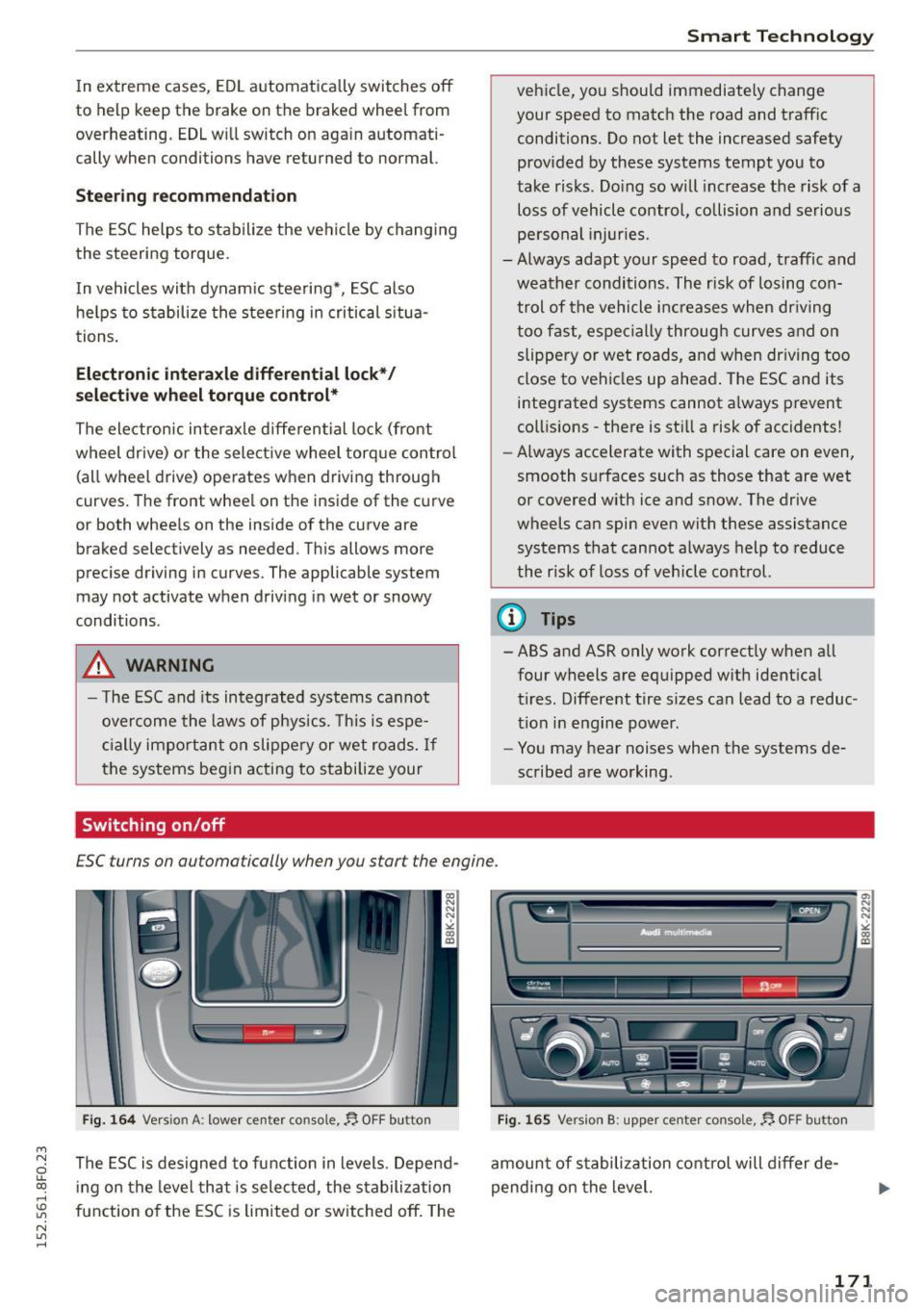
ESC turns on automatically when you start the engine.
Fig. 16 4 Version A: lowe r ce nter console,~ OFF button
The ESC is designed to function in levels. Depend
i ng on the level that is selected, the stabilization
function o f the ESC is limited or switched off . The
F ig. 165 Versio n B: uppe r ce nter console,~ OFF button
amount of s tabilization control will differ de
pend ing on the level.
a, N N N ,.: CX) m
171