stop start AUDI A5 CABRIOLET 2015 User Guide
[x] Cancel search | Manufacturer: AUDI, Model Year: 2015, Model line: A5 CABRIOLET, Model: AUDI A5 CABRIOLET 2015Pages: 268, PDF Size: 66.88 MB
Page 77 of 268

M N
ci LL co
rl I.O
"' N
"' rl
.. Tak e the adapter for the emergency key out of
the glove compartment
r=:> fig. 89.
.. Push the emergency key r=:> fig. 90 fully into the
adapter. Make sure that the Audi rings are fac
ing up.
.. Press the emergency key in the adapter down
until it latches audibly.
.. Insert the adapter with the emergency key for
ward into the ignition switch . The engine can
now be started as usual.
Stopping the engine
Applies to vehicles: with ig ni tion lock
.. Bring the vehicle to a full stop.
.. Automatic transmission: Move the selector lev
er to the P or N position.
.. Press on the ignition key. The engine is turned
off .
.. You can now remove the key.
Steering lock
The steering locks when you remove the ignition
k ey. The locked steering helps prevent vehicle
theft.
Emergency off
If it is necessary in unusual circumstances, the
engine can be switched off while the vehicle is
moving. The engine will be switched off if you
press on the key for an extended period.
A WARNING
- Never turn off the engine before the vehicle
has come to a complete stop. The full func
tion of the brake booster and the power
steering is not guaranteed . You must use
more force to turn or brake if necessary. Be
cause you cannot steer and brake as you
usually would, this could lead to crashes
and serious injuries.
- For safety reasons, you should always park
your vehicle with the selector lever in P. Oth
erwise, the vehicle could inadvertently roll
away.
- The radiator fan can continue to run for up
to 10 minutes even after you have turned
off the engine and removed the ignition key.
Driving
The radiator fan can also turn on again if the
engine coolant heats up because of intense
sunlight or heat build-up in the engine com
partment.
- Always take the key with you whenever you
leave your vehicle. Otherwise, the engine
could be started or electrical equipment
such as the power windows could be operat
ed. This can lead to serious injury.
- Never leave children or persons requiring as
sistance unattended in the vehicle. The
doors can be locked using the remote trans
mitter, preventing people from escaping
from the veh icle on their own in the event of
an emergency. Depending on the time of
year, people inside the vehicle can be ex
posed to very high or very low tempera
tures.
(D Note
If the engine has been under heavy load for
an extended period, heat builds up in the en
gine compartment after the engine is switch
ed off -there is a risk of damaging the engine.
Allow the engine to run at idle for about two minutes before switching it off.
Convenience key
Starting the engine
Applies to vehicles: wi th convenience key
The !START E NGIN E STOPI button switches the
ignition on and starts the engine.
Fig. 91 Center console : START ENGINE STOP button
Starting the engine
.. Step on the brake pedal and move the selector
lever to P or N
¢ &_ . .,.
75
Page 78 of 268

Driving
"'Press on the I START ENGINE STOPI button
¢fig. 91 -the engine wi ll start.
Switching the ignition on /off
If you would like to sw itch the ignition on with
out start ing the e ng ine, fo llow these steps:
"' Press the
!START ENGINE STOPI button with -
out pressing the brake pedal.
"'T o sw itch the ignition off, press the but to n
again.
If the engine sho uld not start immed iately, the
starting p rocess is a utomat ically stopped after a
short time. Repeat sta rting procedure.
When starting the engine, major e lectr ica l loads
are sw itched off temporar ily .
After a cold engine is started, there may be a brief period of increased noise because oil pres
sure must first build up in the hydraulic valve ad
justers. This is normal and not a cause for con
cern.
_& WARNING
- Never allow t he engine to ru n in co nfine d
spaces -dange r of asp hyxiation.
- Never turn off the engine unti l the vehicle
h as come to a comp lete stop.
- Always ta ke t he key with yo u w heneve r you
leave your vehi cle. Otherw ise, the eng ine
c ou ld be started or ele ct rical eq uipment
s u ch as the power w indows co uld be operat
ed. This can lead to serious injury.
- Never leave ch ild ren o r persons requ iring as
sistance unattended in the vehicle. The doo rs can be locked using the remote trans
mitter, preventing peop le from escap ing
from the vehicle on their own in the event of
an emergency. Depending on the time of
year, people inside the vehicle can be ex
posed to very high o r ve ry low tempe ra-
tu res.
(D Note
- Avoid high eng ine rpm, fu ll throttle and
heavy engine loads until the engine has
r eached operating tempe rat ure - otherwise
you r isk eng ine damage.
76
-
@ For the sake of the environment
Do not let the engine run while pa rked to
warm up. Begin dr iv ing immediately. Th is re
d uces unnecessary em issions.
(!} Tips
- After starting a col d en gine, t here may be a
br ie f per iod of increased noise because the
oil pressure must first bui ld up in the hy
draulic valve adjusters. This is norma l and
not a cause for concern.
- If you leave the veh icle with the ignition
switched on, the ig nition w ill switch off af
ter a ce rtain period of time. Please note that
e lect rical equipment such as exte rior lights
wi ll switch off as well when that happens.
Switching engine off
App lies to vehicles: wi th convenience key
"' Br ing your vehi cle to a comple te stop.
"' Move the se lector lever to the P o r N pos ition.
"' Press the
I START ENGINE STOP ! button
r=>poge 75, fig. 91.
Steering lock
The steer ing lo cks w hen yo u tur n the eng ine off
u sing the
I START ENGINE STOP I button a nd open
the d river's doo r. The loc ked steering helps pre
vent ve hicle theft .
Emergency off
If necessary, the e ngine can be switched off with
the se lec to r lever in the R or D/S posi tions. The
engine s tops if you press a nd ho ld the
I START ENGI NE STOP I button at speeds below
6 mph (10 km/ h) and press the brake peda l.
_& WARNING
-Never turn off the engine before the vehicle
has come to a complete stop. The full func
tion of the brake booster and the power
steer ing is not guaranteed. You must use
more force to turn or b rake if necessary. Be
caus e you cannot stee r and brake as you
usually wo uld, this cou ld lead to crashes
a nd se rio us in juries.
~
Page 79 of 268

M N
ci LL co
rl I.O
"' N
"' rl
-For safety reasons, you should always park
your vehicle with the selector lever in P. Oth
erwise, the vehicle could inadvertently roll
away .
- The rad iator fan can continue to run for up
to 10 m inutes even after you have turned
off the engine and removed the ignition key .
The rad iator fan can also turn on aga in if the
engine coolant heats up be cause of intense
s u nlight or heat bui ld-up in the engine com
partment.
- Always ta ke t he key with you wheneve r you
leave your vehicle. Otherwise, the eng ine
cou ld be started or electrical eq uipment
s u ch as the power windows cou ld be operat
ed. This can lead to serious injury.
(D Note
If the e ng ine has been under heavy load for
an extended per iod, heat builds up in the en
gine compartment after the engine is swi tch
ed off -there is a risk of damag ing the engine.
Allow the engine to run at idle for about two
m inutes before switch ing it off.
Driver messages
Ignitio n is on
This message appears and a war ning tone sounds
if you open the driver's door when the ignition is
switched on.
No ke y ide ntifi ed
This message appears when the
I STAR T ENGIN E STOP I button is pressed if t here
i s no master key inside the vehicle o r if the sys
tem does not recogni ze it. For example, the mas
ter key ca nnot be recognized if it is covered by an
object (e .g . alum inum br ie f case) which
screens
the radio signal. Electronic devices such as cell
phones can also interfere w ith the rad io signa l.
Press br ake pedal to sta rt engine
This message appears if you do not press the
b rake peda l to s tart the engine.
Shift to N or P to start engine
Dr ivi ng
This message appears when attempt ing to start
t h e engine if the se lector lever for the automatic
transmission is not in the P or N position. The en
gine can on ly be started w ith the selector in
these positions.
El I s the key in the vehicle?
T his mess age appears if the mas ter key is re
moved from the vehicle wi th the e ngine runn ing .
If the master key is no longer in the ve hicle, you
cannot switch on the ignition after stopping the
engine and you also cannot start the engine
again . Moreover, you cannot lock the vehicle from
t h e outside with the key.
Shift to P otherwise vehicle can roll away . Door s
do not lo ck
if le ve r is not in P.
This message appears for safety reasons along
with a warning signal. It appea rs if the selector
lever for the automatic transmission is not in the
P position when switch ing off the ignition. Move
the selector lever to the P position, otherwise the
vehicle is not secured against rolling away. You
also cannot lock the vehicle us ing the locking
button* on the door handle o r us ing t he remote
key .
Convenience key defe cti ve! Use ign ition lock
This message appears if the engine must be
started or stopped using the ign ition key and not
the
I STAR T ENGINE ST OP ! button.
Electromechanical
parking brake
Operation
The electromechanical parking broke replaces
the hand broke.
Fig . 92 Center co nso le: Pa rk in g b ra ke
77
Page 80 of 268
Driving
"'Pu ll on the switch @ ¢fig. 92 to apply the
parking brake . The indicator lights in the switch
and . (USA models)/ . (Canada mode ls) in
the inst ru ment cluste r il lum inate.
"' With the ign ition switched on, step on the
brake pedal or the accelerator pedal and press
the switch @ at the same t ime to release the
parking b rake . The indicator lights in the switch
and . (USA models)/ . (Canada mode ls) in
the instr ument cluster go o ut.
Your veh icle is equipped w ith an electromechan i
cal parking b rake. The par king b rake is designed
to p revent the veh icle from rolling unintentional
ly and replaces the hand brake.
In addition to the norma l funct ions of a tradit ion
a l hand bra ke, the e lectromechan ical pa rking
b rake provides var ious convenience and safety
f u nctions.
When start ing f rom rest
- The integral starting assist helps you when
driv ing by automat ically releasing the parking
brake ¢
page 78, Starting from rest.
-When sta rting on inclines , the starting assist
prevents the vehicle from un intent ionally roll
ing back. The bra kin g for ce of the par kin g b rake
is no t released until sufficien t driv ing fo rce has
been built up at the wheels .
Emergency brake function
An emergency brake ensures that the vehicle ca n
be slowed down even if the
normal brakes fa il
¢ page 79, Emergency braking.
A WARNING
If a drive range is eng age d with the vehicle
stationary and the engine running, you mus t
in no instance accelerate careless ly . Otherwise
the vehicle will start to move immed iate ly
r isk of an accident.
(D Tips
- If the parking brake is applied with the igni
tion switched off, the indicator lights in the
switch and -(USA models) . (Cana
da models) in t he instrument cl uster will go
out after a certa in period of time.
78
- Occasional noises when the pa rking brake is
applied an d released a re norma l and are not
a cause for concern .
- Whe n the vehicle is pa rked, the park ing
brake goes through a self-test cycle at regu
lar intervals. Any associated noises are nor
ma l.
Parking
"'Press the brake pedal to stop the veh icle .
"' Pull the sw itch @¢
page 77, fig. 92 to set the
parking brake .
"' Move the se lector lever to P.
"' Tur n the engine off ¢_& .
"' When on inclines or de clines, turn the steering
wheel so that the veh icle will roll into the curb
if it begins to move.
A WARNING
-
- When you leave your vehicle -even if only
briefly - always remove the ignition key. This
applies pa rticularly when children remain in
the vehicle . Otherwise the ch ild ren could
start t he engine, release the parking b rake
or operate elect rical equipment (e.g. power
w indows). There is the risk of an acc ident.
- When the veh icle is locked, no one -part icu
larly no t chi ld ren shou ld remain in the ve hi
cle. Lo cked doors m ake it more d ifficul t for
emergency workers to get into the veh icle -
putting lives at risk.
Starting from rest
The star ting assist function ensures that the
parking brake is released automatically upon
starting .
Stopping and applying parking brake
"' Pull the sw itch @¢ page 77, fig. 92 to apply
the par kin g b rake.
Starting and automatically releasing the
parking brake
"' When you sta rt to dr ive as usual, the park ing
bra ke is automatically released and yo ur vehicle
beg ins to move. .,_
Page 81 of 268
M N
ci u.. co ...... \!) ..,.,
N ..,., ......
When stopping at a traffic signal or stopp ing in
city traffic on vehicles with an automatic trans
miss ion, the park ing brake can be applied . T he
vehicle does not have to be held with the foot
brake. The parking brak e eliminates the tendency
to creep with a drive range engaged . As soon as
you dr ive off as usual , the parking brake is re
leased automatically and the veh icle starts to
move.
Starting on sl opes
When starting on inclines, the star ting ass ist pre
vents the vehicle from unintentionally rolling back. The braking force of the parking brake is
not released until sufficient driv ing force has
been b uilt up at the whee ls .
(D Tips
For safety reasons, the park ing brake is re
leased automatically only when the dr iver's
safety belt is engaged in the buckle.
Starting off w ith a trailer
T o prevent rolling back unintentionally on an in
cline, do the following:
.,. Keep the switch@q page 77, fig . 92 pulled
and depress the accelerator . The park ing b rake
stays applied and prevents the vehicle from
ro lling bac kward .
.. You can release the switc h @ once you are su re
t h at you a re developing enough driving force at
the whee ls by depressing the acce lerator .
D epending on the weight o f the r ig (veh icle and
trai ler) and the seve rity of the in cli ne, you may
roll backwards as you sta rt. Yo u can prevent roll
i n g bac kwards by ho lding the parking brake
switch @ pulled out and acce lerating -just as
you would when starting on a hill with a conven
tional hand brake .
Driving
Emergency braking
In the event that the conventional brake system
fails or locks .
.. In an emergency, pull the sw itch @ q page 77,
fig . 92 and continue to pull it to slow your vehi
cle down with the parking brake .
.. As soon as you release the switch @ or accele r-
ate, the b ra ki ng process stops.
If you pull the switch @and hold it above a
speed of about 5 mph (8 km/h), the emergency braking function is i nitiated . The vehicle is b raked
at all fo ur whee ls by act ivati ng the hydrau lic
brake system. The br ake performan ce is s imi la r
to maki ng a n emergency stop
q &. .
In order not to act ivate the eme rgency braking by
mis take, an aud ib le warn ing tone (buz ze r)
sounds when the swi tc h @ is p ulled. As soon as
the switch @ is re lease d, or the acce le rator pedal
is depressed, emergency braking stops.
A WARNING
=
Emergency braking should on ly be used in an
emergency, when the norma l foot brake has
failed or the brake peda l is obstructed. Us ing
the parking brake to perfo rm emergency brak
ing will slow your vehicle down as if you had
made a full bra ke application . T he laws of
physics cannot be suspended ev en with ESC
and its a ssociated components (A BS, ASR,
E DS). In co rners and when road o r we ather
conditions are ba d, a f ull brake applica tion
can cause the ve hicl e to skid o r the rear end to
b reak away -risking an accident.
Speed warning system
Overview
The speed warning sys tem helps you to keep your
driving speed below a set speed limit.
The speed warn ing system warns if the driver ex
ceeds a previous ly s tored maximum speed. A
warning tone will sound as soon as the veh icle
speed exceeds the set speed by about 3 mph
(3 km/h) . At the same time, a warning symbo l
79
Page 83 of 268
M N
ci LL co
rl I.O
"' N
"' rl
Cruise control system
Switching on
The cruise control system makes it possible to
drive at a constant speed starting at 20 mph (30
km/h) .
0
f
®t
0
Fig. 94 Control lever with push-bu tton
Fig. 95 Display : Selected speed
al M 0 ±
ti
~ 0 er: a,
"'
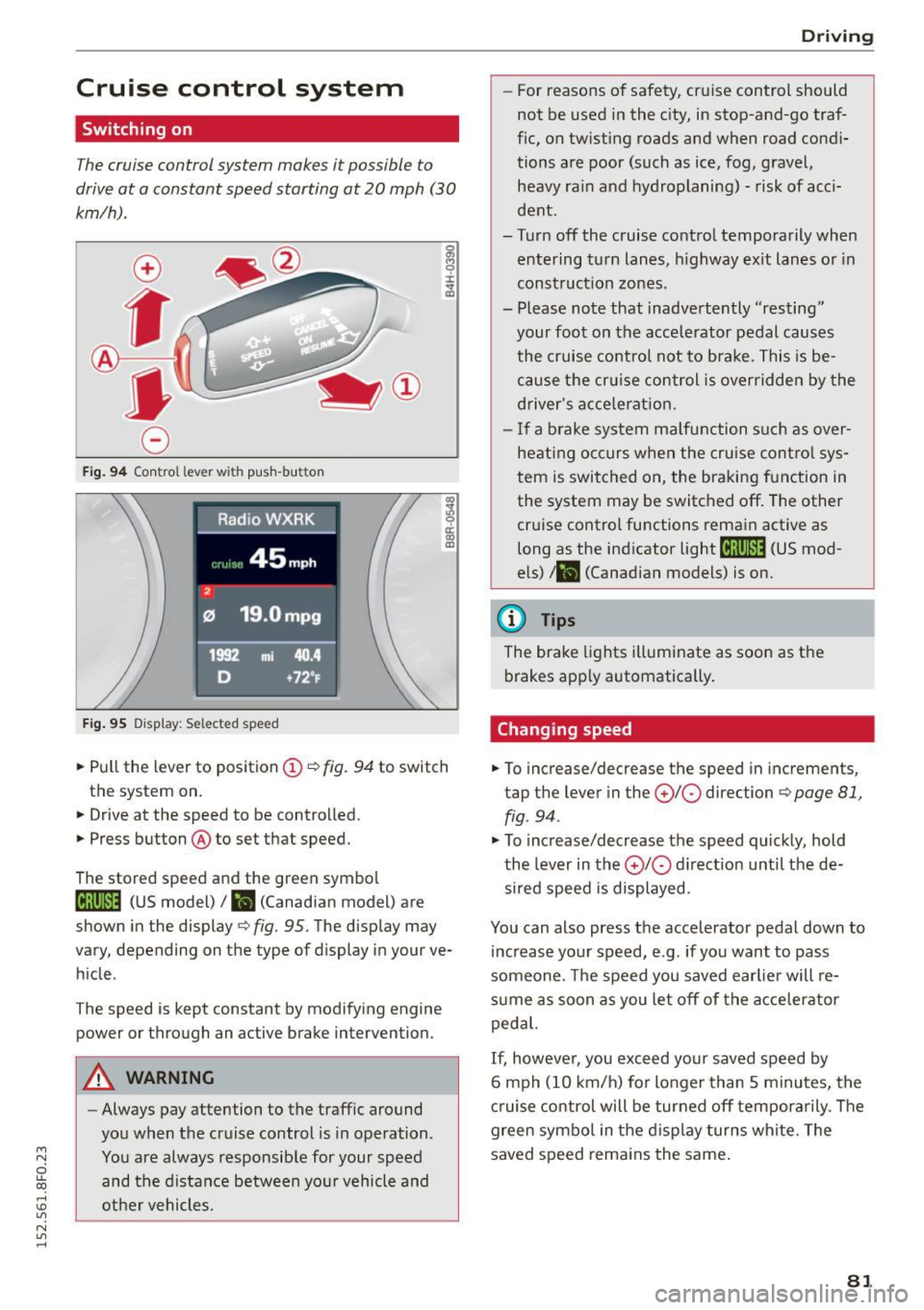
• Pull the lever to position (D ¢ fig. 94 to switch
the system on.
• Drive at the speed to be controlled.
• Press button @to set that speed.
The stored speed and the green symbol
[lj;(i )~i4 (US model)/ l'I (Canadian model) are
shown in the display ¢
fig. 95. The display may
vary, depending on the type of display in your ve
hicle .
The speed is kept constant by modifying engine
power or through an active brake intervention.
A WARNING
-Always pay attention to the traffic around
you when the cruise control is in operation.
You are always responsible for your speed and the distance between your vehicle and
other vehicles.
Driving
- For reasons of safety , cruise control should
not be used in the city, in stop-and-go traf
fic, on twisting roads and when road condi
tions are poor (such as ice, fog, gravel, heavy ra in and hydroplaning) - risk of acci
dent .
- Turn off the cruise control temporarily when entering turn lanes , highway exit lanes or in
construction zones.
- Please note that inadvertently "resting" your foot on the accelerator pedal causes
the cruise control not to brake. This is be
cause the cr uise control is overridden by the
driver's accele rat ion.
- If a brake system malfunction such as over
heating occurs when the cruise control sys
tem is switched on, the braking function in
the system may be switched off . The other
cruise control functions remain active as
long as the ind icator
light til;rnM4 (US mod
els)
t l'I (Canadian models) is on.
(D Tips
The brake lights illuminate as soon as the
brakes apply automatically.
Changing speed
• To increase/decrease the speed in incremen ts,
tap the lever in the
(£)10 direction ¢ page 81,
fig . 94 .
"'To increase/decrease the speed quickly, hold
the lever in the
010 direct ion until the de
sired speed is displayed.
You can also press the accelerator pedal down to increase your speed, e.g . if you want to pass
someone . The speed you saved earlier will re
sume as soon as you let off of the accelerator
pedal.
If, however, you exceed your saved speed by
6 mph (10 km/h) for longer than 5 minutes, the
cruise control will be turned off temporarily . T he
green symbo l in the display turns white. The
saved speed remains the same .
81
Page 87 of 268

M N
ci u.. co ,...., \!) 1.1"1
N 1.1"1 ,....,
At speeds above about 1 mph (2 km/h) the Auto
matic Shift Lock is automatically deactivated in
the N position.
A time delay element prevents the selector lever
from locking when it is moved through the N po
sition (going from R to D/S). The locking element
will lock the se lector lever if the lever is left in N
(Neutral) for more than approximate ly 2 seconds,
without the brake pedal being pressed.
Release button
The release button on the selector lever prevents
the lever from being accidentally shifted into cer
tain positions. Depending on the direction of the
shift, the selector lever locks at different posi
tions. The positions are highlighted in the illus
tration
c> fig . 97.
Ignition key safety interlock
The key cannot be removed from the ignition un
l ess the se lector lever is in the P park posit ion.
When the ignit ion key is removed, the selector
lever will be locked in the P position.
Driving the automatic transmission
Applies to vehicles: with m ultit ron ic/S tronic/t iptronic
F ig . 98 S hift gate on t he center conso le: selector lever w ith
re lease button
Starting the engine
~ The selector lever must be in P or N.
Starting off
~ Press and ho ld the brake pedal.
~ Press and hold the release button in the selec
tor lever handle, select the des ired selector lev
er posit ion such as D/S and release the button.
Automatic transmission
~ Wait briefly until the transmission has shifted
(you will fee l a slight movement).
~ Remove your foot from the brake pedal and ac
celerate.
Stopping temporarily
~ Keep the vehicle stationary using the braking
pedal, for example at traffic lights.
~ Do not press the accelerator peda l when doing
this.
~ To prevent the vehicle from rolling when you
start driving, set the parking brake when stop
p in g on steep inclines
c> .&_.
~ The parking brake will release automat ically
and the vehicle will start mov ing once you press
t he acce lerator pedal.
Stopping/parking
If the selector lever is not in the P position when
you open the dr iver's door, the vehicle could roll.
The message
Transmission: Car may roll! Shift
to park!
appea rs.
~ Press and hold the brake pedal until the vehicle
has come to a complete stop .
~ Apply the parking brake c:;. page 78, Parking .
~ Select the P selector lever posit ion c> .&_ .
Stopping on an incline
~ Always press the brake pedal to hold the vehi
cle in place and prevent it from "rolling back"
c:;. .&_ . Do not try to prevent the veh icle from
"rolling back" when a gear is engaged by in
creasing the engine speed
c> 0 .
Starting on an incline
~ Activate the parking brake.
~ With the driving gear selected, press the accel
erator pedal carefully. The parking brake w ill re
lease automat ically if your seat belt is fastened .
Under certain circumstances, such as driving in
the mounta ins, it may be useful to sw itch tempo
r ar ily to the manual shift program in order to ad
just the gears to the dr iv ing conditions by hand
c>page 87.
On slopes, activate the parking brake first and
then move the selector lever to the P position .
85
Page 88 of 268
Automatic transmission
This prevents too much stress from being placed
on the locking mechanism.
Vehicles with multitronic transmission: Your vehi
cle is equipped with
hill hold assist allowing you
to start while on an incline. The system is activat
ed when the brake pedal is pressed down and
held
for a few seconds. The brake pressure will
hold for
a momen t after the brake pedal loosens
t o preven t the vehicle from rolling backwards
while starting up .
A WARNING
- The vehicle can also roll when the engine is
stopped .
- Unintended vehicle movement can cause se rious injury .
- Never leave your vehicle with the engine
running while in gear.
If you must leave your
vehicle when the engine is running, activate
the parking brake and move the selector lev
er to
P.
-Power is still transmitted to the wheels
when the engine is running at idle. To pre
vent the vehicle from "creeping", you must
keep your foot on the brake when the engine
is running and the selector lever is in 0/5 or
R or "tiptronic" mode is selected.
- Do not press the accelerator pedal when changing the selector lever position while
the vehicle is stationary and the engine is
running .
- Never shift into R or P while driving.
- Before driving down a steep slope, reduce
your speed and shift into a lower gear with
"tiptronic".
- Do not ride the brakes or press the brake
pedal too often or too long when driving
down a hill. Constant braking causes the
brakes to overheat and substantially re
duces braking performance, increases brak
ing distance or causes complete failure of
the brake system .
- To prevent the vehicle from rolling back
when stopping on inclines, always hold it in
place with the brake pedal or parking brake.
- Never hold the vehicle on an incline with a
slipping clutch. The clutch opens automati-
86
cally when it becomes too hot from the
overload. An indicator lamo
[ O ] illuminates
and a driver message appears
¢ page 88
when the clutch is overloaded.
- If the engine must remain running, never
have any driving position engaged when
checking under the hood . Make sure these
lector lever has securely engaged and is
locked in P with the parking brake set
¢ page 195. Otherwise, any increase in en
gine speed may set the vehicle in motion,
even with the parking brake applied.
(D Note
- 5 tronic- and tiptronic transmission: When
stopping on an incline, do not try to hold
the vehicle in place by pressing the accelera
tor pedal while a driving gear is selected.
This can cause the transmission to overheat
and can damage it. Activate the parking
brake or press the brake pedal to prevent
the vehicle from rolling.
- 5 tronic- and tiptronic transmission: Allow
ing the vehicle to roll when the engine is
stopped and the selector lever is in N will
damage the transmission because it is not
lubricated under those circumstances .
(D Tips
For safety reasons, the parking brake is re
leased automatically only when the driver's
safety belt is engaged in the buckle .
· Hill descent control
App lies to vehicles: wit h mult itronic/S tronic/tiptronic
The hill descent control system assists the driver
when driving down declines.
Hill descent control is activated when the selec
tor lever is in 0/5 and you press the brake pedal.
The transmission automatically selects a gear
that is suitable for the incline. Hill descent con
trol tries to maintain the speed achieved at the
time of braking, within physical and technical
limitations.
It may still be necessary to adjust the
speed with the brakes. .,.
Page 90 of 268

Automatic transmi ssion
Appli es to v ehicle s w ith a S tronic- / tiptronic
t ra nsm ission
When you depress the acce lerator pedal beyond
the resistance po int, the automatic transmiss ion
downshifts into a lower gear, dependi ng o n ve hi
cle speed and engi ne speed. The ups hift into the
next h igher gea r tak es place once the max imum
specified engine speed is r eached.
A WARNING
Please note that the drive whee ls can spin if
kick-down is used on a smooth slippery road -
there is a r is k of s kidding.
Launch Control Program
Applies to vehicles: with S tronic
The Launch Control Program provides the best
acceleration possible when starting from a stop.
Requirement: The engine must be at operating
temperature and the steering wheel must not be
turned.
"' Press the
!.!1 O FF I button ¢ page 171 while the
engine is runn ing . The
II indicator light illumi
nates in the instrument cluste r and
Stabil iza
tion contr ol (ESC ): Sport . Warning ! Restricte d
s tabilit y
appears in the d river informat ion sys
tem display.
"' Move the selecto r lever to the D/S position to
select sport mode (S) or select the
d ynamic
driving mode in drive select * ¢page 104.
"'Press the brake peda l strongly with your left
foot and hold it down for at least 1 second.
"' At the same time, press the accelerator pedal
down completely with your right foot until the
engine reaches and maintains a h igh RPM .
"' Remove your foot from t he brake pedal wit hin 5
seconds¢
& -
A WARNING
-Always adapt you r driving to the traffic flow.
- Only use the La unch Control P rog ram when
road and t ra ffi c condi tions a llow i t and oth
er dr ivers will not be endangered or annoyed
by your driving and the vehicle's accelera
t ion .
88
-Please note that the driving wheels can spin
and the vehicle can b reak away when sport
mode is switched on, espec ially when the
road is slippery.
- Once you have accelerated, you should
sw itch sport mode
off by pressing the
I;-; OFFI button.
(D Tips
- The transmission temperature may increase
signif icant ly after using the Launch Control
Program. If that happens, the program may
not be availab le for a few minutes . It will be
available again after a cool-down per iod .
- When accelerating using the Launch Control
program, a ll vehicle parts are subject to
heavy loads. This can result in increased
wea r.
Transmission malfunction
Applies to vehicles: wi th mul titronic/ 5 tronic/t iptronic
rm Transmi ssion : Pres s brak e pedal and sele ct
gear again.
Press the brake peda l and select the desired se
l ector lever position again. You ca n then cont inue
driv ing.
rm Transmission overh eating : Plea se dri ve con
servativel y.
The transm ission temperature has increased s ig
nificantly due to the sporty driving manner . Drive
i n a less spo rty manne r unt il the temperatu re re
turns to the norma l range and the ind icator light
switches of.
rm Tran smission ma lfun ction: You can continue
driv ing
There is a system malfunct ion in the transmis
s ion. You may conti nue driving. Drive to your au
thorized Audi dea ler or qua lified repa ir facility
soon to have the malfunction corrected.
rm Transmission malfunction: Lim ited d riving
functional ity
There is a system malfunct ion i n the t ransmis-
s ion. The transm ission is switching to emergency
mode. This mode on ly shifts into certain gears or .,.
Page 92 of 268

Audi adapt ive cru ise control and brak ing gu ard
Audi adaptive cruise
control and braking
guard
Introduction
App lies to veh icles: w ith Audi adaptive cruise co ntrol
The adaptive cruise control system assists the
d river by regu lating veh icle speed and he lp ing to
maintain a set distance to the vehicle ahead,
within the limits of the system. If the system de
tects a moving vehicle up ahead, adaptive cruise control can brake and then accelerate your vehi
cle. This helps to make driving more comfortable
on long highway stretches.
The braking guard system can warn you about an impending collision and initiate brak ing maneu
vers
c> page 96.
Adapt ive cruise control and braking guard have
technical limitations that you must know, so p lease read this section carefully, understand
how the system works and use them properly at
all times.
General information
General information
A pp lies to veh icles: w ith Audi adaptive cruise control
Fig. 103 Fro nt of the vehicle: Position of radar sensor
The area that contains the radar sensor
c::> fig. 103 must never be covered by stickers or
other objects or obstructed with dirt, insects,
snow or ice that w ill interfere with the adaptive
cru ise control system and braking guard. Fo r i n
formation on cleaning, refer to
c::> page 184. The
same appl ies for any modifications made in the
front area.
90
The function of the adaptive cruise contro l sys
tem and braking guard is limited under some
cond it ions:
- Objects can on ly be detected when they are
within sensor range
,=;, page 92, fig. 106.
- T he system has a limi ted ability to detect ob
jects that are a short d istance ahead, off to the
side of your vehicle or moving into your lane.
- Some k inds of veh icles are hard to detect; for
example motorcycles, vehicles with high
ground clearance or overhanging toads may be
detected when it is too late or they may not be
detected at all.
- When driving through curves
c::> page 91 .
- Stationary objects c::> page 91.
& WARNING
-Always pay attention to traffic when adaptive
cruise control is switched on and braking
guard is active. As the driver, you are still re
sponsible for starting and for maintaining
speed and distance to other objects. Braking
guard is used to assist you . The driver must
a lways take action to avo id a collis ion. The
driver is always responsible for braking at the
correct t ime.
- I mprope r use of adaptive cru ise con tro l can
cause collisions, o ther accidents and serious
personal injury.
- Never let the comfort and conven ience that
adapt ive cr uise control and brak ing guard
offer distrac t you from the need to be alert
to traffic cond it ions and the need to remain
in fu ll control of your vehicle at all times,
- Always remember that the adaptive cruise
contro l and brak ing guard have limits - they
will not slow the vehicle down or maintain
the set distance when you dr ive towards an
obstacle or something on or near the road
that is not moving, such as vehicles stopped in a traff ic jam, a stalled or disab led vehicle.
If registered by the radar sensor, vehicles or
obstacles that are not moving can trigge r a
co llision warning and if confirmed by the
video camera, a n acute collision warning.
IJI,-