ignition AUDI A5 CABRIOLET 2015 Workshop Manual
[x] Cancel search | Manufacturer: AUDI, Model Year: 2015, Model line: A5 CABRIOLET, Model: AUDI A5 CABRIOLET 2015Pages: 268, PDF Size: 66.88 MB
Page 144 of 268

Airb ag syst em
-Never place or attach accessories or other
objects (such as cupholders, telephone
brackets, large, heavy or bulky objects) on
the doors, over or near the area marked "AIRBAG" on the steer ing wheel, instru
ment pane l, seat backrests or between
those areas and yourself. These obje cts
could cause injury in a crash, e specially
when the airbags inflate.
- Never recline the front passenger's seat to
transport objec ts . Items can also move into
t h e area of the side airbag or the front air
bag dur ing braking or in a sudden maneu·
ver. Objects near the airbags can become
projectiles and cause injury, part icularly
when the seat is reclined.
A WARNING
The f ine dust created when a irbags dep loy can
cause breathing problems for people with a
history of asthma or other breathing condi
tions .
- To reduce the r isk of breathing problems,
those w ith asthma or other resp iratory con
ditions should g et fr esh air r ight away by
get ting out of the vehicle o r opening w in
dows or door s.
- If you are in a col lision in w hich a irbags de
p loy, wash your hand s and fa ce wi th mild
soap and water before eating.
- Be caref ul not to get the dus t into you r eyes,
or into any cuts or s cratches.
- If the residue should get into you r eyes,
flush them with water.
Monitoring the
Advanced Airbag System
Airbag monitoring indicator light
Two separa te indicators monitor the function of
the Advanced Airbag System: the airbag moni
toring indicator light and the
PASSENGER AIR
BAG OFF
light.
The Advanced Airbag System (including the elec· tronic control unit, sensor circuits and system
w iri ng) is monitored cont inuous ly to make sure
that it is funct ion ing properly whenever the ign i·
142
tion is on . Each time you t urn on the ignit ion, the
fl airbag monitoring indicator light wi ll come on
for a few seconds (self diagnostics).
The sy stem must be inspected when th e II
indicator light :
-does not come on when the ignition is sw itched
on,
- does not go out a few seconds after you have
switched on t he ignit ion, or
- comes on wh ile driving.
If an airbag system malfunction is detected, t he
i ndic ator light will fi rst s tart flashing to catch the
dr ive r's at ten tion and the n stay on con tinuou sly
to serve as a constant reminder to have the sys
tem inspected immediately .
If a malfu nction occurs that turns the front air
bag on the passenge r side off, the
PASSENGER
AIR BAG OFF
light will come on and stay on
whenever the ignit ion is on .
A WARNING
An airbag system that is not functioning prop
erly cannot provide supp lemental protection
in a frontal crash.
- If the airbag ind icator light
c> page 19
comes when the vehicle is being used, have
the system inspected immediately by your
author ized Audi dealer .
It is possible that
the airbag will inflate when it is not sup·
posed to, or will not inflate when it should.
PASSENGER AIR BAG OFF light
Fig. 15 0 Section fro m t he in strument panel: PASSENGER
AIR BAG O FF ligh t
The PASSENGER AIR BAG OFF light is loca ted in
the center of the inst rument panel
c> fig . 150. ..,.
Page 145 of 268

M N
ci u.. co ,...., \!) 1.1'1
N 1.1'1 ,....,
The PASSENGER AIR BAG OFF light will come on
and stay on to tell you when the front Advanced
Airbag on the passenger side has been t urned
off
by the electron ic control unit. Each time you turn
on the ignition, the
P A SSEN GER AIR BAG OFF
light will flash for a few seconds and:
- wi ll stay on if the front passenger seat is not
occupied,
- will stay on if there is a small child or child re
straint on the front passenger seat,
- wi ll go out if the front passenger seat is occ u
pied by an adult as registered by the weight
sensing mat .
The
PASSENGER AIR BAG OFF light mu st co me
on and st a y on
if the ignition is on and
- a ca r bed has been insta lled on the front seat ,
o r
- a rearward-fac ing c hild restraint has been in
stalled on the front passenger seat, or
- a fo rward-facing child restraint has been insta l
led on the front passenger seat, or
- the weight registered on the front passenger
seat is equal to o r less than the comb ined
weight of a typica l 1 yea r-old restrained in one
of the rear -facing or forwa rd-facing infant re
straints listed in Federal Motor Vehicle Safety
Standard 208 with which the Advanced Airbag
System in your vehicle was certified .
I f the front passenger seat is not occupied, the
fro nt airbag will not deploy, and the
PASSENGER
AIR BAG OFF
light will stay on. Never install a
rearward-facing chi ld restraint on the front pas
senger seat, the safest place for a child in any
kind of child restraint is at one of the seating po
sitions on the rear seat
¢ page 133, Child re
straints on the front seat -some important
things to know
and ¢ page 152, Child safety.
If the PA SSENGER AI R BAG OFF light comes on
when one of the condit ions listed above is met,
be sure to check the light regularly to make cer
tain that the
PASSENGER AIR BAG OFF light
stays on cont inuous ly whenever the ignition is
on.
If the PA SSENGER AIR BAG OFF light does
not appea r and not stay on a ll the time , stop as
soon as it is safe to do so and
Airbag syste m
- reactivate the system by t urning the ignition off
and then turning it on again;
- remove and reins tall the child restra int . Make
sure that the child restraint is properly installed
and that the safety belt for the front passenger
seat has been correct ly routed around the chi ld
restraint as described in the c hild restraint
manufacturer's instruct ions;
- make sure that the convertible locking retractor on the safety belt for the front passenger seat has been activated and that the safety belt has
been pulled tight . T he belt must not be loose or
have loops of s lack so that the sensor below the
safety belt lat ch on the seat can do its job
~ page 161.
-make sure that things that may increase the
weight of the ch ild and c hild safety seat a re not
be ing transpo rted on the fro nt passenge r seat;
- make sure t hat the safety belt tension sensor is
not b locked. Shake the safety belt lat ch on the
front passenge r seat back and forth;
- I f a strap or tet he r is be ing used to tie the child
safety sea t to the front passenge r seat, make
sure that it is not so t ight that it causes the
weight -sensing mat to measure more weight
than is actually on the seat .
If the PASSENGER AIR BAG OFF light still d oes
not come on
and does not stay on continuously
(when the ignition is switched on),
- t ake the child rest raint
off the front passenge r
seat and instal l it properly at one of the rea r
seat pos itions. Have the a irbag system inspec t
ed by your authorized Audi dealer immediately .
- move the child to a rear seat posi tion and make
sure that the child is properly rest ra ined in a
child restraint that is appropr iate for its size
and age .
T he
PASSENGER AIR BAG OFF light sho uld NO T
come on when the ignit ion is on and an adult is
s itting in a proper seating position on the front
passenger seat. If the
PASSENGER AIR BAG OFF
li ght comes on and stays on or flashes for about
5 seconds while dr iv ing, under these circumstan
ces, make sure that :
- the adult on t he front passenger seat is proper-
ly seated on the center of the seat cushion w ith ..,_
143
Page 155 of 268

M N
ci u.. co ,...., \!) er,
N er, ,....,
exceptional circumstances and the PASSEN
GER AIR BAG OFF
light does not come on
and stay on, immediately install the rear
ward-facing child safety seat in a rear seat
ing position and have the airbag system in
spected immediately by your authorized
Audi dealer.
A WARNING
If, in exceptional circumstances, you must in
stall a forward-facing child restraint on the
front passenger's seat:
- Always make sure the forward-facing seat
has been designed and certified by its man
ufacturer for use on a front seat with a pas
senger front and side airbag.
- Always follow the manufacturer's instruc
tions provided with the child safety seat or carrier.
- Always
move the passenger seat into its
rearmost position in the seat's fore and aft
adjustment range, as far away from the air
bag as possible before installing the child
restraint. The backrest must be adjusted to
an upright position.
- Always make sure that the
PASSENGER AIR
BAG OFF
light comes on and stays on all the
time whenever the ignition is switched on.
Always replace child restraints that were in
stalled in a vehicle during a crash. Damage to
a child restraint that is not visible could cause
it to fail in another collision situation.
Advanced front airbag system and children
Your vehicle is equipped with a front "Advanced
Airbag System" in compliance with United States
Federal Motor Vehicle Safety Standard (FMVSS)
208 as applicable at the time your vehicle was
manufactured.
The Advanced Airbag system in your vehicle has
been certified to meet the "low-risk" require
ments for 3- and 6-year old children on the pas
senger side and small adults on the driver side.
The low risk deployment criteria are intended to
Child safety
reduce the risk of injury through interaction with
the airbag that can occur, for example, by being
too close to the steering wheel and instrument
panel when the ai rbag inflates. In addition, the
system has been certified to comply with the "suppression" requirements of the Safety Stand
ard, to turn off the front airbag for infants up to
12 months who are restrained on the front pas
senger seat in child restraints that are listed in
the Standard.
Even though your vehicle is equipped with an Ad
vanced Airbag system, all children, especially
those 12 years and younger, should always ride in
the back seat properly restrained for their age
and size. The airbag on the passenger side makes
the front seat a potentially dangerous place for a
child to ride. The front seat is not the safest place
for a child in a forward-facing child safety seat. It
can be a
very dangerous place for an infant or a
larger child in a rearward-facing seat.
Advanced Airbags and the weight-sensing
mat in the front seat
The Advanced Airbag System in your vehicle de
tects the presence of an infant or child in a child
restraint on the front passenger seat using the
weight-sensing mat in the seat cushion and the sensor below the safety belt latch on the front
passenger seat that measures the tension on the
safety belt .
The weight-sensing mat measures total weight of
the child and the child safety seat and a child blanket on the front passenger seat. The weight
on the front passenger seat is related to the de
sign of the child restraint and its "footprint", the
size and shape of the bottom of the child re
straint as it sits on the seat. The weight of a child
restraint and its "footprint" vary for different
kinds of child restraints and for the different
models of the same kind of child restraint offered
by child restraint manufacturers.
The weight ranges for the individual types, makes
and models of child restraints that the NHTSA
has specified in the Safety Standard together
with the weight ranges of typical infants and typ-
ical 1 year-old child have been stored in the ...,
153
Page 157 of 268
M N
ci u.. co ,...., \!) 1.1'1
N 1.1'1 ,....,
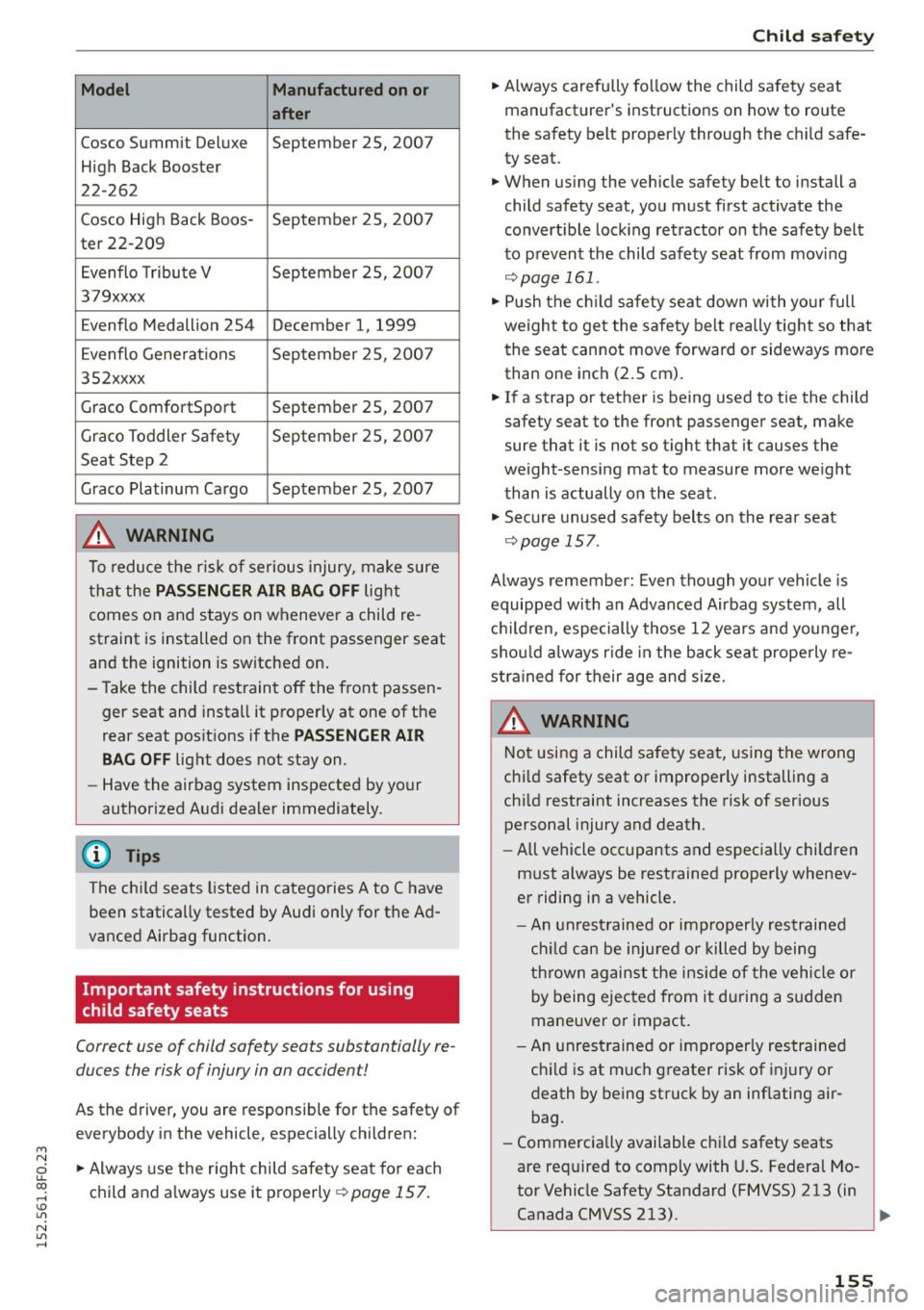
Model Manufactured on or
a fter
Cosco Summit Deluxe September 25, 2007
High Back Booster
22-262
Cosco High Back Boos -September 25, 2007
ter 22-209
Evenflo Tribute V September 25, 2007
379xxxx
Evenflo Medallion 254 December 1, 1999
Evenflo Generations September 25, 2007
3S2xxxx
Graco ComfortSport September 25, 2007
Graco Toddler Safety September 25, 2007
Seat Step 2
Graco Platinum Cargo September 25, 2007
.&, WARNING
To reduce the risk of serious injury, make sure
that the
PASS ENGER AIR BAG OFF light
comes on and stays on whenever a child re
straint is installed on the front passenger seat
and the ignition is switched on.
- Take the child restraint off the front passen ger seat and install it properly at one of the
rear seat positions if the
PASSENGER AIR
BA G OFF
light does not stay on.
- Have the airbag system inspected by your
authorized Audi dealer immediately.
(D Tips
The ch ild seats listed in categories A to C have
been statically tested by Audi on ly for the Ad
vanced Airbag function.
Important safety instructions for using
child safety seats
Correct use of child safety seats substantially re
duces the risk of injury in an accident!
As the driver, you are responsible for the safety of
everybody in the vehicle, especially children:
.,. Always use the right child safe ty seat for each
child and a lways use it properly
¢ page 157 .
Child sa fety
.,. Always carefully follow the child safety seat
manufacturer's instructio ns on how to route
the safety belt properly through the child safe
ty seat.
.,. When using the vehicle safety belt to install a
child safety seat, you must first activate the
convert ible lock ing retractor on the safety belt
to prevent the child safety seat from mov ing
r::) page 161 .
.,. Push the ch ild safety sea t down with yo ur full
weight to get the safety belt rea lly tight so that
the seat cannot move forward or sideways more
than one inch (2.5 cm).
.,. If a strap or tether is being used to tie the child
safety seat to the front passenger seat, make
sure that it is not so tight that it causes the
weight -sensing mat to measure more we ight
than is actually on the seat .
.,. Secure unused safety belts on the rear seat
r::)page 157 .
Always remember : Even though your vehicle is
equipped with an Advanced Airbag system, all
c hi ld ren, especially those 12 years and younge r,
shou ld a lways r ide in the back seat prope rly re
stra ined for their age and size.
A WARNING
=
Not using a child sa fety seat, us ing the wrong
chi ld safety seat or improperly installing a
chi ld restraint increases the risk of serious
personal injury and death.
- All vehicle occ upants and especially children
must always be restrained properly whenev
er riding in a vehicle .
- An unrest rained or improperly restrained
ch ild can be injured or killed by being
thrown against the ins ide of the vehicle o r
b y being ejected from it du ring a s udden
maneuver or impact.
- An unrestrained or improperly res trained
child is at much greater risk of injury or
death by being struck by an inflating air
bag.
- Commercia lly available child safety seats
are req uired to comply with U.S. Federa l Mo
tor Vehicle Safety Standard (FMVSS) 213 (in
Canada CMVSS 213). .,_
155
Page 161 of 268
M N
ci u.. co ,...., \!) 1.1'1
N 1.1'1 ,....,
be properly restrained in a child safety seat certi
fied for their si ze and weight ¢
fig. 157 and
¢ fig. 158.
The airbag on the passenger side makes the front
seat a potentially dangerous place for a child to
ride. The front seat is not the safest place for a
child in a forward-facing child safety seat. It is a
very dangerous place for an infant or a larger
child in a rearward-facing se at.
A WARNING
Not using a child safety seat, using the wrong
child safety seat or improperly installing a
child restraint increases the risk of serious
personal injury and death in a collision or oth
er emergency situation.
- Children on the front seat of any car, even
with Advanced Airbags , can be seriously in
jured or even killed when an airbag inflates.
A child in a rearward-facing child safety seat
installed on the front passenger seat will be
seriously injured and can be killed if the
front airbag inflates -even with an Ad
vanced Airbag System.
- The inflating airbag will hit the child safety
seat or infant carrier with great force and
will smash the child safety seat and child against the backrest, center armrest, door
or roof.
- Always install rearward-facing child safety
seats on the rear seat.
- If you must install a rearward facing child
safety seat on the front passenger seat be
cause of exceptional circumstances and the
PASSENGER AIR BAG OFF light does not
come on and stay on, immediately install
the rearward-facing child safety seat in a
rear seating position and have the airbag
system inspected by your authorized Audi
dealer.
- The rear side of the child safety seat should
be positioned as close as possible to the
backrest on the vehicle seat.
- Always read and heed all WARNINGS when ever using a child restrained in a vehicle is
being used ¢
page 124, Safety belts,
Child safety
¢ page 132, Airbag system and
¢ page 152, Important information.
A WARNING
-If exceptional circumstances require the use
of a forward-facing child restraint on the front
passenger's seat, the child's safety and well
being require that the following special pre
cautions be taken:
- Make sure the forward-facing seat has been designed and certified by its manufacturer
for use on a front seat with a passenger
front and side airbag .
- Always follow the manufacturer's instruc
tions provided with the child safety seat or
infant carrier.
- Always move the front passenger seat into
the rearmost position of the passenger
seat's fore and aft adjustment range, and as
far away from the airbag as possible before
installing the child restraint.
- Always make sure that nothing prevents the
front passenger's seat from being moved to
the rearmost position in its fore and aft ad ·
justment range.
- Always make sure the backrest is in an up
right position.
- Make sure that the
PASSENGER AIR BAG
OFF
light comes on and stays on all the time
whenever the ignition is switched on.
- If the light does not stay on , perform the
checks ¢
page 142, Monitoring the Ad
vanced Airbag System.
- Take the child restraint off the front passen
ger seat and install it properly at one of the
rear seat positions if the
PASSENGER AIR
BAG OFF
light does not stay on whenever
the ignition is switched on.
159
Page 163 of 268
M N
ci u.. co ,...., \!) 1.1'1
N 1.1'1 ,....,
_& WARNING
Not using a booster seat, using the booster
seat improperly, incorrectly installing a boos
ter seat or using the vehicle safety belt im properly increases the risk of serious personal
injury and death in a collision or other emer
gency situation. To help reduce the risk of se
rious personal injury and/or death:
- The shoulder belt must lie as close to the
center of the child's collar bone as possible
and must lie flat and snug on the upper
body.
It must never lie across the throat or
neck. The lap belt must lie across the pelvis
and never across the stomach or abdomen. Make sure the belt lies flat and snug . Pull on
the belt to tighten if necessary.
- Failure to properly route safety belts over a
child's body will cause severe injuries in an
accident or other emergency situation
¢ page 124.
-The rear side of the child safety seat should
be positioned as close as possible to the
backrest on the vehicle seat.
- Children on the front seat of any car, even
with Advanced Airbags, can be seriously in
jured or even killed when an airbag inflates.
- Never let a child stand or kneel on any seat.
- Never let a child ride in the cargo area of
your vehicle.
- Always remember that a child leaning for
ward, sitting sideways or out of position in
any way during an accident can be struck by
a deploying airbag. This will result in serious
personal injury or death.
- If you must install a booster seat on the
front passenger seat because of exceptional
circumstances the
PASSENGER AIR BAG
OFF
light must come on and stay on, when
ever the ignition is switched on.
- If the PASSENGER AIR BAG OFF light does
not come on and stay on, perform the
checks described ¢
page 142, Monitoring
the Advanced Airbag System.
- Take the child restraint off the front passen
ger seat and install it properly at one of the
rear seat positions if the
PASSENGER AIR
-
Child safety
BAG OFF light does not stay on whenever
the ignition is switched on.
- Always read and heed all WARNINGS when
ever using a child restrained in a vehicle is
being used¢
page 124, Safety belts,
¢ page 132, Airbag system and
¢ page 152, Important information.
Securing child seats
Securing a child safety seat using a safety
belt
Safety belts for the rear seats and the front pas
senger's seat can be locked with the convertible
locking retractor to properly secure child safety
seats.
The safety belts emergency locking retractors for
the rear seats safety belts and for the front pas senger's seat safety belt have a convertible lock
ing retractor for child restraints. The safety belt
must be locked so that belt webbing cannot un
ree l. The retractor can be activated to lock the
safety belt and prevent the safety belt webbing
from loosening up during normal driv ing . A child
safety seat can only be properly installed when
the safety belt is locked so that the child and
child safety seat will stay in place.
Always remember: Even though your vehicle is
equipped with an Advanced Airbag system, all
children, especially those 12 years and younger,
should a lways ride in the back seat properly re
strained for their age and weight.
_& WARNING
=
Improperly installed child safety seats in-
crease the risk of serious personal injury and
death in a collision.
- Always make sure that the safety belt re
tractor is locked when installing a child safe
ty seat. An unlocked safety belt retractor
cannot hold the child safety seat in place
during normal driving or in a crash.
- Always buckle the child safety seat firmly in
place even if a child is not sitting in it. A
loose child safety seat can fly around during
a sudden stop or in a collision. ..,.
161
Page 164 of 268

Child safety
-If the backrest is not securely latched, the
child and the child restraint will be thrown
forward together with the backrest and will
strike parts of the vehicle interior. The child
can be seriously injured or killed .
- Never install rearward-facing child safety
seats or infant carriers on the front passen
ger seat . A child will be seriously injured and
can be killed when the passenger airbag in
flates.
- The inflating airbag will hit the child safety
seat or infant carrier with great force and
will smash the child safety seat and child
against the backrest, center armrest, door
or roof.
- Always install rearward-facing child safety
seats or infant carriers on the rear seat.
- Forward-facing child safety seats or infant
carriers installed on the front passenger's
seat may interfere with the deployment of
the airbag and cause serious injury to the
child.
- It is safer to install a forward-facing child
safety seat on the rear seat.
- Always read and heed all WARNINGS when
ever using a child restrained in a vehicle is
being used
c:!> page 152. Special precautions
apply when installing a child safety seat on
the front passenger seat
c:!> page 133, Child
restraints on the front seat -some impor
tant things to know .
A WARNING
Always take special precautions if you must
install a forward or rearward-facing child re
straint on the front passenger's seat in excep
tional situations:
- Whenever a forward or rearward-facing
child restraint is installed on the front pas
senger seat, the
PASSENGER AIR BAG OFF
light must come on and stay on whenever
the ignition is switched on.
-If the PASSENGER AIR BAG OFF light does
not come on and stay on, perform the
checks described
c:!> page 142, Monitoring
the Advanced Airbag System.
162
-
- Take the child restraint off the front passen
ger seat and install it properly at one of the
rear seat positions if the
PASSENGER AIR
BAG OFF
light does not stay on whenever
the ignition is switched on .
- Improper installation of child restraints can
reduce their effectiveness or even prevent
them from providing any protection.
- An improperly installed child restraint can
interfere with the airbag as it deploys and
seriously injure or even kill the child .
-Always carefully follow the manufacturer 's
instructions provided with the child safety
seat or carrier.
- Never place additional items on the seat that can increase the total weight registered
by the weight-sensing mat and can cause in
jury in a crash.
A WARNING
Forward-facing child restraints:
- Always make sure the forward-facing seat
has been designed and certified by its man
ufacturer for use on a front seat with a pas
senger front and side airbag.
- Never put the forward-facing child restraint
up, against or very near the instrument pan
el.
-Always move the passenger seat into its
rearmost position in the seat's fore and aft
adjustment range, as far away from the air
bag as possible before installing the for
ward-facing child restraint. The backrest
must be adjusted to an upright position.
- Make sure that the
PASSENGER AIR BAG
OFF
light comes on and stays on all the time
whenever the ignition is switched on.
A WARNING
Rearward-facing child restraints:
- A child in a rearward-facing child safety seat
installed on the front passenger seat will be
seriously injured and can be killed if the
front airbag inflates -even with an Ad-
vanced Airbag System . .,.
Page 165 of 268
M N
ci u.. co ,...., \!) 1.1'1
N 1.1'1 ,....,
-The inflating airbag will hit the child safety
seat or infant carrier with great force and
will smash the child safety seat and child against the backrest, center armrest, door
or roof.
- Always be especially careful if you must in
stall a rearward facing child safety seat on
the front passenger seat in exceptional cir cumstances.
-A tight tether strap on a rearward-facing child restraint attached to the front passen
ger seat can put too much pressure on the
weight-mat in the seat and register a heavi
er weight in the Advanced Airbag System .
The heavier weight registered can make the
system work as though an adult were on the
seat and deploy the Advanced Airbag when
it must be suppressed causing serious or
even fatal injury to the child.
- Make sure that the
PASSENGER AIR BAG
OFF
light comes on and stays on all the time
whenever the ignition is switched on.
- If the PASSENGER AIR BAG OFF light does
not come on and stay on, immediately in
stall the rearward-facing child safety seat in
a rear seating position and have the airbag
system inspected by your authorized Audi
dealer.
Activating the convertible locking retractor
Use the convertible locking retractor to secure a
child restraint.
Alw ays heed the child s afety seat manufacturer 's
instructions when installing a child restraint in
your vehicle . To activate the convertible locking
retractor:
.. Place the child restraint on a seat, preferably on
the rear seat.
.. Slowly pull the belt
all the way out .
.. Route it around or through the child restraint
belt path ~,& .
.. Push the child safety seat down with your full
weight to get the safety belt really tight.
.. Insert the belt tongue into the buckle for that
seating position.
Child safety
.. Guide the safety belt back into the retractor un
til the belt lies flat and snug on the child safety
seat.
.. You should hear a "clicking" noise as the belt
winds back into the inertia reel. Test the con
vertible locking retractor by pulling on the belt .
You should no longer be able to pull the belt
out of the retractor. The convertible locking re
tractor is now activated .
.. Make sure that the red release button is facing
away from the child restraint so that it can be
unbuckled quickly.
.. Pull on the belt to make sure the safety belt is
properly tight and fastened so that the seat
cannot move forward or sideways more than
one inch (2.S cm).
A WARNING
Using the wrong child restraint or an improp
erly installed child restraint can cause serious
personal injury or death in a crash.
- Always make sure that the safety belt re
tractor is locked when installing a child safe
ty seat. An unlocked safety belt retractor
cannot hold the child safety seat in place
during normal driving or in a crash.
- Always buckle the child safety seat firmly in
place even if a child is not sitting in it. A
loose child safety seat can fly around during
a sudden stop or in a crash.
- Always make sure the seat backrest to which
the child restraint is installed is in an up
right position and securely latched into
place and cannot fold forward. Otherwise,
the seatback with the child safety seat at
tached to it could fly forward in the event of
an accident or other emergency situation .
- Always read and heed all WARNINGS when
ever using a child restrained in a vehicle is
being used
Qpage 152. Special precautions
apply when installing a child safety seat on
the front passenger seat~
page 133, Child
restraints on the front seat -some impor
tant things to know.
163
Page 177 of 268
M N
ci u.. co ,...., \!) ..,.,
N ..,., ,....,
The all-wheel drive concept is designed for high
engine power . Your vehicle is exceptionally pow
erful and has excellent driving character istics
both under normal driving conditions and on
snow and ice. Always read and follow safety pre
cautions <=>
,&.
Winter tire s
When driving in the winter, your vehicle with all
wheel drive has an advantage, even with regular
tires. In winter road conditions it may be advisa
ble to mount w inter tires (or all-season tires) for
improved driveability and braking: these tires
must be mounted on
all four wheels. See also
<=> page 224, Winter tires.
Tire chains
Where tire chains are mandatory on certain
roads, this normally also applies to vehicles with
all-wheel drive <=>
page 224, Snow chains.
Replacing wheels/tires
Vehicles with all-wheel drive must a lways have
tires of the same size. Also avoid tires with differ
ent tread depths. For details see page
<=>
page 216, New tires or wheels.
Off-Road driving?
Your Audi does not have enough ground clear
ance to be used as an off-road vehicle. It is there
fore best to avoid rough tracks and uneven ter
rain as much as possible. Also refer to
<=>page 177.
A WARNING
Always adjust your driving to road and traffic
conditions. Do not let the extra safety afford
ed by all-wheel drive tempt you into taking
extra risks.
- Although the all-wheel dr ive is very effec
t ive, always remember that braking capacity
is limited by tire traction. You should there
fore not drive at excessive speeds on icy or
slippery road surfaces.
- On wet road surfaces, be careful not to dr ive
too fast because the front wheels could be
gin to slide on top of the water (aquap lan
ing). If this shou ld occur, you will have no
Smart Technology
warning from a sudden increase in engine
speed as with a front-wheel drive vehicle.
Always drive at speeds which are suited to the road conditions -risk of crash.
Energy management
Starting ability is optimized
Energy management controls the distribution of
electrical energy and thus optimizes the availa
bility of electrical energy for starting the engine.
If a vehicle with a conventional energy system is
not driven for a long pe riod of time, the battery
is discharged by idling current consumers (e.g.
i mmobil izer). In certain circumstances it can re
su lt in there being insufficient energy available to
start the engine.
Intelligent energy management in your vehicle
hand les the distribution of electrical energy.
Starting ability is markedly improved and the life
of the battery is extended.
Basically, energy management consists of
bat
tery diagnosis , idling current management
and
dynamic energy management.
Battery diagnosis
Battery diagnosis continuously determines the
state of the battery . Sensors determine battery
vo lta ge, battery current and battery tempera
tu re. This determines the current state of charge
and the power of the battery.
Idling current management
Idling current management reduces energy con
sumption whi le the vehicle is standing. With the
ignition switched off, it contro ls the energy sup
ply to the various electrical components. Data
from battery diagnosis is considered.
Depending on the battery's state of charge, indi
vidual consumers are gradually turned off to pre
vent excessive discharge of the battery and thus
maintain starting capability .
Dynamic energy management
While the vehicle is being driven, dynamic energy
management distr ibutes the energy generated ..,.
175
Page 178 of 268

Smart Technology
according to the needs of the individual compo
nents. It regulates consumption, so that more
electrical energy is not being used than is being
generated and ensures an opt imal state of
charge for the battery.
(D Tips
- But even energy management cannot neg
ate the limits of physics. Consider that the
power and life of a battery are limited.
- If starting ability is threatened, the indica tor light (•) appears ¢
page 16.
What you should know
The highest priority is given to maintaining start
ing capability.
The battery is severely taxed in short-distance
driving, in city traffic and during the cold time of
year. Abundant electrica l energy is requ ired, but
only a little is generated. It is also critical if the
engine is not running and electrical components
are turned on. In th is instance energy is being
consumed but none is being generated.
It is in precisely these situations that you will no
tice energy management actively regulating the
d istr ibut ion of energy.
Vehicle stands for an extended period
If you do not drive your vehicle over a period of
several days or weeks, e lectrical components are
gradually cut back or switched
off. This reduces
energy consumption and maintains starting ca pability over a longer period . Some of the con
ven ience funct ions may not operate, such as the
interior lights or the powe r seat adjustment. The
conven ience functions w ill be available again
when yo u sw itch on the ignition and start the en
gine.
With the engine turned off
I f you listen to the radio, for example, with the
engine turned
off or use other MMI functions,
the battery is being discha rged .
If starting capability is jeopardized due to energy
consumption, a message appears in the MMI dis
p la y. The message indicates that the system will
176
be switched off automatically in a moment . If
you wish to continue using the functions, you have to start the eng ine.
With the engine running
Althoug h elec trical energy is generated when the
vehicle is being driven, the battery can become
discharged . This happens mostly when litt le en
ergy is being generated and a great dea l con
sumed and the battery's state of charge is not
optimal.
To bring the energy ba lance back into equilibri
u m, consumers which require especially large
amounts of energy are temporar ily cut back or
switched
off. Heating systems in part icular re
quire a great deal of energy. If you notice, for ex
ample, that the heated seats* or the heated rear
window a re not heating, they have been tempo
rarily cut back or switched
off. These systems w ill
be ava ilable again as soon as the energy ba lance
has been restored.
You will also notice that engine idle speed has
been increased slightly . Thi s is normal and not a
cause for concern. By incr easing eng ine idle
speed the additional energy required is generated
and the battery is cha rged.