ESP AUDI A5 CABRIOLET 2015 Repair Manual
[x] Cancel search | Manufacturer: AUDI, Model Year: 2015, Model line: A5 CABRIOLET, Model: AUDI A5 CABRIOLET 2015Pages: 268, PDF Size: 66.88 MB
Page 184 of 268
Trailer mode
Tire pressure
When tow ing a trailer, inflate the tires of your ve
hicle to the cold tire pressure listed under " Full
load" on the label located on the driver's side B
pillar (visible when the door is open). Inflate
trailer tires to trailer and tire manufacturers'
specifications.
Lights
The headlight settings should be checked with
the trailer attached before driving off . Check to
make sure both vehicle and trailer lights are
working properly.
Safety chains
Be su re trailer safety chains are properly connect
ed from the trailer to the hitch on the vehicle.
Leave enough slack in the chains to permit turn
ing corners. When you install safety chains, make
sure they will not drag on the road when you are
driving.
The chains shou ld cross under the trai ler tongue
to prevent it from dropping in case of separation
from the hitch.
Driving instructions
Driving with a trailer always requires extra care
and consideration.
To obtain the best possible handling of vehicle
and trai ler, please note the following:
.. Do not tow a loaded trailer when your car itself
is not loaded .
.. Be especia lly careful when passing other
vehicles.
.. Observe speed limits.
.. Do not drive at the maximum permissible
speed .
.. Always apply brakes early.
.. Monitor the temperature gauge.
Weight distribution
Towing a loaded trai ler with an empty car results
in a highly unstable distribution of weight. If this
cannot be avoided, drive at very low speeds only
to avoid the risk of losing steering control.
182
A "balanced" rig is easier to operate and contro l.
This means that the tow vehicle shou ld be loaded
to the extent possible and permissib le, wh ile
keep ing the trailer as light as possible under the
c ir cumstances. Whenever poss ible, transfer
some cargo to the luggage compartment of the
tow veh icle while observing tongue load require
ments and vehicle load ing considerat ions .
Speed
The higher the speed, the more difficult it be
comes for the driver to control the rig. Do not
drive at the maximum permissible speed. Reduce
your speed even more if load, weather or w ind
cond it ions are unfavorab le - particularly when
go ing downh ill.
Reduce veh icle speed
immediately if the trailer
shows the slightest sign of swaying.
Do not try
to stop the swaying by accelerating.
Observe speed limits. In some areas, speeds for
vehicles towing tra ilers are lower than for regular
vehicles.
Always apply brakes early. When dr iving down
hill, shift into a lower gear to use the engine
braking effect to slow the vehicle. Use of the
brakes alone can cause them to overheat and fail.
Coolant temperature
The coolant temperature gauge¢ page 10 must
be observed carefully. If the needle moves close
to the upper end of the scale, reduce speed im
med iately and/or turn off the air conditioner .
If the coolant temperature warning light . in
the instrument cluster starts flashing, pull off
the road, stop and let the engine
idle for about
two m inutes to prevent heat build-up .
&_ WARNING
Anyone not properly restrained in a moving
vehicle is at a much greater risk in an acci
dent. Never let anyone ride in your car who is
not properly wearing the restraints provided
by Audi.
-
Page 185 of 268
M N
ci u.. co ,...., \!) ..,.,
N ..,., ,....,
Trailer mode notes
Important to know
Your vehicle hand les differently when tow ing a
trailer because of the additional weight and dif
ferent weight distribution. Safety, performance
and economy will greatly depend on how careful
ly you load your trailer and operate your rig.
Before you actually tow your trailer, practice
turning, stopping and backing up in an area away
from traffic. Keep practicing until you have be
come completely familiar with the way your vehi
cle-trailer combination behaves and responds.
Backing up is difficult and requires practice. Back
ing up with a trailer generally requires steering
action opposite to that when backing up your ve
hicle without a trailer .
Maintain a greater distance between your vehicle
and the one in front of you. You wi ll need more
room to stop. To compensate for the trailer, you
will need a larger than normal turning radius.
When passing, remember that you cannot acce l
erate as fast as you normally would because of
the added load. Make sure you have enough room
to pass. After passing, allow plenty of room for
your trailer before changing lanes again.
Avoid jerky starts, sharp turns or rapid lane
changes.
(D Tips
- Do not tow a trailer during the break-in peri
od of your vehicle.
- If you tow a trailer, your A udi may require
more frequent maintenance due to the ex
tra load
¢ page 248 .
Parking on a slope
Do not park on a slope with a trailer. If it cannot
be avoided, do so only after doing the following:
When parking:
.. Apply the foot brake.
.. Have someone place chocks under both the ve
hicle and the trailer wheels.
Trailer mode
.. With chocks in place, slowly release the brakes
until the wheel chocks absorb the load.
.. Turn the whee ls towards the curb .
.. App ly the parking brake.
.. Move the selector lever to P.
When restarting after parking:
.. App ly the foot brake.
.. Start the engine.
.. Move the selector lever to D/S .
.. Release the parking brake and slowly pull out
and away from the wheel chocks.
.. Stop and have someone retrieve the wheel
chocks .
(D Tips
If you move the selector lever of the automat
ic transmission to P before applying the park
in g brake and before blocking the wheels, you
may have to use more force later to move the
l ever out of the P position.
183
Page 186 of 268
Care and cleaning
Care and cleaning
General information
Regular, proper care he lps to maintain your vehi
cle's value.
It can also be a requirement when
submitting warranty claims for corrosion damage
and paint defects on the body.
The necessary care products can be obtained
from your authorized Audi dealer . Read and fol
low the instructions for use on the packaging.
A WARNING
-Using cleaning and care products incorrectly
can be dangerous to your health.
- Always store cleaning and care products out of reach of children to reduce the risk of poi
soning .
@ For the sake of the environment
-Preferably use environmentally-friendly
products when buying cleaning agents.
- Do not dispose of leftover cleaning and care
products with household trash .
Car washes
The longer that deposits remain on the vehicle,
the more the surface may be damaged. High
temperatures such as those caused by sunlight
increase the damaging effect.
Before washing, rinse
off heavy deposits with
p lenty of water.
Stubborn deposits such as bird dropp ings or tree
sap are best removed with plenty of water and a
microfiber cloth .
A ls o, wash the underside of your veh icle once
road salt stops be ing used for the season .
Pressure washers
When washing your veh icles with a pressure
washer, always follow the operating instructions provided with the pressure washer. This is espe
cially important in regard to the p ressure and
spray ing distance. Do not direct the stream of
water directly onto sea ls for the side windows,
doors, luggage compartment lid or hood or onto
184
the tires , rubber hoses, insulat ing material, the
power top, sensors* or camera lenses *. Keep a
distance of at least 16 inches (40 cm) .
Do not remove snow and ice with a pressure
washer.
Never use rotary nozzles or high pressure noz
zles.
The water temperature must not be above 140 °F
(60 °().
Automatic car washes
Spray off the vehicle before washing.
Make sure that the windows and power top are
closed and the windshield wipers are off. Follow
instructions from the car wash operator, especial
ly if there are accessories attached to your vehi
cle.
If possible, use car washes that do not have
brushes .
Washing by hand
Clean the veh icle starting from the top and work
ing down using a soft sponge or cleaning brush.
Use solvent -free cleaning products.
Washing vehicles with matte finish paint by
hand
To avoid damaging the paint when washing, first
remove dust and large particles from your vehi
c le. Insects, grease spots and fingerprints are
best removed with a specia l cleaner for matte
finish paint.
Apply the product using a microfiber cloth . To
avoid damaging the paint surface, do not use too much pressure.
Rinse the vehicle thoroughly with water. Then
clean using a neutral shampoo and a soft micro
fiber cloth .
Rinse the vehicle thoroughly again and le t it air
dry. Remove any water residue using a sham my.
A WARNING
- Only wash the vehicle when the ignition is
off and follow the instructions from the car
-
Page 188 of 268
Care and cleaning
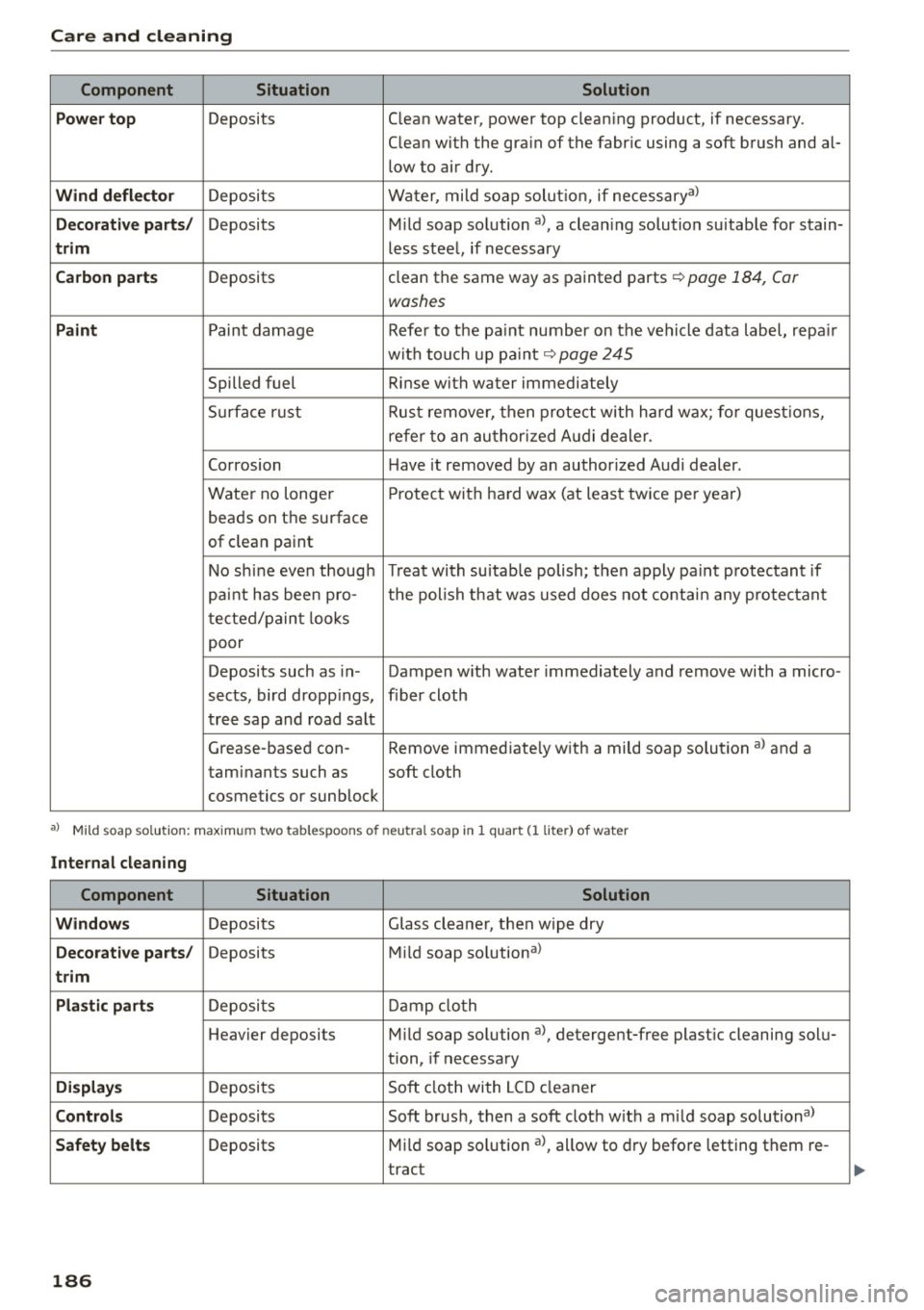
Component Situation Solution
P ower top
Deposits Clean water, power top cleaning product, if necessary.
Clean with the grain of the fabric using a soft brush and al-
low to air dry.
Wind d efle ct or Deposits Water, mild soap solut
ion, if necessaryal
D ec orativ e parts / Deposits Mild soap solution al, a clean ing solution suitable for stain-
t rim less stee l, if necessary
Car bon p art s Deposits clean the same way as painted parts <=>page 184, Car
washes
P aint Paint damage Refer to the pa int number on the vehicle data label, repa ir
with touch up pa int <=>
page 245
Spilled fuel Rinse with water immediately
S urface rust Rust remover, then protect with hard wax; for quest ions,
refer to an authorized A udi dealer.
Corrosion Have it removed by an authorized Audi dealer.
Wate r no longer Protect w ith hard wax (at least twice per year)
beads on the surface
of clean paint
No sh ine even though Treat with suitab le polish; then apply pa int protectant if
pa int has been pro- the polish that was used does not contain any protectan t
tected/paint looks
poor
Deposits such as in- Dampen w ith water immediately and remove with a micro-
sects, bird dropp ings, fiber cloth
tree sap and road salt
Grease-based con-Remove immediate ly with a mild soap solution a) and a
taminants such as soft cloth
cosmetics or sunblock
al Mild soap solution: maximum two tablespoons of neutral soap in 1 quar t (1 liter ) of water
Internal cle ani ng
Component Situation Solution
Window s
Deposits Glass cleaner, then wipe dry
Dec orati ve part s/ Deposits Mild soap solutional
t rim
Pl as tic part s
Deposi ts Damp clo1th
Heavier deposits Mild soap solution al, detergent-free plastic cleaning solu-
tion, if necessary
Di spl ays Deposits Soft cloth with LCD cleaner
Controls Deposits Soft brush, then a soft cloth w ith a mi ld soap solutional
Safet y belt s Deposits Mild soap solution a>, allow to dry before letting them re -
tract
186
Page 189 of 268

M N
ci u.. co ,...., \!) 1.1"1
N 1.1"1 ,....,
Care and cleaning
Component Situation Solution
Te xtile s
Deposits adhering to Vacuum cleaner
artificial leather, the surface
Alcantara Water-based depos its Absorbent
cloth and mild soap solutiona)
such as coffee, tea,
b lood, etc.
Oil-based deposits Apply a m ild soap solution a), blot away the d issolved oil or
such as oil, make-up, dye, treat afterward with water, if necessary
etc.
Special deposits such Specia l sta in remover, blot with absorbent material, treat
as ink, na il polish, la- afterward with mild soap solution, if necessary a)
tex paint, shoe pol-
ish, etc.
Natural leather Fresh stains Woo
l cloth with a mild soap solutiona>
Water-based deposits fresh stains : absorbent cloth
such as coffee, tea, dried stains: stain remover suitable for leather
blood, etc.
Oil-based deposits Fresh stains: absorbent cloth and stain remover sui tab le
such as oil, make-up, for leathe r
etc. dried stains: Oil cleaning spray
Special deposits such Spot remover suitable for leather
as ink, nai l polish, la-
t ex paint, shoe po l-
ish, etc.
Ca re Regularly apply conditioning cream that protects from
light and penetrates into the mate rial. Use specially-col-
ored conditioning cream, if necessary.
Carbon parts Deposits clean the same way as plastic parts
a) Mild soap sol ution : maximu m two tablespoons of neutral soap in 1 quart (1 liter) of water
.8, WARNING
The windshield may not be treated with wa
ter-repelling windshield coating agents . Un
favorab le conditions such as wetness, dark
ness, or low sun can resu lt in increased glare.
Wiper blade chatter is also possible.
@ Note
- Headlights/tail lights
- Never clean headlights or tail lights with a
dry cloth or sponge.
- Do not use any cleaning product that con
tains alcohol, because they could cause
cracks to form.
- Wheels
-
- Never use any paint polish or other abra
sive materials.
- Damage to the protective layer on the
rims such as stone chips or scratches must
be repaired immediately.
- Sensors/camera lenses
-Never use warm or hot water to remove
snow or ice from the camera lens. This
could ca use the lens to crack.
- Never use abrasive cleaning materials or
alcohol to clean the camera lens. This
could cause scratches and cracks.
- Power top
-Remove bird droppings immediately.
187
Page 193 of 268
M N
ci u.. co ,...., \!) 1.1'1
N 1.1'1 ,....,
fill up at busy gas stations where the seasonal
adjustment is more likely to be made in time.
(D Note
- Fuels containing a high pe rcentage of etha
no l such as ESQ and E85 may only be used in
vehicles with f lexible fuel engines. Using
high ethanol fuel in veh icles not equ ipped
with flexible fuel engines can cause severe
engine damage.
- Methanol fuels which do not meet these re quirements may cause corrosion and dam
age to plastic and rubber components in the
fuel system.
- Do not use fuels that fail to meet the spec i
fied criter ia in this chapter .
- If you are unable to determine whether or
not a particular fuel blend meets the speci
fications, ask your service station or its fuel
supplier .
- Do not use fuel for wh ich the contents can
not be identified.
- Fuel system damage and performance prob
lems resulting from the use of fuels differ
ent from those spec ified are not the respon
s ibility of Audi and are not covered under
the New Vehicle o r the Emission Cont ro l
System Warranties.
- If you experience a loss of fue l economy o r
driveability and pe rformance problems due
to the use of one of these f uel b lends, we
r ecommend that yo u switch to unb lended
fuel.
Ethanol fuel (Bio-ethanol)
Applies to vehicles: with flexible fuel engine
You can recognize vehicles with a flexible fuel
engine by looking at the label on the inside of the fuel filler flap.
Vehicles w ith f lexible fuel engines may be operat
ed with bio-ethanol fuels such as E85 (85% e tha
nol and 15% gasoline) or with unleaded gasoline
(91 AKI/ROZ 95) . The vehicle may also be operat
ed with a m ixt ure of these fuels.
Fu el and R efu elin g
Your f uel consumption wi ll increase when using
bio-ethano l fue ls due to the lower amount of en
ergy contained per unit vo lume in ethano l.
Warming up the fle xible fuel engine in low
t e mperatu res
Due to the chemical composition of b io-ethanol,
a certain amount of fue l ends up in the engine oil
when driving short distances in
very low temper
atures. This fuel evaporates again when the en
gine is warmed up .
II Please w arm up eng ine .
If the driver message appears in the instrument
cluster disp lay, drive with a warm engine to re
duce the oil leve l.
(D Note
-Never fill with methano l or with a h igher
percentage of b io-ethanol than 85% (E85).
A highe r percentage of bio-ethanol in the
fue l can cause damage to the engine or to
the fuel system.
- If you use on ly E85, it is recommended to
fill the fue l tank complete ly w ith unleaded
premium grade gasoline every 5,000 miles.
- If you experience starting, rough id le or hes
itat ion driveab ility problems, fill the fuel
tank complete ly w ith unleaded premium
grade gasoline and drive it normally unt il
the gaso line is used. See your author ized
Audi dea ler if the problem pe rsists.
- Inform your author ized Audi dealer that you
are operating or have operated the vehicle
w ith E85.
- Read and follow the information and t ips
about gasoline<=:>
page 190 .
(D Tips
It may take longer to start the engine when
the outs ide temperature is
very cold. If possi
ble, use winte rized fue l if tempe ratu res are
below free zin g.
191
Page 195 of 268
M N
ci u.. co ,...., \!) 1.1'1
N 1.1'1 ,....,
When activating the central locking, the fuel fi ll
er flap is automatically un locked or locked . Re
fue l the vehicle with the ignit ion turned
off.
Tak ing th e fu el cap off
.,. Turn off the ignit ion.
.,. Press the left side o f the fue l filler flap to open
it
c:> fig . 166 -arrow -.
.,. Unscrew fuel cap counter-clockwise and hang it
on the fue l filler flap
c> fig. 167.
R efuellin g proc edu re
.,. Inse rt the fue l nozz le from the gasol ine p ump
into the fuel filler neck as far as it will go .
.,. Se lect a medium refuelling rate so that the
nozzle switches off automatica lly when the
tank is full.
P utting the fuel cap back on
.,. After fi lling your tank, tw ist the fuel cap clock-
wise as far as it wi ll go.
.,. Close the fuel filler flap .
To avo id f uel spi lling or evaporating from the fue l
tank always close fuel cap properly and com
p letely.
A WARNING
Improper refueling or handling of fue l can
cause fire, exp losion and severe burns.
-
- Fuel is highly flammable and can cause se
vere burns and other injuries.
- Failure to shut the engine off whi le refuel
ing and/or to insert the pump nozzle fu lly
into the fuel filler neck could cause fue l to
spray out of f iller neck or to overflow. Fuel
spray and overflow ing fuel can cause a fire.
- Never use a cellular telephone wh ile refuel
ing. The electromagnetic radiation can
cause sparks that can ignite fuel vapors and
cause a fire.
- Never get back into your vehicle while refu
eling. If in exceptional c ircumstances you
must get back in your vehicle while refuel
ing, make certain that you close the door
and touch meta l to discharge static e lectric
ity before touching the filler nozzle again.
Fu el and R efu elin g
Static electricity can cause sparks that can
ignite fue l vapors released during refue ling.
- Never smoke or have an open f lame any
where in or near your vehicle when refueling or filling a portable fuel conta iner .
- For your safety, we strongly recommend
that you do not travel with a portable f uel
container in your veh icle. The container, full
or empty may leak and cou ld cause a fire,
especially in a crash .
- If, under exceptional c ircumstances, you
must transport a portab le fuel container,
please observe the following:
- Never fill a portable fuel container while it
is anywhere in or on the vehicle (for exam
ple, in the l uggage compartment, or on
the trunk). Static e lectric ity can build up
while filling and can ignite fuel vapors
caus ing a fire .
-Always place a portab le fue l conta iner on
the ground before fill ing .
- Always keep the filler nozzle completely
inside the portable container before and
during f il li ng.
- If filling a portab le container made of
metal, the f iller nozzle must always be in
contact with the container. This will help prevent static electricity from d ischarging
and cause a fi re.
- Never spill fuel inside the vehicle or lug
gage compartment. Fuel vapors are highly
flammable.
- Always observe local and state/provincial
laws regarding the use, storage and trans
po rtation of fue l conta iners.
- Make certain the fuel conta iner meets in
dustry standards (ANSI/ AS TM F852 -86).
(D Note
If any fuel has sp illed onto the car, it should
be removed immediately to prevent damage
to the pa int.
@) For the sake of the environment
As soon as the correct ly operated nozzle
switches off automat ically for the first time,
193
Page 197 of 268

M N
ci LL co
rl I.O
"' N
"' rl
Checking and Filling Hood
Releasing and opening the engine hood
The engine hood is released from inside the vehi
cle.
Fig. 170 Driver's side footwell: e ng in e hood release lever
Fig. 171 Releas e lev er un der t he e ngin e hood
Before opening the engine hood, make sure that
the windshield wipers are flat against the wind
shield . Otherwise, they could damage the paint
on the hood.
.. With the driver's door open, pu ll the lever un
der the instrument panel in the direction of the
arrow
c::> fig . 170.
.. Ra ise the hood slightly c::> &.
.. Press the rocker switch under the hood upward
c::> fig . 171. This releases the catch .
.. Open the hood.
A WARNING
Hot engine coolant can burn you.
- To reduce the r isk of being burned, never
open the hood if you see or hear steam or
coolant escaping from the engine compa rt
ment. Wait until no steam or coolant can be
Checking and Filling
seen or heard before carefully opening the
hood .
Closing the engine hood
.. Pull the hood down until the pressure from the
struts is reduced.
"' Let the hood
drop down and latch in place. Do
not try to push it shut;
it may fa il to engage
c::> &. -
A WARNING
A hood that is not comp letely latched could
fly up and block your view while driving.
- When you close the engine hood, check it to
make sure the safety catch has properly en
gaged . The hood should be flush with the
surrounding vehicle body parts.
- If you notice while driv ing that the hood is
not secured properly, stop at once and close
it.
Working in the engine compartment
Be especially careful whenever you work in the
engine compartment.
-
Whenever you must perform any work in the
engine compartment, for example checking and
filling different fluids , there i s a risk of injury ,
burns and accidents. To prevent personal injury
always observe the following WARNINGS . The
engine compartment of any vehicle is a hazard
ous area
c:> .&. .
A WARNING
-
To help avoid injury, before you check any-
thing under the hood:
- Turn off the engine.
- Remove the ignition key .
- Apply the parking brake.
- Move selector lever of automatic transmis-
sion to "P" (Park) .
-Always let the engine cool down. Hot com
ponents wi ll burn skin on contact .
- To reduce the risk of being burned, never
open the hood if you see or hear steam o r
coo lant escaping from the engine
195
Page 203 of 268

M N
ci u.. co ,...., \!) 1.1"1
N 1.1"1 ,....,
specially conditio ned water an d the manu fa ctu r
er's glycol-basedcoolant additive Gl3 antifreeze
with anticorrosion additives (50% for USA mod
els; 60% for Canadian models). This m ixture both
assures the necessary frost protection and pro
tects meta l components in the engine's cooling
system from corrosion and scal ing . It also raises
the boiling point of the coolant.
Do not reduce the concentration of the coolant in
the summer by adding plain water .
The p ropor
tion of coolant addit ive must be at l east 50 %
but n ot mor e th an 60 %
to maintain antifreeze
protection and cooling efficiency. If the coolant
frost protection is too low, the coolant cou ld
freeze and damage the vehicle heating and en
gine cooling system.
F or yea r-round driving, antifreeze is added at the
factory fo r temperatures dow n to:
- -31°F(-35°C)USA
- -40 °F ( - 40 °C) Canada.
If you must add coo lant, use a mixture of water
and coolant addit ive. Mixing the coolant additive
with distilled water is recommended.
A WARNING
Before you check anything in the engine com
partment, always read and heed all WARN
INGS
¢ &. in Working in the engine compart
ment on page 195.
(D Note
- Before winter sets in, have the coolant
checked to see if the coolant addit ive in your
vehicle is suffic ient to meet the cli mate con
dit ions. This is especially important if you
li ve in a region where the win ter is extreme
l y co ld. If ne cessary, i ncrease the proport ion
of coo lant add itive to 60%.
- When adding coolant a ddit ive to you r cool
i ng system, remember:
- We recommend using only coolant addi
tive Gl2++ or Gl3 for your ve hicle. This
coolant additive is ava ilable at authorized
Audi dea lers. Other types of ant ifreeze can
significant ly reduce co rrosion protection.
Checking and Fillin g
The resulting corrosion can ca use a loss o f
coolant and serious engine damage.
- Do not add any type of rad iator le ak sealan t
to your vehicle's engine coolant. Adding ra
diator repai r fluid may adverse ly affect the
function and performance of your cooling
system and could result in damage not cov
ered by your New Vehicle Lim ited Warranty.
Checking the engine coolant level
The engine coolant level can be checked with a
quick glance.
Fi g. 175 Engine compartment: Cover on the coolant ex
pa nsion tank
.. Before you check anything in the engine com
partment,
alwa ys re ad and heed all WARN
INGS ¢ A in Working in the engine compart
ment on page 195.
.. Park your vehicle on a level su rface.
.. Tu rn off the ignition .
.. Read the engine coolant level from the coolant
expansion tank
¢fig . 175, ¢page 197,
fig . 172 .
With a cold engine, the coolant leve l
should be between the "M IN" and "MAX" mark
ings. When the eng ine is warm, the level may
be slightly above the "MAX" marking.
The location of the coo lant expansion tank can be
seen in the engine compartment illustration
¢page 197.
To obtain an a ccur ate reading, the engine m ust
be switched off.
T he expansion tank in yo ur veh icle is eq uipped
with an electric coo lant level senso r.
When the coolant leve l is too low, the wa rn ing
light in the Auto-Check System¢
page 17 will
201
Page 207 of 268

M N
ci u.. co ,...., \!) 1.1'1
N 1.1'1 ,....,
Disconnecting the battery terminals
Some vehicle functions (power window regula
tors , for example) are lost if the battery termi
nals are disconnected. These functions have to be
re learned after th e battery terminals are con
nected again. To prevent this, the batte ry should
only be disconnected from the ve hicle electrical
system when absolutely necessary for repairs.
Vehicles not driven for long periods
If you do not drive your vehicle over a period of
several days or weeks, e lectrica l components are
gradually cut back or switched off. This reduces
energy consumption and maintains starting ca pability over a longer period
c:> page 175 .
Some of the conven ience functions may not oper
ate, such as the interior lights or the power seat
adjustment. The convenience functions will be
available aga in when you turn on the ignition and
start the engine.
Winter operation
During the winter months, battery capacity tends
to decrease as temperatures drop. This is because
more power is also consumed while s tart ing, and
the headlights, rear window defogger, etc ., are
used more often .
Avoid unnecessary power consumption, part icu
larly in city traffic or when traveling only short
d istances . Let your authorized Aud i dealer check
the capacity of the vehicle battery before w inter
sets in ¢
page 206 . A well charged battery will
not only prevent starting problems when the
weather is cold, but will also last longer.
(D Tips
If your vehicle is left standing for severa l
weeks at extremely low temperatures, the ve
hicle battery should be removed and stored
where it will not freeze. This will prevent it
from being damaged and having to be re placed.
Checking and Filling
Working on the battery
Be especially careful when working on or near
the battery.
The battery is located in the luggage compart
men t under the floor. Before you check anything
in the luggage compartment ,
read and heed all
WARNINGS
c:> .&_ .
Always heed the safety warnings, when working
on the vehicle battery or the vehicle electr ical
system to prevent injury .
The following WARNINGS are very important
when working on the battery :
Always heed the following WARNING SYM-
BOLS and safety precautions when working on
the battery.
®
Always wear eye protection.
A
Battery acid contains sulfuric acid. Al-
ways wear gloves and eye protection.
@
No
- sparks
- flames
- smoking.
~
When a battery is charged, it produces
hydrogen gas which is explosive and
could cause personal injury.
®
Always keep the battery well out of reach
of children.
A WARNING
= -
Whenever working on the battery or on the
e lectr ical system, there is the risk of injury,
accident and even f ire. Read and heed the fol
lowing WARNINGS:
- Always wear eye protection . Do not let bat
tery ac id or any lead particles get on your
skin or clothing. Shield your eyes. Exp losive
gases can cause blindness or other in jury.
- Battery acid conta ins sulfuric acid . Sulfuric
acid can cause blindness and severe burns.
- Always wear g loves and eye protection. Do
not tilt the battery because acid could leak
out of the ventilation openings. ...,
205