light AUDI A5 CABRIOLET 2017 Owners Manual
[x] Cancel search | Manufacturer: AUDI, Model Year: 2017, Model line: A5 CABRIOLET, Model: AUDI A5 CABRIOLET 2017Pages: 266, PDF Size: 66.64 MB
Page 204 of 266
Checking and Filling
Brake fluid
Checking brake fluid level
The brake fluid level can be checked with a quick
glance.
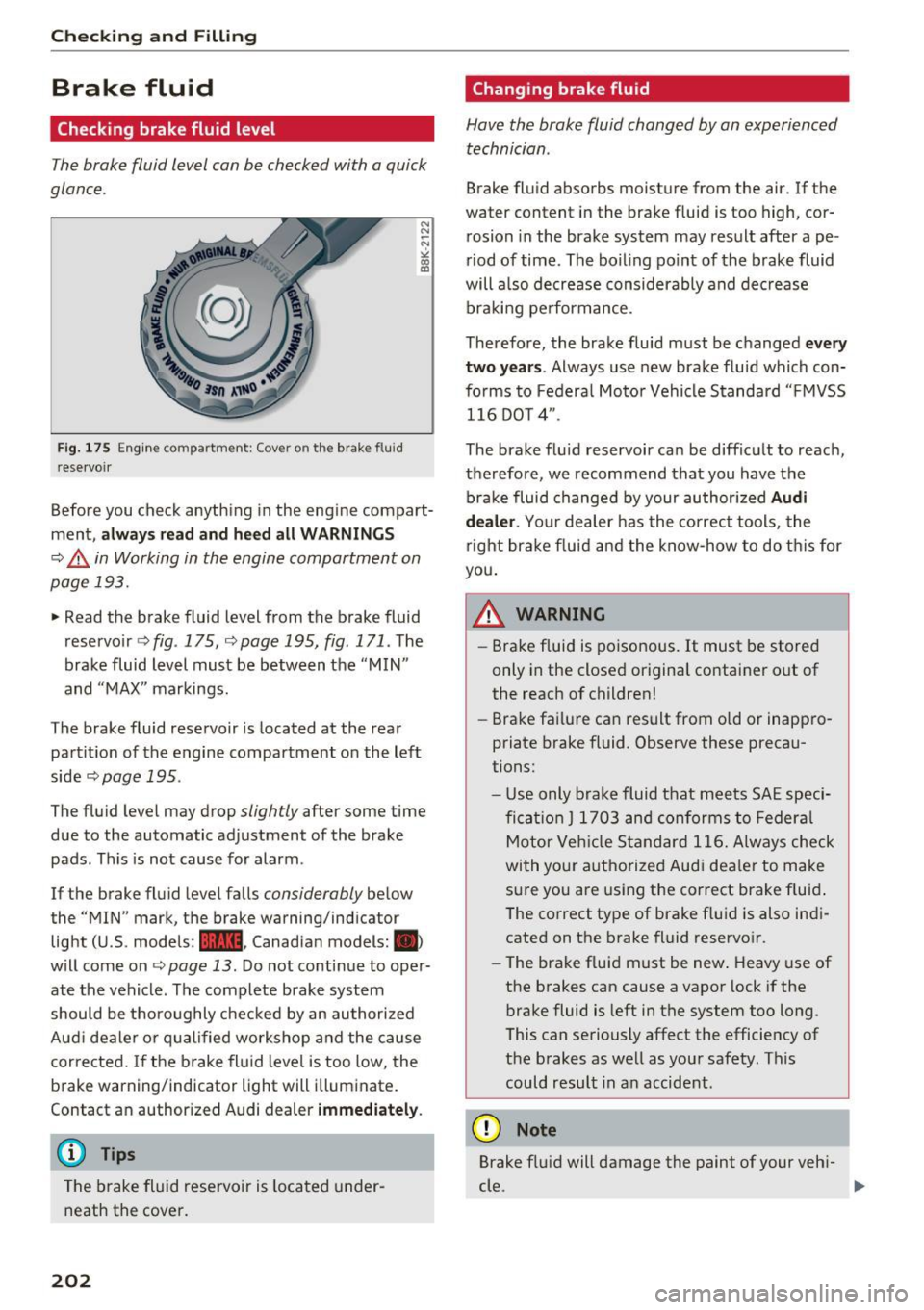
Fig. 175 Engine compartment: Cover on the brake fluid
r eservoir
Before you check anything in the engine compart
ment,
always read and heed all WARNINGS
¢ A in Working in the engine compartment on
page 193.
., Read the brake fluid level from the brake fluid
reservoir
<=> fig . 175, ¢page 195, fig . 171 . The
brake fluid level must be between the
" MIN"
and "MAX " markings.
The brake fluid reservoir is located at the rear
partition of the engine compartment on the left
side
¢ page 195.
The fluid level may drop slightly after some time
due to the automatic adjustment of the brake
pads . This is not cause for alarm .
If the brake fluid level falls
considerably below
the ' 'MIN" mark, the brake warning/indicator
light (U .S. models:
1111 , Canadian models: 1111)
will come on¢ page 13 . Do not continue to oper
ate the vehicle . The complete brake system
should be thoroughly checked by an authorized
Aud i dealer or qualified workshop and the cause
corrected . If the brake fluid level is too low, the
brake warning/indicator light w ill illuminate.
Contact an author ized Audi dealer
immediately.
(D} Tips
The brake fluid reservoir is located under
neath the cover.
202
Changing brake fluid
Have the brake fluid changed by an experienced
technician .
Brake fluid absorbs moisture from the air. If the
water content in the brake fluid is too high, cor
rosion in the brake system may result after ape
riod of time . The boiling po int of the brake fluid
will a lso decrease considerably and decrease
braking performance.
Therefore , the brake fluid must be changed
every
two years .
Always use new brake fluid which con
forms to Feder-al Motor Vehicle Standard "FMVSS
116 DOT 4 ".
The brake fluid reservoir can be difficult to reach ,
therefore, we recommend that you have the
brake fluid changed by your author ized
Audi
dealer .
Your dealer has the correct tools, the
right brake fluid and the know-how to do this for
you.
A WARNING
- Brake fluid is poisonous. It must be stored
only in the closed original container out of
the reach of children!
- Brake fai lure can result from o ld or inappro
priate brake fluid. Observe these precau
tions:
- Use only brake fluid that meets SAE speci
fi cation
J 1703 and conforms to Federal
Motor Veh icle Standard 116. Always check
with your authorized Audi dealer to make
sure you are using the correct brake f luid .
The correct type of brake f luid is also indi
cated on the brake fluid reservoir.
- The brake fluid must be new . Heavy use of
the brakes can cause a vapor lock if the
brake fluid is left in the system too long .
This can seriously affect the efficiency of
the brakes as well as your safety. This
could result in an accident.
(D Note
Brake fluid will damage the paint of your vehi-
cle .
lilJJ,
Page 205 of 266
a:,
a:,
...... N r--. N ...... 0
0
LL 00
@ For the sake of the environment
Because of the problem of proper disposal of
brake fluid as we ll as the special toots re
quired and the necessary expertise, we rec
ommend that you have the brake fluid
changed by your authorized Audi dealer .
Battery
General information
Under normal operating conditions, the battery
in your Audi does not need any maintenance.
With
high outside temperatures or long daily
drives we recommend that you have the electro
lyte level checked by an authorized Audi dealer or
qualified workshop. The electrolyte level should
also be checked each time the battery is charged
¢ page 205.
Have the battery checked when you take your ve
hicle in for serv ice. You are well advised to re
place a battery t hat is older than 5 years.
Disconnecting the battery terminals
Some vehicle functions (power window regula
tors, for example) are lost if the battery termi nals are disconnected. These functions have to be
relearned after the battery terminals are con
nected again. To prevent th is, the battery should
only be disco nnected from the vehicle e lectr ica l
system when abso lutely necessary for repairs.
Vehicles not driven for long periods
If you do not drive your vehicle over a period of
several days or weeks, electrical components are
gradually cut back or sw itched off. This reduces
energy consumption and maintains starting ca
pability over a longer period¢
page 173.
Some of the conven ience functions may not oper
ate, such as the interior lights or the power seat
adjustment. The convenience functions will be
available again when you turn on the ignition and
start the engine.
Winter operation
During the winter months, battery capacity tends
to decrease as temperatures drop . T his is be-
Checking and Filling
cause more power is also consumed while start
ing, and the headlights, rear window defogger,
etc., are used more often.
Avo id unnecessary power consumption, particu
larly in city traff ic or when traveling only short
distances . Let your authorized Audi dealer check
the capacity of the vehicle battery before winter
sets in ¢
page 205. A well charged battery will
not only prevent starting problems when the
weather is cold, but will also last longer .
(D Tips
If your vehicle is left standing for several
weeks at extremely low temperatures, the ve
hicle battery should be removed and stored
where it w ill not freeze. This will prevent it
from be ing damaged and having to be re
placed.
Working on the battery
Be especially careful when working on or near
the battery.
The battery is located in the luggage compart
ment under the floo r. Before you check anything
in the luggage compartment,
read and heed all
WARNINGS ¢
LD.·
Always heed the safety warnings, when working
on the vehicle battery or the veh icle electrical
system to prevent injury.
The following WARNINGS are very important
when working on the battery:
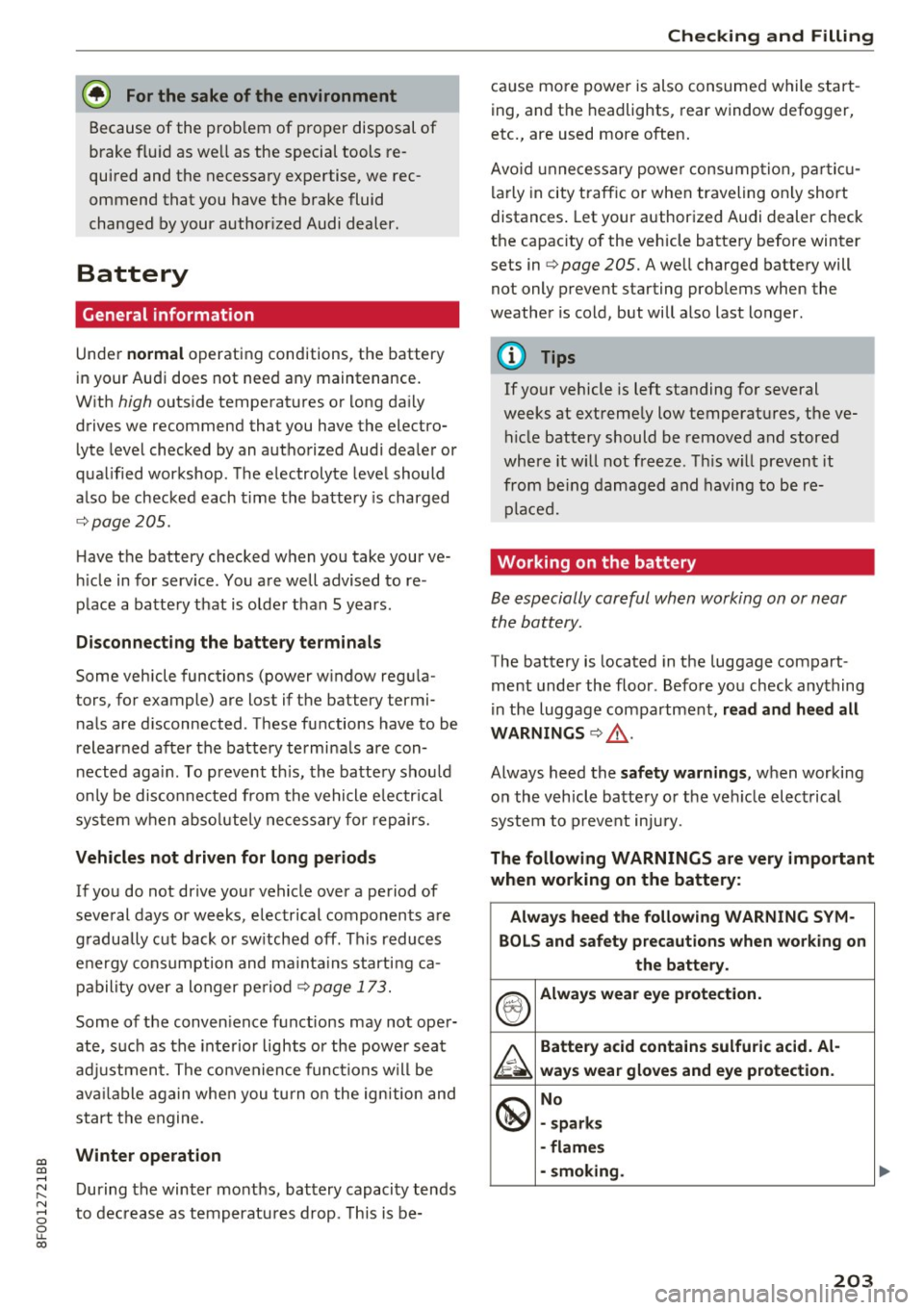
Always heed the following WARNING SYM·
BOLS and safety precautions when working on
the battery.
®
Always wear eye protection.
A
Battery acid contains sulfuric acid. Al·
ways wear gloves and eye protection .
@
No
- sparks
· flames
· smoking.
203
Page 206 of 266

Checking and Filling
A
When a battery is charged, it produces hydrogen gas which is explosive and
could cause personal injury.
®
Always keep the battery well out of reach
of children.
A WARNING
Whenever working on the battery or on the
electrical system, there is the risk of injury ,
accident and even fire. Read and heed the fol
lowing WARNINGS:
- Always wear eye protection. Do not let bat
tery acid or any lead particles get on your
skin or clothing. Shield your eyes. Explosive gases can cause blindness or other injury.
- Battery acid contains sulfuric acid. Sulfuric acid can cause blindness and severe burns.
- Always wear gloves and eye protection . Do
not tilt the battery because acid could leak
out of the ventilation openings.
- If you get battery acid in your eyes or on
your skin, immediately rinse with cold wa
ter for several minutes and get medical at
tention .
- If you should ingest any battery acid, seek
medical attention immediately.
- Do not expose the battery to an open flame,
electric sparks or an open light .
- Do not smoke.
- Do not interchange the positive and nega-
tive cables .
- When working on the battery, be sure not to
short-circuit the terminals with tools or oth
er metal objects. This would cause the bat
tery to heat up very quickly, which could
lead to damage or explosion and personal
lnJUry.
- When a battery is charged, it produces hy
drogen gas which is explosive and could
cause personal injury.
- Always keep the battery well out of the
reach of children.
- Before work is done on the electrical sys
tem, disconnect the negative ground cable.
- Before performing any work on the electri
cal system, switch off the engine and igni
tion as well as any electrical equipment. The
204
-
negative cable on the battery must be dis
connected. If you are just going to replace a light bulb, then it is enough to switch off
the lights.
- Before disconnecting the battery, switch off
the anti-theft alarm system! Otherwise you
will set off the alarm .
- When disconnecting the battery, first dis
connect the negative cable and then the
positive cable.
- Before reconnecting the battery, make sure
all electrical consumers are switched off .
Reconnect the positive cable first and then
the negative cable . Never interchange the
cables - this could start a fire!
- Never charge a frozen or a thawed-out bat
tery.
It could explode! If a battery has fro
zen, then it must be replaced. A discharged
battery can freeze over at 32°F (0°C).
- Make sure the vent hose is always attached
to the opening on the side of the battery .
- Never use batteries which are damaged .
There is the danger of an explosion! Always
replace a damaged battery.
A WARNING
California Proposition 65 Warning :
- Battery posts, terminals and related acces
sories contain lead and lead compounds,
chemicals known to the State of California
to cause cancer and reproductive problems.
Wash hands after handling.
(D Note
- Do not disconnect the vehicle battery when
the ignition is switched on or when the en
gine is running, otherwise, you will damage
electronic components in the electrical sys
tem .
- If your vehicle is going to stand for a long
period of time without being driven, protect
the battery from "freezing", otherwise it
will be damaged and will then have to be re placed .
Page 208 of 266
Check ing and F illing
CJ) Note
Never use a fast charger as a booster to start
the engine . This will serio us ly damage sensi
tive electronic components, such as control
un its, relays, radio, etc., as well as the battery
charger .
Battery replacement
The new ba ttery mu st have the same specifica
tions and dimensions as the original equipmen t
battery .
Intelligent energy management in your vehicle is
responsible for dist ributing the electrical energy
throughout your vehicle¢
page 173. The inte lli
gent ene rgy ma nagement system wi ll keep the
eng ine batte ry charged better the n ve hicles w ith
ou t th is system . To make su re the addit io nal
e lec trica l energy is avail ab le on ce again after you
h a ve changed the battery, we recommend t hat
you insta ll batteries o f the same type an d manu
facture on ly (t he same as those insta lled at the
time your veh icle was delive red). Spec ificat ions
are listed on the battery housing. Your author
ized Audi dealer must code the battery in the en
ergy management system to enab le you to use
the energy manageme nt functions correctly after
replacing the battery .
If it is not possible to use a battery of th is type,
the new battery must have the same capacity ,
voltage (12-volts) , ampe rage, construct ion and
p lug sealing.
When insta lling the battery, make sure the igni
tion and all electrical consumers are tur ned off .
@ Note
Make sure the ventilation hose on the side of
the batte ry is connected, othe rw ise fumes or
battery acid can lea k out.
@ For the sake of the environment
Because of the prob lem of proper disposal of
a battery, we recommend your author ized
Audi dea le r change the battery fo r you. Bat
t er ies con ta in su lf ur ic ac id a nd lead a nd must
always be disposed of prop erly i n comp lianc e
206
with a ll environmenta l re gu lations . Disposing
of veh icle batteries im properly is very danger
ous to t he environment.
Windshield/headlight*
washer container
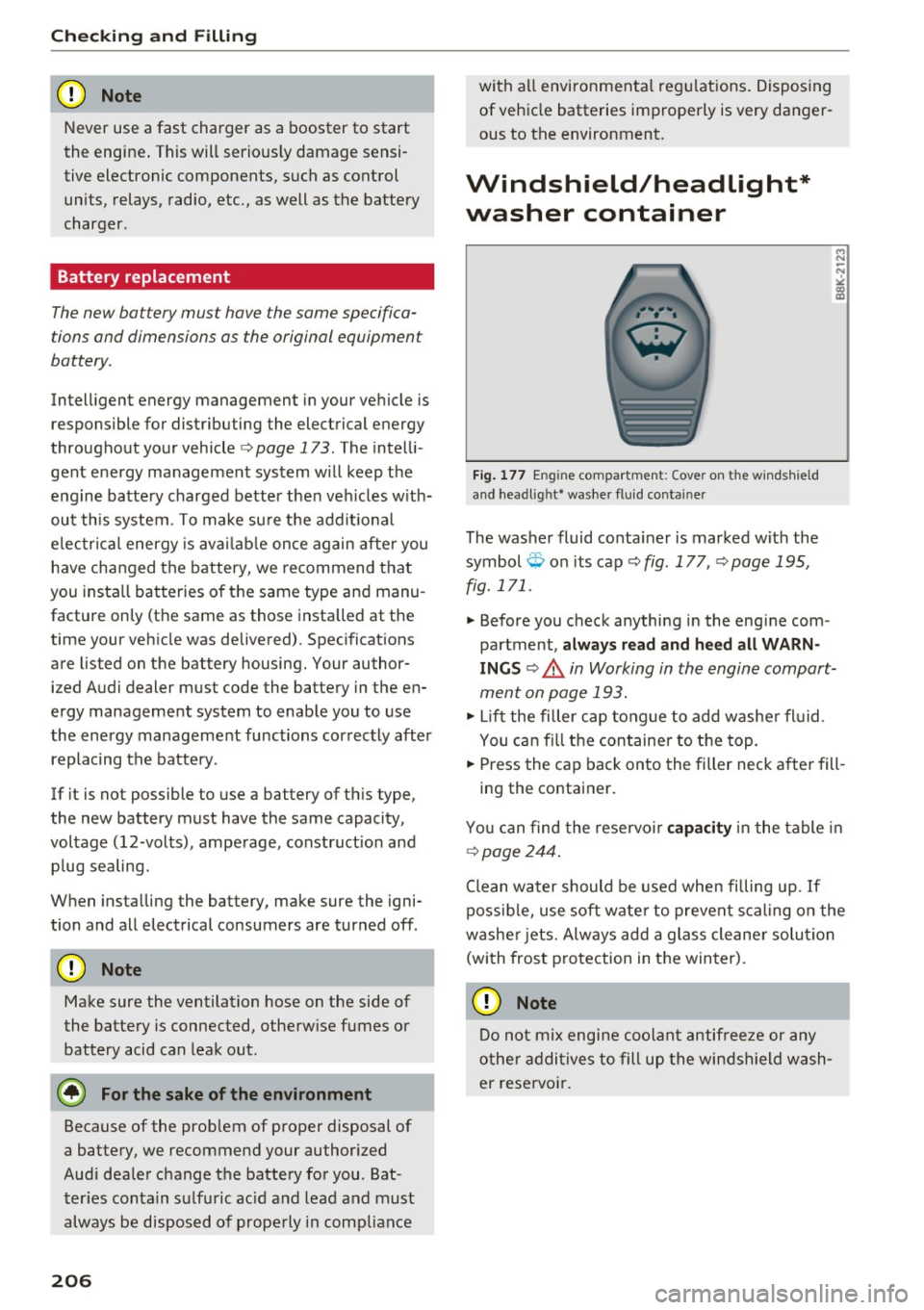
Fig. 177 En gin e compar tment: Cove r on the w inds hield
a n d head lig ht* was he r flu id conta iner
The washer fluid co nta iner is marked with the
symbol
Q on its cap ~ fig. 177, ¢ page 195,
fig. 1 71.
M N
-N ,.:
"' m
.. Before you check anythi ng i n the engine com
partment,
always read and heed all WARN
INGS ¢ .& in Working in the engine compart
ment on page 193.
.. Lift the fi ller cap to ngue to add w ashe r fl uid .
You c an f ill the containe r to t he top .
.. Press the ca p back on to the filler neck a fte r fill -
ing the contai ner.
Yo u c an find the reservo ir
capacity in t he table in
~page 244.
Clean water should be used when filling up . If
possible, use soft wate r to preve nt scaling on the
w ashe r jets. Alw ays add a glass cleane r solu tion
(wi th fros t protection in the win ter) .
@ Note
Do n ot mix engi ne coolan t antifree ze or any
o the r ad ditive s t o fill u p the wi ndshi eld wash
er reservo ir.
Page 209 of 266
CX)
CX)
-N ,.._ N
-0
0 l,L
CX)
Wheels
Wheels and Tires
General information
.,.Check your tires regularly for
damage (punctures, cuts, cracks
and bulges). Remove foreign ob
jects from the tire tread.
.,. If driving over curbs or similar
obstacles, drive slowly and ap
proach the curb at an angle.
.,.Have faulty tires or rims re
placed immediately.
"'Protect your tires from oil,
grease and fuel.
.,.M ark tires before removing
them so that the same running
direction can be maintained if
they are reinstalled.
"'Lay tires flat when storing and
store them in a cool, dry location
with as little exposure to light as
possible.
(D Note
-Please note that summer and
winter tires are designed for
the conditions that are typical in those seasons. Audi recom
mends using winter tires dur
ing the winter months. Low
temperatures significantly de crease the elasticity of summ
er tires, which affects traction
Wheels
and braking ability. If summer
tires are used in very cold
temperatures, cracks can form
on the tread bars, resulting in
permanent tire damage that
can cause loud driving noise
and unbalanced tires.
-Burnished, polished or
chromed rims must not be
used in winter driving condi
tions. The surface of the rims
does not have sufficient corro
sion protection for this and
could be permanently dam aged by road salt or similar
substances.
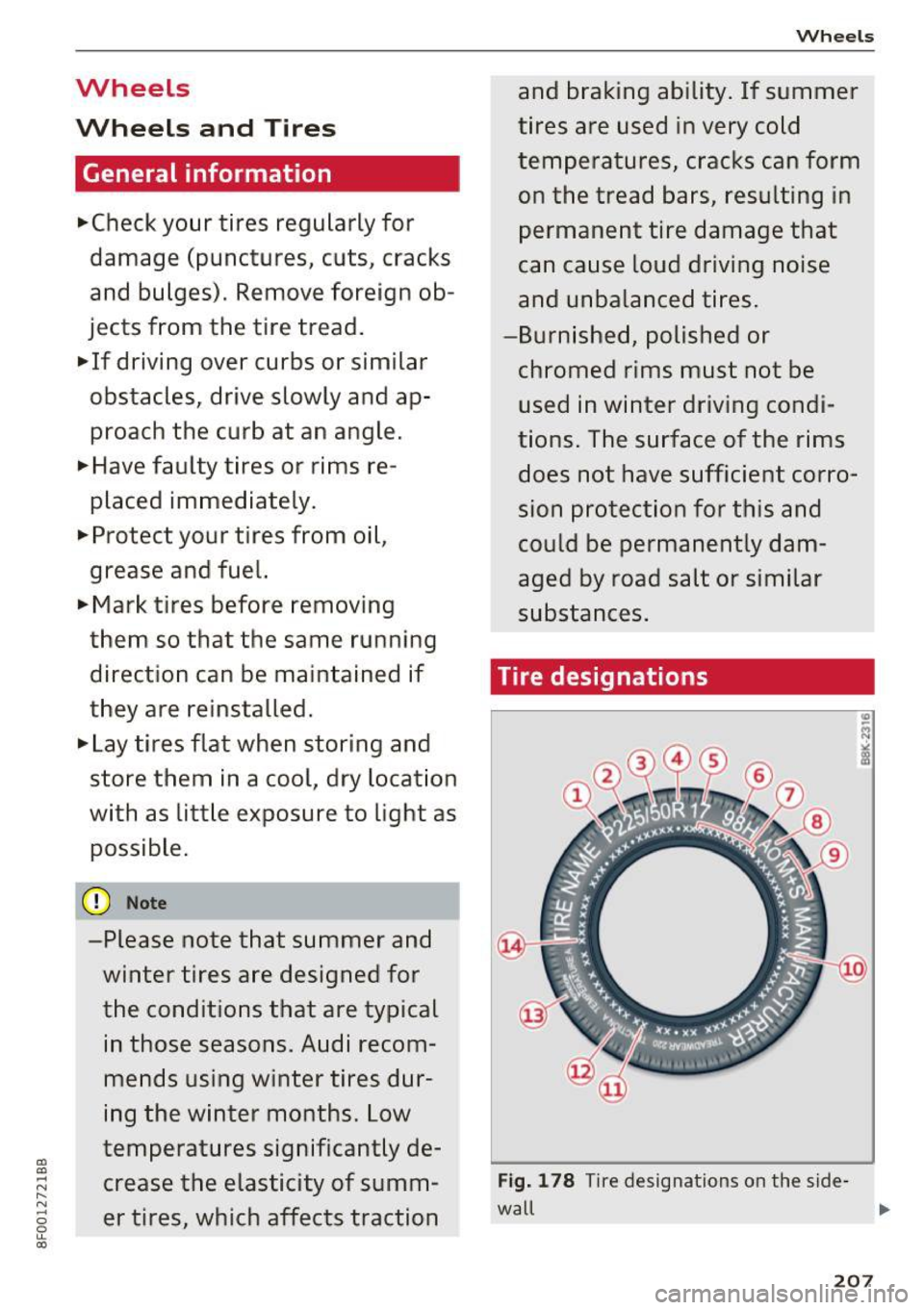
Tire designations
Fig. 178 T ir e designations on the side -
wall Ill>
207
Page 227 of 266

a:,
a:,
...... N r--. N ...... 0
0
LL 00
check your tires as soon as possible, and inflate
them to the proper pressure. Driving on a signifi
cantly under-inflated tire causes the tire to over
heat and can lead to t ire failure. Under-inflation
a lso reduces fuel efficiency and tire tread life,
and may affect the vehicle 's handling and stop
p ing ability .
Please note that the TPMS is not a substitute for
proper tire maintenance, and it is the driver's re
sponsib ility to ma intain correct tire pressure,
even if under-inflation has not reached the level
to tr igger illum inat ion of the TPMS low tire p res
sure telltale.
Your veh icle has also bee n eq uipped w ith a TPMS
malfunct ion indicator to indicate when the sys
tem is not operat ing properly . The TPMS ma l
function ind icator is combined w ith the low tire
p ressure tellta le. Whe n the system detects a
malfunct ion, the te lltale will flash fo r approx i
mately one mi nute and then remain continuo usly
illuminated. This sequence will continue upon
subseq uent veh icle start-ups as long as the ma l
function ex ists .
When t he malfunction indicator is ill uminated,
the system may not be ab le to detect or signal
l ow tire press ure as intended. TPMS ma lf u nctions
may occur for a var iety of reasons, including the
installation of replacement or alternate t ires or
wheels on the vehicle that prevent the TPMS
from functioning properly . Always c heck the
TPMS malfunction telltale afte r rep lacing one o r
mo re t ires o r whee ls on your ve hicl e to e nsur e
th at t he replacement or al tern ate tir es and
wheels a llow the TPMS to con tinue to function
p roperly .
Wheel s
If the Tire Pressure Monitoring System
indicator appears
Applies to : vehicles wi th Tir e Pressure Monito ring Syste m
Th e tire pressure indicator in th e instrument
cluster informs you if the tire pressure is too low
or if there is a system malfunction.
Fi g. 182 Instrument cl uster: indic ator lig ht w ith message
U sing the ABS sensors, the t ire pressure monito r
i ng system compares the tire tread c ircumfer
ence and v ibration characterist ics of the ind ividu
al tires. If the press ure changes in one or more
t ir es, th is is indicated in the instrument cluster
display with an indica to r li gh t
IE and a message.
If only one tire is affected, the loc ation of tha t
t ir e will be indicated.
T he t ire press ures mus t be stored in the Infota in
me nt system again each time t he pr essures
c h ange (switching between parti al and full load
pressure) or afte r changing or replac ing a tire on
yo ur vehicle ¢
page 226 . The tire p ressure moni
toring system on ly monitors the tire pressure you
have stored. Re fer to the t ire pressure label for
the recommended t ire pressure for yo ur vehicle
r=> page217, fig.181.
T ire tread c irc umference and vibration character
istics can change and ca use a tire press ure warn
ing if :
- the tire pressure in one or more tires is too low.
- t he t ire h as str uctural damage.
- t he t ire w as re pla ce d or the t ire pressu re was
ch anged and it was no t store d ¢
page 226 .
- the spare tire* is i nstalled .
Indicator lights
IE Loss of pressure in at least one tire¢.& .
Check the tires and replace or repair if necessary .
IJJ,,
225
Page 228 of 266

Wheels
Check/correc t the p ress ures o f all four tires and
store the pressure again in the Infotainment sys
tem
¢ page 226.
mm (Ti re Pressure Moni to ring System) Tire
pressure: S ystem malfunction !.
Ifm:im appears
afte r switc hing the ignition on or whi le driving
and the
RI] i ndicator light in the instrument cl us
ter blinks for approximate ly one minute and then
stays on, there is system malfunction. Try to
store the correct tire pressures¢
page 226 . If
the ind icator light does tur n off or turns on again
after a short period of t ime, dr ive to an a uthor
ized Audi dealer o r autho rized Aud i Service Faci li
ty immedia tely to have the malfunct ion corre ct
ed .
A WARNING
- If the ti re pressu re indicator appears in the
display, reduce your speed immediate ly and
avoid any hard steering or braking maneu
vers. Stop as soon as possib le and check the
t ires and t heir pressure.
- The driver is responsib le for maintaining the
correct tire pressure. You must check the
t ire pressure regu larly .
- Under certain conditions (such as a sporty
dr iv ing style, winter cond itions or unpaved
roads), the tire pressure mo nitoring system
indicator may be delayed.
- Do not use run-flat tires on your vehicle. Us
ing them when not permitted ca n lead to
vehicle damage or accidents.
(D Tips
- The t ire pressure monitoring system can al
so stop work ing when there is an ESC mal
funct io n.
- Using snow chains may result in a system
malfunction.
- The t ires with the identification "AO" or
"RO" ¢
page 214 have been matched with
your Audi tire pressure monitoring system .
We recommend that you use these t ires.
226
· Storing tire pressures
Applies to: vehicles with Tire Pressure Mon itor ing System
If the tire pressure changes or a tire is replaced,
it must be confirmed in the Infotainment sys
tem .
.. Make sure before stor ing that the t ire pressures
of all four tires mee t the specified values and
are adapted to the load ¢
page 217 .
.. Switch the ignit io n on .
.. Sele ct: the
I CARI fu nct ion button > Tire pres
s ure monitoring
cont rol button. O r
.. Select: the
I CAR I fun ct ion but ton > Car Sys
tem s*
control b utton > Service & check s > Tire
pressure monitoring.
(D Tips
Do not store the tire pressures if snow chains
are installed .
Page 231 of 266

always fully set the parking brake and block
the wheel diagonally opposite the wheel be ing changed with the folding chocks or oth
er objects. When one front wheel is lifted
off the ground, placing the Automatic
Transmission in "P" (Park) will
not prevent
the vehicle from moving.
- Before you change a wheel, be sure the
ground is level and firm. If necessary, use a
sturdy board under the jack.
- Always store the vehicle tool kit, the jack*
and the replaced tire in the luggage com
partment
r::!>page 116.
(D Note
If you are changing the wheel on a steep in
cline, use a rock or similar object to block the
opposite wheel to prevent the vehicle from
moving.
(D Tips
Obey all laws.
Changing a wheel
When you change a wheel, follow the sequence
described below step-by-step and in exactly that
order.
1.
Remove the decorative wheel cover* or the
wheel bolt caps*. For more details see also
r::!> page 229, Decorative wheel covers or
r::!> page 230, Wheels with wheel bolt caps .
2. Loosen the wheel bolts~ page 230.
3. Locate the proper mounting point for the
jack and align the jack below that point
r::!> page 2 31.
4. lift the car with the jack r::!> page 231.
5. Remove the wheel with the flat tire and then
in stall the
spare tire r::::> page 232.
6. Tighten all wheel bolts lightly .
7 .
lower the vehicle with the jack.
8 . Use the wheel bolt wrench and
firmly tighten
all wheel bolts in a crisscross pattern
r::!> page 230.
~ 9. Replace the decorative wheel cover* or the ......
~ wheel bolt caps*. N ...... 0
0
LL co
Emergency assistance
A WARNING
-Always read and follow all WARNINGS and in-
formation
r::!> .&. in Raising the vehicle on
page231
and r::::> page233.
After changing a wheel
A wheel change is not complete without the do
ing the following.
.. Always store the vehicle tool kit, the jack*, and
the replaced tire in the luggage compartment
r::::>page 116.
.. Check the tire pressure of the spare tire as soon
as possible .
.. As soon as possible, have the
tightening tor
ques
on all wheel bolts checked with a torque
wrench. The correct tightening torque is 90 ft
lbs .
(120 Nm).
.. Have the flat tire
replaced as soon as possible.
@ Tips
-If you notice that the wheel bolts are cor
roded and difficult to turn while changing a
tire, they should be replaced before you
check the tightening torque.
- Drive at reduced speed until you have the tightening torques checked.
Decorative wheel covers
Applies to: vehicles wit h deco rative w heel covers
The decorative wheel covers must be removed
first to access the wheel bolts.
Fig. 18S C ha nging a wheel: removing the wheel cover
229
Page 233 of 266

Raising the vehicle
The vehicle must be li~ed with the jack first be
fore the wheel can be removed .
Fig. 188 S ill panels: markings
Fig. 189 Sill: posit ion ing th e vehicle jack
The location of the jack point is indicated by an
indentat ion on the underside of the vehicle
c::> fig. 188.
;:;; N 0 u. a, ID
~ Activate the parkin g brake to p reve nt the vehi
cle from roll ing unintentionally.
~ Move the selector lever to position P.
~ Find the m ark in g (imprint) on the sill that is
nearest the wheel that will be changed
<=> fig . 188. Behind the marking, there is a lift
i ng p oint on the sill for the vehicle jack .
~ Turn the ve hicle ja ck located under the lifting
po int on the s ill to ra ise the jack until the jaw
<=> fig. 189 @cove rs the n o tch on the vehicle
Q ,& c::>0 .
~ Align the vehicle jack so the jaw @covers the
notch and the base plate @ is flat on the floor.
The base plate @ must be
vertical under the
lifting point @.
~ Install the rod on the vehicle jack: Insert the
; rod into the opening on the handwheel. Turn
~ the rod left or right to secure it. N .... 0
0
LL co
Emergen cy a ssis tanc e
~ Continue ra ising the jack with t he rod unti l the
wheel lifts off the ground slightly .
Pos ition the vehicle jack
only under the des igna t
ed lift ing points on the sill
c::> fig. 188. There is ex
actly
one l ocation for each wheel. The jack must
not be posit ioned at any ot her location
c::> &<=>CD .
Soft ground under the jack can cause the vehicle
to s lip off the jack. A lways p lace the jack on firm
ground . Use a f lat, stab le support if necessary .
Use a non-s lip surface such as a rubber mat on a
slipp ery s urface such as tile.
_& WARNING
--You or your passengers could be injured
while changing a wheel if you do not follow
these safety precautions:
- Position the vehicle jack only at t he des ig
nated lifting points and align the jack .
Otherwise, the vehicle jack could slip and
cause an injury if it does not have suffi
c ient hold on the vehicle.
- A soft or unstable surface under the jack
may cause the veh icle to slip off the jack.
Always provide a firm base for the jack on
the ground . If necessary, use a sturdy
board unde r the jack .
- On hard, slippery surface (such as t iles)
use a rubber mat or similar to prevent the
jack from slipping.
- To help prevent injury to yourse lf and your
passengers:
- Do no t raise the veh icle until you are sure
the jack is securely engaged.
- Passengers m ust not remai n in the vehicle
when it is jacked up.
- Make su re tha t passengers wait in a safe
place away from the vehicle and well away
from the road and traffic.
- Make s ure jack position is correct, adjus t
as necessary and t hen continue to raise
the jack .
(D Note
Do not lift the vehicle by the s ill. Pos ition the
vehicle j ack only at the des ignated lift ing
231
Page 234 of 266

Emergency assistance
points on the sill. Otherwise, your vehicle will
be damaged .
Taking the wheel off/installing the spare
tire
Follow these instructions step-by-step for chang
ing the wheel .
Fig. 190 Cha nging a wheel : usin g the screwdr iver handle
(with the b lade removed) to turn th e bo lts
Fig. 191 Chan gin g a wheel: align ment pin inside the top
h ole
After you have loosened all wheel bolts and
raised the vehicle off the ground, remove and re
p lac e the whee l as follows:
Removing the wheel
"' Remove the topmost wheel bolt completely
with the
hexagonal socket in the screwdriver
handle (vehicle tool kit)
¢fig. 190 and set it
aside on a
clean surface.
"' Screw the threaded end of the
alignment pin
from the tool kit hand -tight into the empty bolt
hole
r=;, fig . 191 .
"'Then remove the other wheel bo lts as described
above.
"' Take off the wheel leaving the alignment pin in
the bolt hole
r=;, (D.
232
Putting on the spare tire
"'Push the spare tire over the alignment pin.
"' Scr ew on the whee l bolts and tighten them
slightly using the hexagona l socket.
"' Remove the alignment pin and insert and tight
en the remaining wheel bolt slightly like the
rest.
"' Turn the jack handle counter-clockw ise to lower
the vehicle until the jack is fully released .
"' Use the wheel bolt wrench to tighten a ll wheel
bolts firmly ¢
page 230. Tighten them in a
crisscross pattern,
from one bolt to the (ap
proximate ly) opposite one, to keep the whee l
centered.
"' Perform the steps required after changing the
wheel
r=;, page 229, After changing a wheel .
The hexagonal socket makes it easier to remove
the wheel bolts from the rim. Care should be tak
en when removing the reversible blade.
(D Note
When removing or installing the wheel, the
rim could hit the brake rotor and damage the
rotor. Work carefully and have a second per
son to help you.
(D Tips
-When mounting tires with unidirectional
tread design
make sure the tread pattern is
pointed the right way¢
page 233.
-The wheel bolts should be clean and easy to
turn. Check for dirt and corrosion on the
mating surfaces of both the wheel and the
hub. Remove all dirt from these surfaces be
fore remounting the wheel.
- Do not use the hexagonal socket in the
screwdriver handle to loosen or tighten the
wheel bolts .