brakes AUDI A5 CABRIOLET 2017 User Guide
[x] Cancel search | Manufacturer: AUDI, Model Year: 2017, Model line: A5 CABRIOLET, Model: AUDI A5 CABRIOLET 2017Pages: 266, PDF Size: 66.64 MB
Page 93 of 266

a:,
a:,
...... N
" N ...... 0
0
LL co
Audi ada pti ve c ruise contr ol and br akin g gu ard
tachometer @and is also shown briefly in the
display @¢
fig. 10 7.
Switching Audi adapti ve c ru is e control off
~ Push the lever away from you into position @
un til it clicks into place. The message
AC C off
appea rs.
@ Indic ator lights
II -Adapt ive cru ise control is switched on . No
vehicles are detected up ahead . T he stored speed
is ma inta ined .
• -A moving vehicle is detected up ahead . T he
adapt ive cruise control system regulates the
speed and distance to the moving vehicle ahead
and accelerates/brakes automatically.
• -When automatic braking is not able to keep
enough d ista nce to a previo usly detected moving
vehicle up ahead, you must take contro l and
brake ¢
page 93, Request for driver interven
tion .
© Displa y
If adaptive cruise control is not shown in the dis
play, you can call it up with the
I RES ET I button
¢ page 21.
Based on the symbols in the display, you can de
termine if the system is ma inta ining a distance to
the vehicle ahead and what that distance is .
N o v ehicl e -No vehicle ahead was detected.
W hite vehi cle -A veh icle ahead was detected .
Red vehi cle -Prompt for the driver to take action
¢ page 93.
Both arr ow s on the sc ale © indicate the distance
to the veh icle ahead. No arrow appears when the
vehicle is on an open road and there is no object
ahead .
If an object is detected ahead, the arrow
moves on the scale.
The green zone on the scale shows the stored dis
tance . For informa tion on changing the stored
d ista nce, refer to ¢
page 92. If the distance se
lected is too close or may soon become too close,
the arrows move into the red zone on th e scale .
A WARNING
Improper use of the adaptive cruise control
can cause collisions, other accidents and seri
ous personal injuries .
- Press ing the
ISETI button when driving at
speeds below 20 mph (30 km/h) , will auto
matica lly acce lerate the veh icle to 20 mph
(30 km/h), wh ic h is the minimum speed
that c an be set.
a) Tips
- If you switch the ignition or the adaptive
cruise control off, the set speed is erased
from the system memory .
- The electronic stabilization control (ESC)
and the anti-slip-regulation (ASR) are auto
matically turned on when the adaptive
cruise control is t urned on . Both systems
cannot be turned off if the adaptive cru ise
control is turned on.
Changing the speed
Appl ies to: vehicles wi th Audi ada ptive c ruise con trol
0
f
•
0
Fi g. 108 Se lector leve r: c han gin g the speed
~ To increase or reduce the speed in increments,
ta p the lever up or down.
~ To increase or reduce the speed q uickly, h o ld
the lev er up or down until the red LED @ reach
es the des ir e d speed
¢ pag e 90, fig. 107.
Following any changes , the new stored speed will
be displayed briefly in the display@¢
page 90,
fig. 107 .
91
Page 96 of 266

Audi adaptive cruise control and braking guard
Audi braking guard
Description
Applies to: vehicles w ith Audi adaptive cruise co ntro l
Fig. 112 Instrument cluster : approac h warning
Braking guard uses a radar sensor. It also func
tions within the limits of the system when adap
tive cruise control is switched off.
What can Audi braking guard do?
When detected in time, the system can assess
situations when a vehicle ahead brakes suddenly
or if your own vehicle is traveling at a high speed
and approaching a vehicle up ahead that is mov
ing more slowly. Braking guard does not react if
it cannot detect the situat ion.
The system advises you of various situations:
- The
distance warning is given if you are too
close to the vehicle ahead for a long time. If the
vehicle ahead brakes sharply, you will not be
able to avoid a collision. The indicator light .
in the display comes on.
- The
approach warning is given when a detected
vehicle up ahead in your lane is moving much
more slowly than you are or if it brakes sharply.
When this warning is given, it may only be pos
s ible to avoid a collision by swerving or braking
sharply. The indicator light . will warn yo u
about the danger¢
fig. 112. You will also hear
an acoustic signal.
If you do not react fast enough or do not react at
a ll to the situation, Braking guard will intervene
by braking and the message
braking guard inter
vention
will appear.
l) This is not ava ilab le in some countries.
94
- If a collision is imminent, the system will first
provide an
acute warning by briefly and sharply
app lying the brakes.
- If you do not react to the acute warning, brak
ing guard can brake within the limits of the sys
tem. This reduces the vehicle speed in the event
of a collis ion.
- At speeds under 20 mph (30 km/h), the system
can initiate a complete deceleration shortly be
fore a collision ll.
- If the braking guard senses that you are not
braking hard enough when a collision is immi
nent, it can increase the braking force.
Which functions can be controlled?
You can switch braking guard and the distance/
approach warning on or off in the radio or MMI
¢ page 95, Settings in the radio/MM!.
A WARNING
Lack of attent ion can cause collisions, other
accidents and ser ious personal injuries. The
braking guard is an assist system and cannot
prevent a collision by itself . The driver must
always intervene. The driver is always respon
sible for braking at the correct time .
- Always pay close attention to traffic, even
when the braking guard is switched on. Be
ready to intervene and be ready to take
complete control whenever necessary. Al
ways keep the safe and legal distance be
tween your vehicle and vehicles up ahead .
- Braking guard works within limits and will
not respond outside the system limits, for
examp le when approach ing a stopped vehi
cle or stationary obstacle (end of a traffic
jam or vehicle that has broken down in traf
fic).
- Always remember that the radar sensor for
the braking guard works only within defined
detection and range limits that may prevent
the proper detection of other vehicles.
- The radar sensor's function and range can
be reduced by rain, snow and heavy spray.
Moving vehicles up ahead may not be
-
Page 172 of 266
Intelligent Technology
These electronic control modules record data
dur ing normal vehicle operation that may be
needed by trained technicians for diagnostic and
repair purposes. The recording capability of these
modules is l imited to data (no sound is record
ed). Only a small amount of data is actually re
corded over a very limited per iod of time, or stor
ed when a system fau lt is detected by a control
mod ule. Some of the data stored may re late to
ve hicl e speed, dire ct ion, or brak ing, as well as re
stra int system use and performance in the event
of a crash. Stored data can also only be read and
downloaded with special equipment that is di rectly connected to the veh icle.
@ Tips
Your vehicle may be equipped with Audi con
nect. Your use of certain Audi connect fea
tures requires wireless services that are pro
vided by a third party wire less te lecommuni
cations provider. For detai ls regarding how in
formation obtained through Audi connect is collected, processed, t ransmitted, used, and
shared, please see your contract with the
w ireless te lecommunica tions p rovider and the
"About Aud i connec t" tab in your vehi cle's
M M I:
!MENUI b utton> Audi connect > About
Audi conne ct.
Braking
What affects broking efficiency?
New brake pads
During the fi rs t 250 miles (400 km), new b rake
pads do not possess the ir full braking effect, they
have to be "broken in" first ¢.& . You can com
pensate for this s light ly reduced bra king power
by pushing harde r on the brake pedal. Avoid
heavy braking loads during the break-in period .
Operating conditions and driving habits
The brakes on today's automobiles a re st ill s ub
ject to wea r, depending la rgely on ope rating con
ditions and driving habits¢.&, . On vehicles that
are either dr iven most ly in stop-and-go city traf
f ic or are driven hard, the brake pads should be
checked by your authorized Aud i dea ler more of
ten than specified in the
War ranty & Mainte-
170
nance booklet . Failure to have your brake pads
inspected can result in reduced brake perform
ance.
On steep slopes, you should use the bra king ef
fect o f the engine. This way, you prevent unnec
essary wear on the brake system. If you must use
your brakes, do not ho ld the brakes down contin
uously. Pump the brakes at intervals.
Ope rating nois e
Noises may occu r when braking depen ding on the
speed, braking force and outside conditions such
as temperature and h umidity.
Effect of water and road salt
In certain si tuations, for examp le after d riving
t hr ough water, in heavy rain, after over nigh t con
densa tion or after washing your car, the brak ing
effect can be reduced by moisture or ice on the
brake rotors and brake pads . The brakes must be
dried f irst with a few careful brake app lications.
At higher speeds and w ith the windshield wipe rs
turned on, the brake pads press against the brake rotors for a short amount of time . This occurs at
regu lar intervals without the dr iver not icing and
provides for better brake response t ime under
wet cond itions .
The effectiveness of the brakes can be reduced
when the vehicle is driven on a salt-covered road
and the brakes are not used. Likewise, you clean
off accumulated salt coating from brake discs
and pads with a few caut ious applications of the
brake ¢.& .
Corrosion
There may be a tendency for dirt to build up on
the brake pads and corrosion to form on the discs
i f the car is not driven regularly or only for short
trips with little use of the brakes .
If the brakes are not used frequently, or if corro
s io n has formed on the discs, it is advisable to
clean off the pads and discs by braking firmly a
few times from a moderately high speed ¢ .& .
Page 173 of 266
a:,
a:,
...... N r--. N ...... 0
0
LL 00
Fa ults in the brake system
If yo u should notice a sudden increase i n brake
pedal travel, then one of the two brake circuits
may have failed
¢ .&. .
Low brake fluid level
Malf unct ions can occur in the bra ke system if the
b rake fl uid leve l is too low. The brake fluid level
i s monitored e lectronica lly .
Bra ke booste r
The brake booster increases the pressure that
you generate with the brake pedal.
It works on ly
when the engine is run ning
.¢ .&.
Bra ke lining we ar status
Brake lining wear may be checked by visual in
spection of the condition of the brake pads
through the open ings in the wheel. If necessary,
the wheel may be removed for this inspection
¢ page 228, Replacing wheels.
A WARNING
- New bra ke pads don't have the best stop
ping power and must be "bro ken- in" dur ing
the init ia l 250 m iles (400 kilometers). Yo u
can compensate for th is by press ing the
brake pedal more firmly. This a lso applies
later when new pads are installed.
- Yo u should perfo rm braking maneuvers for
the p urpose of clean ing the brake system
only if road conditions permit. Other road
users must not be put at risk -you may
cause an accident!
- Before descending a steep grade, reduce
speed and shift t ransm iss ion into a lower
gear or lowe r driving range. Do not ride the
brakes or hold the pedal down too long or
too often. This could ca use the brakes to get
hot and diminish brak ing efficie ncy.
- Do not "r ide t he b rakes" by resting your foot
on the pe dal when yo u do not inten d to
bra ke. This may cause the bra kes to over
heat, premat ure wear and increased stop
ping distance.
- Under certa in climatic and operating condi
tio ns such as passing thro ugh water, driving
in heavy rain or after washing the vehicle,
Intellig ent Technology
the effectiveness o f the brakes can be re
duced. In winter, ice can accum ulate on the
brake pads, lin ings, d iscs and drums . Care
fu lly apply brakes for a test . Brakes will dry
and ice coat ings will be cleaned off after a
few ca refu l brake applications .
- Driving for an extended period of t ime on
salt-covered roads without usi ng your
b rakes can also affect braking eff iciency.
Clea n off acc umul ated salt coat ing from
b rake discs an d pa ds w ith a few careful
b rake appli cat ions .
- I f you d amage the front spoile r, or if you in
s t all a different spoiler, be s ure the a ir flow
to the front brakes is not obstruc ted. Other
wise the brake system could overheat reduc ing the effectiveness of t he ent ire bra ke sys
tem.
- Fai lure of one brake circuit w ill impa ir the
braking capability resulting in an increased
stopping distance . Avoid driving the vehicle
and have it towed to the nearest authorized
Aud i dealer or qualified workshop.
- Never let the vehicle roll to a stop with the
engine shut off.
- If the brake booster is not working, the
brake pedal must be pressed cons iderab ly
ha rder to make up fo r the lack of booste r
assis tance .
Electro-mechanical
power assist, dynamic
steering
The electro-mechanical power assist helps the
driver when steering.
Power steer ing adapts electronically based on
the vehicle speed.
Indicator lights and messages
• Steering defe ctive! Do not drive vehicle!
If this indicato r light turns on and stays on and
t hi s message appears, the powe r steering may
have failed.
171
Page 177 of 266
a:,
a:,
...... N r--. N ...... 0
0
LL 00
Driving and the
environment
Breaking in
New engine
The engine needs to be run-in during the first
1,000 miles (1,500 km).
For the first 600 miles (1 ,000 kilometer s):
"' Do not use full throttle .
"' Do not drive at engine speeds that are more
than
2/3 of the max imum permitted RPM .
From 600 to 1,000 miles (1 ,000 to 1 ,500
kilometers):
"' Speeds can gradually be increased to the maxi
mum pe rm issib le road or engine speed .
During and after break-in pe riod
"' Do not rev the engine up to high speeds when it
is cold. This applies whether the transmission is
in N (Neutral) or in gear .
After the break-in period
"'Do not exceed maximum engine speed under
any c ircumstances.
"'U pshift into the next higher gear
before reach
ing the red area at the end of the tachometer
sca le
c=>page 8.
During the first few hours of driving, the eng ine's
internal friction is higher than later when all the
mov ing parts have been broken in . How well this
b reak-in process is done depends to a considera
b le exte nt on the way the veh icle is d rive n during
t he first 1,000 miles (1,500 kilometers).
(D Note
Extremely high eng ine speeds a re au toma ti
cally reduced. However, these rpm limits are
programme d for a n engine well run-in, not a
new engine.
@) For the sake of the environment
D o not dr ive with u nnecessari ly high eng in e
spee ds -ups hifting ea rly saves fuel, reduces
noise and pro tec ts the envi ronme nt .
Driving and the envir onment
New tires
If your vehicle is runn ing on new tires, d rive very
car efu lly fo r the firs t 35 0 miles (500 kilometers)
a ft er fit ting.
New tires tend to be slippe ry and must a lso
be "bro ken-in". Be sure to remembe r th is dur
i ng the fi rst 350 m iles (500 kilometers).
Brake gent ly. Avoid following closely behind
other vehicles or other s ituations that m ight
r equire sudden, hard b raking.
Avoid damaging the
vehicle
When yo u are dr iv ing o n poor roa ds, or over
cur bs, stee p ramps, e tc., ma ke cert ain that low
ly ing parts s uch a s spo ile rs a nd exh aust sy stem
parts do no t bottom o ut and get dama ged.
T his is espec ially true for ve hicles with low-s lung
c h ass is (sports c hass is) * and fully loaded
vehicles.
Driving through water on
roads
Note t he following to avoi d ve hicle damage w hen
driv ing through water, for examp le on flooded
roads:
- The water must not be any hig her t han the bot
tom of the vehicle body.
- Do not dr ive faste r than walk ing speed.
A WARNING
= -
Afte r driv ing th ro ugh water, m ud, slush, etc .,
the brakes may be slow to take effect beca use
of wet brake rotors and pa ds. Dry the brakes
f irst by braking carefully to restore the full
b raking effect.
(D Note
Ve hicle compone nts such as the engine,
transmission, suspension o r electrica l system
can be severely damaged by driving throug h
water.
Iii>
175
Page 179 of 266
a:,
a:,
...... N r--. N ...... 0
0
LL 00
on necessary precautions e.g. co rrosion preven
tion, maintenance and storage . Pay attention to
addit ional information concerning the battery .
Refer to
¢ page 203 .
Economical and environ
mentally-friendly driving
General
Your personal style of driving will determine the
economy of your vehicle, as well as exhaust and
noise levels.
F ue l economy, environmenta l impact, and we ar
on your engine, brakes and tires la rgely depend
on three factors :
- you r persona l dr iving sty le
- operating conditions
- technical lim itations
If you anticipate what you need to do next and
drive economically, you can eas ily cut your fue l
consumption by
10-15 percen t. This section will
g ive you some tips on how you can help the envi
ronment and yo ur pocketbook .
(!) Tips
The consumpt ion estimates as published by
ENVIRONMENTAL PROTECTION AGENCY (EPA) and Transport Canada may not cor re
spond to your actual consumption on the
road, which will va ry depending upon vehicle
load and speed, road and wea ther condi tions,
t rip length, etc.
Drive smoothly and keep a lookout ahead
Vehicles use the most fuel when they are acceler
ating.
" Avoid unnecessary accelerating a nd braking .
Veh icles use the most fuel when they are acceler
ating . If you anticipate what is going to happen
next , you will need to brake less and, thus, accel
e rate less . let the vehicle coast wheneve r possi
b le -fo r example when yo u see that the next traf
fic light is red.
Driving and the envir onment
Avoid full throttle
Driving at moderate speeds saves fuel and im
proves your mileage .
"Try and keep well below your car 's maximum
speed.
Acce lerating gently reduces fuel consumption,
engine wear, and does not disturb the environ
ment.
Fuel consumption, exhaust emissions and engine
noise increase disproport ionately at high speeds.
If you drive at approximately three quarters of
top speed, fuel consumption will be reduced by
one half. Never drive faster than the posted
speed limit and weather cond itions permit .
Reducing unnecessary idling
Even when your car is jus t idling it burns up fuel.
" Shut the eng ine off when you are not driving
the vehicle.
" Do not warm up the vehicle by lett ing the en-
gine run at idle.
It makes sense to shut off the engine in traffic
jams, when waiting for trains to pass at railroad cross ings, or at traff ic lights that have long waits
on red . Turning the engine off for just
30 -40 sec
onds saves more f uel than is burned starting the
. . engine again.
It takes a long time for the eng ine to warm up
fully when it is running at idle . However, wear
and noxious emissions are especially h igh when
the engine is warming up . So yo u should dr ive
away as soon as you start the eng ine and avoid
runn ing at high rpms w hile the engine is st ill
warming up .
(D Note
Do not leave eng ine idling unattended after
s tart ing. If wa rning lights sho uld come on to
i ndicate improper operation, they would go
unheeded . Extended idling also prod uces
heat, which could resu lt in overheating or
other damage to the vehicle or other proper
ty .
177
Page 181 of 266

Trailer towing Driving with a trailer
General information
Your Audi was designed primarily for passenger
transportation .
If you plan to tow a trailer, please remember that
the additional load will affect durability, econo
my and performance.
Trailer towing not only places more stress on the
vehicle, it also calls for more concentration from
the driver.
For this reason, always follow the operating and
driving instructions provided and use common
sense.
Technical requirements
Trailer hitch
Use a weight-carrying hitch conforming to the
gross trailer weight. The hitch must be suitable
for your vehicle and trailer and must be mounted
securely on the vehicle's chassis at a technically
sound
location . Use only a trailer hitch with a re
movable ball mount . Always check with the trail
er hitch manufacturer to make sure that you are
using the correct hitch.
Do not use a bumper hitch.
The hitch must be installed in such a way that it
does not interfere with the impact -absorbing
bumper system . No modifications should be
made to the vehicle exhaust and brake systems .
From time to time, check that all hitch mounting
bo lts remain securely fastened.
When you are not towing a trailer,
remove the
tra iler hitch ball mount . This prevents the hitch
from causing damage shou ld your vehicle be
struck from beh ind ¢
,&. .
Trailer brakes
If your trailer is equipped with a braking system,
gi check to be sure that it conforms to all regula-......
~ tions . N ...... 0
0
LL 00
Trailer towing
The trailer hydraulic brake system must not be
directly connected to the vehicle's hydraulic
brake system ¢.&. .
Safety chains
Always use safety chains between your vehicle
and the trailer.
Trailer lights
T ra iler lights must meet all regulations . Be sure
to check w ith your author ized Audi dealer for cor
rect wiring, switches, and relays.
Mirrors
If you are unable to see the traffic behind you us
ing the regular outside mirrors, then you
must in
stall extended mirrors. It is important that you
always have clear vision to the rear.
,8. WARNING
-If a tra iler has electr ical brakes please note
that these bra kes are not activated by the
factory-fitted control unit -risk of accident!
- After removing the trailer hitch, do not
store it in your vehicle. In case of sudden
braking, the hitch could fly forward and in
jure you or your passengers.
Operating instructions
Maximum trailer weight
A trailer for your vehicle is limited to a typical
class 1 or class 2 trailer.
Trailer load distribution
Be sure the load in the trailer is held sec ure ly in
place to prevent it from shifting forward, back
ward or sideways.
Never allow a passenger to ride in a trailer¢.&.
in Driving instructions on page 180.
Engine cooling system
Towing a trailer makes the engine work harder . It
is important that the cooling system's perform
ance is up to the additional load . Make sure that
the cool ing system has enough fluid. .,..
179
Page 182 of 266
Trailer towing
Tire pr essure
When tow ing a tra iler, inflate the tires of yo ur
veh icle to the tire pressure listed under " Fu ll
load" on the label ¢
page 217. Inflate trai ler
tires to trai ler and tire manufacturers' specifica
tions.
Lights
The headlight settings should be chec ked with
the trailer attached before driving off . Check to
make sure both vehicle and trailer lights are
working properly.
Safety chains
Be s ure t railer safety chains are properly connect
ed from the trailer to the hitch on the vehicle .
L eave enough slack in the chains to permit turn
ing corners. When you install safety chains, make
sure they wi ll not drag on the road when you are
driving.
The chains shou ld cross under the trailer tongue
to prevent it from dropping in case of separation
from the hitch.
Driving instructions
Driving with a trailer always requires extra care
and consideration .
Weight distribution
Towing a loaded trailer with an empty car res ults
in a high ly unstable distribution of weight . If this
cannot be avo ided, drive at very low speeds on ly
to avoid the risk of losing steering control.
A "balanced" rig is easie r to operate and cont rol.
This means that the tow vehicle should be loaded
to the extent possible and permissible, while keeping the trai ler as light as possib le under the
circumstances . Whenever possible, transfer
some cargo to the luggage compartment of the
tow vehicle while observ ing tongue load requ ire
ments and vehicle loading considerat ions .
Spe ed
The higher the speed, the more difficult it be
comes for the driver to contro l the rig. Do not
drive at the maximum permiss ible speed. Reduce
your speed even more if load, weather or w ind
180
conditions are unfavorab le -particularly when
going downhi ll.
Reduce vehicle speed
immediate ly if the trailer
shows the slightest sign of sway ing.
Do not try
to st op the swaying by accele rating.
Observe speed limits. In some a reas, speeds fo r
vehicles towing tra ilers are lower tha n for regular
vehicles.
A lways apply brakes ear ly . When driving down
hill, shift into a lower gea r to use the engine
braki ng effect to slow the vehicle. Use of the
brakes alone ca n cause them to overheat and fa il.
Coolant temperature
The coolant temperature gauge¢ page 8 must
be observed carefully. If the needle moves close
to the upper end of the scale, reduce speed im
med iate ly and/or tu rn off the a ir cond itioner .
If the coolant temperatu re warning light . in
the instrument cluster starts flashing, p ull off
the road, stop and let the engine
idle for about
two minu tes to p revent heat build-up .
.&, WARNING
Anyone not properly res trained in a moving
vehicle is at a much greater risk in an acci
dent . Never let anyone ride in your car who is
not properly wear ing the restraints provided
by Aud i.
Trailer towing
information
Important to know
-
Your vehicle handles differently when towing a
trailer because of the addit iona l weight and dif
ferent weight distribution. Safety, performance
and economy will greatly depend on how careful
ly you load your tra iler and operate your rig.
Before you actually tow your trailer, pract ice
turning, stopping and backing up in an area away
from traffic. Keep pract icing u nti l you have be
come completely fam iliar w ith the way your vehi-
cle-tra ile r combination behaves and respo nds . .,.
Page 183 of 266
Backing up is difficult and requires practice.
Backing up with a trailer generally requires steer
ing action oppos ite to that when backing up your
vehicle without a trailer.
Maintain a greater distance between your vehicle
and the one in front of you. You wi ll need more
room to stop. To compensate for the tra iler, you
will need a larger than normal turning radius.
When passing, remember that you cannot accel
erate as fast as you normally would because of
the added load. Make sure you have enough room
to pass. After passing, allow plenty of room for
your trailer before changing lanes again.
Avoid jerky starts, sharp turns or rapid lane
changes.
@ Tips
- Do not tow a trailer during the break-in peri
od of your vehicle.
- If you tow a trailer, your Audi may require
more frequent maintenance due to the ex
tra load
~ page 246.
Parking on a slope
Do not pork on o slope with o trailer. If it cannot
be avoided, do so only ofter doing the following:
When parking:
" Apply the foot brake.
"Have someone place chocks under both the ve
hicle and the trailer wheels.
" With chocks in place, slowly release the brakes
until the wheel chocks absorb the load.
" Turn the wheels towards the curb.
" Apply the parking brake.
" Move the selector lever to P .
When restarting after parking:
" Apply the foot brake.
" Start the engine .
" Move the selector lever to D/S.
" Release the parking brake and slowly pull out
and away from the wheel chocks.
a:,
~ " Stop and have someone retrieve the wheel
~ chocks . N .... 0
0
LL 00
Trailer towing
(D Tips
If you move the selector lever of the automat
ic transmission to P before applying the park
ing brake and before blocking the wheels, you
may have to use more force later to move the
lever out of the P posit ion .
181
Page 204 of 266
Checking and Filling
Brake fluid
Checking brake fluid level
The brake fluid level can be checked with a quick
glance.
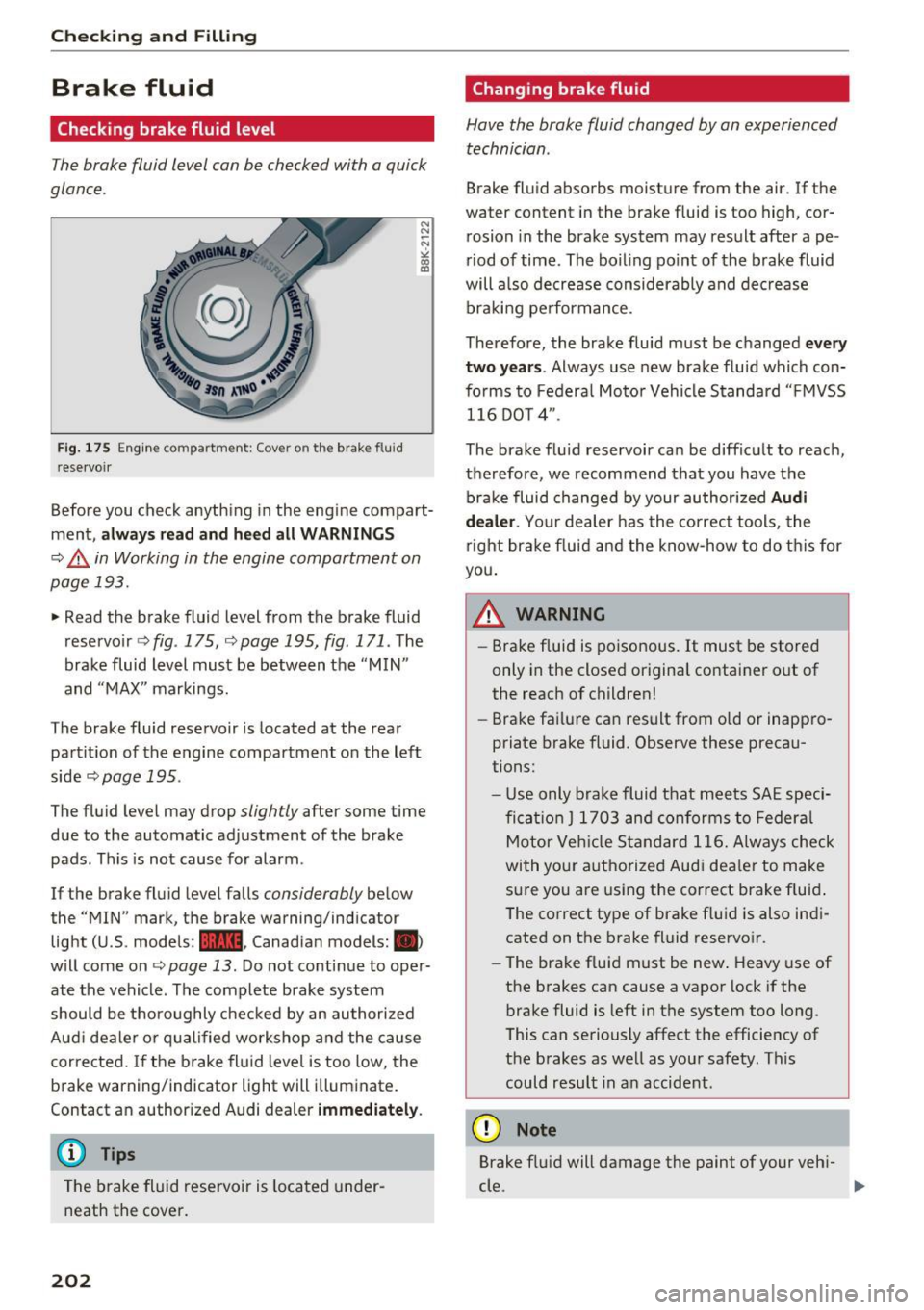
Fig. 175 Engine compartment: Cover on the brake fluid
r eservoir
Before you check anything in the engine compart
ment,
always read and heed all WARNINGS
¢ A in Working in the engine compartment on
page 193.
., Read the brake fluid level from the brake fluid
reservoir
<=> fig . 175, ¢page 195, fig . 171 . The
brake fluid level must be between the
" MIN"
and "MAX " markings.
The brake fluid reservoir is located at the rear
partition of the engine compartment on the left
side
¢ page 195.
The fluid level may drop slightly after some time
due to the automatic adjustment of the brake
pads . This is not cause for alarm .
If the brake fluid level falls
considerably below
the ' 'MIN" mark, the brake warning/indicator
light (U .S. models:
1111 , Canadian models: 1111)
will come on¢ page 13 . Do not continue to oper
ate the vehicle . The complete brake system
should be thoroughly checked by an authorized
Aud i dealer or qualified workshop and the cause
corrected . If the brake fluid level is too low, the
brake warning/indicator light w ill illuminate.
Contact an author ized Audi dealer
immediately.
(D} Tips
The brake fluid reservoir is located under
neath the cover.
202
Changing brake fluid
Have the brake fluid changed by an experienced
technician .
Brake fluid absorbs moisture from the air. If the
water content in the brake fluid is too high, cor
rosion in the brake system may result after ape
riod of time . The boiling po int of the brake fluid
will a lso decrease considerably and decrease
braking performance.
Therefore , the brake fluid must be changed
every
two years .
Always use new brake fluid which con
forms to Feder-al Motor Vehicle Standard "FMVSS
116 DOT 4 ".
The brake fluid reservoir can be difficult to reach ,
therefore, we recommend that you have the
brake fluid changed by your author ized
Audi
dealer .
Your dealer has the correct tools, the
right brake fluid and the know-how to do this for
you.
A WARNING
- Brake fluid is poisonous. It must be stored
only in the closed original container out of
the reach of children!
- Brake fai lure can result from o ld or inappro
priate brake fluid. Observe these precau
tions:
- Use only brake fluid that meets SAE speci
fi cation
J 1703 and conforms to Federal
Motor Veh icle Standard 116. Always check
with your authorized Audi dealer to make
sure you are using the correct brake f luid .
The correct type of brake f luid is also indi
cated on the brake fluid reservoir.
- The brake fluid must be new . Heavy use of
the brakes can cause a vapor lock if the
brake fluid is left in the system too long .
This can seriously affect the efficiency of
the brakes as well as your safety. This
could result in an accident.
(D Note
Brake fluid will damage the paint of your vehi-
cle .
lilJJ,