fuel AUDI A5 CABRIOLET 2017 User Guide
[x] Cancel search | Manufacturer: AUDI, Model Year: 2017, Model line: A5 CABRIOLET, Model: AUDI A5 CABRIOLET 2017Pages: 266, PDF Size: 66.64 MB
Page 28 of 266
Driver information system
If the light does not go out after the engine is
started, or illuminates whi le you are driving, a
malfunct ion may exist in the engine system. If
the light illuminates, the catalytic converter
could be damaged.
Continue driving
with reduced power (avoiding
sustained high speeds and/or rapid accelera
tions) and have the condition corrected. Contact
your authorized Audi dealer.
If the light illuminates, the electronic speed limiter may a lso be malfunctioning. For more infor
mation
c:> page 26, Electronic speed limiter.
An improperly closed fuel filler cap may also
cause the MIL light to illuminate
c:> page 190.
On-Board Diagnostics
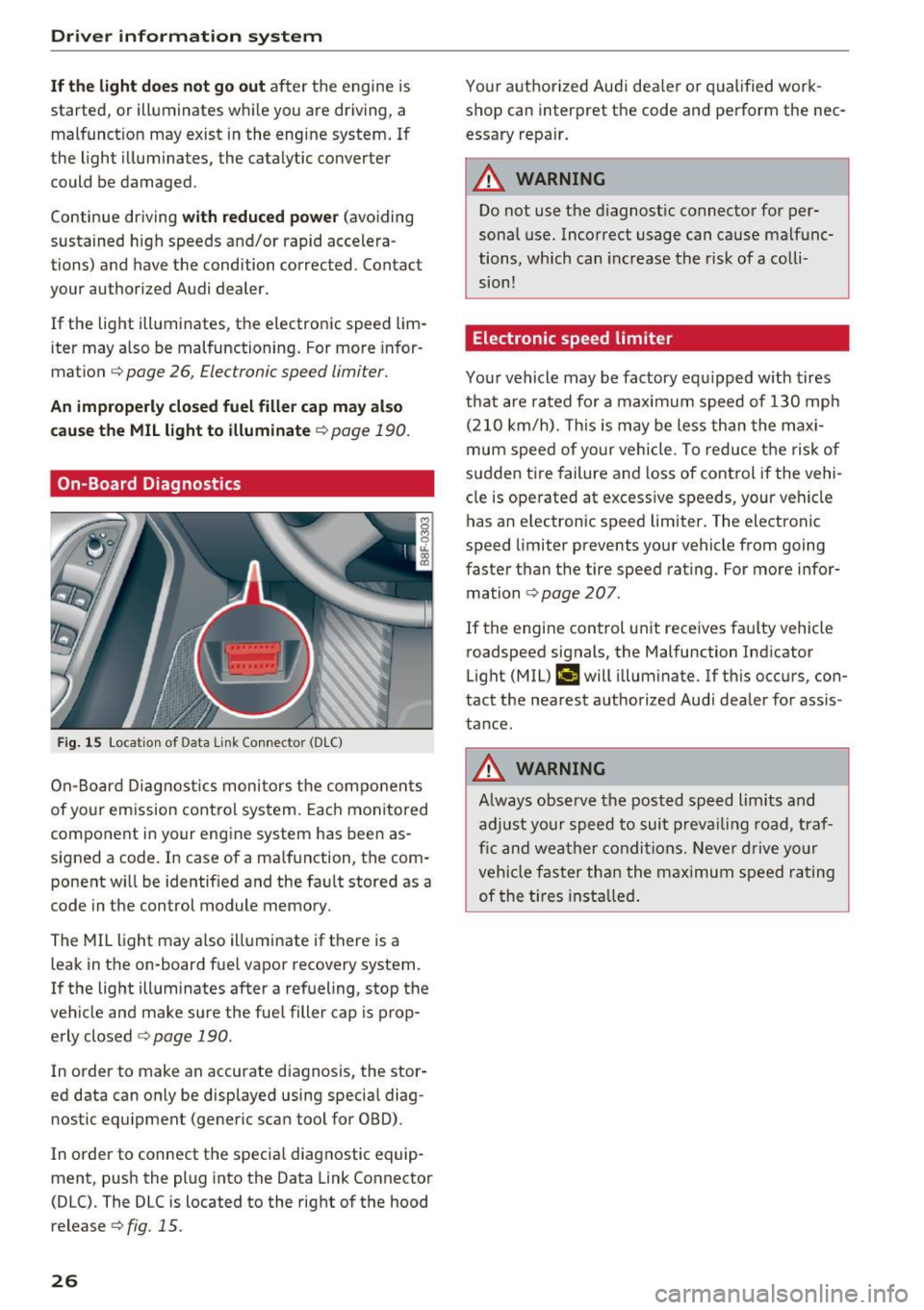
Fig. 15 Loca tion of Data Li nk Connector (D LC)
On-Board Diagnostics monitors the components
of your emission control system. Each monitored
component in your engine system has been as
signed a code . In case of a malfunction, the com
ponent will be identif ied and the fau lt stored as a
code in the control module memory.
The MIL light may also illuminate if there is a
leak in the on-board fuel vapor recovery system .
If the light illuminates after a refueling, stop the
vehicle and make sure the fue l filler cap is prop
erly closed
c:> page 190 .
In order to make an accurate diagnosis, the stor
ed data can only be displayed using special diag
nostic equipment (generic scan tool for OBD).
In order to connect the specia l diagnostic equip
ment, push the plug into the Data Link Connector
(DLC). The DLC is located to the right of the hood
release
c:> fig. 15.
26
Your authorized Audi dea ler or qual ified work
shop can interpret the code and perform the nec
essary repair.
_& WARNING
Do not use the diagnostic connector for per
sonal use. Incorrect usage can cause malfunc
tions, which can increase the risk of a colli
sion!
Electronic speed limiter
-
Your vehicle may be factory equ ipped w ith tires
that are rated fo r a maximum speed of 130 mph
(210 km/h). This is may be less than the maxi
mum speed of your vehicle. To reduce the risk of
sudden tire failure and loss of control if the vehi
cle is operated at excessive speeds , your vehicle
has an e lectronic speed limiter. The electronic
speed limiter prevents your vehicle from going
faster than the tire speed rating . For more infor
mation
c:> page 207.
If the engine control unit receives faulty vehicle roadspeed signals, the Malfunction Indicator
Light (MIL)
II will illuminate. If this occurs, con
tact the nearest authorized Audi dealer for ass is
tance .
_& WARNING
Always observe the posted speed limits and
adjust your speed to suit prevailing road, traf
fic and weather conditions. Never drive your
vehicle faster than the maximum speed rating
of the tires insta lled .
-
Page 30 of 266
Opening and clo sin g
- If the power locking system should fail, you
can still open the fuel tank flap in an emer
gency ¢
page 192.
-You are well advised not to keep val uables
inside an unatte nded vehicle, v is ible or not.
Even a properly locked vehicle cannot pro
v ide the security of a safe.
- If the LED in the upper edge of the driver's
door panel comes on for about 30 seconds
after t he vehicle is locked, there is a mal
funct ion in the power lock ing or the anti
theft warning system . Have the malf unct io n
cor rected by an authorized Audi dealership
or q ualified repair facility.
Key set
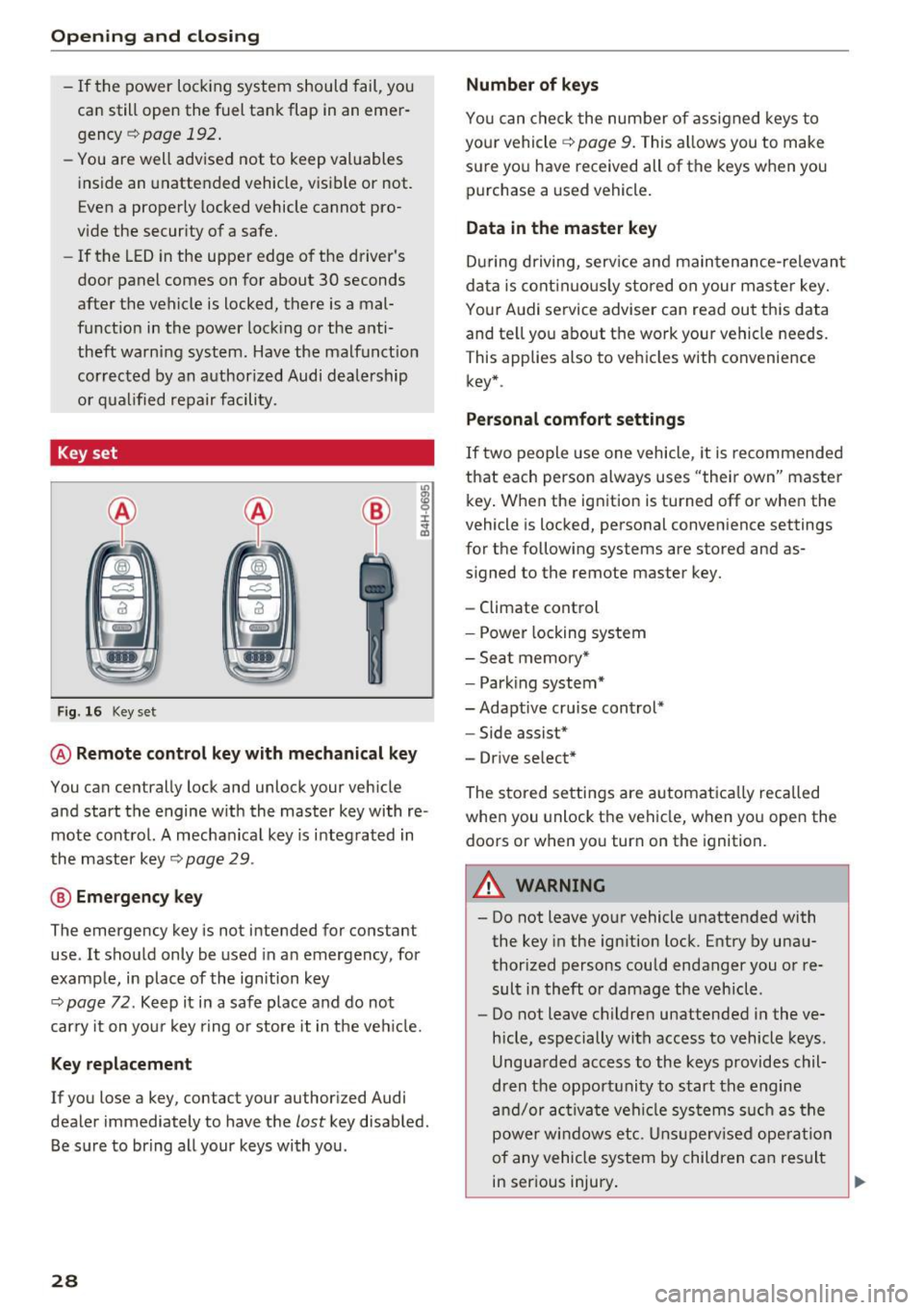
F ig . 16 Key set
m 0 ±
~
@ Remote control key with mechanical key
You can centrally lock and unlock your veh icle
and start the engine w it h the master key with re
mote cont rol. A mecha nical key is i nteg rated in
the master key¢
page 29.
@ Eme rgency key
The emergency key is not intended for constant
use . It shou ld only be used in an emergency, for
example, in place of the ign ition key
t:!:> page 72 . Ke ep it in a safe place and do not
car ry it on yo ur key r ing o r store it in the ve hicle.
Key replacement
If you lose a key, contact your author ized Audi
dealer immediately to have the
lost key disab led .
Be s ure to bring all your keys with you .
28
Number of keys
You can chec k the num ber of assigned keys to
your vehicle ¢
page 9. This allows you to make
sure yo u have received all of the keys when you
purchase a used vehicle .
Data in the master key
Dur ing driving, serv ice and maintenance-re levan t
da ta is cont inuous ly stored on your master key.
Your A udi service adviser can read out this data
and te ll yo u about the work your vehicle needs.
This applies also to veh icles with convenience
key *.
Personal comfort settings
If two people use one vehicle, it is recommended
that each person always uses "their own" maste r
k ey . W hen the ig nit ion is turned off or when the
vehicle is loc ked, personal conven ience settings
for the following systems are stored and as
s igned to the remote master key.
- Climate control
- Power locking sy stem
- Sea t memory *
- Park ing system*
-Adapt ive cr uise control*
- Side assist*
- Drive se lect*
The stored settings are a utomat ica lly rec alled
when you unlock t he vehicle, when yo u ope n the
doo rs or when yo u turn on the ignition.
A WARNING
- Do not leave you r vehicle unattended with
the key in the ignition lock. Entry by una u
thor ized persons could endanger you o r re
sult i n theft o r damage the vehicle .
- Do not leave childre n unattended in the ve
hicle, especially with access to vehicle keys .
Ungua rded access to the keys provides chil
dren t he opport unity to start the engine
a nd /or ac tiva te ve hicl e sys tems s uch as the
power wi ndows etc. Unsu perv ised ope ration
of any vehicle system by children c an res ult
in ser ious injury.
.
Page 68 of 266
Warm and cold
Warm and cold
Climate control system
Description
The climate control system warms, cools and
adds humidity to the air in the veh icle inter ior. It
is the most effective when the windows and pow
er top are closed. If there is a bui ld-up of heat in
side the vehicle, ventilation can help to speed up
the cooling process.
I n all heating mode functions except
defrost, the
b lower only switches to a higher speed once the
engine coolant has reached a certain tempera
ture .
Condensat ion from the cooling system can drip
and form a puddle of water under the veh icle.
This is normal and does not mean there is a leak.
P ollutant filt er
The pol lutant filte r removes pollutants such as
dust and pollen from the a ir.
The air pollutants filter must be changed at the intervals specif ied in your Warranty
& Mainte
nance booklet, so that the a ir cond it ioner can
properly work.
If you drive your vehicle in an area with high air pollut ion, the filter may need to be changed
more frequently than specified i n your Aud i War
ranty
& Maintenance booklet. If in doubt, ask
your author ized Audi Service Advisor for advice.
Ke y cod ed setting s
The climate control settings are automatically
stored and assigned to the remote control key
that is in use . These sett ings are different whe n
the powe r top is open or closed.
_& WARNING
Reduced visibility is dangerous and can ca use
accidents.
6 6
- For safe driving it is very important that all
w indows be free of ice, snow and condensa
tion.
- Completely familiarize yourself with the
proper use and function of the heating and
ventilation system and especially how to de
fog and defrost the windows .
- Never use the windshield wiper/washer sys
tem in freezing weather until you have
warmed the windshield first, using the heat
ing and vent ilation system . The washe r solu
tion may freeze on the windshield and re
duce visibility.
(U;) Note
- If you suspect that the air conditioner has
been damaged, sw itch the system off to
avoid furthe r damage and have it inspected
by a q ualified dealership .
- Repa irs to the Aud i air cond itioner requ ire
special techn ica l know ledge and spec ial
tools. Contact an a uthorized Audi dea ler fo r
assistance .
@ For the sake of the environment
By reduc ing the amo unt of fuel you use, you
a lso red uce the amount of pollutants emitted
into the air.
(D Tips
- Keep the a ir intake slots (in front of the
windshield) free from ice, snow and debr is
in order to maintain the proper function of
the climate control system .
- The energy managemen t sys tem may sw itch
the seat heating * or rear window defroster
off temporarily. These systems are available
again as soon as the energy balance has
been restored.
- Air escapes through vents under the rear
window. When placing items of clothing on
the luggage compartment cover, ensure
that the openings are not covered.
Page 71 of 266

a:,
a:,
...... N
l'
N
...... 0
0
LL co
the risk of injury, these individuals should
not use seat heating.
(D Note
To avoid damage to the heating elements in
the seats, do not kneel on the seats or place
heavy loads on a small area of the seat.
Setup
The basic climate control settings can be adjust
ed in the radio or MMI*.
.,. Select : I CAR I function button > A/C control but
ton. Or
.,. Select :
ICARI function button> Car systems*
control button > AC.
Automatic recirculation*
When switched on, automatic recirculation con
trols the recirculation mode automatica lly. If the
windows fog up, press the
I@ F RONT I button.
Synchronization*
When synchronization is switched on, the same
settings are applied to both the driver and front
passenger, except for the seat heating/venti la
tion* . Synchronization switches
off when you ad
just the settings on the front passenger's side .
You can also switch synchronization on by press
in g and holding the knob on the driver's side.
Supplementary heater
The supplementary heater warms the interior of
veh icles with flexible fuel engines more quickly .
The supplementary heater is controlled automat ically in the
Auto setting .
Warm and cold
Upper cabin heating
App lies to: vehicles with upper cab in heating
Fig. 84 Driver 's se a t: ve nt for upper c ab in heating
Fig . 85 D rive r's se at: upper cabin heating button
The upper cabin area of the front seats can be
heated at three levels when the engine is run
ning .
.,. Press the ~ button to switch the upper cabin
hea ting on . The LED illum inates.
.,. Press the~ button repeatedly until the LED
goes out to switch the upper cabin heating
off .
A WARNING
-Individuals w ith redu ced sensitivity to pain
or temperature could develop burns when
using the upper cabin heating. To reduce
the risk of injury, these individuals should
not use upper cabin heating.
- The output from the upper cabin heating
system may be very hot temporarily if the
air vents in the seats <=>
fig. 84 are covered
by clothing or other objects when the sys
tem is switched on. This can cause burns on
unprotected skin exposed directly to the
vents.
69
Page 83 of 266
Automatic transmission multitronic, S tronic,
tiptronic
Introduction
Applies to: vehicle s with multitronic/S tronic/tiptronic
The automatic transmission is cont rolled e lec
tronica lly. The transmission upshifts or down
shifts automatically depending on which drive program is selected.
When a
moderate drivi ng style is used, the
transmission selects the most economical driving
mode. It will then change up early and delay the
downshifts to give better fuel economy.
The transm ission switches to a sporty mode afte r
a kick -down or when the driver uses a
s po rt y
d riv ing sty le
characterized by quick accelerator
pedal movements, heavy acce leration, frequent
changes in speed and traveling at the maximum
speed.
If desired, the driver can also select the gears
manually { tip tron ic mode) 9 page 81.
Various automatic transmissions may be instal
led, depending on the model :
multitronic transmission
The multitronic transmission is a cont inuous ly
va riable t ransmiss ion. Power is transferred using
a mu ltidisk clutch. In contrast to conventiona l
automatic transmissions using shifting opera
tions, the transmission ratio in the continuous ly
variable transmiss ion is changed continuously.
This optimizes the comfort level and conserves
fuel.
S tr onic transmi ssion
The S tronic is a dua l-clutch transmiss ion . Power
is transferred using two clutches that work inde
pendently from one another. They replace the
torque converter used in conventional automatic
transmissions and allow the vehicle to accelerate
without a noticeable interruption in tract ion.
a:,
a:,
...... tip tron ic tran smis sion N r--.
~ In the tiptron ic transmission, power is transfer-
fi:' red by a torque converter. 00
Autom atic tran sm iss ion
Selector lever positions
Applies to: vehicles wit h mult itron ic/S tro nic/t iptronic
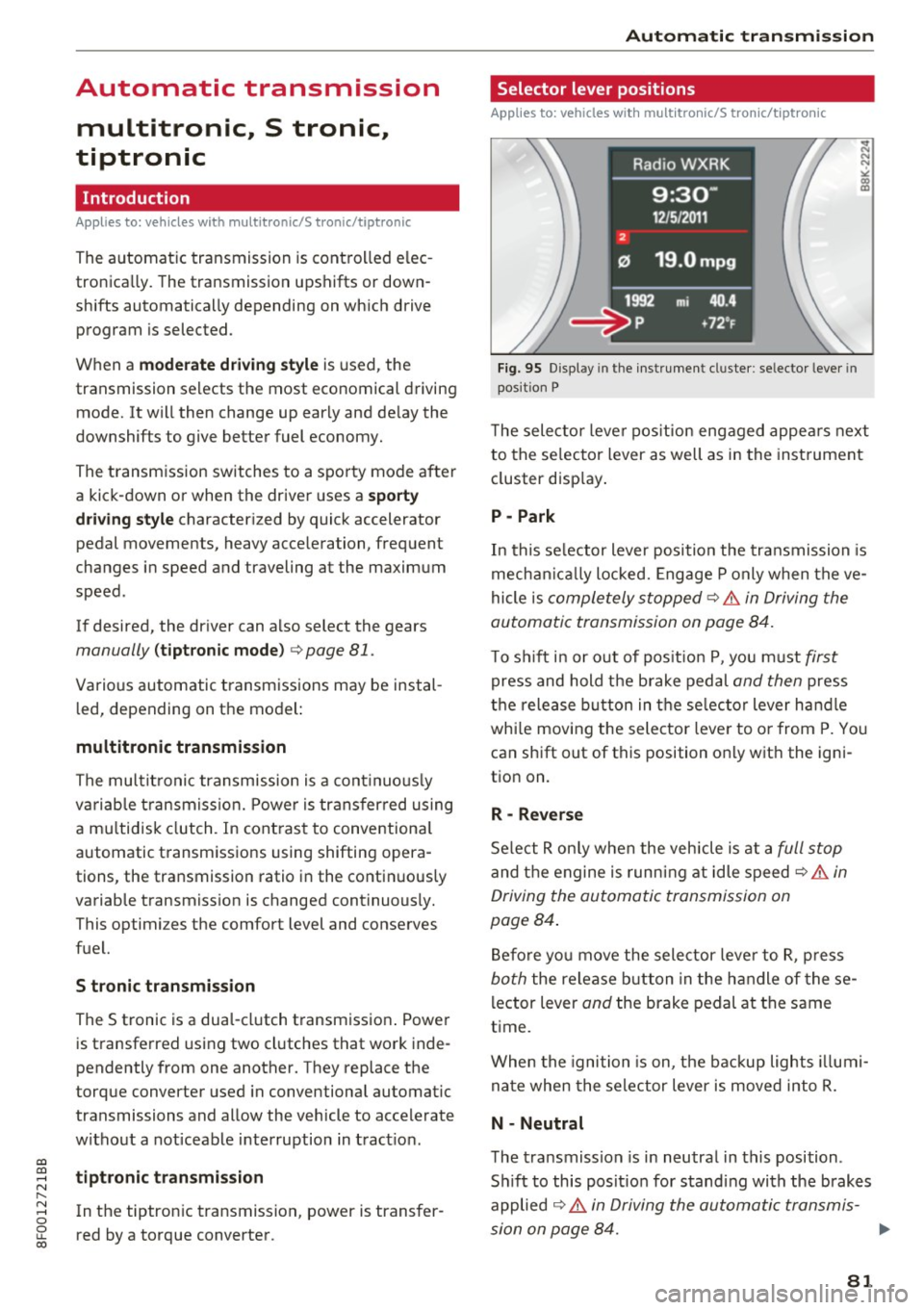
F ig. 95 Display in the instrument cl uste r: se lector lever in
posit ion P
T he selector leve r pos ition engaged appea rs next
to the se lector lever as well as in the instrument
cluster disp lay .
P -Park
In this se lector lever position the transmission is
mechan ica lly locked. Engage P only when the ve
hicle is
completely stopped~.&. in Driving the
automatic transmission on page 84.
T o s hift i n or out of pos it ion P, you must first
press and hold the brake pedal and then press
t h e release button in the se lec tor lever ha ndle
whi le mov ing the selector lever to o r from P. Yo u
can shift out of this position on ly with the igni
tion on.
R -Reverse
Se lect R on ly when the vehicle is at a full stop
and the engine is runn ing at idle speed C? .&. in
Driving the automatic transmission on
page 84 .
Before yo u move the selector leve r to R, p ress
both the release b utton in the handle of these
l ector lever
and the brake pedal at the same
time.
When the ignition is on, t he backup lights illumi
na te when the selector lever is moved into R.
N -Neutral
The transmiss ion is in neutral in this position .
S hi ft to this posit io n for standing with the brakes
applied
~ .&. in Driving the automatic transmis-
sion on page 84. ..,
81
Page 177 of 266
a:,
a:,
...... N r--. N ...... 0
0
LL 00
Driving and the
environment
Breaking in
New engine
The engine needs to be run-in during the first
1,000 miles (1,500 km).
For the first 600 miles (1 ,000 kilometer s):
"' Do not use full throttle .
"' Do not drive at engine speeds that are more
than
2/3 of the max imum permitted RPM .
From 600 to 1,000 miles (1 ,000 to 1 ,500
kilometers):
"' Speeds can gradually be increased to the maxi
mum pe rm issib le road or engine speed .
During and after break-in pe riod
"' Do not rev the engine up to high speeds when it
is cold. This applies whether the transmission is
in N (Neutral) or in gear .
After the break-in period
"'Do not exceed maximum engine speed under
any c ircumstances.
"'U pshift into the next higher gear
before reach
ing the red area at the end of the tachometer
sca le
c=>page 8.
During the first few hours of driving, the eng ine's
internal friction is higher than later when all the
mov ing parts have been broken in . How well this
b reak-in process is done depends to a considera
b le exte nt on the way the veh icle is d rive n during
t he first 1,000 miles (1,500 kilometers).
(D Note
Extremely high eng ine speeds a re au toma ti
cally reduced. However, these rpm limits are
programme d for a n engine well run-in, not a
new engine.
@) For the sake of the environment
D o not dr ive with u nnecessari ly high eng in e
spee ds -ups hifting ea rly saves fuel, reduces
noise and pro tec ts the envi ronme nt .
Driving and the envir onment
New tires
If your vehicle is runn ing on new tires, d rive very
car efu lly fo r the firs t 35 0 miles (500 kilometers)
a ft er fit ting.
New tires tend to be slippe ry and must a lso
be "bro ken-in". Be sure to remembe r th is dur
i ng the fi rst 350 m iles (500 kilometers).
Brake gent ly. Avoid following closely behind
other vehicles or other s ituations that m ight
r equire sudden, hard b raking.
Avoid damaging the
vehicle
When yo u are dr iv ing o n poor roa ds, or over
cur bs, stee p ramps, e tc., ma ke cert ain that low
ly ing parts s uch a s spo ile rs a nd exh aust sy stem
parts do no t bottom o ut and get dama ged.
T his is espec ially true for ve hicles with low-s lung
c h ass is (sports c hass is) * and fully loaded
vehicles.
Driving through water on
roads
Note t he following to avoi d ve hicle damage w hen
driv ing through water, for examp le on flooded
roads:
- The water must not be any hig her t han the bot
tom of the vehicle body.
- Do not dr ive faste r than walk ing speed.
A WARNING
= -
Afte r driv ing th ro ugh water, m ud, slush, etc .,
the brakes may be slow to take effect beca use
of wet brake rotors and pa ds. Dry the brakes
f irst by braking carefully to restore the full
b raking effect.
(D Note
Ve hicle compone nts such as the engine,
transmission, suspension o r electrica l system
can be severely damaged by driving throug h
water.
Iii>
175
Page 178 of 266
Driving and th e en vironm ent
(D Tips
- Check the depth of the water before driving
through it .
- Do not stop the veh icle, drive in reverse or
switch the engine
off when driving through
water.
- Keep in mind that oncoming vehicles may
create waves that raise the water level and
make it too deep for your veh icle to drive
through safely.
- Avoid driving through salt water because it
can cause corrosion.
Catalytic converter
It is very important that your emission control
system (catalytic converter) is functioning prop erly to ensure that your vehicle is running in an
environmentally sound manner .
~ Always use lead-free gasoline ¢ page 188,
Fuel supply .
~ Never run the tank down a ll the way to empty .
~ Never put too much motor oil in your engine
¢ page 19 7, 9::?l Adding engine oil .
~ Never try to push- or tow-start you r vehicle.
The cata lytic converter is an efficient "clean-up"
dev ice bu ilt into the exha ust system of the vehi
cle. The cata lytic conve rter burns many of the
pollutants in the exhaust gas before they are re
leased into the atmosphere.
The exclusive use of unleaded fue l is critica lly im
portant for the l ife of the catalytic conve rter and
p roper functioning of the engine.
A WARNING ,..____ -
- The temperature of the exhaust system is
high, both when driving and after stopping
the engine.
- Never touch the exha ust tail pipes once they
have become hot. This could result in burns.
- Do not park or ope rate t he vehicle in areas
where the hot exha ust system may come in
contact with dry grass, br ush, fue l spill or
other mater ial which can cause a fire.
- Do not apply additional undercoating or
rustproofing on or near the exhaust mani-
176
fold, exha ust pipes, cata lytic conve rter or
heat shields. D uring driving, the substance
used for undercoat ing could overheat and
cause a f ire.
Cl) Note
- Be aware that just one tank f illing wit h
leaded fu e l w ill already seriously degrade
the performance of the catalytic converter.
- Do not exceed the correct engine oil leve l
¢page 197.
-Do not drive until the fue l tank becomes
completely empty. The engine could mis
fire. Unbu rned fue l cou ld also get into the
exhaust system and this could cause the
catalytic converter to overheat.
- Do not turn off the ign ition while the vehicle
is moving .
- Do not continue to operate your vehicle un
der these conditions, as otherw ise fuel can
reac h the catalytic converter. T his could re
sult in overheat ing of the converter, requir
ing its replacement.
- T o ass ure eff icient operat ion of the Emis
sion Contro l System:
- Have you r vehicle maintained properly and
i n accordance wit h the service recommen
dations in your Warranty
& Ma intenance
booklet.
- Lack of proper ma intenance as well as im
p roper use of the veh icle will impa ir the
function of the emission control system
and could lead to damage.
(® For the sake of the environment
Even when the Emiss ion Control System is op
erating properly, t he exhaust gas can have a
sulfur-like exhaust gas smell under some op
erating states. Th is depends on the sulfur
content of the fuel being used. Us ing a d iffer
ent brand of fuel may help, or fi lli ng the tank
wi th lead-free super g rade gasoline.
Shutting down vehicle
If you wo uld like yo ur vehicle to remain inopera
tive for a longer pe riod of time, con tact an Audi
o r other spec ia liz ed dealer. They can adv ise you ..,.
Page 179 of 266
a:,
a:,
...... N r--. N ...... 0
0
LL 00
on necessary precautions e.g. co rrosion preven
tion, maintenance and storage . Pay attention to
addit ional information concerning the battery .
Refer to
¢ page 203 .
Economical and environ
mentally-friendly driving
General
Your personal style of driving will determine the
economy of your vehicle, as well as exhaust and
noise levels.
F ue l economy, environmenta l impact, and we ar
on your engine, brakes and tires la rgely depend
on three factors :
- you r persona l dr iving sty le
- operating conditions
- technical lim itations
If you anticipate what you need to do next and
drive economically, you can eas ily cut your fue l
consumption by
10-15 percen t. This section will
g ive you some tips on how you can help the envi
ronment and yo ur pocketbook .
(!) Tips
The consumpt ion estimates as published by
ENVIRONMENTAL PROTECTION AGENCY (EPA) and Transport Canada may not cor re
spond to your actual consumption on the
road, which will va ry depending upon vehicle
load and speed, road and wea ther condi tions,
t rip length, etc.
Drive smoothly and keep a lookout ahead
Vehicles use the most fuel when they are acceler
ating.
" Avoid unnecessary accelerating a nd braking .
Veh icles use the most fuel when they are acceler
ating . If you anticipate what is going to happen
next , you will need to brake less and, thus, accel
e rate less . let the vehicle coast wheneve r possi
b le -fo r example when yo u see that the next traf
fic light is red.
Driving and the envir onment
Avoid full throttle
Driving at moderate speeds saves fuel and im
proves your mileage .
"Try and keep well below your car 's maximum
speed.
Acce lerating gently reduces fuel consumption,
engine wear, and does not disturb the environ
ment.
Fuel consumption, exhaust emissions and engine
noise increase disproport ionately at high speeds.
If you drive at approximately three quarters of
top speed, fuel consumption will be reduced by
one half. Never drive faster than the posted
speed limit and weather cond itions permit .
Reducing unnecessary idling
Even when your car is jus t idling it burns up fuel.
" Shut the eng ine off when you are not driving
the vehicle.
" Do not warm up the vehicle by lett ing the en-
gine run at idle.
It makes sense to shut off the engine in traffic
jams, when waiting for trains to pass at railroad cross ings, or at traff ic lights that have long waits
on red . Turning the engine off for just
30 -40 sec
onds saves more f uel than is burned starting the
. . engine again.
It takes a long time for the eng ine to warm up
fully when it is running at idle . However, wear
and noxious emissions are especially h igh when
the engine is warming up . So yo u should dr ive
away as soon as you start the eng ine and avoid
runn ing at high rpms w hile the engine is st ill
warming up .
(D Note
Do not leave eng ine idling unattended after
s tart ing. If wa rning lights sho uld come on to
i ndicate improper operation, they would go
unheeded . Extended idling also prod uces
heat, which could resu lt in overheating or
other damage to the vehicle or other proper
ty .
177
Page 180 of 266
Driving and th e en vironm ent
Regular maintenance
A badly tuned engine unnecessarily wastes a lot
of fuel.
.,. Have your vehicle serviced at regular intervals.
By having your vehicle regu larly serviced by an
author ized Audi dealer he lps to ensure that it
runs properly and econom ically . The condition of
your veh icle not only affects its safety and ability
to hold its value, it also affects
fu el consump
tion .
C he ck your oil e ach t ime you fill you r ta nk .
The amount of oil used is re lated to engine load
and speed.
It is normal for the oil consumpt ion of a new en
g ine to reach its lowest val ue afte r a certa in mile
age has been driven .
You must d rive you r vehicle about 3 ,000 miles
(5,000 k ilome ters) before you can p roperly as
sess o il cons umption .
This a lso applies to fuel consumption and engine
outpu t.
(D Note
- Have your vehicle maintained properly and
in accordance with the service recommenda
tions in you r Warranty
& Maintenance book
l et . La ck of p roper main tenance as well as
i mproper use of the vehicle will impa ir the
f u nct ion of the emission control system and
could lead to damage.
- Do not al ter or remove any component of
the Emission Control System unless ap proved by the manufacturer.
- Do not a lter or remove any device, such as
heat shie lds, switches, ignition wires,
valves, which are designed to protect your
vehicle's Emission Control System and other i mportant vehicle components.
178 ·
Fewer short trips
Fuel consumption will always be relatively high
on short trips .
.,. Try to avoid driving short distances with a cold
eng ine .
T he eng ine and catalytic converter have to reac h
their opt imal
operating temper atu re to reduce
fuel consumpt ion and noxious emiss ions effec
tively .
Just after start ing, a cold engine in a mid-size car
on ly achieves a fuel economy of 6-8 miles per
gallon (30-40 l/100 km) . After about a half a
mile, fuel economy climbs to 12 mpg (20 l/100
km) . After about
2 .5 m iles (4 km), the engine is
at its proper operating temperatu re and fuel
economy has reached a no rma l level. So you can
see that you should avoid sho rt tr ips wheneve r
possible .
The
out sid e temperatur e is also cr it ica l in th is re
gard. Your car cons umes more fue l in the winter
than in the summer.
Page 186 of 266

Care and cleaning
Component Situation Solution
Power top
Deposits Clean water, power top cleaning product , if necessary .
C lean with the grain of the fabric using a soft brush and al-
low to air dry.
Wind deflector Deposits Water, mild soap solution,
if necessaryal
Decorative parts/ Deposits Mild soap solution a>, a cleaning solution suitable for stain-
Trim less stee l, if necessary
Carbon parts Deposits clean the same way as
painted parts~ page 182, Car
washes
Paint Paint damage Refer to the paint number on the vehicle data label, repair
with touch up paint~
page 243
Spilled fuel Rinse with water immediately
Surface rust Rust remover, then protect with hard wax; for questions,
consult an authorized Audi dealer or authorized Audi Se rv-
ice Facility .
Corros ion Have it removed by an authorized Aud i dealer or author -
ized Audi Service Fac ility .
Water no longer Protect with hard wax (at least twice per year)
beads on the surface
of clean paint
No shine even though Treat wit h suitable polish; then apply paint protectant if
paint has been pro- the polish that was used does not contain any protectant
tected/paint looks
poor
Deposits such as in- Dampen with water immediately and remove with a micro-
sects, bird droppings, fiber cloth
t ree sap and road salt
Grease-based con- Remove immediately with a mild soap solution a) and a
taminants such as soft cloth
cosmetics or sunb lock
a) M ild soap so lution: maxim um two ta bles poo ns o f neu tral soap in 1 quar t (l liter) of wat er
Interior cleaning
Component Situation Solution
Windows
Deposits Glass cleaner, then wipe dry
Decorative parts/ Deposits Mild soap solutiona >
trim
Plastic parts
Deposits Damp cloth
Heavier deposits Mild soap solution a>, detergent-free plastic clean ing solu-
tion, if necessary
Displays Deposits
Soft cloth with LCD cleaner
Controls Deposits Soft brush, then a soft cloth with a mild soap solutiona >
Safety belts Deposits Mild soap so lution a>, allow to dry before letting them re-
tract
184