seat adjustment AUDI A5 CABRIOLET 2017 User Guide
[x] Cancel search | Manufacturer: AUDI, Model Year: 2017, Model line: A5 CABRIOLET, Model: AUDI A5 CABRIOLET 2017Pages: 266, PDF Size: 66.64 MB
Page 156 of 266
Child safety
-When buying a child restraint, select one
that fits your child and the vehicle.
- Only use child restraint systems that fully
contact the flat portion of the seat cush
ion. The child restraint must not tip or
lean to either side. Audi does not recom
mend using child safety seats that rest on
legs or tube-like frames . They do not pro
vide adequate contact with the seat.
- Always heed all legal requirements per
taining to the installation and use of child
safety seats and carefully follow the in
structions provided by the manufacturer
of the seat you are using.
- Never allow children under 57 inches
(1.45 meters) to wear a normal safety belt.
They must always be restrained by a proper
child restraint system. Otherwise, they
could sustain injuries to the abdomen and
neck areas during sudden braking maneu
vers or accidents.
- Never let more than one child occupy a child
safety seat.
- Never let babies or older children ride in a
vehicle while sitting on the lap of another
passenger .
- Holding a child in your arms is never a sub
stitute for a child restraint system.
- The strongest person could not hold the
child with the forces that exist in an acci
dent. The child will strike the interior of
the vehicle and can also be struck by the
passenger.
- The child and the passenger can also in
jure each other in an accident.
- Never install rearward-facing child safety
seats or infant carriers on the front passen
ger seat. A child will be seriously injured and
can be killed when the passenger airbag in
flates -even with an Advanced Airbag Sys
tem .
- The inflating airbag will hit the child safe
ty seat or infant carrier with great force
and will smash the child safety seat and
child against the backrest, center arm
rest, door or roof.
- Always install rearward-facing child safety
seats or infant carriers on the rear seat.
154
-Forward-facing child safety seats installed
on the front passenger's seat can interfere
with the airbag when it inflates and cause
serious injury to the child . Always install for
ward-facing child safety seats on the rear seat .
- If exceptional circumstances require the use
of a forward-facing child restraint on the
front passenger's seat, the child's safety
and well-being require that the following
special precautions be taken:
- Make sure the forward-facing seat has been designed and certified by its manu
facturer for use on a front seat with a pas
senger front and side airbag .
- Always carefully follow the manufacturer's
instructions provided with the child safety
seat or carrier.
- Always move the front passenger seat into
the rearmost position of the passenger
seat's fore and aft adjustment range, and
as far away from the airbag as possible be
fore installing the child restraint.
- Always make sure that nothing prevents
the front passenger's seat from being
moved to the rearmost position in its fore
and aft adjustment range.
- Always make sure that the backrest is in
the upright position.
- Always buckle the child safety seat firmly in
place even if a child is not sitting in it. A
loose child safety seat can fly around during
a sudden stop or in a collision.
- Always read and heed all WARNINGS when
ever using a child restrained in a vehicle is
being used¢
page 122, Safety belts,
¢ page 130, Airbag system
and
¢ page 150, Child safety.
A WARNING
To reduce the risk of serious injury, make sure
that the
PASSENGER AIR BAG OFF light
comes on and stays on whenever a child re
straint is installed on the front passenger seat
and the ignition is switched on. ..,.
Page 159 of 266
a:,
a:,
...... N r--. N ...... 0
0
LL 00
be properly restrained in a chi ld safety seat certi
fied for their size and weight¢
fig. 156 and
¢fig . 157.
The airbag on the passenger side makes the front
seat a potentia lly dangerous p lace for a child to
ride. The front seat is not the safest place for a
child in a forward-facing child safety seat . It is a
very dangerous place for an infant or a larger
child in a rearward-facing seat.
A WARNING
Not using a ch ild safety seat, using the wrong
child safety seat or improperly installing a
child restra int increases the r isk of serious
personal inju ry and death in a collis ion or oth
er emergency situation.
- Children on the front seat of any car, even
with Advanced Airbags, can be seriously in
jured or even killed when an a irbag inflates.
A chi ld in a rearward-facing child safety seat
installed on the front passenger seat wi ll be
seriously injured and can be killed if the
front airbag inflates -even with an Ad
vanced Airbag System.
- The inflating a irbag w ill hit the child safety
seat or infant carrier with great force and
will smash the child safety seat and child
against the backrest, center armrest, door
or roof .
- Always install rearward-fac ing ch ild safety
seats on the rear seat .
- If you must install a rearward fac ing ch ild
safety seat on the front passenger seat be cause of exceptional circumstances and the
PASSENGER AIR BAG OFF light does not
come on and stay on, immed iate ly install
the rearward-facing child safety seat in a
rear seating position and have the airbag
system inspected by your authorized Audi
dealer .
- The rear side of the child safety seat should
be positioned as close as possible to the
backrest on the vehicle seat .
-Always read and heed all WARNINGS when
ever using a child restrained in a vehicle is
being used ¢
page 122, Safety belts,
Child safety
¢ page 130 , Airbag system and
¢ page 150, Important information.
A WARNING
-If exceptional c ircumstances requ ire the use
of a forward-facing ch ild restraint on the
front passenger's seat, the child's safety and well-being requ ire that the following special
p recautions be taken:
- Make sure the forward-fac ing seat has been
designed and certified by its manufacturer
for use on a front seat with a passenger
front and side ai rbag.
- Always follow the manufacturer's instruc
tions provided with the child safety seat o r
infant carrie r.
- Always move the front passenger seat into
the rea rmost pos ition of the passenger
seat's fore and aft adjustment range, and as
far away from the airbag as possib le before
installing the child restraint.
- Always make sure that nothing preven ts the
front passenger's seat from being moved to
the rearmost position in its fore and aft ad ·
justment range.
- Always make sure the backrest is in an up
right position.
- Make sure that the
PASSENGER AIR BAG
OFF
li ght comes on and stays on all the time
whenever the ignit ion is switched on .
- If the light does not stay on, perform the
checks ¢
page 140, Monitoring the Ad
vanced Airbag System.
- Take the child restraint off the front passen
ge r seat and install it properly at one of the
rear seat positions if the
PA SS ENGER AIR
BAG OFF
light does not stay on whenever
the ignition is switched on.
157
Page 162 of 266
Child safety
-If the backrest is not securely latched, the
child and the child restraint will be thrown
forward together with the backrest and will
strike parts of the vehicle interior. The child
can be seriously injured or killed .
- Never install rearward-facing child safety
seats or infant carriers on the front passen
ger seat . A child will be seriously injured and
can be killed when the passenger airbag in
flates.
- The inflating airbag will hit the child safety
seat or infant carrier with great force and
will smash the child safety seat and child
against the backrest, center armrest, door
or roof.
- Always install rearward-facing child safety
seats or infant carriers on the rear seat.
- Forward-facing child safety seats or infant
carriers installed on the front passenger's
seat may interfere with the deployment of
the airbag and cause serious injury to the
child.
- It is safer to install a forward-facing child
safety seat on the rear seat.
- Always read and heed all WARNINGS when ever using a child restrained in a vehicle is
being used
9 page 150. Special precautions
apply when installing a child safety seat on
the front passenger seat
9 page 131, Child
restraints on the front seat -some impor
tant things to know .
A WARNING
Always take special precautions if you must
install a forward or rearward-facing child re
straint on the front passenger's seat in excep
tional situations:
- Whenever a forward or rearward-facing
child restraint is installed on the front pas
senger seat, the
PASSENGER AIR BAG OFF
light must come on and stay on whenever
the ignition is switched on.
- If the PASSENGER AIR BAG OFF light does
not come on and stay on, perform the
checks described
9 page 140, Monitoring
the Advanced Airbag System.
160
-
- Take the child restraint off the front passen
ger seat and install it properly at one of the
rear seat positions if the
PASSENGER AIR
BAG OFF
light does not stay on whenever
the ignition is switched on .
- Improper installation of child restraints can
reduce their effectiveness or even prevent
them from providing any protection.
- An improperly installed child restraint can
interfere with the airbag as it deploys and
seriously injure or even kill the child .
-Always carefully follow the manufacturer's instructions provided with the child safety
seat or carrier .
- Never place additional items on the seat that can increase the total weight registered
by the weight-sensing mat and can cause in
jury in a crash.
A WARNING
Forward-facing child restraints:
- Always make sure the forward-facing seat
has been designed and certified by its man
ufacturer for use on a front seat with a pas
senger front and side airbag.
- Never put the forward-facing child restraint
up, against or very near the instrument pan
el.
-Always move the passenger seat into its
rearmost position in the seat's fore and aft
adjustment range, as far away from the air
bag as possible before installing the for
ward-facing child restraint. The backrest
must be adjusted to an upright position.
- Make sure that the
PASSENGER AIR BAG
OFF
light comes on and stays on all the time
whenever the ignition is switched on.
A WARNING
Rearward-facing child restraints:
- A child in a rearward-facing child safety seat
installed on the front passenger seat will be
seriously injured and can be killed if the
front airbag inflates - even with an Ad -
vanced Airbag System .
~
Page 176 of 266

Intelligent Technology
It is in precisely these situations that yo u will no
tice energy management active ly regulating the
d istr ibut ion of energy.
Vehicle stands for an e xtended period
If you do not drive you r ve hicle over a period of
seve ral days or weeks, elec trical components are
g radually cut back or switched off . This reduces
energy cons umption and ma intains starting ca
pability over a longer period. Some of the con
ven ience funct ions may not operate, such as the
interior lights or the power seat adjustment. T he
conven ience functions will be available again
when yo u switch on t he ign it io n and start the en
g ine .
With the engine turned off
If you listen to the radio, for example, with the
engine turned off o r use other MMI fu nctions,
the battery is being discharged .
If start ing capability is jeopardized due to energy
consumption, a message appears in the M MI dis
p lay. The message indicates that the system will
be sw itched off automatically in a moment. If
you wish to cont inue using t he functions, you
have to start the engine.
With the engine running
Although electrical energy is generated when the
veh icle is being driven, t he battery can become
d ischa rged. This happens most ly when l ittle en
ergy is be ing generated and a g reat deal con
sumed and t he battery's state of cha rge is not
opti mal.
To br ing the energy ba lance back into equ ilibri
um, consume rs which req uire especially la rge
amo unts of energy a re tempora rily cut bac k or
sw itche d off. Hea ting systems i n par tic ul ar r e
qu ire a gre at deal of energy. If you not ice, for ex
ample , that the heated seats* or the heated rear
window are not heating, they have been tempo
rari ly cu t back or switched off . These systems will
be ava ilab le aga in as soon as the energy balance
has been restored .
You will a lso notice that engine idle speed has
been inc reased slightly. This is normal and not a
cause for conce rn. By increasing eng ine idle
174
speed the a ddi tional energy required is genera t
ed and the battery is charged.
Page 205 of 266
a:,
a:,
...... N r--. N ...... 0
0
LL 00
@ For the sake of the environment
Because of the problem of proper disposal of
brake fluid as we ll as the special toots re
quired and the necessary expertise, we rec
ommend that you have the brake fluid
changed by your authorized Audi dealer .
Battery
General information
Under normal operating conditions, the battery
in your Audi does not need any maintenance.
With
high outside temperatures or long daily
drives we recommend that you have the electro
lyte level checked by an authorized Audi dealer or
qualified workshop. The electrolyte level should
also be checked each time the battery is charged
¢ page 205.
Have the battery checked when you take your ve
hicle in for serv ice. You are well advised to re
place a battery t hat is older than 5 years.
Disconnecting the battery terminals
Some vehicle functions (power window regula
tors, for example) are lost if the battery termi nals are disconnected. These functions have to be
relearned after the battery terminals are con
nected again. To prevent th is, the battery should
only be disco nnected from the vehicle e lectr ica l
system when abso lutely necessary for repairs.
Vehicles not driven for long periods
If you do not drive your vehicle over a period of
several days or weeks, electrical components are
gradually cut back or sw itched off. This reduces
energy consumption and maintains starting ca
pability over a longer period¢
page 173.
Some of the conven ience functions may not oper
ate, such as the interior lights or the power seat
adjustment. The convenience functions will be
available again when you turn on the ignition and
start the engine.
Winter operation
During the winter months, battery capacity tends
to decrease as temperatures drop . T his is be-
Checking and Filling
cause more power is also consumed while start
ing, and the headlights, rear window defogger,
etc., are used more often.
Avo id unnecessary power consumption, particu
larly in city traff ic or when traveling only short
distances . Let your authorized Audi dealer check
the capacity of the vehicle battery before winter
sets in ¢
page 205. A well charged battery will
not only prevent starting problems when the
weather is cold, but will also last longer .
(D Tips
If your vehicle is left standing for several
weeks at extremely low temperatures, the ve
hicle battery should be removed and stored
where it w ill not freeze. This will prevent it
from be ing damaged and having to be re
placed.
Working on the battery
Be especially careful when working on or near
the battery.
The battery is located in the luggage compart
ment under the floo r. Before you check anything
in the luggage compartment,
read and heed all
WARNINGS ¢
LD.·
Always heed the safety warnings, when working
on the vehicle battery or the veh icle electrical
system to prevent injury.
The following WARNINGS are very important
when working on the battery:
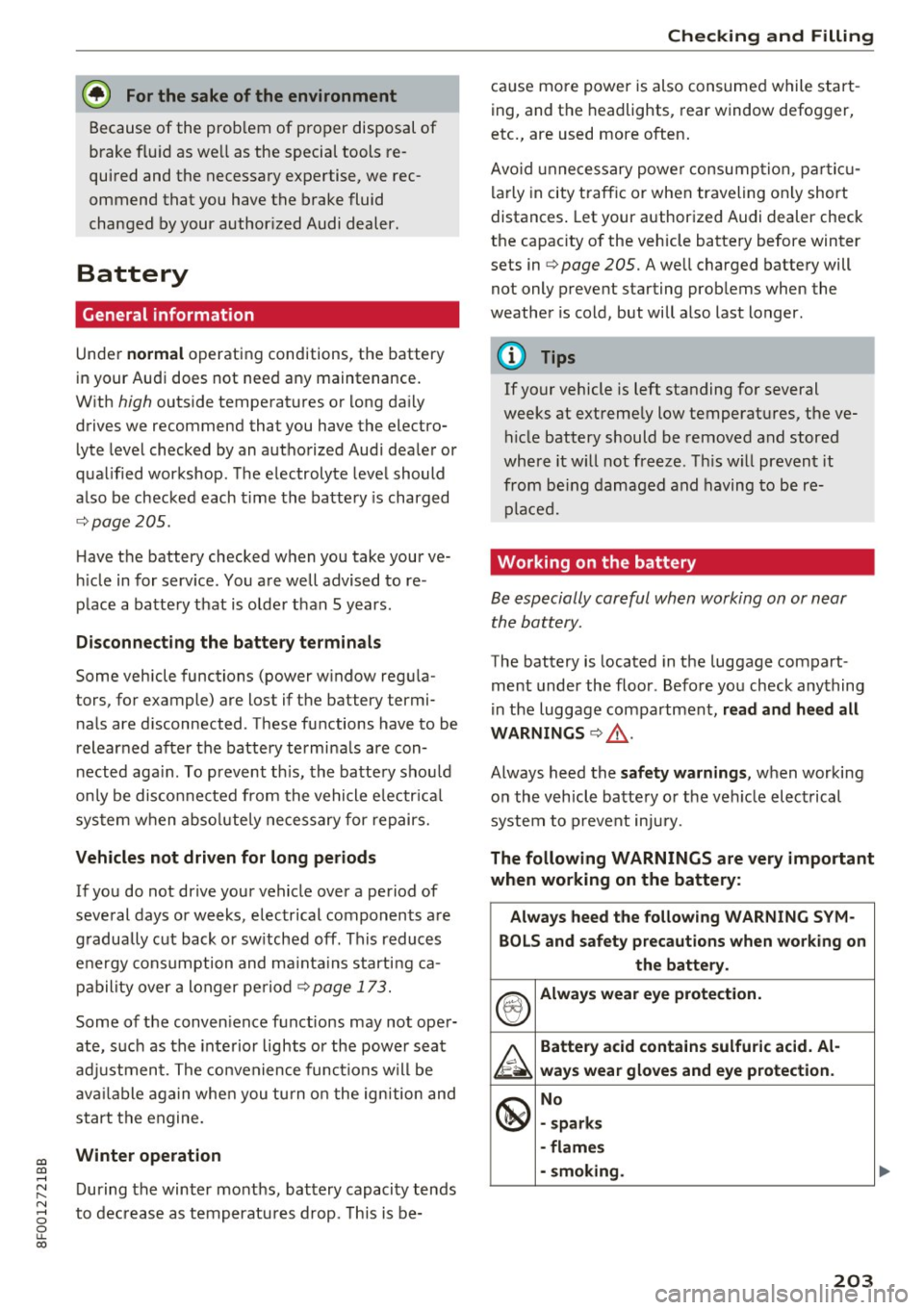
Always heed the following WARNING SYM·
BOLS and safety precautions when working on
the battery.
®
Always wear eye protection.
A
Battery acid contains sulfuric acid. Al·
ways wear gloves and eye protection .
@
No
- sparks
· flames
· smoking.
203
Page 259 of 266
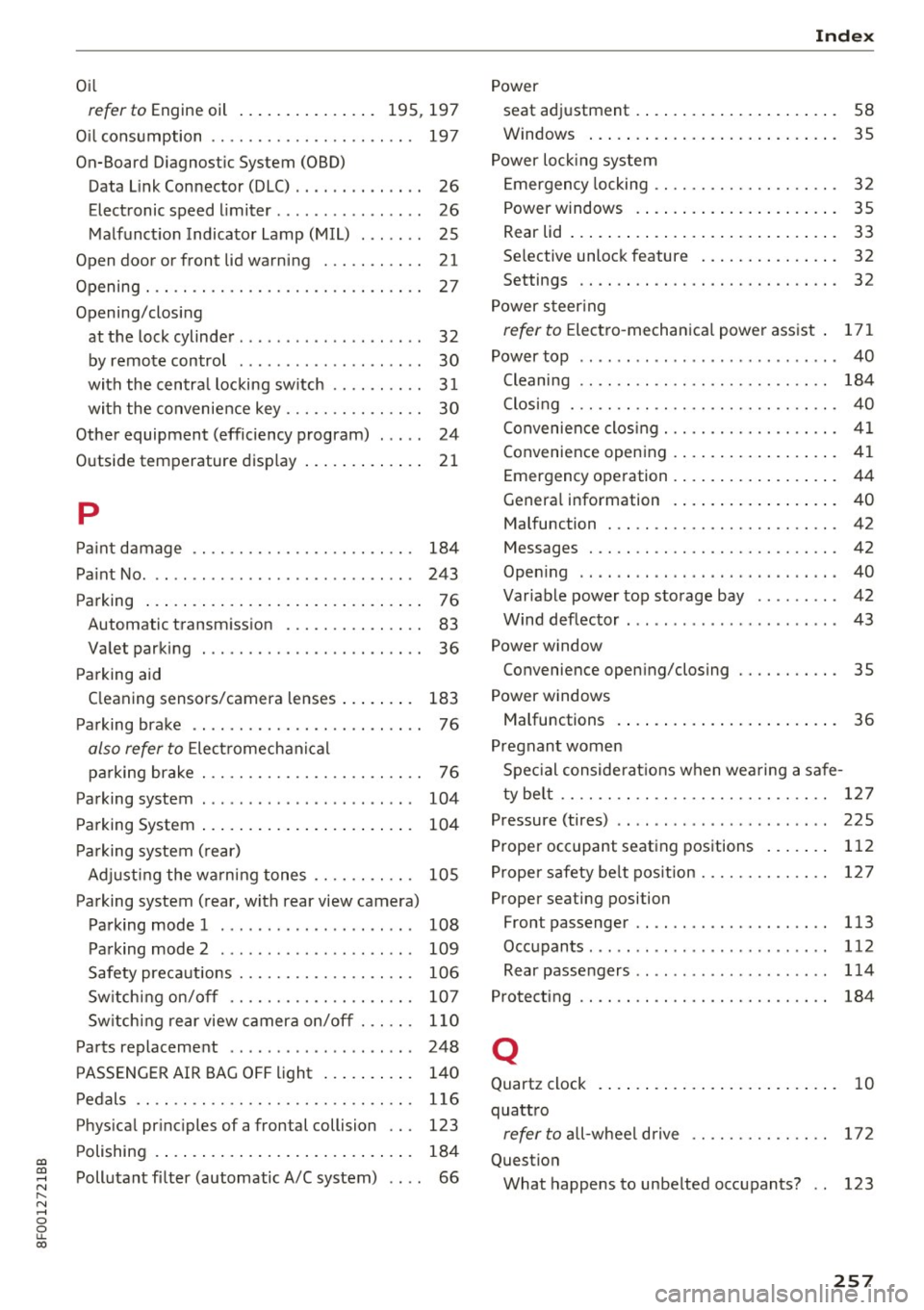
a:,
a:,
...... N r--. N ...... 0
0
LL 00
Oil
refer to Engine oil . . . . . . . . . . . . . . . 195, 197
O il consumption . . . . . . . . . . . . . . . . . . . . . . 197
On-Board Diagnostic System (OBD) Data L ink Connector (DLC) . . . . . . . . . . . . . . 26
Electronic speed limiter . . . . . . . . . . . . . . . . 26
Malfunction Indicator Lamp (MIL) . . . . . . . 25
Open door or front lid warning . . . . . . . . . . . 21
Opening. .. .. .. ............... .. .. .. .. 27
Opening/closing at the lock cylinder. . . . . . . . . . . . . . . . . . . . 32
by remote control . . . . . . . . . . . . . . . . . . . . 30
with the central locking sw itch . . . . . . . . . . 31
with the convenience key . . . . . . . . . . . . . . . 30
Other equipment (efficiency program) . . . . . 24
Outside temperature display . . . . . . . . . . . . . 21
p
Paint damage . . . . . . . . . . . . . . . . . . . . . . . . 184
Paint No. . . . . . . . . . . . . . . . . . . . . . . . . . . . . 243
Parking . . . . . . . . . . . . . . . . . . . . . . . . . . . . . . 76
Automatic transmission . . . . . . . . . . . . . . . 83
Vale t parking . . . . . . . . . . . . . . . . . . . . . . . . 36
Parking aid
C leaning sensors/camera lenses . . . . . . . . 183
Parking brake . . . . . . . . . . . . . . . . . . . . . . . . . 76
also refer to E lectromechanical
parking brake . . . . . . . . . . . . . . . . . . . . . . . . 76
Parking system . . . . . . . . . . . . . . . . . . . . . . . 104
Parking System . . . . . . . . . . . . . . . . . . . . . . . 104
Parking system (rear)
Adjusting the warning tones . . . . . . . . . . . 105
Parking system (rear, with rear view camera) Parking mode 1 . . . . . . . . . . . . . . . . . . . . . 108
Parking mode 2 . . . . . . . . . . . . . . . . . . . . . 109
Safety precautions . . . . . . . . . . . . . . . . . . . 106
Switching on/off . . . . . . . . . . . . . . . . . . . . 107
Sw itching rear view camera on/off . . . . . . 110
Parts replacement . . . . . . . . . . . . . . . . . . . . 248
PASSENGER AIR BAG OFF light . . . . . . . . . . 140
Pedals . . . . . . . . . . . . . . . . . . . . . . . . . . . . . . 116
Physical principles of a frontal collision . . . 123
Polishing . . . . . . . . . . . . . . . . . . . . . . . . . . . . 184
Pollutant filter (automatic A/C system) . . . . 66
Index
Power
seat adjustment . . . . . . . . . . . . . . . . . . . . . . 58
Windows . . . . . . . . . . . . . . . . . . . . . . . . . . . 35
Power locking system
Emergency locking . . . . . . . . . . . . . . . . . . . . 32
Power windows . . . . . . . . . . . . . . . . . . . . . . 35
Rear lid . . . . . . . . . . . . . . . . . . . . . . . . . . . . . 33
Se lective unlock featur e . . . . . . . . . . . . . . . 32
Settings . . . . . . . . . . . . . . . . . . . . . . . . . . . . 32
Power steering
refer to Electro-mechanical power assist . 171
Power top . . . . . . . . . . . . . . . . . . . . . . . . . . . . 40
Cleaning . . . . . . . . . . . . . . . . . . . . . . . . . . . 184
Closing . . . . . . . . . . . . . . . . . . . . . . . . . . . . . 40
Convenience closing . . . . . . . . . . . . . . . . . . . 41
Convenience opening . . . . . . . . . . . . . . . . . . 41
Emergency operation . . . . . . . . . . . . . . . . . . 44
General information . . . . . . . . . . . . . . . . . . 40
Malfunction . . . . . . . . . . . . . . . . . . . . . . . . . 42
Messages . . . . . . . . . . . . . . . . . . . . . . . . . . . 42
Opening . . . . . . . . . . . . . . . . . . . . . . . . . . . . 40
Variable power top storage bay . . . . . . . . . 42
Wind deflector . . . . . . . . . . . . . . . . . . . . . . . 43
Power window Convenience opening/closing . . . . . . . . . . . 35
Power windows
Malfunctions . . . . . . . . . . . . . . . . . . . . . . . . 36
Pregnant women Spec ial considerat ions when wearing a safe-
ty belt . . . . . . . . . . . . . . . . . . . . . . . . . . . . . 127
Pressure (tires) . . . . . . . . . . . . . . . . . . . . . . . 225
Proper occupant seat ing positions . . . . . . . 112
Proper safety be lt pos ition . . . . . . . . . . . . . . 127
Proper seating position Front passenger . . . . . . . . . . . . . . . . . . . . . 113
Occupants ....... .. ................. 112
Rear passengers . . . . . . . . . . . . . . . . . . . . . 114
Protecting . . . . . . . . . . . . . . . . . . . . . . . . . . . 184
Q
Quartz clock . . . . . . . . . . . . . . . . . . . . . . . . . . 10
quattro
refer to all-wheel drive . . . . . . . . . . . . . . . 172
Question What happens to unbelted occupants? . . 123
257
Page 260 of 266

Index
R
Radiator fan . . . . . . . . . . . . . . . . . . . . . . . . . 201
Ra in/lig ht senso r
H eadlights . . . . . . . . . . . . . . . . . . . . . . . . . . 48
I n termittent (w indshield wipe rs) . . . . . . . . 53
Sensor defect ive . . . . . . . . . . . . . . . . . . . . . . 19
Ra is ing the veh icle . . . . . . . . . . . . . . . . . . . . 242
Reading lights . . . . . . . . . . . . . . . . . . . . . . . . . 51
Rea r fog lights . .. .. . .......... .. .. .... 48
Rea r lid
Escape hand le . . . . . . . . . . . . . . . . . . . . . . . 34
Opening and clos ing . . . . . . . . . . . . . . . . . . 33
Rear light Defective . . . . . . . . . . . . . . . . . . . . . . . . . . . 19
Rea r par kin g sys tem . . . . . . . . . . . . . . . . . . . 104
Rear parking system w ith rearview camera . 105
Rear view came ra
Pa rking mode 1 . . . . . . . . . . . . . . . . . . . . . 108
Parking mode 2 . . . . . . . . . . . . . . . . . . . . . 109
Re ar view m irro r . . . . . . . . . . . . . . . . . . . . . . . 52
Rear window heat ing . . . . . . . . . . . . . . . . . . . 68
Recirc ulat ion mode (automatic climate con-
trol) . . . . . . . . . . . . . . . . . . . . . . . . . . . . . . . . . 68
Ref uell ing . . . . . . . . . . . . . . . . . . . . . . . . . . . 190
Re lease lever for hood . . . . . . . . . . . . . . . . . 193
Remote control key . . . . . . . . . . . . . . . . . . . . 28
Pe rsonalizing . . . . . . . . . . . . . . . . . . . . . . . . 28
un locking/locking . . . . . . . . . . . . . . . . . . . . 30
Remote con trol ope ra tion
Garage doo r opener (Home link) . . . . . . . . . 36
Remote rear lid release . . . . . . . . . . . . . . . . . 33
Repair man uals . . . . . . . . . . . . . . . . . . . . . . . 246
Repairs Ai rbag system . . . . . . . . . . . . . . . . . . . . . . 1 43
Replacement key . . . . . . . . . . . . . . . . . . . . . . 28
Replacing b ulbs . . . . . . . . . . . . . . . . . . . . . . 237
Replac ing wiper b lades . . . . . . . . . . . . . . . . . 54
Reporting Safety Defects ........... 118, 119
Reset button . . . . . . . . . . . . . . . . . . . . . . . . . . 1 0
Retractor . . . . . . . . . . . . . . . . . . . . . . . . . . . . 126
Right hand drive . . . . . . . . . . . . . . . . . . . . . . . SO
R ims . . . . . . . . . . . . . . . . . . . . . . . . . . . . . . . 22 1
Rollbar
refer to Act ive ro llover p rotection system 119
258
s
SA FE
10
Safe d rivi ng habits . . . . . . . . . . . . . . . . . . . . 111
Safelock . . . . . . . . . . . . . . . . . . . . . . . . . . . . . . 27
S afety
A irbag sys tem . . . . . . . . . . . . . . . . . . . . . . 130
Be lts . . . . . . . . . . . . . . . . . . . . . . . . . . . . . . 122
Cargo . . . . . . . . . . . . . . . . . . . . . . . . . . . . . 116
Co rrect seat ing pos it ion . . . . . . . . . . . . . . 112
Pedal area ..... .. .. .. ............... 116
S afety be lt pos it ion . . . . . . . . . . . . . . . . . . . 1 27
Safety be lts worn by pregnant women . . . 127
Safety be lt prete nsione r
Se rvice and disposal. . . . . . . . . . . . . . . . . . 129
Safety be lts . . . . . . . . . . . . . . . . . . . . . . 122, 125
Be lt pos itioner . . . . . . . . . . . . . . . . . . . . . . 125
Cleaning . . . . . . . . . . . . . . . . . . . . . . . . . . . 184
Danger to passengers who do not wear a
safety belt . . . . . . . . . . . . . . . . . . . . . . . . . 123
Fas tening . . . . . . . . . . . . . . . . . . . . . . . . . . 126
I m prope rly worn . . . . . . . . . . . . . . . . . . . . 1 28
Not worn . . . . . . . . . . . . . . . . . . . . . . . . . . 123
Safety be lt position . . . . . . . . . . . . . . . . . . 12 7
Safety instr uctions . . . . . . . . . . . . . . . . . . . 124
Securing child safety seats . . . . . . . . . . . . 159
Spec ial considerat ions for pregnant wom-
en . . . . . . . . . . . . . . . . . . . . . . . . . . . . . . . . 127
Un fastening . . . . . . . . . . . . . . . . . . . . . . . . 128
War ning/ indicato r light . . . . . . . . . . . . . . 122
War ning light . . . . . . . . . . . . . . . . . . . . . . . . 14
Wo rn prope rly . . . . . . . . . . . . . . . . . . . . . . 12 4
Safety be lt warning light . . . . . . . . . . . . . . . 122
Safety compliance sticker . . . . . . . . . . . . . . 243
Safety eq uipme nt . . . . . . . . . . . . . . . . . . . . . 111
Safety features fo r occupant restraint and
protect ion . . . . . . . . . . . . . . . . . . . . . . . . . . . 111
Safety gu idelines
Seats . . . . . . . . . . . . . . . . . . . . . . . . . . . . . . . 57
Safe ty instr uctions
En gine compartmen t.. ............. .. 193
for using ch ild s afety sea ts . . . . . . . . . . . . 153
for using sa fety belts . . . . . . . . . . . . . . . . . 124
Monito ring the Advanced Airbag System 142
Seat adjustment Hea d rest raints . . . . . . . . . . . . . . . . . . . . . 11 4
Seat belts
refer to Safety belts . . . . . . . . . . . . . . . . . . 122