tow AUDI A5 CABRIOLET 2017 User Guide
[x] Cancel search | Manufacturer: AUDI, Model Year: 2017, Model line: A5 CABRIOLET, Model: AUDI A5 CABRIOLET 2017Pages: 266, PDF Size: 66.64 MB
Page 89 of 266
a:,
a:,
...... N
" N ...... 0
0
LL co
will no longer shift at all. The engine may sta ll.
D rive to yo ur aut horized Audi dea le r or q ualified
repair fac ility immediately to have the malfunc
tion corrected.
rm liJ Transmission malfunction: No reverse
You can continue driving
S t roni c tra nsmissi on: The re is a s ystem m alfu nc
tion in t he tra nsmission. The transmiss io n is
switch ing to emergency mode . This mo de only
shifts into certain gears or will no longer sh ift at
all. The engine may stall. You cannot engage the
reverse gea r. D rive to your authorized A udi dealer
or qua lified repa ir facility immed iate ly to have
the ma lfunction co rrected.
rm Transmission malfunction: Stop vehicle and
sh ift to park.
Do not cont inue driving . Selec t the P se lector lev
e r p osition and see you r authorized Audi dea ler
or qua lified repa ir facility for assistance.
([) Note
If the tr ansmi ssion swi tc h es to emer gency
mo de, you s ho uld take the ve hicle to a n au
t horized A udi dealersh ip as soon as poss ible
to have the condition c orrected.
Selector lever emergency release
Applies to: vehicles with multitronic/S tron ic/tiptronic
If the vehicle 's power supply foils, the selector
lever can be released in an emergency.
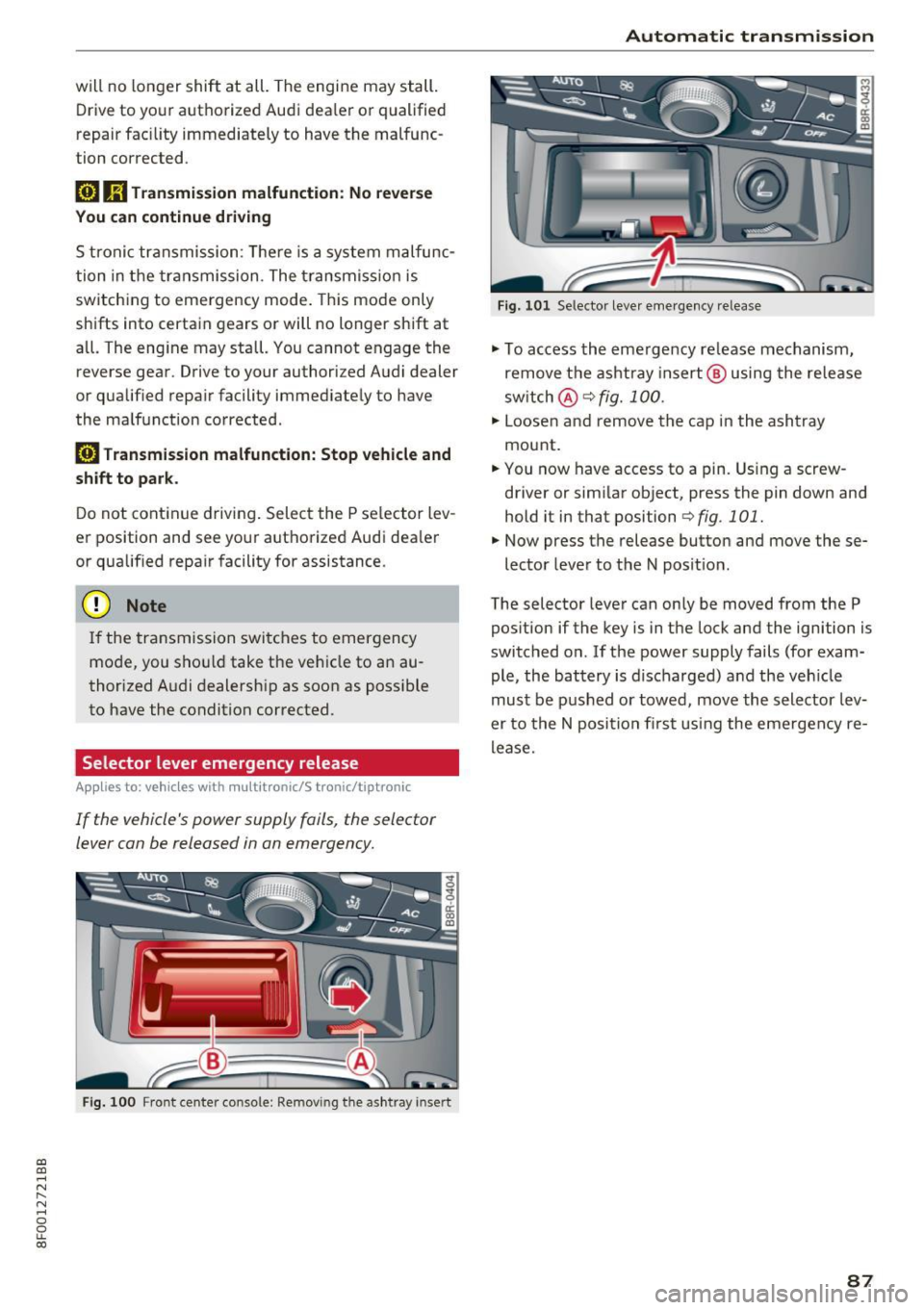
F ig . 100 Front center co nsole: Removing the ashtray insert
Automatic transmission
Fig. 10 1 Selec tor leve r em erge ncy re lease
"' To access the eme rg ency re lease me chanism,
remove t he ash tra y insert @ usin g the re lease
sw itch @
¢fig. 100.
"' Loose n and r emove the c ap in the ash tray
mount .
"' You now have access to a pin. Using a screw
driver or sim ila r ob ject, press the pin down and
hold it in that positi on
¢ fig. 101.
"' Now press the release button and move these-
lector leve r to the N pos it io n.
The selector leve r can on ly be moved from the P
pos ition if the key is in t he lock and the ign ition is
switched on. If the power supply fails (fo r exam
ple, the bat tery is d ischarged) a nd the veh icle
must be p ushed or towed, move th e selector lev
er to th e N posi tion first using the e merge ncy re
lease.
87
Page 90 of 266

Audi adaptive cruise control and braking guard
Audi adaptive cruise
control and braking
guard
Introduction
A pp lies to: ve hicles w ith Aud i adapt ive cruise co ntro l
The adaptive cruise contro l system assists the
driver by regulating vehicle speed and helping to
maintain a set distance to the veh icle ahead ,
within the limits of the system. If the system de
tects a moving vehicle up ahead, adaptive cruise
control can brake and then accelerate your vehi
cle. This helps to make driving more comfortable
on long highway stretches.
The braking guard system can warn you about an
impending collision and initiate braking maneu
vers
c> page 94.
Adaptive cruise control and braking guard have
technical limitations that you must know, so
please read th is section carefully, understand
how the system works and use them properly at
all times.
General information
General information
A pplies to : ve hicles w ith Aud i adapt ive cruise co ntrol
Fig. 102 Front of t he veh icle: Posit ion of radar sensor
The area that contains the radar sensor
c> fig. 102 must never be covered by st ickers or
other objects or obstructed with dirt, insects,
snow or ice that w ill interfere w ith the adaptive
cruise control system and braking guard. For in
formation on cleaning, refer to
c> page 182. The
same appl ies for any modifications made in the
front area .
88
The function of the adaptive cruise control sys
tem and braking guard is limited under some
condit ions:
- Objects can only be detected when they are
within sensor range
<:!) page 90, fig . 105.
-The system has a limited ability to detect ob
jects that are a short distance ahead, off to the
side of your vehicle or moving into your lane.
- Some k inds of veh icles are hard to detect; for
example motorcycles, veh icles with high
ground clearance or overhanging loads may be
detected when it is too late or they may not be
detected at all.
- When driving through curves
c:::> page 89.
- Stationary objects i::!) page 89 .
& WARNING
-Always pay attention to traffic when adaptive
cruise control is switched on and braking
guard is active. As the driver, you are still re
sponsible for starting and for maintaining
speed and distance to other objects . Braking
guard is used to assist you . The driver must
a lways take act ion to avoid a collision . The
driver is always responsible for braking at the
cor rect time.
- Improper use of adaptive cruise contro l can
cause collisions, other accidents and serious
personal injury.
- Never let the comfort and convenience that
adapt ive cr uise control and braking guard
offe r distract you from the need to be alert
to traffic conditions and the need to remain
in full control of your ve hicle at all times,
- Always remember that the adaptive cruise
control and braking guard have limits -they
will not slow the vehicle down or maintain
the set distance when you dr ive towards an
obstacle or something on or near the road
that is not moving, such as vehicles stopped
in a traff ic jam, a stalled or disabled veh icle.
If registered by the radar sensor, veh icles o r
obstacles that are not moving can trigger a
coll ision warning and if confirmed by the
video camera, an acute collision warning. ..,
Page 92 of 266

Audi adaptive cruise control and braking guard
Audi adaptive cruise
control
Description
A pplies to: ve hicles w ith Aud i adapt ive cruise co ntrol
F ig. 105 Detection range
What can Audi adaptive cruise control do?
The adaptive cruise control works in conjunct ion
with a radar sensor installed in the front of the
veh icle¢
page 88, fig. 102, wh ich is subject to
des ignated system limits
c:;;> page 90. Stationary
objects a re disregarded.
On open roads with no traffic, adaptive cru ise
control works like a regular cruise control sys
tem. The stored speed is ma inta ined. When ap
proaching a moving vehicle detected up ahead,
the adaptive cruise control system automatically
slows down to match that vehicle's speed and
then maintains the distance that the driver previ
ously stored. As soon as the system does not de
tect
a vehicle up ahead, adaptive cruise control
accelerates back up to the stored speed.
Which functions can be controlled?
When you switch adaptive cruise control on, you
can set the current speed as the "control speed"
¢ page 90, Switching on and off.
When driving, you can stop cruise control
¢
page 92 or change the speed ¢ page 91 at
any time.
You can also set the distance to the object ahead
and set the adaptive cruise control driving pro
gram
¢ page 92.
90
Switch ing on and off
App lies to : vehicles wit h Audi ada ptive cruise control
Fig. 106 Selector lever: switch ing o n/o ff
Fig. 107 Instrume nt cl uster: Aud i adapt ive cru ise con trol
You can set any speed between 20 mph and 95
mph (30 and 150 km/h) .
Indicator lamps and messages in the instrument
cluster display inform you about the current sys
tem status and settings.
Switching Audi adaptive cruise control on
"" Pull the lever toward you into position (D
¢ fig . 106 . ACC standby appears in the instru
ment cluster display .
Setting the speed and activating regulation
""To set the current speed, press the ISETI button
¢
page 9, fig . 4 . The set speed is shown in the .,_
Page 99 of 266

Audi side assist Side assist
Description
App lies to: veh icles with Audi side assist
Fig. 113 Se nsor dete ction rang e
Fig. 114 Display o n the exterio r mirror
Side assist helps you monitor your blind spot and
traffic behind your vehicle . Within the limits of
the system , it warns you about vehicles that are
coming closer or that are traveling with you with
in sensor range ©
¢fig. 113 : if a lane change is
classified as critical, the display @ in the exter ior
mirror
r:¢> fig . 114 turns on .
The display in the left exterior mirror provides as
sistance when making a lane change to the left,
while the d isp lay in the right exterior mirror pro
vides assistance when making a lane change to
the right .
Information stage
As long as you do not activate the turn signal,
side assist
informs you about vehicles that are
detected and classified as critica l. The disp lay in
~ the respective mirro r turns on, but is dim .
...... N
" N ...... 0
0
LL co
Aud i side assist
The display remains dim intentionally in the in
formation stage so that your view toward the
front is not disturbed.
Warning stage
If you activate the turn signal , side assist warns
you about vehicles that are detected and classi
fied as critical. The display in the respect ive mir
ror blinks bright ly. If this happens, check traffic
by glancing in the rearview mirror and ove r you r
shoulder
c::, .&. in General informa tion on
page 98.
{!) Tips
- You can adjust the brightness of the display
@ c:;, page 99.
-Please refer to the instructions for towing a
trailer located in
c::, page 98.
97
Page 100 of 266

Audi side assist
General information
Applies to: ve hicles w ith Aud i s ide ass is t
®
@
©
F ig . 115 Dr iving s itu atio ns
I AU DI
0 0
Fig. 116 Rear of the vehicle: pos it ion of the sensors
Side assist functions at speeds above approxi
mately 19 mph (30 km/h).
@ Vehicles that are approaching
In certain cases, a vehicle will be classified as
cr itical for a lane change even if it is still some
what far away. The faster a veh icle approaches ,
the sooner the display in the exterior mirror w il l
turn on.
@ Vehicles traveling with you
Vehicles traveling with you are indicated in the
exterior mirror if they are classified as critical for
a lane change. All vehicles detected by side assist
98
are indicated by the time they enter your "blind
spot", at the latest .
© Vehicles left behind
If you slow ly pass a vehicle that side assist has
de tected (the diffe rence in speed between the
vehicle and your vehicle is less than 9 mph
(15 km/h)), the display in the exterior mirror
turns on as soon as the vehicle enters your blind
spot .
The display wi ll not turn on if you quickly pass a
vehicle that side assist has detected (the differ ence in speed between the vehicle and your vehi
cle is greater than 9 mph (15 km/h)) .
Functional limitations
The radar sensors are designed to detect the left
and right adjacent lanes when the road lanes are
the normal width . In certain situations, the dis
play in the exterior mirror may turn on even
though there is no vehicle located in the area
that is crit ica l for a lane change. For example:
- if the lanes are narrow or if your are driving on
the edge of your lane. If this is the case, the
system may have detected the vehicle in anoth
er lane that is
not adjacent to your current lane.
- if you are driv ing through a curve. Side assist
may react to a vehicle that is one lane over
from the adjacent lane.
- if side assist reacts to other objects (such as
high or displaced guard rails) .
- In poor weather conditions. The side ass ist
functions are limited.
Do not cover the radar sensors
c:> fig. 116 with
stickers, deposits, bicycle wheels or other ob
j ects, because th is w ill affect the function . Do not
use side assist when towing a trailer. For infor
mation on cleaning, refer to
c:> page 182.
A WARNING
- Always pay attention to traff ic and to the
area around your vehicle. Side assist cannot
replace a driver's attention . The driver alone
is always responsible for lane changes and
-
similar driving maneuvers . IJ>-
Page 102 of 266

Audi side assist
(D Tips
-Si de assist is not active w hile you are mak
i ng t he a dju stment .
- You r settings are automatic ally store d an d
assi gned to t he remote co ntrol key being
u sed.
Driver messages
App lies to: ve hicles w ith Audi side assist
If s ide ass ist switches off by itself, the LED in the
button turns off a nd a message will appear in the
i n str ument cluster d isp lay :
Aud i side assist unavailable: Sensors blocked
T he rada r senso rs ' vision is affe cted . Do not cove r
the area in front of the sensors wit h bike wheels,
sticke rs, dirt o r other objects. Clean the area in
front of the sensors, if necessary
c> page 98,
fig. 116.
Audi side assist : Currently unavailable
S ide assist c an no t be swi tc h ed on tem pora ril y be
c a use there is a mal func tio n (fo r ex am ple, the
bat tery ch arge level may be too low) .
Audi side assist: System fault!
The system cannot guarantee that it wi ll detect
ve hicles co rrectly and it is swi tched off . The sen
sors have bee n disp lace d or are fa ulty . Have the
sys tem chec ked by a n aut hori zed Audi de aler or
a uthor ized Audi Se rvice F acility soon.
Audi side assist: Unavailable when towing
Side assist sw itches off automatica lly when a fac
tory-installed trailer hitch is connected to the
electr ica l co nnector on the trailer. The re is no
gua rantee the system will sw itch off when usi ng
a retrofi tte d t raile r hi tc h. D o not use s ide ass is t
w hen towing a trailer.
100
Page 108 of 266

Parking System
The rear acoustic park assist system is integrated
in the rear of the vehicle and the rear view cam
era is integrated in the rear lid~
page 107 .
A WARNING
The rear view camera has blind spots , in which
objects cannot be detected. Be especially
careful to check fo r small ch ildren and ani
mals before backing up . Small children a nd
animals will not a lways be detected by the
sen sors .
General Information
Applies to: vehicles with parking system (rear, with rear view
camera)
F ig . 1 22 Cov ered area (!) an d un covered area @ of th e rear
v iew came ra
F ig . 12 3 Tru nk lid : Locat ion of t he rea r view came ra
Sensors in the bumper
Sensors are located in the rear bumpers . If these
detect an obstacle, audible s ignals warn you . The
range a t which t he sensors beg in to measu re is
approx ima tely:
To the side
2 ft (0.60 m)
C enter rear 5. 2 ft (1.60 m)
Distance warning when reversing sta rts when an
obstacle is detected in the range of the pa rking
106
assist system. As the distan ce decreases, t he
time interval between the audib le tones becomes
sho rter.
When the distance is less than 1ft (0 .30 m), the
tone becomes cont inuo us. At th is point you
shou ld stop backing up .
If the distance to an obstacle stays t he sa me , the
vo lume of the dis tan ce signal chime is g radua lly
reduced after a bout 4 seconds (does not a ffect
the continuous signal tone) . Approaching anoth
er obstacle will cause the distance s ignal to
sound again at the normal volume.
Rear view camera coverage area
The M MI display shows t he area cove red by the
rear view camera
¢ fig . 122 (!). Objects that are
not in the a rea covered @are not shown on the
MMI display.
We recommend tha t you prac tic e parking wit h
the rear v iew camera in a t raffic -free location or
parking lot to become familiar with the system,
the orientat ion lines, and their function . When
do ing th is, there should be good light and weath
er condit ions.
In the MMI display, objects or vehicles appear closer or further away if:
- you a re dr iv ing in reve rse gear from a level s ur
face onto an incline, or a downward slope,
- you a re dr iving in reve rse gear tow ard prot rud
ing objects,
- t he vehicle is car rying too much load in the
rear.
The acc uracy of the or ie ntation lines and blue
s ur faces dim inishes if:
- the rear v iew camera does not provide a reliab le
image, fo r example, in poor visib ility co ndi tions
or if the le ns is dirty,
- the image on the screen is not v isible d ue to
sun glare and reflect io n.
Caring fo r the rear v iew camera lens
T he rear view camera is located above the rear li
cense p late bracket . For the pa rking assist to op-
erate, the lens ¢
fig. 123 must be kept clea n: .,..
Page 115 of 266
a:,
a:,
...... N r--. N ...... 0
0
LL 00
For detailed information on how to adjust the
driver's seat, see
¢ page 58.
A WARNING
Drivers who are unbelted, out of position or
too close to the airbag can be seriously in
jured by an airbag as it unfolds. To help re
duce the risk of serious personal injury:
- Always adjust the driver's seat and the
steering wheel so that there are at least 10 inches (25 cm) between your breastbone
and the steering wheel.
- Always hold the steering wheel on the out
side of the steering wheel rim with your
hands at the 9 o'clock and 3 o'clock posi
tions to help reduce the r isk of personal in
jury if the driver's airbag inflates.
- Never hold the steering wheel at the
12 o'clock position or with your hands at
other positions inside the steering wheel
rim or on the steering wheel hub. Holding
the steering wheel the wrong way can cause
serious injuries to the hands, arms and head
if the driver's airbag deploys.
- Pointing the steering wheel toward your
face decreases the ability of the supplemen
tal driver's airbag to protect you in a colli sion.
- Always sit in an upright position and never lean against or place any part of your body
too close to the area where the airbags are located .
- Before driving, always adjust the front seats
and head restraints properly and make sure
that all passengers are properly restrained.
- Never adjust the seats while the vehicle is
moving . Your seat may move unexpectedly
and you could lose control of the vehicle .
- Never drive with the backrest reclined or
tilted far back! The farther the backrests are
tilted back, the greater the risk of injury due
to incorrect positioning of the safety belt
and improper seating position.
- Children must a lways ride in child safety
seats¢
page 150. Special precautions ap
ply when installing a child safety seat on the
front passenger seat ¢
page 130.
Driving safety
Proper seating position for the front
passenger
The proper front passenger seating position is
important for safe, relaxed driving.
For your own safety and to reduce the risk of in
jury in the event of an acc ident, we recommend
that you adjust the seat for the front passenger
to the following position:
" Move the front passenger seat back as far as
possible . There must be a minimum of 10 in
ches (25 cm) between the breastbone and the
instrument panel¢.&, .
"Adjust the angle of the seatback so that it is in
an upright position and your back comes in full
contact with it whenever the vehicle is moving.
" Applies to vehicles with adjustable head re
straints : Adjust the head restraint so the upper
edge is as even as possible with the top of your
head . If that is not possible, try to adjust the
head restraint so that it is as close to this posi
tion as possible .
" Keep both feet flat on the floor in front of the
front passenger seat.
" Fasten and wear safety belts correctly
¢page 125.
For detailed information on how to adjust the
front passenge r's seat, see ¢
page 57.
A WARNING ~
Front seat passengers who are unbelted, out
of position or too close to the airbag can be
seriously injured or killed by the airbag as it unfolds. To help reduce the risk of serious
personal injury:
- Passengers must always sit in an upright po
sition and never lean against or place any
part of their body too close to the area
where the airbags are located .
- Passengers who are unbelted, out of posi
tion or too close to the airbag can be seri
ously injured by an airbag as it unfolds with
great force in the blink of an eye.
-Always make sure that there are at least 10 inches (25 cm) between the front passen
ger's breastbone and the instrument panel.
113
Page 118 of 266
Driving sa fe ty
the a irbag dep loys and injure you or yo ur
passengers.
Pedal area
Pedals
The pedals must always be free to move and
must never be interfered with by a floor mat or
any other object.
Make sure that all pedals move freely without in
terference and that noth ing prevents them from
retu rni ng to the ir origi nal positions.
Only use floor mats that leave the pedal area free
and can be secured with floor mat fasteners.
If a brake circuit fails, increased brake pedal trav
el is required to br ing the veh icle to a full stop.
_&. WARNING
Peda ls that cannot move free ly can cause loss
of vehicle control and increase the risk of seri
ous inj ury.
- Never place any objects in the driver's foot
well. An object could get into the pedal area
and interfere w ith pedal function . In case of
s u dden brak ing o r an accident, you would
not be ab le to bra ke or accelerate!
- Always make sure that nothing can fa ll or
move into the dr ive r's footwell.
Floor mats on the driver side
Always use floor mats that can be securely at
tached to the floor mat fasteners and do not in
terfere with the fre e movement of the pedals .
... Make sure that the floor mats are properly se
cured and cannot move and interfere with the
peda ls ~ .&_ .
Use on ly floor mats that leave the pedal area un
obstructed and that are firmly secured so that
they cannot slip o ut of pos ition . Yo u ca n obtain
suitable floo r mats from you r authorized Aud i
dea le r.
F loor mat fasteners are insta lled in your Audi.
116
Floor mats used in your vehicle must be attached
to these fasteners. Properly securing the floor
mats will prevent them from slid ing into posi
tions that could interfere with the pedals or im
pair safe operat ion of your vehicle in other ways.
_&. WARNING
Pedals that ca nnot move freely can res ult in a
loss of vehicle co ntro l and increase the r isk of
serious pe rsonal injury.
-Always make sure that floo r mats a re prop
erly secured.
- Never p lace or install floor mats o r other
floor coverings in the vehicle that cannot be
proper ly sec ured in place to prevent them
from s lipping and interfer ing wi th t he ped
al s or the ab ili ty to cont ro l t he vehicle.
- Never p lace or ins tall floor mats o r other
floor coverings on top of a lready installed
floor m ats. Addi tional floor ma ts and o ther
cover ings will reduce the size o f th e pedal
area and interfere with the pedals.
- Always proper ly re insta ll and se cure floo r
mats tha t have been taken ou t for cleaning.
- Alway s make sure th at o bje cts canno t fall
into the driver foo twell whi le the vehicle is
mov ing. Objects can become trapped under
the brake pedal a nd accelerator pedal caus
ing a loss o f vehicle control.
Storing cargo correctly
Loading the luggage compartment
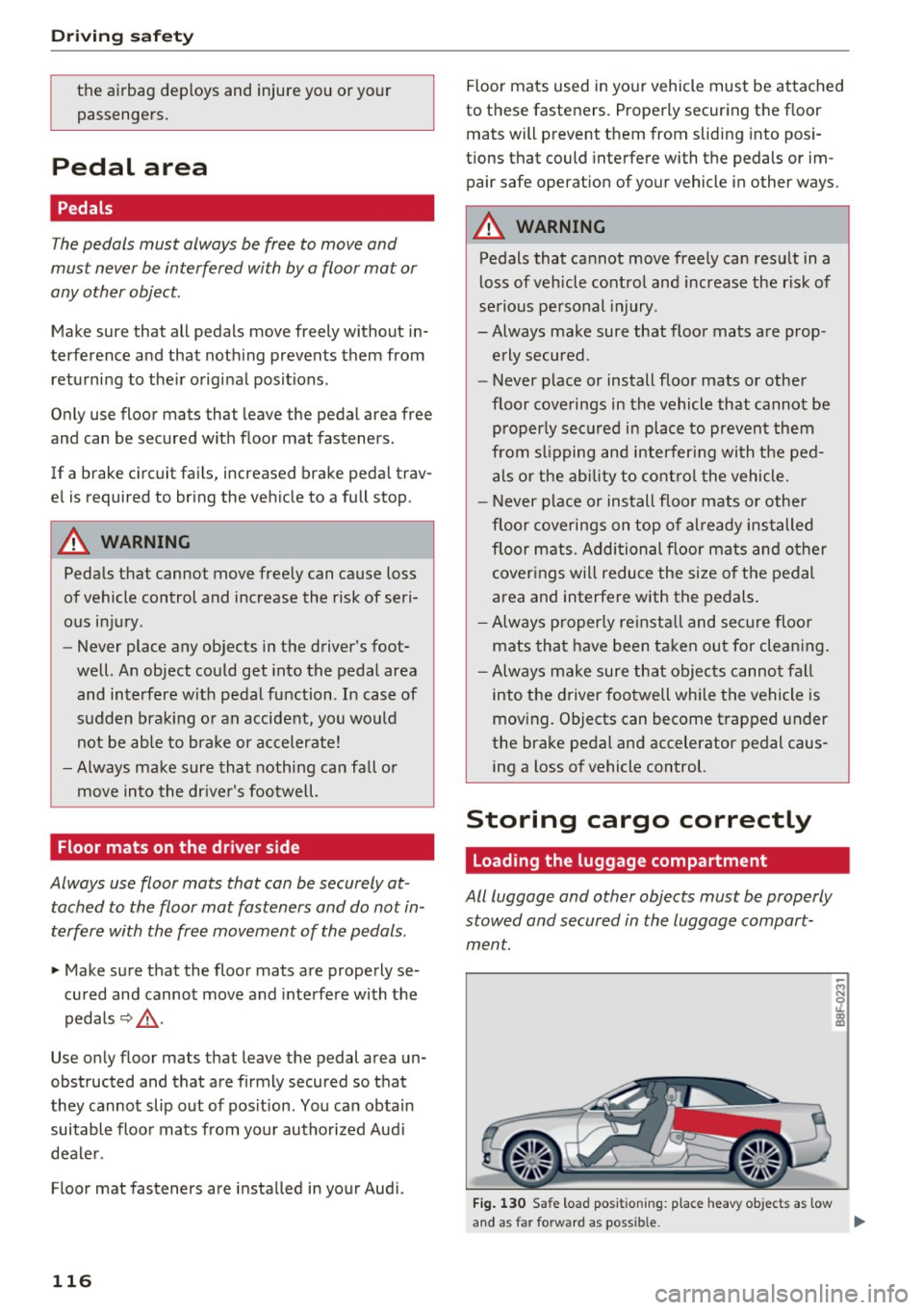
All luggage and other objects must be properly
stowed and secured in the luggage compart
ment .
Fig. 13 0 Safe load pos it ion ing: p lace heavy objects as low
-M N 0 oL CD m
an d as far forwa rd as possible. .,.
Page 130 of 266

Safe ty belts
Unfastening safety belts
Unbuckle the safety belt with the red relea se
button only after the vehicle has stopped .
Fig. 145 Rele asing th e to ngu e fro m the buck le
.. Push the red release button on the buckle
Q fig. 145 . The belt tongue will spring out of
the buckle
Q ,& .
.. Let the belt wind up on the retractor as you
guide the belt tongue to its stowed position.
A WARNING
Never unfasten safety belt while the vehicle is
moving . Doing so will increase your risk of be
ing injured or k il led.
Improperly worn safety belts
a
~ 0 :i: .. 0J
Incorrectly positioned safety belts can cause se
vere injuries .
Wearing safety belts improperly can cause seri
ous injury or death . Safety belts can only work
when they are correctly positioned on the body .
Imp roper seating positions reduce the effect ive
ness of safety belts and wi ll
even i ncrease the
risk of injury and death by mov ing the safety bel t
to cr it ica l areas of the body. Imp roper seating
positions a lso increase the risk of se rio us inj ury
and death when an airbag deploys and strikes an
occupant who is not in the correct seating pos i
tion . A
drive r is responsible fo r the safety of all
veh icle occupants and especially for children.
Therefore:
.. Never permit anyon e to assume an incorrect
sitting position in the vehicle whi le traveling
Q A .
128
A WARNING
Improperly worn safety belts increase the risk
of ser ious personal injury and death whenever
a veh icle is being used .
- Always make sure that all veh icle occupants
are cor rectly restrained and stay in a correct
seating position whenever the vehicle is be ing used.
- Always read and heed all WARNINGS a nd
other impo rtant informat ion
Q page 124 .
Belt tensioners
How safety belt pretensioners work
In front, side and rear-end collisions above a
particular sev erity, saf ety belts are tensioned au
tomatically .
The safety belts are eq uipped w ith safety belt
pretensioners. The system is activa ted by sensors
in front, side and rear -end collisions of great se
verity. This tightens the be lt and takes up belt
s lack
Q .&. in Service and disposal of safety belt
pretensioner on page 129 .
Taking up the slack
helps to reduce forward occupant movement dur
i ng a collis ion .
@ Note
Never let the belt remain over a rear seatback
that has been folded forward.
@ Tips
The sa fety belt pretensioner can only be acti
vated once .
- The safety belt pretensioners do not deploy
in minor frontal, side and rear -end coll i
sions.
- When the safety belt pretensioners are acti
vated, a f ine dust is released. This is normal
and is not caused by a fire in the veh icle.
- The relevant safety requirements must be
observed when the vehicle or components
of the system are scrapped. An authorized
Audi dealer or qua lified workshop is familiar
w ith these regu lations and will be pleased
to pass on the information to you. .,._