wheel AUDI A5 CABRIOLET 2017 User Guide
[x] Cancel search | Manufacturer: AUDI, Model Year: 2017, Model line: A5 CABRIOLET, Model: AUDI A5 CABRIOLET 2017Pages: 266, PDF Size: 66.64 MB
Page 87 of 266
a:,
a:,
...... N
" N ...... 0
0
LL co
Hill descent control switches off once the decline
levels out or you press the accelerator pedal.
On vehicles w ith the cruise control system*
¢ page 79, hill descent control is also activated
when the speed is set.
&,_ WARNING
H ill descent control cannot overcome physical
limitations, so it may not be able to maintain
a constant speed under all conditions. Always
be ready to apply the brakes.
Manual shift program
A ppl ies to: ve hicles w ith mul titronic/S tronic/tip troni c
Using the manual shift program you can man
ually select gears.
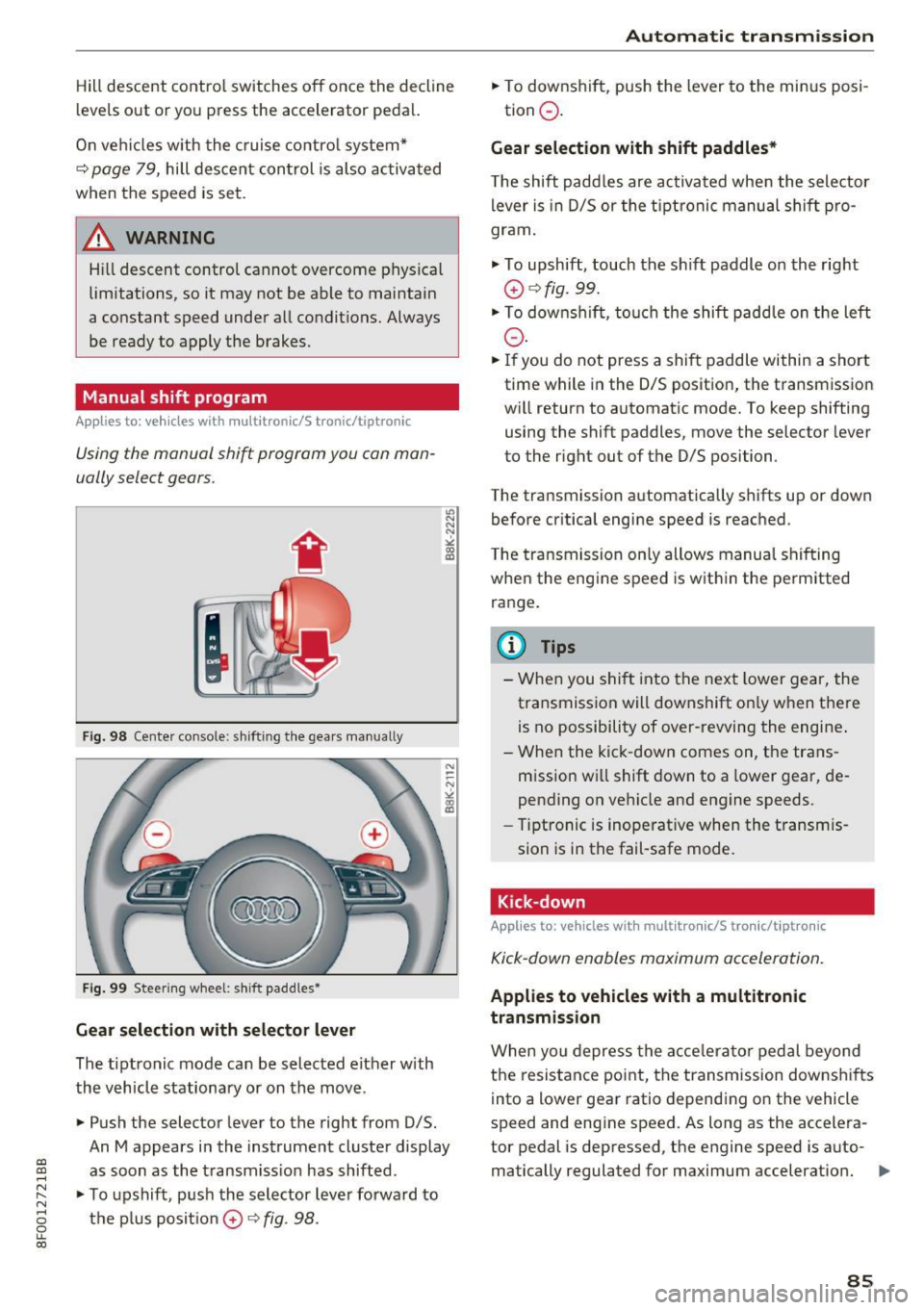
Fig. 98 Cente r console: shifting the gea rs manua lly
Fig. 99 Steering wheel: shift paddles•
Gear selection with selector lever
The tiptronic mode can be selected either with
the vehicle stationary or on the move.
• Push the selector lever to the right from D/5.
"' N N N ,.:i
~
An M appears in the instrument cluster display
as soon as the transmiss ion has shifted.
• To upshift, push the selector lever forwa rd to
the plus posit ion
0 ¢ fig . 98.
Automatic transmission
• To downshift, push the lever to the minus posi-
tion
0 .
Gear selection with shift paddles*
The shift paddles are activated when the selector
lever is in D/5 or the tip tronic manual shift pro
gram.
• To upshift, touch the sh ift paddle on the right
0 ¢fig. 99.
• To downshift, touch the shift paddle on the left
0-
• If you do not press a shift paddle within a short
time while in the 0/5 position, the transmission
wi ll return to automatic mode. To keep shifting
using the shift paddles, move the selector lever
to the right out of the D/S position.
The transmission automatically shifts up or down before critical engine speed is reached .
The transmission only allows manual shifting
when the engine speed is within the permitted
range.
@ Tips
- When you shift into the next lower gear, the
transmission will downshift on ly when there
is no possibility of over-revving the engine .
- When the kick-down comes on, the trans
mission will shift down to a lower gear, de
pending on vehicle and engine speeds.
- Tiptronic is inoperative when the transmis
sion is in the fail-safe mode.
Kick-down
Applies to : vehicles wi th mult itro nic/S tro nic/t ipt ronic
Kick-down enables maximum acceleration.
Applies to vehicles with a multitronic
transmission
When you depress the acce lerator pedal beyond
the resistance point, the transmission downshifts
into a lower gear ratio depending on the vehicle
speed and engine speed. As long as the accelera
tor pedal is depressed, the engine speed is auto-
matically regulated for maximum acceleration.
Ill>
85
Page 88 of 266

Automatic transmissio n
Appli es to vehicl es with a S troni c-/ tiptronic
t ran smissi on
When you depress the accelerator peda l beyond
the resistance point, the automatic t ransmission
downshifts into a lower gear, depending on vehi
cle s peed and engi ne speed. The upshift into the
next h igher gear takes place once the maximum
specif ied e ngine speed is reached.
A WARNING
Please note that the drive whee ls can spin if
kick-down is used on a smooth s lippery road -
there is a risk of skidding.
Launch Control Program
A pp lies to: ve hicles w ith S tro nic
The Launch Control Program provides the best
acceleration possible when starting from a stop.
Requirement: The engine must be at operating
temperature and the steer ing wheel must not be
turned .
"' Press the
lfl O FF ! button ¢ page 168 while the
engine is run ning . T he
II indicator light illumi
nates in the instrument cluste r and
Stabil iza
tion control (ESC ): Sp ort. Warning! R estricted
s tab ilit y
appears in the d river informat ion sys
tem display.
"' Move the selecto r lever to the D/S position to
select sport mode (S) or select the
d ynami c
driving mode in drive select * ¢page 102.
"'Press the brake pedal strongly with your left
foot and hold it down fo r at least 1 second.
"' At the same t ime, press the acce lerator pedal
down completely with your right foot until the engine reaches and maintains a high RPM .
"' Remove your foot from the b rake pedal within
S seconds ¢
&-
A WARNING
-Always adapt yo ur driv ing to the traffic flow.
- Only use the La unch Control Prog ram when
ro ad and tra ffic conditions allow it and oth
er drivers will not be endangered or an
noyed by you r driving and the vehicle 's ac
celeration.
86
- Please note that the d riving wheels can spin
and the vehicle can b reak away when sport
mode is switched on, espec ially when the
road is slippery .
- Once you have acce lerated, you should
sw itch sport mode off by pressing the
I ~ OFFI button .
(D Tips
-The transmission temperat ure may increase
significant ly after using the Launch Contro l
Program. If that happens, the program may
not be ava ilable for a few minutes . It will be
available again afte r a cool-down period .
- When accelerating using the Launch Control
program, all vehicle pa rts a re subject to
heavy loads . This ca n result in increased
wea r.
Transmission malfunction
App lies to: vehicles wi th mult itro nic/S tro nic/ tip tronic
I>] Tran smi ssion : Pres s brake ped al and select
gear again.
P ress the b rake peda l and select the desired se
l ector lever posi tion again. Yo u can then co nti nu e
driv ing.
I>] Tran smiss ion ov erheating: Plea se drive con
servativel y.
The transmission temperature has increased sig
nificantly due to t he sporty dr iving ma nner . Drive
i n a less spo rty manner unti l the temperature re
turns to t he norma l range and the i ndicator light
switches of.
I>] Tran smiss ion malfun ct ion : You can co ntinue
driv ing
There is a system malfunction in the transmis
s io n. You may continue driving. Dr ive to your au
thorized Audi dea ler or qua lified repair facility
soon to have the ma lfunction corrected .
I>] Transmission malfunct ion : Limited dri ving
functional ity
There is a system malfunction in the transmis-
s ion. The t ransmission is switch ing to emergency
mode. This mode only s hifts into certain gears or ..,_
Page 100 of 266

Audi side assist
General information
Applies to: ve hicles w ith Aud i s ide ass is t
®
@
©
F ig . 115 Dr iving s itu atio ns
I AU DI
0 0
Fig. 116 Rear of the vehicle: pos it ion of the sensors
Side assist functions at speeds above approxi
mately 19 mph (30 km/h).
@ Vehicles that are approaching
In certain cases, a vehicle will be classified as
cr itical for a lane change even if it is still some
what far away. The faster a veh icle approaches ,
the sooner the display in the exterior mirror w il l
turn on.
@ Vehicles traveling with you
Vehicles traveling with you are indicated in the
exterior mirror if they are classified as critical for
a lane change. All vehicles detected by side assist
98
are indicated by the time they enter your "blind
spot", at the latest .
© Vehicles left behind
If you slow ly pass a vehicle that side assist has
de tected (the diffe rence in speed between the
vehicle and your vehicle is less than 9 mph
(15 km/h)), the display in the exterior mirror
turns on as soon as the vehicle enters your blind
spot .
The display wi ll not turn on if you quickly pass a
vehicle that side assist has detected (the differ ence in speed between the vehicle and your vehi
cle is greater than 9 mph (15 km/h)) .
Functional limitations
The radar sensors are designed to detect the left
and right adjacent lanes when the road lanes are
the normal width . In certain situations, the dis
play in the exterior mirror may turn on even
though there is no vehicle located in the area
that is crit ica l for a lane change. For example:
- if the lanes are narrow or if your are driving on
the edge of your lane. If this is the case, the
system may have detected the vehicle in anoth
er lane that is
not adjacent to your current lane.
- if you are driv ing through a curve. Side assist
may react to a vehicle that is one lane over
from the adjacent lane.
- if side assist reacts to other objects (such as
high or displaced guard rails) .
- In poor weather conditions. The side ass ist
functions are limited.
Do not cover the radar sensors
c:> fig. 116 with
stickers, deposits, bicycle wheels or other ob
j ects, because th is w ill affect the function . Do not
use side assist when towing a trailer. For infor
mation on cleaning, refer to
c:> page 182.
A WARNING
- Always pay attention to traff ic and to the
area around your vehicle. Side assist cannot
replace a driver's attention . The driver alone
is always responsible for lane changes and
-
similar driving maneuvers . IJ>-
Page 101 of 266

a:,
a:,
...... N
" N ...... 0
0
LL co
-Improper reliance on the side assist system
can cause collisions and serious personal in
jury:
- Never rely only on side assist when chang
ing lanes.
- Always check rear view mirrors to make
sure that it is safe to change lanes.
- Side assist cannot detect all vehicles under
all conditions- danger of accident!
- Please note that side assist indicates there
are approaching vehicles, or vehicles in your
blind spot, only after your vehicle has
reached a driving speed of at least 19 mph
(30 km/h).
- In certain situations, the system may not
function or its function may be limited. For
example:
- if vehicles are approaching or being left
behind very quickly. The display may not
turn on in time.
- in poor weather conditions such as heavy
rain, snow or heavy mist.
- on very wide lanes, in tight curves or if
there is a rise in the road surface. Vehicles
in the adjacent lane may not be detected
because they are outside of the sensor
range.
(D Note
The sensors can be displaced by impacts or
damage to the bumper, wheel housing and
underbody. This can affect the system. Have
your authorized Audi dealer or authorized
Audi Service Facility check their function.
(D Tips
-If the window glass in the driver's door or
front passenger's door has been tinted , the
display in the exterior mirror may be misin
terpreted.
- For Declaration of Compliance to United
States FCC and Industry Canada regulations
¢page 249.
Audi side assist
Activating and deactivating
App lies to : veh icles w it h Aud i s ide ass ist
Fig. 117 Driver 's do or: Side ass ist button
.,. Press the button ¢ & in General information
on page
98to switch the system on/off . The
LED in the button turns on when side assist is
switched on .
Adjusting the display brightness
Applies to: veh icles w it h Audi s ide assist
The signal brightness can be set in the radio or
MM!*.
.,. Select: !CAR ! function button> Audi side assist .
.,. Select: I CAR I function button > Car systems*
control button > Driver assist > Audi side as
sist.
The display brightness adjusts automatically to
the brightness of the surroundings, both in the
information and in the warning stage . In very
dark or very bright surroundings, the display is
already set to the minimum or maximum level by
the automatic adjustment. In such cases, you
may notice no change when adjusting the bright
ness, or the change may only be noticeable once
the surroundings change.
Adjust the brightness to a level where the display
in the information stage will not disrupt your
view forward. If you change the brightness, the
display in the exterior mirror will briefly show the
brightness level in the information stage. The
brightness of the warning stage is linked to the
brightness in the information stage and is adjust
ed along with the information stage adjustment.
Ill>
99
Page 102 of 266

Audi side assist
(D Tips
-Si de assist is not active w hile you are mak
i ng t he a dju stment .
- You r settings are automatic ally store d an d
assi gned to t he remote co ntrol key being
u sed.
Driver messages
App lies to: ve hicles w ith Audi side assist
If s ide ass ist switches off by itself, the LED in the
button turns off a nd a message will appear in the
i n str ument cluster d isp lay :
Aud i side assist unavailable: Sensors blocked
T he rada r senso rs ' vision is affe cted . Do not cove r
the area in front of the sensors wit h bike wheels,
sticke rs, dirt o r other objects. Clean the area in
front of the sensors, if necessary
c> page 98,
fig. 116.
Audi side assist : Currently unavailable
S ide assist c an no t be swi tc h ed on tem pora ril y be
c a use there is a mal func tio n (fo r ex am ple, the
bat tery ch arge level may be too low) .
Audi side assist: System fault!
The system cannot guarantee that it wi ll detect
ve hicles co rrectly and it is swi tched off . The sen
sors have bee n disp lace d or are fa ulty . Have the
sys tem chec ked by a n aut hori zed Audi de aler or
a uthor ized Audi Se rvice F acility soon.
Audi side assist: Unavailable when towing
Side assist sw itches off automatica lly when a fac
tory-installed trailer hitch is connected to the
electr ica l co nnector on the trailer. The re is no
gua rantee the system will sw itch off when usi ng
a retrofi tte d t raile r hi tc h. D o not use s ide ass is t
w hen towing a trailer.
100
Page 110 of 266

Parking System
-You can change the volume and pitch of the
signals as well as the display
¢ page 110.
-What appears in the display is time-de
layed.
Reverse Parking
Applies to: veh icles with park ing system (rear, with rear view
camera)
Parking mode 1 can be used when parking in a
garage or parking space .
Fig. 124 MMI Di spla y: Aiming at a pa rk in g spot
Fig. 125 MM I Di splay: Alig ning the ve hicle
.-Switch the MMI on and select the reverse gear .
.- Turn the steering wheel until the orange orien
tation lines(!) appear in the parking spot
¢ fig. 124. Use the markings @to h elp you es
timat e the distance from an obstacl e. Each
marking corresponds to 3 ft (1 m). The blue
area represents an ex tension of the vehicle 's
outline by approximately 16
ft (5 m) to the
rear .
.- While driving in reverse gear, adjust the steer
ing wheel angle to fit the parking space with
the aid of the orange orientation lines
~ CD. @
marks the rear bumper. You should stop driving
in reverse as soon as and no later than when
108
the red orientation line@ abuts an object
¢,&. !
A WARNING
-The rear view camera does not show the en
tire area behind the vehicle
¢ page 106,
fig . 122.
Watch out especially for small chil
dren and animals. The rear view camera can
not always detect them, posing risk of an
accident!
- Please note that objects not touching the
ground can appear to be further away than
they really are (for example, the bumper of
a parked vehicle, a trailer hitch, or the rear
of a truck). In this case, you should not use
the help lines to help with parking, which
poses danger of an accident!
(D Note
- Low obstacles already signaled by a warning
can disappear from the system's detection
range as they are approached and will not
continue to be signaled. Objects such as
barrier chains, trailer draw bars, thin paint
ed vertical poles or fences may not be de
tected by the system , posing risk of dam
age .
- In the MMI display, the direction of travel of
the vehicle rear is represented depending on
the steering wheel angle. The vehicle front
swings out more than the vehicle rear .
Maintain plenty of distance from an obsta
cle so that your outside mirror or a corner of
your vehicle does not collide with any obsta
cles -danger of accident!
Page 111 of 266

Parallel Parking
Applies to: vehicles with parking system (rear, with rear view
camera)
Use parking mode 2 to help you pork on the edge
of a street.
Fig. 126 MMI Display: b lue s urface in the parking spo t
Fig. 127 MMI D isplay : B lue cu rve o n th e curb
The following steps app ly only when there is no
obstacle (such as a wall) near the parking spot .
Otherw ise, please read the "T ips on Parking Next
to Obstacles"
c:::;, page 109.
.,. Activate the turn s ignal.
.,. Pos ition your vehicle parallel to the edge of the
street, approx imately 3
ft (1 m) from a parked
vehicle .
.,. Switch the MMI on and se lect the reverse gea r.
The pa rking aid tu rns on and parking mode 1
appears on the display.
.,. Press the
Mode c:::;, fig. 126 (!) control button on
the MMI control console. Parking mode 2 ap pears.
.,. Back up in reverse gear and align your vehicle
so that the blue area @borders on the rear end
~ of the vehicle or on the park ing spot line . The
;:::: blue area represents an extension of the veh i-
" ~ cle's outline by approximately 16 ft (5 m) to 0
~ the rear. The long side of the b lue area s hou ld co
Parking S ystem
be on the curb. The entire blue area must fit in
to the parking spot.
.,. Wh ile the vehicle is stat ionary, turn the steer
ing wheel to the right as far as it will go.
.,. Back into the parking spot. Stop the vehicle as
soon as the blue curve touches the curb
c:::;,fig. 127 .
.,. Wh ile the vehicle is stat ionary, turn the steer
ing wheel to the left as far as it will go .
.,. Continue to b ack up into the parking spot unt il
the vehicle is parked para lle l to the curb. @
marks the rear bumper. You should stop driving
in reverse as soon as and no later than when
the red or ientation line @abuts an object
c:::;, &_ ! Keep an eye on the front of your vehicle
while doing this
c:::;, (I) _
Parking n ext to ob stacles
When there is an obstacle (s uch as a wall) next to
the parking spot, choose a spot with mo re space
on the sides . Position the long side of the blue
area so that there is sufficient space from the
curb . The area must not be on the curb . You w ill
also need to start turning the steering wheel
much earlie r. There should be a sufficient
amount of space between the curb a nd the blue
c ur ve, and the blue curve
c:::;, fig. 127 mus t not
touch the curb.
A WARNING
- The rear view camera does not show the en
tire area behind the vehicle
c:::;, page 106,
fig. 122 .
Watch out especially for small chi l
dren and animals. The rear view camera can
not always detect them, posing r isk of an
accident!
- Please note that objects not touching the
ground can appear to be further away than
they rea lly are (for examp le, the bumper of
a parked vehicle, a t railer hitch, o r the rear
of a tr uck). In this case, you shou ld not use
the help lines to help wi th par kin g, which
poses dange r of an accident!
(D Note
In the MMI d isplay, the direction of travel of
the veh icle rear is represented depend ing on
the steer ing whee l ang le. The ve hicle front
109
Page 114 of 266
Driving safety
• Fasten your safety be lt and wear it properly . Al
so instruct your passengers to fasten their
safety be lts properly ¢
page 122.
What impairs driving safety?
Safe driving is directly related to the condition of
the vehicle, the driver as well as the driver 's abili
ty to concentrate on the road without being dis
tracted .
The driver is responsible for the safety of the ve
h icle and all of its occupants. If your ability to
drive is impaired, safety risks for everybody in the
veh icle increase and you also become a hazard to
everyone else on the road ¢.&, .Therefore :
• Do not let yourself be distracted by passengers
or by using a cellular telephone .
• NEVER drive when your driving ability is im
paired (by medications, alcohol, drugs, etc.) .
• Observe all traff ic laws, rules of the road and
speed limits and plain common sense .
• AL WAYS ad just you r speed to road, traffic and
weathe r cond itions.
• Take frequent breaks on long trips. Do not d rive
for more than two ho urs at a stretch .
• Do NOT drive when you are tired, under pres
s u re or when you are stressed .
A WARNING
Impaired driv ing safety increases the risk of
ser ious personal injury and death whe never a
vehicle is being used .
112
.
Correct passenger
seating positions
Proper seating position for the driver
The proper driver seating position is important
for safe, relaxed driving.
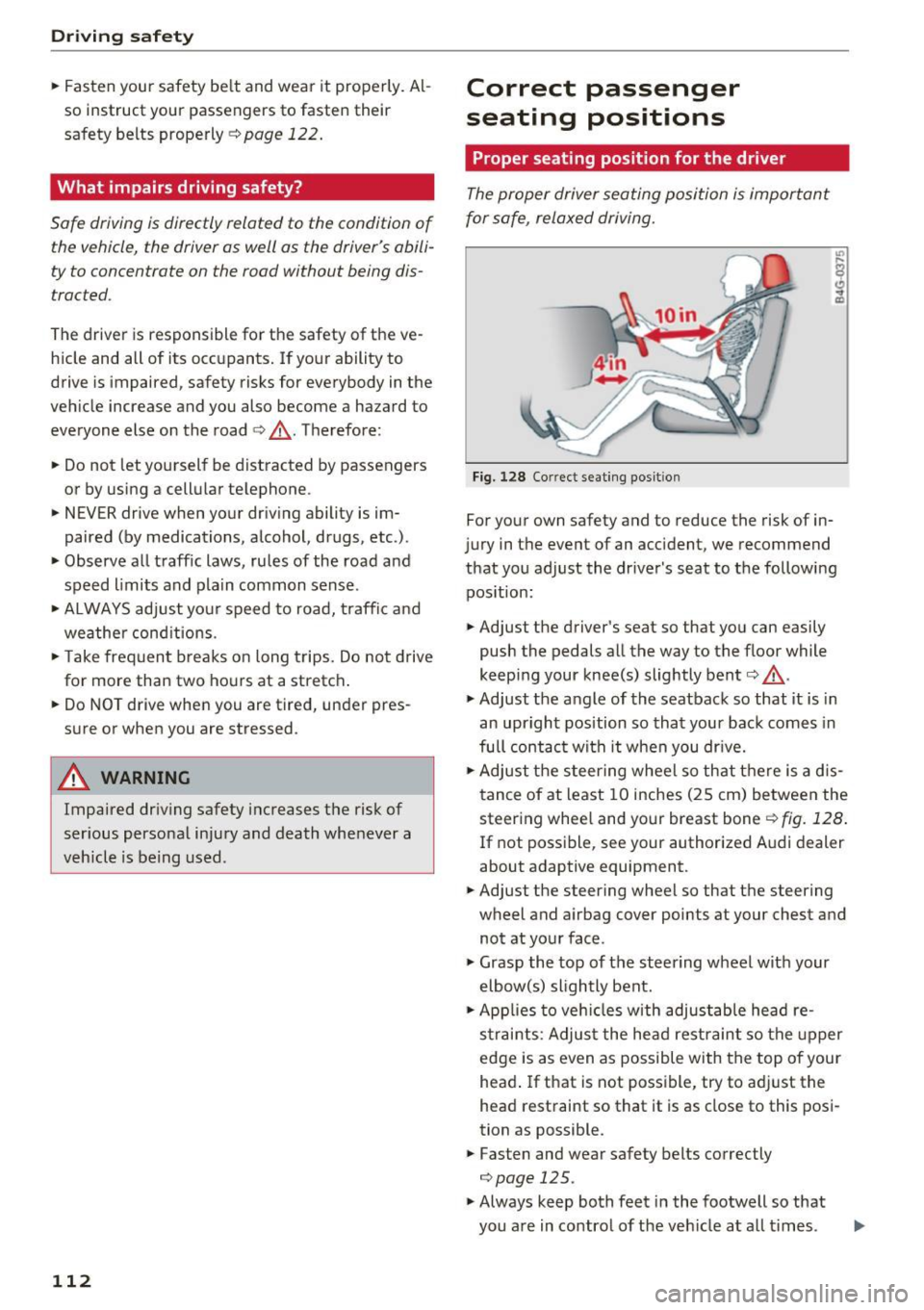
Fig. 128 Co rrect seat ing pos it ion
For your own safety and to reduce the risk of in
jury in the event of an acc ident, we recommend
that you adjust the drive r's seat to the following
pos ition:
• Ad just the driver's seat so that you can easily
push the pedals all the way to the floor while
keeping your knee(s) slightly bent¢.&, .
• Ad just the angle of the seatback so that it is in
an upright position so that your back comes in
full contac t with it when you dr ive.
• Ad just the steer ing wheel so that t here is a d is
t ance of at least 10 inches (25 cm) between the
steer ing whee l and your breast bone ¢
fig. 128.
If not possible, see your authorized A udi dealer
about adaptive equipment.
• Ad just the steering wheel so that the steering
wheel and airbag cover points at your chest and
not at yo ur face .
• Grasp the top of the steer ing wheel with your
elbow(s) sligh tly bent.
• App lies to veh icles with adjustable hea d re
s trai nts: Adjus t the head restraint so the upper
edge is as even as possible with the top of your
head . If that is not possible, try to ad just the
head restraint so that it is as close to this pos i
tion as possible .
• Fasten and wear safety belts correctly
¢ page 125.
• Always keep both feet in the footwell so that
you are in contro l of the veh icle at a ll times .
Page 115 of 266
a:,
a:,
...... N r--. N ...... 0
0
LL 00
For detailed information on how to adjust the
driver's seat, see
¢ page 58.
A WARNING
Drivers who are unbelted, out of position or
too close to the airbag can be seriously in
jured by an airbag as it unfolds. To help re
duce the risk of serious personal injury:
- Always adjust the driver's seat and the
steering wheel so that there are at least 10 inches (25 cm) between your breastbone
and the steering wheel.
- Always hold the steering wheel on the out
side of the steering wheel rim with your
hands at the 9 o'clock and 3 o'clock posi
tions to help reduce the r isk of personal in
jury if the driver's airbag inflates.
- Never hold the steering wheel at the
12 o'clock position or with your hands at
other positions inside the steering wheel
rim or on the steering wheel hub. Holding
the steering wheel the wrong way can cause
serious injuries to the hands, arms and head
if the driver's airbag deploys.
- Pointing the steering wheel toward your
face decreases the ability of the supplemen
tal driver's airbag to protect you in a colli sion.
- Always sit in an upright position and never lean against or place any part of your body
too close to the area where the airbags are located .
- Before driving, always adjust the front seats
and head restraints properly and make sure
that all passengers are properly restrained.
- Never adjust the seats while the vehicle is
moving . Your seat may move unexpectedly
and you could lose control of the vehicle .
- Never drive with the backrest reclined or
tilted far back! The farther the backrests are
tilted back, the greater the risk of injury due
to incorrect positioning of the safety belt
and improper seating position.
- Children must a lways ride in child safety
seats¢
page 150. Special precautions ap
ply when installing a child safety seat on the
front passenger seat ¢
page 130.
Driving safety
Proper seating position for the front
passenger
The proper front passenger seating position is
important for safe, relaxed driving.
For your own safety and to reduce the risk of in
jury in the event of an acc ident, we recommend
that you adjust the seat for the front passenger
to the following position:
" Move the front passenger seat back as far as
possible . There must be a minimum of 10 in
ches (25 cm) between the breastbone and the
instrument panel¢.&, .
"Adjust the angle of the seatback so that it is in
an upright position and your back comes in full
contact with it whenever the vehicle is moving.
" Applies to vehicles with adjustable head re
straints : Adjust the head restraint so the upper
edge is as even as possible with the top of your
head . If that is not possible, try to adjust the
head restraint so that it is as close to this posi
tion as possible .
" Keep both feet flat on the floor in front of the
front passenger seat.
" Fasten and wear safety belts correctly
¢page 125.
For detailed information on how to adjust the
front passenge r's seat, see ¢
page 57.
A WARNING ~
Front seat passengers who are unbelted, out
of position or too close to the airbag can be
seriously injured or killed by the airbag as it unfolds. To help reduce the risk of serious
personal injury:
- Passengers must always sit in an upright po
sition and never lean against or place any
part of their body too close to the area
where the airbags are located .
- Passengers who are unbelted, out of posi
tion or too close to the airbag can be seri
ously injured by an airbag as it unfolds with
great force in the blink of an eye.
-Always make sure that there are at least 10 inches (25 cm) between the front passen
ger's breastbone and the instrument panel.
113
Page 125 of 266
Why use safety belts?
Frontal collisions and the law of physics
Frontal crashes create very strong forces for peo
ple riding in vehicles .
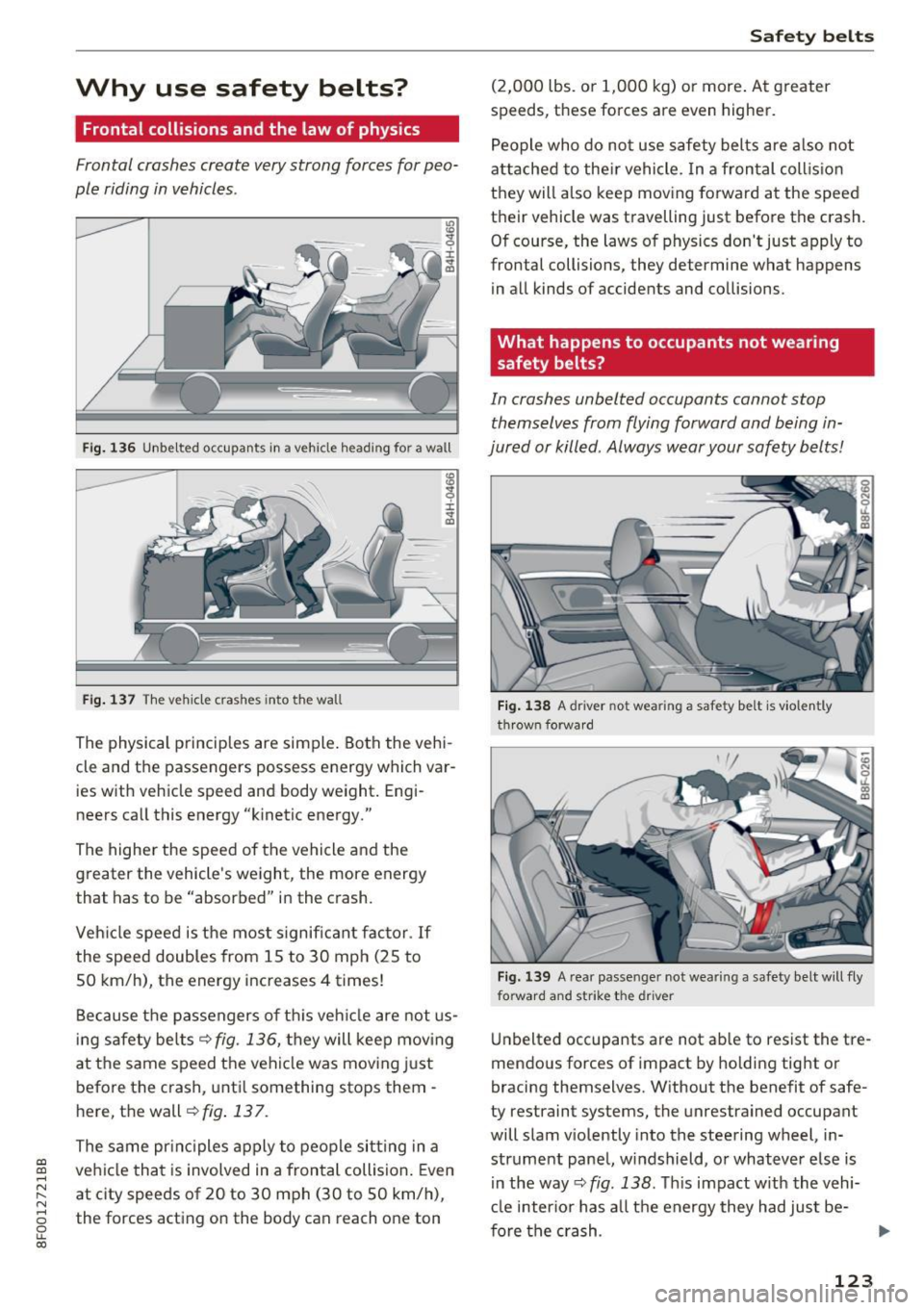
Fig. 136 Unbelted occupants in a vehicle heading for a wall
Fig . 137 The vehicle crashes into the wall
CD
~ ±
cle and the passengers possess energy which var
ies with vehicle speed and body weight. Engi
neers call this energy "kinetic energy."
The higher the speed of the vehicle and the
greater the vehicle's weight, the more energy
that has to be "absorbed" in the crash.
Veh icle speed is the most significant factor.
If
the speed doubles from 15 to 30 mph (25 to
50 km/h), the energy increases 4 times!
Because the passengers of this vehicle are not us
ing safety belts ¢
fig. 136, they will keep mov ing
at the same speed the vehicle was moving just
before the crash, until something stops them -
here, the wall
¢fig . 137.
The same principles apply to people sitting in a
~ vehicle that is involved in a frontal collision. Even ......
~ at city speeds of 20 to 30 mph (30 to 50 km/h), N
8 the forces acting on the body can reach one ton 0 LL co
Safety belts
(2,000 lbs. o r 1,000 kg) or more . At greater
speeds, these forces are even higher.
People who do not use safety belts are also not
attached to their vehicle. In a frontal collision
they will also keep moving forward at the speed
their vehicle was travelling just before the crash.
Of course, the laws of physics don't just apply to
frontal collisions, they determine what happens in all kinds of accidents and collisions.
What happens to occupants not wearing
safety belts?
In crashes unbelted occupants cannot stop
themselves from flying forward and being in
jured or killed . Always wear your safety belts!
Fig. 138 A driver not wea ring a safe ty belt is violen tly
throw n forwa rd
Fig . 139 A rear passe nge r not wea ring a safety belt will fly
forward and str ike t he driver
Unbelted occupants are not ab le to resist the tre
mendous forces of impact by holding tight or
bracing themselves. W ithout the benefit of safe
ty restraint systems, the unrestrained occupant
will slam v iolently into the steering wheel, in
strument panel, windshield, or whatever else is i n the way ¢
fig. 138. This impact w ith the vehi
cle inter io r has all the energy they had just be-
fore the crash . .,.
123