airbag off AUDI A5 CABRIOLET 2017 Owner's Manual
[x] Cancel search | Manufacturer: AUDI, Model Year: 2017, Model line: A5 CABRIOLET, Model: AUDI A5 CABRIOLET 2017Pages: 266, PDF Size: 66.64 MB
Page 144 of 266

Airbag syste m
-the adu lt on the front passenger seat is proper
ly seated on the center of the seat cushion with
his or her back up against the backrest and the
backrest is not reclined
r::>page 112, Correct
passenger seating positions,
-the adu lt is not taking weight off the seat by
holding on to the passenger assist handle
above the front passenger door or supporting
their we ight on the armrest,
- the safety belt is being properly worn and that
there is not a lot of slack in the safety belt web
bing,
- accessory seat covers or cushions or other
th ings that may cause an incorrect read ing or
impression on the weight-sensing mat under
the upho lstery of the seat have been removed
from the front passenge r seat,
- a safety be lt extender has not been left in the
safety belt latc h for the front passenge r seat.
In addition to the
PASSE NGER AIR BAG OFF
light in the center of the instrument panel, the
message
PASSENGER AIR BAG OFF or PASSEN
GER AIR BAG ON
w ill briefly appear in the inst ru
ment cluster display . T his is to inform the driver
of the current front passenger airbag status.
Important safety instructions on
monitoring the Advanced Airbag System
A WARNING
An airbag system that is not funct ion ing prop
er ly cannot p rovide supplemental p rotection
in a frontal crash.
- If the airbag indicato r light
c> page 17
comes when the vehicle is be ing used, h ave
the system inspected immediate ly by yo ur
authorized Aud i dealer. It is possible that
the airbag will inflate when it is not s up
posed to, or will not inflate when it should.
A WARNING
If the front airbag inflates, a child without a
child restraint, in a rearward-facing child safe
ty seat or in a forward-facing child restraint
that has not been properly installed will be
ser iously injured and can be killed .
142
-Even though your vehicle is equipped with
an Advanced A irbag System, make certain
that all children, espec ia lly 12 years and
younger, always ride on the back seat prop
erly restrained for their age and s ize.
- Always install forward or rear-facing child
safety seats on the rear seat -even with an
Advanced A irbag System.
- If you must install a rearward-facing child
safety seat on the front passenger seat be
cause of exceptional circumstances and the
PASSENGER AIR BAG OFF l ight does not
appear and s tay on, immedi ately ins tall the
rear-facing child safety seat in a re ar seat ing
position and have the a irbag system in
spected by your a uthorized Audi dea ler.
- A t ight tether or other s trap on a rearward
facing chi ld restraint attached to the front
passenger seat can put too much pressure
on the weight-sensing mat in the seat and
register more weight than is actually on the
seat. The heavier weight registered can
make the system work as thoug h an adu lt
were on the seat and deploy the Advanced
Airbag when it must be suppressed causing
serious or even f atal injury to the child.
- If, in exceptional circumstances, you must
install a forward-fa cing child res traint on
the front p assenge r seat, always move the
seat into i ts rearmost posi tion in the sea t's
fore and aft ad justment range, as far away
from the ai rbag as possible . The back rest
must be adjusted to an upr ight position.
Make sure that the
PASSENGER AIR BAG
OFF
li ght comes on and stays on all the time
wheneve r the ignit ion is switched on.
A WARNING
- If the PASSENGER AIR BAG OFF light does
not go out when an adult is sitting on the
front passenger seat afte r taking the steps
described above, make s ure the adult is
p roper ly sea ted and restra ined at one o f the
rear sea ting posit ions .
- Have the ai rbag system inspec ted by your
author ized Audi dealer befo re t ransporting
anyone on the front passenger seat.
Page 145 of 266
a:,
a:,
...... N r--. N ...... 0
0
LL 00
(D Tips
If the weight-sensing mat in the front passen
ger seat detects an empty seat, the front air
bag on the passenger side will be turned off,
and
P ASS ENGER AIR B AG OFF will stay on.
Repair , care and disposal of the airbags
Parts of the a irbag system are installed at many
d ifferent p laces on your Aud i. Installing, remov
ing, servicing o r repa iring a part in an area of the
vehicle can damage a pa rt of an airbag system
and prevent that system from working properly in a co llision.
There are some importa nt things you have to
know to make sure that the effectiveness of the
system w ill not be impaired and that discarded
components do not cause injury or pollute the
environment.
A WARNING
Improper care, serv icing and repair proce
dures can increase the r isk of personal injury
and death by preventing an airbag from de
ploying when needed or deploying an airbag
unexpectedly :
-
-Never cover, obstruct, or change the steer
ing wheel horn pad or a irbag cover or the in
strument panel or mod ify them in any way .
- Never attach any objects such as cupholders
or telephone mountings to the surfaces cov
er ing the airbag units .
- For cleaning the horn pad or instrument panel, use only a soft, dry cloth or one mois
tened with plain water. Solvents or cleaners
cou ld damage the a irbag cover or change
the stiffness or strength of the mater ial so
that the airbag cannot dep loy and protect
properly.
- Never repair, adjust, or change any parts of
the airbag system.
- All work on the stee ring wheel, instr ument
pane l, front seats or electrical system (in
cluding the installation of audio equipment,
cellu lar telephones and CB radios, etc .)
must be performed by a qualified technician
Airb ag sys tem
who has the training and special equ ipment
necessary.
- For any wo rk on the airbag system, we
strong ly recommend that you see your au
thorized Audi dealer or qualified workshop .
- Never modify the front bumper or parts of
the vehicle body.
- Always make sure that the side a irbag can
inflate without interference:
- Never install seat covers or replacement
upholstery ove r the front seatbacks that
have not been specifica lly approved by
Audi .
- Never use addi tional seat cushions that
cove r the areas where the side airbags in
flate.
- Damage to the orig inal seat cove rs or to
the seam in the area of the s ide airbag
module must a lways be repaired immedi
ate ly by an authorized Aud i dealer.
- The airbag system can be activated only
once . A fter an airbag has inflated, it must
be replaced by an authorized Audi dealer or
qualified technic ian who has the technical
information, t raining and spec ial equ ipment
necessary.
- The airbag system can be deployed only
once . After an airbag has been deployed, it
must be replaced with new rep lacement
parts des igned and approved especially for
your Aud i model version. Replacement of
comp lete airbag systems or airbag compo
nents must be performed by qualified work
shops only. Ma ke sure that any airbag serv
ice act ion is en tered in your Aud i Wa rranty
& Maintenance booklet under AIRBAG RE
PLACEMENT RECORD.
- In accidents when an airbag is dep loyed, the
vehicle battery separates the alternator and
the starter from the veh icle electrical sys
tem for safety reasons w ith a pyrotechnic
circu it interrupter.
- Wo rk on the pyrotechnic c ircuit inte rrupt
er must on ly be performed by a qu alified
dealer -risk of an acc ident!
- If the vehicle or the circuit interr upter is
scrapped, all applicable safe ty p recautions
must be followed .
143
Page 146 of 266
Airbag system
@ For the sake of the environment
Undeployed airbag modu les and pretension
ers might be classified as Perchlorate Materi
al -special handling may apply, see
www.dtsc.ca.gov/hazardouswaste/perchlo rate . When the vehicle or parts of the re
straint system including airbag modules safe
ty belts with pretens ioners are scrapped, all
applicable laws and regulat ions must be ob
served. Your authorized Audi dealer is familiar
with these requirements and we recommend
that you have your dealer perform this service
for you.
Other things that can affect Advanced
Airbag performance
Changing the vehicle's suspension system can
cha nge the way that the Advanced Airbag System
pe rforms in a crash. For example, using tire-r im
comb inat ions not approved by Audi, lower ing the
veh icle, changing the stiffness of the suspens ion,
including the spr ings, suspension struts, shock
absorbers etc . can change the forces that are
measured by the airbag sensors and sent to the
electronic control unit . Some suspens ion changes
can, for example, increase the force levels meas
ured by the sensors and make the airbag system
deploy in crashes in wh ich it would not deploy if
the changes had not been made. Other ki nds of
changes may reduce the force levels measured by
the sensors and preven t the airbag from deploy
ing when it should .
A WARNING
Changing the vehicle's suspension including
use of unapproved tire-rim combinations can
change Advanced A irbag performance and in
crease the risk of serious personal injury in a
crash.
- Never install suspension components that
do not have the same performance charac
teristics as the components originally insta l
led on your veh icle .
- Never use tire-rim comb inations that have
not been approved by Audi.
144
A WARNING
Items stored between the safety belt buckle
and the center console can cause the sensors in the buckle to send the wrong information
to the electronic control module and prevent
the Advanced A irbag System from working
properly.
- Always make sure that nothing can inte rfe re
w ith the safety belt buckles and that they
are not obstructed.
Knee airbags
Description of knee airbags
Applies to: vehicles with knee airbags
The knee airbag system can provide supplemen
tal protection to properly restrained front seat
occupants.
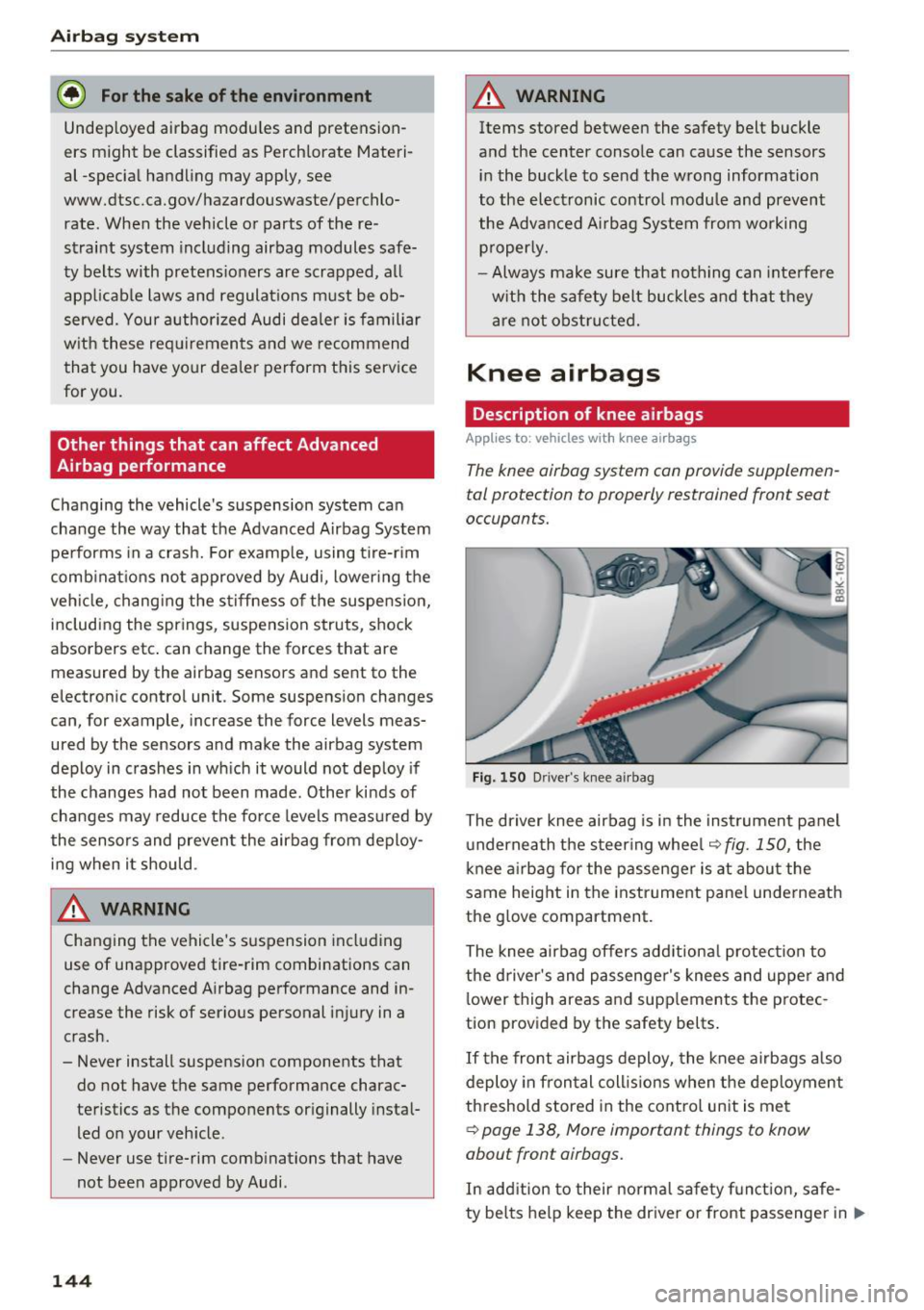
Fig. 150 Driver's knee a irbag
The driver knee airbag is in the instrument panel
underneath the steering whee l~
fig. 150, the
knee airbag for the passenger is at about the
same height in the instrument panel underneath
the g love compartment.
The knee airbag offers additional protection to
the driver's and passenger's knees and uppe r and
l ower thigh areas and supp lements the protec
tion provided by the safety belts .
If the front airbags deploy, the knee airbags also
deploy in frontal collis ion s when the deployment
th reshold stored in the control unit is met
~ page 138, More important things to know
about front airbags.
In addition to their normal safety funct ion, safe-
ty belts help keep the driver or front passenger in
IJJ>
Page 147 of 266
position in a frontal collision so that the airbags
can provide supplemental protection.
The airbag system is not a s ubst itute for yo ur
safety belt. Rather, it is part of the overa ll occu
pant restraint system in your vehicle. Always re
member that the airbag system can only help to
protect you if you are wearing your safety belt
and wear ing it properly . This is why you should
always wear your safety belt, not just because
the law requires you to do soc::,
page 122, Gener
al information.
Remember too, airbags will deploy only once and
only in certain k inds of accidents -your safety
be lts
a re always there to offer protection in those
accidents in which airbags are not supposed to
deploy or when they have a lready dep loyed, for
examp le when yo ur vehicle str ikes or is str uck by
anothe r afte r the f irst collis ion.
This is just one of the reasons why an airbag is
not a substitute for the safety belt. The a irbag
sys tem wo rks most effec tively when used with
the safety belts. Therefore , al ways wear your
safety bel ts cor rect ly .
It is important to remember that while the sup
p lemental knee a irbag sys tem is designed to re
d uce the like lihood of serious injur ies, other inju
ries, fo r example, swell ing, b ruising, and m inor
abrasions and fr iction burns can also occu r when
an airbag inflates.
The kne e airbag system basically consists of:
- The electronic contro l modu le
- Two inf latab le airbags (airbag and gas genera-
tor), one for the dr ive r and one fo r the front
passenge r
- T he airbag ind icator light in the instrument
pane l
The knee airbag system will not deploy:
-when the ignition is turned off
- in frontal collisions when the deceleration
measured by the control unit is too low
- in side collisions
~ -in rear-end collisions ......
~ -in rollovers N ...... 0
0
LL co
Airb ag sys tem
-in the event of a system malfunction (warning/
indicator light is on)
c::, poge 17.
A WARNING
-
-Safety belts and the airbag system can only
provide protect ion when occupants are in
the proper seat ing pos ition c::,
page 138.
-If the airbag indicator light c::, page 17
comes w hen the veh icle is being used, have
the system inspected immediately by your
author ized Audi dealer. It is possible that
the airbag will inflate when it is not sup
posed to, or w ill not inflate w hen it should.
How knee airbags work
Applies to: vehicles with knee airbags
The risk of injury to the leg area can be reduced
by fully deployed knee airbags.
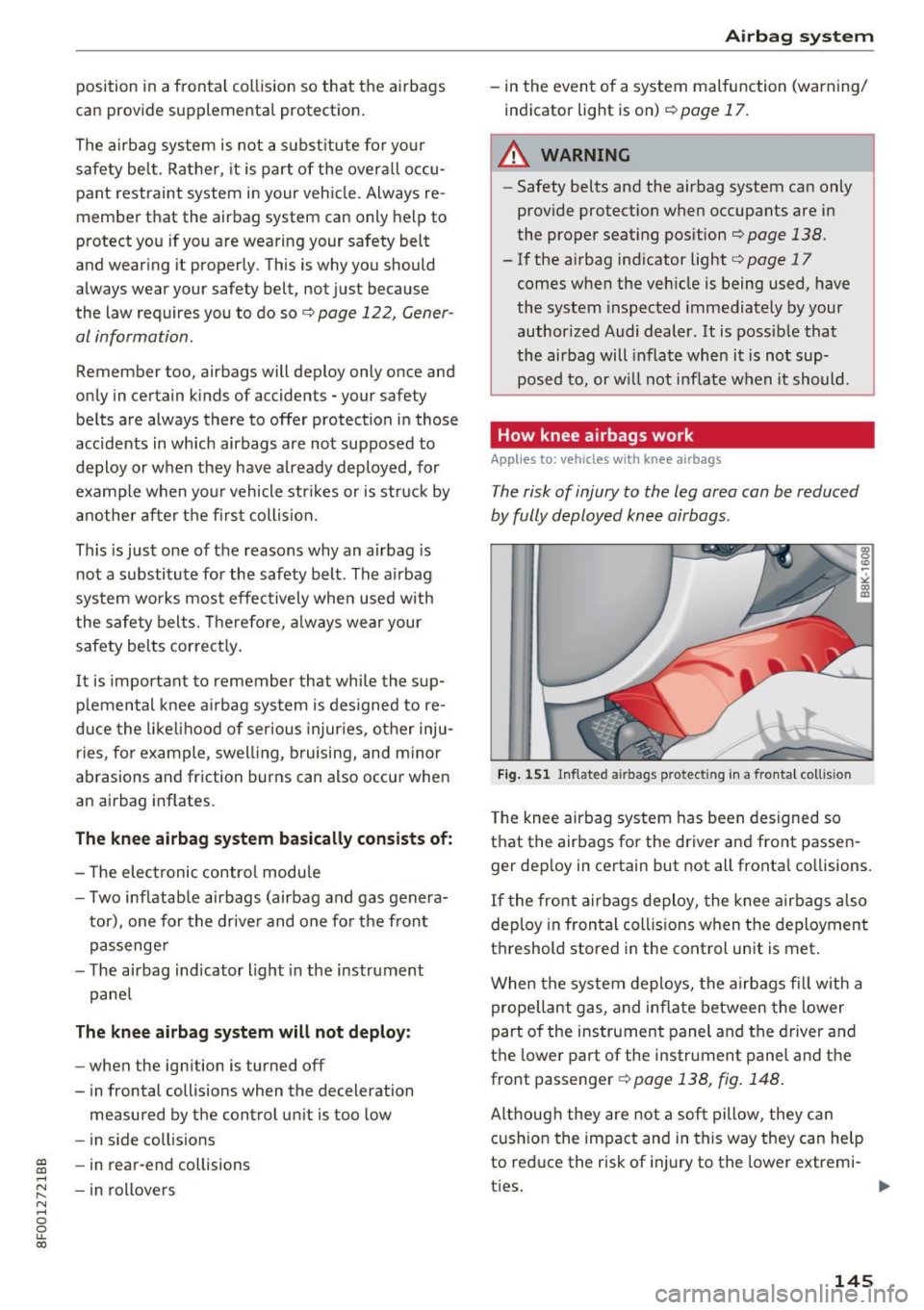
F ig . 15 1 Inflated ai rbags protecting in a fronta l co llision
T he knee air bag system has been designed so
t h at the airbags fo r the driver and front passen
ger dep loy in certain but not all fronta l co llisions.
If t he front airbags deploy, the knee a irbags also
deploy in frontal coll is ions when t he deploy ment
th reshold stored in the cont rol unit is met .
When the system deploys, the a irbags fi ll with a
prope llant gas, and infla te between the lower
part o f the instrument panel and t he driver an d
the lowe r part of the instrument panel and the
front passenger
c::, page 138, fig . 148 .
Although they are not a soft pillow, they can
cush io n the impact and in th is way they can help
to red uce the risk of in jury to the lower extremi-
ties . ""
145
Page 149 of 266

a:,
a:,
...... N r--. N ...... 0
0
LL 00
-the e lectron ic control modu le and externa l side
impact sensors
- the two side airbags located in the sides o f the
front backrests
- the a irbag warning light in the inst rument cl us-
ter.
The a irbag system is monitored electronically to
make certa in that it is func tioning properly at all
times. Each time you turn on the ignit ion, the air
bag system indicator light will come on for a few
seconds (self diagnostics).
The s ide a irbag system supp lements the safety
be lts and can help to reduce the risk of injury to
the driver's and fron t passenger 's upper torso on
the side of the vehicle that is struck in a side col lision. The airbag d eploys on ly in side impacts
and only when the veh icle acceleration reg istered
by the contro l unit is high enough. If this rate is
below the reference value programmed into the
control un it, the s ide a irbags w ill not be tr ig
gered, even though the car may be badly dam
aged as a resu lt of the collision .
It is not possib le
to define an airbag trigge ring range that w ill cov
e r every possible angle of impact, since the ci r
cumstances wi ll vary considerably between one
collision and another. Important factors include,
for examp le, the nature (hard or soft) of the im
pacting objec t, the ang le of impact, vehicle
speed, etc. ¢
page 148, Impor tant safety in
structions on the side airbag system .
Aside from their normal safety function, safety
be lts work to help keep the driver or front pas
senger in posit ion in the event of a side collision
so that the s ide a irbags can provide protection .
T he airbag system is
not a substitute for your
safety belt. Rather, it is part of the overa ll occu
pant restrain t system in your veh icle. Always re
member that the s ide a irbag system can only
h elp to protect yo u if you a re wearing your safety
be lt and wea ring it properly. This is another rea
son why you s hou ld always wear yo ur safety
be lts, not just bec ause the law req uires yo u to do
so ¢
page 122 , General information.
It is important to remember that wh ile the s up
p lemental s ide a irbag system is designed to re
d uce the likelih ood of serious injur ies, other inju-
Airb ag sys tem
ries, for example, swelling, bru is ing , and minor
abrasions can also be associated wit h deployed
s ide airbags . Remember too, s ide airbags will de
ploy only once and only in certain k inds of acci
den ts -your safety belts are always there to offer
protect io n.
Vehicle damage, repair costs or even the lack of
vehicle damage are not necessar ily an ind ication
of over-sens it ive or fa iled a irbag activation. In
some collisions, both front and side airbags may i nflate. Remember too, that a irbags w ill deploy
only once and only i n certa in kinds of collisions -
you r safety be lts are always there to offer protec
t ion in those accidents in wh ich airbags are no t
s u pposed to deploy or when they have already
deployed .
The side airbag system will not deploy:
-when t he ignit ion is t urned off
- in side collisions whe n the acceleration meas-
ured by the sensor is too low
- in front -end coll is ions
- in rear-end collisions
- in rollovers.
In some types of accidents the fron t air bags and
s ide airbags may be triggered togethe r.
.&, WARNING ~
- Safety belts and the airbag system will only
provide protect ion when occupants are in
the proper seat ing pos ition ¢
page 148 .
-If the ai rbag ind icator light¢ page 17
comes when the veh icle is being used, have
the system inspected immediately by your
author ized Audi dealer. It is possib le that
the airbag will inflate when it is not sup
posed to, or w ill not inflate w hen it should .
147
Page 153 of 266

a:,
a:,
...... N r--. N ...... 0
0
LL 00
exceptional circumstances and the PASSEN·
GER AIR BAG OFF
light does not come on
and stay on, immediately insta ll the rear
ward-facing child safety seat in a rear seat
ing posit ion and have the airbag system in
spected immediately by your authorized
Audi dealer.
A WARNING
If, in except ional circumstances, you must in
stall a forward-facing chi ld restraint on the
front passenger's seat :
- Always make sure the forward-fac ing seat
has been designed and certified by its man
ufacturer for use on a front seat with a pas
senger front and s ide airbag .
- Always follow the manufac turer 's instruc
tions provided with the chi ld safety seat or
carrier.
- Always move the passenger seat into its
rearmost position in the seat's fore and aft
adjustment range, as far away from the air
bag as possib le before installing the child
restra int. The backrest must be adjusted to
an upr ight position.
-Always make sure that the
PA SSENGER AIR
B AG OFF
light comes on and stays on all the
t ime whenever the ignition is switched on.
Always replace ch ild restraints that were in
stalled in a vehicle dur ing a crash. Damage to
a child restraint that is not visib le could cause
it to fail in another collision situation.
Advanced front airbag system and children
Your veh icle is equipped with a front "Advanced
A irbag System" i n compliance w ith United States
F edera l Moto r Vehicle Safety Standard ( FMVSS)
208, as well as Canada Motor Ve hicle Safety
Standard (CMVSS) 208 as applicable at the time
your vehicle was manufactured .
The Advanced Airbag system in your ve hicle has
been ce rtified to meet the " low-risk" requ ire
ments for 3 -and 6-yea r old children on the pas
senger side and sma ll adults on the driver side .
Child safety
The low risk deployment criteria a re intended to
reduce the risk of injury through interaction with
the a irbag that can occur, for example, by be ing
too close to the steering wheel and instrument panel when the airbag inflates. In addition, the
system has been certified to comply with the "suppression" requirements of the Safety Stand·
ard, to turn off the front airbag for infants up to
12 months who are restrained on the front pas
senger seat in ch ild rest raints that are listed in
the Standard.
Even though your veh icle is equipped with an Ad·
vanced Airbag system, all ch ild ren, especially
those 12 yea rs and you nger, sho uld a lways ride
in the back seat proper ly restrained for their age
and size . The airbag on the passenger side makes
the front seat a potentially dangerous p lace for a
child to ride. The front seat is not the safest place
for a ch ild in a forward-fac ing ch ild safety seat. It
can be a very dangerous place for an infant or a
larger ch ild in a rearward-facing seat .
' Advanced Airbags and the weight-sensing
mat in the front seat
The Advanced A irbag System in your vehicle de
tects the presence of an infant or chi ld in a chi ld
restraint on the front passenger seat using the
weight -sensing mat in the seat cushion and the
sensor below the safety belt latch on the front
passenger seat that measures the tens ion on the
safety belt.
The weight-sensing mat measures total weight of the child and the chi ld safety seat and a child
blanket on the front passenger seat . The weight
on the front passenger seat is related to the de
s ign of the child restra int and its "footprint", the
s ize and shape of the bottom of the ch ild re-
straint as it sits on the seat. The weight of a ch ild
restra int and its "footprint" va ry for different
k inds of child restra ints and for the different
models of the same kind o f chi ld rest raint of -
fered by chi ld restraint manufacturers.
T he we igh t ranges for the indiv id ual types,
makes and mode ls of ch ild restraints that the
NH TSA has specified in the Safety Standard to
gether with the weight ranges of typical infants .,.
15 1
Page 154 of 266
Child safet y
and typical 1 year -old child have been sto red in
the co ntrol unit of the Advanced Airbag System.
When a chi ld restra int is being used on the front
passenger seat with a typical 1 year-old child, the
Advanced Airbag System compares the we ight
measured by the we ight sensing mat with the in
formation stored in the electronic control unit.
The electronic control un it also registers the ten
sion on the front passenger safety belt. The ten
sion on the safety belt for the fro nt passenger
seat will be d ifferent for an adult w ho is p roperly
using the safety belt as compared to the tension
on the belt w hen it is used to attach a ch ild re
s tra int to the sea t. The senso r below the la tch for
t he safety belt for the front sea t passenger
measures the tension on the belt. The inp ut from
this senso r is then used with the weight to "de
cide", whether there is a child restra int w ith a
typical 1 year-old child on the front passenge r
seat and whether or not the a irbag must be
turned off.
Child restraints and Advanced Airbags
Regard less of the child restra int tha t you use,
make su re that it h as been cert ified to meet Safe
ty Standa rds and has been certified by its manu
facture r for use wi th an a irba g. A lways be sure
t hat the chi ld restrain t is properly insta lled at
one of the rear seating positions . If in exception
al c ircumstances yo u m ust use it on the front
passenger seat, carefully read all of the informa
tion on child safety and Advanced Airbags and heed a ll of the app licab le WARNINGS . Make cer
tain tha t the child res tra int is correc tly recog
n iz ed by the we ight-sens ing mat inside the front
passenger seat, that t he fron t passe nger a irbag
is t urned off and tha t the airbag st atus is always
corre ct ly sign aled by the
PASSENGER AIR BAG
OFF li ght .
M any types and mo dels of child res traints have
been available ove r the ye ars, new mode ls are in
troduce d regularly inco rpora ting new and im
p roved designs and o lder mode ls are taken o ut of
product ion . Chi ld restraints a re not standardized .
Ch ild restraints of the same type typ ica lly have
d ifferent weights and s izes and d ifferent 'foot
prints,' the size a nd shape of the bottom of t he
152 ch
ild restraint t hat sits on the seat, when they
a re installed on a vehicle seat . These differences
make it virtua lly impossib le to certify comp liance
with the requirements for advanced a irbags w ith
each and every child restra int that has ever been
sold in the past or wi ll be sold over the course of
t h e usefu l life of your vehicle .
For t his reason, the United States National High
way Traffic Safety Admin istrat ion has published a
li st of specific type, makes and mode ls of ch ild
res tra ints tha t must be used to certify compli
ance of the Advanced Airbag System in your ve hi
cl e w ith the s uppression requirements of Federa l
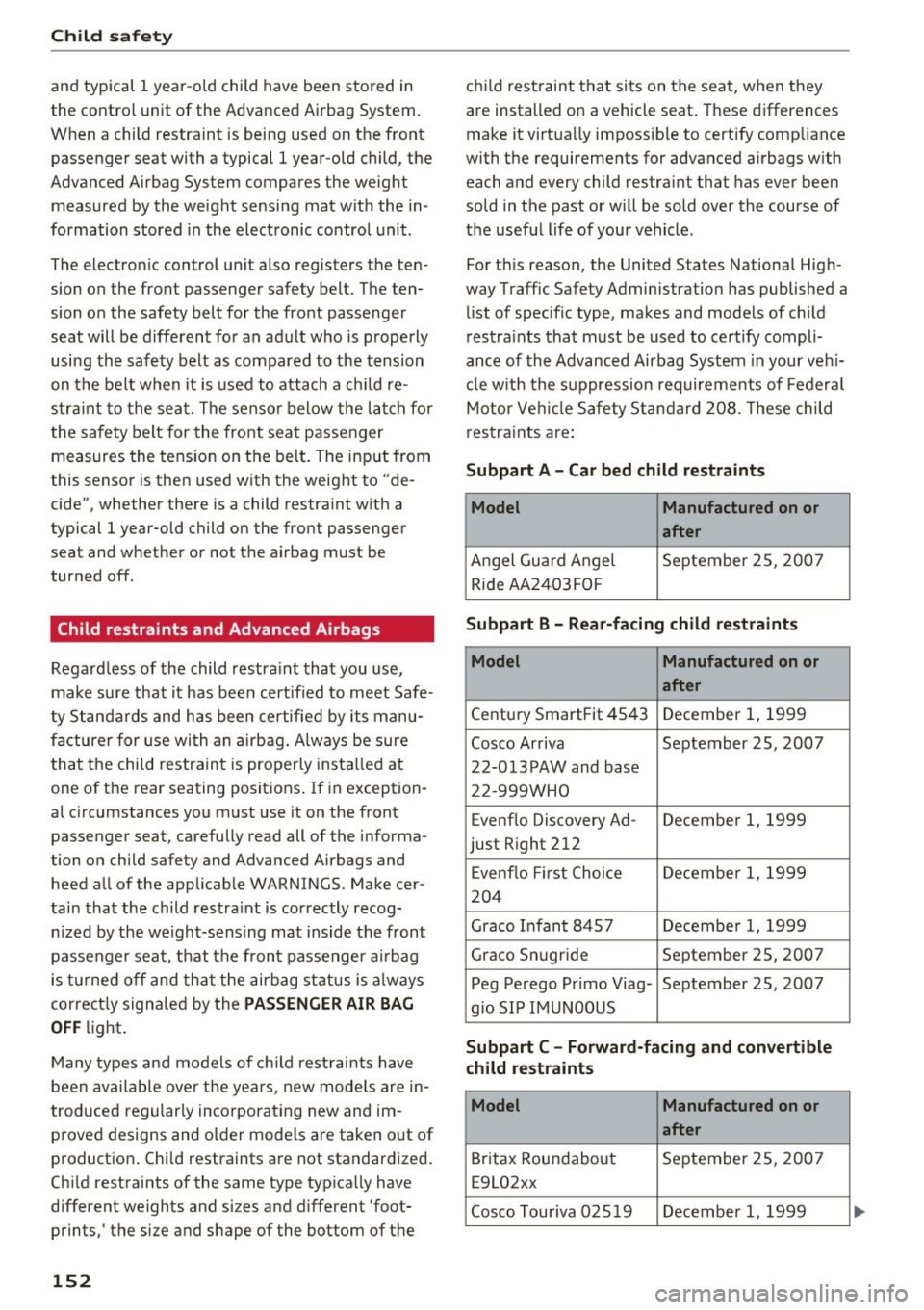
Mot or Ve hicl e Safety St and a rd 208. These child
r es tra ints are :
Subpart A- Car bed child restraints
Model Manufactured on or
after
A ngel Guard Angel Se pte mber 2 5, 20 07
Ride AA 2403F OF
Subpart B - Rear-facing child restraints
Model Manufactured on or
after
Century SmartFit 4543 December 1, 1999
Cosco Arriva September 25, 2007
22-013PAW and base 22- 999WHO
Evenflo Discove ry Ad- December 1, 1999
just R ight 212
E ven flo Firs t Choi ce December
1, 1 999
2 04
Grace I nfant 8457 December 1, 1999
Grace Sn ugride September 25, 2007
Peg Perego Primo Viag- September 25, 2007
g io SIP I MUNOOUS
Subpart C -Forward-facing and convertible
child restraints
Model Manufactured on or
after
Br itax Roundabo ut September 25, 2007
E9L02xx
Cosco Tou riva 0 2519 December 1, 1999
...
Page 155 of 266
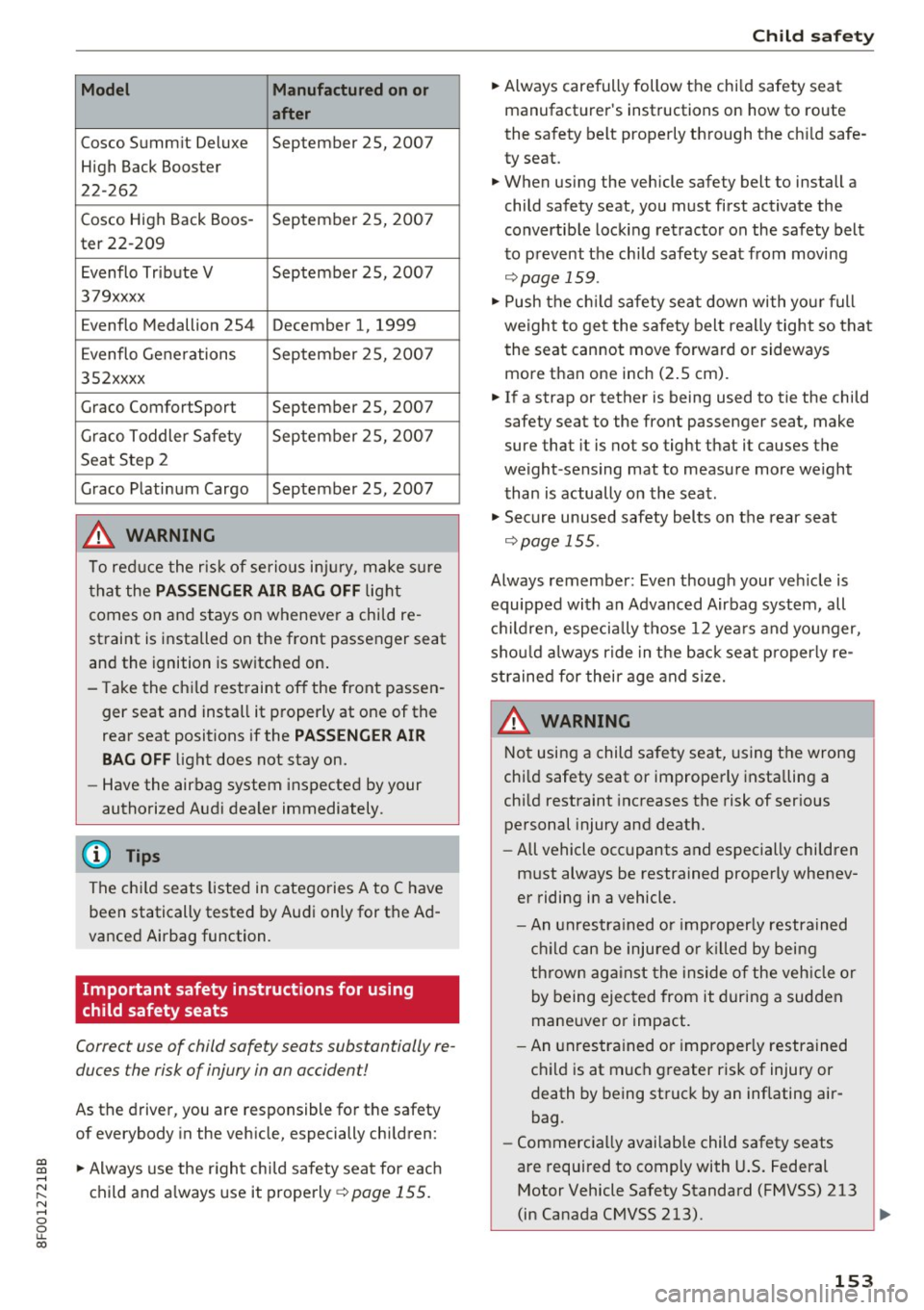
Model Manufactured on or
after
Cosco Summit Deluxe September 25, 2007
High Back Booster
22-262
Cosco High Back Boos -
September 25, 200 7
ter 22-209
Evenflo Tr ibute V September 25, 2007
379xxxx
Evenflo Medallion 254 December 1, 1999
Evenflo Generations September 25, 2007
352xxxx
Graco ComfortSport September 25, 2007
Graco Toddler Safety September 25, 2007
Seat Step 2
Graco Platinum Cargo September 25, 2007
.&, WARNING
To reduce the risk of serious inju ry, make sure
that the
PA SSEN GER AIR BAG OFF light
comes on and stays on whenever a child re
straint is installed on the front passenger seat
and the ignition is switched on.
- Take the child restraint off the front passen
ger seat and install it properly at one of the
rear seat positions if the
P A SSEN GER AIR
BAG OFF
light does not stay on.
- Have the airbag system inspected by your
authorized Audi dealer immediately.
(D Tips
The chi ld seats listed in categories A to C have
been statically tested by Audi only for the Ad
vanced Airbag function.
Important safety instructions for using
child safety seats
Correct use of child safety seats substantially re
duces the risk of injury in an accident!
As the driver, you are responsible for the safety
of everybody in the veh icle, especially children:
gi .,. Always use the right chi ld safety seat for each ......
~ child and a lways use it properly qpage 155. N ...... 0
0
LL 00
Child safety
.,. Always carefully follow the chi ld safety seat
manufacturer's instructions on how to route
the safety belt properly through the ch ild safe
ty seat.
.,. When using the vehicle safety belt to install a
child safety seat, you must first activate the
convertible locking retractor on the safety belt
to prevent the chi ld safety seat from moving
q page 159.
.,. Push the ch ild safety sea t down with yo ur full
weight to get the safety belt really tight so that the seat cannot move forward or sideways
more than one inch (2.5 cm).
.,. If a strap or tether is being used to tie the child
safety seat to the front passenger seat, make
sure that it is not so tight that it causes the
weight -sensing mat to measure more weight
than is actually on the seat .
.,. Secure unused safety belts on the rear seat
q page 155.
Always remember: Even though your veh icle is
equipped with an Advanced Airbag system, all
c hi ldren, especia lly t hose 12 yea rs and younger,
sho uld a lways ride in th e back seat p roper ly re·
strained for their age and s ize.
A WARNING
=
Not using a child safety seat, using the wrong
chi ld safety seat or improperly insta lling a
chi ld restraint increases the risk of serious
personal injury and death.
- All vehicle occupants and especially children
must always be restrained properly whenev
er riding in a vehicle.
- An unrestra ined o r improperly restrained
c hi ld can be injured o r killed by being
thrown aga inst the inside of the veh icle or
by being ejected from it during a sudden
maneuver or impact.
- An unrestra ined or improperly restrained
child is at much greater risk of injury or
death by being struck by an inflating air bag.
- Commercially availab le child safety seats
are requi red to comply with U .S. Federal
Motor Vehicle Safety Standard (FMVSS) 213
(in Canada CMVSS 213). ..,_
153
Page 156 of 266
Child safety
-When buying a child restraint, select one
that fits your child and the vehicle.
- Only use child restraint systems that fully
contact the flat portion of the seat cush
ion. The child restraint must not tip or
lean to either side. Audi does not recom
mend using child safety seats that rest on
legs or tube-like frames . They do not pro
vide adequate contact with the seat.
- Always heed all legal requirements per
taining to the installation and use of child
safety seats and carefully follow the in
structions provided by the manufacturer
of the seat you are using.
- Never allow children under 57 inches
(1.45 meters) to wear a normal safety belt.
They must always be restrained by a proper
child restraint system. Otherwise, they
could sustain injuries to the abdomen and
neck areas during sudden braking maneu
vers or accidents.
- Never let more than one child occupy a child
safety seat.
- Never let babies or older children ride in a
vehicle while sitting on the lap of another
passenger .
- Holding a child in your arms is never a sub
stitute for a child restraint system.
- The strongest person could not hold the
child with the forces that exist in an acci
dent. The child will strike the interior of
the vehicle and can also be struck by the
passenger.
- The child and the passenger can also in
jure each other in an accident.
- Never install rearward-facing child safety
seats or infant carriers on the front passen
ger seat. A child will be seriously injured and
can be killed when the passenger airbag in
flates -even with an Advanced Airbag Sys
tem .
- The inflating airbag will hit the child safe
ty seat or infant carrier with great force
and will smash the child safety seat and
child against the backrest, center arm
rest, door or roof.
- Always install rearward-facing child safety
seats or infant carriers on the rear seat.
154
-Forward-facing child safety seats installed
on the front passenger's seat can interfere
with the airbag when it inflates and cause
serious injury to the child . Always install for
ward-facing child safety seats on the rear seat .
- If exceptional circumstances require the use
of a forward-facing child restraint on the
front passenger's seat, the child's safety
and well-being require that the following
special precautions be taken:
- Make sure the forward-facing seat has been designed and certified by its manu
facturer for use on a front seat with a pas
senger front and side airbag .
- Always carefully follow the manufacturer's
instructions provided with the child safety
seat or carrier.
- Always move the front passenger seat into
the rearmost position of the passenger
seat's fore and aft adjustment range, and
as far away from the airbag as possible be
fore installing the child restraint.
- Always make sure that nothing prevents
the front passenger's seat from being
moved to the rearmost position in its fore
and aft adjustment range.
- Always make sure that the backrest is in
the upright position.
- Always buckle the child safety seat firmly in
place even if a child is not sitting in it. A
loose child safety seat can fly around during
a sudden stop or in a collision.
- Always read and heed all WARNINGS when
ever using a child restrained in a vehicle is
being used¢
page 122, Safety belts,
¢ page 130, Airbag system
and
¢ page 150, Child safety.
A WARNING
To reduce the risk of serious injury, make sure
that the
PASSENGER AIR BAG OFF light
comes on and stays on whenever a child re
straint is installed on the front passenger seat
and the ignition is switched on. ..,.
Page 157 of 266
a:,
a:,
...... N
" N ...... 0
0
LL co
-Take the child restraint off the front passen
ger seat and install it properly at one of the
rear seat positions if the
PASSENGER AIR
BAG OFF
light does not stay on.
- Have the airbag system inspected by your
authorized Audi dealer immediately.
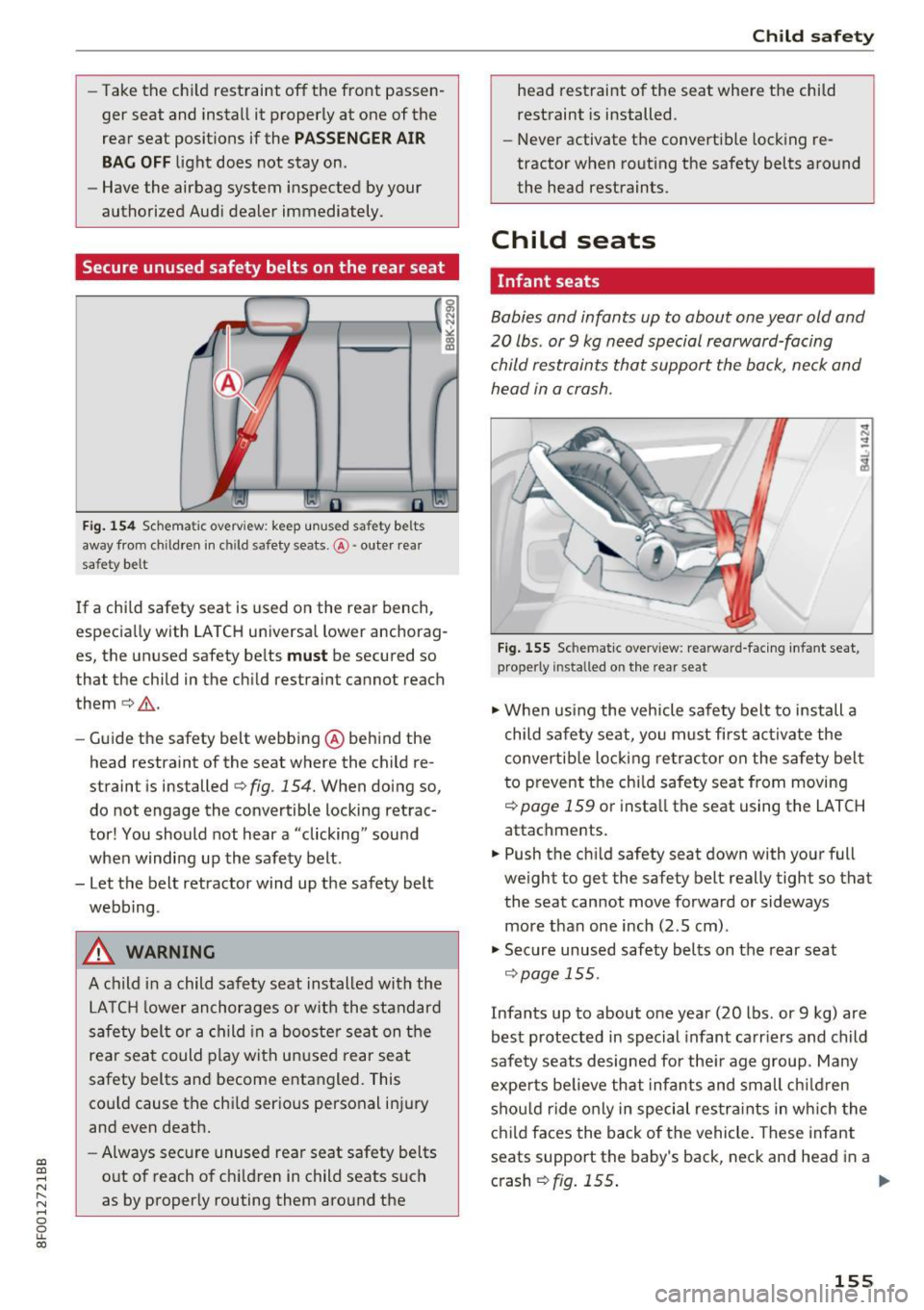
Secure unused safety belts on the rear seat
Fig. 154 Schemat ic overv iew: keep unused s-afety belts
away from children in chil d safety seats. @-oute r rear
sa fety belt
If a chi ld safety seat is used on the rear bench,
especially with LA TCH universal lower anchorag
es, the unused safety belts
must be secured so
that the child in the child restraint cannot reach
them
c::> ,& .
-Guide the safety belt webbing @behind the
head restraint of the seat where the child re
straint is installed
c::> fig . 154. When doing so,
do not engage the convertible locking retrac
tor! You should not hear a "clicking" sound
when winding up the safety belt .
- Let the belt retractor wind up the safety belt
webbing .
A WARNING
A child in a child safety seat installed with the
LATCH lower anchorages or with the standard
safety belt or a child in a booste r seat on the
rear seat could play with unused rear seat
safety belts and become entangled. This
cou ld cause the chi ld serious personal injury
and even death.
- Always secure unused rear seat safety belts
out of reach of children in child seats such
as by proper ly routing them aro und the
Child safety
head restraint of the seat where the child
restraint is installed .
- Never activate the convertible locking re
tractor when routing the safety belts around
the head restraints.
Child seats
Infant seats
Babies and infants up to about one year old and
20 lbs. or
9 kg need special rearward-facing
child restraints that support the back , neck and
head in a crash.
Fig. 155 Schematic overview: rearward -facing infant seat,
p roper ly insta lled o n the rear seat
... When using the vehicle safety belt to install a
child safety seat, you must first activate the
convertib le locking retractor on the safety belt
to prevent the child safety seat from moving
c::>poge 159 or install the seat using the LATCH
attachments.
... Push the ch ild safety seat down with your full
weight to get the safety belt really tight so that
the seat cannot move forward or sideways more than one inch (2 .5 cm) .
... Secure unused safety belts on the rear seat
c::>page 155.
Infants up to about one year (20 lbs. or 9 kg) are
best protected in special infant carriers and child
safety seats designed for their age group . Many
experts believe that infants and small children
shou ld ride only in special restraints in which the
child faces the back of the vehicle. These infant
seats support the baby's back, neck and head in a
crash
r=;, fig. 155 . .,..
155