battery AUDI A5 CABRIOLET 2017 Owner's Manual
[x] Cancel search | Manufacturer: AUDI, Model Year: 2017, Model line: A5 CABRIOLET, Model: AUDI A5 CABRIOLET 2017Pages: 266, PDF Size: 66.64 MB
Page 208 of 266
Check ing and F illing
CJ) Note
Never use a fast charger as a booster to start
the engine . This will serio us ly damage sensi
tive electronic components, such as control
un its, relays, radio, etc., as well as the battery
charger .
Battery replacement
The new ba ttery mu st have the same specifica
tions and dimensions as the original equipmen t
battery .
Intelligent energy management in your vehicle is
responsible for dist ributing the electrical energy
throughout your vehicle¢
page 173. The inte lli
gent ene rgy ma nagement system wi ll keep the
eng ine batte ry charged better the n ve hicles w ith
ou t th is system . To make su re the addit io nal
e lec trica l energy is avail ab le on ce again after you
h a ve changed the battery, we recommend t hat
you insta ll batteries o f the same type an d manu
facture on ly (t he same as those insta lled at the
time your veh icle was delive red). Spec ificat ions
are listed on the battery housing. Your author
ized Audi dealer must code the battery in the en
ergy management system to enab le you to use
the energy manageme nt functions correctly after
replacing the battery .
If it is not possible to use a battery of th is type,
the new battery must have the same capacity ,
voltage (12-volts) , ampe rage, construct ion and
p lug sealing.
When insta lling the battery, make sure the igni
tion and all electrical consumers are tur ned off .
@ Note
Make sure the ventilation hose on the side of
the batte ry is connected, othe rw ise fumes or
battery acid can lea k out.
@ For the sake of the environment
Because of the prob lem of proper disposal of
a battery, we recommend your author ized
Audi dea le r change the battery fo r you. Bat
t er ies con ta in su lf ur ic ac id a nd lead a nd must
always be disposed of prop erly i n comp lianc e
206
with a ll environmenta l re gu lations . Disposing
of veh icle batteries im properly is very danger
ous to t he environment.
Windshield/headlight*
washer container
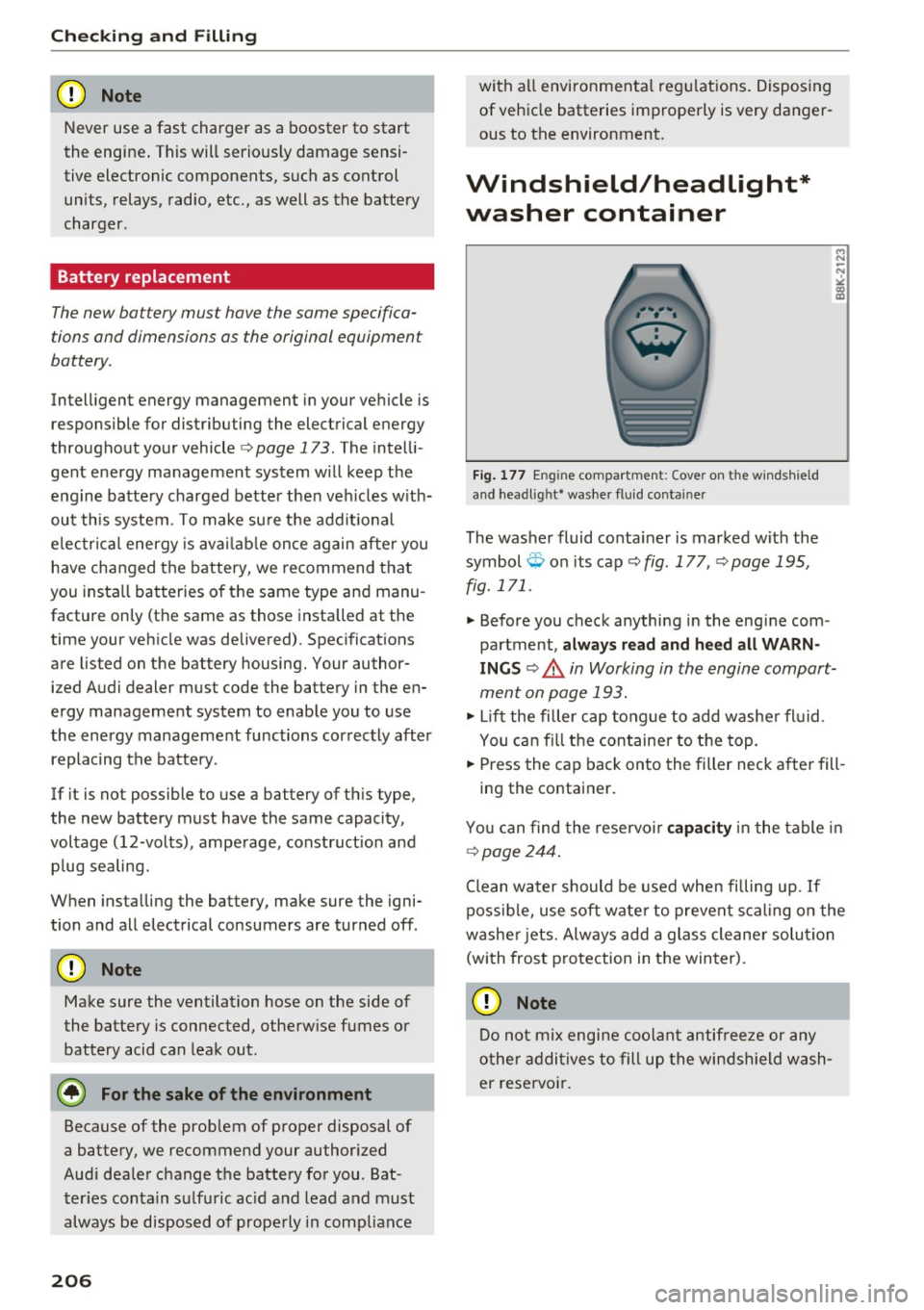
Fig. 177 En gin e compar tment: Cove r on the w inds hield
a n d head lig ht* was he r flu id conta iner
The washer fluid co nta iner is marked with the
symbol
Q on its cap ~ fig. 177, ¢ page 195,
fig. 1 71.
M N
-N ,.:
"' m
.. Before you check anythi ng i n the engine com
partment,
always read and heed all WARN
INGS ¢ .& in Working in the engine compart
ment on page 193.
.. Lift the fi ller cap to ngue to add w ashe r fl uid .
You c an f ill the containe r to t he top .
.. Press the ca p back on to the filler neck a fte r fill -
ing the contai ner.
Yo u c an find the reservo ir
capacity in t he table in
~page 244.
Clean water should be used when filling up . If
possible, use soft wate r to preve nt scaling on the
w ashe r jets. Alw ays add a glass cleane r solu tion
(wi th fros t protection in the win ter) .
@ Note
Do n ot mix engi ne coolan t antifree ze or any
o the r ad ditive s t o fill u p the wi ndshi eld wash
er reservo ir.
Page 213 of 266

"' "' .... N ,.._ N .... 0
0
u. a:,
Maximum (permissible )
inflat ion pressure
means the maximum cold infla
tion pressure to wh ich a t ire may
be inflated . Also called "maxi
mum inflation pressure ."
Normal occupant weight
means 150 lbs . (68 kilograms)
times the numbe r of occupants
seated in the veh icle up to the to
tal seating capacity of your vehi
c le .
Occupant distribution
means distribution of occupants
in a vehicle .
Outer diameter
means the overall diameter of an
inflated new tire .
Overall width
means the linear dis ta n ce be
tween the exteriors of the side
walls of an inflated tire, inc luding
e levations due to labeling, deco
rations, or protect ive bands or
ribs.
Ply
means a layer of rubber-coated
parallel cords .
Wheels
Production options weight
means the combined weight of
those installed regular production
options weighing over 5 lbs. (2.3 kg) in excess of those standard
items which they replace, not pre
viously considered in curb weight
or accessory weight , including
heavy duty brakes, ride levelers,
heavy duty battery, and special
trim .
Radial ply tire
means a pneumatic tire in which
the ply cords that extend to the
beads are laid at substantia lly 90
degrees to the centerline of the
tread .
Recommended inflation
pressure
see c:::> page 210, Cold tire infla
tion pressure .
Reinforced tire
means a tire designed to operate
at higher loads and at higher in
fl ation pressures than the corre
sponding standard tire. Rein
forced tires may be iden tified as
"X L" "x l" "EXTRA LOA D" or "RF"
, , ,
on the sidewa ll. ..,
211
Page 240 of 266

Emergency situations
Emergency situations
General
This chapter is intended for trained emergency crews and working personnel who have the nec
essary tools and equipment to perform these
operations.
Starting by pushing or
towing
(D Note
Vehicles with an automatic transmission
cannot be started by pushing or towing.
Starting with jumper
cables
If necessary, the engine con be started by con
necting it to the battery of another vehicle .
If the engine should fail to start because of a dis
charged or weak battery, the battery can be con
nected to the battery of
another vehicle, using a
pair of jumper cables to start the engine.
Jumper cables
Use only jumper cables of sufficiently largecross
section
to carry the starter current safely. Refer
to the manufacturer's specifications.
Use only jumper cables with
insulated terminal
clamps which are distinctly marked :
plus(+) cable in most cases colored red
minus(-) cable
in most cases colored black .
A WARNING
Batteries contain electricity, acid, and gas.
Any of these can cause very serious or fatal in
jury. Follow the instructions below for
safe
handling of your vehicle's battery .
-Always shield your eyes and avoid leaning
over the battery whenever possible.
-A dead battery can freeze at temperatures
around 32 °F (0 °C) . If the vehicle battery is
frozen, you must thaw it before connecting
the jump start cables.
If you do not, this in-
238
creases the risk of an explosion and chemi
cal burns. After jump starting the vehicle,
drive to an authorized Audi dealer or author
ized Audi Service Facility immediately to
have the vehicle battery checked.
- Do not allow battery acid to contact eyes or
skin . Flush any contacted area with water
immediately.
- Improper use of a booster battery to start a
vehicle may cause an explosion .
- Vehicle batteries generate explosive gases.
Keep sparks, flame and lighted cigarettes
away from batteries.
- Do not try to jump start any vehicle with a
low acid level in the battery .
- The voltage of the booster battery must also
have a 12 -Volt rating . The capacity (Ah) of
the booster battery should not be lower
than that of the discharged battery. Use of
batteries of different voltage or substantial
ly different "Ah" rating may cause an explo
sion and personal injury.
- Never charge a frozen battery. Gas trapped
in the ice may cause an explosion.
- Never charge or use a battery that has been
frozen . The battery case may have be weak
ened.
- Use of batteries of different voltage or sub
stantially different capacity (Ah) rating may
cause an explosion and injury. The capacity (Ah) of the booster battery should not be
lower than that of the discharged battery.
- Before you check anything in the engine
compartment, always read and heed all
WARNINGS
r=> poge 193.
([) Note
-Applying a higher voltage booster battery
will cause expensive damage to sensitive electronic components, such as control
units, relays, radio, etc.
- There must be no electrical contact between
the vehicles as otherwise current could al
ready start to flow as soon as the positive
(+) terminals are connected .
Page 241 of 266
a:,
a:,
...... N
" N .... 0
0
LL co
@ Tips
The discharged battery must be properly con
nected to the vehicle's electrical system .
When jump starting or charg ing the battery,
never connect the negative ground cable to
the battery negative post because the battery
manager system must be able to detect the
battery's state of charge. Always connect the
negative ground cable to the negative ground
post of the battery manager control unit.
Use of jumper cables
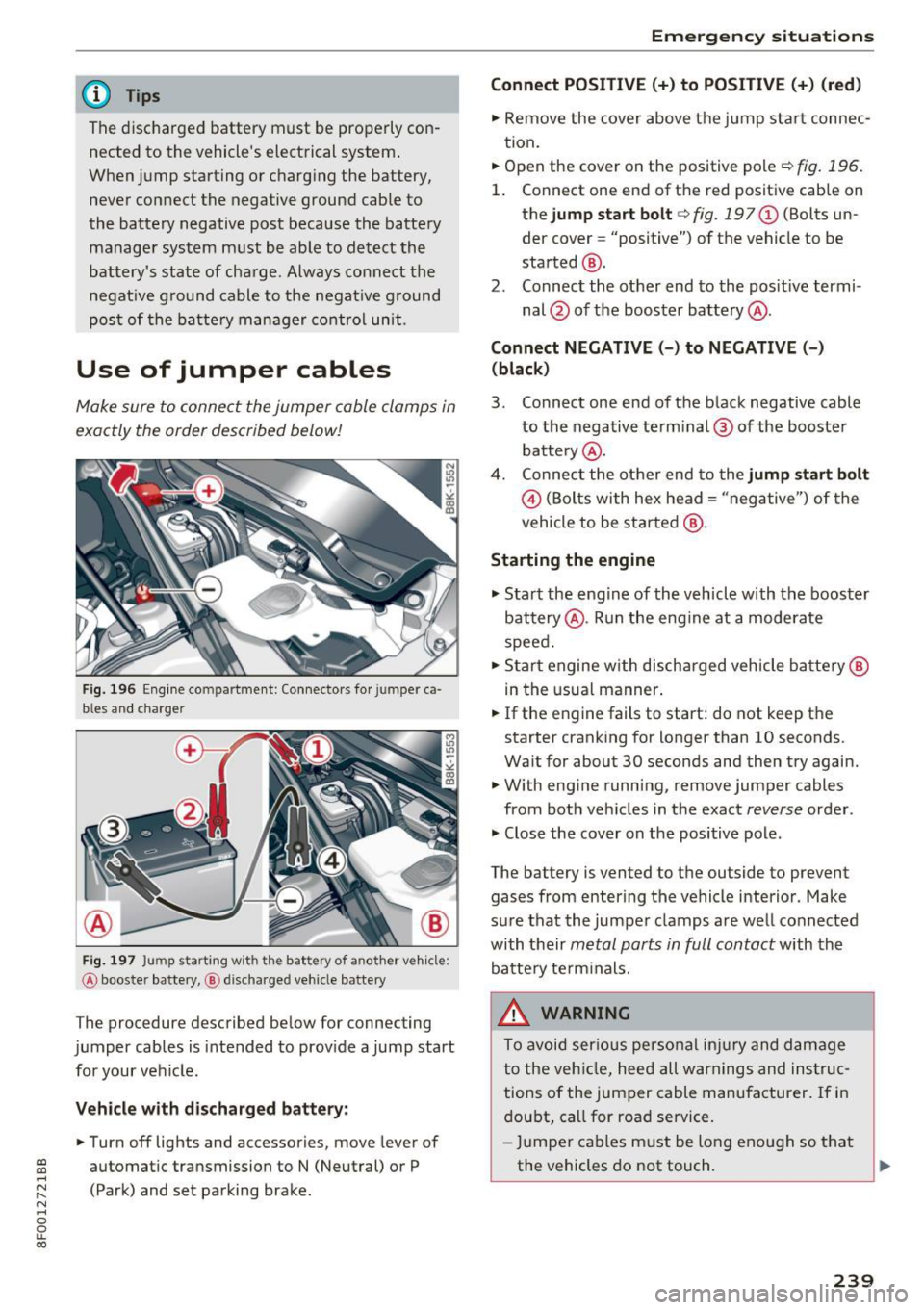
Make sure to connect the jumper cable clamps in
exactly the order described below!
Fig. 196 Engine compartment: Connectors fo r jumper ca
bles and charger
Fig. 197 Jump starting with the battery of another vehicle:
@ booster battery, @ discharged vehicle battery
The procedure described below for connecting
jumper cables is intended to provide a jump start
for your vehicle.
Vehicle with discharged battery: .. Turn off lights and accessories, move lever of
automatic transmission to N (Neutral) or P
(Park) and set parking brake.
Emergency situations
Connect POSITIVE(+) to POSITIVE (+) (red)
.. Remove the cover above the jump start connec
tion.
.. Open the cover on the positive pole
c;, fig. 196.
1. Connect one end of the red positive cab le on
the jump start bolt
c;, fig. 197@ (Bolts un
der cover= "positive") of the vehicle to be
started @.
2. Connect the other end to the positive termi-
nal @ of the booster battery @.
Connect NEGATIVE(-) to NEGATIVE(-) (black)
3. Connect one end of the black negative cable
to the negative te rm i nal @of the booster
battery @.
4. Connect the other end to the jump start bolt
@ (Bolts with hex head= "negative") of the
vehicle to be started @.
Starting the engine
"' Start the engine of the vehicle with the booster
battery @. Run the engine at a moderate
speed.
"' Start engine w ith discharged vehicle battery@
in the usual manner.
"' If the eng ine fails to start: do not keep the
starter cranking for longer than 10 seconds.
Wait for about 30 seconds and then try again.
"' With engine running, remove jumper cables
from both vehicles in the exact
reverse order .
"' Close the cover on the positive pole.
The battery is vented to the outside to prevent gases from entering the vehicle interior. Make
sure that the jumper clamps are well connected
with their
metal parts in full contact with the
battery term inals.
_&. WARNING
To avoid serious personal injury and damage
to the veh icle, heed all warnings and instruc
tions of the jumper cable manufacturer. If in
doubt, call for road service.
- Jumper cables must be long enough so that
the vehicles do not touch. ""
239
Page 242 of 266

Emergency situations
-When connecting jumper cables, make sure
that they cannot get caught in any moving
parts in the engine compartment.
- Do not bend over the batteries -danger of
chemical burns!
- The battery cell locking screws must be
tightened securely.
- Before you check anything in the engine
compartment, always read and heed all
WARNINGS
i=> page 193.
(D Note
Improper hook-up of jumper cables can ruin
the generator.
- Always connect POSITIVE(+) to POSITIVE
(+), and NEGATIVE(-) to NEGATIVE(-)
ground post of the battery manager control
unit.
- Check that all screw p lugs on the battery
cells are screwed in firmly. If not, tighten
plugs prior to connect ing clamp on negative
battery terminal.
- Please note that the procedure for connect
i ng a jumper cable as described above ap
plies specifically to the case of your vehicle
being jump started . When you are giving a
ju mp start to another vehicle, do
not con
nect the negative (-) cable to the negative
(-) terminal on the discharged batte ry @
c> fig. 197. Instead, securely connect the
negative( -) cab le to either a solid metal
component that is firm ly bolted to the en
gine block or to the engine block itself. If
the battery that is being charged does not
vent to the outside, escap ing battery gas
could ignite and explode!
Towing with a tow truck
General hints
Your Audi requires special handling for towing.
The following information is to be used by com
mercial tow truck operators who know how to op
erate the ir equipment safely.
-Never tow your Audi, towing will cause dam
age to the engine and transmission.
240
-Never wrap the safety chains or winch cables
around the brake lines .
- To prevent unnecessary damage, your Audi
must be transported with a flat bed truck .
- To load the vehicle on to the flat bed, use the
towing loop found in the vehicle tools and at
tach to the front or rear anchorage
i=> page 240 and c> page 241 .
A WARNING
A vehicle being towed is not safe for passen
gers. Never allow anyone to ride in a vehicle
being towed, for any reason.
Front towing loop
Do not install the front towing loop until it is
needed.
Fig. 198 Front bumper: removing the cover cap
Fig. 199 Front bumper : sc rew ing in t he towing loop
The towing loop fits into the threaded hole locat
ed on the right side o f the front bumper and cov
ered by a small cover when not in use .
.,. Remove the towing loop from the vehicle tool
ki t
c> page 227 .
.,. Press the cover in by applying short strong
pressure to the bottom part to release it from
the bumper
c> fig . 198 . Ill>
Page 253 of 266
a:,
a:,
...... N r--. N ...... 0
0
LL 00
Automatic transmission . . . . . . . . . . . . . . . . . 81
Automatic Shift Lock (ASL) . . . . . . . . . . . . . 82
Driving . . . . . . . . . . . . . . . . . . . . . . . . . . . . . 83
Emergency mode . . . . . . . . . . . . . . . . . . . . . 86
Emergency release . . . . . . . . . . . . . . . . . . . . 87
Kick -down . . . . . . . . . . . . . . . . . . . . . . . . . . . 85
Manua l shift program . . . . . . . . . . . . . . . . . 85
Removal lock (ignition key) . . . . . . . . . . . . . 71
Selector lever . . . . . . . . . . . . . . . . . . . . . . . . 81
Automatic wipers . . . . . . . . . . . . . . . . . . . . . . 53
Auto Safety Hotline . . . . . . . . . . . . . . . . . . . 118
Average speed . . . . . . . . . . . . . . . . . . . . . . . . 22
Avoid damaging the vehicle . . . . . . . . . . . . . 175
B
Battery . . . . . . . . . . . . . . . . . . . . . . . . . . . . . . 14
Battery location inside the luggage compart-
ment ..............................
203
Charge level . . . . . . . . . . . . . . . . . . . . . . . . 173
Charging . . . . . . . . . . . . . . . . . . . . . . . . . . . 205
Energy management . . . . . . . . . . . . . . . . . 173
Important warnings when working on the
battery . . . . . . . . . . . . . . . . . . . . . . . . . . . .
203
Jump starting . . . . . . . . . . . . . . . . . . . . . . . 238
Replac ing the battery . . . . . . . . . . . . . . . . 206
Work ing on the battery . . . . . . . . . . . . . . . 203
Before driving . . . . . . . . . . . . . . . . . . . . . . . . 111
Belt positioner . . . . . . . . . . . . . . . . . . . . . . . 125
Belt tensioners . . . . . . . . . . . . . . . . . . . . . . . 128
Bio -ethanol (Fuel) . . . . . . . . . . . . . . . . . . . . . 189
Blended gasoline . . . . . . . . . . . . . . . . . . . . . 188
Blower (automatic climate control) . . . . . . . . 68
Booster seats . . . . . . . . . . . . . . . . . . . . . . . . 158
Brake fluid
Changing the brake fluid . . . . . . . . . . . . . .
202
Checking the brake fluid l evel . . . . . . . . . . 202
Brake system
Anti-lock brak ing system . . . . . . . . . . . . . . .
17
Brake fluid specifications for refill and re
placement . . . . . . . . . . . . . . . . . . . . . . . . .
202
Brake light defective . . . . . . . . . . . . . . . . . . 19
Brake power assist unit . . . . . . . . . . . . . . . 170
Brakes. .. .. .. ............... .. ..... 170
Ceramic brakes . . . . . . . . . . . . . . . . . . . . . . 170
Electromechan ical parking brake . . . . . . . . 76
Warning/indicator lights . . . . . . . . . . . . . . . 13
Worn brake pads symbol . . . . . . . . . . . . . . . 18
Index
Braking
Brake assist . . . . . . . . . . . . . . . . . . . . . . . .
167
Emergency braking function . . . . . . . . . . . . 77
braking guard . . . . . . . . . . . . . . . . . . . . . . . . . 88
Messages . . . . . . . . . . . . . . . . . . . . . . . . . . . 95
Settings . . . . . . . . . . . . . . . . . . . . . . . . . . . . 95
Break-in period
Brake pads .. .. .. .. ............. .. . .
Tires ..... .... .. .. ........ · · · · · · · · ·
Breaking in ... .. .. .. ............... . .
New tires
Bulbs
C
170
175
175
214
237
California Proposition 65 Warning . . . . . . . 194
Battery specific . . . . . . . . . . . . . . . . . . . . . 204
Capacities . . . . . . . . . . . . . . . . . . . . . . . . . . . 244
Engine oil . . . . . . . . . . . . . . . . . . . . . . . . . . 195
Care . . . . . . . . . . . . . . . . . . . . . . . . . . . . . . . . 182
Cargo area
refer to Luggage compartment ...... 63, 116
Catalytic converter . . . . . . . . . . . . . . . . . . . . 176
Center armrest . . . . . . . . . . . . . . . . . . . . . . . . 60
C en tral locking . . . . . . . . . . . . . . . . . . . . . . . .
27
Central locking switch . . . . . . . . . . . . . . . . . 31
Convenience key . . . . . . . . . . . . . . . . . . . . . . 30
Remote control key . . . . . . . . . . . . . . . . . . . 30
Ceramic brake rotors
New brake pads . . . . . . . . . . . . . . . . . . . . .
170
Certification . . . . . . . . . . . . . . . . . . . . . . . . . 249
Changing engine oil . . . . . . . . . . . . . . . . . . . 198
Checking
Engin e coolant level. . . . . . . . . . . . . . . . . .
199
Child restraints
Danger of using child restraints in the front
seat.... .. .. .. .. .. ............. ....
131
Where can I get add itiona l information
about child restra ints and their use? . . . .
166
Child restraint system anchors . . . . . . . . . . 163
Child safety . . . . . . . . . . . . . . . . . . . . . . . . . . 150
Impo rtant safety instructions for using child
safety seats . . . . . . . . . . . . . . . . . . . . . . . .
153
Installing a c hild restraint using the LATCH
system . . . . . . . . . . . . . . . . . . . . . . . . . . . .
165
251
Page 256 of 266

Index
Engine oil . . . . . . . . . . . . . . . . . . . . . . . . . . . 195
Adding . . . . . . . . . . . . . . . . . . . . . . . . . . . . 197
Addit ives . . . . . . . . . . . . . . . . . . . . . . . . . . . 197
Changing . . . . . . . . . . . . . . . . . . . . . . . . . . 198
Check oil level . . . . . . . . . . . . . . . . . . . . . . 197
Consumption . . . . . . . . . . . . . . . . . . . . . . . 197
Indicator light . . . . . . . . . . . . . . . . . . . . 15, 18
Oi l consumption . . . . . . . . . . . . . . . . . . . . . 196
Pressure malfunction . . . . . . . . . . . . . . . . . 15
Sensor defective . . . . . . . . . . . . . . . . . . . . . . 18
Specification and viscosity . . . . . . . . . . . . . 195
Engine speed limitation . . . . . . . . . . . . . . . . . 18
Environment Catalytic converter . . . . . . . . . . . . . . . . . . . 176
Disposing of your vehicle battery . . . . . . . 206
Driving at high speeds . . . . . . . . . . . . . . . . 177
Fuel ...... .... ........... ........ . . 190
Leaks under your vehicle . . . . . . . . . . . . . . 193
L ett ing the veh icle stand and warm up . . . 177
Proper disposal of drained brake fluid . . . 202
Proper disposal of drained engine coolant 200
Proper disposal of drained engine oil 197, 198
Recycling used engine oil . . . . . . . . . . . . . 197
Unleaded fuel . . . . . . . . . . . . . . . . . . . . . . . 188
What should I do with an old battery? . . . 206
EPC
refer to Electronic power control . . . . . . . . 18
Ethyl alcohol (Fuel) . . . . . . . . . . . . . . . . . . . . 189
E vent Data Recorder (EDR) . . . . . . . . . . . . . 169
Expansion tank . . . . . . . . . . . . . . . . . . . . . . . 199
Exterior lighting . . . . . . . . . . . . . . . . . . . . . . . 48
Exterior mirrors Adjusting . . . . . . . . . . . . . . . . . . . . . . . . . . . 51
Dimming . . . . . . . . . . . . . . . . . . . . . . . . . . . . 52
He ating . . . . . . . . . . . . . . . . . . . . . . . . . . . . . 51
F
Fan
Radiator 201
Fa sten ing
Booster seats . . . . . . . . . . . . . . . . . . . . . . . 158
Convertible child safety seats . . . . . . . . . . 156
Infant seats . . . . . . . . . . . . . . . . . . . . . . . . 155
f lexible fuel . . . . . . . . . . . . . . . . . . . . . . . . . . 189
Floor mats . . . . . . . . . . . . . . . . . . . . . . . . . . . 116
Fog lights/rear fog light(s) . . . . . . . . . . . . . . 48
Folding the rear seats . . . . . . . . . . . . . . . . . . . 64
254
Foot pedals .......................... 116
For the sake of the environment Environmentally-friendly driving . . . . . . . 177
Gasoline fumes and the env ironment . . . . 190
Letting the engine warm up . . . . . . . . . 71 , 73
Refueling . . . . . . . . . . . . . . . . . . . . . . . . . . 190
Saving fuel by early upshifting . . . . . . . . . . . 9
Front airbags Description . . . . . . . . . . . . . . . . . . . . . . . . . 134
How they work . . . . . . . . . . . . . . . . . . . . . . 138
Frontal collisions and the laws of physics . . 123
Front passenger's door emergency locking . . 32
Front seats Adjust ing . . . . . . . . . . . . . . . . . . . . . . . . . . 113
Child restraints in the front seat........ 131
Upper cabin heating . . . . . . . . . . . . . . . . . . . 69
Fuel Additives. . . . . . . . . . . . . . . . . . . . . . . . . . . 188
B lended gasol ine . . . . . . . . . . . . . . . . . . . . 188
Consumption . . . . . . . . . . . . . . . . . . . . . . . . 22
Fuel gauge . . . . . . . . . . . . . . . . . . . . . . . . . . 10
Gasoline additives . . . . . . . . . . . . . . . . . . . 190
Low fuel level symbol . . . . . . . . . . . . . . . . . 18
Octane rating . . . . . . . . . . . . . . . . . . . . . . . 188
Recommendation . . . . . . . . . . . . . . . . . . . . 188
Refuelling . . . . . . . . . . . . . . . . . . . . . . . . . . 190
Reserve . . . . . . . . . . . . . . . . . . . . . . . . . . . . . 10
Saving fuel ......................... 177
T ank capacity . . . . . . . . . . . . . . . . . . . . . . . 244
Tank system . . . . . . . . . . . . . . . . . . . . . . . . . 18
Unlocking the fuel filler flap by hand . . . . 192
Fuel economy messages (efficiency program) .24
F u el filler flap
Unlocking the fuel filler flap by hand . . . . 192
Fuses Assignment ... .. .. .. ....... 234, 235, 236
Replacing . . . . . . . . . . . . . . . . . . . . . . . . . . 234
G
Garage door opene r (Home Link) . . . . . . . . . . 36
Gas discharge lamps ................... 237
Gauges Engine coolant temperature . . . . . . . . . . . . . 8
Fuel gauge . . . . . . . . . . . . . . . . . . . . . . . . . . 10
Tachometer . . . . . . . . . . . . . . . . . . . . . . . . . . 9
General illustration Instruments and controls . . . . . . . . . . . . . . . 6
Page 257 of 266
a:,
a:,
...... N r--. N ...... 0
0
LL 00
Generator Wa rni ng/indicator lig hts . . . . . . . . . . . . . . . 1 4
Glossa ry of tire and load ing term inology .. 209
Glove compartment . . . . . . . . . . . . . . . . . . . . 63
Valet parking . . . . . . . . . . . . . . . . . . . . . . . . 36
G PS controlled clock . . . . . . . . . . . . . . . . . . . . 1 0
Gross Vehicle Weight Rat ing (GVWR) . . . . . 24 3
H
Head lights
Clean ing . . . . . . . . . . . . . . . . . . . . . . . . . . . 183
Headlights Cleaning system . . . . . . . . . . . . . . . . . . . . . . 53
Defective . . . . . . . . . . . . . . . . . . . . . . . . . . . 19
H eadlig ht range control . . . . . . . . . . . . . . . 19
L eft hand dr ive, right hand dr ive . . . . . . . . . 50
T rave l mode . . . . . . . . . . . . . . . . . . . . . . . . . 50
Headlight washe r reservoir . . . . . . . . . . . . . 206
H ea d restra ints . . . . . . . . . . . . . . . . . . . . . . . 114
Ad justing .. .. .. ... . .... ... .. .. .. 60, 1 14
H eated
exte rior m irro rs . . . . . . . . . . . . . . . . . . . . . . 5 1
rear w indow . . . . . . . . . . . . . . . . . . . . . . . . . 68
se ats . . . . . . . . . . . . . . . . . . . . . . . . . . . . . . . 68
windshie ld washer spray noz zles . . . . . . . . 53
H eating . . . . . . . . . . . . . . . . . . . . . . . . . . . . . . 66
Heavy clothing and safety belts . . . . . . . . . . 124
H igh be am . . . . . . . . . . . . . . . . . . . . . . . . . . . . 49
H igh voltage war ning label . . . . . . . . . . . . . 243
H ill descent contro l . . . . . . . . . . . . . . . . . . . . 84
H omelink (garage door ope ne r) . . . . . . . . . . 36
Hood Opening . . . . . . . . . . . . . . . . . . . . . . . . . . . 193
Re lease lever . . . . . . . . . . . . . . . . . . . . . . . 193
H orn . . . . . . . . . . . . . . . . . . . . . . . . . . . . . . . . . 6
H ow are child res tra int sys tem anchors re lat -
ed to ch ild safety . . . . . . . . . . . . . . . . . . . . . 163
H ow many airbags does my vehicle have? . . 136
H ow safety belt pretensioners work
128
I
Ignition
switch ing on/off . . . . . . . . . . . . . . . . . . . . . 71
I gnition key
E me rgency un loc king. . . . . . . . . . . . . . . . . . 30
Index
Ig nition loc k . . . . . . . . . . . . . . . . . . . . . . . . . . 71
I n dicator light . . . . . . . . . . . . . . . . . . . . . . . 16
Malfunction . . . . . . . . . . . . . . . . . . . . . . . . . 20
Imbalance (whee ls) . . . . . . . . . . . . . . . . . . . 215
Immobilize r . . . . . . . . . . . . . . . . . . . . . . . . . . 10
Importantth ingstodobefo redriv ing . ... 111
Imprope rly worn safety belts . . . . . . . . . . . 128
Ind icator lights . . . . . . . . . . . . . . . . . . . . . . . . 11
Airbag system . . . . . . . . . . . . . . . . . . . . . . 140
Dynam ic steeri ng . . . . . . . . . . . . . . . . . . . . 171
PASS ENG ER AIR BAG OFF . . . . . . . . . . . . . 140
also refer to War ning/ indicato r lights . . . . 11
Infant seats . . . . . . . . . . . . . . . . . . . . . . . . . 155
Inf lation press ure (t i res) . . . . . . . . . . . . . . . 217
Instruments . . . . . . . . . . . . . . . . . . . . . . . . . . . 8
Adjust ing the light ing . . . . . . . . . . . . . . . . . 51
Instruments and contro ls
Genera l illustration . . . . . . . . . . . . . . . . . . . . 6
Inte rior ligh ts
F ront ... .. .. .. .. ... .. .. ..... ... .. .. . 51
Rear . . . . . . . . . . . . . . . . . . . . . . . . . . . . . . . 51
Inte rmit ten t (windsh ie ld w ipers) 53
]
Jump-starting 238
Jumper cables . . . . . . . . . . . . . . . . . . . . . . . . 239
K
Key... ... .. .. .. .. .. ... .. ..... ... .. .. . 28
Battery replacement . . . . . . . . . . . . . . . . . . 29
Check lig ht . . . . . . . . . . . . . . . . . . . . . . . . . . 29
Emergency key . . . . . . . . . . . . . . . . . . . . 28, 72
Ig nit ion/eng ine on/off . . . . . . . . . . . . . . . . 71
Key replacement . . . . . . . . . . . . . . . . . . . . . 28
Mecha nica l key . . . . . . . . . . . . . . . . . . . . 28, 29
r emov ing . . . . . . . . . . . . . . . . . . . . . . . . . . . 73
u nlocking/lo cking . . . . . . . . . . . . . . . . . 3 0, 32
K ick-dow n . . . . . . . . . . . . . . . . . . . . . . . . . . . . 85
Knee a irbags . . . . . . . . . . . . . . . . . . . . . . . . . 144
Desc ription . . . . . . . . . . . . . . . . . . . . . . . . . 144
How they work . . . . . . . . . . . . . . . . . . . . . . 145
Important safety instr uctions . . . . . . . . . . 146
255