child seat AUDI A5 CABRIOLET 2017 Owners Manual
[x] Cancel search | Manufacturer: AUDI, Model Year: 2017, Model line: A5 CABRIOLET, Model: AUDI A5 CABRIOLET 2017Pages: 266, PDF Size: 66.64 MB
Page 59 of 266
a:,
a:,
...... N r--. N ...... 0
0
LL 00
Seats and storage
General information
Why is your seat adjustment so important?
The safety belts and the airbag system can only
provide maximum protection if the front seats are corr ectly adjusted .
There are various ways of adjusting the front
seats to provide safe and comfortable support
for the driver and the front passenger . Adjust
your seat properly so that:
- you can easily and quickly reach all the switches
and controls in the instrument panel
- your body is properly supported thus reducing
physical stress and fatigue
- the safety belts and a irbag system can offer
maximum protection
Q page 130.
In the following sections, you will see exact ly
how you can best adjust your seats.
There are spec ial regulations and instr uctions for
installing a child safety seat on the front pas
senger's seat . Always fo llow the information re
garding child safety provided in
¢ page 150,
Child safety.
A WARNING -
Refer to Q page 111, Driving safety for im
portant information, tips, suggestions and
warnings that you should read and follow for
your own safety and the safety of yo ur pas
senge rs.
A WARNING
Incorrect seat ing position of the driver and all
other passengers can result in serious person
al injury .
- Always keep yo ur feet on the floor when the
vehicle is in motion -never pu t your feet on
top of the instrument pane l, out o f the win
dow or on top of the seat cushion. This ap
plies especially to the passengers. If your
seating pos it ion is incorrect, you increase
the risk of injury in the case of sudden brak
ing or an accident. If the airbag inflates and
Seat s and sto rage
the seating position is incorrect, this could
result in persona l injury or even death.
- It is important for both the driver and front
passenger to keep a distance of at least
10 inches (25 cm) between themselves and
the steering wheel and/or instrument pan
el. If you're sitt ing any closer than this, the
airbag system cannot protect you properly .
In addition, the front seats and head re
stra ints must be adjusted to you r body
he ight so that they can g ive you maximum
p rotection.
- Always try to keep as much dis tance as pos
sible between yourself and the steer ing
wheel or instrument pane l.
- Do not adjust the driver's o r front passeng
er 's seat while the veh icle is moving . Your
seat may move unexpectedly, causing sud
den loss of vehicle contro l and personal in
jury. If you ad just your seat while the veh icle
is moving, you are out of pos ition.
Driver's seat
The correct seat position is important for safe
and relaxed driving.
We recommend that you adjust the driver's seat
in the following manner:
.,. Adjust the seat in fo re and aft direction so tha t
you c an ea sil y push the pedals to the floor
while keeping yo ur knees s light ly bent ¢.&.
in
Why is your seat adjustment so important? on
page
57.
.,. Adj ust the seatback so that when you sit with
your back against the seatback, you can still
grasp the top of the steering wheel.
.,. App lies to ve hicles w ith ad justable head re
stra ints: Adjust the head rest raint so the upper
edge is as even as possible w ith the top of your
head. If t hat is not possible , try to adjust the
he ad restraint so that it is as close to this pos i
tion as possible ¢
page 60.
A WARNING ~
Never place any objects in the driver 's foot-
well. An object could get into the pedal area and interfere with pedal function. In case of
57
Page 60 of 266
Sea ts and stor age
sudden braking or an accident, you would not
be able to brake or accelerate.
Front passenger's seat
Always move the front passenger seat into the
rearmost position.
To avoid contact with the a irbag while it is de
p loying, do not sit any closer to the instrument
panel than necessary and a lways wear the three
point safety belt provided adjusted correctly. We
recommend that you adjust the passenger's seat
in the following manner:
.,. Bring the backrest up to an (a lmost) upright
position .
Do not ride with the seat reclined.
.,. Applies to vehicles with adjustable head re
straints: Adjust the head restra int so the upper
edge is as even as poss ible with the top of your
head. If that is not possible, try to adjust the
head restraint so that it is as close to th is posi
tion as poss ible
¢ page 60.
.,. Place your feet on the floor in front of the pas
senger's seat.
Front seats
Power seat adjustment
App lies to: vehicles with power adjustable seats
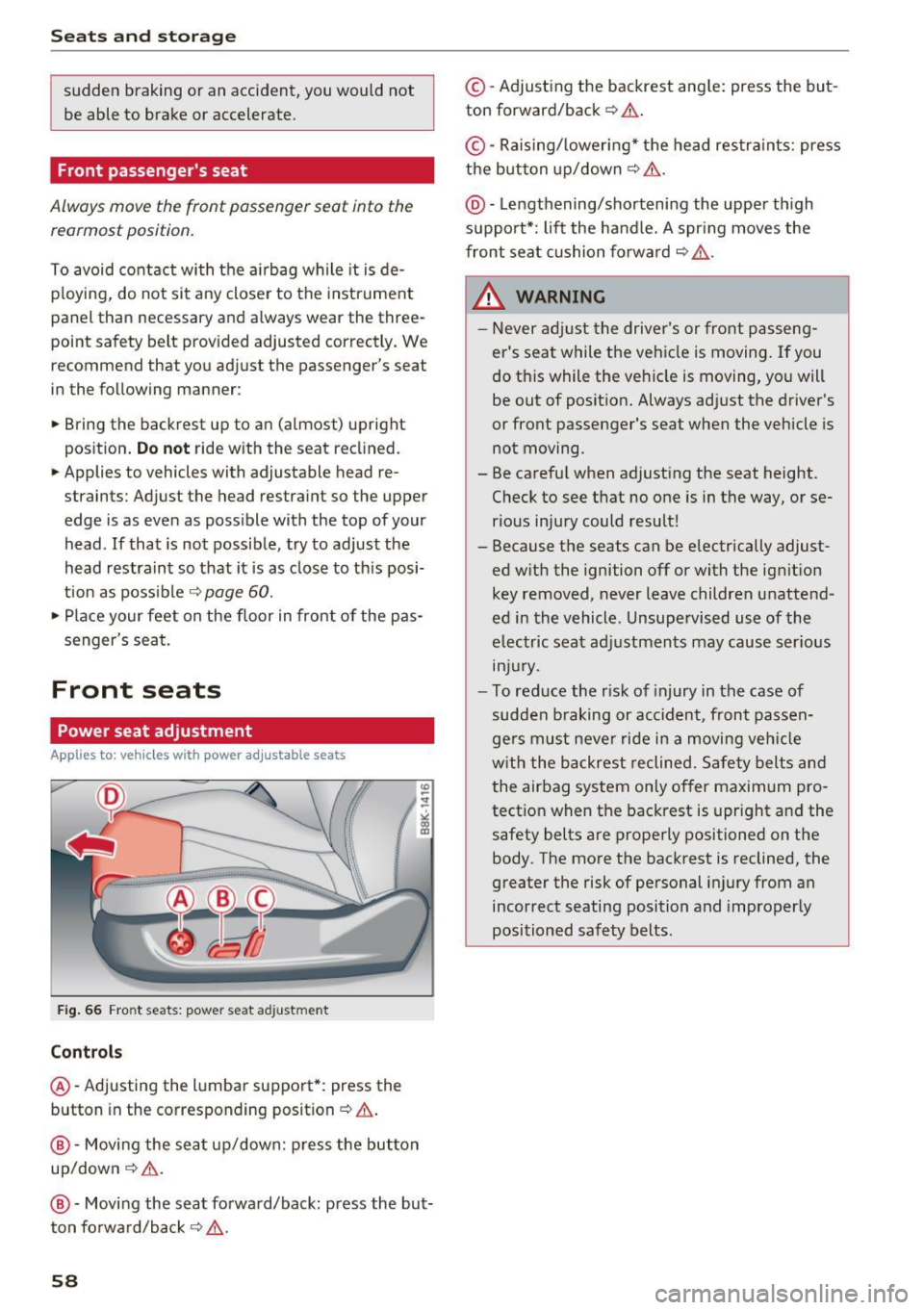
Fig . 66 Fro nt seats: power seat adjustment
Controls
@ -Adjusting the lumba r support*: press the
button in the corresponding position¢& .
@-Movi ng the seat up/down: p ress the but ton
up/down¢ &.
@ -Moving the seat forward/back: press the but
ton forwa rd/back ¢,& .
58
©-Adjusting the backrest ang le: press the but
ton forward/back ¢
.&..
©-Raising/ lower ing* the head restra ints: press
the button up/down ¢& .
@ -Lengthening/sho rtening the upper th igh
suppo rt*: lift the handle. A spr ing moves the
front seat cushion forward ¢
,&.
& WARNING
-Never ad just the driver's or front passeng
er's seat while the vehicle is moving.
If you
do this while the veh icle is moving, you will
be out of posit ion. Always ad just the driver's
or front passenger's seat when the vehicle is
not moving .
- Be carefu l when adjusting the seat height .
Check to see that no one is in the way, or se
rious injury could result!
- Because the seats can be electrically adjust
ed w ith the ignition off or with the ig nition
key removed, never leave children unattend
ed in the vehicle. Unsupe rvised use of the
electric seat adj ustments may cause ser ious
m Jur y.
- To red uce the r isk of injury in the case of
sudden b raking or acc ident, front passen
ge rs must neve r ride in a moving ve hicle
w it h the backrest reclined. Sa fety belts and
the airbag system on ly offer maximum pro
tect ion when the backrest is upr ight and the
safety belts are properly positioned on the
body. The more the backrest is reclined, the
greater the risk of personal injury from an
incorrect seating position and improper ly
positioned safety belts.
-
Page 113 of 266
a:,
a:,
,....,
N r--. N ,....,
0
0
LL 00
Driving safety
Basics
Safe driving habits
Please remember -safety first!
This chapter contains important information,
tips, instructions and warnings that you need to read and observe for your own safety, the safety
of your passengers and others . We have summar
ized here what you need to know about safety
belts, airbags, child restraints as well as child
safety. Your safety is for us
priority number 1. Al
ways observe the information and warnings in
this section - for your own safety as well as that
of your passengers.
The information in this section applies to all
model versions of your vehicle. Some of the fea
tures described in this sections may be standard
equipment on some models, or may be optional
equipment on others. If you are not sure, ask
your authorized Audi dealer.
A WARNING
- Always make sure that you follow the in
structions and heed the WARNINGS in this
Manual. It is in your interest and in the in
terest of your passengers .
-
-Always keep the complete Owner's Litera
ture in your Audi when you lend or sell your
vehicle so that this important information
will always be available to the driver and passengers.
-Always keep the Owner's literature handy so
that you can find it easily if you have ques
tions.
Safety equipment
The safety features are part of the occupant re
straint system and work together to help reduce the risk of injury in a wide variety of accident sit
uations.
Your safety and the safety of your passengers
should not be left to chance. Advances in tech
nology have made a variety of features available
to help reduce the risk of injury in an accident.
Driving safety
The following is a list of just a few of the safety
features in your Audi:
- sophisticated safety belts for driver and all pas-
senger seating positions,
- belt force limiters for the front seats,
- belt pretensioners for the seats,
- head restraints for each seating position,
- front airbags,
- side airbags in the front seats,
- special LATCH anchorages for child restraints,
- adjustable steering column.
These individual safety features, can work to gether as a system to help protect you and your
passengers in a wide range of accidents. These
features cannot work as a system if they are not
always correctly adjusted and correctly used.
Safety is everybody's responsibility!
Important things to do before driving
Safety is everybody 's job! Vehicle and occupant
safety always depends on the informed and care
f1,1/ driver.
For your safety and the safety of your passen
gers,
before driving always:
.,. Make sure that all lights and signals are operat
ing correctly .
.,. Make sure that the tire pressure is correct .
.,. Make sure that all windows are clean and afford
good visibility to the outside.
.,. Secure all luggage and other items carefully
qpage 62.
.,. Make sure that nothing can interfere with the
pedals.
.,. Adjust front seat, head restraint and mirrors
correctly for your height .
.,. Instruct passengers to adjust the head re
straints according to their height.
.,. Make sure to use the right child restraint cor
rectly to protect children
¢ page 150, Child
safety.
.,. Sit properly in your seat and make sure that
your passengers do the same
q page 57, Seats
and storage.
Ill>
111
Page 115 of 266
a:,
a:,
...... N r--. N ...... 0
0
LL 00
For detailed information on how to adjust the
driver's seat, see
¢ page 58.
A WARNING
Drivers who are unbelted, out of position or
too close to the airbag can be seriously in
jured by an airbag as it unfolds. To help re
duce the risk of serious personal injury:
- Always adjust the driver's seat and the
steering wheel so that there are at least 10 inches (25 cm) between your breastbone
and the steering wheel.
- Always hold the steering wheel on the out
side of the steering wheel rim with your
hands at the 9 o'clock and 3 o'clock posi
tions to help reduce the r isk of personal in
jury if the driver's airbag inflates.
- Never hold the steering wheel at the
12 o'clock position or with your hands at
other positions inside the steering wheel
rim or on the steering wheel hub. Holding
the steering wheel the wrong way can cause
serious injuries to the hands, arms and head
if the driver's airbag deploys.
- Pointing the steering wheel toward your
face decreases the ability of the supplemen
tal driver's airbag to protect you in a colli sion.
- Always sit in an upright position and never lean against or place any part of your body
too close to the area where the airbags are located .
- Before driving, always adjust the front seats
and head restraints properly and make sure
that all passengers are properly restrained.
- Never adjust the seats while the vehicle is
moving . Your seat may move unexpectedly
and you could lose control of the vehicle .
- Never drive with the backrest reclined or
tilted far back! The farther the backrests are
tilted back, the greater the risk of injury due
to incorrect positioning of the safety belt
and improper seating position.
- Children must a lways ride in child safety
seats¢
page 150. Special precautions ap
ply when installing a child safety seat on the
front passenger seat ¢
page 130.
Driving safety
Proper seating position for the front
passenger
The proper front passenger seating position is
important for safe, relaxed driving.
For your own safety and to reduce the risk of in
jury in the event of an acc ident, we recommend
that you adjust the seat for the front passenger
to the following position:
" Move the front passenger seat back as far as
possible . There must be a minimum of 10 in
ches (25 cm) between the breastbone and the
instrument panel¢.&, .
"Adjust the angle of the seatback so that it is in
an upright position and your back comes in full
contact with it whenever the vehicle is moving.
" Applies to vehicles with adjustable head re
straints : Adjust the head restraint so the upper
edge is as even as possible with the top of your
head . If that is not possible, try to adjust the
head restraint so that it is as close to this posi
tion as possible .
" Keep both feet flat on the floor in front of the
front passenger seat.
" Fasten and wear safety belts correctly
¢page 125.
For detailed information on how to adjust the
front passenge r's seat, see ¢
page 57.
A WARNING ~
Front seat passengers who are unbelted, out
of position or too close to the airbag can be
seriously injured or killed by the airbag as it unfolds. To help reduce the risk of serious
personal injury:
- Passengers must always sit in an upright po
sition and never lean against or place any
part of their body too close to the area
where the airbags are located .
- Passengers who are unbelted, out of posi
tion or too close to the airbag can be seri
ously injured by an airbag as it unfolds with
great force in the blink of an eye.
-Always make sure that there are at least 10 inches (25 cm) between the front passen
ger's breastbone and the instrument panel.
113
Page 116 of 266
Driving safety
-Each passenger must always sit on a seat of
their own and properly fasten and wear the
safety belt belonging to that seat.
- Before driving, always adjust the front pas
senger seat and head restraint properly.
- Always keep your feet on the floor in front
of the seat. Never rest them on the seat, in
strument panel, out of the window, etc. The
airbag system and safety belt will not be
able to protect you properly and can even in crease the risk of injury in a crash.
- Never drive with the backrest reclined or
tilted far back! The farther the backrests are
t il ted back, the greater the risk of injury due
to incorrect positioning of the safety belt
and improper seating position.
- Children must always ride in child safety
seats¢
page 150. Special precaut ions ap
ply when installing a child safety seat on the
front passenger seat¢
page 130.
Proper seating positions for passengers in
rear seats
Rear seat passengers must sit upright with both
feet on the floor consistent with their physical
size and be properly restrained whenever the ve
hicle is in use.
To reduce the risk of injury caused by an incorrect
seating position in the event of a sudden braking
maneuver or an accident, your passengers on the
rear bench seat must always observe the follow
i ng:
... Make sure that the seatback is securely latched
in the upright position ¢
page 64.
.,. Keep both feet flat in the footwell in front of
the rear seat.
... Fasten and wear safety belts properly
¢ page 125 .
.,. Make sure that children are always properly re
strained in a child restraint that is appropriate
for their size and age¢
page 150.
A WARNING
Passengers who are improperly seated on the
rear seat can be seriously injured in a crash.
114
-Each passenger must always sit on a seat of
their own and properly fasten and wear the safety belt belonging to that seat.
- Safety belts only offer maximum protection
when the seatback is securely latched in the upright position and the safety belts are
properly positioned on the body . By not sit
ting upright, a rear seat passenger increases
the risk of personal injury from improperly
positioned safety belts!
Proper adjustment of head restraints
Applies to: vehicles with adjustable head restraints
Correctly adjusted head restraints are an impor
tant part of your vehicle's occupant restraint sys
tem and can help to reduce the risk of injuries in
accident situations.
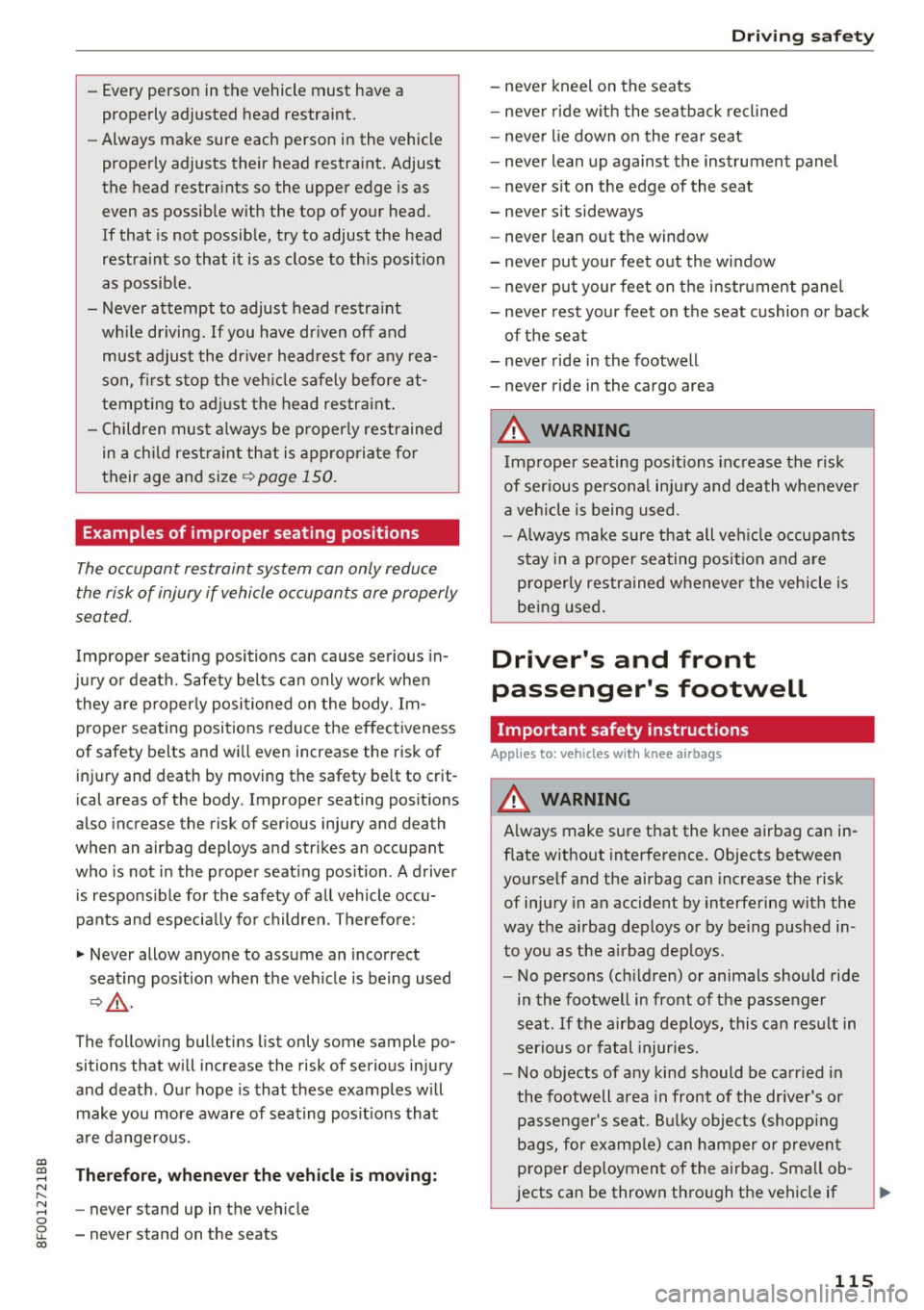
Fig. 129 Head restraint: viewe d from t he front
The head restraints must be correctly adjusted to
achieve the best protection.
... Adjust the head restraints so the upper edg e is
as even as possible with the top of your head. If
that is not possible, try to adjust the head re
straint so that it is as close to this position as
possible
¢ fig . 129 .
Adjusting head restraints¢ page 60 .
A WARNING
All seats are equipped with head restraints.
Driving without head restraints or with head
restraints that are not properly adjusted in
creases the risk of serious or fatal neck injury
dramatically . To help reduce the risk of injury:
-Always drive with the head restra ints in
place and properly adjusted.
-
Page 117 of 266
a:,
a:,
...... N r--. N ...... 0
0
LL 00
-Every person in the vehicle must have a
properly adjusted head restraint.
- Always make sure each person in the vehicle
properly adjusts their head restraint. Adjust
the head restraints so the upper edge is as
even as possible with the top of your head.
If that is not possible, try to adjust the head
restraint so that it is as close to this position
as possible.
- Never attempt to adjust head restraint
while driving. If you have driven off and
must adjust the driver headrest for any rea
son, first stop the vehicle safely before at
tempting to adjust the head restra int.
- Children must always be properly restrained
in a child restraint that is appropriate for
their age and size
q page 150.
Examples of improper seating positions
The occupant restraint system con only reduce
the risk of injury if vehicle occupants ore properly
seated.
Improper seating positions can cause serious in
jury or death. Safety belts can only work when
they are properly positioned on the body. Im
proper seating positions reduce the effectiveness
of safety belts and will even increase the risk of
injury and death by moving the safety belt to crit
ical areas of the body. Improper seating positions
also increase the risk of serious injury and death
when an airbag deploys and strikes an occupant
who is not in the proper seating position. A driver
is responsible for the safety of all vehicle occu
pants and especially for children. Therefore:
.. Never allow anyone to assume an incorrect
seating position when the vehicle is being used
q& -
The following bulletins list only some sample po
sitions that will increase the risk of serious injury
and death. Our hope is that these examples will
make you more aware of seating positions that
are dangerous.
Therefore, whenever the vehicle is moving:
-never stand up in the vehicle
- never stand on the seats
Driving safety
- never kneel on the seats
- never ride with the seatback reclined
- never lie down on the rear seat
- never lean up against the instrument panel
- never sit on the edge of the seat
- never sit sideways
- never lean out the window
- never put your feet out the window
- never put your feet on the instrument panel
- never rest your feet on the seat cushion or back
of the seat
- never ride in the footwell
- never ride in the cargo area
A WARNING
Improper seating positions increase the risk
of ser ious personal injury and death whenever
a veh icle is being used.
-Always make sure that all vehicle occupants
stay in a proper seating posit ion and are
properly restrained whenever the vehicle is
being used.
Driver's and front
passenger's footwell
Important safety instructions
Applies to: vehicles with knee airbags
A WARNING
--=
Always make sure that the knee airbag can in-
flate without interference. Objects between
yourself and the airbag can increase the risk
of injury in an accident by interfering with the
way the airbag deploys or by being pushed in
to you as the airbag deploys .
- No persons (children) or animals should ride
in the footwell in front of the passenger
seat . If the airbag deploys, this can result in
serious or fatal injur ies.
- No objects of any kind should be carried in
the footwell area in front of the driver's or passenger's seat. Bulky objects (shopping
bags, for example) can hamper or prevent
proper deployment of the airbag. Small ob
jects can be thrown through the vehicle if
115
Page 119 of 266
a:,
a:,
...... N r--. N ...... 0
0
LL 00
Loose items in the luggage compartment can
shift suddenly, changing vehicle handling charac
teristics . Loose items can also increase the risk of
serious personal injury in a sudden vehicle ma
neuver or in a collision.
~ Distribute the load evenly in the luggage com
partment.
~ Always place and properly secure heavy items in
the luggage compartment as low and as far for
ward as possible
c> fig . 130 .
~ Secure luggage using the tie-downs provided
i=>page 64 .
~ Make sure that the rear seatback is securely
latched in place.
A WARNING ,~ -
Improperly stored luggage or other items can
fly through the vehicle causing serious per
sonal injury in the event of hard braking or an
accident. To help reduce the risk of serious
personal injury:
- Always put objects, for example, luggage or
other heavy items in the luggage compart
ment.
-Always secure objects in the luggage com
partment using the tie-down eyelets and
suitable straps.
A WARNING
Heavy loads will influence the way your vehi
cle handles . To help reduce the risk of a loss
of contro l leading to serious personal injury:
- Always keep in mind when transporting heavy objects, that a change in the center of
gravity can also cause changes in vehicle
hand ling:
- Always distribute the load as evenly as
possible.
- Place heavy objects as far forward in the
luggage compartment as possible.
- Never exceed the Gross Axle Weight Rating
or the Gross Vehicle Weight Rating specified
on the safety compliance sticker on the left
door jamb. Exceeding permissible weight
standards can cause the vehicle to slide and
handle differently .
Driving safety
-Please observe information on safe driving
i=> page 111.
A WARNING
-To help prevent poisonous exhaust gas from
being drawn into the vehicle, always keep the
rear lid closed while driving.
- Never transport objects larger than those
fitting completely into the luggage area be
cause the rear lid cannot be fully closed.
- If you absolutely must drive with the rear lid
open, observe the following notes to reduce
the risk of poisoning:
- Close all windows,
- Close the power top,
- Open all a ir outlets in the instrument pan-
el,
- Switch off the air recirculation,
- Set the fresh air fan to the highest speed.
A WARNING ~ -
Always make sure that the doors, all win
dows , the power top and the rear lid are se
curely closed and locked to reduce the risk of
in jury when the vehicle is not being used.
- After closing the rear lid, always make sure
that it is properly closed and locked.
- Never leave your vehicle unattended espe
cially with the rear lid left open. A child
could crawl into the vehicle through the lug
gage compartment and close the rear lid be
coming trapped and unable to get out. Be
ing trapped in a vehicle can lead to serious
personal injury.
- Never let children play in or around the vehi
cle.
- Never let passengers ride in the luggage
compartment. Vehicle occupants must a l
ways be properly restrained in one of the
ve
hicle's seating positions.
(D Tips
-Air circulation helps to reduce w indow fog
ging. Stale air escapes to the outside
through vents in the trim panel. Be sure to
keep these slots free and open.
117
Page 120 of 266
Driving sa fe ty
-The tire pressure must correspond to the
l oad . The tire pressure is shown on the tire
pressure labe l. The tire pressure label is lo
cated on the driver's s ide B-pillar. The tire
pressure labe l lists the recommended cold
tire inflation pressures for the vehicle at its
max imum capacity weight and the t ires t hat
were on your vehicle at the t ime it was man
ufa ctu red. Fo r recommended tire p ressures
fo r no rmal load cond itions, please see chap
te r
~ page 217 .
Tie-downs
Appl ies to: ve hicles w ith tie-dow ns
The Luggage compartment is equipped with four
tie-downs to secure Luggage and other items.
Use the tie-downs to secure your cargo proper ly
~ page 116, Loading the luggage compartment.
In a collis io n, the laws of phys ics mean that even
smalle r items that are loose in the vehicle will
become heavy missiles that can cause ser ious in
jury. Items in the ve hicle possess energy whi ch
vary wi th vehicle speed and t he weight of the
item . Veh icle speed is the most s ignifica nt facto r.
For examp le, in a frontal collision at a speed of
30 mph (48 km/h), the forces ac ting o n a 10-lb
( 4 . 5 kg) object are abo ut 20 times the no rma l
weight of the item. This means that t he weight
of the item would suddenly be about
200 lbs. (90 kg) . You can imagine the injuries
that a 200 lbs. (90 kg) item flying free ly through
the passenge r compartment could cause in a col
lision l ike this .
A WARNING
Weak, damaged or improper s traps used to
secure i tems to tie-downs can fail d uring ha rd
brak ing o r in a col lision and cause se rious per
sonal i nju ry.
- Always use suitab le mou nti ng straps and
prope rly secure items to the tie-downs in
t h e luggage compartmen t to help p revent
items from sh ifting or flying fo rwa rd as dan
gerous missiles.
- When the rea r seat b ackrest is folde d down,
always use suitab le mounting str aps and
118
-
proper ly sec ure items to the tie-downs in
the l uggage compartment to help prevent
items from flying forward as dangerous
m iss iles into the passenger compartment.
- Never attach a child safety seat tether strap
to a tie-down.
Reporting Safety Defects
Applicable to U.S.A.
If you believe that your vehicle
ha s a d efect which could cause a
crash or could cau se injur y or
death, you should immedi ate ly in
form the Nat ional High way Traffic
Safet y Administration (NHT SA) in
addition t o notifyin g Audi of
America, Inc.
If NHTSA re ce ives s imilar com
pl aint s, it m ay ope n an in ve sti ga
tion , and if it find s that a safety
defe cts ex is ts in a group of
v ehi cle s, i t m ay order a re call and
remed y campaign . H ow ev er ,
NHT SA cann ot become in vol ve d in
indi vidu al probl ems b etween you ,
y o ur deal er, o r Audi of Am erica ,
In c.
To contact the NHTSA, you may
either call:
T el. : 1-888- 327-4236 (TTY :
1-800-424 -9153) or
1 -800-424-9 393
or you may write to:
Page 127 of 266
a:,
a:,
...... N
" N ...... 0
0
LL co
A WARNING
Not wearing safety belts or wearing them im
properly increases the risk of serious personal
injury and death . Safety belts can work only
when used correct ly.
-Always fasten your safety belts correctly be fore driving off and make sure all passen
gers are cor rect ly restrained.
- For maximum protection, safety belts must
always be posit ioned properly on the body .
- Never strap more than one person, includ ing small ch ildren, into any belt .
- Never place a safety belt over a child sitt ing
on your lap.
- Always keep feet in the footwell in front of
the seat wh ile the vehicle is being driven.
- Never let any person ride w ith their feet on
the instrument panel or sticking out the
window or on the seat .
- Never remove a safety belt while the vehicle
is moving . Do ing so will increase your risk of
being injured or k illed.
- Never wear belts twisted.
- Never wear belts over rigid or breakable ob-
jects in or on your clothing, such as eye
glasses, pens, keys, etc., as these may cause
injury.
- Never allow safety belts to become dam
aged by being caught in door or seat hard
ware.
- Do not wear the shoulder part of the belt
under your arm or otherwise out of position .
- Several layers of heavy clothing may inter
fere with correct positioning of belts and re
duce the overall effectiveness of the system.
- Always keep belt buckles free of anything
that may prevent the buckle from latching
securely .
- Never use comfort clips or devices that cre ate slack in the shoulder be lt . However, spe
cial clips may be requ ired for the proper use
of some child restraint systems.
- Torn or frayed safety belts can tear, and
damaged belt ha rdware can break in an acc i
dent. Inspect belts regularly.
If webbing,
bind ings, buckles, or re tractors are dam-
Safet y bel ts
aged, have belts rep laced by an authorized
Aud i dea ler .
- Safety belts that have been worn and loaded
in an accident must be replaced with the
correct replacement safety belt by an au
thorized Audi dealer. Replacement may be
necessary even if damage cannot be clearly
seen. Anchorages that were loaded must al
so be inspected.
- Never remove, mod ify, d isassemble, or try
to repair the safety belts yourse lf.
-Always keep the belts clean . Dirty belts may
not work properly and can impair the func
tion of the inert ia reel~
page 182.
Safety belts
Belt positioner
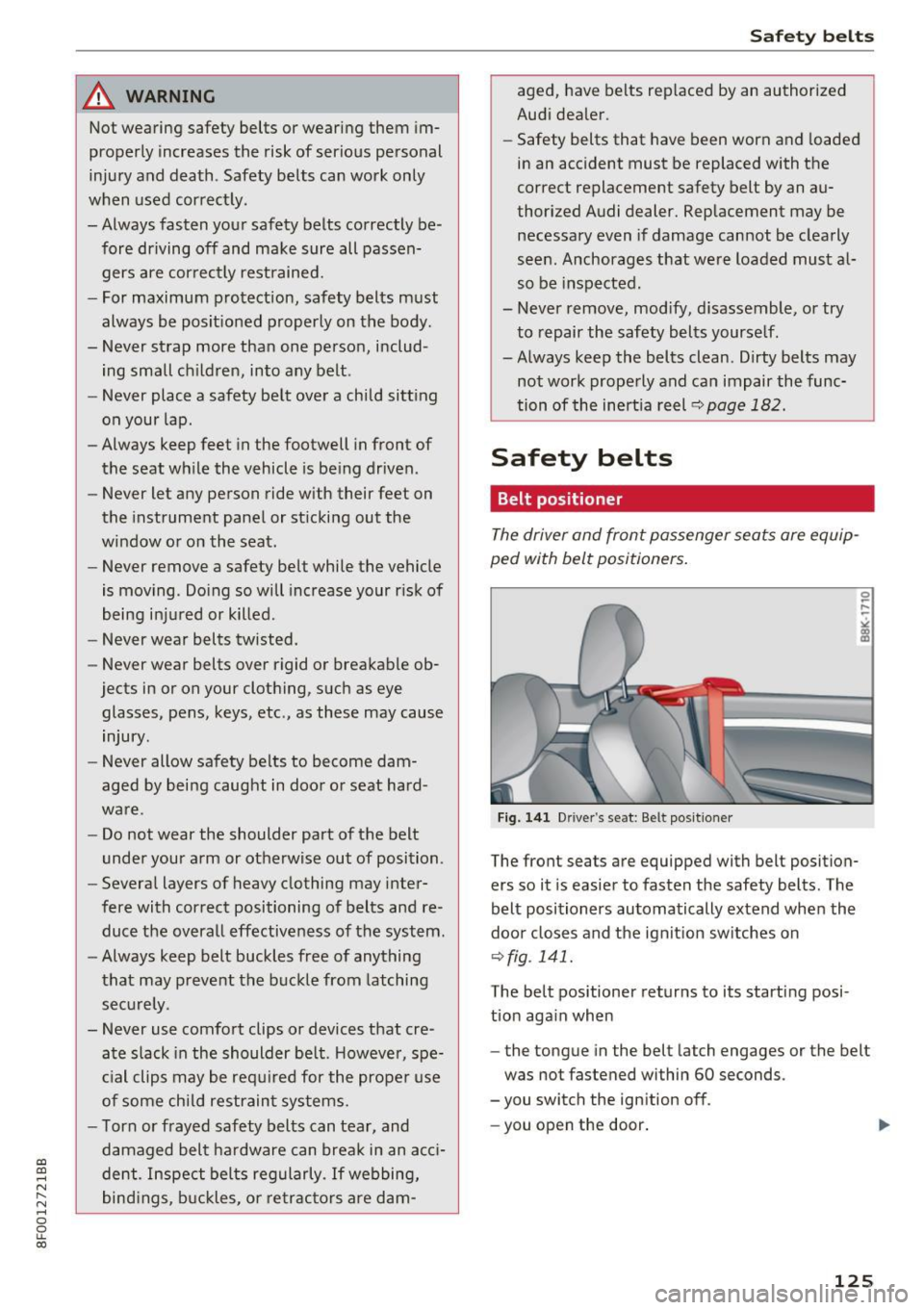
The driver and front passenger seats are equip
ped with belt positioners.
F ig. 141 Driv er's seat: Belt pos it ioner
The front seats are equipped with belt position
ers so it is easier to fasten the safety belts . The
belt positioners automatically extend when the
door closes and the ignit ion sw itches on
~ fig . 141.
The belt positioner returns to its start ing posi
tion aga in when
- the tongue in the belt latch engages or the belt
was not fastened within 60 seconds.
-you switch the ignition off.
- you open the door .
125
Page 128 of 266
Safe ty belts
_& WARNING
-Only your authorized Audi dealer shou ld
work on the system or remove and installing
system components when perform ing other
work.
- The belt pos itioners could cause injury or
damage if they pinch peop le or objects
when extending or ret ract ing.
Fastening safety belts
Safety first -everybody buckle up!
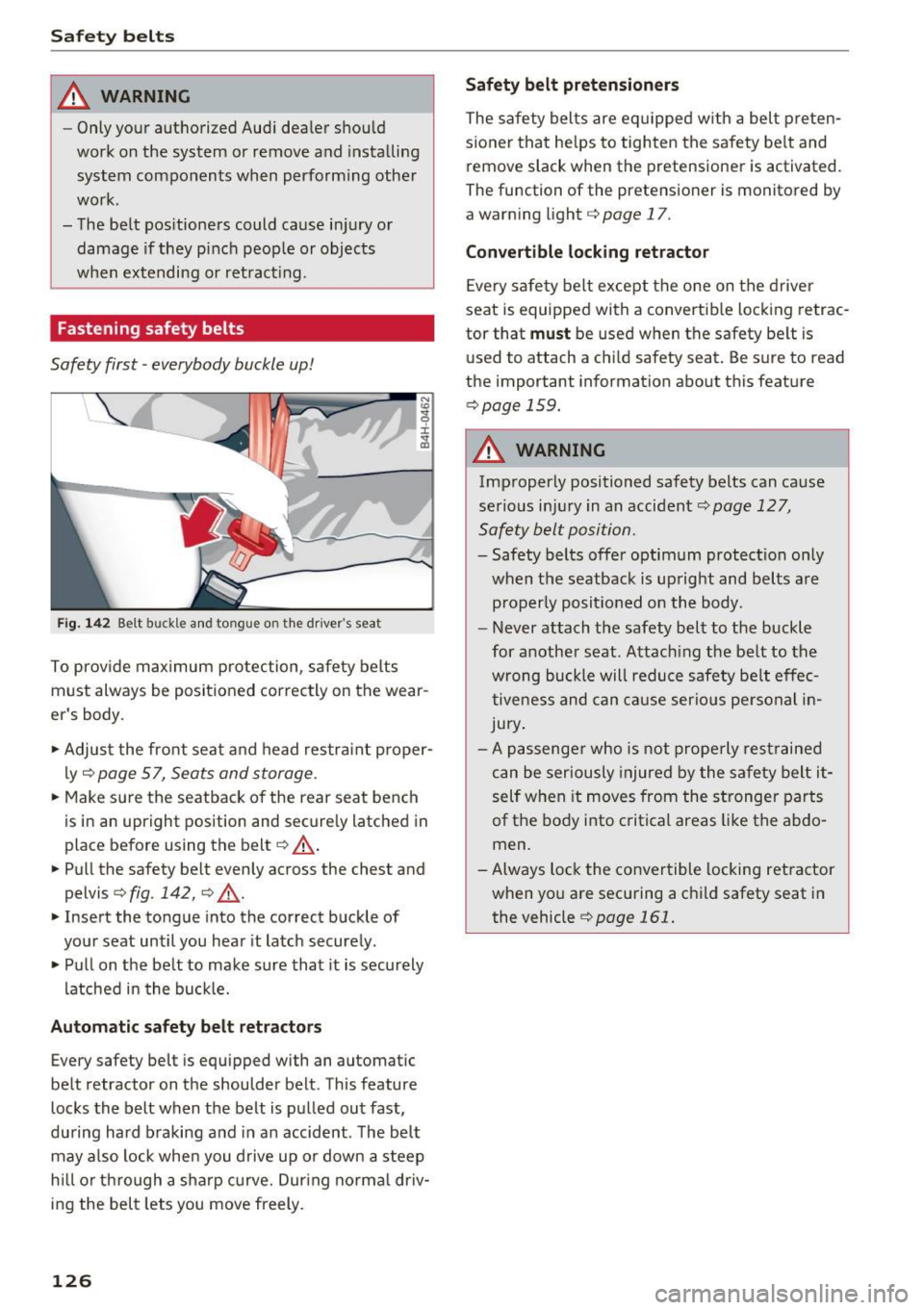
F ig. 1 42 Belt buckle a nd tong ue o n the dr iver's seat
To prov ide max imum protection, safe ty belts
must always be posit ioned correctly on the wear
er's body .
.,. Adjust the fro nt sea t an d head restra int proper
ly ¢
page 57, Seats and storage .
.,. Make s ure the seatback of the rear seat bench
is in an upright position and sec ure ly latched in
place before using the belt¢.&_ .
.,. Pull the safety belt evenly across the chest and
pelvis
¢ fig. 142, ¢ .&_ .
.,. Insert the tongue into the correct buckle of
your seat until you hear it latch securely .
.,. Pull on the be lt to make sure that it is securely
latched in the buck le.
Autom atic safety belt retractors
Every safety belt is equipped with an automatic
belt retractor on the shoulder belt . This feature
locks the belt when the belt is pulled out fast,
du ring hard b raking and in an accident . The belt
may a lso lock when you drive up or down a steep
h ill or th rough a s harp c urve. Dur ing no rmal driv
ing the belt lets you move freely.
126
Safety belt pr etensioners
The safety belts are eq uipped w ith a bel t preten
s ioner that he lps to tighten the safety be lt and
remove slack when the pretensione r is activated.
The function of the pretens ioner is monitored by
a warn ing light ¢
page 17.
Convertible locking retractor
Every safety belt except the o ne on the driver
seat is equipped with a convertib le locking retrac
tor that
mu st be used when the safety be lt is
used to attach a child safety seat . Be sure to read
the important information about this feature
¢ page 159.
_& WARNING
Improperly positioned safety belts can cause
serious i nju ry in an accident
¢page 127,
Safety belt position.
- Safety belts offer optimum protection only
when t he seatback is up right and belts a re
properly positioned on the body .
- Never attach the safety belt to the buckle
for another seat . Attach ing the be lt to the
w rong buckle will reduce safety be lt effec
tiveness and can cau se serio us pe rsonal in
jury .
- A passenge r who is not prope rly rest rained
can be ser iously injured by the safety belt i t
self when it moves from the st ronger parts
of the body into c ritical areas like the abdo
men.
- Always lock the co nver tible locking retractor
when yo u are securing a c hild safety seat in
the vehicle
¢ page 161.