instrument cluster AUDI A5 CABRIOLET 2017 Owner's Manual
[x] Cancel search | Manufacturer: AUDI, Model Year: 2017, Model line: A5 CABRIOLET, Model: AUDI A5 CABRIOLET 2017Pages: 266, PDF Size: 66.64 MB
Page 96 of 266

Audi adaptive cruise control and braking guard
Audi braking guard
Description
Applies to: vehicles w ith Audi adaptive cruise co ntro l
Fig. 112 Instrument cluster : approac h warning
Braking guard uses a radar sensor. It also func
tions within the limits of the system when adap
tive cruise control is switched off.
What can Audi braking guard do?
When detected in time, the system can assess
situations when a vehicle ahead brakes suddenly
or if your own vehicle is traveling at a high speed
and approaching a vehicle up ahead that is mov
ing more slowly. Braking guard does not react if
it cannot detect the situat ion.
The system advises you of various situations:
- The
distance warning is given if you are too
close to the vehicle ahead for a long time. If the
vehicle ahead brakes sharply, you will not be
able to avoid a collision. The indicator light .
in the display comes on.
- The
approach warning is given when a detected
vehicle up ahead in your lane is moving much
more slowly than you are or if it brakes sharply.
When this warning is given, it may only be pos
s ible to avoid a collision by swerving or braking
sharply. The indicator light . will warn yo u
about the danger¢
fig. 112. You will also hear
an acoustic signal.
If you do not react fast enough or do not react at
a ll to the situation, Braking guard will intervene
by braking and the message
braking guard inter
vention
will appear.
l) This is not ava ilab le in some countries.
94
- If a collision is imminent, the system will first
provide an
acute warning by briefly and sharply
app lying the brakes.
- If you do not react to the acute warning, brak
ing guard can brake within the limits of the sys
tem. This reduces the vehicle speed in the event
of a collis ion.
- At speeds under 20 mph (30 km/h), the system
can initiate a complete deceleration shortly be
fore a collision ll.
- If the braking guard senses that you are not
braking hard enough when a collision is immi
nent, it can increase the braking force.
Which functions can be controlled?
You can switch braking guard and the distance/
approach warning on or off in the radio or MMI
¢ page 95, Settings in the radio/MM!.
A WARNING
Lack of attent ion can cause collisions, other
accidents and ser ious personal injuries. The
braking guard is an assist system and cannot
prevent a collision by itself . The driver must
always intervene. The driver is always respon
sible for braking at the correct time .
- Always pay close attention to traffic, even
when the braking guard is switched on. Be
ready to intervene and be ready to take
complete control whenever necessary. Al
ways keep the safe and legal distance be
tween your vehicle and vehicles up ahead .
- Braking guard works within limits and will
not respond outside the system limits, for
examp le when approach ing a stopped vehi
cle or stationary obstacle (end of a traffic
jam or vehicle that has broken down in traf
fic).
- Always remember that the radar sensor for
the braking guard works only within defined
detection and range limits that may prevent
the proper detection of other vehicles.
- The radar sensor's function and range can
be reduced by rain, snow and heavy spray.
Moving vehicles up ahead may not be
-
Page 104 of 266
Audi drive select
sporty shifting characteristics . The S gear
position engages automatically.
- In vehicles that have dynamic steering*, op
erating noise is heard when starting or stop
ping the engine. This does not ind icate a
problem.
Selecting the driving mode
Applies to: vehicl es w ith Aud i dri ve select
You con choose between Comfort, Auto , Dynam
ic and Individual * modes.
N N 0
0
'l::=====:::: 1-'gi
drive I sel,.c,ct _ J -~-
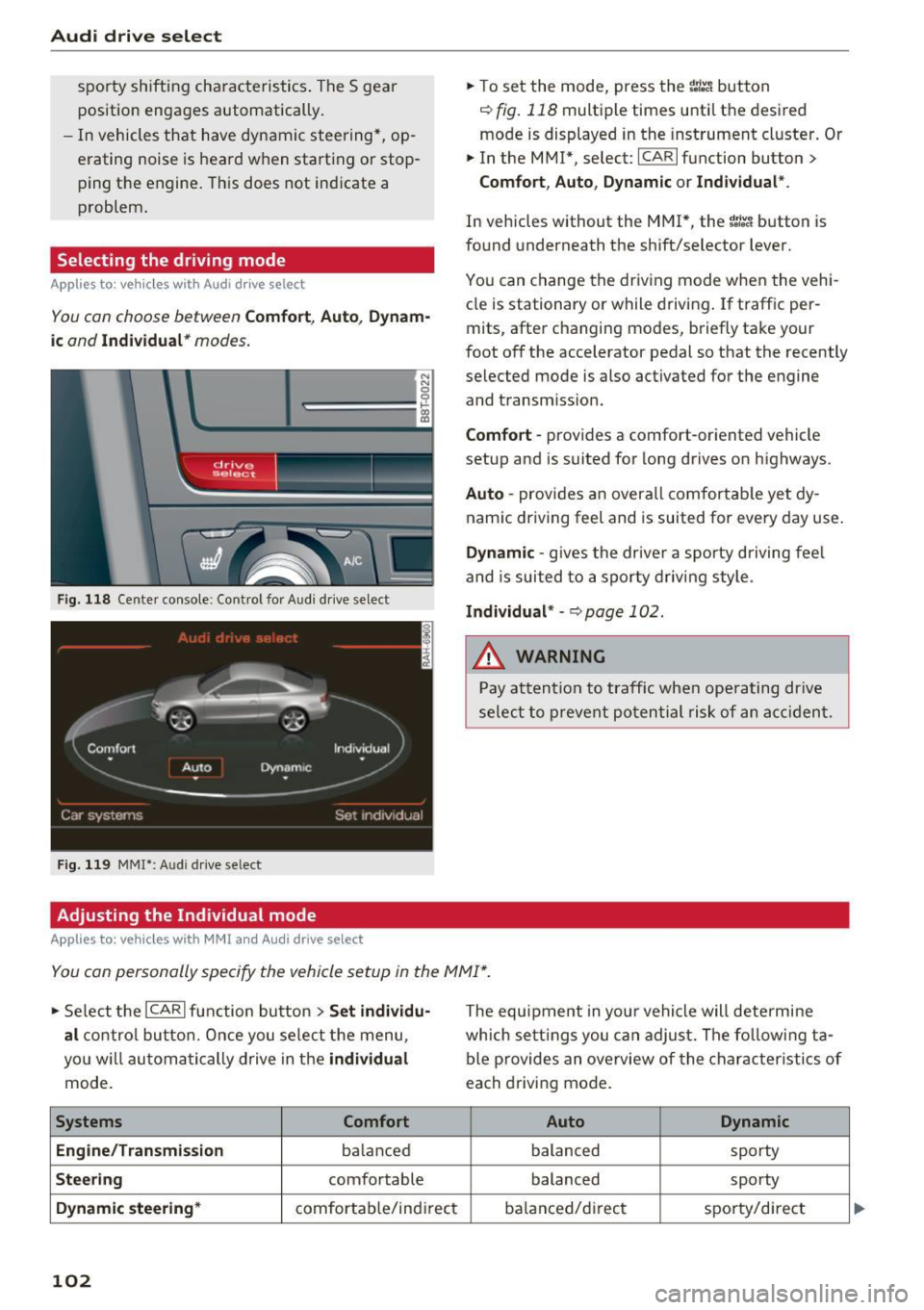
Fig. 118 Center console: Control fo r Aud i dr ive select
Fig . 119 MMI*: A udi drive select
Adjusting the Individual mode
Applies to : ve hicles w ith MMI and Audi drive select
.,. To set the mode, press the ~:i:a button
r::!) fig. 118 multiple times until the desired
mode is displayed in the instrument cluster. Or
.,. In the MMI* , select: ICARlfunction button>
Comfort, Auto, Dynamic or Individual".
In vehicles without the MMI*, the ~:/:a button is
found underneath the shift/selector lever.
You can change the driving mode when the vehi
cle is stationary or while driving. If traff ic per
mits, after changing modes, briefly take your
foot off the accelerator pedal so that the recently
selected mode is also activated for the engine
and transm iss ion.
Comfort -provides a comfort-oriented vehicle
setup and is suited for long drives on highways.
Auto -provides an overall comfortable yet dy
namic driving feel and is suited for every day use.
Dynamic -gives the drive r a sporty driving fee l
and is suited to a sporty driving style .
Individual* -c>page 102.
&_ WARNING
Pay attention to traffic when operating drive
select to prevent potential risk of an accident.
You can personally specify the vehicle setup in the MMI* .
.,. Select the ICAR I function button > Set individu
al
control button. Once you select the menu,
you w ill automatically drive in the
individual
mode.
Systems Comfort
Engine/Transmission
ba lanced
Steering comfortable
Dynamic steering* comfortab le/indi rect
102
The equipment in you r vehicle will determine
which settings you can adjust. The following ta
ble provides an overview of the characteristics of
each driving mode.
Auto Dynamic
balanced
sporty
balanced sporty
ba lanced/d irec t sporty/direct
Page 134 of 266
Airbag syste m
safety seat. It can be a very dangerous p lace for
an infant or a child in a rearward-facing seat.
The Advanced Airbag System i n your veh icle has
been ce rt ified to comp ly with the requirements
of United States Federal Motor Vehicle Safety
Standard (FMVSS)
208, as well as Canada Motor
Veh icle Safety Standard (CMVSS)
208 as applica
b le at the time your vehicle was manufactured.
According to requirements, the front Advanced
Airbag System on the passenger s ide has been
certified for "suppression " for infants of about
12 month old and younger and for "low risk de
p loyment " for children aged
3 to 6 years o ld (as
defined in the standard).
The
PA SSENGER AIR BAG OFF light in the instru
ment panel tells you when the front Advanced
Ai rbag on the passenger side has been tu rned off
by the elect ronic cont rol unit.
Each t ime you tur n on the ignit ion , the
PASSEN
GER AIR BAG OFF
light will come on fo r a few
seconds and :
- will stay on if the front passenger seat is not
occupied,
- will s tay on if there is a small c hild or child re
straint on the front passenger seat,
- will go off if the front passenger seat is occu
pied by an adult as reg istered by the weight
sensing mat¢
page 140 , Monitoring the Ad
vanced Airbag System .
The PAS SENGER AIR BAG O FF light comes on
when the control unit detects a total we ight on
the front passenger seat that requires the front
airbag to be turned off.
If the tota l weight on the front passenger seat is
more than that of a typical 1 year -old child but
less than the we ight of a small adult, the front
a irbag on the passenger side can deploy (the
PAS SENGER AIR BAG OFF light does not come
on) .
If the PAS SENGER AIR BAG OFF light does
not come on, the front a irbag on the passenger
side has not been turned off by the electronic
control unit and can deploy if the control unit
senses an impact that meets the condit ions stor
ed in its memory.
For e xample, the airbag may deploy if:
132
- a small chi ld that is heavier than a typica l 1
year-o ld child is on th e front passenger seat
(regard less of whether the child is in one of the
child safety seats listed¢
page 152), or
- a child who has outgrown c hild restraints is on
the front passenger seat.
If the front passenger a irbag is t urned off, the
PASSENGER AIR BAG OFF light comes on in the
instrument cluster and stays on.
The fro nt airbag on the passenge r side may
not
deploy (the PAS SENGER AIR BAG OFF light does
not ill uminate and stay lit) even if a small adu lt
or teenager, or a passenger who is not sitting up
right with thei r back against a non-recl ined back
rest with the ir fee t on the vehicle floor in front of
the sea t is on the fron t passenger sea t
<=> page 112, Proper seating position for the driv
er .
If the front passenger a irbag deploys, the Feder
al Standard requires the airbag to meet the "low
risk" deployment cr iteria to reduce the r isk of in
jury through interaction w ith the airbag . "low
risk " deployment occurs in those crashes that
take place at lowe r de cele rations as defined in
the e lec tronic co ntro l unit ¢
page 140, PASSEN
GER AIR BAG OF F light.
Always remembe r, a chi ld safety seat or infant
c ar rie r ins talled on the front seat may be s truck
and knocked ou t of posit ion by t he rap idly i nflat
i ng passenge r's airbag in a frontal coll is ion . The
airbag could greatly red uce the effectiveness of
the child restraint and even seriously injure the child during inflation.
Fo r th is reason, and beca use the back seat is the
safest place for children -when properly restrain
ed according to their age and size -we strongly
recommend that children always sit in the back
seat
c> page 150, Child safety .
A WARNING
A child in a rearward-facing child safety seat
installed on the front passenger seat will be
seriously injured and can be killed if the front
a ir bag inflates - even with an Advanced Airbag
Sys tem.
Ill>
Page 139 of 266

a:,
a:,
...... N r--. N ...... 0
0
LL 00
greater detail below. Because the front passen
ger seat contains important parts of the Ad
vanced A irbag System, you must take care to pre
vent it from being damaged. Damage to the seat
may prevent the Advanced Airbag for the front
passenger seat from doing its job in a crash .
The front Ad vanced Airb ag S ystem con sis ts
of the follo wing :
-Crash sensors in the front of the vehicle that
measure vehicle acceleration/decelerat io n to
provide information to the Advanced Airbag
System about the severity of the crash .
- An electronic control unit, with integrated
crash sensors for front and side impacts . The
contro l unit "decides" whether to fire the front
airbags based on the information received from
the crash sensors. The control unit also "de
cides" whether the safety be lt pretensioners
shou ld be activated.
- An Advanced Airbag with gas generator and
contro l valve for the driver inside the steering
whee l hub .
- An Advanced Airbag with gas generator and
contro l valve inside the instrument pane l for
the front passenger.
- A weight -sensing mat under the upho lstery
padding of the front passenger seat cushion
that measures the total weight on the seat . The
information registered is sent continuously to
the electron ic control unit to regulate deploy
ment of the front Adva need A irbag on the pas
senger side.
- An airbag monitoring system and indicator
light i n the instrument cluster
¢page 140.
-A sensor in each front seat registers the dis
tance between the respective seat and the
steering wheel or instrument panel. The infor
mation reg istered is sent cont inuous ly to the
electronic control unit to regulate deployment
of the fro nt Adv a need A irbags.
- T he
PASS EN GE R AIR BAG OFF light comes on
and stays on in the center of the instrument
pane l¢
page 140, fig . 149 and tells you when
the front Advanced Airbag on the passenge r
side has been turned off.
- A sensor below the safety belt latch fo r the
front seat passenger to meas ure the tension on
Airb ag sys tem
the sa fety belt. The tension on the safety belt
and the weight registered by the weight-sens
ing mat help the control unit "decide" whether
the front airbag for the front passenger seat
should be turned off or not¢
page 131, Child
restraints on the front seat -some important
things to know.
- A sensor in the safety belt latch for the driver
and for the front seat passenger that senses
whether that safety belt is latched or not and
transmits this information to t he electronic
cont rol un it.
_& WARNING
Damage to the front passenge r seat can pre
vent the front airbag from working properly.
- Imp roper repair or disassembly of the front
passenger and driver seat will p revent the
Advanced Airbag System from f unctioning
properly.
- Repairs to the front passenger seat must be
performed by qualified and properly trained
workshop personne l.
- Never remove the front passenger or driver
seat from the vehicle.
- Never remove the upholstery from the front
passenger seat.
- Never d isassemble o r remove par ts from the
seat o r disconnect w ires from it.
- Never carry sh arp objects in your pocke ts or
p lace them on the seat. If the weight-sens
ing mat in the passenger seat is punctu red
it cannot work proper ly.
- Never carry things on your lap or carry ob
jects on the passenger seat. S uch items can
increase the weight reg istered by the
weight-sensing mat and send the wrong in
formation to the airbag control unit.
- Never store items under the front passenger
seat. Parts of the Advanced Airbag System
under the passenger seat could be dam
aged, p reventing them and the airbag sys
tem from working p roper ly.
- Never p lace seat covers or replacement up
holstery that have not been specifically ap
p roved by A udi on the front seats.
- Seat covers can prevent the Advanced A ir
bag System from recognizing chi ld
137
Page 144 of 266

Airbag syste m
-the adu lt on the front passenger seat is proper
ly seated on the center of the seat cushion with
his or her back up against the backrest and the
backrest is not reclined
r::>page 112, Correct
passenger seating positions,
-the adu lt is not taking weight off the seat by
holding on to the passenger assist handle
above the front passenger door or supporting
their we ight on the armrest,
- the safety belt is being properly worn and that
there is not a lot of slack in the safety belt web
bing,
- accessory seat covers or cushions or other
th ings that may cause an incorrect read ing or
impression on the weight-sensing mat under
the upho lstery of the seat have been removed
from the front passenge r seat,
- a safety be lt extender has not been left in the
safety belt latc h for the front passenge r seat.
In addition to the
PASSE NGER AIR BAG OFF
light in the center of the instrument panel, the
message
PASSENGER AIR BAG OFF or PASSEN
GER AIR BAG ON
w ill briefly appear in the inst ru
ment cluster display . T his is to inform the driver
of the current front passenger airbag status.
Important safety instructions on
monitoring the Advanced Airbag System
A WARNING
An airbag system that is not funct ion ing prop
er ly cannot p rovide supplemental p rotection
in a frontal crash.
- If the airbag indicato r light
c> page 17
comes when the vehicle is be ing used, h ave
the system inspected immediate ly by yo ur
authorized Aud i dealer. It is possible that
the airbag will inflate when it is not s up
posed to, or will not inflate when it should.
A WARNING
If the front airbag inflates, a child without a
child restraint, in a rearward-facing child safe
ty seat or in a forward-facing child restraint
that has not been properly installed will be
ser iously injured and can be killed .
142
-Even though your vehicle is equipped with
an Advanced A irbag System, make certain
that all children, espec ia lly 12 years and
younger, always ride on the back seat prop
erly restrained for their age and s ize.
- Always install forward or rear-facing child
safety seats on the rear seat -even with an
Advanced A irbag System.
- If you must install a rearward-facing child
safety seat on the front passenger seat be
cause of exceptional circumstances and the
PASSENGER AIR BAG OFF l ight does not
appear and s tay on, immedi ately ins tall the
rear-facing child safety seat in a re ar seat ing
position and have the a irbag system in
spected by your a uthorized Audi dea ler.
- A t ight tether or other s trap on a rearward
facing chi ld restraint attached to the front
passenger seat can put too much pressure
on the weight-sensing mat in the seat and
register more weight than is actually on the
seat. The heavier weight registered can
make the system work as thoug h an adu lt
were on the seat and deploy the Advanced
Airbag when it must be suppressed causing
serious or even f atal injury to the child.
- If, in exceptional circumstances, you must
install a forward-fa cing child res traint on
the front p assenge r seat, always move the
seat into i ts rearmost posi tion in the sea t's
fore and aft ad justment range, as far away
from the ai rbag as possible . The back rest
must be adjusted to an upr ight position.
Make sure that the
PASSENGER AIR BAG
OFF
li ght comes on and stays on all the time
wheneve r the ignit ion is switched on.
A WARNING
- If the PASSENGER AIR BAG OFF light does
not go out when an adult is sitting on the
front passenger seat afte r taking the steps
described above, make s ure the adult is
p roper ly sea ted and restra ined at one o f the
rear sea ting posit ions .
- Have the ai rbag system inspec ted by your
author ized Audi dealer befo re t ransporting
anyone on the front passenger seat.
Page 182 of 266
Trailer towing
Tire pr essure
When tow ing a tra iler, inflate the tires of yo ur
veh icle to the tire pressure listed under " Fu ll
load" on the label ¢
page 217. Inflate trai ler
tires to trai ler and tire manufacturers' specifica
tions.
Lights
The headlight settings should be chec ked with
the trailer attached before driving off . Check to
make sure both vehicle and trailer lights are
working properly.
Safety chains
Be s ure t railer safety chains are properly connect
ed from the trailer to the hitch on the vehicle .
L eave enough slack in the chains to permit turn
ing corners. When you install safety chains, make
sure they wi ll not drag on the road when you are
driving.
The chains shou ld cross under the trailer tongue
to prevent it from dropping in case of separation
from the hitch.
Driving instructions
Driving with a trailer always requires extra care
and consideration .
Weight distribution
Towing a loaded trailer with an empty car res ults
in a high ly unstable distribution of weight . If this
cannot be avo ided, drive at very low speeds on ly
to avoid the risk of losing steering control.
A "balanced" rig is easie r to operate and cont rol.
This means that the tow vehicle should be loaded
to the extent possible and permissible, while keeping the trai ler as light as possib le under the
circumstances . Whenever possible, transfer
some cargo to the luggage compartment of the
tow vehicle while observ ing tongue load requ ire
ments and vehicle loading considerat ions .
Spe ed
The higher the speed, the more difficult it be
comes for the driver to contro l the rig. Do not
drive at the maximum permiss ible speed. Reduce
your speed even more if load, weather or w ind
180
conditions are unfavorab le -particularly when
going downhi ll.
Reduce vehicle speed
immediate ly if the trailer
shows the slightest sign of sway ing.
Do not try
to st op the swaying by accele rating.
Observe speed limits. In some a reas, speeds fo r
vehicles towing tra ilers are lower tha n for regular
vehicles.
A lways apply brakes ear ly . When driving down
hill, shift into a lower gea r to use the engine
braki ng effect to slow the vehicle. Use of the
brakes alone ca n cause them to overheat and fa il.
Coolant temperature
The coolant temperature gauge¢ page 8 must
be observed carefully. If the needle moves close
to the upper end of the scale, reduce speed im
med iate ly and/or tu rn off the a ir cond itioner .
If the coolant temperatu re warning light . in
the instrument cluster starts flashing, p ull off
the road, stop and let the engine
idle for about
two minu tes to p revent heat build-up .
.&, WARNING
Anyone not properly res trained in a moving
vehicle is at a much greater risk in an acci
dent . Never let anyone ride in your car who is
not properly wear ing the restraints provided
by Aud i.
Trailer towing
information
Important to know
-
Your vehicle handles differently when towing a
trailer because of the addit iona l weight and dif
ferent weight distribution. Safety, performance
and economy will greatly depend on how careful
ly you load your tra iler and operate your rig.
Before you actually tow your trailer, pract ice
turning, stopping and backing up in an area away
from traffic. Keep pract icing u nti l you have be
come completely fam iliar w ith the way your vehi-
cle-tra ile r combination behaves and respo nds . .,.
Page 197 of 266
a:,
a:,
...... N
l'
N
...... 0
0
LL co
Checking and Filling
Engine compartment
Engine compartment
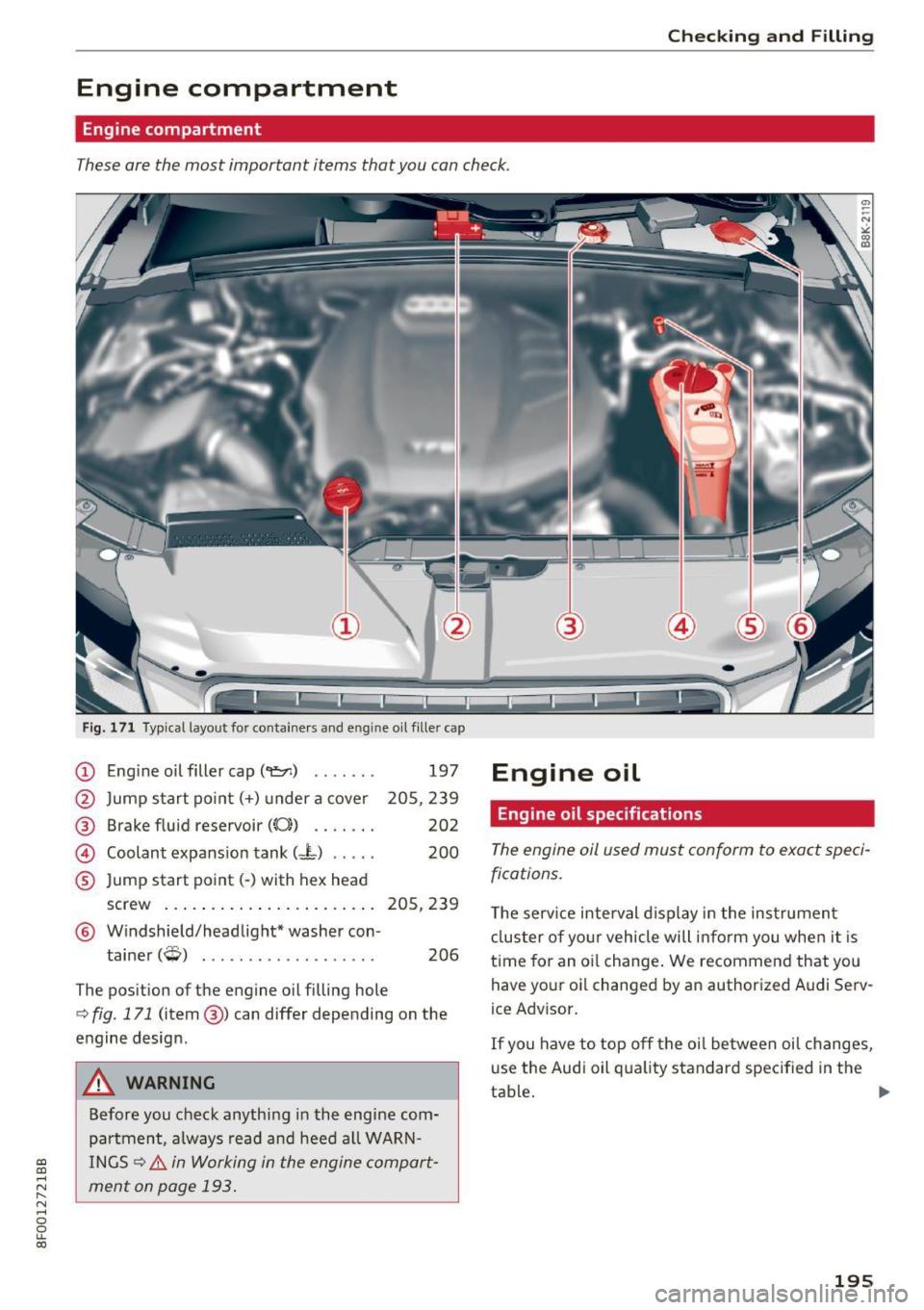
These are the most important items that you can check.
Fig. 171 Typical layout for containers and e ngin e oil fille r cap
(D Eng ine o il filler cap (
@ Brake fluid reservoir
((0) ...... .
@ Coolant expansion tank (- L) .... .
® Jump start point( -) with hex head
197
205,239
202
200
screw . . . . . . . . . . . . . . . . . . . . . . . 205, 239
@ Windshield/headlight* washer con-
tainer
(W) . . . . . . . . . . . . . . . . . . . 206
The position of the engine oil filling hole
c:> fig. 171 (item@) can differ depending on the
engine design .
A WARNING
Before you check anything in the engine com
partment, always read and heed all WARN
INGS
c:> &. in Working in the engine compart
ment on page 193.
Engine oil
Engine oil specifications
The engine oil used must conform to exact speci
fications.
T he serv ice interval display in the instrument
cluster of your vehicle will inform you when it is
time for an oi l change . We recommend that you
have your oi l changed by an authorized Audi Serv
ice Advisor.
If you have to top off the oil between oil changes,
use the Audi oil quality standard specified in the
tab~ .
~
195
Page 198 of 266
Check ing and F illing
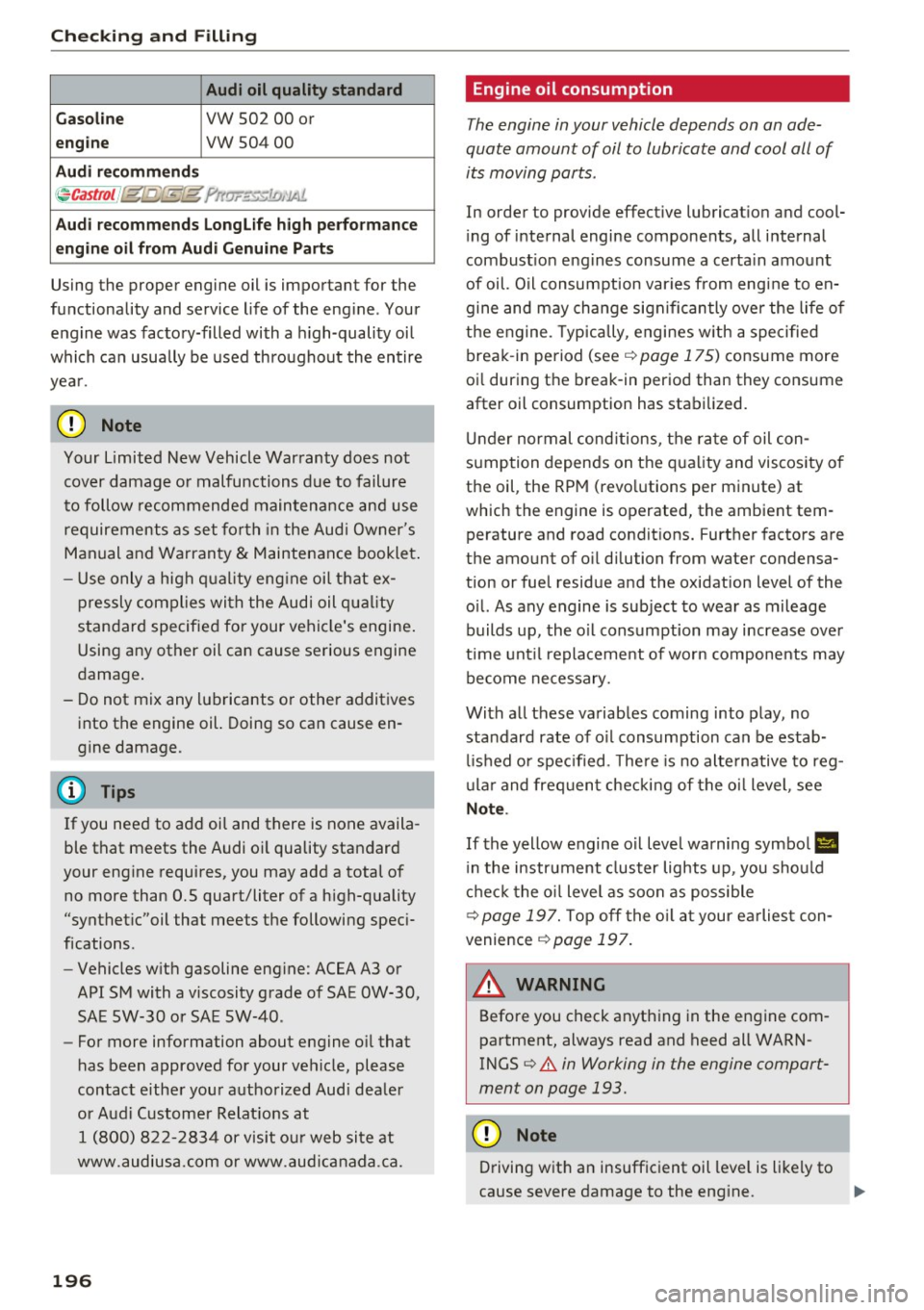
Audi oil quality standard
Gas olin e
VW 502 00 or
engi ne vw 50400
A udi reco mmend s
~Castrol I jgl[J,'fE{g ?r,w.:..~J ri, '.IA!,
Audi rec ommends Longlif e high perform ance
engi ne oil from Au di Genuin e Parts
Using the proper engine oil is important for the
functionality and service life of the engine. Your
engine was factory-filled with a h igh-quality oil
which can usually be used throughout the entire
yea r.
(D Note
Your Limited New Vehicle Warranty does not
cover damage or malfunctions due to failure
to follow recommended maintenance and use
requirements as set forth in the Audi Owner's
Manual and Warranty & Maintenance booklet .
- Use only a high qual ity eng ine oil that ex-
pressly complies with the Audi oil quality
standard specified for your vehicle's engine .
Using any other oil can cause serious engine
damage.
- Do not mix any lubricants or other additives into the engine oil. Doing so can cause en
gine damage.
@ Tips
If you need to add oil and there is none availa
ble that meets the Audi oil quality standard
your engine requires, you may add a total of
no more than 0.5 quart/liter of a h igh-quality
"synthet ic"oil that meets the following speci
fications.
- Vehicles w ith gasoline eng ine: ACEA A3 or
API SM with a viscosity grade of SAE OW-30,
SAE 5W-30 or SAE 5W-40.
- For more information about engine o il that
has been approved for your vehicle, please
contact either your authorized Audi dea ler
or Aud i Custome r Relat ions at
1 (800) 822- 2834 or visit ou r web site at
www.audiusa.com or www .aud icanada.ca.
196
· Eng ine oil consumption
The engine in your vehicle depends on an ade
quate amount of oil to lubricate and cool all of
its moving parts.
In order to provide effect ive lubricat ion and cool
i ng of internal engine components, all internal
combust ion eng ines consume a certa in amount
of oil. Oil consumption var ies from engine to en
gine and may change sign ificantly over the life of
the engine . T ypically, engines w ith a specified
break -in period (see¢
page 175) consume more
oi l during the break-in period than they consume
after oil consumption has stabilized.
U nder normal cond itions, the rate of oil con
sumption depends on the quality and viscosity o f
the oil , the RPM (revo lutions per minute) at
which the engine is operated, the ambient tem perature and road conditions. Further factors are
the amount of o il dilution from water condensa
tion or fuel residue and the oxidation level of the
o il. As any engine is subject to wear as mileage
builds up, the o il consumption may increase over
ti me unt il replacement of wo rn compo nents may
become necessary.
With all these variables coming into play, no standard rate of o il consumption can be estab
li shed or spec ified . T he re is no alte rnative to reg
u la r and freq uent checki ng of the oi l level, see
Note.
If the yellow engine oil level warning symbo l II
in the instrument cluster lights up, you sho uld
chec k the o il level as soon as possible
¢
page 197. Top off the o il at your earlies t con
venience
¢ page 197.
A WARNING
Before you check anything in the engine com
partment, always read and heed all WARN
INGS
¢ .&. in Working in the engine compart
ment on page 193.
(D Note
D riving with an insuffic ient oil level is likely to
cause severe damage to the eng ine.
Page 199 of 266
a:,
a:,
...... N
" N ...... 0
0
LL co
@ Tips
-The oil pre ssure w arning display. i s not
an indicator of the oil level. Do not rel y on
it. Instead , check the oil level in your en
gine at regular inte rval s, preferably each
t ime you refuel , and alway s befo re going
on a long trip.
- If you have the impression your engine con
sumes excessive amounts of oil, we recom
mend that you cons ult an autho rized Aud i
dealer to have the cause of your concern properly d iagnosed. Keep in mind that the
accurate measurement of oil consump tion
requi res great care and may take some
time. An a uthorized Audi dea ler has instruc
tions about how to measure oil consump
tion accurately.
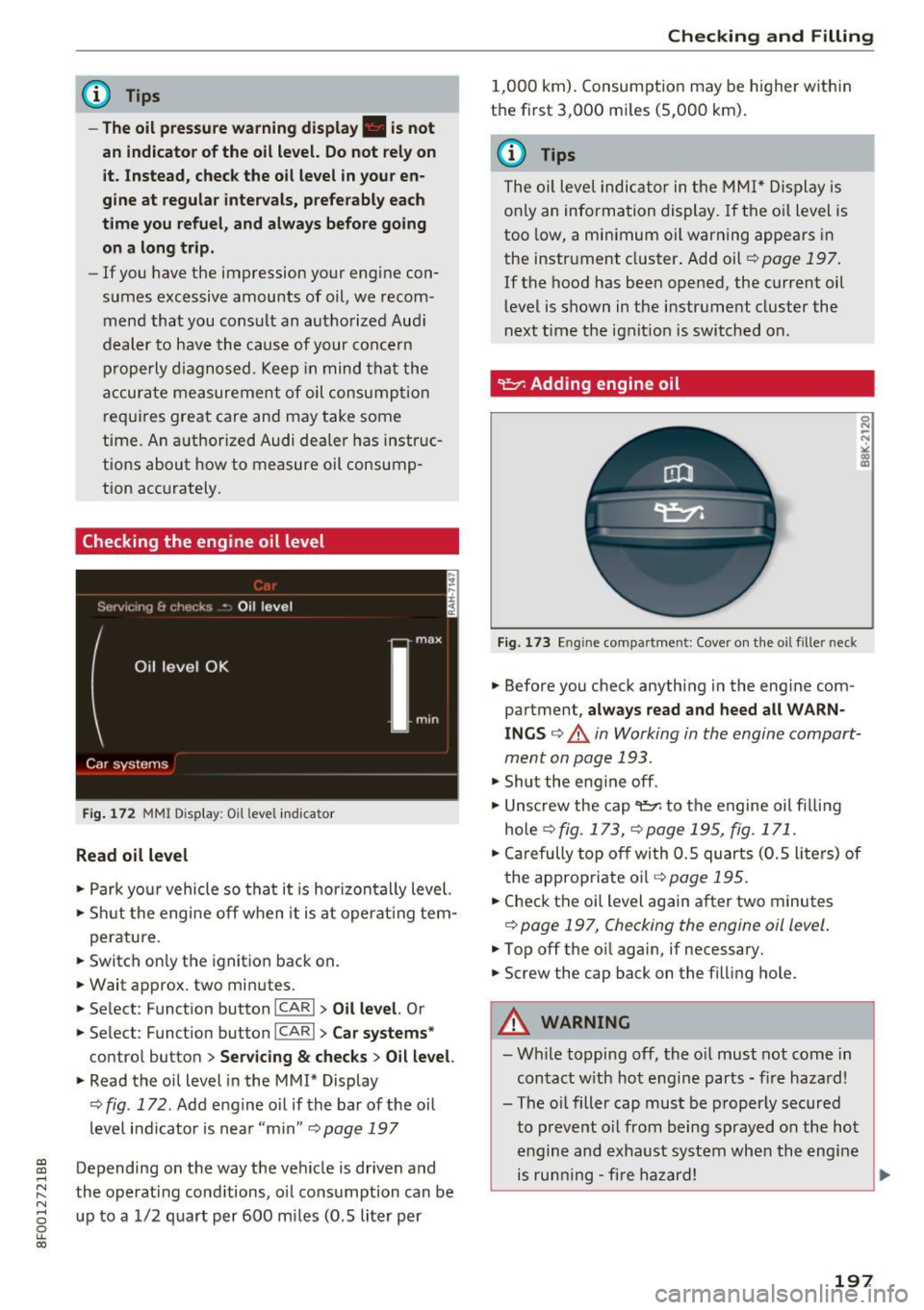
Checking the engine oil level
Fig. 172 MM I D isp lay: O il leve l in dicator
Read oil level
.. Park yo ur vehicle so that it is hor izontally level.
.. Shu t the engine off w hen it is at operat ing tem-
perature.
.. Switch only the ignition back on.
.. Wait approx . two mi nutes .
.. Se lect : Function button
~IC~A~R~I > Oil le vel. Or
.. Select : Funct ion button
ICARI > C ar sy stems *
contro l button > S ervici ng & checks > Oil leve l.
.. Read the oil level in the MMI* Display
¢fig . 172. Add engine o il if the bar of the oil
level indicator is near "min"
r::;, page 197
Depending on the way the vehicle is driven and
the operating cond itions, o il cons umption can be
up to a 1/2 quart per 600 m iles (0.5 liter per
Checking and Filling
1,000 km) . Consumptio n may be higher w ithin
the first 3,000 mi les (5,000 km).
(D Tips
The oil leve l indicato r in the M MI * Display is
on ly an information display. If the oi l level is
too low, a minimum oil warning appears in
the instr ument cluster . Add oil¢
page 197 .
If the hood has been opened, the current oil
l evel is shown in the instrument cluster the
next time the ignit ion is switched on.
"l=:7: Adding engine oil
Fig. 173 En g in e compartment: Cover on the oil filler nec k
.. Before you check anything in the eng ine com
partment,
a lwa ys read and heed all WARN
INGS
r::;, .&. in Working in the engine compart
ment on page 193 .
.. Shu t the eng ine off .
.. Uns crew the cap
't=;,: to the engine oil filling
hole
r::;, fig. 173, r::;,page 195, fig. 171 .
.. Carefully top o ff wi th 0.5 quarts (0.5 liters) of
the appropriate oil
r::;, page 195 .
.. Check the oil level again after two minutes
r::;, page 197, Checking the engine oil level.
.. Top off the o il again, if necessary .
.. Screw the cap back on the filling hole .
A WARNING
-- Wh ile topping off, the o il must not come in
con tact w ith ho t engine parts - fi re hazard!
- The oil filler cap must be p roper ly secured
to p revent o il from being sprayed on t he ho t
engine and exhaust system when the engine
is running - fi re ha zard!
~
197
Page 227 of 266

a:,
a:,
...... N r--. N ...... 0
0
LL 00
check your tires as soon as possible, and inflate
them to the proper pressure. Driving on a signifi
cantly under-inflated tire causes the tire to over
heat and can lead to t ire failure. Under-inflation
a lso reduces fuel efficiency and tire tread life,
and may affect the vehicle 's handling and stop
p ing ability .
Please note that the TPMS is not a substitute for
proper tire maintenance, and it is the driver's re
sponsib ility to ma intain correct tire pressure,
even if under-inflation has not reached the level
to tr igger illum inat ion of the TPMS low tire p res
sure telltale.
Your veh icle has also bee n eq uipped w ith a TPMS
malfunct ion indicator to indicate when the sys
tem is not operat ing properly . The TPMS ma l
function ind icator is combined w ith the low tire
p ressure tellta le. Whe n the system detects a
malfunct ion, the te lltale will flash fo r approx i
mately one mi nute and then remain continuo usly
illuminated. This sequence will continue upon
subseq uent veh icle start-ups as long as the ma l
function ex ists .
When t he malfunction indicator is ill uminated,
the system may not be ab le to detect or signal
l ow tire press ure as intended. TPMS ma lf u nctions
may occur for a var iety of reasons, including the
installation of replacement or alternate t ires or
wheels on the vehicle that prevent the TPMS
from functioning properly . Always c heck the
TPMS malfunction telltale afte r rep lacing one o r
mo re t ires o r whee ls on your ve hicl e to e nsur e
th at t he replacement or al tern ate tir es and
wheels a llow the TPMS to con tinue to function
p roperly .
Wheel s
If the Tire Pressure Monitoring System
indicator appears
Applies to : vehicles wi th Tir e Pressure Monito ring Syste m
Th e tire pressure indicator in th e instrument
cluster informs you if the tire pressure is too low
or if there is a system malfunction.
Fi g. 182 Instrument cl uster: indic ator lig ht w ith message
U sing the ABS sensors, the t ire pressure monito r
i ng system compares the tire tread c ircumfer
ence and v ibration characterist ics of the ind ividu
al tires. If the press ure changes in one or more
t ir es, th is is indicated in the instrument cluster
display with an indica to r li gh t
IE and a message.
If only one tire is affected, the loc ation of tha t
t ir e will be indicated.
T he t ire press ures mus t be stored in the Infota in
me nt system again each time t he pr essures
c h ange (switching between parti al and full load
pressure) or afte r changing or replac ing a tire on
yo ur vehicle ¢
page 226 . The tire p ressure moni
toring system on ly monitors the tire pressure you
have stored. Re fer to the t ire pressure label for
the recommended t ire pressure for yo ur vehicle
r=> page217, fig.181.
T ire tread c irc umference and vibration character
istics can change and ca use a tire press ure warn
ing if :
- the tire pressure in one or more tires is too low.
- t he t ire h as str uctural damage.
- t he t ire w as re pla ce d or the t ire pressu re was
ch anged and it was no t store d ¢
page 226 .
- the spare tire* is i nstalled .
Indicator lights
IE Loss of pressure in at least one tire¢.& .
Check the tires and replace or repair if necessary .
IJJ,,
225