ecu AUDI A5 CABRIOLET 2017 Owner's Guide
[x] Cancel search | Manufacturer: AUDI, Model Year: 2017, Model line: A5 CABRIOLET, Model: AUDI A5 CABRIOLET 2017Pages: 266, PDF Size: 66.64 MB
Page 163 of 266
-The inflating airbag will hit the child safety
seat or infant carrier with great force and
will smash the child safety seat and child
against the backrest, center armrest, door
or roof .
- Always be especially careful if you must in
stall a rearward facing child safety seat on
the front passenger seat in exceptional c ir
cumstances.
-A tight tether strap on a rearward-facing child restraint attached to the front passen
ger seat can put too much pressu re on the
we ight-mat in the seat and register a heavi
er weight in the Advanced Ai rbag System.
T he heavier we ight registered can make the
system work as though an adult were on the
seat and deploy the Advanced Airbag when
it must be suppressed causing serious or
even fatal injury to the child.
- Make sure that the
PASS ENG ER AIR B AG
OFF
light comes on and stays on all the time
whenever the ignition is switched on.
- If the
PA SSENGER AIR BAG OFF light does
not come on and stay on, immediately in
stall the rearward-facing child safety seat in a rear seating position and have the a irbag
system inspected by your author ized Audi
dealer.
Activating the convertible locking retractor
Use the convertible locking retractor to secure a
child restraint.
Always heed the child safety seat manufacturer's
instructions when installing a child restraint in
your veh icle . T o act ivate the convertible locking
retractor:
.. Place the child restraint on a seat, preferab ly
on the rear seat.
.. Slowly pull the belt all the way out .
.. Route it around or through the ch ild rest raint
belt path
Q .&, .
.. Push the child safety seat down with your fu ll
weight to get the safety be lt rea lly t ight .
a:,
~ .. Insert the belt tongue into the buckle for that
N ~ seating position .
... 0
0
LL 00
Ch ild safety
.. Guide the safety belt back into the retractor un
til the belt lies flat and snug on the child safety
seat.
.. You shou ld hear a "cl icking" noise as the belt
w inds back into the inertia reel. Test the con
vert ible lock ing retractor by pulling on the belt.
You should no longer be able to pull the belt out of the retractor . The convertib le locking re
tracto r is now activated.
.. Ma ke sure that t he red release bu tton is facing
away from the child restraint so that it can be
unbuckled quickly .
.. Pull on the belt to make sure the safety belt is
properly t ight and fastened so that the seat
cannot move forward or sideways more than
one inch (2.5 cm).
A WARNING
Using the wrong ch ild restraint or an improp
e rly installed child restra int can cause serious
personal injury or death in a crash .
- Always make sure that the safety belt re
tractor is locked when installing a child
safety seat. An unlocked safety belt retrac
tor cannot hold the ch ild safety sea t in place
during normal driving or in a crash.
- Always buckle the child safety seat fi rm ly in
p lace even if a ch ild is not si tting in it. A
loose child safety seat can fly around dur ing
a sudden stop or in a crash.
- Always make sure the seat backrest to which
the child restraint is installed is in an up right position and securely latched into
p lace and cannot fo ld forward. Otherw ise,
the seatback with the child safety seat at
tached to it could fly forward in the event of
an accident or other emergency s ituation .
- Always read and heed all WARNINGS when
ever using a child restrained in a vehicle is
be ing used
Q page 150 . Special precautions
apply when install ing a child safety seat on
the front passenge r seat
Q page 131, Child
restraint s on the front seat -some impor
tant things to know .
161
Page 165 of 266
a:,
a:,
...... N r--. N ...... 0
0
LL 00
LATCH system (lower
anchorages and tethers
for children)
Child Restraint System anchors and how
are they related to child safety
To prov ide a simpler and more practicable way to
attach the child restra int on the vehi cle seat,
F eder al reg ulat ions req uire speci al lower ancho
rages in vehicles and dev ices on new child re
straints to at tach to the vehicle anchorages .
The combination of the tether a nchorages and
the lower a nchorages is now genera lly called the
LATCH system for " Lower Anchorages an d
T ethers fo r Ch ildren."
F orwa rd-facing child res tra ints man ufactu red af
ter September 1, 1999, are required by U .S. fed
e ral regulations to comply with new child head
movement performance requirements. These
new performance requirements make a tethe r
necessary on most new child seats.
I nstall ing a child restraint that requ ires a top
tether witho ut one can serio usly impair the per
formance of the chi ld restraint and its ability to
protect the chi ld in a collision. Installing a chi ld
restraint t hat requires a top tether w ithout the
top tether may be a v iolation of state law.
C hild rest raint manufacturers offer LATCH lower
anchorages on the ir ch ild seats with hook -on or
push-on connectors attached to adjustable
straps.
In addition to the LATCH lower anchorages, these
child restraint systems usually require the use of
tether straps to he lp keep the child restraint
f irm ly in place.
Tether anchorag es
Your Audi Cabriolet is not equ ipped with a LATCH
system . It is not equipped with top tether ancho
rages . It is equ ipped with lower anchorages o nly.
Your Cab riole t is equipped wi th t he Active Ro ll
over Protection System, which is integrated into
the backrest of the rear seat . The Active Rollove r
Protection System dep loys upwards to help pro
vide addit ional protection in certain collisions
Child safety
and crash situations. For this reason, your vehicle
is
not equipped wit h top tether anchorages for
u se with fo rwa rd -facing child restra ints .
In Canada , provincial law requ ires th at forward
f acing child res traints use both top tether ancho
rages and lower anchorages; therefo re, it is
not
possible to install a fo rwa rd -f acing child re
straint in this vehicle.
In the United States , ch ild restraint installation
must conform with the chi ld restraint manufac
tu rer's instruct ions . Check the instr uctions that
come with the child restraint or contact the man
ufacturer to determ ine if the child restra int may
be insta lled facing forward without securing the
top tether s trap.
A WARNING ,..__ -Im proper installa tion of child restra ints w ill
i nc rease the risk of injury and dea th in a
crash.
- Always follow t he in structions prov ided by
the ma nufactu rer of t he ch ild restraint you
i n te nd to inst all in you r vehicle.
- I mp roper use of chi ld restraint LA T CH lower
a nchorage poin ts c an le ad to inju ry in a col li
sion. The LA TCH lower an cho rage points are
des igned to w ithstand only those loads im
posed by correctly fitted child restraints .
- Never mo unt two child res traint systems on
one LATCH lowe r anchorage point.
- Never secure or atta ch any lug gage o r othe r
item to the LA TCH lower anchorages .
(D Tips
In other cou ntries, the term "ISOFIX" is used
t o des cribe the lower anchorages.
163
Page 166 of 266

Child safety
Location
Fig. 159 Schematic overview: LA TCH anchorage point loca
tio ns
The illustration shows the seating locations in
your vehicle w hich are equipped with the lower
anchorages system.
Description
The lower anchorage positions are marked for
quick locating.
Fig . 160 Rear seatbacks: locator buttons for lowe r ancho
rages
Fig. 161 Rear seats : lower anc horage bracket locations
164
Attachment locator markers for lower
anchorages
Circular locator buttons on the rear seatback in
dicate the lower anchorage locations on the rear
seat ing positions ¢fig. 160.
Lower anchorages
The lower anchorage attachment points are lo
cated between the rear seatback and rear seat
cushion Qfig. 161 .
Lower anchorages secure the child restraint in
the seat without using the vehicle's safety belts.
Anchorages provide a secure and easy-to-use at
tachment and minimize the possibility of improp
er child restraint installation.
All child restraints manufactured after Septem ber 1, 2002, must have lower anchorage attach
ments for the LATCH system.
Remember that the lower anchorage points are
only intended for installation and attachment of
child restraints specifically certified for use with
LATCH lower anchorages. Child restraints that
are not equipped with the lower anchorage at
tachments can still be installed in compliance
with the child restraint manufacturer's instruc
tions on using vehicle safety belts .
_&. WARNING
Improper use of LATCH lower anchorages can
cause serious personal injury in an accident.
-Alway s carefully follow the child restraints
manufacturer's instructions for proper in
stallation of the child restraint and proper
use of the lower anchorages or safety belts
in your vehicle.
- Never secure or attach any luggage or other
items to the LATCH lower anchorages.
- Always read and heed the important infor
mation about child restraints in this chapter
and WARNINGS ¢page 150, Child safety.
Page 167 of 266
Installing a child restraint with LATCH
lower anchorages
Whenever you install a child restraint always fol
low the child restraint manufacturer's instruc tions.
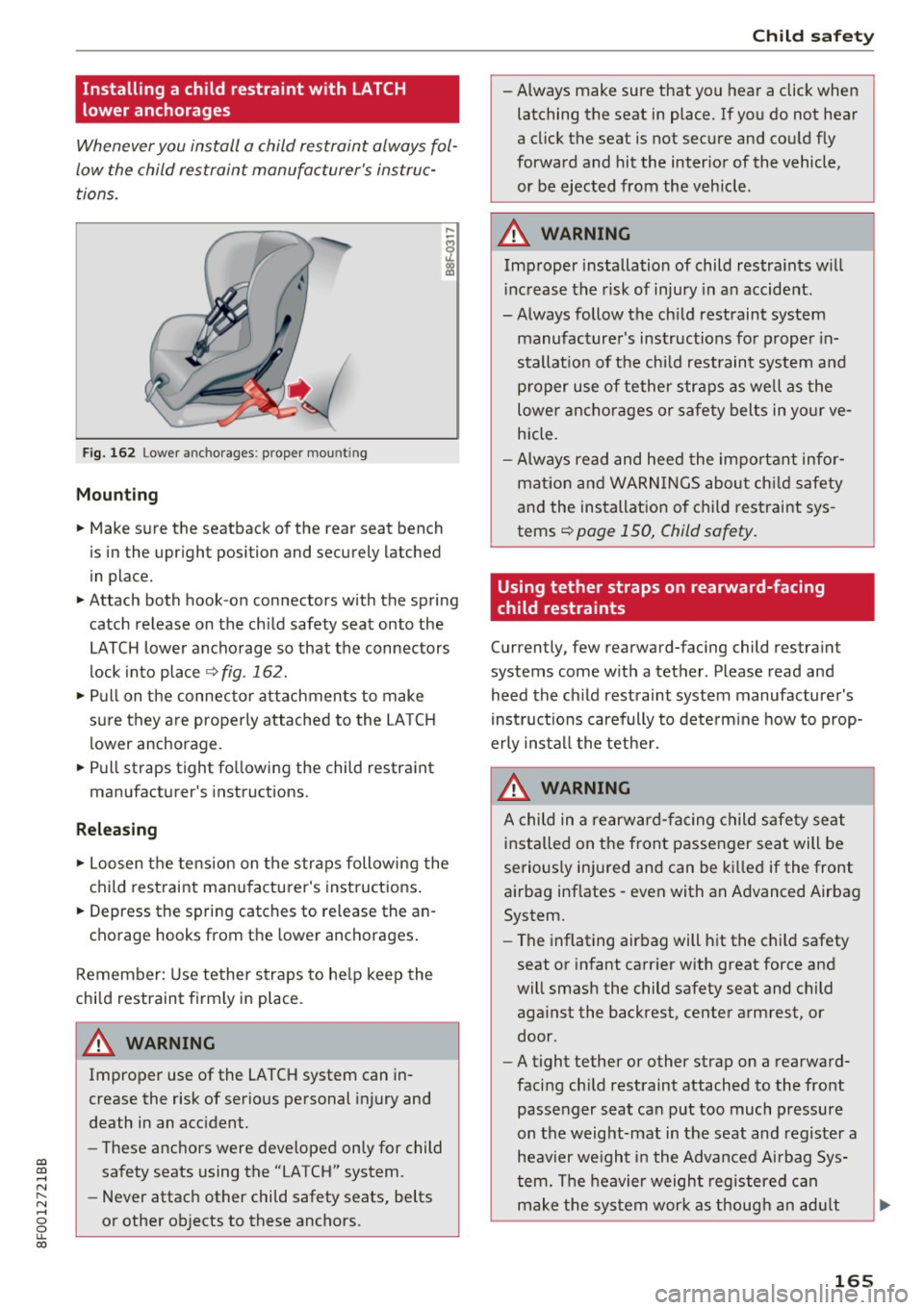
Fig. 162 Lowe r anch orages : proper mo untin g
M ounting
~ Make sure the seatback of the rear seat bench
is in the upright position and securely latched
in place.
~ Attach both hook-on connectors with the spring
catch release on the ch ild safety seat onto the
LATCH lower anchorage so that the connectors
lock into place
¢ fig . 162.
~ Pullon the connector attachments to make
sure they are properly attached to the LA TCH
l ower anchorage.
~ Pull straps tight following the child restraint
manufacturer's instructions.
R el ea sing
~ Loosen the tension on the straps following the
child restraint manufactu rer's instruct ions.
~ Depress the spring catches to release the an
chorage hooks from the lower anchorages .
Remember: Use tether straps to he lp keep the
chi ld restraint firm ly in place.
A WARNING
Improper use of the LATCH system can in
crease the risk of serious personal injury and
death in an acc ident.
-
- These anchors were deve loped only for child a:,
~ safety seats using the "LATCH" system.
N
~ - Never attach other child safety seats, belts ..... g or other objects to these anchors .
LL 00
Child safety
-Always make sure that you hear a click when
latching the seat in place. If you do not hear
a cl ick the seat is not secure and cou ld fly
forward and hit the inter ior of the vehicle,
or be ejected from the vehicle .
A WARNING
'"----
Improper installation of child restra ints w ill
i ncrease the risk of injury in an accident.
-Always follow the ch ild restraint system
manufacturer's instructions for proper in
stallat io n of the chi ld restraint system a nd
proper use of tether straps as well as the
lowe r anchorages or safety belts in yo ur ve
h icle.
- Always read and heed the importan t info r
mat ion and WARNINGS abou t ch ild safety
and the installation of child restraint sys
tems
¢ page 150, Child safety.
Using tether straps on rearward-facing
child restraints
Currently, few rearward-facing child restraint
systems come w ith a tether . Please read and
heed the ch ild restraint system manufacturer's
instruct ions carefully to determ ine how to prop
erly install the tethe r.
A WARNING
A child in a rearward-facing child safety seat
installed on the front passenger seat will be
seriously injured and can be ki lled if the front
airbag inflates - even with an Advanced Airbag
System.
- The inflating airbag will hit the child safety
seat or infant carrier with great force and
will smash the child safety seat and child against the backrest, center armrest, or
door .
- A tight tether or other strap on a rearward
facing ch ild restraint attached to the front
passenger seat can put too much pressure
on the weight-mat in the seat and register a
heavier we ight in the Advanced Ai rbag Sys
tem. The heavier weight registered can
make the system wor k as thoug h an ad ul t
Ill>
165
Page 181 of 266

Trailer towing Driving with a trailer
General information
Your Audi was designed primarily for passenger
transportation .
If you plan to tow a trailer, please remember that
the additional load will affect durability, econo
my and performance.
Trailer towing not only places more stress on the
vehicle, it also calls for more concentration from
the driver.
For this reason, always follow the operating and
driving instructions provided and use common
sense.
Technical requirements
Trailer hitch
Use a weight-carrying hitch conforming to the
gross trailer weight. The hitch must be suitable
for your vehicle and trailer and must be mounted
securely on the vehicle's chassis at a technically
sound
location . Use only a trailer hitch with a re
movable ball mount . Always check with the trail
er hitch manufacturer to make sure that you are
using the correct hitch.
Do not use a bumper hitch.
The hitch must be installed in such a way that it
does not interfere with the impact -absorbing
bumper system . No modifications should be
made to the vehicle exhaust and brake systems .
From time to time, check that all hitch mounting
bo lts remain securely fastened.
When you are not towing a trailer,
remove the
tra iler hitch ball mount . This prevents the hitch
from causing damage shou ld your vehicle be
struck from beh ind ¢
,&. .
Trailer brakes
If your trailer is equipped with a braking system,
gi check to be sure that it conforms to all regula-......
~ tions . N ...... 0
0
LL 00
Trailer towing
The trailer hydraulic brake system must not be
directly connected to the vehicle's hydraulic
brake system ¢.&. .
Safety chains
Always use safety chains between your vehicle
and the trailer.
Trailer lights
T ra iler lights must meet all regulations . Be sure
to check w ith your author ized Audi dealer for cor
rect wiring, switches, and relays.
Mirrors
If you are unable to see the traffic behind you us
ing the regular outside mirrors, then you
must in
stall extended mirrors. It is important that you
always have clear vision to the rear.
,8. WARNING
-If a tra iler has electr ical brakes please note
that these bra kes are not activated by the
factory-fitted control unit -risk of accident!
- After removing the trailer hitch, do not
store it in your vehicle. In case of sudden
braking, the hitch could fly forward and in
jure you or your passengers.
Operating instructions
Maximum trailer weight
A trailer for your vehicle is limited to a typical
class 1 or class 2 trailer.
Trailer load distribution
Be sure the load in the trailer is held sec ure ly in
place to prevent it from shifting forward, back
ward or sideways.
Never allow a passenger to ride in a trailer¢.&.
in Driving instructions on page 180.
Engine cooling system
Towing a trailer makes the engine work harder . It
is important that the cooling system's perform
ance is up to the additional load . Make sure that
the cool ing system has enough fluid. .,..
179
Page 195 of 266

a:,
a:,
...... N
" N ...... 0
0
LL co
Checking and Filling Hood
Releasing and opening the engine hood
The engine hood is released from inside the vehi
cle.
Fig. 169 Driver's side footwell: engine hood re lea se lever
Fig. 170 Release lever under the engine hood
Before opening the engine hood, make sure that
the windshield wipers are flat against the wind
shield. Otherwise, they could damage the paint
on the hood.
.. With the driver's door open, pull the lever un
der the instrument panel in the direction of the
arrow
¢ fig. 169.
.. Raise the hood slightly¢&.
.. Press the rocker switch under the hood upward
¢
fig . 170. This releases the catch.
.. Open the hood.
A WARNING
Hot engine coolant can burn you.
- To reduce the risk of being burned, never
open the hood if you see or hear steam or
coolant escaping from the engine compart
ment. Wait until no steam or coolant can be
Checking and Filling
seen or heard before carefully opening the
hood.
Closing the engine hood
.. Pull the hood down until the pressure from the
struts is reduced.
"' Le t the hood
drop down and latch in place. Do
not try to push it shut;
it may fail to engage
¢&, .
A WARNING
A hood that is not completely latched could
fly up and block your view while driving.
- When you close the engine hood, check it to
make sure the safety catch has properly en
gaged. The hood should be flush with the
surrounding vehicle body parts.
- If you notice while driving that the hood is
not secured properly, stop at once and close
it.
Working in the engine compartment
Be especially careful whenever you work in the
engine compartment.
-
Whenever you must perform any work in the
engine compartment, for example checking and
filling different fluids, there is a risk of injury, burns and accidents. To prevent personal injury
always observe the following WARNINGS. The
engine compartment of any vehicle is a hazard
ous area
¢ .&. .
A WARNING
-~
To help avoid injury, before you check any
thing under the hood:
- Turn off the engine.
- Remove the ignition key .
- Apply the parking brake.
- Move selector lever of automatic transmis-
sion to "P" (Park).
-Always let the engine cool down. Hot com
ponents will burn skin on contact.
- To reduce the risk of being burned, never
open the hood if you see or hear steam or
coolant escaping from the engine
193
Page 199 of 266
a:,
a:,
...... N
" N ...... 0
0
LL co
@ Tips
-The oil pre ssure w arning display. i s not
an indicator of the oil level. Do not rel y on
it. Instead , check the oil level in your en
gine at regular inte rval s, preferably each
t ime you refuel , and alway s befo re going
on a long trip.
- If you have the impression your engine con
sumes excessive amounts of oil, we recom
mend that you cons ult an autho rized Aud i
dealer to have the cause of your concern properly d iagnosed. Keep in mind that the
accurate measurement of oil consump tion
requi res great care and may take some
time. An a uthorized Audi dea ler has instruc
tions about how to measure oil consump
tion accurately.
Checking the engine oil level
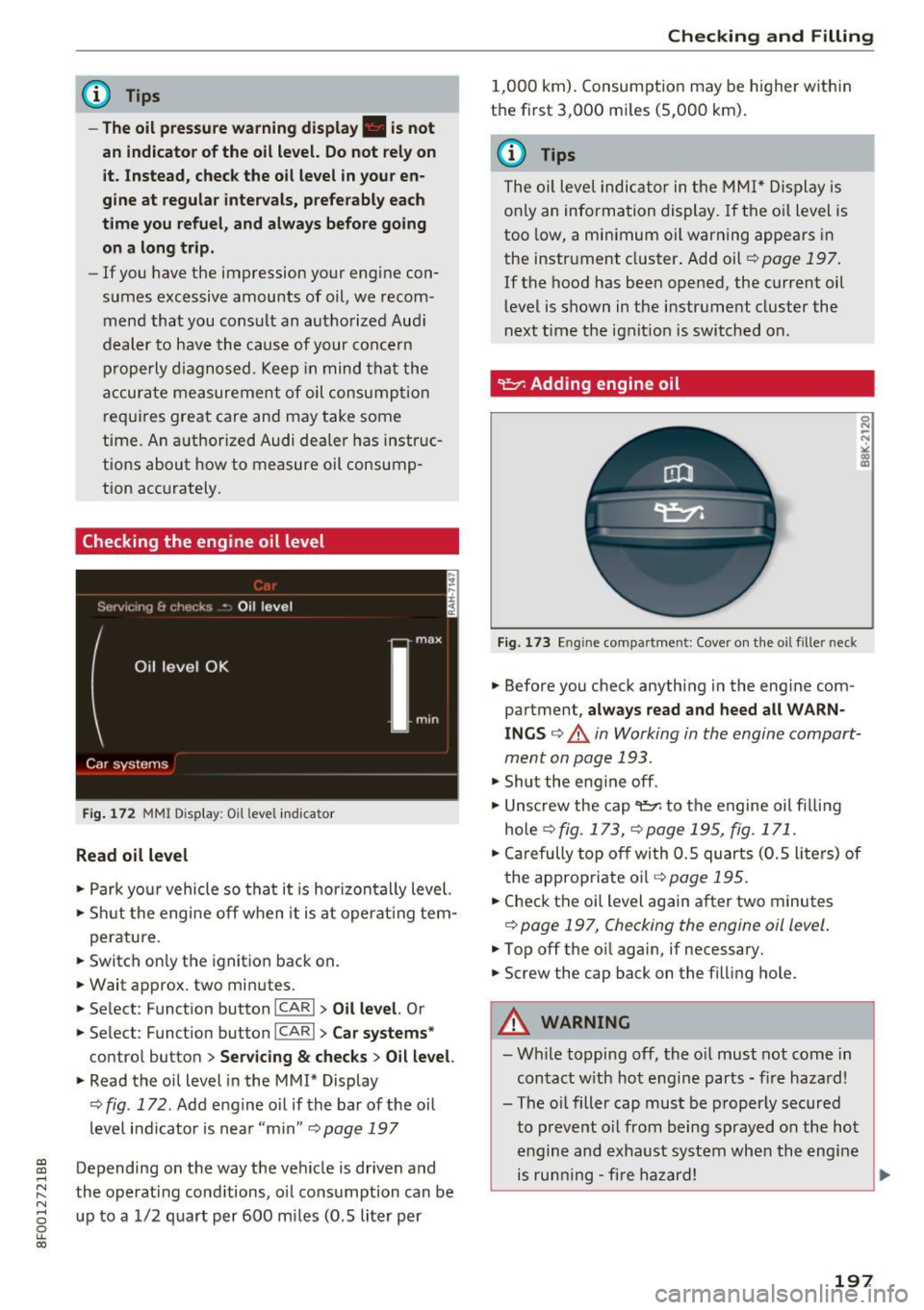
Fig. 172 MM I D isp lay: O il leve l in dicator
Read oil level
.. Park yo ur vehicle so that it is hor izontally level.
.. Shu t the engine off w hen it is at operat ing tem-
perature.
.. Switch only the ignition back on.
.. Wait approx . two mi nutes .
.. Se lect : Function button
~IC~A~R~I > Oil le vel. Or
.. Select : Funct ion button
ICARI > C ar sy stems *
contro l button > S ervici ng & checks > Oil leve l.
.. Read the oil level in the MMI* Display
¢fig . 172. Add engine o il if the bar of the oil
level indicator is near "min"
r::;, page 197
Depending on the way the vehicle is driven and
the operating cond itions, o il cons umption can be
up to a 1/2 quart per 600 m iles (0.5 liter per
Checking and Filling
1,000 km) . Consumptio n may be higher w ithin
the first 3,000 mi les (5,000 km).
(D Tips
The oil leve l indicato r in the M MI * Display is
on ly an information display. If the oi l level is
too low, a minimum oil warning appears in
the instr ument cluster . Add oil¢
page 197 .
If the hood has been opened, the current oil
l evel is shown in the instrument cluster the
next time the ignit ion is switched on.
"l=:7: Adding engine oil
Fig. 173 En g in e compartment: Cover on the oil filler nec k
.. Before you check anything in the eng ine com
partment,
a lwa ys read and heed all WARN
INGS
r::;, .&. in Working in the engine compart
ment on page 193 .
.. Shu t the eng ine off .
.. Uns crew the cap
't=;,: to the engine oil filling
hole
r::;, fig. 173, r::;,page 195, fig. 171 .
.. Carefully top o ff wi th 0.5 quarts (0.5 liters) of
the appropriate oil
r::;, page 195 .
.. Check the oil level again after two minutes
r::;, page 197, Checking the engine oil level.
.. Top off the o il again, if necessary .
.. Screw the cap back on the filling hole .
A WARNING
-- Wh ile topping off, the o il must not come in
con tact w ith ho t engine parts - fi re hazard!
- The oil filler cap must be p roper ly secured
to p revent o il from being sprayed on t he ho t
engine and exhaust system when the engine
is running - fi re ha zard!
~
197
Page 229 of 266
a:,
a:,
...... N
" N ...... 0
0
LL co
Emergency assistance
Vehicle tool kit
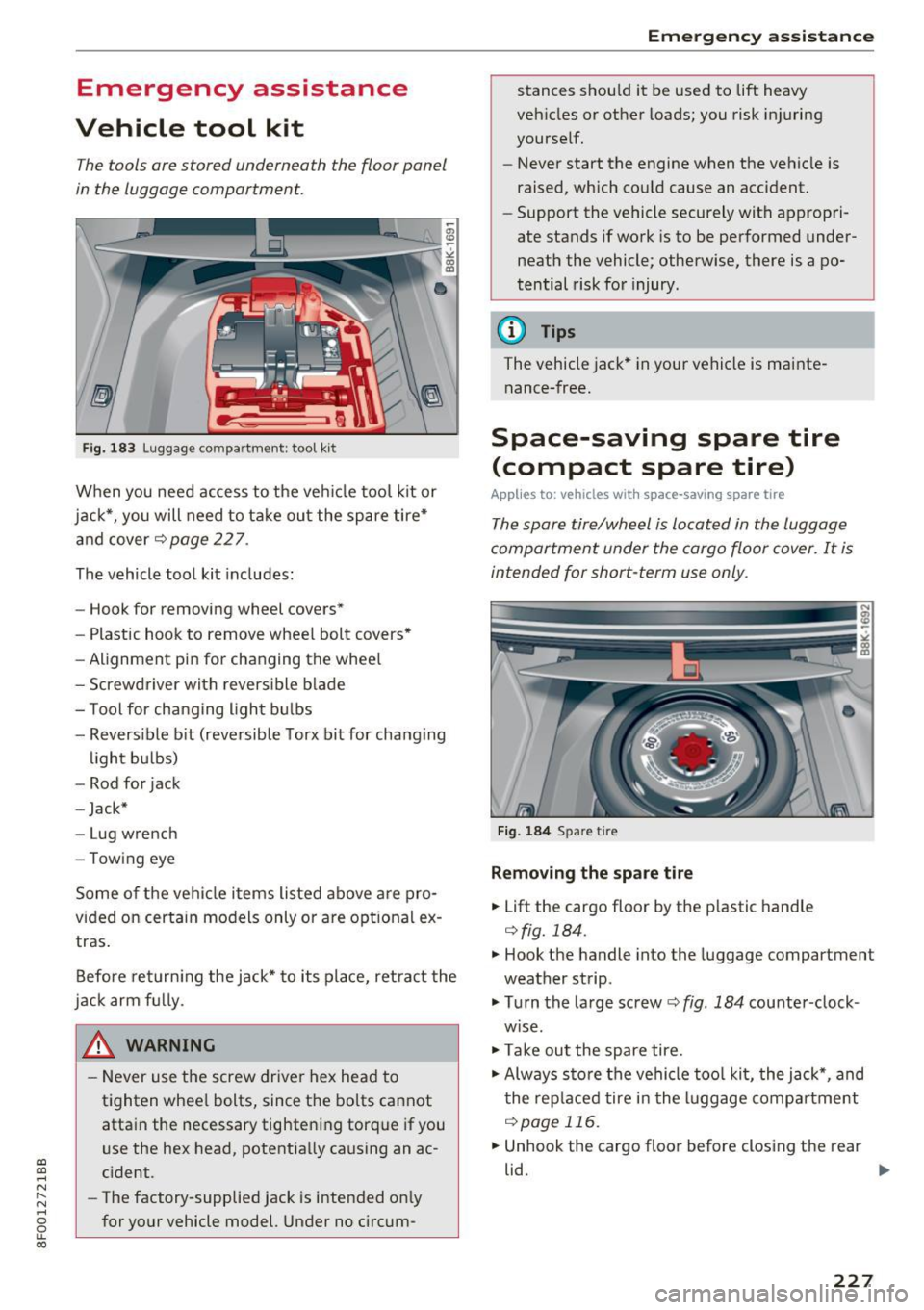
The tools ore stored underneath the floor panel
in the luggage comportment.
Fig. 183 Luggage compartment: tool ki t
When you need access to the veh icle tool kit or
jack*, you will need to take out the spare tire*
and cover
q page 22 7.
The vehicle tool kit includes:
- Hook for removing wheel covers*
- Plastic hook to remove wheel bolt covers*
- Alignment pin for changing the wheel
- Screwdriver with reversible blade
- T ool for changing l ight bulbs
- Revers ible b it (reversible Torx bit for changing
li ght bulbs)
- Rod for jack
- Jack*
- Lug wrench
- Towing eye
Some of the vehicle items listed above are pro
vided on certa in models only or are optional ex
tras.
Before return ing the jack* to its place, retract the
jack arm f ully.
_& WARNING
-Never use the screw driver hex head to
tighten wheel bolts, since the bo lts cannot
attain the necessary tightening torque if you
use the hex head, potentially causing an ac
c ident.
- The factory-supplied jack is intended on ly
for your vehicle model. Under no circum-
Emergency assistance
stances should it be used to lift heavy
vehicles or other loads; you risk injuring
yourself.
- Never start the engine when the vehicle is
raised, which could cause an accident.
- Support the vehicle securely with appropri
ate stands if work is to be performed under
neath the vehicle; otherwise, there is a po
tential risk for injury .
(D Tips
The vehicle jack* in your vehicle is mainte
nance-free.
Space-saving spare tire (compact spare tire)
App lies to : vehicles wi th space-saving spare tire
The spore tire/wheel is located in the luggage
comportment under the cargo floor cover . It is
intended for short-term use only .
Fig. 184 Spare tire
Removing the spare tire
.. Lift the cargo floor by the p lastic handl e
Q fig. 184 .
.. Hook the handle into the lugg age compartment
weather strip .
.,. Turn the large screw
qfig. 184 counter-clock
w ise.
.,. Take out the spare tire .
.,. Always store the vehicle tool kit, the jack *, and
the replaced tire in the luggage compartment
qpoge 116.
.. Unhook the cargo floor before closing the rear
lid . ...
227
Page 233 of 266

Raising the vehicle
The vehicle must be li~ed with the jack first be
fore the wheel can be removed .
Fig. 188 S ill panels: markings
Fig. 189 Sill: posit ion ing th e vehicle jack
The location of the jack point is indicated by an
indentat ion on the underside of the vehicle
c::> fig. 188.
;:;; N 0 u. a, ID
~ Activate the parkin g brake to p reve nt the vehi
cle from roll ing unintentionally.
~ Move the selector lever to position P.
~ Find the m ark in g (imprint) on the sill that is
nearest the wheel that will be changed
<=> fig . 188. Behind the marking, there is a lift
i ng p oint on the sill for the vehicle jack .
~ Turn the ve hicle ja ck located under the lifting
po int on the s ill to ra ise the jack until the jaw
<=> fig. 189 @cove rs the n o tch on the vehicle
Q ,& c::>0 .
~ Align the vehicle jack so the jaw @covers the
notch and the base plate @ is flat on the floor.
The base plate @ must be
vertical under the
lifting point @.
~ Install the rod on the vehicle jack: Insert the
; rod into the opening on the handwheel. Turn
~ the rod left or right to secure it. N .... 0
0
LL co
Emergen cy a ssis tanc e
~ Continue ra ising the jack with t he rod unti l the
wheel lifts off the ground slightly .
Pos ition the vehicle jack
only under the des igna t
ed lift ing points on the sill
c::> fig. 188. There is ex
actly
one l ocation for each wheel. The jack must
not be posit ioned at any ot her location
c::> &<=>CD .
Soft ground under the jack can cause the vehicle
to s lip off the jack. A lways p lace the jack on firm
ground . Use a f lat, stab le support if necessary .
Use a non-s lip surface such as a rubber mat on a
slipp ery s urface such as tile.
_& WARNING
--You or your passengers could be injured
while changing a wheel if you do not follow
these safety precautions:
- Position the vehicle jack only at t he des ig
nated lifting points and align the jack .
Otherwise, the vehicle jack could slip and
cause an injury if it does not have suffi
c ient hold on the vehicle.
- A soft or unstable surface under the jack
may cause the veh icle to slip off the jack.
Always provide a firm base for the jack on
the ground . If necessary, use a sturdy
board unde r the jack .
- On hard, slippery surface (such as t iles)
use a rubber mat or similar to prevent the
jack from slipping.
- To help prevent injury to yourse lf and your
passengers:
- Do no t raise the veh icle until you are sure
the jack is securely engaged.
- Passengers m ust not remai n in the vehicle
when it is jacked up.
- Make su re tha t passengers wait in a safe
place away from the vehicle and well away
from the road and traffic.
- Make s ure jack position is correct, adjus t
as necessary and t hen continue to raise
the jack .
(D Note
Do not lift the vehicle by the s ill. Pos ition the
vehicle j ack only at the des ignated lift ing
231
Page 235 of 266

Tires with unidirectional tread design
Tires with unidirectional tread design must be
mounted with their tread pattern pointed in the
right dir ection .
Using a spare tire with a tread pattern
intended for use in a specific direction
When us ing a spa re t ire with a tread pa tte rn in
tended fo r use in a specific direction, please note
the following:
- The direct ion of rotat io n i s marked by an
arrow
on the side of the tire .
-If the spare tire has to be installed in the incor
rect d irection, use the spare tire only tempora
rily s ince the tire w ill not be ab le to achieve its
opt imum performanc e ch arac teristics with re
gar d to a quaplaning, noise and wea r.
- We recommend that you pay particular atten
t io n t o this fac t during we t weat he r and that
yo u a dju st yo ur speed to match road condi
t ions.
- Replace the fla t tir e with a new one and have i t
i ns ta lled on yo ur vehicle a s soon as possible t o
res tore the handling advantages of a unid irec
t iona l tire .
Notes on wheel changing
Please read t he info rmation ¢ page 214, New
tires or wheels
i f you are going to use a spare tire
which is different from t he tires on your vehicle.
Afte r you change a tire:
- Check the tire pressure on the spare immedi
ately after installation .
- Have the wheel bolt tightening torque
checked with a torque wrench as soon as pos
sible by your authorized Audi dealer or quali
fied workshop.
- With steel and alloy wheel rims, the wheel
bolts are correctly tightened at a torque of 90
ft lbs. (120 Nm).
- If you notice that the wheel bolts are corroded
and difficult to turn while changing a tire ,
gi they should be replaced before you check the ......
~ tightening torque.
N ...... 0
0
LL 00
Emergency assistance
-Replace the flat tire with a new one and have
it installed on your vehicle as soon as possi
ble. Remount the wheel cover .
Until then , drive with extra care and at reduced
speeds.
_& WARNING
- If you are going to equip yo ur vehicle with
tires or r ims which differ from those wh ich
were factory installed, then be sure to read
the information
c> page 214, New tires or
wheels.
- Always make sure the damage d w heel or
even a flat tire and the jack and tool kit are proper ly secured in the luggage compart
men t an d ar e not loose in the passenger
compa rtme nt.
- In an accident or sudde n maneuver they
coul d fly forward, injuring a nyo ne in t he ve
h icl e.
- Always s tore damaged w heel, jack and tools
secure ly i n t he lu ggage compartmen t. Ot h
e rw ise, in an accident or sud den m aneuve r
they could fly forward, causing injury to pas
sen gers in t he veh icle.
(D Note
D o no t use c omm erc ially ava ilable tire se al
a nts. Otherwise, t he e lectr ical comp onents of
the tire p re ssu re m on ito ring syst em * w ill no
l on ger wor k pro perly and t he sensor fo r the
tire p ressure monito ring system* wi ll have to
b e replaced by qualifie d wo rkshop .
-
233