winter tires AUDI A5 CABRIOLET 2017 Owners Manual
[x] Cancel search | Manufacturer: AUDI, Model Year: 2017, Model line: A5 CABRIOLET, Model: AUDI A5 CABRIOLET 2017Pages: 266, PDF Size: 66.64 MB
Page 80 of 266
Driving
had made a fu ll brake application. The laws of
physics cannot be suspended even with ESC
and its associated components ( ABS, ASR,
EDS) . In corners and when road or weather
conditions are bad, a ful l brake application
can cause the vehicle to sk id or the rea r end to
break away- r isk ing an accide nt.
Speed warning system
Overview
The speed warning system helps you to keep your
driving speed below a set speed limit.
The speed warning system warns if the driver ex
ceeds a prev ious ly stored max imum speed. A
warn ing tone wi ll sound as soon as the vehicle
speed exceeds the set speed by about
3 mph
(3 km/h) . At the same time, a warning symbo l
appears in the display. The symbol 's appearance
might be d ifferent in some models.
The speed warning system has two warn ing
thresho lds that funct ion independent ly of each
other and that have somew hat different purpos
es:
Speed warn ing 1
You can use speed warn ing 1 to set the maximum
speed wh ile you are dr iving . This setting wi ll re
main in effect unti l yo u turn
off the ignition, as
sum ing that you have not changed or reset the
sett ing .
The . (USA models)/ . (Canada mode ls)
speed warning symbol in the wa rning
1 display
appears when you exceed the maximum speed . It
goes out when the speed falls below the stored
maximum speed .
The speed warning symbo l will also go out if the
speed
exceeds the stored maximum speed by
more than about 25 mph (40 km/h) for at least
10 seconds . The stored maximum speed is de let
ed.
Speed warn ing 2
Stor ing warning 2 is recommended if yo u always
want to be reminded of a certain speed, for ex
ample when you are traveling in a country that
78
has a general maximum speed limit, or if you do
not want to exceed a specified speed for winter
tires.
The . (USA models)
I. (Canada models)
speed warning 2 symbol appears in the display
when you exceed the stored speed limit. Unlike
warning
1, it will not go out unt il the vehicle
speed drops below the stored speed limit.
Setting speed warning
2 c;, page 79.
(D Tips
Eve n t hough yo ur vehicle is e quipped w ith a
speed w arning system, you should still wa tch
the speedome ter to ma ke sure you are no t
d rivin g faste r than the speed lim it.
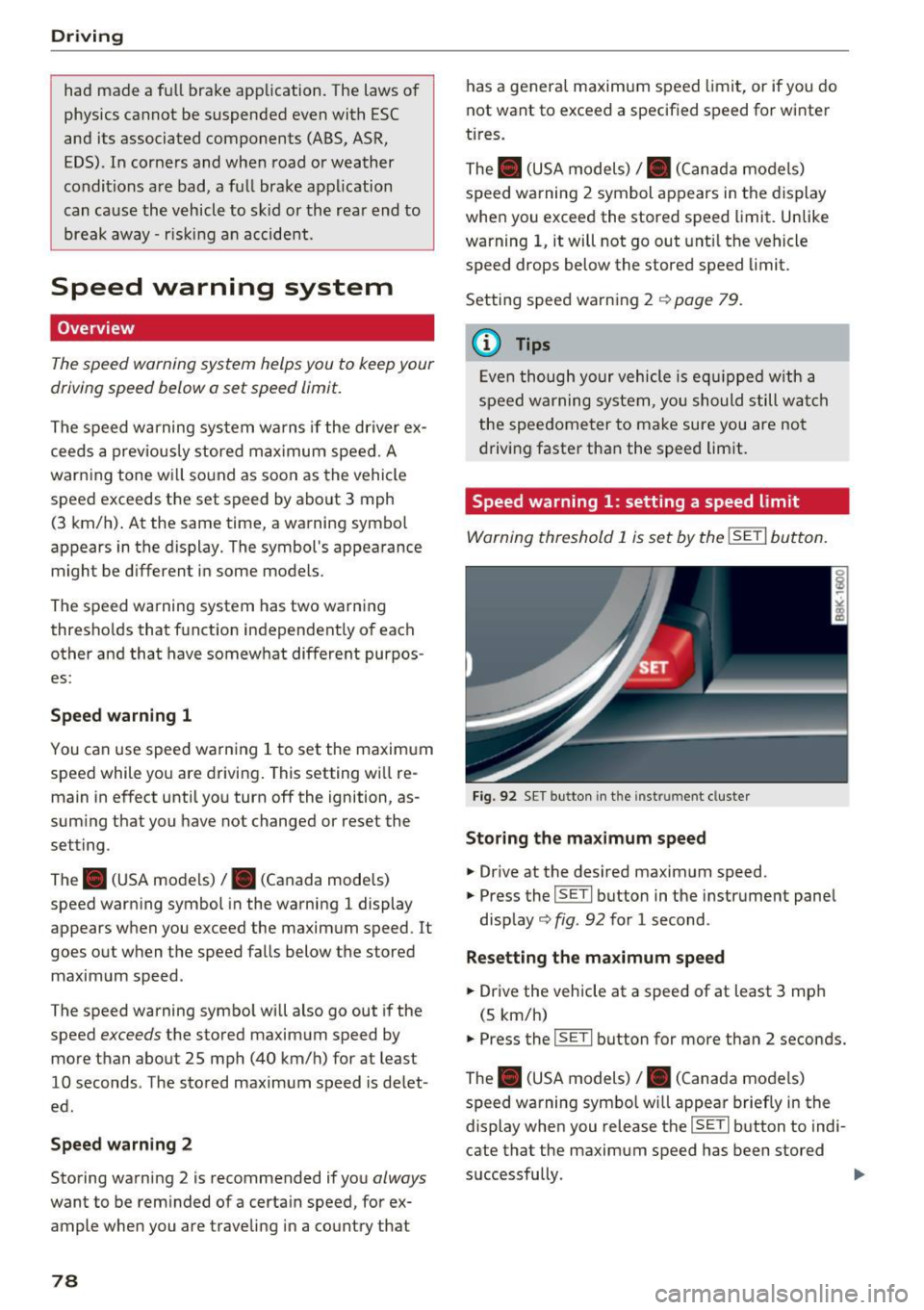
Speed warning 1: setting a speed limit
Warning threshold 1 is s et by the !SE TI button.
Fig. 92 SET butt on in t he in strum en t cl uste r
Storing the maximum speed
.. Drive at the desired maximum speed .
.. Press the
!SET I button in the instrument pane l
disp lay
c;, fig. 92 for 1 second .
Resetting the maximum speed
.. Drive the vehicle at a speed of at least 3 mp h
(5 km/h)
.. Press the
~ 1s=E T= I button for more than 2 seconds.
The . (USA models)
I. (Canada mo dels)
speed warning symbo l w ill appear brief ly in the
display when you release the
!SE TI button to indi
cate that the maximum speed has been stored
successfully.
Page 174 of 266
Intelligent Technology
Do not contin ue driving . See yo ur authori zed
Aud i dea ler or a qua lified repair facility for assis
tance.
'I@ Dynamic steering : Sy stem fault! You can
cont inue d riv ing
If the indi cator lig ht t urns on and the message
appears, the steering m ay be more difficul t to
move or mo re sensit ive than usual. The steering
wheel may also be at an angle when dr iving
straight .
Dr ive s low ly to your author ized A udi dealer or
qu alified wor kshop to have the ma lfunction co r
rected .
l;:r-ij Dynamic steering : initializing
If th is driver message appears and the ind icator
light is flas hing on the instrument panel, dynam
ic stee ring* is be ing rein itia lized . Afte r start ing
the engine , the steer ing wheel will move s light ly.
Re-i nitializ ation m igh t b e necessa ry if the s teer
i n g wheel was moved hard to the left and r igh t
while the veh icle was not moving. The disp lay
goes out as soon as initia lization is complete.
A WARNING
Have the dynamic steering* system malfunc
tion repaired as soon as possible by an au
thorized Audi dealer or qualified workshop -
r isk of accident!
(D Tips
- If the . or l;pij indicator light only stays on
fo r a short time, you may continue driving.
- The dynamic steering* stability systems are
not available in the event of a system mal
funct ion.
- Fo r additional informat ion on dynamic
steering*, refer to
¢ page 101.
172
-
Driving with your
quattro
App lies to : vehicles wit h all -w hee l drive
With all-wheel drive , all four wheels ore driven .
General information
With a ll-wheel d rive, power is distrib uted to a ll
fo ur wheels. Th is happens automat ica lly depend
i ng on your driving style and the road conditions
at the t ime . See also
¢ page 167.
A center d ifferential distributes the driving powe r
variably to the front and rear axle. It works to
gether w ith select ive whee l torque contro l, wh ic h
activates when d rivi ng through curves
¢ page 167. With the spor t different ial*, power
dist ribution to the rear wheels is var iable and can
be adjusted wi th d rive select ¢
page 101 .
The all-whee l dr ive concept is designed for hig h
engine powe r. Your vehicle is except ionally pow
e rfu l an d has excellent driving cha racteristics
bot h unde r no rmal d riving condi tions and o n
snow and i ce. A lways read and follow safety pre
ca utions
~ ..&. .
Winter tires
When dr iving in the winter, yo ur vehicle with all
whee l dr ive has a n advantage, even with regu la r
t ir es. In w inte r road cond it ions i t may be advisa
ble to mo unt win ter tires (o r all-se ason tires) for
i mproved driveability an d braking: these ti res
must be mo unted on
all four whee ls. See also
¢ page 2 22, Winter tires.
Tire chains
Where tire ch ains are mandatory on certain
r oads, t his normally also applies to vehicles wi th
a ll- wheel drive ¢
page 222, Snow chains .
Replacing wheels/tires
Vehicles with all-w heel d rive mus t always have
ti res of the same size. Also avoid tires with diffe r
en t tread dep ths. Fo r d eta ils see page
¢ page 21 4, New tires or wheels. liJJ>
Page 209 of 266
CX)
CX)
-N ,.._ N
-0
0 l,L
CX)
Wheels
Wheels and Tires
General information
.,.Check your tires regularly for
damage (punctures, cuts, cracks
and bulges). Remove foreign ob
jects from the tire tread.
.,. If driving over curbs or similar
obstacles, drive slowly and ap
proach the curb at an angle.
.,.Have faulty tires or rims re
placed immediately.
"'Protect your tires from oil,
grease and fuel.
.,.M ark tires before removing
them so that the same running
direction can be maintained if
they are reinstalled.
"'Lay tires flat when storing and
store them in a cool, dry location
with as little exposure to light as
possible.
(D Note
-Please note that summer and
winter tires are designed for
the conditions that are typical in those seasons. Audi recom
mends using winter tires dur
ing the winter months. Low
temperatures significantly de crease the elasticity of summ
er tires, which affects traction
Wheels
and braking ability. If summer
tires are used in very cold
temperatures, cracks can form
on the tread bars, resulting in
permanent tire damage that
can cause loud driving noise
and unbalanced tires.
-Burnished, polished or
chromed rims must not be
used in winter driving condi
tions. The surface of the rims
does not have sufficient corro
sion protection for this and
could be permanently dam aged by road salt or similar
substances.
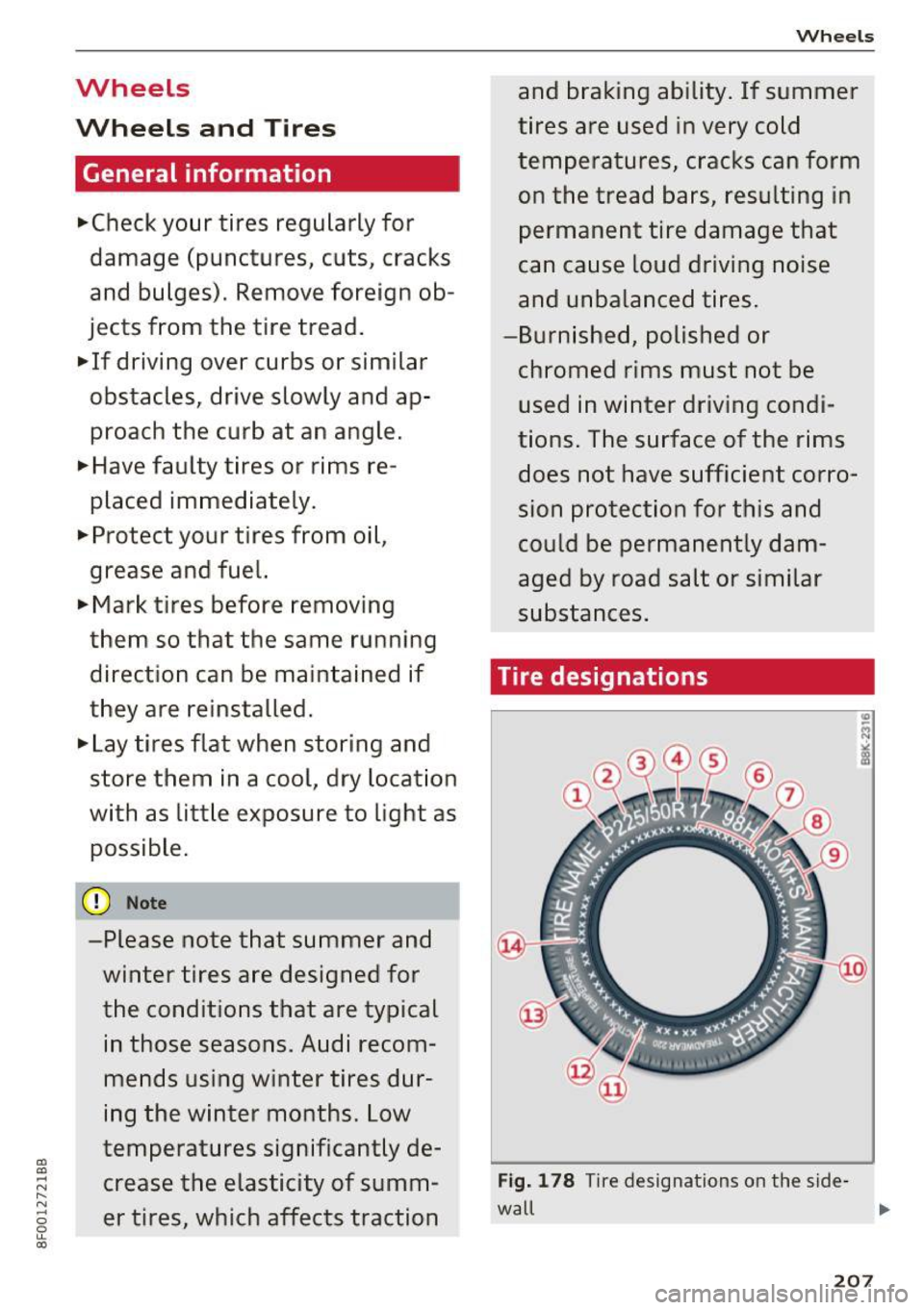
Tire designations
Fig. 178 T ir e designations on the side -
wall Ill>
207
Page 211 of 266
"' "' .... N ,.._ N .... 0
0
u. a:,
® Mud and snow capability
"M/5" or "M+S" indicates the tire
is suitable for driving on mud and
snow. £ indicates a winter tire.
@Composition of the tire cord
and materials
The number of plies indicates the
number of rubberized fabric lay
ers in the tire . In general: the
more layers, the more weight a
tire can carry. Tire manufacturers
must also specify the materials
used in the ti re . These inc lude
stee l, nylon, polyester and other
materials.
@ Maximum permitted load
This number indicates the maxi
mum load in kilograms and
pounds that the tire can carry.
@ Un iform tire quality grade
standards for treadwear,
traction and temperature resistance
Treadwear, traction and tempera
ture ranges
c:::> page 224.
@ Running direction
T he arrows indicate the running
direction of unidirectional tires.
You must always follow the speci
fied running direction
c:::>page 233 .
~ Maximum permitted
inflation pressure
Wheels
T his number indicates the maxi
mum pressure to which a tire can
be inflated under normal operat
ing condit ions .
Glossary of tire and loading
terminology
Accessory weight
means the combined weight (in
excess of those standard items
which may be replaced) of auto matic t ransmission, power steer
ing, power brakes, power win
dows , powe r seats, radio, and
heater, to the extent tha t these
items are avai lab le as factory- in
stalled equipment (whether in
s t alled or not).
Aspect ratio
means the ratio of the height to
the w idth of the tire in percent.
Numbers of 55 or lower indicate a
low sidewall for improved steer
ing response and better overall
handling on dry pavement .
Bead
means the part of the tire that is
made of steel wires, wrapped or
reinfo rced by ply cords and that is
shaped to fit the rim. ...
20 9
Page 214 of 266

Wheels
Rim
means a metal support for a tire
or a tire and tube assembly upon
which the t ire beads are seated .
Rim diameter
means nominal diameter of the
bead seat . If you change your
wh eel size, you will have to p ur
chase new tires to match the new
rim d iameter .
Rim size designation
means rim diameter and w idth.
Rim width
means nomina l distance between
r im flanges .
Sidewall
means that portion of a t ire be
twee n the tread and bead .
Speed rating (letter code)
means the speed at which a t ire is
designed to be driven for extend
ed periods of ti me. The ratings
range from 93 mph (150 km/h)
to 186 mph (298 km/h)
¢ table
on page 2 08 .
You may not find
this information on all tires be
cause it is not required by law.
The speed rating letter code,
wh ere applicable, is molded on
the tire sidewall and ind icates the
2 12
maximum permissible road
speeds
¢ A in Winter tires on
page 222 .
Tire pressure monitoring
system *
means a system that detects
when one or mo re of a vehicle's
tires a re underinflated and illumi
nates a low tire pressure war ning
telltale .
Tread
means that portion of a tire that
comes into contact wi th the road.
Tread separation
means pulling away of the tread
from the tire carcass .
Treadwear indicators (TWI)
means the project ions wi thin the
pr inc ipal grooves designed to g ive
a visua l indication of the degrees
of wear of the tread . See
¢ page 215, Treadwear indicator
for mo re information on meas ur
ing tire wear.
Uniform Tire Quality Grading
i s a tire informa tion system devel
oped by the Unite d States Nation
a l Highway Traffic Safety Admin
istration (NHTSA) that is designed
to help buyers make re lative
..
Page 216 of 266

Wheels
positions. Refer to the table
¢
page 218 for the number of
people that correspond to the ve
h icle normal load.
New tires or wheels
Audi recommends having all work
on tires or wheels performed by
an authorized Audi dealer or au
thor ized Audi Service Facility.
These facilit ies have the proper
knowledge and are equipped with
the required tools and replace ment parts.
.,. New tires do not yet have the
optimum gripping properties .
Drive carefully and at moderate
speeds for the first 350 miles
(500 km) with new tires.
1>-Use ti res of the same construc
tion , size (rolling circumference)
and as close to the same tread
pattern as possible on all four
wheels.
1>-0o not replace tires individually.
At least replace both tires on the
same axle at the same time.
1>-Audi recommends that you use
Audi Original Tires. If you would like to use different tires, please
note that the tires may perform
differently even if they are the
same size ¢
.&..
214
1>-Ifyou would like to equip your
vehicle with a tire/rim combina
tion that is different from what
was installed at the factory, con
sult with an authorized Audi
dealer or authorized Audi Service Facility before making a pur
chase ¢,&. .
The spare tire* is different from
the regular tires installed on the
vehicle -for example, if winter
tires or wide tires are installed -
so only use the spare tire* tempo
rarily in case of emergency and
drive carefully while it is in use. It
should be replaced with a regular
tire as soon as possible.
On
all wheel drive vehicles, all
four wheels must be equipped
with tires that are the same brand and have the same construction
and tread pattern so that the
drive system is not damaged by
different tire speeds . For this rea
son, in case of emergency , only
use a spare tire* that is the same
circumference as the regular
tires.
! WARNING
- Only use tire/rim combina
tions and suitable wheel bolts
that have been approved by .,.
Page 224 of 266

Wheels
and a special procedure. You must not repair or
disassemble them¢&. .
A WARNING
Wheel bolts that are tightened or repaired in
correctly can become loose and result in loss
of vehicle control, which increases the risk of
an accident. For the correct t ightening specifi
cation, see ¢
page 229, After changing a
wheel .
-Always keep the wheel bolts and the
threads in the wheel hub clean and free of
grease.
- Only use wheel bolts that fit the rim .
- Always have damaged rims repaired by an
authorized Audi dealer or authorized Aud i
Service Facility . Never repair or disassemble
rims yourself, because this inc reases the risk
of an accident.
Winter tires
Winter tires s ignificantly improve the vehicle's
handling when driving in winter conditions . Be
cause of their construction (width, compound,
tread pattern), summer tires provide l ess trac
tion on ice and snow.
.,. Use winter tires on all four wheels.
.,. Only use winter tires that are approved for your
vehicle.
.,. Please note that the maximum permitted
speed may be lower with winter tires
q .&,. . An
authori zed Audi dealer or authori zed Audi Serv
ice Facility can inform you about the maximum
permitted speed for your tires .
.,. Check the tire pressure after install ing wheels
q page 217.
The effectiveness of winter tires is reduced great
ly when the tread is worn down to a depth of
0 .157 inch (4 mm). The character istics of winter
tires also decrease greatly as the tire ages, re
gardless of the remaining tread.
A WARNING
- Never drive faster than the maximum per
mitted speed for your tires. This could cause
the tires to heat up too much. This increases
222
-
the risk of an accident because it can cause
the tire to burst.
- Always adapt your driving to the road and
traffic conditions . Drive carefully and reduce
your speed on icy or slippery roads . Even
winter tires can lose traction on black ice .
@ For the sake of the environment
Reinstall summer tires at the appropriate
time, because they prov ide better handling
when roads are free of snow and ice. Summer
tires cause less road noise, tire wear and fuel
consumpt ion .
(D Tips
You can also use all season tires instead of
winter tires. Please note that in some coun
tries where winter tires are required, only
winter tires w ith the ~ symbol may be per
mitted.
Snow chains
Snow chains improve traction in the snow .
.,. Only install snow chains on the front wheels.
This applies also to vehicles with all wheel
drive* .
.,. Check and correct the seating of the snow
chains if necessary after driving a few feet. Fol
low the instructions from the manufacturer.
.,. Note the maximum permitted speed when dr iv
ing with snow chains. Do not exceed 30 mph (SO km/h).
Snow cha ins not only improve the
driving in win
ter road conditions, but also the
braking .
Use of snow chains is only permitted with certain
rim/tire combinat ions due to technical reasons .
Check with an author ized Audi dealer or author
ized Audi Service Facility to see if you may use
snow chains.
Use
fine-mesh snow chains. They must not add
more than 0.53 inch (13.5 mm) in height, includ
ing the chain lock.
You must remove the chains when driving on
roads that are
free of snow . When roads are free ..,.
Page 225 of 266

a:,
a:,
...... N r--. N ...... 0
0
LL 00
of snow, snow chain s can imp air handling and
damage the t ires, and t he chains will quickly be
destroyed.
A WARNING
Using incorrect snow chains or installing snow
chains incorrect ly can result in loss of vehicle
co ntrol, which increases the risk of an acc i
dent .
Snow chains can damage the r ims/wheel cov
ers* if the chains come into d irect contact
w ith them. Remove the wheel covers* first.
Use coated snow chains .
@ Tips
When using snow chains, it may be useful to
switch on sport mode
¢ page 168.
Low aspect ratio tires
Your Aud i is factory-equipped with low aspect ra
t io ti res. These t ires have been tho rough ly tested
a n d been se lected specifically fo r yo ur model for
t he ir superb performance, road feel and handling
under a variety o f driving conditions. Ask your au
thor ized Audi dealer for more details .
The low aspect ratio of these t ires is indicated by
a numera l of
55 or l ess in the tire 's size designa
tion. The numera l represents the rat io o f the
tire's sidewall height in relat ion to its tread width
expressed in pe rcentage. Conventional t ires have
a height/w idth rat io of 60 or more.
The performan ce of low- aspect- ratio tire s is par
ticularl y sensiti ve to imp roper inflat ion pres
sure . It is therefore import ant that low a spect
ratio tires are infl ated to the specified pressure
and that the inflation pre ssure is regularl y
checked and mainta ined . Tire pre ssure s shoul d
be checked at least once a month and alwa ys
befor e a long t rip
¢ page 217.
What you can do to avoid tire and rim
damage
Low aspect rat io tires can be damaged more easi
ly by impact with potho les, curbs, gull ies or
Wh eel s
ridges on the road, particular ly if the tire is un
deri nflated.
In orde r to min imi ze the occurrence of imp act
damage to the tires of yo ur vehicle, we recom
mend that you observe the following preca u
tions:
- Always ma intain recommended inflat io n pres
sures. Check yo ur ti re pressure every 2,000
miles (3,000 km) and add air if necessary .
- Dr ive ca refully on roads w ith po tholes, deep
gullies or ridges . The impac t from dr iving
through or over such obstacles can damage
your tires. Impact with a curb may a lso cause
damage to your tires.
- After any impact, immediate ly inspect your
tires or have them inspected by the nearest au
thorized Audi dealer. Replace a damaged tire as
soon as possible.
- Inspect your tires every 2,000 m iles (3,000 km)
for damage and wear. Damage is not a lways
easy to see . Damage can lead to loss of air and
underinflation, wh ic h could eventually cause
tire fa ilure. If you believe that a tire may have
been damaged, replace the tire as soon as pos
sib le.
- These tires may wear more quickly than others .
- Please also remember that, while these tires
delive r responsive ha ndling, they may ride less
comfortably a nd make more noise than other
choi ces.
Reduced perfo rmance in winter /cold se ason
conditions
All tires are des igned for certai n purposes. The
low aspect ratio, ultra high performance tires
o rigi na lly installed o n your veh icle are intended
f or maximum dry and wet road per formance and
handling . They are not suitable for co ld, snowy or
icy weather conditions . If you drive under those
c ircumstances, you should equip your vehicle
with all-season or winter tires, which offer better
tract ion under those conditions. We suggest you
use the recommended snow or all-season tires
spec ified for your veh icle, or their equiva lent .
Refer to¢
page 222 for more detailed informa
t ion regarding winter tires.
223
Page 228 of 266

Wheels
Check/correc t the p ress ures o f all four tires and
store the pressure again in the Infotainment sys
tem
¢ page 226.
mm (Ti re Pressure Moni to ring System) Tire
pressure: S ystem malfunction !.
Ifm:im appears
afte r switc hing the ignition on or whi le driving
and the
RI] i ndicator light in the instrument cl us
ter blinks for approximate ly one minute and then
stays on, there is system malfunction. Try to
store the correct tire pressures¢
page 226 . If
the ind icator light does tur n off or turns on again
after a short period of t ime, dr ive to an a uthor
ized Audi dealer o r autho rized Aud i Service Faci li
ty immedia tely to have the malfunct ion corre ct
ed .
A WARNING
- If the ti re pressu re indicator appears in the
display, reduce your speed immediate ly and
avoid any hard steering or braking maneu
vers. Stop as soon as possib le and check the
t ires and t heir pressure.
- The driver is responsib le for maintaining the
correct tire pressure. You must check the
t ire pressure regu larly .
- Under certain conditions (such as a sporty
dr iv ing style, winter cond itions or unpaved
roads), the tire pressure mo nitoring system
indicator may be delayed.
- Do not use run-flat tires on your vehicle. Us
ing them when not permitted ca n lead to
vehicle damage or accidents.
(D Tips
- The t ire pressure monitoring system can al
so stop work ing when there is an ESC mal
funct io n.
- Using snow chains may result in a system
malfunction.
- The t ires with the identification "AO" or
"RO" ¢
page 214 have been matched with
your Audi tire pressure monitoring system .
We recommend that you use these t ires.
226
· Storing tire pressures
Applies to: vehicles with Tire Pressure Mon itor ing System
If the tire pressure changes or a tire is replaced,
it must be confirmed in the Infotainment sys
tem .
.. Make sure before stor ing that the t ire pressures
of all four tires mee t the specified values and
are adapted to the load ¢
page 217 .
.. Switch the ignit io n on .
.. Sele ct: the
I CARI fu nct ion button > Tire pres
s ure monitoring
cont rol button. O r
.. Select: the
I CAR I fun ct ion but ton > Car Sys
tem s*
control b utton > Service & check s > Tire
pressure monitoring.
(D Tips
Do not store the tire pressures if snow chains
are installed .
Page 230 of 266
Emerg enc y assis ta nc e
Using th e spa re tire (co mpact sp are tire)
The compact spare tire is only intended for emer
genc ies until you can reach a repair shop. Repla ce
it as qu ickly as possible with a standard wheel
and tir e.
There are some restrictions on the use of the
compact spare tire . The compact spare tire has
been designed specifically for yo ur type of vehi
cle. It must not be swapped with a compact
spare tire from another type of vehicle.
Snow chain s
For technica l reasons, the use of snow chains on
the compact spare tire is
not p ermitt ed .
If you do have to dr ive with snow cha ins and a
front tire fails , mo unt the spare wheel with t ire
instead of a rear tire. Install the snow chains on
the rear tire and use it to rep lace the defective
front tire .
A WARNING
-Never use the spare tire if it is damaged or if
it is worn down to the tread wear indicators.
- If the spare tire is more than 6 years o ld,
use it only in an emergency and with ex
treme caution and carefu l dr iving .
- The spare tire is intended on ly for tempora
ry and short-term use. It shou ld be replaced
as soon as possible with the normal wheel
and t ire .
- After mounting the compact spare t ire, the
t ire pressure must be checked as soon as
poss ible. The tire pressure of the compact
spare tire m ust be 4.2 bar; otherwise, you
risk having an accident .
- Do not drive faster than SO mph (80 km/h) .
You risk hav ing an accident.
- Avoid full-throttle accelerat ion, heavy brak
ing, and fast cornering. You risk having an
acc ident.
- Never dr ive using more than one spare
wheel and tire . You risk having an acc ident .
- Normal summer or winter tires must not be mounted on the compact spare wheel rim .
- For technical reasons, the use of tire chains
on the spare tire is not perm itted . If it is
228
necessary to drive with tire chains, the spare
wheel must be mounted on the front axle in
the event of a flat in a rear tire. The newly
ava ilable front wheel must then be installed
in place of the rear wheel w ith the flat tire.
Installing the tire chain before mounting
the wheel and tire is recommended.
- Loose items in the passenger compartment can cause serious personal injury during
ha rd braking or in an accident. Never store
the spare tire or jack and tools in the pas
senger compartment.
Replacing wheels
· Before changing a wheel
Observe the following precautions for your own
and your passenger's safety when changing a wheel.
.,. After you experience a tire failure, pull the car
well away from moving traffic and try to reach
lev el ground before you stop¢ A_.
.,. All passengers should le av e the car and move
to a safe location (for instance, behind the
guardrail) ¢
&_.
.,. Engage the parkin g brake to prevent your vehi
cle from rolling unintentionally ¢
A_.
.,. Move the se lector lever to the P p osition.
.,. If you are towing a trai ler: unhitch the trailer
from your vehicle.
.,. Take the
jack ¢ page 22 7 and the sp ar e ti re
¢ page 227 out of the luggage compartment.
A WARNING
You or your passengers could be injured while
changing a wheel if you do not follow these
safety precaut ions:
- If you have a flat tire, move a safe distance
off the road . Turn off the eng ine, turn the
emergency flashers on and use other warn ing dev ices to alert other motorists.
- Make sure that passengers wait in a safe
place away from the vehicle and well away
from the road and traff ic.
- To help prevent the veh icle from moving
suddenly a nd possibly slipping off the jac k,