weight AUDI A5 COUPE 2008 User Guide
[x] Cancel search | Manufacturer: AUDI, Model Year: 2008, Model line: A5 COUPE, Model: AUDI A5 COUPE 2008Pages: 313, PDF Size: 13.86 MB
Page 174 of 313
Seat belts
172The physical principles involved in a frontal collision are relatively
simple:
Both the moving vehicle and the passengers possess energy, which
is known as “kinetic energy” ⇒ page 171, fig. 178. The amount of
“kinetic energy” depends on the speed of the vehicle and the weight
of the vehicle and passengers. The higher the speed and the greater
the weight, the more energy there is to be absorbed in an accident.
The most significant factor, however, is the speed of the vehicle. If
the speed doubles from 25 km/h to 50 km/h, for example, the kinetic
energy increases by a factor of four. Because these passengers are
not restrained by seat belts, the entire amount of kinetic energy has
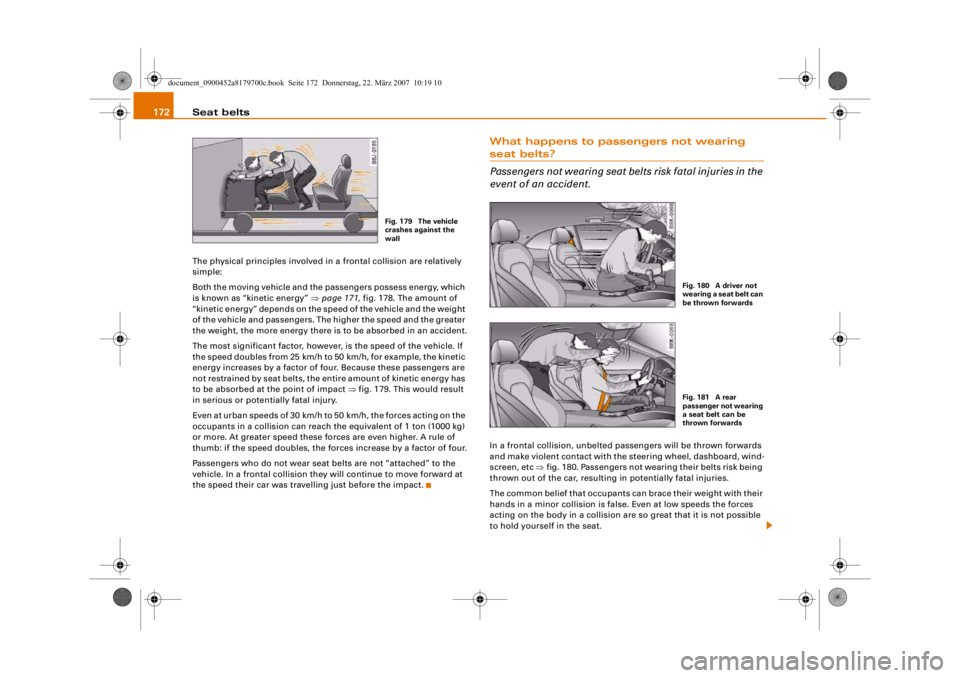
to be absorbed at the point of impact ⇒fig. 179. This would result
in serious or potentially fatal injury.
Even at urban speeds of 30 km/h to 50 km/h, the forces acting on the
occupants in a collision can reach the equivalent of 1 ton (1000 kg)
or more. At greater speed these forces are even higher. A rule of
thumb: if the speed doubles, the forces increase by a factor of four.
Passengers who do not wear seat belts are not “attached” to the
vehicle. In a frontal collision they will continue to move forward at
the speed their car was travelling just before the impact.
What happens to passengers not wearing seat belts?
Passengers not wearing seat belts risk fatal injuries in the
event of an accident.In a frontal collision, unbelted passengers will be thrown forwards
and make violent contact with the steering wheel, dashboard, wind-
screen, etc ⇒ fig. 180. Passengers not wearing their belts risk being
thrown out of the car, resulting in potentially fatal injuries.
The common belief that occupants can brace their weight with their
hands in a minor collision is false. Even at low speeds the forces
acting on the body in a collision are so great that it is not possible
to hold yourself in the seat.
Fig. 179 The vehicle
crashes against the
wall
Fig. 180 A driver not
wearing a seat belt can
be thrown forwardsFig. 181 A rear
passenger not wearing
a seat belt can be
thrown forwards
document_0900452a8179700c.book Seite 172 Donnerstag, 22. März 2007 10:19 10
--4 -
-T
-+ +-
•
Page 183 of 313
Airbag system181
Controls
Safety
Driving tips
General maintenance
Self-help
Technical data
Important safety notes on the side airbag system
There are a number of safety points concerning the airbag
system which you should remember. This will help to
reduce the risk of injury in an accident.
WARNING
•
If you do not wear a seat belt, if you lean forward, or are not
seated correctly while the vehicle is in motion, you are at greater
risk of injury should the side airbags be triggered in an accident.
•
If children are not seated correctly, they are at greater risk of
injury in an accident. This is particularly the case if the child is
travelling on the front passenger' s seat and the airbag system is
triggered. This could result in serious or potentially fatal injury
⇒ page 185, “Child safety”.
•
It is important not to attach any accessories (such as cup
holders) to the doors. This would impair the protection offered by
the side airbags.
•
The sensors for the airbags are lo cated in the front doors. You
must therefore not make any modi fications to the doors or door
trim (e.g. retrofitting loudspeakers), as this could impair the func-
tion of the side airbags. Any damage to the front doors could lead
to faults in the system. Repairs or any other work on the front
doors must therefore always be ca rried out by a qualified work-
shop.
•
The built-in coat hooks should only be used for lightweight
clothing. Do not leave any heav y or sharp-edged objects in the
pockets.
•
Do not apply excessive force to the sides of the backrests (such
as hard knocks or kicks), as this could damage parts of the system.
The side airbags could then fa il to operate when required.
•
If you intend to fit protective co vers over the seats, these must
be of the specific type approved for use on Audi seats with side
airbags. Conventional seat covers would obstruct the side airbag when it inflates out of the ba
ckrest, and seriously reduce the
airbag's ef fectiveness.
•
Any damage to the original seat upholstery or around the
seams of the side airbag units mu st be repaired immediately by a
qualified workshop.
•
Any work involving the side airbag system or removal and
installation of the airbag components for other repairs (such as
repairs to the seats) must al ways be performed by a qualified
workshop. Otherwise the airbag system may fail to work
properly.
Head-protection airbags (sideguard)Description of head-protection airbags
The head-protection airbags work together with the side
airbag system to give extra protection in a side impact.The head-protection airbags are located above the doors on the left
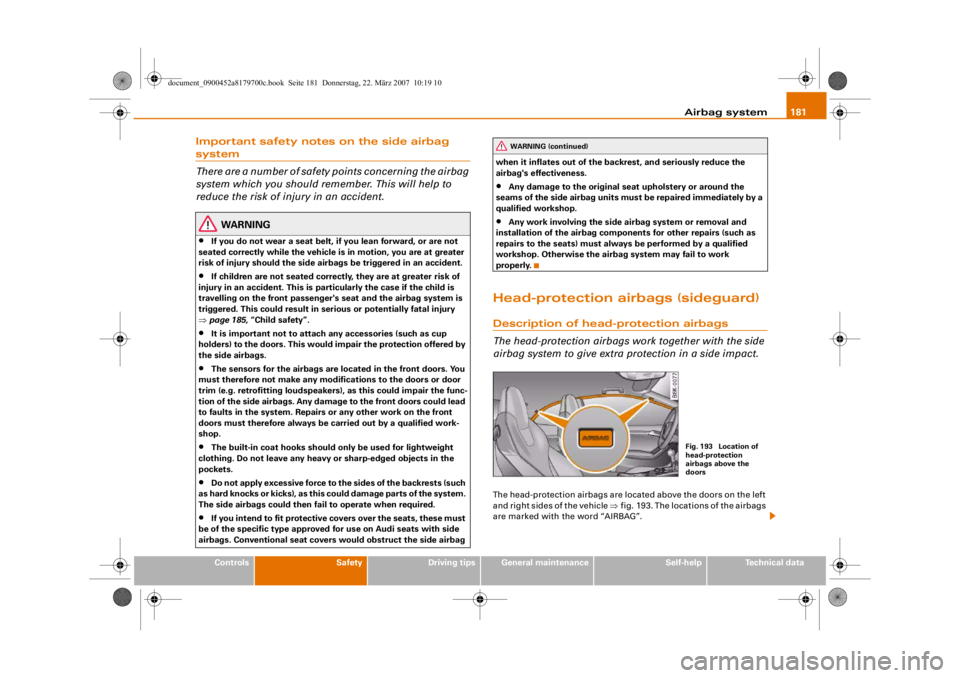
and right sides of the vehicle ⇒fig. 193. The locations of the airbags
are marked with the word “AIRBAG”.
WARNING (continued)
Fig. 193 Location of
head-protection
airbags above the
doors
document_0900452a8179700c.book Seite 181 Donnerstag, 22. März 2007 10:19 10
--4 -
-T
•
-+ +-
Page 184 of 313
Airbag system
182In conjunction with the three-point seat belts and side airbags, the
head-protection airbags give th e occupants additional protection
against head and neck injuries in a severe side collision ⇒ in
“Important safety notes on th e head-protection airbags” on
page 182 .
Together with other design featur es (including cross-braces in the
seats and the overall strength of the body structure), the sideguard
system offers an effective further improvement to occupant protec-
tion in side impacts.How the head-protection airbags work
When fully inflated, the airbags reduce the risk of head or
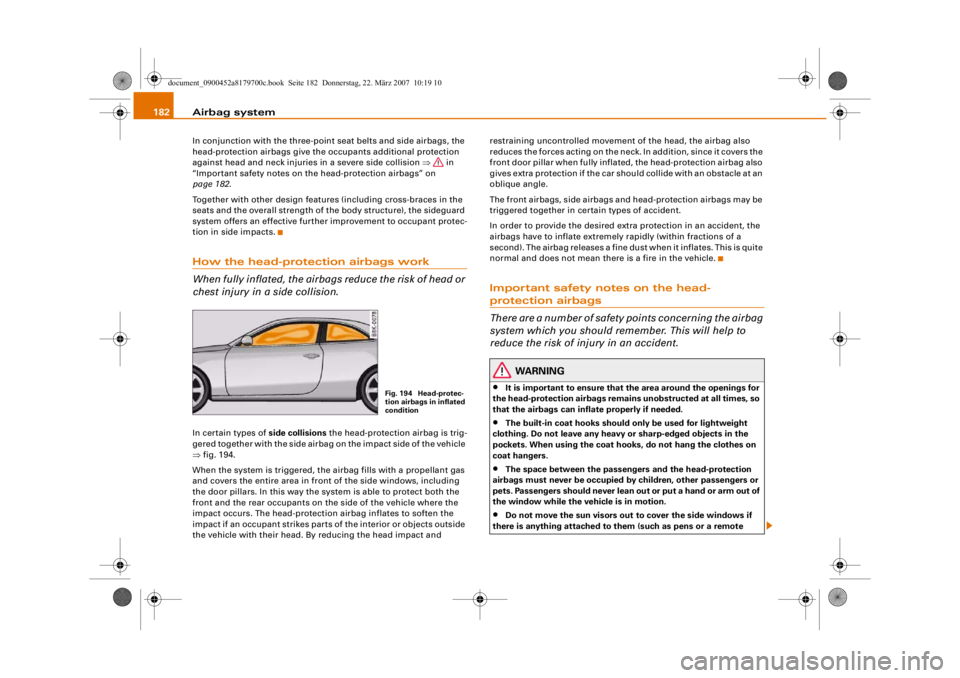
chest injury in a side collision.In certain types of side collisions the head-protectio n airbag is trig-
gered together with the side airbag on the impact side of the vehicle
⇒ fig. 194.
When the system is triggered, the airbag fills with a propellant gas
and covers the entire area in front of the side windows, including
the door pillars. In this way the sy stem is able to protect both the
front and the rear occupants on th e side of the vehicle where the
impact occurs. The head-protection airbag inflates to soften the
impact if an occupant strikes parts of the interior or objects outside
the vehicle with their head. By reducing the head impact and restraining uncontrolled movement
of the head, the airbag also
reduces the forces acting on the neck. In addition, since it covers the
front door pillar when fully inflat ed, the head-protection airbag also
gives extra protection if the car should collide with an obstacle at an
oblique angle.
The front airbags, side airbags and head-protection airbags may be
triggered together in certain types of accident.
In order to provide the desired extra protection in an accident, the
airbags have to inflate extremel y rapidly (within fractions of a
second). The airbag releases a fine dust when it inflates. This is quite
normal and does not mean there is a fire in the vehicle.
Important safety notes on the head-protection airbags
There are a number of safety points concerning the airbag
system which you should remember. This will help to
reduce the risk of injury in an accident.
WARNING
•
It is important to ensure that the area around the openings for
the head-protection airbags remain s unobstructed at all times, so
that the airbags can inflate properly if needed.
•
The built-in coat hooks should only be used for lightweight
clothing. Do not leave any heav y or sharp-edged objects in the
pockets. When using the coat hooks, do not hang the clothes on
coat hangers.
•
The space between the passeng ers and the head-protection
airbags must never be occupied by children, other passengers or
pets. Passengers should never lean out or put a hand or arm out of
the window while the vehicle is in motion.
•
Do not move the sun visors out to cover the side windows if
there is anything attached to them (such as pens or a remote
Fig. 194 Head-protec-
tion airbags in inflated
condition
document_0900452a8179700c.book Seite 182 Donnerstag, 22. März 2007 10:19 10
--4 -
-T
•
•
-+ +-
Page 187 of 313
Child safety185
Controls
Safety
Driving tips
General maintenance
Self-help
Technical data
Child safetyPoints to remember if children are
travelling in the carIntroduction
Statistics show that children are generally safer on the
rear seat than on the front passenger's seat.Children under 12 years of age shou ld normally travel on the rear
seat
4). Children travelling on the rear seat must use a child restraint
system or the seat belts provided, depending on their age, height
and weight. For safety reasons, the child restraint system should be
installed behind the front passenger's seat.
The physical principles involved and the forces acting in a collision
apply to children just as much as adults ⇒page 171, “Forces acting
in a collision”. But, unlike adults, children do not have fully devel-
oped muscle and bone structures. This means that children are
subject to a greater risk of injury.
To reduce this risk, children must always use special child restraint
systems when travelling in the car.
Use only child restraint systems which are officially approved under
the European standard ECE R 44 and are suitable for the child. ECE R
refers to the Economic Commission of Europe Recommendation,
which categorises child restraint systems in 5 groups ⇒page 186,
“Child seat categories”. Child restraints that have been tested and
approved under the ECE R 44 standard bear the ECE-R 44 test mark
on the seat (the letter E in a circle with the test number below it).
We recommend using child restraint systems from the range of
Audi Genuine Accessories available from Audi dealers. The
“Huckepack” range includes suitable restraint systems for all ages. These systems have been specially developed and tested for use in
Audi vehicles and comply with the ECE-R 44 standard.
Follow the manufacturer's instru
ctions and observe any statutory
requirements when installing and using child restraints ⇒ in
“Important safety notes for using child safety seats”.
Important safety notes for using child safety seats
Correct use of child safety seats can help to reduce the
risk of injury in an accident.
WARNING
•
All vehicle occupants, especially children, must wear a seat
belt while the vehicl e is in motion.
•
Children who are less than 1.5 metres tall must not wear a
normal seat belt without a child restraint, as this could cause inju-
ries to the abdominal and neck areas.
•
Babies and children must never travel on another occupant's
lap.
•
A suitable child safety seat can protect your child ⇒ page 186,
“Child safety seats”.
•
Never allow two children to occupy one child safety seat.
•
Never leave a child without supervision in a child safety seat.
•
Never allow a child to travel in the car without a suitable child
restraint.
•
Never allow a child to stand up or kneel on a seat while the car
is moving. In an accident, the child could be catapulted through
the car, causing possibly fatal injuries to itself and other occu-
pants.
4)Observe any restrictions or regulations to the contrary.
document_0900452a8179700c.book Seite 185 Donnerstag, 22. März 2007 10:19 10
--4 -
-T
&
•
-+ +-
Page 189 of 313
Child safety187
Controls
Safety
Driving tips
General maintenance
Self-help
Technical data
Children who are taller than 1.5 metres can use the existing seat
belts without a booster cushion.
Child restraints that have been tested and approved under the ECE
R 44 standard bear the ECE-R 44 test mark on the seat (the letter E
in a circle with the test number below it).
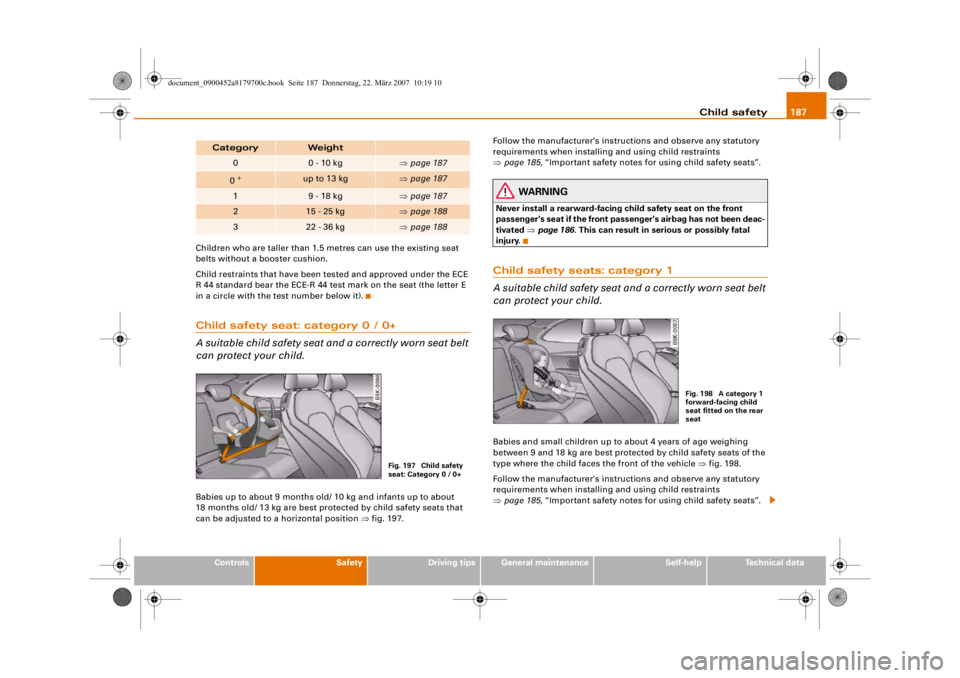
Child safety seat: category 0 / 0+
A suitable child safety seat and a correctly worn seat belt
can protect your child.Babies up to about 9 months old/
10 kg and infants up to about
18 months old/ 13 kg are best prote cted by child safety seats that
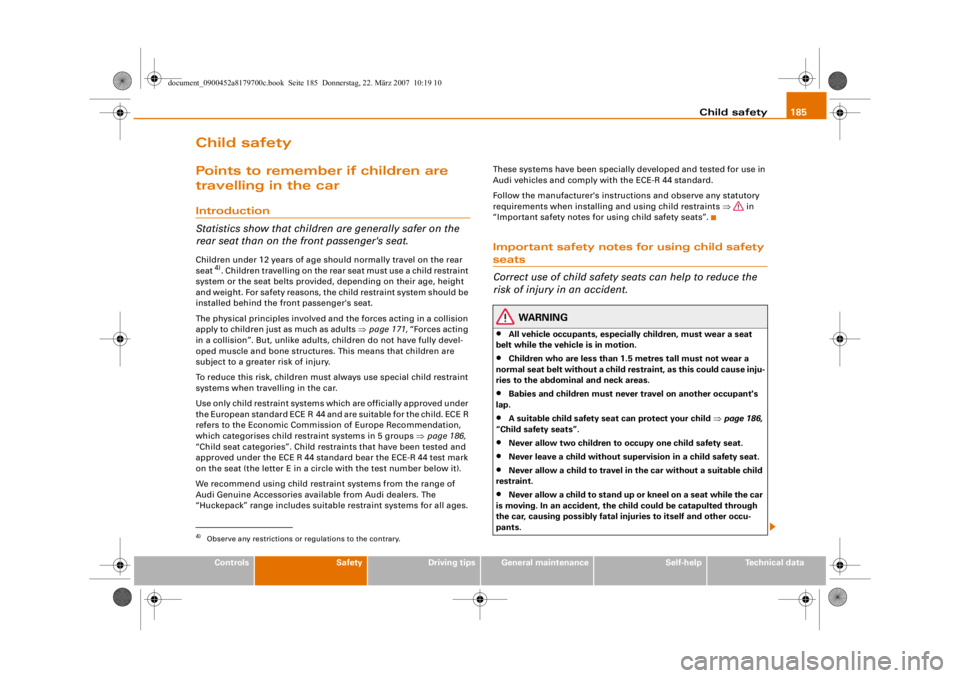
can be adjusted to a horizontal position ⇒fig. 197. Follow the manufacturer's instru
ctions and observe any statutory
requirements when installing and using child restraints
⇒ page 185, “Important safety notes for using child safety seats”.
WARNING
Never install a rearward-facing child safety seat on the front
passenger's seat if the front pass enger's airbag has not been deac-
tivated ⇒page 186 . This can result in serious or possibly fatal
injury.Child safety seats: category 1
A suitable child safety seat and a correctly worn seat belt
can protect your child.Babies and small children up to about 4 years of age weighing
between 9 and 18 kg are best protected by child safety seats of the
type where the child faces the front of the vehicle ⇒fig. 198.
Follow the manufacturer's instru ctions and observe any statutory
requirements when installing and using child restraints
⇒ page 185, “Important safety notes for using child safety seats”.
Category
Weight
0
0 - 10 kg
⇒page 187
0 +
up to 13 kg
⇒page 187
1
9 - 18 kg
⇒page 187
2
15 - 25 kg
⇒page 188
3
22 - 36 kg
⇒page 188Fig. 197 Child safety
seat: Category 0 / 0+
Fig. 198 A category 1
forward-facing child
seat fitted on the rear
seat
document_0900452a8179700c.book Seite 187 Donnerstag, 22. März 2007 10:19 10
--4 -
-T
•
-+ +-
Page 191 of 313
Child safety189
Controls
Safety
Driving tips
General maintenance
Self-help
Technical data
Fitting child safety seatsGeneral information
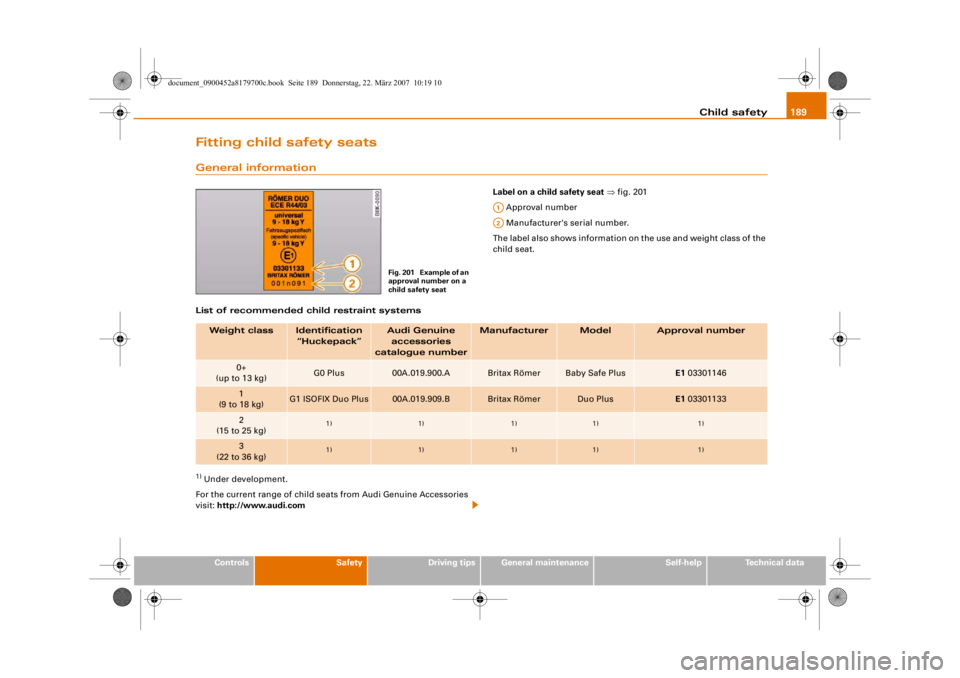
Label on a child safety seat ⇒ fig. 201
Approval number
Manufacturer's serial number.
The label also shows information on the use and weight class of the
child seat.
List of recommended child restraint systems
1) Under development.
For the current range of child seats from Audi Genuine Accessories
visit: http://www.audi.com
Fig. 201 Example of an
approval number on a
child safety seat
A1A2
Weight class
Identification
“Huckepack”
Audi Genuine accessories
catalogue number
Manufacturer
Model
Approval number
0+
(up to 13 kg)
G0 Plus
00A.019.900.A
Britax Römer
Baby Safe Plus
E1 03301146
1
(9 to 18 kg)
G1 ISOFIX Duo Plus
00A.019.909.B
Britax Römer
Duo Plus
E1 03301133
2
(15 to 25 kg)
1)
1)
1)
1)
1)
3
(22 to 36 kg)
1)
1)
1)
1)
1)
document_0900452a8179700c.book Seite 189 Donnerstag, 22. März 2007 10:19 10
--4 -
-T
-+ +-
Page 192 of 313
Child safety
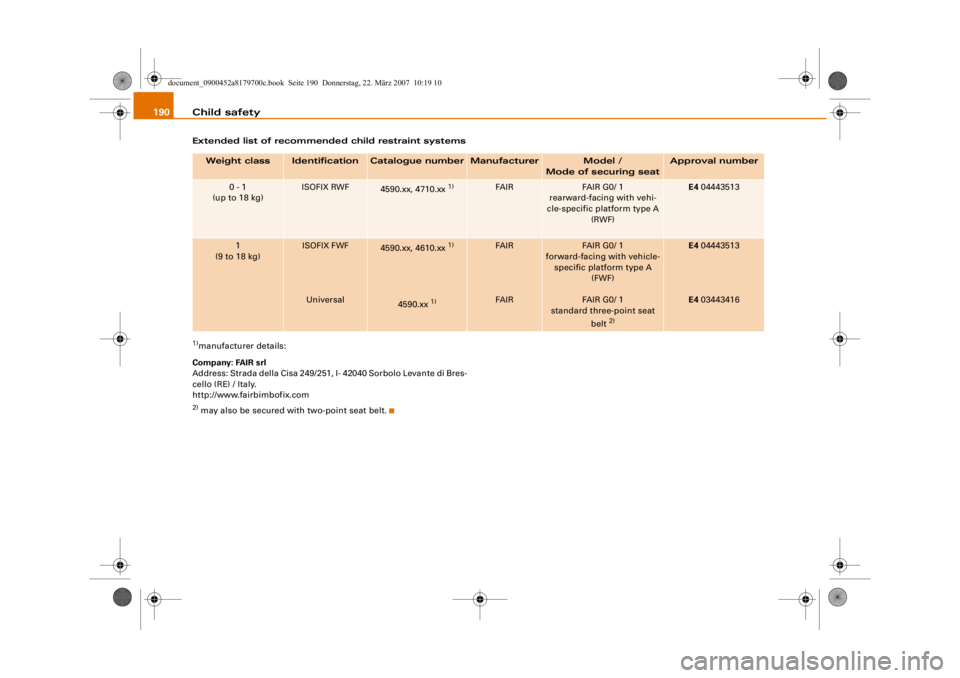
190Extended list of recommended child restraint systems1)manufacturer details:
Company: FAIR srl
Address: Strada della Cisa 249/251, I- 42040 Sorbolo Levante di Bres-
cello (RE) / Italy.
http://www.fairbimbofix.com2) may also be secured wi th two-point seat belt.Weight class
Identification
Catalogue number
Manufacturer
Model /
Mode of securing seat
Approval number
0 - 1
(up to 18 kg)
ISOFIX RWF
4590.xx, 4710.xx
1)
FA I R
FAIR G0/ 1
rearward-facing with vehi-
cle-specific platform type A
(RWF)
E4 04443513
1
(9 to 18 kg)
ISOFIX FWF
Universal
4590.xx, 4610.xx
1)
4590.xx
1)
FA I R
FA I R
FAIR G0/ 1
forward-facing with vehicle- specific platform type A (FWF)
FAIR G0/ 1
standard three-point seat
belt
2)
E4 04443513
E4 03443416
document_0900452a8179700c.book Seite 190 Donnerstag, 22. März 2007 10:19 10
--4 -
-T
-+ +-
•
Page 193 of 313
Child safety191
Controls
Safety
Driving tips
General maintenance
Self-help
Technical data
Possible alternatives for securing a child safety seat
A child safety seat can be secured on the rear seats and
on the front passenger's seat.The following alternatives are avai lable for safely securing a child
safety seat on the rear seats and on the front passenger's seat.•
Child safety seats of the categories 0 to 3 can be secured with the
standard three-point seat belts.
•
Child safety seats of the categories 0, 0+ and 1 with the “ISOFIX”
system can be secured without seat belts using the “ ISOFIX”
retainers* ⇒page 191 .
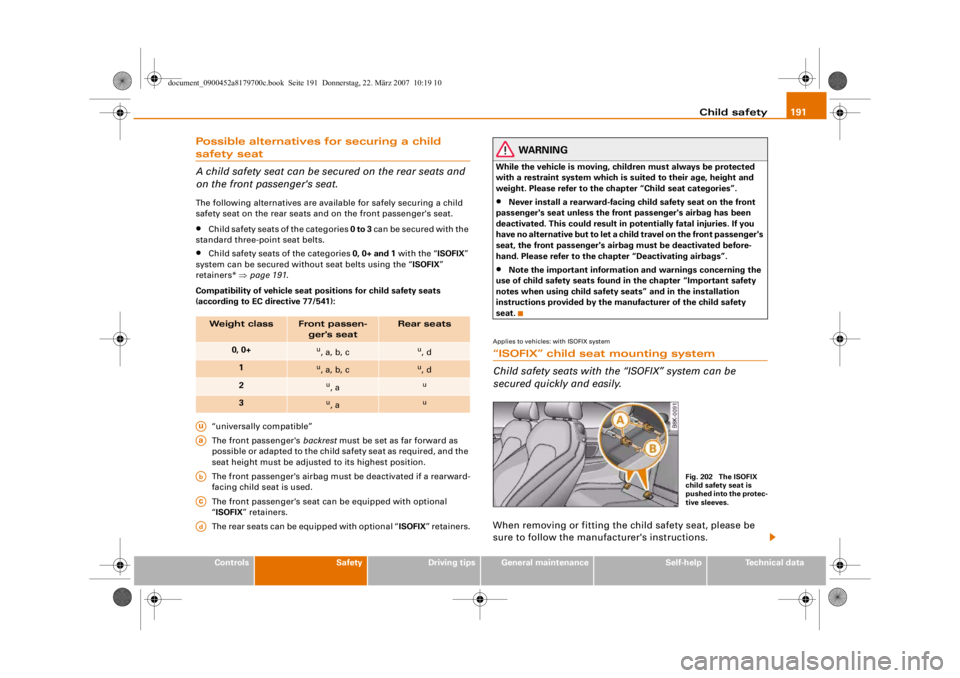
Compatibility of vehicle seat positions for child safety seats
(according to EC directive 77/541):
“universally compatible”
The front passenger's backrest must be set as far forward as
possible or adapted to the child safety seat as required, and the
seat height must be adjust ed to its highest position.
The front passenger's airbag must be deactivated if a rearward-
facing child seat is used.
The front passenger's seat can be equipped with optional
“ ISOFIX ” retainers.
The rear seats can be equipped with optional “ ISOFIX” retainers.
WARNING
While the vehicle is moving, chi ldren must always be protected
with a restraint system which is suited to their age, height and
weight. Please refer to the chapter “Child seat categories”.•
Never install a rearward-facing child safety seat on the front
passenger's seat unless the fr ont passenger's airbag has been
deactivated. This could result in potentially fatal injuries. If you
have no alternative but to let a child travel on the front passenger's
seat, the front passenger's airb ag must be deactivated before-
hand. Please refer to the chapter “Deactivating airbags”.
•
Note the important information and warnings concerning the
use of child safety seats found in the chapter “Important safety
notes when using child safety seats” and in the installation
instructions provided by the manufactur er of the child safety
seat.
Applies to vehicles: with ISOFIX system“ISOFIX” child seat mounting system
Child safety seats with the “ISOFIX” system can be
secured quickly and easily.When removing or fitting the child safety seat, please be
sure to follow the manufacturer's instructions.
Weight class
Front passen- ger's seat
Rear seats
0, 0+
u, a, b, c
u, d
1
u, a, b, c
u, d
2
u, a
u
3
u, a
u
AuAaAbAcAd
Fig. 202 The ISOFIX
child safety seat is
pushed into the protec-
tive sleeves.
document_0900452a8179700c.book Seite 191 Donnerstag, 22. März 2007 10:19 10
--4 -
-T
-+
•
+-
Page 209 of 313
Your vehicle and the environment207
Controls
Safety
Driving tips
General maintenance
Self-help
Technical data
fuel consumption will return to a normal level. This is the reason
why we recommend avoiding short trips wherever possible.
Maintain the correct tyre pressures
Always make sure the tyres are inflated to the correct pressures
⇒
page 243 to save fuel. If the tyre pressures are just 0.5 bar too low,
this can increase the fuel consumption by as much as 5 %. Due to
the greater rolling resistance, under-inflation also increases tyre
wear and impairs handling.
Do not use winter tyres all through the year; they will increase fuel
consumption by up to 10 %.
Avoid carrying unneccessary loads
Every kilo of extra weight will increase the fuel consumption, so it is
worth checking the luggage compartment occasionally to make
sure that no unnecessary loads are being transported.
A roof carrier is often left in place for the sake of convenience, even
when it is no longer needed. At a speed of 100-120 km/h your car will
use about 12 % more fuel as a result of the extra wind resistance
caused by the roof carrier - even when it is empty.
Save electrical energy
The engine drives the alternator to generate electricity. This means
that fuel consumption rises when more power is required for elec-
trical equipment. Switch off electrical equipment when it is not
needed. Electrical equipment which uses a lot of electricity includes
the blower (at a high se tting), the rear window heating and the seat
heating*.
Environmental compatibilityEnvironmental protection is a top priority in the design, choice of
materials and production of your new Audi. Design measures for economical recycling
•
Joints and connections designed for ease of dismantling
•
Modular construction to
facilitate dismantling
•
Increased use of single-grade materials
•
Plastic parts and elastomers are labelled in accordance with ISO
1043, ISO 11469 and ISO 1629
Choice of materials
•
Nearly all materials used can be recycled
•
Similar types of plastics grouped together for easy recycling
•
Recycled materials used in manufacture
•
Reduced vapour emissions from plastics
•
CFC-free refrigerant in air conditioner
Compliance with the laws prohibiting the use of : Cadmium,
asbestos, lead, mercury and chrome VI.
Manufacturing methods
•
Using recycling material for manufacturing plastic parts
•
Solvent-free cavity sealing
•
Solvent-free wax for protecting the vehicles in transit
•
Solvent-free adhesives
•
No CFCs used in production
•
Surplus materials used extensively for energy conversion and
building materials
•
Overall water consumption reduced
•
Heat recovery systems
•
Water-soluble paint
document_0900452a8179700c.book Seite 207 Donnerstag, 22. März 2007 10:19 10
--4 -
-T
-+ +-
•
•
Page 210 of 313
Towing a trailer
208Towing a trailerDriving the vehicle with a trailer or
caravanTechnical requirements
The towing bracket must comply with certain technical
requirements.Your car is intended mainly for transporting passengers and
luggage. However, if suitably equipped, it can also be used to tow a
trailer or caravan.
If the car is supplied with a factory-fitted towing bracket it will
already have the necessary technical modifications and meet the
statutory requirements.
A 13-pin socket is provided to make the electrical connection
between the car and the trailer. If the trailer has a 7-pin plug you can
use an adapter cable. This is available from Audi dealers.
WARNING
If a towing bracket is retrofitted, the installation should be carried
out by a qualified workshop.•
In particular in high outside tem peratures it is not possible to
drive up long steep gradients with out a suitable cooling system.
The engine would then overheat.
•
Incorrect installation can result in a safety risk.
Points to check before towingTrailer weights
Never exceed the maximum permitted trailer weights ⇒page 295 .If you do not load the trailer up
to the maximum permitted trailer
weight, you can then climb correspondingly steeper gradients.
The maximum trailer weights listed are only applicable for altitudes
up to 1000 m above sea level. With increasing altitude the engine
power and therefore the car's climbing ability are impaired because
of the reduced air density, so the maximum trailer weight has to be
reduced accordingly. The weight of the car and trailer must be
reduced by 10% for every further 1000 m (or part thereof). This
figure refers to the combined weight of the (loaded) vehicle and
(loaded) trailer.
The figures for the draw bar weight that appear on the identification
plate of the towing bracket are for certification purposes only. The
correct figures for your specific vehicle, which may be lower than
these figures for the towing bracket, are given in the registration
documents. Also refer to ⇒page 295 .
Distributing the load
Distribute loads in the trailer so th at heavy objects are as near to the
axle as possible. Loads carried in the trailer must be secured to
prevent them slipping.
Where possible, operate the trai ler with the maximum permitted
draw bar weight on the ball joint of the towing bracket, but do not
exceed the specified limit.
Tyre pressure
Check the tyre pressures on your car and adjust for “full load” condi-
tions (refer to the sticker listing the tyre pressures on the end face
of the driver's door). It may also be necessary to adjust the tyre pres-
sures on the trailer according to the recommendations of the trailer
manufacturer.
Exterior mirrors
Check whether you can see enough of the road behind the trailer
with the standard mirrors. If this is not the case you should have
document_0900452a8179700c.book Seite 208 Donnerstag, 22. März 2007 10:19 10
--4 -
-T
-+ +-
•