weight AUDI A5 COUPE 2008 Owner's Manual
[x] Cancel search | Manufacturer: AUDI, Model Year: 2008, Model line: A5 COUPE, Model: AUDI A5 COUPE 2008Pages: 313, PDF Size: 13.86 MB
Page 211 of 313
Towing a trailer209
Controls
Safety
Driving tips
General maintenance
Self-help
Technical data
additional mirrors fitted. Both exterior mirrors should be mounted
on hinged extension brackets. Adjust the mirrors to give sufficient
vision to the rear.
Headlights
Before starting a journey, check
the headlight beam settings with
the trailer hitched up. If necessary, alter the height of the headlight
beams by means of the headlight range control ⇒page 56 .
Power supply
When you remove the ignition key the power supply to the trailer is
interrupted.
Removable ball joint coupling
Vehicles with a factory-fitted towing bracket are equipped with a
removable ball joint coupling. It is carried under the floor panel on
the left-hand side of the luggage compartment.
Note
We recommend having the car serviced between the normal inspec-
tion intervals if it used frequently for towing a trailer.Applies to vehicles: with towing bracketTrailer stabilisation system
Trailer stabilisation helps to reduce the risk of the vehicle
skidding when towing a trailer.When is the trailer stab ilisation system activated?
Trailer stabilisation is active when the following requirements are
met:•
The ESP must NOT be switched off ⇒page 196 ,
•
The trailer connector must be properly secured in the vehicle
socket.
•
Vehicle speed must be higher than approx. 60 km/h. How trailer stabilisation works:
In many cases, the driver can stabilise a swaying trailer by manually
braking the vehicle.
However, if the ESP detects that th
e trailer is swaying and this is
affecting the towing vehicle, it will automatically brake the vehicle
to stabilise the trailer by slowing it down. The warning lamp
will
light up in the instrument cluste r. If possible, do not turn the
steering wheel at this stage.
In order to warn traffic behind you, the brake lights will come on
during this automatic braking operation.
A trailer weighing less than 70% of the kerb weight of the towing
vehicle may sway quite considerably without the trailer stabilisation
system intervening. This can happen when the swaying movements
of the light-weight trailer are not or hardly passed on to the towing
vehicle and are therefore not detected by the ESP.
If the system for activating the trai ler brake lights is defective, this
will be indicated in the instrument cluster display ⇒page 36, “Bulb
monitor ”.
Requirements for correct functioning of the trailer
stabilisation system
If these conditions are not met in full, the trailer stabilisation system
will only intervene to a limited extent or not at all ⇒.
•
The electrical connection between the towing vehicle and the
trailer must be functioning correctly, without any defects.
•
The load on the trailer must be properly secured.
•
The tyre pressures on both the vehicle and the trailer must be
adapted to the load that is being carried.
•
Where possible, operate the trai ler with the maximum permitted
draw bar weight.
•
The trailer overrun brake must be set correctly. This is important
to ensure that the trailer can be braked correctly, to avoid the vehicle
and trailer “jack-knifing” and to pr event excess braking of the trailer.
document_0900452a8179700c.book Seite 209 Donnerstag, 22. März 2007 10:19 10
--4 -
-T
•
+-
Page 212 of 313
Towing a trailer
210•
In low outside temperatures , both the towing vehicle and the
trailer should be fitted with winter tyres.
WARNING
It is essential that you adjust your speed to suit the weather, road
and traffic conditions. Do not let the trailer stabilisation system
tempt you into taking any risks wh en driving – this can cause acci-
dents.•
The ESP and trailer stabilisatio n system cannot defy the laws
of physics. This should be kept in mind, particularly on slippery
and wet roads and when towing a trailer with a light load.
•
The trailer stabilisation system is functional, regardless of
whether the trailer has a mechanical overrun brake or not.
•
The trailer stabilisation system is not always able to detect
swaying of trailers with a light load and will therefore not inter-
vene.
•
A trailer can still “jack-knife” on slippery roads with little grip,
even if the towing vehicle is eq uipped with the trailer stabilisation
system.
•
Trailers with a high centre of gravity may even tip over before
they start to sway sideways.
•
If you are not towing a trailer, but the trailer socket is being
used (e.g. for an illuminated bicycl e rack), the trailer stabilisation
system may be activated in extreme driving conditions.
•
Please note the additional information and warnings
⇒ page 210 .
Notes on towing
Driving with a trailer always requires extra care.Weight distribution
Try to avoid towing a loaded trailer with an unladen vehicle. If this
cannot be avoided, drive extra slowly to allow for the unbalanced
weight distribution.
Speed
The stability of the car and trailer is reduced with increasing speed.
For this reason it is advisable not to drive at the maximum permis-
sible top speed in unfavourable road, weather or wind conditions.
This applies especially on a downhill gradient.
You should always reduce speed immediately if the trailer shows
the slightest sign of swaying. Never try to stop the swaying by accel-
erating further.
Always brake in good time. If the trailer has an overrun brake, apply
the brakes gently at first and then firmly. This will prevent the jerking
that can be caused by the trailer wheels locking. Change down in
good time before going down a steep hill so that you can use the
engine braking effect to slow down the vehicle.
Swaying and pitching can be reduced by stabiliser aids. We recom-
mend having stabiliser aids installed when towing trailers with a
high trailer weight. They can be purchased and installed at an Audi
dealer.
Overheating
When climbing long hills in hot weather with the engine running
fast in low gear, you should keep an eye on the coolant temperature
gauge ⇒page 11 . Reduce speed immediately if the needle moves to
the top end of the scale. If the temperature warning lamp
in the
instrument cluster should start flashing, stop the car and let the
engine cool down by running it at idling speed for a few minutes.
document_0900452a8179700c.book Seite 210 Donnerstag, 22. März 2007 10:19 10
--4 -
-T
-+ +-
•
•
Page 213 of 313
Towing a trailer211
Controls
Safety
Driving tips
General maintenance
Self-help
Technical data
Accessories
Before mounting equipment an d accessories (e.g. bicycle
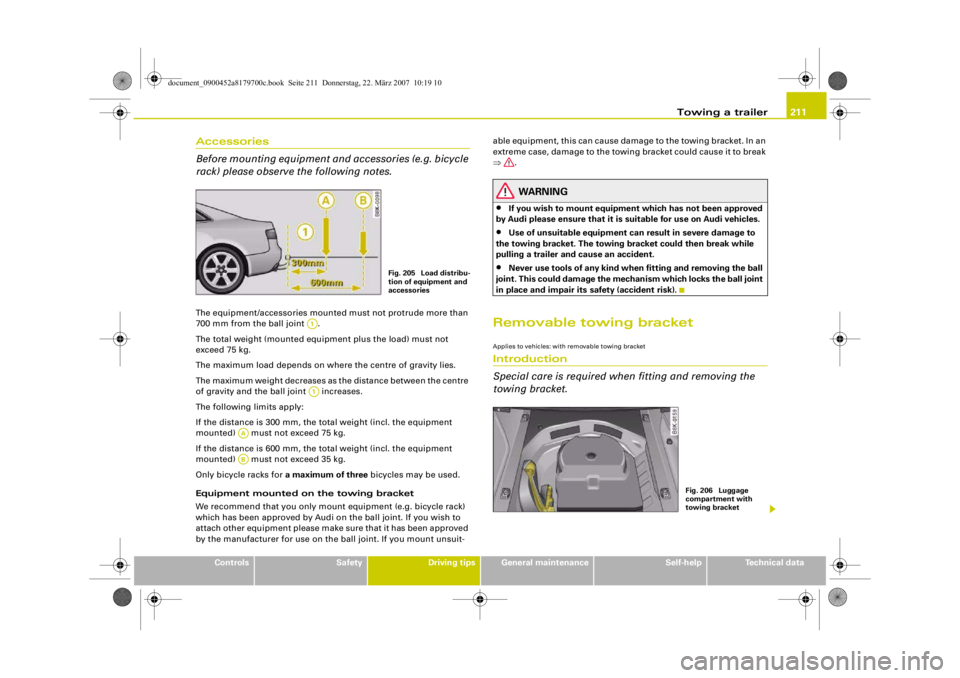
rack) please observe the following notes.The equipment/accessories mounted must not protrude more than
700 mm from the ball joint .
The total weight (mounted equipment plus the load) must not
exceed 75 kg.
The maximum load depends on where the centre of gravity lies.
The maximum weight decreases as the distance between the centre
of gravity and the ball joint increases.
The following limits apply:
If the distance is 300 mm, the total weight (incl. the equipment
mounted) must not exceed 75 kg.
If the distance is 600 mm, the total weight (incl. the equipment
mounted) must not exceed 35 kg.
Only bicycle racks for a maximum of three bicycles may be used.
Equipment mounted on the towing bracket
We recommend that you only mount equipment (e.g. bicycle rack)
which has been approved by Audi on the ball joint. If you wish to
attach other equipment please make sure that it has been approved
by the manufacturer for use on the ball joint. If you mount unsuit- able equipment, this can cause dama
ge to the towing bracket. In an
extreme case, damage to the towing bracket could cause it to break
⇒ .
WARNING
•
If you wish to mount equipmen t which has not been approved
by Audi please ensure that it is suitable for use on Audi vehicles.
•
Use of unsuitable equipment can result in severe damage to
the towing bracket. The towing bracket could then break while
pulling a trailer and cause an accident.
•
Never use tools of any kind when fitting and removing the ball
joint. This coul d damage the mechanism wh ich locks the ball joint
in place and impair it s safety (accident risk).
Removable towing bracketApplies to vehicles: with removable towing bracketIntroduction
Special care is required when fitting and removing the
towing bracket.
Fig. 205 Load distribu-
tion of equipment and
accessories
A1A1
AAAB
Fig. 206 Luggage
compartment with
towing bracket
document_0900452a8179700c.book Seite 211 Donnerstag, 22. März 2007 10:19 10
4----
--4 -
T T
& &
@
~
~ ~
I
I Ol
I I
--
•
-+ +-
Page 229 of 313

Fuel and filling the tank227
Controls
Safety
Driving tips
General maintenance
Self-help
Technical data
Fuel and filling the tankPetrolApplies to vehicles: with petrol enginePetrol grade
The correct grade of petrol is listed inside the fuel tank
flap.The vehicle is equipped with a catalytic converter and must only be
run on unleaded petrol . Unleaded petrol must comply with the
European EN 228 standard. The petrol grades have different octane
ratings (RON). If, in exceptional circumstances, the correct octane
rating is not available, please note the following:•
For engines which require Premium unleaded petrol (95 RON)
according to ⇒page 295, “Performance, weights and dimensions”:
Regular unleaded fuel with 91 RON can also be used. This will,
however, result in a slight loss of power.
•
For engines which require Super Plus unleaded petrol (98 RON)
according to ⇒page 295, “Performance, weights and dimensions”:
Premium unleaded fuel with 95 RON can also be used. This can,
however, result in a slight loss of power under certain driving condi-
tions. – If premium unleaded petrol is not available, the engine can
be run on regular unleaded petrol with 91 RON as an emergency
measure . In this case only use moderate engine speeds and a light
throttle. Avoid using full throttle. Fi ll up with premium or Super Plus
petrol as soon as possible.Caution
•
Petrol complying with the EN 228 standard can contain small
quantities of ethanol. However, “bioethanol fuels”, which are
retailed under various different names such as E50 and E85, and
which contain a large proportion of ethanol, must not be put into
the vehicle, as this would damage the fuel system.
•
Even one tankful of leaded fuel would permanently impair the
efficiency of the catalytic converter.
•
High engine speed and full throttle can damage the engine when
using petrol with an octane rating lower than the correct grade for
the engine.
DieselApplies to vehicles: with diesel engineDiesel fuel
Please note the information on the inside of the fuel tank
flap.Diesel fuel must comply with the European EN 590 standard. It must
have a cetane number (CN) of at least 51. The cetane number indi-
cates the ignition quality of the diesel fuel.
Winter-grade diesel
Diesel fuel can thicken in winter. For this reason petrol stations in
some countries also offer winter diesel.
Caution
•
The vehicle is not designed for the use of biodiesel (FAME fuel).
The fuel system would be damaged if you use biodiesel.
•
Do not mix fuel additives (“thinners”, petrol or similar additives)
with the diesel fuel.
•
If poor-quality diesel fuel is used, it may be necessary to drain
the water separator on the fuel filter more frequently than is speci-
fied in the Service Schedule. We recommend having this done by a
specialist workshop. If water is allowed to collect in the filter, this
can cause engine performance problems.
document_0900452a8179700c.book Seite 227 Donnerstag, 22. März 2007 10:19 10
--4 -
-T
•
-+ +-
CD
CD
•
Page 235 of 313
Checking and topping up fluids233
Controls
Safety
Driving tips
General maintenance
Self-help
Technical data
The positions of the engine oil filler cap and the engine oil dipstick
⇒
page 232, fig. 223 (items and ) may be different on some
engine versions.
Engine oilGeneral notesWe recommend that you have the oil change carried out by an Audi
dealership/qualified workshop according to the intervals stated in
the Service Schedule or according to the service interval display in
the instrument cluster.
Whether your vehicle is serviced at flexible service intervals or fixed
service intervals is shown in the Service Schedule.
The correct oil specifications for your engine are listed in the Te c h -
nical data section ⇒page 295, “Performance, weights and dimen-
sions”.
Check that the specifications quoted (VW standards) appear on the
container either singly or in combination with other specifications.
Flexible service intervals (Audi LongLife Service*)
Special engine oils ⇒page 295, “Performance, weights and dimen-
sions” have been developed as part of the Audi LongLife Service
( ⇒ “Service Schedule”).
This type of oil must be used if you intend to take advantage of the
extended maintenance intervals allowed by the Audi LongLife
Service.•
Do not mix the LongLife oil with oil intended for fixed service
intervals, as the requirements for the extended service intervals are
then no longer guaranteed.
•
In exceptional circumstances, if the engine oil level is too low
⇒ page 234 and you cannot obtain the specified LongLife oil, you
can put in a small quantity of oil for fixed service intervals -
⇒ page 295, “Performance, weights and dimensions”. This should not be done more than once and no more than 0.5 litres should be
used.
Fixed service intervals (Inspection Service)*
If you do not take advantage of th
e LongLife service for your car, you
can use the oils for fixed service intervals - ⇒ page 295, “Perform-
ance, weights and dimensions”. In this case, your car must be serv-
iced after a fixed interval of 1 year / 15,000 km (10,000 miles) – see
Service Schedule.
•
In exceptional circumstances, if the engine oil level is too low
⇒ page 234 and you cannot obtain the oil specified for your vehicle,
you can put in a small quantity of oil conforming to the specification
ACEA A2 or ACEA A3 (petrol engines) or ACEA B3 or ACEA B4 (diesel
engines). This should not be done more than once and no more than
0.5 litres should be used.
Vehicles with diesel particulate filter*
The Service Schedule states whether your vehicle is fitted with a
diesel particulate filter.
•
Vehicles with diesel particulate filter must only be filled with
engine oil VW 507 00. This oil can be used regardless of whether the
vehicle is serviced at flexible service intervals (Audi LongLife
Service) or fixed service intervals.
•
Avoid mixing this oil with other engine oils.
•
In exceptional circumstances, if the engine oil level is too low
⇒ page 234 and you cannot obtain the oil specified for your vehicle,
you can put in a small quantity of oil conforming to the specification
VW 506 00 / VW 506 01 or VW 505 00 / VW 505 01 or ACEA B3 /
ACEA B4. This should not be done more than once and no more than
0.5 litres should be used.
A3
A4
document_0900452a8179700c.book Seite 233 Donnerstag, 22. März 2007 10:19 10
--4 -
-T
•
-+ +-
•
Page 250 of 313
Wheels and tyres
248In winter road conditions winter tyres will considerably improve the
car's handling. Due to their type of construction (width, rubber
compound, tread pattern), summer tyres give less grip on ice and
snow. This applies particularly to vehicles equipped with wide
section tyres or high speed tyres (code letters H, V or Y on the side-
wall).
Only use winter tyres of the correct type approved for your vehicle.
The sizes of the winter tyres approved for your vehicle are listed in
the vehicle's documents (e.g. EC Certificate of Conformity or COC
document
6)). The vehicle documents vary depending on the
country of residence. Also refer to ⇒page 245 .
Winter tyres are no longer fully effective when the tread is worn
down to a depth of 4 mm.
The performance of winter tyres is also severely impaired by ageing ,
even if the tread is still much deeper than 4 mm.
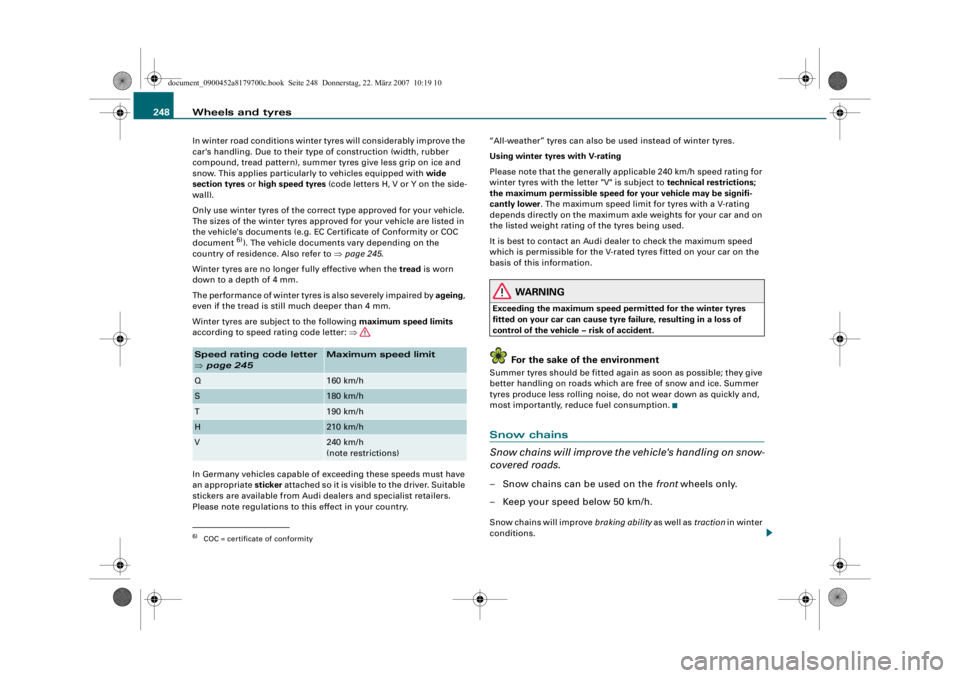
Winter tyres are subject to the following maximum speed limits
according to speed rating code letter: ⇒
In Germany vehicles capable of exceeding these speeds must have
an appropriate sticker attached so it is visible to the driver. Suitable
stickers are available from Audi dealers and specialist retailers.
Please note regulations to th is effect in your country. “All-weather” tyres can also be used instead of winter tyres.
Using winter tyres with V-rating
Please note that the generally applicable 240 km/h speed rating for
winter tyres with the letter "V" is subject to
technical restrictions;
the maximum permissible speed fo r your vehicle may be signifi-
cantly lower . The maximum speed limit for tyres with a V-rating
depends directly on the maximum axle weights for your car and on
the listed weight rating of the tyres being used.
It is best to contact an Audi dealer to check the maximum speed
which is permissible for the V-rated tyres fitted on your car on the
basis of this information.
WARNING
Exceeding the maximum speed perm itted for the winter tyres
fitted on your car can cause tyre failure, resulting in a loss of
control of the vehicle – risk of accident.
For the sake of the environment
Summer tyres should be fitted again as soon as possible; they give
better handling on roads which are free of snow and ice. Summer
tyres produce less rolling noise, do not wear down as quickly and,
most importantly, reduce fuel consumption.Snow chains
Snow chains will improve the vehicle's handling on snow-
covered roads.– Snow chains can be used on the front wheels only.
– Keep your speed below 50 km/h.Snow chains will improve braking ability as well as traction in winter
conditions.
6)COC = certificate of conformitySpeed rating code letter
⇒ page 245
Maximum speed limit
Q
160 km/h
S
180 km/h
T
190 km/h
H
210 km/h
V
240 km/h
(note restrictions)
document_0900452a8179700c.book Seite 248 Donnerstag, 22. März 2007 10:19 10
--4 -
-T
-+
I&
+-
•
Page 256 of 313
Self-help
254Self-helpApplies to vehicles: with warning triangleWarning triangleThe factory-supplied warning tr iangle is attached to the
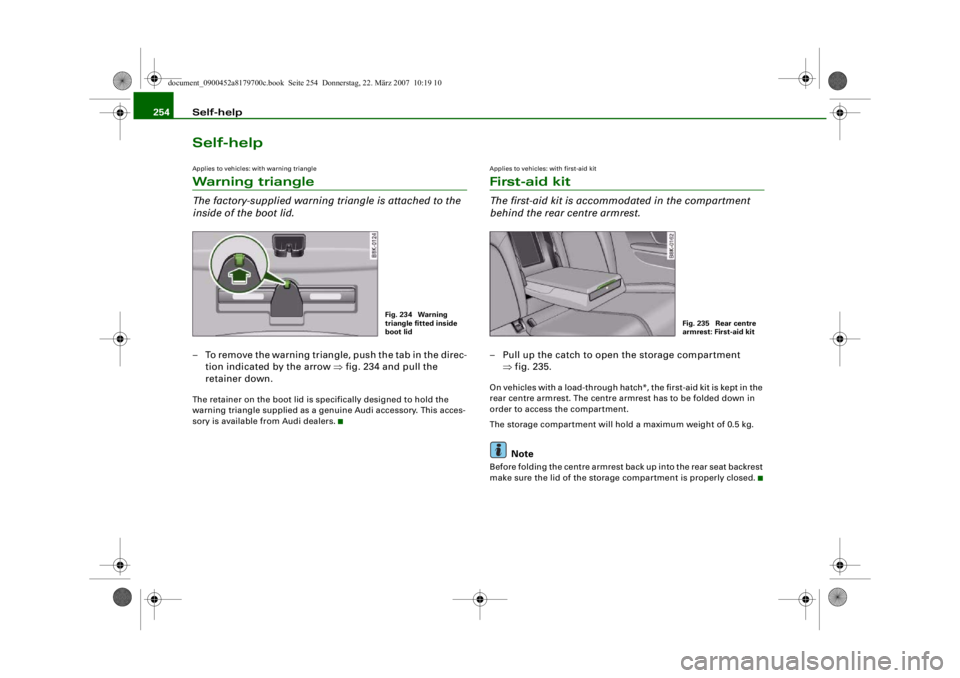
inside of the boot lid.– To remove the warning triangle, push the tab in the direc-
tion indicated by the arrow ⇒fig. 234 and pull the
retainer down.The retainer on the boot lid is specifically designed to hold the
warning triangle supplied as a genuine Audi accessory. This acces-
sory is available from Audi dealers.
Applies to vehicles: with first-aid kitFirst-aid kitThe first-aid kit is accommodated in the compartment
behind the rear centre armrest.– Pull up the catch to open the storage compartment ⇒fig. 235.On vehicles with a load-through hatc h*, the first-aid kit is kept in the
rear centre armrest. The centre armrest has to be folded down in
order to access the compartment.
The storage compartment will hold a maximum weight of 0.5 kg.
Note
Before folding the centre armrest back up into the rear seat backrest
make sure the lid of the storag e compartment is properly closed.
Fig. 234 Warning
triangle fitted inside
boot lid
Fig. 235 Rear centre
armrest: First-aid kit
document_0900452a8179700c.book Seite 254 Donnerstag, 22. März 2007 10:19 10
--4 -
-T
-+ +-
•
[I]
•
Page 294 of 313
General notes
292General notesExplanation of technical dataWhere not otherwise indicated or separately listed, all technical
data apply to vehicles with st andard equipment for the German
market. Other figures may apply for special versions and export
models.
Please note that the details listed in the vehicle's registration docu-
ments can be taken as correct.
Engine data
The figures for engine power output are determined according to
EU standards.
Performance figures
The performance figures were measured without equipment which
may influence performance, such as mudflaps or extremely wide-
section tyres.
Kerb weight (unladen weight)
These figures (kerb weight according to the currently applicable
version of EU Directive 92/21/EEC) apply to the vehicle with the tank
90% full, with no special equipment. The figures include an addi-
tional 75 kg to allow for the weight of the driver.
When towing a trailer, the gross vehicle weight may be exceeded by
up to 30 kg and the maximum rear axle weight may be exceeded by
up to 80 kg.
Maximum trailer weights
The maximum trailer weights are calculated in accordance with the
currently applicable version of EU Directive 92/21/EEC.
The figures for a trailer with brakes, on gradients up to 8% are appli-
cable only up to a maximum speed of 80 km/h (even though higher
speeds may be permitted when towing a trailer in some countries). The figures for a trailer with brakes on gradients up to 12%
and for
the weight of car and trailer on gradients up to 12% are applicable
up to a maximum speed of 100 km/h. This maximum speed must not
be exceeded even in countries where higher speeds are permitted.
Maximum draw bar loading
The vertical load exerted by the trailer drawbar on the ball joint of
the towing bracket must not exceed 80 kg.
In the interest of safety, we recommend applying the maximum
permitted draw bar weight. The stability of the trailer could be
adversely affected if too little weight is applied.
If the maximum permitted drawbar weight cannot be obtained, e.g.
when using small or light trailers, statutory regulations require that
the drawbar weight be at least 4% of the actual trailer weight (for
single-axle trailers or twin-axle trailers with an axle spacing less
than 1.0 m).
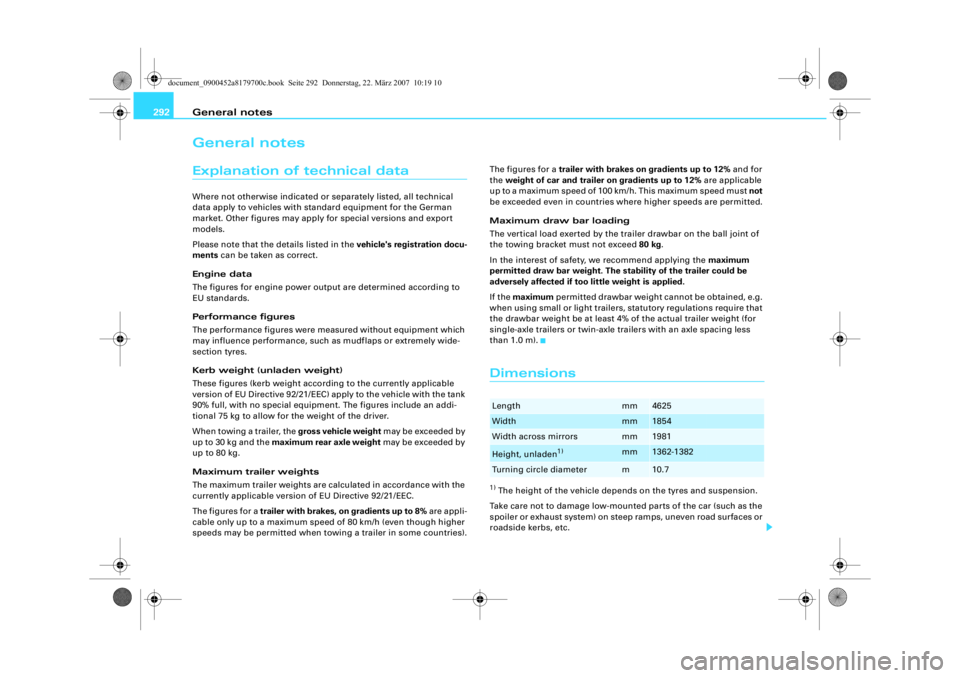
Dimensions1) The height of the vehicle depends on the tyres and suspension.
Take care not to damage low-mounted parts of the car (such as the
spoiler or exhaust system) on steep ramps, uneven road surfaces or
roadside kerbs, etc.Length
mm
4625
Width
mm
1854
Width across mirrors
mm
1981
Height, unladen
1)
mm
1362-1382
Turning circle diameter
m
10.7
document_0900452a8179700c.book Seite 292 Donnerstag, 22. März 2007 10:19 10
--4 -
-T
-+
•
+-
Page 297 of 313
Performance, weights and dimensions295
Controls
Safety
Driving tips
General maintenance
Self-help
Technical data
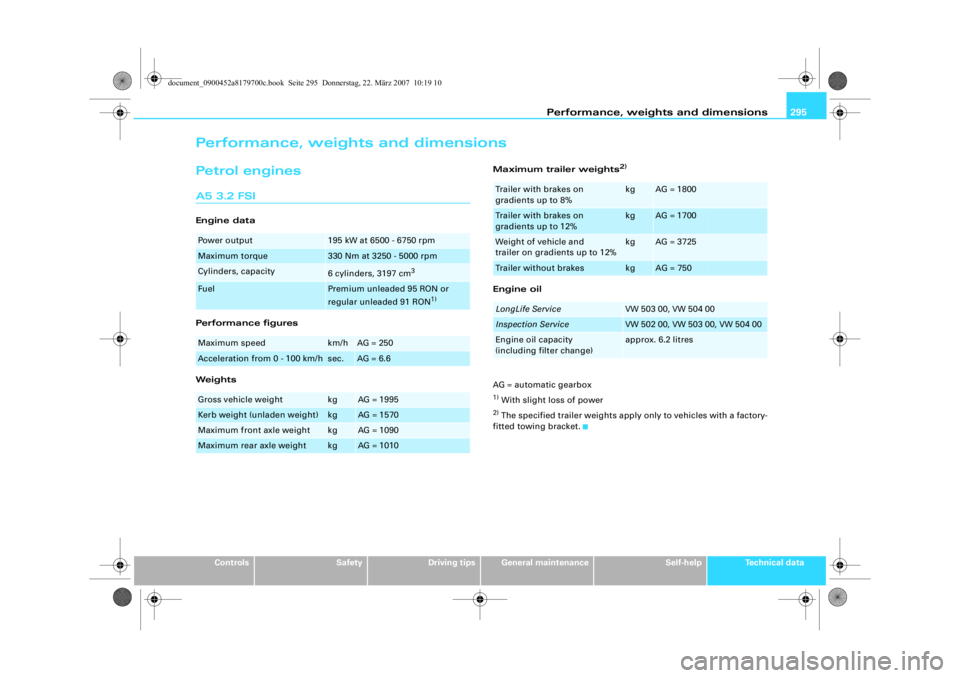
Performance, weights and dimensionsPetrol enginesA5 3.2 FSIEngine data
Performance figures
Weights Maximum trailer weights
2)
Engine oil
AG = automatic gearbox1) With slight loss of power2) The specified trailer weights apply only to vehicles with a factory-
fitted towing bracket.
Power output
195 kW at 6500 - 6750 rpm
Maximum torque
330 Nm at 3250 - 5000 rpm
Cylinders, capacity
6 cylinders, 3197 cm
3
Fuel
Premium unleaded 95 RON or
regular unleaded 91 RON
1)
Maximum speed
km/h
AG = 250
Acceleration from 0 - 100 km/h
sec.
AG = 6.6
Gross vehicle weight
kg
AG = 1995
Kerb weight (unladen weight)
kg
AG = 1570
Maximum front axle weight
kg
AG = 1090
Maximum rear axle weight
kg
AG = 1010
Trailer with brakes on
gradients up to 8%
kg
AG = 1800
Trailer with brakes on
gradients up to 12%
kg
AG = 1700
Weight of vehicle and
trailer on gradients up to 12%
kg
AG = 3725
Trailer without brakes
kg
AG = 750
LongLife Service
VW 503 00, VW 504 00
Inspection Service
VW 502 00, VW 503 00, VW 504 00
Engine oil capacity
(including filter change)
approx. 6.2 litres
document_0900452a8179700c.book Seite 295 Donnerstag, 22. März 2007 10:19 10
--4 -
-T
-+ +-
•
Page 298 of 313
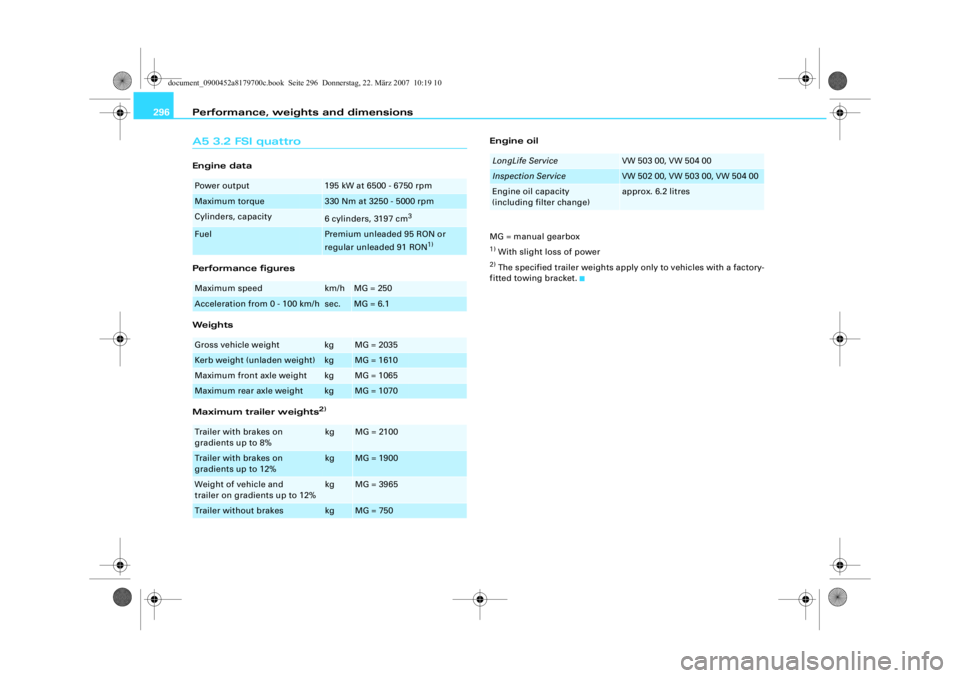
Performance, weights and dimensions
296A5 3.2 FSI quattroEngine data
Performance figures
Weights
Maximum trailer weights
2)
Engine oil
MG = manual gearbox1) With slight loss of power2) The specified trailer weights apply only to vehicles with a factory-
fitted towing bracket.
Power output
195 kW at 6500 - 6750 rpm
Maximum torque
330 Nm at 3250 - 5000 rpm
Cylinders, capacity
6 cylinders, 3197 cm
3
Fuel
Premium unleaded 95 RON or
regular unleaded 91 RON
1)
Maximum speed
km/h
MG = 250
Acceleration from 0 - 100 km/h
sec.
MG = 6.1
Gross vehicle weight
kg
MG = 2035
Kerb weight (unladen weight)
kg
MG = 1610
Maximum front axle weight
kg
MG = 1065
Maximum rear axle weight
kg
MG = 1070
Trailer with brakes on
gradients up to 8%
kg
MG = 2100
Trailer with brakes on
gradients up to 12%
kg
MG = 1900
Weight of vehicle and
trailer on gradients up to 12%
kg
MG = 3965
Trailer without brakes
kg
MG = 750
LongLife Service
VW 503 00, VW 504 00
Inspection Service
VW 502 00, VW 503 00, VW 504 00
Engine oil capacity
(including filter change)
approx. 6.2 litres
document_0900452a8179700c.book Seite 296 Donnerstag, 22. März 2007 10:19 10
--4 -
-T
•
-+ +-