trailer AUDI A5 COUPE 2008 Owner's Manual
[x] Cancel search | Manufacturer: AUDI, Model Year: 2008, Model line: A5 COUPE, Model: AUDI A5 COUPE 2008Pages: 313, PDF Size: 13.86 MB
Page 216 of 313
Towing a trailer
214
– Pull out the knob in direction , hold and turn in direc-tion until the locking ball engages ⇒.
Inserting the ball joint
– With the spring mechanism in the “ready” position, insert the ball joint into the mounting fixture and push it
upwards ⇒page 213, fig. 211 in the direction indicated
(arrow) ⇒. The spring mechanism should then
engage automatically wi th an audible click.
– Lock the ball joint by turn ing the key anti-clockwise.
– Take out the key and press the cover cap provided onto the lock.Continued ⇒page 214, “Fitting the ball joint (step 4)”.
WARNING
•
If it is not possible to set th e spring mechanism to the "ready"
position as described abov e, do not use the ball joint. Please take
your vehicle to a qualified workshop.
•
To avoid injury, keep your hand s away from the knob and the
cover piece when inserting the ball joint into the mounting fixture.Note
Make sure that the knob can turn freely when the ball joint is
inserted.
Applies to vehicles: with removable towing bracketFitting the ball joint (step 4)Safety check
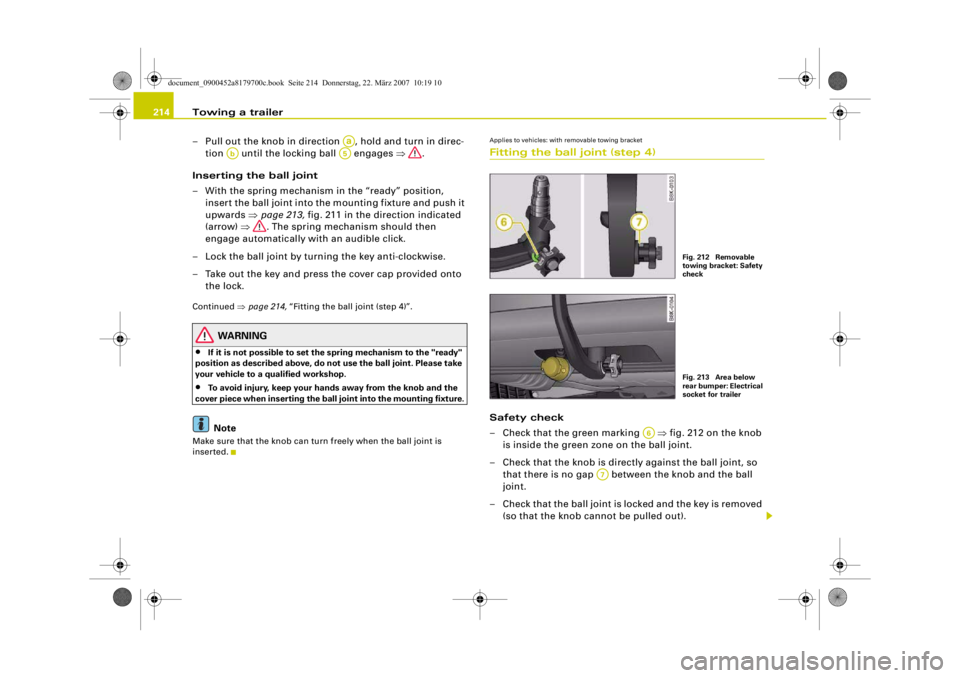
– Check that the green marking ⇒fig. 212 on the knob
is inside the green zone on the ball joint.
– Check that the knob is directly against the ball joint, so that there is no gap between the knob and the ball
joint.
– Check that the ball joint is locked and the key is removed (so that the knob cannot be pulled out).
Aa
Ab
A5
Fig. 212 Removable
towing bracket: Safety
checkFig. 213 Area below
rear bumper: Electrical
socket for trailer
A6
A7
document_0900452a8179700c.book Seite 214 Donnerstag, 22. März 2007 10:19 10
--4 -
-T
-+
r-----6
-----------j
+-
[I]
•
Page 217 of 313
Towing a trailer215
Controls
Safety
Driving tips
General maintenance
Self-help
Technical data
– Check that the ball joint fits tightly in the mounting
fixture (try moving it about to check).
Electrical socket for trailer
– The cable of the towing bracket can be connected to the socket ⇒page 214, fig. 213.If the safety check is not satisfactory, the ball joint must be fitted
again properly.
WARNING
To avoid accidents, the ball joint must meet all the safety require-
ments listed in the safety check. The towing bracket must not be
used if any one of these requirements is not met. If this is the case,
you should contact a qualified workshop.Applies to vehicles: with removable towing bracketRemoving the ball joint
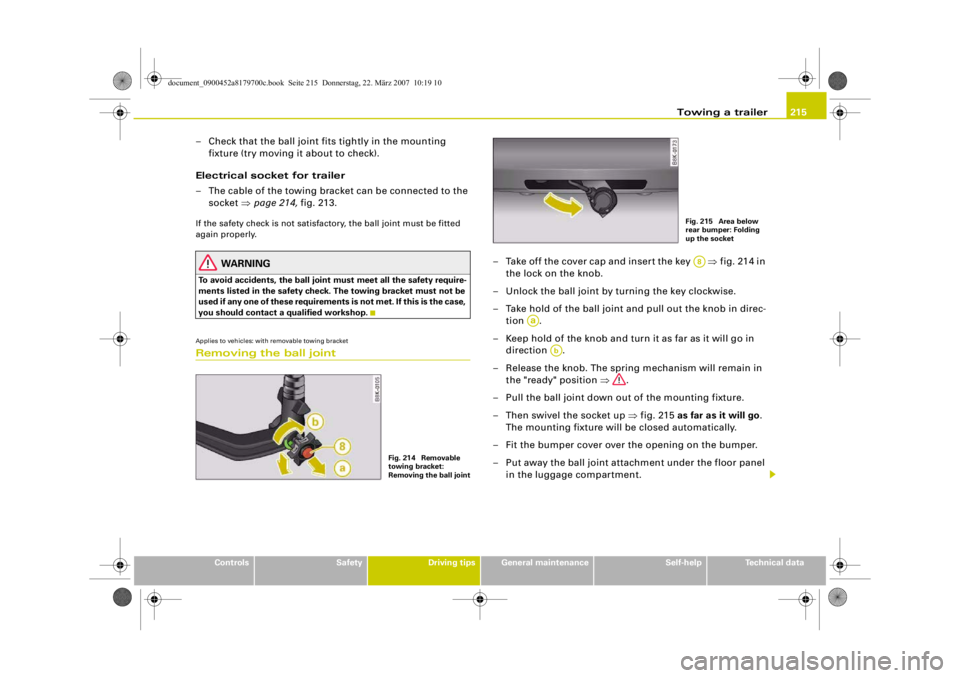
– Take off the cover cap and insert the key ⇒fig. 214 in
the lock on the knob.
– Unlock the ball joint by turning the key clockwise.
– Take hold of the ball joint and pull out the knob in direc- tion .
– Keep hold of the knob and turn it as far as it will go in direction .
– Release the knob. The spring mechanism will remain in the "ready" position ⇒.
– Pull the ball joint down out of the mounting fixture.
– Then swivel the socket up ⇒fig. 215 as far as it will go .
The mounting fixture will be closed automatically.
– Fit the bumper cover over the opening on the bumper.
– Put away the ball joint attachment under the floor panel in the luggage compartment.
Fig. 214 Removable
towing bracket:
Removing the ball joint
Fig. 215 Area below
rear bumper: Folding
up the socketA8
Aa
Ab
document_0900452a8179700c.book Seite 215 Donnerstag, 22. März 2007 10:19 10
--4 -
-T
-+
•
+-
Page 218 of 313
Towing a trailer
216
WARNING
M a k e su re t h a t t he so ck e t u ni t has closed off the mounting fixture
of the towing bracket properly. Oth erwise the ball joint may fail to
engage securely if dirt accumulates in the mounting fixture.Towing bracket (retrofitting)
If required, the vehicle can be retrofitted with a towing
bracket.If a towing bracket is to be fitted after the car is purchased, this must
be done according to the instructions of the towing bracket manu-
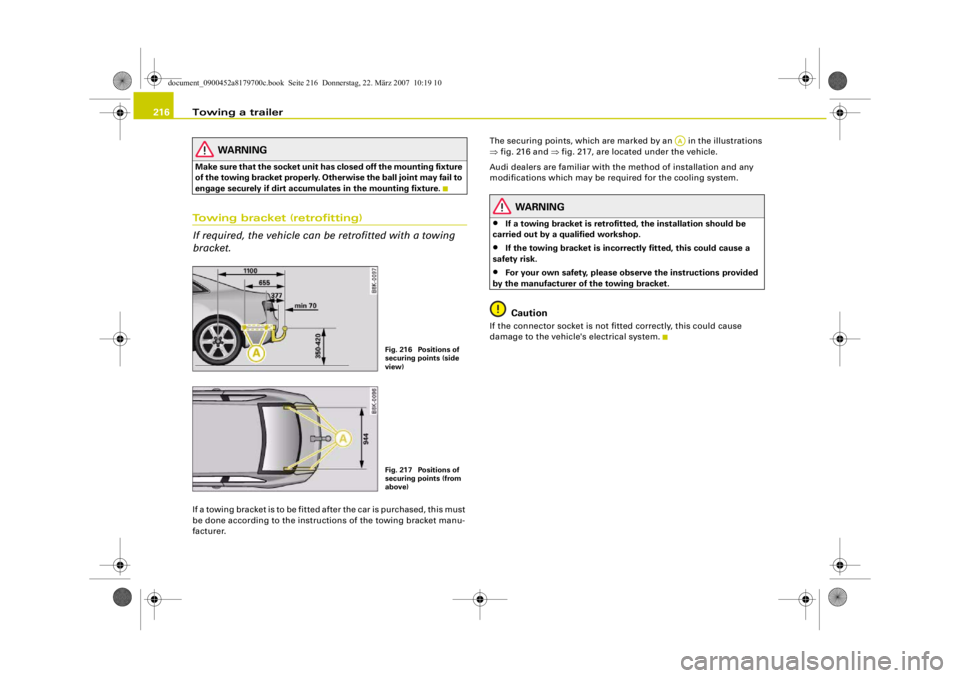
facturer. The securing points, which are marked by an in the illustrations
⇒
fig. 216 and ⇒fig. 217, are located under the vehicle.
Audi dealers are familiar with the method of installation and any
modifications which may be required for the cooling system.
WARNING
•
If a towing bracket is retrofitted, the installation should be
carried out by a qualified workshop.
•
If the towing bracket is incorrectly fitted, this could cause a
safety risk.
•
For your own safety, please ob serve the instructions provided
by the manufacturer of the towing bracket.Caution
If the connector socket is not fi tted correctly, this could cause
damage to the vehicle's electrical system.
Fig. 216 Positions of
securing points (side
view)Fig. 217 Positions of
securing points (from
above)
AA
document_0900452a8179700c.book Seite 216 Donnerstag, 22. März 2007 10:19 10
--4 -
-
. I
,---------
T
-+
CD
•
+-
~
i
-
9
,
~
l
I
I
+
I
i
~
,
I
j
~..I
-
__./
Page 219 of 313
Towing a trailer217
Controls
Safety
Driving tips
General maintenance
Self-help
Technical data
document_0900452a8179700c.book Seite 217 Donnerstag, 22. März 2007 10:19 10
--4 -
-T
-+ +-
Page 262 of 313
Self-help
260•
Seek professional assistance if th e repair of a tyre puncture is
not possible with the sealing compound.
•
If tyre pressure is less than 1.3 bar after driving about 10
minutes, the tyre is too badly damaged. Do not drive on. You
should obtain professional assistance.Caution
Take special care if you have to repair a tyre on a gradient.
Note
•
Do not use the compressor for longer than 6 minutes at a time,
as it could overheat. When the compressor has cooled down, you
can use it again.
•
If tyre sealant should leak out, leave it to dry and then pull it off
like foil.
•
After carrying out a tyre repair remember to buy a new tyre
sealant can at a qualified workshop. This will ensure that the Tyre
Mobility System is operative again.
•
Please observe the relevant regulations.
Changing a wheelPreparations
Some preparations are necessary before changing a
wheel.– If you have a flat tyre, stop the car well away from moving traffic. Choose a location that is as level as possible.– All passengers should
leave the car. They should wait in
a safe place (for instance behind the roadside crash
barrier).
– Apply the parking brake to stop the vehicle moving acci-
dentally.
–Engage first gear (manual gearbox) or move selector
lever to position P (automatic gearbox).
– When towing a trailer: unhitch the trailer from your vehicle.
– Take the tools ⇒ page 255 and the spare wheel*
⇒ page 256 out of the luggage compartment.
WARNING
If you have a puncture in moving traffic, switch on the hazard
warning lights and place the warning triangle in a visible location.
This is for your own safety and also warns other road users.
Caution
If you have to change the tyre on a gradient, block the wheel oppo-
site the wheel being changed by placing a stone or similar object
under it to prevent the vehicle from rolling away.
Note
Please observe the relevant regulations.How to change a wheel
Change the wheel as described below.–Pull off the hub cap . Also refer to ⇒page 261, “Hub
caps”.
WARNING (continued)
document_0900452a8179700c.book Seite 260 Donnerstag, 22. März 2007 10:19 10
--4 -
-T
0 [I)
-+
I&
+-
0
•
•
Page 270 of 313
Self-help
268Do not pull too hard with the towi ng vehicle and take care to avoid
jerking the towrope. When towing on a loose surface there is always
a risk of overloading and damaging the anchorage points.
Caution
If there is no oil in the gearbox or no lubricant in the automatic
transmission the car may only be towed with the driven wheels
lifted clear of the road, or transported on a special car transporter
or trailer.
Note
•
Note the regulations concerning towing.
•
The hazard warning lights of bo th vehicles must normally be
switched on. However, observe an y regulations to the contrary.
•
Make sure that the towrope is not twisted, as otherwise the front
towline anchorage on your vehicle could work itself loose.
Front towline anchorage
The front towline anchorage is only mounted if the vehicle
has to be towed.
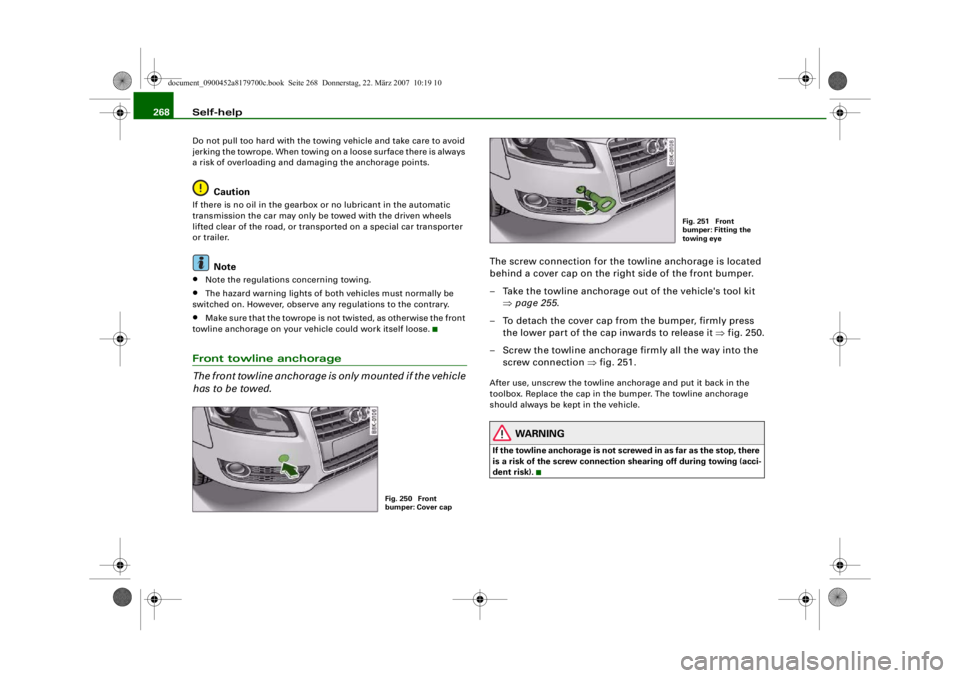
The screw connection for the towline anchorage is located
behind a cover cap on the right side of the front bumper.
– Take the towline anchorage ou t of the vehicle's tool kit
⇒ page 255 .
– To detach the cover cap from the bumper, firmly press the lower part of the cap inwards to release it ⇒fig. 250.
– Screw the towline anchorage firmly all the way into the screw connection ⇒fig. 251.After use, unscrew the towline anchorage and put it back in the
toolbox. Replace the cap in th e bumper. The towline anchorage
should always be kept in the vehicle.
WARNING
If the towline anchorage is not scre wed in as far as the stop, there
is a risk of the screw connection shearing off during towing (acci-
dent risk).
Fig. 250 Front
bumper: Cover cap
Fig. 251 Front
bumper: Fitting the
towing eye
document_0900452a8179700c.book Seite 268 Donnerstag, 22. März 2007 10:19 10
--4 -
-T
0 [I]
-+
•
+-
Page 272 of 313
Self-help
270
WARNING
There is a high risk of accidents when tow-starting, as the towed
vehicle can easily be driven into the towing vehicle.
Caution
When tow-starting the vehicle, do not tow it further than 50 metres:
otherwise the catalytic converter could be damaged.Towing a vehicle with manual gearbox and front-wheel drive
Towing is relatively straightforward.Please observe the notes ⇒page 267 .
The vehicle can be towed using a towbar or towrope in the normal
way, with all four wheels on the road; it can also be towed with
either the front or rear wheels lifted off the road. The vehicle must
not be towed faster than 50 km/h.Towing a vehicle with automatic gearbox and front-wheel drive
Certain restrictions must be observed when towing your
vehicle.Please observe the notes ⇒page 267 .
The vehicle can be towed with a towbar or towrope in the normal
way, with all four wheels on the ground. When doing so, please note
the following points:•
Release the parking brake ⇒page 121 .
•
Make sure the selector lever is in the N position.
•
The vehicle must not be towed faster than 50 km/h.
•
The vehicle must not be towed further than 50 km. The reason
for this is: when the engine is not running, the gearbox oil pump
does not work and the gearbox is not adequately lubricated for
higher speeds or longer distances.
If the vehicle has to be towed with a breakdown truck, it must only
be suspended at the front wheels. The reason for this is: the drive
shafts are located on the front whee ls. If the car is towed with the
rear wheels lifted off the road (i.e. travelling backwards), the drive
shafts also turn backwards. The planetary gears in the automatic
gearbox then turn at such high speeds that the gearbox will be
severely damaged in a short time.Note
If it is not possible to tow the vehicle as described above, or if it has
to be towed further than 50 km, it must be transported on a special
car transporter or trailer.Towing a vehicle with manual gearbox and four-wheel drive
Certain restrictions must be observed when towing your
vehicle.Please observe the notes ⇒page 267 .
The vehicle can be towed with a towbar or towrope in the normal
way, with all four wheels on the ground. It can also be towed by a
breakdown truck, with the wheels li fted at either the front or rear.
When doing so, please note the following points:•
The vehicle must not be towed faster than 50 km/h.
•
The vehicle must not be towed further than 50 km.
document_0900452a8179700c.book Seite 270 Donnerstag, 22. März 2007 10:19 10
--4 -
-T
0
•
---- [I)
-+
•
•
+-
Page 273 of 313
Self-help271
Controls
Safety
Driving tips
General maintenance
Self-help
Technical data
Note
If it is not possible to tow the vehicle as described above, or if it has
to be towed further than 50 km, it must be transported on a special
car transporter or trailer.Towing a vehicle with automatic gearbox and four-wheel drive
Certain restrictions must be observed when towing your
vehicle.Please observe the notes ⇒ page 267.
The vehicle can be towed with a towbar or towrope in the normal
way, with all four wheels on the ground. When doing so, please note
the following points:•
Release the parking brake ⇒page 121 .
•
Make sure the select or lever is in the N position.
•
The vehicle must not be towed faster than 50 km/h.
•
The vehicle must not be towed further than 50 km. The reason
for this is: when the engine is not running, the gearbox oil pump
does not work and the gearbox is not adequately lubricated for
higher speeds or longer distances.
The vehicle must not be towed with the wheels lifted at either the
front or rear.Note
If it is not possible to tow the vehicle as described above, or if it has
to be towed further than 50 km, it must be transported on a special
car transporter or trailer.
document_0900452a8179700c.book Seite 271 Donnerstag, 22. März 2007 10:19 10
--4 -
-
(I]
T
•
-+ +-
(I]
•
Page 277 of 313
Fuses and bulbs275
Controls
Safety
Driving tips
General maintenance
Self-help
Technical data
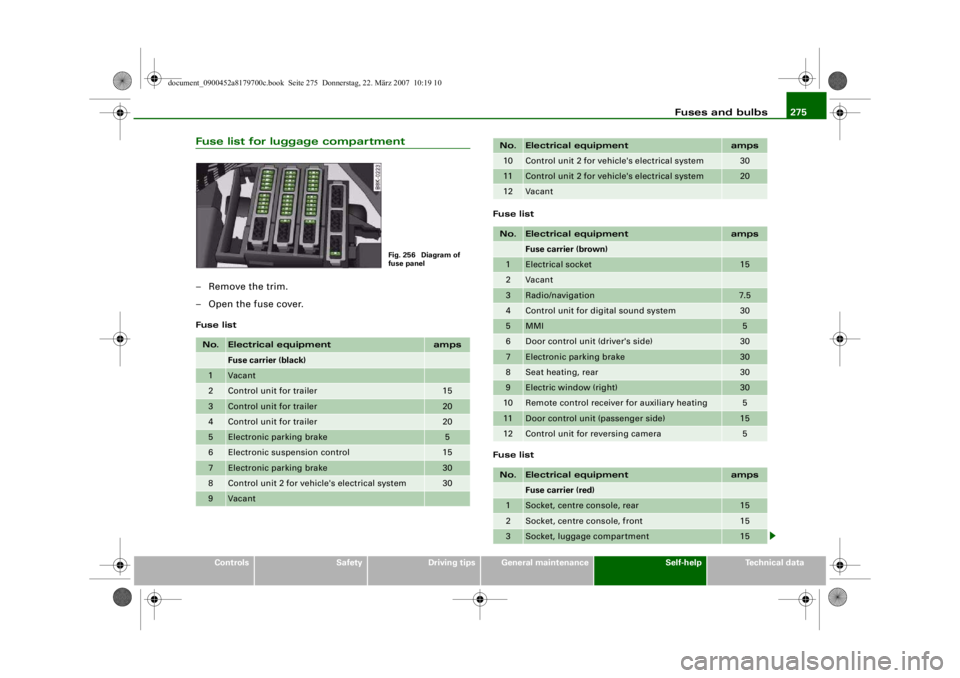
Fuse list for luggage compartment– Remove the trim.
– Open the fuse cover.Fuse list Fuse list
Fuse listNo.
Electrical equipment
amps
Fuse carrier (black)
1
Vacant
2
Control unit for trailer
15
3
Control unit for trailer
20
4
Control unit for trailer
20
5
Electronic parking brake
5
6
Electronic suspension control
15
7
Electronic parking brake
30
8
Control unit 2 for vehicle's electrical system
30
9
Vacant
Fig. 256 Diagram of
fuse panel
10
Control unit 2 for vehicle's electrical system
30
11
Control unit 2 for vehicle's electrical system
20
12
Vacant
No.
Electrical equipment
amps
Fuse carrier (brown)
1
Electrical socket
15
2
Vacant
3
Radio/navigation
7.5
4
Control unit for digital sound system
30
5
MMI
5
6
Door control unit (driver's side)
30
7
Electronic parking brake
30
8
Seat heating, rear
30
9
Electric window (right)
30
10
Remote control receiver for auxiliary heating
5
11
Door control unit (passenger side)
15
12
Control unit for reversing camera
5
No.
Electrical equipment
amps
Fuse carrier (red)
1
Socket, centre console, rear
15
2
Socket, centre console, front
15
3
Socket, luggage compartment
15
No.
Electrical equipment
amps
document_0900452a8179700c.book Seite 275
Donnerstag, 22. März 2007 10:19 10
--4 -
-
-
T
-
-
-
-
-+
-
+-
1111
-
-
1111
--
1111
-
-
1111
-
1111
--
1111
--
~
-~
Page 294 of 313
General notes
292General notesExplanation of technical dataWhere not otherwise indicated or separately listed, all technical
data apply to vehicles with st andard equipment for the German
market. Other figures may apply for special versions and export
models.
Please note that the details listed in the vehicle's registration docu-
ments can be taken as correct.
Engine data
The figures for engine power output are determined according to
EU standards.
Performance figures
The performance figures were measured without equipment which
may influence performance, such as mudflaps or extremely wide-
section tyres.
Kerb weight (unladen weight)
These figures (kerb weight according to the currently applicable
version of EU Directive 92/21/EEC) apply to the vehicle with the tank
90% full, with no special equipment. The figures include an addi-
tional 75 kg to allow for the weight of the driver.
When towing a trailer, the gross vehicle weight may be exceeded by
up to 30 kg and the maximum rear axle weight may be exceeded by
up to 80 kg.
Maximum trailer weights
The maximum trailer weights are calculated in accordance with the
currently applicable version of EU Directive 92/21/EEC.
The figures for a trailer with brakes, on gradients up to 8% are appli-
cable only up to a maximum speed of 80 km/h (even though higher
speeds may be permitted when towing a trailer in some countries). The figures for a trailer with brakes on gradients up to 12%
and for
the weight of car and trailer on gradients up to 12% are applicable
up to a maximum speed of 100 km/h. This maximum speed must not
be exceeded even in countries where higher speeds are permitted.
Maximum draw bar loading
The vertical load exerted by the trailer drawbar on the ball joint of
the towing bracket must not exceed 80 kg.
In the interest of safety, we recommend applying the maximum
permitted draw bar weight. The stability of the trailer could be
adversely affected if too little weight is applied.
If the maximum permitted drawbar weight cannot be obtained, e.g.
when using small or light trailers, statutory regulations require that
the drawbar weight be at least 4% of the actual trailer weight (for
single-axle trailers or twin-axle trailers with an axle spacing less
than 1.0 m).
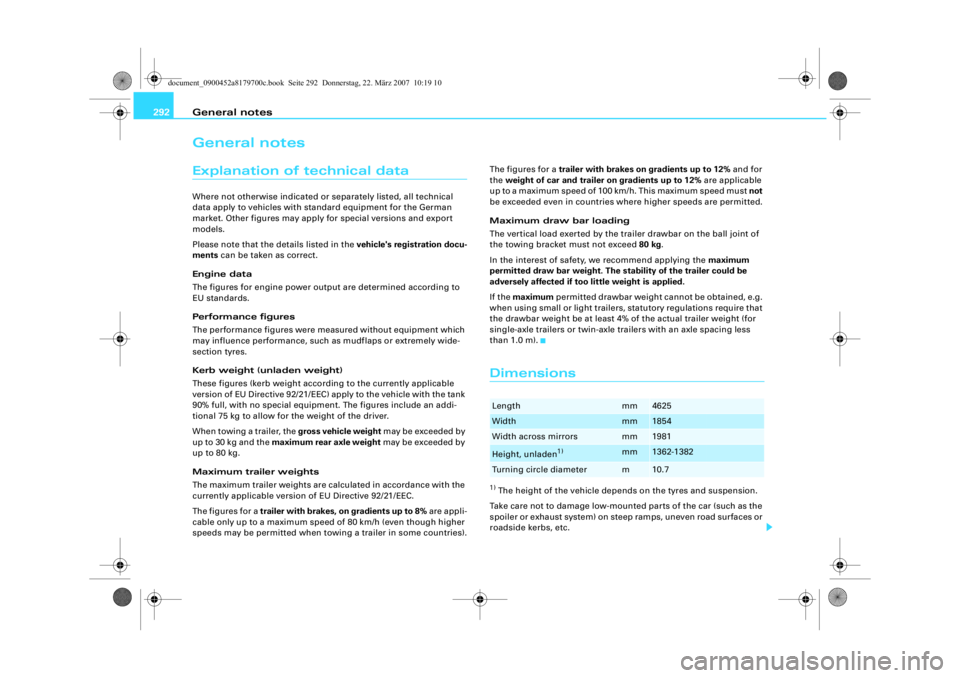
Dimensions1) The height of the vehicle depends on the tyres and suspension.
Take care not to damage low-mounted parts of the car (such as the
spoiler or exhaust system) on steep ramps, uneven road surfaces or
roadside kerbs, etc.Length
mm
4625
Width
mm
1854
Width across mirrors
mm
1981
Height, unladen
1)
mm
1362-1382
Turning circle diameter
m
10.7
document_0900452a8179700c.book Seite 292 Donnerstag, 22. März 2007 10:19 10
--4 -
-T
-+
•
+-