cooling AUDI A5 COUPE 2008 Owner's Guide
[x] Cancel search | Manufacturer: AUDI, Model Year: 2008, Model line: A5 COUPE, Model: AUDI A5 COUPE 2008Pages: 313, PDF Size: 13.86 MB
Page 233 of 313
Checking and topping up fluids231
Controls
Safety
Driving tips
General maintenance
Self-help
Technical data
Working on components in the engine compartment
Extra caution is necessary when working on components
in the engine compartment.Always be aware of the danger of injury and scalding as well as the
risk of accident or fire when working in the engine compartment
(e.g. when checking and refilling fluids). Always observe the warn-
ings listed below and follow al l normal safety precautions. The
engine compartment of any motor vehicle is a potentially
hazardous area . ⇒ .
WARNING
•
Switch off the engine.
•
Remove the ignition key.
•
Apply the parking brake.
•
Put the gear lever in neutral or selector in P.
•
Wait for the engine to cool down.
•
Keep children away from engine compartment.
•
Never spill fluids on hot engine components. These fluids can
cause a fire (e.g. radiator anti-freeze).
•
Take care not to cause short circ uits in the electrical system,
especially when working on the battery.
•
Do not touch the radiator fan when the engine is hot. The fan
may start running suddenly.
•
Do not unscrew the cap on the ex pansion tank when the engine
is hot. The cooling system is under pressure.
•
Protect face, hands and arms by covering the cap with a large,
thick rag to protect against escaping coolant and steam.
•
If any tests have to be performed with the engine running,
there is an extra safety risk from the rotating parts, such as the
drive belts, alternator and radiator fan, etc., and from the high-
voltage ignition system.
•
Vehicles with automatic gearbox: Never open the throttle inad-
vertently (for instance by hand from the engine compartment) if a
gear is engaged while the vehicle is stationary with the engine
running. The vehicle could otherwise start moving immediately
and possibly cause an accident.
•
Observe the following a dditional warnings if work on the fuel
system or the electrical system is necessary:
−Always disconnect the battery.
− Do not smoke.
− Never work near naked flames.
− Always keep an approved fire extinguisher immediately
available.Caution
When topping up fluids make sure the correct fluid is put into the
correct filler opening. This can otherwise cause serious malfunc-
tions or engine damage.
For the sake of the environment
Inspect the ground un derneath your vehicle regularly so that any
leaks are detected at an early stag e. If you find oil spots or other
fluids, have your vehicle inspected by a qualified workshop.
Note
On right-hand drive vehicles* some of the containers/ reservoirs
mentioned below are located on the other side of the engine
compartment.
WARNING (continued)
document_0900452a8179700c.book Seite 231 Donnerstag, 22. März 2007 10:19 10
--4 -
-T
-+
CD
+-
[I]
•
Page 237 of 313
Checking and topping up fluids235
Controls
Safety
Driving tips
General maintenance
Self-help
Technical data
–Unscrew cap
from oil filler opening ⇒page 234,
fig. 226.
– Carefully put in the specified grade of oil ⇒page 295
0.5 litres at a time.
– After two minutes check the oil level once again ⇒page 234 .
– If the oil level is too low, add more engine oil.
– Replace the oil filler cap carefully and push the dipstick all the way in.
WARNING
•
Ensure that no oil comes into contact with hot engine compo-
nents when topping up: th is could cause a fire.
•
Wash your skin thoroughly if it comes into contact with engine
oil.Caution
•
The oil level must never be above area , as this may result in
damage to the catalytic converter or to the engine. Contact a quali-
fied workshop to extract the engine oil if necessary.
•
No additives should be used with engine oil. Any damage caused
by the use of such additives woul d not be covered by the factory
warranty.For the sake of the environment
•
Never pour oil down drains or into the ground.
•
Always observe statutory requ irements when disposing of
empty oil canisters.
Cooling systemCoolant
The purpose of the coolant is to carry heat away from the
engine. The correct amount of anti-freeze is important to
prevent the cooling system from freezing in winter.The cooling system is filled for life at the factory, so the coolant does
not need to be changed. The coolant consists of a mixture of water
and anti-freeze additive G12+. This is a glycol-based anti-freeze with
anti-corrosion additives.
Anti-freeze additive
The amount of anti-freeze additive required depends on the temper-
atures to be expected in the winter season. If the anti-freeze concen-
tration is too low the coolant can freeze, resulting in failure of the
cooling system and heater.
The cooling system is filled at the factory with the correct amount of
anti-freeze for the country concerned.
In most cases the mixture consists of 60% water and 40% additive.
This mixture gives the necessary antifreeze protection down to –
25 °C and protects the alloy part s of the cooling system against
corrosion. It also prevents scaling an d raises the boiling point of the
coolant.
Countries with warm climate
The coolant concentration must not be reduced by adding plain
water, even in the summer or in warm climates. The concentration
of the anti-freeze additive must always be at least 40%.
Countries with cold climate
If greater anti-freeze protection is required in very cold climates, the
proportion of the anti-freeze additive G12+ can be increased. A
concentration of 60% offers protection down to about -40 °C. The
concentration of the antifreeze additive must not be more than 60%,
Aa
document_0900452a8179700c.book Seite 235 Donnerstag, 22. März 2007 10:19 10
--4 -
-T
-+
CD
+-
•
Page 238 of 313
Checking and topping up fluids
236otherwise this would reduce the antifreeze protection. In addition,
the cooling effect will be adversely affected.
Vehicles for export to countries with a cold climate (such as Sweden,
Norway and Finland) are supplied with antifreeze protection down
to about -35 °C. The concentration of the antifreeze additive for
these countries should always be at least 50%.
Caution
•
It is advisable to have the cooling system checked before the
winter season to make sure that the antifreeze concentration is
adequate for the conditions to be expected. This applies particularly
if you intend to take the car into a colder climate zone. If necessary,
have the anti-freeze concentration increased to 50 - 60% as required.
•
Use only anti-freeze additive G12+, an additive meeting the spec-
ification “TL-VW 774 F ”. Other additives may give considerably infe-
rior corrosion protection. The resulting corrosion in the cooling
system can lead to a loss of coolant, causing serious damage to the
engine.
•
The coolant additive G12+ can be mixed only with additives G11
and G12.
Checking coolant level
The coolant level can be checked at a glance.
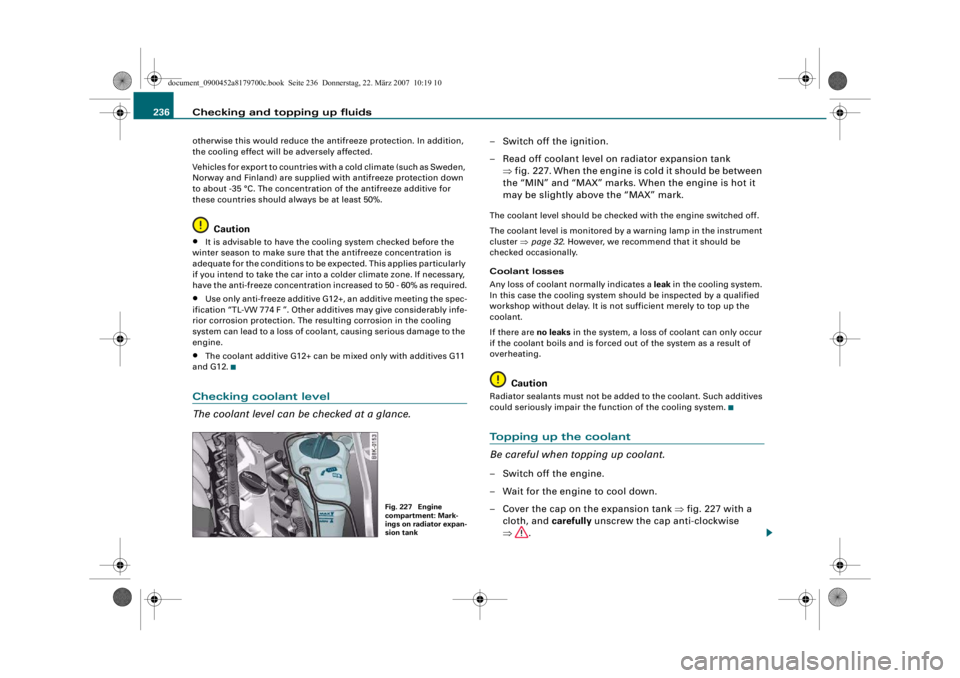
– Switch off the ignition.
– Read off coolant level on radiator expansion tank ⇒fig. 227. When the engine is cold it should be between
the “MIN” and “MAX” marks. When the engine is hot it
may be slightly above the “MAX” mark.The coolant level should be checke d with the engine switched off.
The coolant level is monitored by a warning lamp in the instrument
cluster ⇒page 32 . However, we recommend that it should be
checked occasionally.
Coolant losses
Any loss of coolant normally indicates a leak in the cooling system.
In this case the cooling system should be inspected by a qualified
workshop without delay. It is no t sufficient merely to top up the
coolant.
If there are no leaks in the system, a loss of coolant can only occur
if the coolant boils and is forced out of the system as a result of
overheating.
Caution
Radiator sealants must not be added to the coolant. Such additives
could seriously impair the function of the cooling system.Topping up the coolant
Be careful when topping up coolant.– Switch off the engine.
– Wait for the engine to cool down.
– Cover the cap on the expansion tank ⇒fig. 227 with a
cloth, and carefully unscrew the cap anti-clockwise
⇒ .
Fig. 227 Engine
compartment: Mark-
ings on radiator expan-
sion tank
document_0900452a8179700c.book Seite 236 Donnerstag, 22. März 2007 10:19 10
--4 -
-T
0
-+
•
+-
0
•
Page 239 of 313
Checking and topping up fluids237
Controls
Safety
Driving tips
General maintenance
Self-help
Technical data
– Add coolant.
– Screw the cap on again tightly.Make sure that the coolant meet s the required specifications
⇒ page 235, “Coolant”. Do not use a differ ent type of additive if anti-
freeze additive G12+, G12 or G11 is not available. In this case use
only water and bring the coolant concentration back up to the
correct level as soon as possible by putting in the specified additive.
Always top up with fresh, unused coolant.
Do not fill above the “MAX” mark. Ex cess coolant is forced out of the
system through the valve in the filler cap when the engine gets hot.
If a lot of coolant has been lost, wait for the engine to cool down
before putting in cold coolant. Failure to do so could result in
serious engine damage.
WARNING
•
The cooling system is under pr essure. Do not unscrew the cap
on the expansion tank when the engine is hot: you could be
scalded by escaping steam
•
The coolant and coolant additive can be a health hazard. Store
the coolant additive in the original container in a safe place out of
reach of children – risk of poisoning.For the sake of the environment
Drained off coolant should not be used again. Drain off the used
coolant into a suitable container and dispose of it in the proper
manner (observe environmental regulations).
Radiator fan
The radiator fan can start running spontaneously.The radiator fan is driven by the engine via a poly V-belt. The speed
of the fan is varied by a viscous clutch according to the temperature.
There is also an auxiliary electric fan, which cuts in automatically
whenever the temperature of the coolant and the engine compart-
ment rises above a certain level.
The auxiliary fan can continue to run for as long as 10 minutes after
stopping the engine – even after the ignition is switched off. It may
also start running suddenly ⇒ after a while if•
residual heat raises the coolant temperature, or
•
the hot engine compartment is additionally heated up by the
sun.
WARNING
When working in the engine compartment be aware that the radi-
ator fan may start running suddenly – risk of injury.
document_0900452a8179700c.book Seite 237 Donnerstag, 22. März 2007 10:19 10
--4 -
-T
-+
t----&
-------II
t----& --- . ------,
+-
•
Page 306 of 313

Index
304Convenience open function . . . . . . . . . . . 50
Cooling system
Anti-freeze additive . . . . . . . . . . . . . . . 235
Checking coolant level . . . . . . . . . . . . 236
Coolant . . . . . . . . . . . . . . . . . . . . . . . . . 235
Coolant temperature gauge . . . . . . . . . 11
Malfunction . . . . . . . . . . . . . . . . . . . . . . 32
Radiator fan . . . . . . . . . . . . . . . . . . . . . 237
Topping up coolant . . . . . . . . . . . . . . 236
Cruise control system Adjusting speed . . . . . . . . . . . . . . . . . 127
Control lever on steering wheel . . . . 125
Cruise mode . . . . . . . . . . . . . . . . . . . . 126
Indicator lamp . . . . . . . . . . . . . . . . . . . . 17
Introduction . . . . . . . . . . . . . . . . . . . . . 125
Pre-selecting a speed . . . . . . . . . . . . . 128
Resuming cruise control . . . . . . . . . . 128
Safety notes . . . . . . . . . . . . . . . . . . . . . 125
Switching off . . . . . . . . . . . . . . . . . . . . 129
Switching off temporarily . . . . . . . . . 128
Cup holders . . . . . . . . . . . . . . . . . . . . . . . . . 85
Current fuel consumption . . . . . . . . . . . . . 25DDate display . . . . . . . . . . . . . . . . . . . . . . . . 13
Daytime running lights . . . . . . . . . . . . . . . 56
DCP See Dynamic gear control program . 133
Deactivating front passenger's airbag . . 183
Deadlock mechanism . . . . . . . . . . . . . . 43, 46
Defrosting windows . . . . . . . . . . . . . . 98, 107 Deluxe automatic air conditioner . . . . . . . 93
Air distribution . . . . . . . . . . . . . . . . . . . 97
Air outlets . . . . . . . . . . . . . . . . . . . . . . . . 99
Air outlets for rear passengers . . . . . . 99
Air recirculation mode . . . . . . . . . . . . . 97
Automatic mode . . . . . . . . . . . . . . . . . . 95
Basic settings . . . . . . . . . . . . . . . . . . . 100
Blower . . . . . . . . . . . . . . . . . . . . . . . . . . 96
Controls . . . . . . . . . . . . . . . . . . . . . . . . . 94
Defrosting . . . . . . . . . . . . . . . . . . . . . . . 98
Description . . . . . . . . . . . . . . . . . . . . . . . 93
Economical operation . . . . . . . . . . . . . 100
Heated rear window . . . . . . . . . . . . . . . 98
Seat heating, front . . . . . . . . . . . . . . . 115
Supplementary heater . . . . . . . . . . . . 101
Switching on and off . . . . . . . . . . . . . . 95
Temperature . . . . . . . . . . . . . . . . . . . . . 96
Deluxe automatic air conditioner plus . . 101 AC mode . . . . . . . . . . . . . . . . . . . . . . . . 107
Air distribution . . . . . . . . . . . . . . . . . . 106
Air outlets . . . . . . . . . . . . . . . . . . . . . . . 108
Air outlets for rear passengers . . . . . 108
Air recirculation mode . . . . . . . . . . . . 106
Automatic mode . . . . . . . . . . . . . . . . . 104
Automatic recirculation . . . . . . . . . . . 110
Auxiliary heating . . . . . . . . . . . . . . . . . 111
Auxiliary heating - remote control . . 114
Auxiliary heating - running time . . . . 113
Basic settings . . . . . . . . . . . . . . . . . . . 109
Blower . . . . . . . . . . . . . . . . . . . . . . . . . 105
Controls . . . . . . . . . . . . . . . . . . . . . . . . 103
Defrosting . . . . . . . . . . . . . . . . . . . . . . 107
Description . . . . . . . . . . . . . . . . . . . . . . 101
Economical operation . . . . . . . . . . . . . 109 Heated rear window . . . . . . . . . . . . . . 107
Supplementary heater . . . . . . . . . . . . 110
Switching on and off . . . . . . . . . . . . . . 104
Synchronisation . . . . . . . . . . . . . . . . . 110
Temperature . . . . . . . . . . . . . . . . . . . . 104
Diesel . . . . . . . . . . . . . . . . . . . . . . . . . . . . . 227
Diesel particulate filter . . . . . . . . . . . . 37, 205 Engine oil . . . . . . . . . . . . . . . . . . . . . . . 233
Digital clock . . . . . . . . . . . . . . . . . . . . . . . . . 13
Digital compass . . . . . . . . . . . . . . . . . . . . . 68
Digital speedometer . . . . . . . . . . . . . . . . . . 22
Dimensions . . . . . . . . . . . . . . . . . . . . . . . . 292
Dipped headlights . . . . . . . . . . . . . . . . . . . 54 Defective . . . . . . . . . . . . . . . . . . . . . . . . . 36
DIS See Driver information system . . . . . . 20
Door catches/boot lid warning . . . . . . . . . 23
Doors Manual locking . . . . . . . . . . . . . . . . . . . 48
Driver See Sitting position . . . . . . . . . . . . . . . 164
Driver information system . . . . . . . . . . . . . 20 Auto-check control . . . . . . . . . . . . . . . . 29
Bulb monitor . . . . . . . . . . . . . . . . . . . . . 36
CD and radio display . . . . . . . . . . . . . . . 21
Digital speedometer . . . . . . . . . . . . . . . 22
Door catches/boot lid warning . . . . . . 23
Driver messages . . . . . . . . . . . . . . . . . . 30
On-board computer . . . . . . . . . . . . . . . . 25
Outside temperature display . . . . . . . . 21
Red symbols . . . . . . . . . . . . . . . . . . . . . 30
Service interval display . . . . . . . . . . . . . 23
document_0900452a8179700c.book Seite 304 Donnerstag, 22. März 2007 10:19 10
--4 -
-T
-+ +-
Page 313 of 313
Index311
Controls
Safety
Driving tips
General maintenance
Self-help
Technical data
Weights
See Performance, weights and
dimensions . . . . . . . . . . . . . . . . . . . . 295
Wheel bolts . . . . . . . . . . . . . . . . . . . . . . . . 247
Wheel imbalance . . . . . . . . . . . . . . . . . . . . 243
Wheels . . . . . . . . . . . . . . . . . . . . . . . . 222, 243 Changing . . . . . . . . . . . . . . . . . . . . . . . 260
Changing wheels round . . . . . . . . . . . 245
Window heating . . . . . . . . . . . . . . . . . 98, 107
Windows Cleaning . . . . . . . . . . . . . . . . . . . . . . . . 222
De-icing . . . . . . . . . . . . . . . . . . . . . . . . . 222
Malfunctions . . . . . . . . . . . . . . . . . . . . . 51
Windows (electric) See Electric windows . . . . . . . . . . . . . . . 50
Windscreen washer fluid . . . . . . . . . . . . . 242
Windscreen wiper and washer system . . . 62
Windscreen wipers . . . . . . . . . . . . . . . . . . . 62 Changing blades . . . . . . . . . . . . . . . . . . 65
Defective . . . . . . . . . . . . . . . . . . . . . . . . . 38
Service position . . . . . . . . . . . . . . . . . . . 64
Winter conditions Battery . . . . . . . . . . . . . . . . . . . . . . . . . . 239
Care of vehicle . . . . . . . . . . . . . . . . . . . 220
Cooling system . . . . . . . . . . . . . . . . . . 235
Defrosting windows . . . . . . . . . . . 98, 107
De-icing windows . . . . . . . . . . . . . . . . 222
Diesel . . . . . . . . . . . . . . . . . . . . . . . . . . 227
Seat heating (deluxe automatic air conditioner) . . . . . . . . . . . . . . . . . . . . 115
Seat heating for rear seats . . . . . . . . . 115
Snow chains . . . . . . . . . . . . . . . . . . . . . 248 Tyres . . . . . . . . . . . . . . . . . . . . . . . . . . . 247
Windscreen washer . . . . . . . . . . . . . . . 242
Winter tyres . . . . . . . . . . . . . . . . . . . . . . . . 247
Wiper blades See Windscreen wipers . . . . . . . . . . . . . 65
XXenon lights . . . . . . . . . . . . . . . . . . . . . . . . 205
document_0900452a8179700c.book Seite 311 Donnerstag, 22. März 2007 10:19 10
--4 -
-T
-+ +-