ABS AUDI A5 COUPE 2010 User Guide
[x] Cancel search | Manufacturer: AUDI, Model Year: 2010, Model line: A5 COUPE, Model: AUDI A5 COUPE 2010Pages: 360, PDF Size: 84.39 MB
Page 182 of 360
___ S_a_ f_ e_ t-= y_ b_e_ l_ t _s _______________________________________________ _
- Make sure that your passengers also b uckle up and prop
erly wea r th eir sa fety belts.
Protect your childre n with a child restraint system appro
priate for t he size and age of the children.
The warning light i in the instrument cluster lights up when the
ignition is switched on as a reminder to fasten the safety belts. In
addition, you will hear a warning sound.
After the ignition is switched on, the warning tone will come on for about 6 seconds along w ith a ,!,-warning light in the ins trument
cluster if either the driver or (on USA models on ly) front seat
passenger has not fastened their safe ty belt. As soon as the driver
and front seat passenger have fastened the safety belt, the warning
tone wi ll stop and the warning light will go out.
If both the driver and front seat passenger have not buck led-up
within about 24 seconds after the warning tone has stopped, the
warning tone wi ll sound aga in for about 6 seconds . The warning
tone wi ll sound repeatedly for about 6 seconds at 24 second inter
va ls unti l both the driver and front passenger have buckled-up . The
safety belt warning system is active for about 5 minutes and during
t his time the wa rn ing light in the instrument c luster w ill stay on.
Fa sten your safety belt now and make sure th at your pa ssenger s
a lso proper ly put on the ir saf ety belt s. •
Why safety belts?
Frontal co11isions and the law of physics
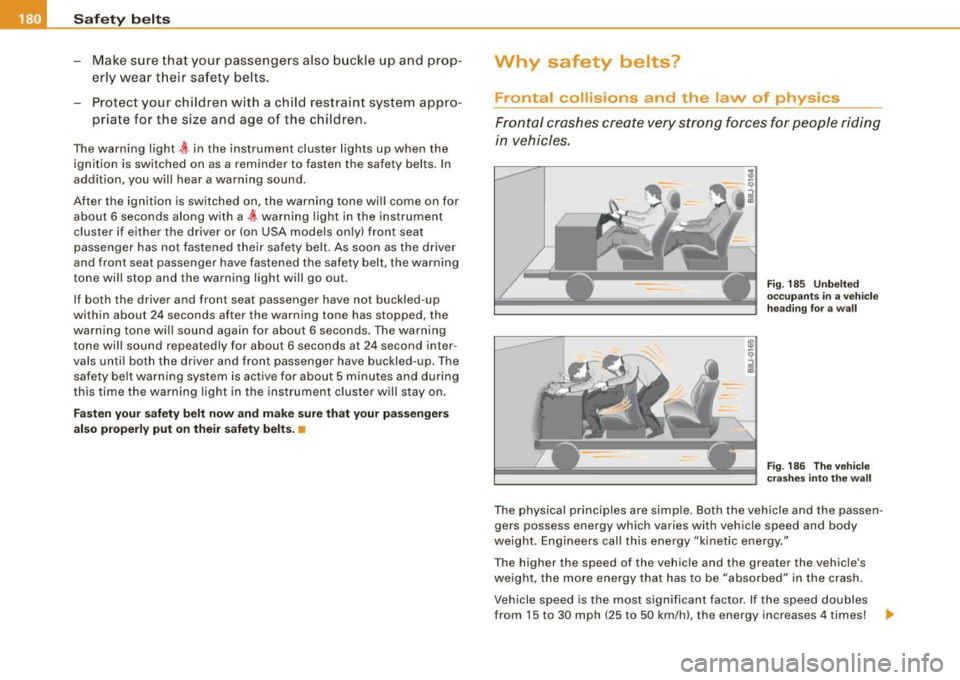
Front al crashes create very strong forces for pe ople rid ing
in vehicles.
Fi g. 185 U nbel ted
o cc up ants in a ve hicle
he ading for a wa ll
F ig . 18 6 The vehi cle
c ras hes in to the wa ll
The physical principles are simple. Both the vehicle and the passen
gers possess energy which varies with vehicle speed and body
we ight. Engineers cal l this energy "kinetic energy ."
T he higher the speed of the vehicle and the greater the vehic le's
we ight, the more energy that has to be "absorbed" in the crash .
Vehicle speed is the most significan t factor. If the speed doubles
from 15 to 30 mph (25 to 50 km/h), the energy increases 4 times! .,
Page 184 of 360
__ __::S~a ~f ~e ~ty ~ b~ e~ l~ t ~s ____________________________________________ _
Safety belts protect
People think it's possible to use the hands to brace the
body in a minor collision. It's simply not true!
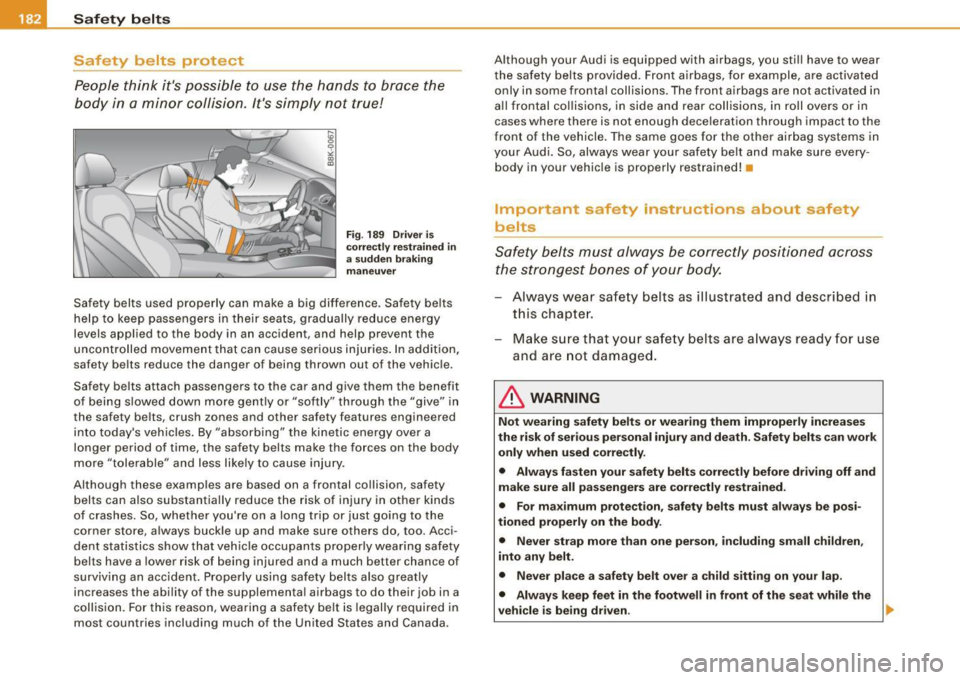
Fi g. 189 Driver is
co rrec tly res trai ned in
a sudden braking
m an euver
Safety belts used properly can make a big difference . Safety belts
help to keep passengers in their seats, gradually reduce energy
levels applied to the body in an accident , and help prevent the
uncontrolled
movement that can cause serious injuries. In addition,
safety be lts reduce the danger of being thrown out of the vehic le.
Safety belts attach passengers to the car and g ive them the benefit
of being s lowed down more gently or "softly" through the "give" in
the safety belts, crush zones and other safety features engineered
into today's vehicles . By "absorbing" the kinetic energy
over a
longer period of time, the safety belts make the forces on the body
more "tolerable" and less like ly to cause injury.
Although these examples are based on a frontal collision , safety
belts can also substantially reduce the risk of injury in other kinds
of crashes. So, whether you're on a long trip or just going to the
corner store, always buckle up and make sure others do, too. Acci
dent statistics show that vehicle occupants proper ly wearing safety
bel ts have a lower risk of being injured and a much better chance o f
surviving an accident . Proper ly using safety belts also greatly
increases the abi lity of the supplementa l airbags to do their job in a
collision. For this reason, wearing a safety be lt is legally required in
most countries including much of the United States and Canada . Although your Audi is equipped with airbags, you sti
ll have to wear
the safety belts provided . Fron t airbags, for example, are activated
only in some frontal collisions . T he front airbags are not activated in
all frontal col lisions, in side and rear collisions, in roll overs or in
cases where there is not enough dece leration through impact to the
front of the vehicle . The same goes for the other airbag systems in
your Audi . So, always wear your safety belt and make sure
every
body in your vehic le is properly restrained! •
Important safety instructions about safety
belts
Safety belts must always be correctly positioned across
t he strongest bones of your body.
Always wear safety belts as illustrated and described in
this chapter.
Make sure tha t your safe ty belts are a lways ready for use
and are not damaged .
& WARNING
Not wearing safety belts or w earing them improperl y increas es
the ri sk of s eriou s pers onal inj ury an d death . S afe ty belt s can work
onl y w hen used corre ctl y.
• Alway s fas te n yo ur sa fe ty belt s corre ctl y befo re dri ving off and
mak e sure all p assenger s ar e correctly re strain ed.
• For m aximum protect ion , safet y belt s mu st alway s be p osi
ti oned properly on the body .
• Never strap more th an one person , includi ng sm all child ren ,
into any belt.
• Never pla ce a sa fety belt ove r a child sitting on your l ap .
• Alway s keep feet in t he foot well
in front of the seat while t he
vehi cle is being dri ven .
~
Page 195 of 360

__________________________________________________ A_ i_ r _b _a...: g::::_ s_ y=--- s_t _e _m __ lllll
& W ARNING (continued )
• Even when they deploy, airbags provide only supplemental
p rotect ion .
• Airbag work most effectively when used with properly worn
safety belts .
• Therefore , always wear your safety belts and make sure that
everybody in your vehi cle is properly restrained .
& WARNING
A person on the front passenger seat , especially infants and small
children, will receive serious injuries and can even be killed by
being too close to the a irbag when it inflates .
• Although the Advanced Airbag System in your vehicle is
designed to tu rn off the front passenger airbag if an infant or a
small child is on the front pa ssenger seat, nobody can absolutely
guarantee that deployment under these special cond itions is
impossible in all conceivable situations that may happen during
the useful life of your vehi cle .
• The Advanced Airbag System can deploy in accordance with
the "low risk" option under the U .S . Federal Standard if a child that
is heavier than the typical one -year old child is on the front
passenger seat and the other conditions for airbag deployment
are met.
• Accident statistics have shown that children are generally safer
in the rear seat area than in the front seating position .
• For their own safety , all children , espec ially 12 years and
younger, should always ride in the back properly restrained for
their age and size . •
Controls and equip ment Safety first Vehicle operation
Advanced front airbag system
Your vehicle is equipped with a front Advanced Airbag Syste
m in
compl ia nce w it h Un ited States Federal M oto r Ve hicle Sa fe ty S tan
dard 208 as appl icab le at the time your vehic le was manufactured.
The fro nt Advanced Ai rbag System supplemen ts the safety bel ts to
provide additional protection for the driver's and front passenger's
heads and upper bodies in fronta l cras hes. The ai rbags inflate o nly
i n fronta l im pac ts when the vehic le dece leratio n is h ig h enou gh.
T he front Advanced Airbag System for the front seat occupants is
n ot a su bstit ute fo r y ou r sa fety belts. Ra ther, i t is par t of th e overa ll
occupant restraint system in you r vehicle . A lways remember that
t he ai rbag sys te m can o nly h elp to pro tec t yo u, if y ou are sit ting
upright, wearing your safety be lt and wearing it properly. This is why
yo u an d your pas senge rs mu st always be p rope rly restrai ned, not
j us t because th e law requ ire s you to be.
T he Advanced Airbag System in your vehicle has been certified to
m ee t the " low r is k" requ ireme nts fo r 3 a nd 6 year -o ld c hildr en o n the
passenger s ide and very small adults on the driver side. The low risk
de ploym ent cr iteria a re inte nd ed t o he lp reduc e th e risk of in jury
through interaction with the front airbag that can occur, for
e xam ple, by be ing to o cl ose to the stee rin g wh eel and i nstru men t
panel w hen th e airbag inflates .
I n addition, the system has been certified to comply with the
"suppressio n" r eq uirem ents of t he Sa fety Standard , to tu rn off th e
front airbag for infants 12 months old and younger who a re
r es train ed o n th e fr ont p assenger sea t i n c hild re strai nts that a re
listed in the Standard ~
page 215, "Child restraints and Advanced
A irb ags" .
"Suppression" requires the front airba g on the passenger side to be
turned off if :
• a child up to abo ut on e year o f age is res traine d on the fr ont
passenger seat in one of the rear -facing or forward -facing infant
res traints l is te d in Federal Moto r Ve hicle Safe ty Standar d 208 wit h
which the Advanced Airbag System in your vehicle was certifi ed . For ...
Vehicle care Do-it-yourself service Technical data
Page 196 of 360
___ A_ ir_ b_ a-g _ s_y _ s_ t_ e_ m _________________________________________________ _
a listing of the child restraints that were used to certify your
vehicle's compliance with the US Safety Standard=>
page 215,
• weight less than a threshold level stored in the control unit is
detected on the front passenger seat.
When a person is detected on the front passenger seat, weighing more than the total weight of a child that is about 1 year old
restrained in one of the rear-facing or forward-facing infant
restraints (listed in Federal Motor Vehicle Safety Standard
208 with
which the Advanced Airbag System in your vehicle was certified),
the front airbag on the passenger side may or may not deploy.
The
PASSENGER AIR BAG OFF light comes on when the electronic
control unit detects a total weight on the front passenger seat that
requires the front airbag to be turned off. If the
PASSENGER AIR BAG
OFF
light does not come on, the front airbag on the passenger side
has not been turned off by the control unit and can deploy if the
control unit senses an impact that meets the conditions stored in its
memory.
If the total weight on the front passenger seat is more than that of
a typical
1 year-old, but less than the weight of a small adult, the
front airbag on the passenger side may deploy (the
PASSENGER AIR
BAG OFF
light does not come on).
For example, the airbag may deploy if:
• a small child that is heavier than a typical 1 year-old child is on
the front passenger seat (regardless of whether the child is in one
of the child safety seats listed=>
page 215!,
• a child who has outgrown child restraints is on the front
passenger seat.
If the front passenger airbag is turned off, the
PASSENGER AIR BAG
OFF
light in the center of the instrument panel will come on and stay
on.
The front airbag on the passenger side may
not deploy (the
PASSENGER AIR BAG OFF light does not illuminate and stay lit) if:
• a small adult or teenager is on the front passenger seat •
a passenger who is not sitting upright with their back against a
non -reclined backrest with their feet on the vehicle floor in front of
the seat is on the front passenger seat.
If the front passenger airbag deploys, the Federal Standard requires
the airbag to meet the "low risk" deployment criteria to help reduce
the risk of injury through interaction with the airbag . "Low risk"
deployment occurs in those crashes that take place at lower decel
erations as defined in the electronic control unit.=>
page 199
Always remember:
Even though your vehicle is equipped with
Advanced Airbags, the safest place for children is properly
restrained on the back seat. Please be sure to read the important
information in the sections that follow and be sure to heed all of the
WARNINGS.
& WARNING
To reduce the risk of injury when an airbag inflates, always wear
safety belts properly.
• If you are unrestrained, leaning forward, sitting sideways or out
of position in any way, your risk of injury is much higher.
• You will also receive serious injuries and could even be killed if
you are up against the airbag or too close to it when it inflates -
even with an Advanced Airbag=>
page 188.
& WARNING
A child in a rearward-facing child safety seat installed on the front
passenger seat will be seriously injured and can be killed if the
front airbag inflates -even with an Advanced Airbag System.
• Although the Advanced Airbag System in your vehicle is
designed to turn off the front airbag when a rearward -facing child
restraint has been installed on the front passenger seat, nobody
can absolutely guarantee that deployment is impossible in all
conceivable situations that may happen during the useful life of
your vehicle.
~
Page 205 of 360

_______________________________________________ .=_A ::_ i :.:.r ~b ~a:=.; 9!:!...: S~ y[: s~ t~ e:::_ m ~ --""
& WARNING (continued )
• Always make sure that the side airbag can inflate without inter
ference :
- Never install seat covers or replacement upholstery over the
front seatbacks that have not been specifically approved by
Audi.
- Never use additional seat cushions that cover the areas
where the side airbags inflate.
- Damage to the or iginal seat covers or to the seam in the area
of the side airbag module must always be repaired immedi
ately by an authorized Audi dealer.
• The airbag system can be activated only once. After an airbag
has inf lated , it must be replaced by an authorized Audi dealer or
qualified technician who has the technical information , training
and special equipment necessary .
• The airbag system can be deployed only once . After an airbag
has been deployed, it must be replaced with new replacement
parts designed and approved especially for your Audi model
version. Replacement of complete airbag systems or airbag
components must be performed by qualified workshops only .
Make sure that any airbag service action is entered in you r Audi
Warranty
& Maintenance booklet under AIRBAG REPLACEMENT
RECORD .
• In accidents when an airbag is deployed , the vehicle battery
separates the alternator and the starter from the vehicle electrical
system for safety reasons with a pyrotechnic circuit interrupter.
-Work on the pyrotechnic circuit interrupter must only be
performed by a qualified dealer -risk of an accident!
- If the vehi cle or the circuit interrupter is scrapped, all appli
c able safety precautions must be followed .
Controls and equip ment Safety first Vehicle operation
<£' For the sake of the environment
U
ndep loyed airbag modu les a nd p retens ioners mi ght be c lassified
as Perch lorate Mate rial -sp ecia l handling may apply, see
www .dtsc.ca.gov/ haza rdous waste/perc hlorate. W hen the vehicle or
parts of the restraint system including airbag modules safety be lts
w it h pre ten sio ne rs are scrapped, a ll appl ica ble l aws and re gula
tions must be observed. Your authorized Audi dealer is familiar with
t hese re qu irements and we rec om men d th at you h ave yo ur dealer
perform this service for you. •
Other things that can affect Advanced Airbag
performance
Changing the vehicle 's suspension system can change the way that
t he Adva nced Airb ag Sys te m per form s in a crash . For e xamp le,
u sing ti re -rim combinations not approved by Audi, lowering the
ve hicle , c hangi ng th e s tif fness of the sus pension , in cluding the
springs, suspension struts, shock absorbers etc. can change the
forc es that are meas ured by the ai rbag se nso rs a nd se nt to t he ele c
tronic control unit. Some suspension chan ges can, for examp le,
i nc rea se t he for ce le v e ls mea sur ed by the se nso rs and make th e
ai rbag system dep lo y in cras hes in w hich it wou ld not d ep loy if the
changes had not been made . Other kind s of changes may reduce
th e force l eve ls measured by t he sensors and prevent t he airba g
from deploy ing when it should .
Th e sen so rs in the s afet y b elt buckle fo r the driv er and front
passen ger seat tell the electronic control module if the safety belt is
l a tc h e d or n ot. If the safet y b elt i s bei ng use d, th e fr ont ai rb ag will
dep loy at a s lightly hi gher rate of vehic le dece leration than if the
safet y belt is not be ing u sed . The refo re, in a partic ular coll isi on, it i s
poss ible t hat an airbag will not deploy at a s eati ng position where
the safety be lt i s being used b ut wi ll inf late at the pos ition where the
sa fety belt is not being used. I t is im porta nt t hat nothi ng i nterf ere
with the safety belt b uckles so that the sens ors can send the correct
i n fo rm ati on about sa fety belt use to the elect ron ic contro l u nit. .,.
Vehicle care Do-it-yourself service Technical data
Page 224 of 360
-Child Safety P'll:f _______________ _
-Always make sure that the chi ld can pr operly wear t he
lap por tion of the be lt low acr oss the thighs or pelvis and
never over the stomach or abdomen.
Children up to at least 8 years old (over 40 lbs . or 18 kg) are best
protected in child safety seats designed for their age and weight.
Exper ts say that the ske le tal s tructure, particu lar ly the pe lvis, of
these children is not fully deve loped, and they must not use the
vehic le safety belts without a suitab le chi ld rest raint.
Children who are at least 4 ft. 9 in. (57 inches/1.45 meters) tall can
generally use the vehic le 's three point lap and shou lder belts . Never
use the lap belt portion of the vehic le's safety belt a lone to restrain
any chi ld, regardless of how big the child is. Always remember that
children do not have the pronounce d pelvic struc ture required for
the proper function of lap be lt portion of the vehicle's three point
lap and shou lder belts. The child' s safety abs olutely requires that a
lap belt portion of the safety belt be fastened snugly and as low as
possible aro und the pelv is. Never let the lap be lt portion of the
safety be lt pass over the child 's stomach or abdomen .
It is usua lly best to put thes e chi ldren in appropriate booster seats .
Be sure the booster seat me ets all app licable safety standards.
Booster seats raise the seating pos ition of the child and reposition
both the lap and s hou lder par ts of t he safety belt so that they pass
across the child's body in the right places. The routing of the belt
over the child's body is very important for the child 's protection,
whether or not a booster seat is used. Children age 12 and under must a lways ride in the rear seat.
In a crash, air bags must inflate wi th in a b link of an eye and with
considerab le force . In order to do its job, the airbag needs room to
inf la te so tha t it will be there to pr otec t the occ upant as the occu
pant moves forward in to the airbag .
A vehicle occupant who is out of position and too close to the airbag ge ts in t he way of an inflating a irbag. When an occupant is too
close, he or she will be struck vio lent ly and will receive serious or
poss ibly even fatal inju ry. I
n order for the airbag to offer protection, it is important that all
v eh ic le occupan ts, espec ially any c hildren, who mus t be in the fron t
seat because of exceptiona l circumstances, be properly restrained
and as far away fro m the airbag as possible . By keepi ng room
between the child's body and the front of the passenger compart
ment, the ai rbag can inflate comp lete ly and provide s upplemental
p rotectio n in ce rtai n fr ontal collis ions .
& WARNING
Not u sing a booster seat , using the booster seat improperly , incor
rectly installing a boo ster seat or using the vehicle safety belt
improperly in creases the risk of serious personal injury and death
in a collision or other emergency situation . To help reduce the risk
of serious personal injury and /or death :
• Alway s make sure to position the shoulder portion of the three
point belt over the middle of child's shoulder .
• Never let the shoulder portion of the belt rest against or acro ss
the ne ck, fa ce , c hin , or throat of the child .
• Alway s make sure the lap belt portion of the three -point belt is
worn snug and pa sses as low a s po ssible across the child' s pel vis .
Never let the belt pass over the soft abdomen.
• Failure to properly route s afety belts over a ch ild's body will
cau se severe injurie s in an accident or other emergency situation
~ page 179 .
• Children on the front seat of any car , even with Advanced
Airb ags , c an be seriou sly injured or even killed when an airbag
inflate s.
• Never let a child stand or kneel on any seat .
• Never let a child ride in the cargo a rea of you r veh icle .
• Always remember that a child leaning forward, sitting s ide
ways or out of po sition in any way during an accid ent can be
s tru ck by a deploying airbag . This will result in serious personal
injury or death . ...,
Page 237 of 360

The system operates across the entire speed range in combination
with the ABS system. If the Anti -Lock Brake System (ABS) ma lfunc
tions, the ESP wil l also shut down .
How the system works
The Anti -Lock Brake System (ABS), Electronic Differential Lock (EDU
and the Anti -Slip Regulation System (ASR) are integrated in the elec
tronic stabilization program. In addition to the data provided by
th ese functions, the ESP control unit requires additional measure
ment data provided by high performance sensors . The rotational
speed of the vehicle about its vertica l axis, vehicle acceleration in
the fore-and-aft and lateral directions , the brake pressure, and the
steering angle are all measured.
The direction in which the driver wishes to travel is determined with
the aid of the steering angle and vehicle speed and is continua lly
compared with the actual behavior of the vehicle. If the two do not
match, for example, when the vehicle starts hydrop laning on a wet
road, ESP will automatically brake the appropriate whee l to correct
the prob lem.
The vehicle is then stabi lized by the forces acting on the whee l
during braking. If the vehicle is
oversteering (the vehicle turns too
sharply and the rear wheels slide toward th e ou tside of a curve), the
brakes are main ly app lied on the wheel that is on the outside of the
curve . In the case of a vehicle that is
understeering (the vehicle does
not turn sharply enough and pushes out of a curve), the brakes are
applied as needed on the wheel that is on the inside of the curve or
additional ly on the other wheels. An acoustic signal indicates when
ESP brake app lication cuts in=>&.
T he system operates across the entire speed range in combination
with the ABS system =>
page 238. If the Anti-Lock Brake System
(ABS) malfunctions, the ESP will be out of action as well.
Activating
When you turn on the engine, ESP will automatica lly be activated
and will perform a se lf-test. As soon as the test is comp leted, the
system is in norma l operating mode.
Controls and equip
ment Safety first Vehicle operation
Intelligent technology
You
can activate a deactivated ESP or deactivated ESP/ASR if
required by pressing the::::>
page 234, fig. 215 ::::> page 234, fig. 214
button . When they are activated, the message
ESP /ASR on appears
briefly in the display .
Deactivating
The ESP should normally be activated al l the time. If necessary, you
can deactivate Anti -Slip Regu lation (ASR) or the Electronic Stabiliza
tion Program (ESP) by pressing the button=>
page 234, fig. 215.
• Deactivating ASR: Tap the button . In certain exceptional situa
tions (e .g. driving with tire chains), the Anti-Slip Regulation (ASR)
can be deactivated =>
page 236. The message ASR off appears in the
display as we ll.
• Deact ivating ESP/ASR Press the button for more than 3 seconds.
With the ESP/ASR deactivated, the indicator light comes on, see
=>
page 13. The message ESP switched off appears in the disp lay as
we ll.
& WARNING
The Electronic Stabilization Program is nevertheless subject to the
laws of physics . It is particularly important to pay attention to this
fact on wet and slippery roads. It is therefore important that you
always adapt your driving to the condition of the road and traffic
conditions. Do not allow the increased safety provided by the Elec
tronic Stabilization Program system to lull you into accepting
additional safety risks. •
Electronic differential lock (EDL)
---------
The electronic differential lock monitors the rotational
speed of the drive wheels.
General notes
The electronic differential lock (EDU helps the car to start moving,
acc elerate and c limb a gradient on surfaces providing poor or
Vehicle care Do-it-yourself service Technical data
Page 238 of 360

ll}JI Intelligent technology
---""'------------ ....::....:...:~---------------------------
almost no grip. Without EDL, this would be difficult, if not impos
sible.
How the system works
The EDL operates automatically. It monitors the rotational speed of
wheels with the help of the ABS sensors=:,
page 238 . If a noticeable
slip is detected at the wheels (e.g. on slippery ground on one side),
the spinning wheels are braked and power is transferred to the
other wheels. This is done up to a speed of about 60 mph (100 km/h).
Noises from the brake system signal that wheel spin is being
controlled.
Driving off
When driving off, always be sure to keep road conditions in mind as
you accelerate. If one drive wheel spins because it is on a surface
with less grip, apply
plenty of throttle until the car starts to move.
Overheating of brakes
To prevent the disc brake of the braked wheel from overheating if
subjected to excessive loads on this wheel, the EDL cuts out tempo rarily. The vehicle remains operational and behaves in the same way
as a vehicle without EDL.
As soon as the brake has cooled down, EDL switches on again auto
matically.
& WARNING
• When accelerating on slippery surfaces, such as on ice or snow,
always be careful when depressing the accelerator pedal. Even
with the EDL working, the drive wheels can spin and reduce your ability to control your car. Risk of crash!
• The increased safety afforded by EDL does not mean that you
can take safety risks. Always adapt your driving style to the road
conditions and traffic situation.
[ i] Tips
If a fault occurs in the ABS, the EDL is also not functioning . This is
indicated by the ABS warning light=:,
page 15. •
Anti-Slip Regulation System (ASR)
The Anti-Slip Regulation System prevents the driven
wheels from spinning when the car is accelerating.
General notes
The Anti-Slip Regulation System (ASR) is integrated in the electronic
stabilization program (ESP) . When the vehicle starts up and acceler
ates, the wheels are prevented from spinning by adjusting the
engine power to match the amount of grip available from the road
surface.
How the system works
ASR performs automatically , i.e. without the driver's intervention .
With the aid of the ABS sensors=:,
page 238, ASR monitors the
speed of the driven wheels. If the wheels start to spin, engine torque
is reduced automatically until the tires find enough grip to lock onto
the road surface. The system is active across the entire speed range.
The ASR works in conjunction with the ABS. If a malfunction should
occur in the ABS, the ASR will also be out of action.
Activating
The ESP is automatically activated when the engine is started and it
performs a self-test . You can activate a deactivated ASR if required
by pressing the=:,
page 234, fig. 215 button. When it is activated,
the message
ESP/ASR on appears briefly in the display.
Deactivating
You can deactivate the ASR if required by pressing the button (for
less than 3 seconds) =:,
page 234, fig. 215. With the ASR deactivated,
the ESP check light comes on, see=:,
page 13. The message ASR off ._
Page 240 of 360
ll}Jl __ ln_t _e_ ll-'"ig ...,_ e_ n_t _t_ e_ c_h _ n_o _ l_o _,.g= y,_ __________________________________________ _
Low brake fluid level
Ma lfu ncti ons can occ ur in th e brake system if the bra ke flu id leve l is
too low. The brake fluid leve l is monitored e lectronically.
Brake lining wear status Bra ke lining wear may be checked by visual inspection of the condi
t ion of the brake pa ds through the o pen in g s in t he wheel. If neces
sary, the wheel may be removed for this inspection=>
page 312,
" C hanging a whee l" .
& WARNING
• You should perform braking maneuver s for the purpose of
cleaning the brake system only if road cond itions permit . Other
road u sers must not be put at risk -you may cause an accident !
• Before des cending a steep grade , reduce speed and shift trans
mission into a lower gear or lower driving range. Do not ride the
brake s or hold the pedal down too long or too often . This could
c ause the brakes to get hot and diminish braking efficiency.
• Do not "ride the brakes " by resting your foot on the pedal when
you do not intend to brake. This may cause the brakes to overheat, p rem ature wear and in creased stopping distance .
• Under certain climatic and operating conditions such as
passing through water , driv ing in heavy rain or after washing the
vehicle , the effectiveness of the brakes can be reduced. In winter ,
ice can accumulate on the brake pads , linings , discs and drums.
Carefully apply brakes for a test. Brakes will dry and ice coatings
will be cleaned off afte r a few careful b rake appli cations .
• Driving for an extended period of time on salt -covered roads
without using your brakes can also affe ct braking effic ien cy. Clean
off accumulated salt coating from brake discs and pads with a few
careful brake applications .
• If you damage the front spoiler , or if you install a different
spoiler , be sure the air flow to the front brakes is not obstru cted .
Otherwise the brake system could overheat reducing the effe ctive
ness of the entire brake system .
& WARNING (continued )
• Failure of one brake circuit will impair the braking capability
resulting in an increased stopping distance . Avoid driv ing the
vehicle and have it towed to the nearest authorized Audi dealer or
qu alified workshop. •
Brake booster
The bra ke boos ter adds e xtra bra king pow er.
Th e brake boost er wo rks wit h vacuum p ressu re wh ich is created
only when the engine is running=>& .
& WARNING
• Never let the vehicle roll to a stop with the engine shut off.
• If the brake booster is not working , for e xample when towing
your vehicle, or because the brake booster has somehow been damaged , the brake pedal must be pressed considerably harder to
make up for the lack of booster assistance . •
Functioning of Anti-Lock Brake System (ABS}
A BS p revents t he wheels from lockin g up unde r braking.
The ABS co ntrib utes effectively to ve hic le c ont ro l since it preven ts
the whee ls from locking when the bra kes are app lied. Th is means
that the vehicle remains stee rable and is less l ikely to skid .
With ABS you do not need to
pump the brake. Just hold the brake
pedal down .
Ho wever , do not e xpect the AB S to sho rten braking d istance under
all circumstances. When driving o n grave l or on newly fallen snow
o n t op of icy su rfaces, b raking distance may be even lo nger, there
f ore, unde r these circumsta nces, it is especially impo rtan t th at you
drive slow ly and with great ca re. ._
Page 241 of 360

How the ABS system works
An au tomatic check is made when a speed of about 12 mph (20
km/h) is reached. When this happens, a pumping no ise can be
heard .
I f an individua l wheel begins to ro tate too s low ly in relation to
vehic le speed and tends to lock, the ABS automatical ly reduces
b rake pressure t o preven t tha t whee l from locking.
This automatic adjustment process wil l cause a
slight vibration of
t he brake peda l and some noises to ale rt you tha t veh ic le sp eed
must be adapted to existing road and traffic conditions.
in. WARNING
Although the ABS is very effe ctive , always remember that braking
c apability is limited by tire traction. Always adjust your driving
speed a ccording to the road and traffi c conditions. Do not let the
extra safety afforded by the ABS tempt you into taking extra risks.
The ABS c annot overcome the laws of physics .
[ i J Tips
• I f ABS is not functioning properly, a warning l ight wil l come on .
See
~ page 15.
• I f a fau lt occurs in the ABS, the EDL is also not funct ioning. This
is indicated by the ABS warning light .
Brake assist
Brake assist is designed to achieve the optimum brakin g
effect.
B rake a ssist hel ps to in crease the eff ective b raking powe r an d t hus
to achieve a shorter stopping distance. If the driver presses the
br ake pe dal ve ry q uickl y, br ake a ss is t auto matically boo sts t he
braking force to the maximum lev el, up to the point where the anti
lock b ra ke function (ABS) intervenes to stop the wheels from
Controls and equip
ment Safety first Vehicle operation
Intelligent technology
locking
. You shou ld then keep the brake pedal pressed until the
ve hic le has braked to the required spee d. Brake assist swi tches itse lf
off as soon as you release the brake pedal.
in. WARNING
Please remember that the accident r isk always increases if you
drive too fast , espe cially in corners or on a slippery road , or if you
follow the vehicle ahead of you too closely. Increa sed risk of an
accident cannot be compensated for even by brake as sist , so
always maintain a safe speed .•
Servotronic® -advanced power
steering system
The pow er st eer in g systems uses th e po we r of t he
run nin g eng ine to a llow prec ise s tee ring with lit tle eff ort.
The advanced S ervotronic ® power steering system senses the road
s p eed and electr onically a djusts power assis tance t o provide
comfortab le and safe steering response exactly matched to the
ve hicle speed .
Power steering wi ll n ot work if the eng ine is off. As a result, the
steering whee l wil l be hard to turn.
Th e power s teering flu id leve l is check ed during the sc hed uled
maintenance services .
0 Note
If there is an electronic ma lfunction, servotronic wi ll still function
like a conventi onal power s teer ing sys te m , pr ovi ding a constan t
steering support force that is no longer proportionate to the vehicle
speed. This is mo st noticeable when tu rning t he steering whee l at
low speeds {for examp le when parking), -more effort wi ll be
r equired than usual.
~
Vehicle care Do-it-yourself service Technical data