ECU AUDI A5 COUPE 2010 User Guide
[x] Cancel search | Manufacturer: AUDI, Model Year: 2010, Model line: A5 COUPE, Model: AUDI A5 COUPE 2010Pages: 360, PDF Size: 84.39 MB
Page 85 of 360
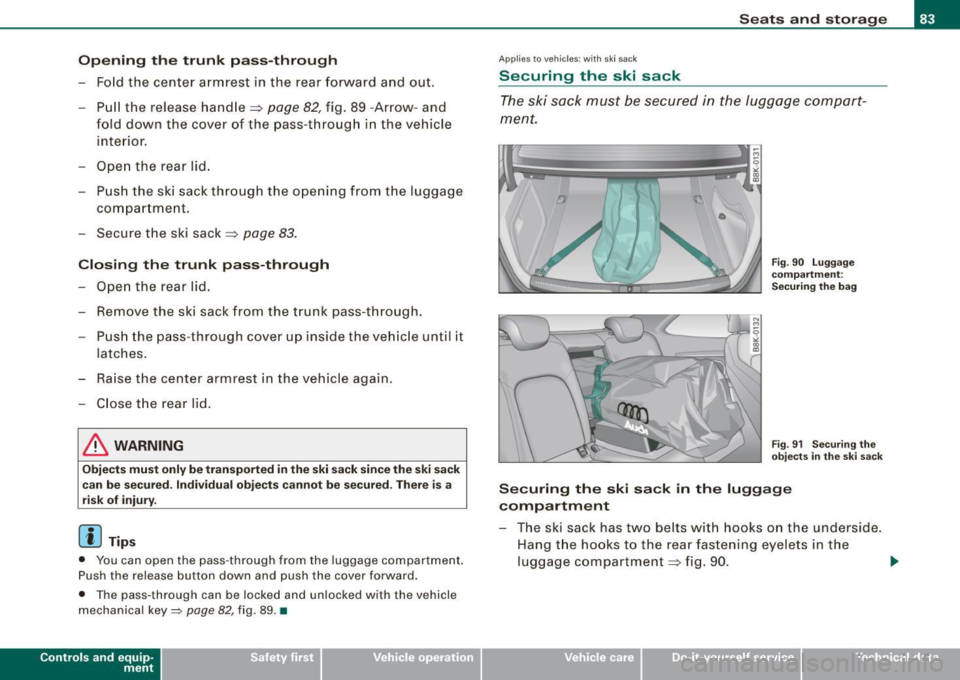
Opening the trunk pass-through
-Fold the center armrest in the rear forward and out .
- Pull the release handle=:> page
82, fig. 89 -Arrow- and
fold down the cover of the pass-through in the vehicle interior.
- Open the rear lid.
- Push the ski sack through the opening from the luggage
compartment.
- Secure the ski sack => page
83.
Closing the trunk pass-through
- Open the rear lid.
- Remove the ski sack from the trunk pass-through.
- Push the pass-through cover up inside the vehicle until it
latches.
- Raise the center armrest in the vehicle again .
- Close the rear lid .
& WARNING
Objects must only be transported in the ski sack since the ski sack
can be secured. Individual objects cannot be secured. There is a
risk of injury.
[ i] Tips
• You can open the pass -through from the luggage compartment.
Push the release button down and push the cover forward.
• The pass -through can be locked and unlocked with the vehicle
mechanical key:::::, page
82, fig. 89 . •
Con tro ls and eq uip
ment
A pp lies to vehicles: wit h ski sa ck
Securing the ski sack
Seats and storage
The ski sack must be secured in the luggage compart
ment.
Fig . 90 Luggage
compartment :
Securing the bag
Fig . 91 Securing the
objects in the ski sack
Securing the ski sack in the luggage
compartment
- The ski sack has two belts with hooks on the underside.
Hang the hooks to the rear fastening eyelets in the
luggage compartment => fig. 90.
Vehicle care I I irechnical data
Page 86 of 360
Seats and storage
Securing the objects in the ski sack
- Pull the safety be lt taut=> page 83, fi g. 91 at the free e nd
of the be lt.
[ i J Tips
Make sure that the ski sack is not stored wet. •
Roof rack
Description
Additional cargo can be carried with a roof luggage rack.
If luggage o r cargo is to be carr ied on the roof, you must observe the
following:
• Your vehic le has aerodynamic rain gutters mo lded into the roof.
This is why co nventiona l roof luggage rac ks cannot be used . We
recommend using roof racks from the Audi original accessories
program.
• These approved roof racks are the basis fo r a complete roof rack
system . Addit ional attachments for the basic roof rack are neces
sary to safely transport luggage, bicycles, surf boards, skis or smal l
boats. All necessary ha rdware for these sys tems is available at your
authorized Audi dealer.
• We rec ommend tha t you keep the installation instructions for
your roof rack system together with your Owner's literature in the
vehic le .
When should the roof r ack be removed?
• Before goin g through an automat ic car wash (it is best to ask the
car wash operator for advice).
• When not in use, to reduce fue l consumption, wind noise and to
guard against theft.
& WARNING
• Use of an unappro ved roof rack o r in correct mounting of an
approved roof r ack can cause the roof rack or the items attached
to it to fall off the roof onto the road .
• Objects falling from the roof of a vehi cle can cau se a crash and
person al injur y.
• Only mount the system between the markings shown in
=> page 85 , fig . 92 .
• The roof rack sy stem mu st be in stalled e xactly according to the
instruct ions provided .
0 Note
• Your vehicle warranty does not cover any damages to the vehicle
caused by using roof racks or mounting structures not approved by
Audi for your vehicle. The same app lies to damage resulting from
incorrect r oof rac k in sta llation .
• Always check the roof rack mountings and hardware before each
trip and du ring a tr ip to make su re everything is securely tightened.
I f necessary, retighten the mountings and check the entire system
from time to time.
• After mounting a roof rack system, or when you transport
objects on the roof of your vehicle, the he ight of the vehicle is nat u
rally increased . B e carefu l when driving under low bridges or in
parking garages for example . This could cause da mage to th e lo ad
and even the vehic le itself .•
Page 87 of 360

Mounting points
The roof r ack must be a ttached onl y at the loc ations
marked .
Installation
Fig . 92 Mou ntin g lo ca
tion s for r oof rac k
When ins tall ing the front fee t, make sure that they are p ositioned
exactly on the positioning bolts provided @between the side panel
and the upper roof frame=> fig. 92. The bol t is visible as soon as you
push back the seal from the upper roof frame us ing the insta llation
t ool s upplied with the roof rack . The rear markings ® are identified
at the upper edge of the side g lass by two smal l arrowheads.
& WARNING
After tra veling several mile s, ens ure that the roof ra ck is secure .
[ i ] Tip s
The roof rack indicates whether it is to be mounted in the front or
b ack .•
Con tro ls and eq uip
ment
Seats and storag e
Roof load
The cargo on the roof must be securely attached.
Han dling c har acteristic s change when c argo is trans
ported .
The permissible roof load for your vehicle is 165 lb s. (75 kgl. The roof
load is a combination of the weight of the carrier system and the
cargo .
W hen using roof rack systems with a lower load capacity, you
cannot use the maximum permissib le roof load . In this case , the
ro of rack can only be loaded to the we ight li mit given in the instal
lation guide.
& WARNING
• The cargo must be se curel y attached on the roof ra ck, other
wise you risk an a ccident.
• You mu st under no cir cumstances exceed the permissible roof
load , the permi ssible axle load s and the permis sible overall we ight
of your vehicle -risk of an a ccident.
• Consider that when tra nspo rting heavy obje cts or one with a
la rg e surface , the handling characteristi cs change due to shift in
the center of gravity or the greater surface exposed to the w ind.
So adapt your driv ing and your speed to pre vailing condit ion s.
<£> For the sake of the environment
As a result of the increase wind resistance created by a roof rack ,
your vehicle is using fuel unnecessarily . So remove the roof rack
after using i t.•
Vehicle care I I irechnical data
Page 88 of 360
Seats and storage
Beverage holders
Front beverage holders
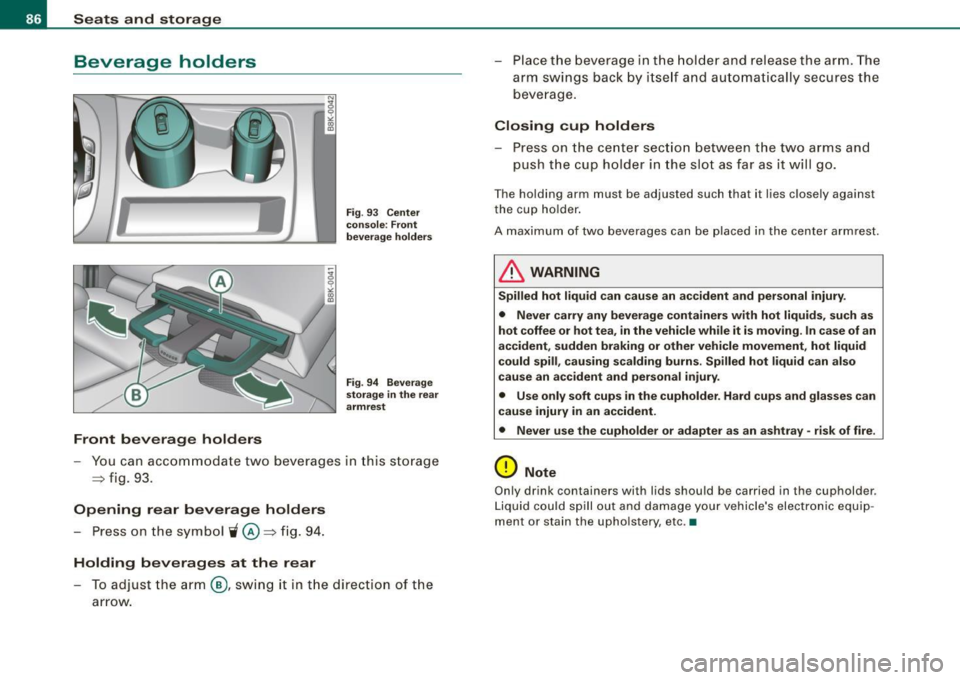
Fig. 93 Center
console: Front
beverage holders
Fig .
94 Beverage
storage
in the rear
armrest
- You can accommodate two beverages in this storage
=> fig . 93.
Opening rear beverage holders
- Press on the symbol W@ ::::;, fig. 94.
Holding beverages at the rear
To adjust the arm ®, swing it in the direction of the
arrow. Place the
beverage in the holder and release the arm. The
arm swings back by itse lf and automatically secures the
beverage.
Closing cup holders
Press on the center section between the two arms and
push the cup holder in the slot as far as it will go.
The holding arm must be adjusted such that it lies closely against
the cup holder.
A maximum of two beverages can be placed in the center armrest.
& WARNING
Spilled hot liquid can cause an accident and personal injury.
• Never carry any beverage containers with hot liquids, such as
hot coffee or hot tea, in the vehicle while it is moving. In case of an
accident , sudden braking or other vehicle movement, hot liquid
could spill, causing scalding burns. Spilled hot liquid can also
cause an accident and personal injury.
• Use only soft cups in the cupholder. Hard cups and glasses can
cause injury in an accident.
• Never use the cupholder or adapter as an ashtray -risk of fire .
0 Note
Only drink containers with lids should be carried in the cupholder.
Liquid could spill out and damage your vehicle's electronic equip
ment or stain the upholstery, etc.•
Page 110 of 360

• ..__O_ n_ t_h _ e_ r_ o_ a_ d ____________________________________________________ _
Ignition lock and ignition switch
Starting engine with the key
The ignition is switched on and the engine started with
the ignition key.
Fi g. 11 7 Ignit ion key
Insert the key into the ignit ion lock .
Manual transmission : Fully depress the clutch pedal a nd
move t he shi ft lever to the neutra l posi tion .
Automatic transmission*: Step on the brake peda l and
move the selector lever to the
P or N posit ion.
Press the key=::> fig . 117 -the eng ine will sta rt.
By pressing the key w ithout stepping on the clutch or the brake, the
ign ition is switched on and off. With the ignition on, the steering
whee l is unlocked.
You can only remove the key with the ignition switched off. To do
this, you have to press on the key again. With an automatic trans mission, the selector lever m ust be in the
P position.
When starting the engine, major electrical loads are switched off
temporarily. After starting a cold engine
, there may be a brief period of increased
noise because the o il pressure must first build up in the hydraulic
valve adjusters . This is normal and not a cause for concern .
I f the engine should not start immediately, the starting process is
automatically stopped a fter a short t ime . Repeat starting procedure.
Driv er me ssage in the instrument clust er di spl ay
Pre ss b rake ped al to s ta rt engine
This message appears if you do not step on the brake pedal to start
the engine on a vehicle with an automatic transmission .
Press clut ch pedal to sta rt engine
T his message appears if you do not step on the c lutch peda l to start
the engine on a vehicle with a manua l transmission .
Engage N or P to start engine
This message appea rs when attempting to start the engine if the
selector lever for the automatic transmission is not in the
P or N
position . The engine can only be started with the selec tor in these
positions.
S hift to P, othe rwis e veh icle can roll away. Doors do not lock if le ver
is not in
P.
This message appears for safety reasons along with a warning
signal. It appears if the selector lever for the automatic transmiss ion
is not in the
P p o sition after the ign it ion is switched off. Move the
selector lever to the
P position, otherwise the vehicle is not secured
aga inst ro lling away. You a lso cannot l ock the vehicle using the
locking bu tton on the door handle or using the remote key .
& WARNING
• Always take the key with you wheneve r you leave yo ur vehi cle .
Otherwi se , the engine could be start ed or electr ical equipment
s u ch as the po wer windows could be oper ated . Th is ca n lead to
seri ous injury.
Page 113 of 360

On the road -
----------------
engine again . Moreover, you cannot lock the vehicle from the
ou tside with the key.
S hift to P, other wise v ehicle can roll a way. Doors d o not lo ck if lev er
i s not in
P.
This message appears for safety reasons along with a warning
signal. It appears if the selector lever for the automatic transmission
is not in the P position when switching off the ignition with the
I START ENG INE STOP I button. Move the selec tor lever to the P
position, otherwise the vehicle is not secured against rolling away.
You a lso cannot lock the vehic le using the locking button on the
door handle or using the remote key .
Convenience key defective ! Use ign it ion lock
This message appears if the vehicle has to be started not with the
I S TART ENG IN E STOP I button bu t with the ignition key .
& WARNING
• Nev er allow the engine to run in confined spaces · danger of
asphy xia ti on.
• Never turn off th e engine until th e vehicl e ha s come to a
c omplete stop .
• The br ake boo ster and servotronic only work when the engine
is running . With the ignit ion turned off , you have to apply m ore
force wh en ste ering or braking. Since you cannot steer and stop
norm ally , th is c an lead to accidents and serious injuries.
0 Note
• Avoid high engine rpm, ful l throttle and heavy engine loads unti l
the engine has reached operating temperature -o therwise you risk
engine damage .
• The engi ne cannot be started by pushing or tow ing the vehic le .
• I f the engine has been under heavy load for an extended period,
heat builds up in the engine compa rtment after the engine is
Controls and equip
ment
switched off -there is a risk of damaging the engine . Allow the
engine to run at idle for about 2 minutes be fore switch ing it off .
[ i ] Tips
If you open the driver's door with the ign it ion switched on, a buzzer
sounds and the message
Ign itio n is on appears in the instrument
c luster display. Sw itc h t he ign ition off .•
Ap plies to ve hic les: w it h con venie nc e key
Switching engine off with th e
[START ENGINE STOP] button
-Bring you r vehi cle to a comp lete st op.
- Automat ic transm ission*: Move the selector lever to the
P or N position .
-Press the[S TA RT EN GINE S TO P] button => page 110,
fig. 118.
Em ergen cy OFF fun ction
If necessary, the engine can be sw itc hed off wit h the selector lever
in the
R , D or S* positions . To do so, step on the brake pedal and
press and hold the
I S TA RT ENGINE ST OP I button (vehicle speed
must be less than 6 mph/ 10 km/h.
& WARNING
• Never turn off the engine unt il the vehicle h as come to a
complete s top.
• The brake boo ster and servotroni c on ly wor k when the eng ine
is running . With the ignition turned off , you have to apply more
for ce when stee ring or braking . Since you cannot steer and stop
norm ally, t his can lead to accident s and seriou s injuries .
~
I • •
Page 151 of 360
_______________________________________________________ T_ ra_ n_s_ m __ is_s_ io_ n __ BII
& WA RNIN G (continu ed )
- Do not accelerate while sele cting a driving pos ition. At this
time the engine mu st be at idle speed so that undue stre ss is
not placed on the clutches in the transmiss ion .
- Remember: Even when stopped briefly with the automatic
transmission in D ,S or R, engine power is being transmitted to
the wheels. Your vehicle could "creep " forward or back ward .
When stopped , keep the brake pedal fully depressed and use
the parking brake if necess ary to keep the vehicle from rolling.
• If the selector lever i s unintentionally moved into N while you
are driving, take your foot off the accele rator pedal and wait for
the eng ine to return to idle speed before selecting a dr iving posi
tion.
• Never shift into R or P when the vehicle is in mot ion .
• Never get out of the driver 's seat when the engine is running .
• If you mu st get out of the vehicle , move the selector lever
securely into the
P pos ition and apply the parking brake firmly .
• If the engine must remain running , never have any driving po si
tion engaged when che cking under the hood. Make sure the
selector lever has securely engaged and is locked in
P with the
parking brake firmly set~ page
263 , "Engine compartment ".
Otherwise , any increase in engine speed may set the vehicle in
motion , even with the parking brake applied. •
Controls and equip
ment
Ap plies to vehicles: wit h auto matic tra nsmiss io n
Selector lever positions
This sec tion describes the selec tor l ever positi ons an d
dr iv ing ra ng es.
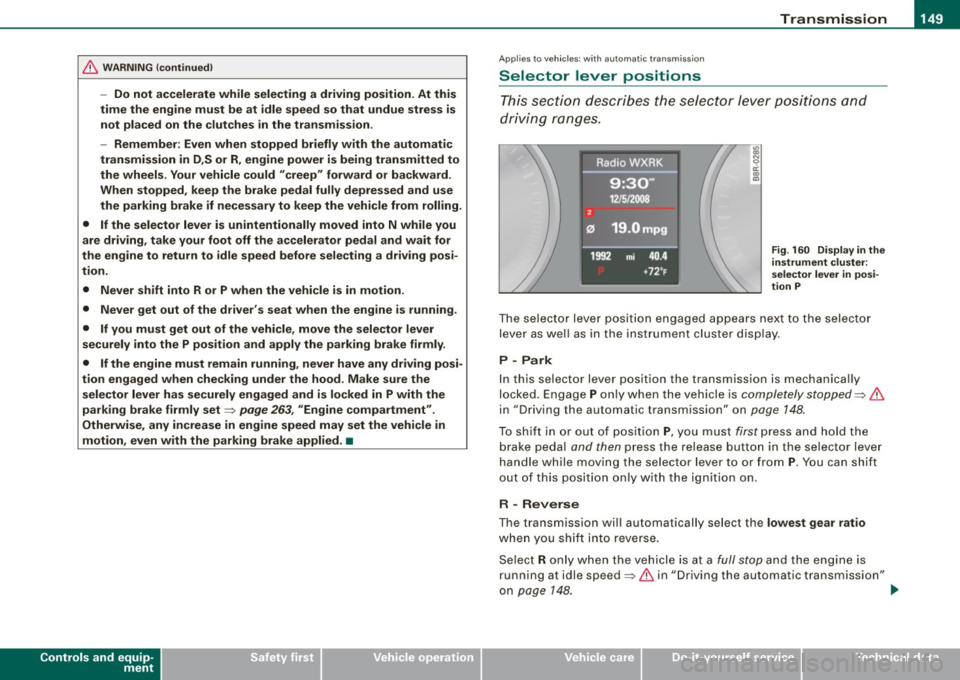
Fig . 160 Display in the
instrument clu ste r:
se lector lever in posi
tion P
The se le cto r lev er p osit io n engaged ap pears ne xt to the selec to r
lever as wel l as in the instrument cluster display .
P -Park
In this selecto r lever position the transmission is mechanica lly
lo cked. Engage
P o nly w hen th e vehicle is comple tely stopped ~ &
in "Driving the automatic transm ission" on page 148.
To s hift i n or out of positi on P, yo u m us t first p ress and h old the
b rake peda l and then press the re lease button in the se lector lev er
handle while moving the selector lever to o r from
P . You can shift
out o f this pos it io n only with the ig niti on on .
R - Reverse
The transmission wi ll automatically sel ect the lowest gear ratio
whe n you sh ift i nto reverse.
Se lec t R only w hen th e ve hicle is a t a
full stop an d the en gin e is
running at idle speed~
& in "Driving the automatic transmission"
on page
14 8. ~
I • •
Page 169 of 360
___________________________________________________ H_ o_m_ e_ L_ i_ n _ k_ @_ R __ !II
Ap plies to vehi cles : w ith Hom elin k® un iversal re mote con tro l
Reprogramming a single button
A Homelink® button can be reprogrammed individually without affecting the other button allocations.
Programming the overhead keypad
Press the appropriate Homelink® button until the indi
cator light begins flashing slowly.
At the radiator grille
1. Point the original remote control to the middle of the
radiator grille of your vehicle~
page 165, fig. 178.
2. Hold the
original remote control at a distance between 0-
5 in. (0-13 cm) (use the shortest distance possible) .
3. Press and hold the activation button on the remote
control.
4. The emergency flashers will flash three times (after
about
15-60 seconds) when the programming is
successful. Now release the button on the remote
control.
- If the device utilizes a rolling code, please follow phase 3
of ~
page 165, "Programming the Homelink® trans
mitter" for rolling code programming.
This procedure will cause the existing programming on the
Homelink ® button to be erased!•
Controls and equip
ment
Ap plies to ve hicles: wit h Hom el ink ® universal re mote co ntro l
Erasing the programming of the Homelink ®
transmitter
When you erase the programming , the programming on
all three of the transmitter channels with be lost!
- Perform steps 1 to 4 as described on~ page 165, "Phase
1: programming the overhead keypad".
When completed, the Homelink ® system will be in the program
ming mode and is then ready to learn the codes for remo te
controlled devices.
[ i ] Tips
• Programmed buttons cannot be erased individual ly .
• For secu rity reasons you are advised to erase the programming
of the HomeLink ® system before you sell your vehicle. •
I • •
Page 171 of 360

________________________________________________ D_r_iv _ i _n_ g~ S_ a_ fe_ ly __ BI
Important things to do before driving
Safety is everybody's job! Vehicle and occupant safety
always depends on the informed and careful driver.
For your safety and the safety of your passengers, before
driving always:
-Make sure that all lights and signals are operat ing
correctly.
- Make sure that the tire pressure is correct.
- Make sure that all windows are clean and afford good
visibility to the outside.
- Secure all luggage and other items carefully =>
page 88.
-Make sure that noth ing can interfere w ith the pedals.
- Adjust front seat, head restraint and mirrors correctly for your height .
- Instruct passengers to adjust the head restraints
according to their height.
- Make sure to use the right ch ild restraint correctly to
protect children =>
page 213, "Child Safety ".
- Sit properly in your seat and make sure that your passen
gers do the same=>
page 69, "General recommenda
tions".
- Fasten your safety belt and wear it p roperly. Also instruct
your passengers to fasten the ir safety belts properly
=>
page 179. •
Controls and equip
ment Safety first
Vehicle operation
What impairs driving safety?
Safe driving is directly related to the condition of the
vehicle, the driver as well as the driver's ability to concen
trate on the road without being distracted.
The driver is responsible for the safety of the vehicle and all
of its occupants. If your ability to drive is impaired, safety
risks for everybody in the vehicle increase and you also
become a hazard to everyone else on the road =>& .There
fore:
Do not let yourself be distracted by passengers or by
using a cellular telephone .
NEVER drive when your driving ability is impaired (by
medications, alcohol, drugs, etc.).
- Observe all traffic laws, rules of the road and speed limits
and plain common sense .
- ALWAYS adjust your speed to road, traffic and weather
conditions.
- Take frequent breaks on long trips. Do not drive for more
than two hours at a stretch.
- Do NOT drive when you are tired, under pressure or when
you are stressed .
& WARNING
Impaired driving safety increases the risk of serious personal
injury and death whenever a vehicle is being used. •
Vehicle care Do-it-yourself service Technical data
Page 174 of 360
-Driving
Safely ------=-------=----------------
& WARNING
(continued)
• Passengers must always sit in an upright position and never
lean against or place any part of their body too close to the area
where the airbags are located.
• Passengers who are unbelted, out of position or too close to the
airbag can be seriously injured by an airbag as it unfolds with
great force in the blink of an eye .
• Always make sure that there are at least 10 inches (25 cm)
between the front passenger's breastbone and the instrument
panel.
• Each passenger must always sit on a seat of their own and
properly fasten and wear the safety belt belonging to that seat.
• Before driving, always adjust the front passenger seat and
head restraint properly.
• Always keep your feet on the floor in front of the seat . Never
rest them on the seat, instrument panel, out of the window, etc.
The airbag system and safety belt will not be able to protect you properly and can even increase the risk of injury in a crash.
• Never drive with the backrest reclined or tilted far back! The
farther the backrests are tilted back, the greater the risk of injury due to incorrect positioning of the safety belt and improper
seating position.
• Children must always ride in child safety seats~
page 213.
Special precautions apply when installing a child safety seat on
the front passenger seat
~ page 188 . •
Proper seating positions for passengers in
rear seats
Rear seat passengers must sit upright with both feet on
the floor consistent with their physical size and be prop
erly restrained whenever the vehicle is in use.
To reduce the risk of injury caused by an incorrect seating
position in the event of a sudden braking maneuver or an
accident, your passengers on the rear bench seat must
always observe the following:
- Make sure that the seatback is securely latched in the
upright position~
page 80.
Keep both feet flat in the footwell in front of the rear seat.
Fasten and wear safety belts properly ~
page 183.
-Make sure that children are always properly restrained in
a child restraint that is appropriate for their size and age
~ page 213.
& WARNING
Passengers who are improperly seated on the rear seat can be
seriously injured in a crash.
• Each passenger must always sit on a seat of their own and
properly fasten and wear the safety belt belonging to that seat.
• Safety belts only offer maximum protection when the seatback
is securely latched in the upright position and the safety belts are
properly positioned on the body . By not sitting upright, a rear seat
passenger increases the risk of personal injury from improperly
positioned safety belts!
• Always adjust the head restraint properly so that it can give
maximum protection . •