ECU AUDI A5 COUPE 2010 Owner's Manual
[x] Cancel search | Manufacturer: AUDI, Model Year: 2010, Model line: A5 COUPE, Model: AUDI A5 COUPE 2010Pages: 360, PDF Size: 84.39 MB
Page 176 of 360
........ _o_ r_iv _i_ n""' g::;._ S_ a_f _e _ly =---------------------------------------------------
examp les w ill make you mo re aware of seating positions that ar e
d an gerous .
Therefore, whenever the vehicle is moving:
• ne ver stan d up i n the vehicle
• never stand on the seats
• never knee l on th e seats
• n ever ride with th e seatba ck re cl in ed
• never lie down on the rear seat
• nev er lea n up aga inst t he instrument pa ne l
• n ever sit on the e dge of the seat
• never sit sideways
• ne ve r le an ou t th e w indo w
• never put your feet out the window
• never put your feet on t he instrument p ane l
• n ever re st yo ur f ee t on t he seat cus hion or back of the sea t
• never ride in the footwell
• n ever ride i n the car go area
& WARNING
Improper seating positions increase the risk of serious personal
injury and death whenever a vehicle is being used.
• Always make sure that all vehi cle occupants stay in a proper
seating position and are properly restrained whenever the vehicle
is being used . •
Driver and passenger side footwell
App lies to vehicles: with knee air bags
Important safety instructions
& WARNING
Always make sure that the knee airbag can inflate without inter
ference . Objects between yourself and the airbag can increase the
risk of injury in an accident by interfering with the way the airbag
deploys or by being pushed into you as the airbag deploys.
• No persons (children) or animals should ride in the footwell in
front of the passenger seat .
If the airbag deploys, this can result in
serious or fatal injuries .
• No objects of any kind should be carried in the footwell area in
front of the driver's or passenger's seat . Bulky objects (shopping
bags, for example ) can hamper or prevent proper deployment of
the airbag. Small objects can be thrown through the vehicle if the airbag deploys and injure you or your passengers. •
Pedal area
Pedals
The ped al s m ust al ways be fre e to move an d must never
be in te rfered wi th by a floor mat or an y other object.
M ake sure t hat all pedals move free ly w ithout i nte rference and that
nothing prevents them from returning to their origina l positions.
O nl y use floor m ats th at l eave the ped al a rea free a nd can be
secured with floor mat fasteners.
I f a brake circuit fa ils, increased brake pedal travel is required to
br ing th e ve hicle to a fu ll stop.
Page 177 of 360

---------------------------------------------------=D..:.r..:..iv .:....:..: in..:. 9 ::!-- S .=..::a:..:f...:e :..: l~y ---
& WARNING
Pedals that cannot move freely can cause loss of vehicle control
and increase the risk of serious injury.
• Never place any objects in the driver's footwell . An object could
get into the pedal area and interfere with pedal function. In case
of sudden braking or an accident, you would not be able to brake
or accelerate!
• Always make sure that nothing can fall or move into the
driver's footwell. •
Floor mats on the driver side
Always use floor mats that can be securely attached to
the floor mat fasteners and do not interfere with the free
movement of the pedals.
- Make sure that the floor mats are properly secured and
cannot move and interfere with the pedals =>& .
Use only floor mats that leave the pedal area unobstructed and that
are firmly secured so that they cannot slip out of position . You can
obtain suitable floor mats from your authorized Audi dealer.
Floor mat fasteners are installed in your Audi.
Floor mats used in your vehicle must be attached to these fasteners .
Properly securing the floor mats will prevent them from sliding into
positions that could interfere with the pedals or impair safe opera
tion of your vehicle in other ways.
& WARNING
Pedals that cannot move freely can result in a loss of vehicle
control and increase the risk of serious personal injury.
• Always make sure that floor mats are properly secured.
Controls and equip ment Safety first
Vehicle operation
& WARNING (continued)
• Never place or install floor mats or other floor coverings in the
vehicle that cannot be properly secured in place to prevent them
from slipping and interfering with the pedals or the ability to
control the vehicle.
• Never place or install floor mats or other floor coverings on top
of already installed floor mats. Additional floor mats and other
coverings will reduce the size of the pedal area and interfere with
the pedals.
• Always properly reinstall and secure floor mats that have been
taken out for cleaning.
• Always make sure that objects cannot fall into the driver foot
well while the vehicle is moving. Objects can become trapped
under the brake pedal and accelerator pedal causing a loss of
vehicle control. •
Stowing luggage
Loading the luggage compartment
All luggage and other objects must be properly stowed
and secured in the luggage compartment.
Vehicle care
Fig. 183 Safe load
positioning: place
heavy objects as low
and as far forward as
possible. ...
Do-it-yourself service Technical data
Page 178 of 360
___ o_ r_iv _ i _n....; g::;_ S_ a_f _e _ly=-- -------------------------------------------------
Loose items in the luggage compartment can shift
suddenly, changing vehicle handling characteristics. Loose
items can also increase the risk of serious personal injury in
a sudden vehicle maneuver or in a collision.
- Distribute the load evenly in the luggage compartment.
- Always place and properly secure heavy items in the
luggage compartment as low and as far forward as
possible
~ fig. 183.
Secure luggage using the tie-downs provided~
page 79.
- Make sure that the rear seat back is securely latched in
place.
& WARNING
Improperly stored luggage or other items can fly through the
vehicle causing serious personal injury in the event of hard braking or an accident. To help reduce the risk of serious personal injury:
• Always put objects , for example, luggage or other heavy items
in the luggage compartment.
• Always secure objects in the luggage compartment using the
tie-down eyelets and suitable straps.
& WARNING
Heavy loads will influence the way your vehicle handles. To help
reduce the risk of a loss of control leading to serious personal
injury:
• Always keep in mind when transporting heavy objects, that a
change in the center of gravity can also cause changes in vehicle
handling:
-Always distribute the load as evenly as possible.
& WARNING (continued)
-Place heavy objects as far forward in the luggage compart
ment as possible.
• Never exceed the Gross Axle Weight Rating or the Gross
Vehicle Weight Rating specified on the safety compliance sticker on the left door jamb. Exceeding permissible weight standards
can cause the vehicle to slide and handle differently.
• Please observe information on safe driving~
page 168.
& WARNING
To help prevent poisonous exhaust gas from being drawn into the
vehicle, always keep the rear lid closed while driving.
• Never transport objects larger than those fitting completely
into the luggage area because the rear lid cannot be fully closed.
• If you absolutely must drive with the rear lid open, observe the
following notes to reduce the risk of poisoning:
-Close all windows,
- Close the panoramic tilting sunroof*,
- Open all air outlets in the instrument panel,
- Switch off the air recirculation,
- Set the fresh air fan to the highest speed.
& WARNING
Always make sure that the doors, all windows, the panoramic
tilting sunroof* and the rear lid are securely closed and locked to
reduce the risk of injury when the vehicle is not being used.
• After closing the rear lid, always make sure that it is properly
closed and locked.
• Never leave your vehicle unattended especially with the rear lid
left open. A child could crawl into the vehicle through the luggage
compartment and close the rear lid becoming trapped and unable .,_
Page 179 of 360

________________________________________________ D_r_iv _ i _n_ g~ S_ a_ fe_ ly __ !II
& WA RNIN G (continu ed )
to get out . Being tr apped in a vehi cle can lead to serious personal
injury.
• Never let children play in or around the vehicle .
• Never let pa ssengers ride in the lugg age compartment . Vehicle
occupants must always be properly restrained in one of the
vehicle 's seating po sitions.
[ i ] Tips
• Air circu lation helps to reduce window fogging . Stale air escapes
to the outside through vents in the tr im panel. Be sure to keep these
s lots free a nd ope n.
• T he tire pressure must correspond to the load. The ti re pressure
is shown on th e tire pressure label. On USA vehicles, the tire pres
sure label is located on the driver 's side 8 -pillar. On Canada vehicles,
t he t ire pressure la bel is located e ither on the driver's s ide 8 -p illar
or ins ide the fuel fil ler flap. The tire pressu re labe l lists the recom
m en ded c old tire in flati on press ures for the vehicle at i ts m axim um
capacity weight and the tires that were on your vehicle at the time
i t w as manu factur ed. F or rec ommend ed tire pressu res for normal
load conditions, p lease see chapter=>
page 291 . •
Tie-downs
T h e lu gga ge compart ment is equipped with four tie
do wns t o sec ure lu gg ag e and oth er item s.
Use the tie -downs to secure your cargo properly=> page 175,
"Lo adi ng th e luggag e compartm ent".
I n a co llis ion, the laws of physics mean that even smaller items that
are l oose i n t he vehic le wi ll become heavy mis siles that can ca use
serious injur y. It e ms in the vehicle possess energy which vary with
veh ic le speed and the weight of the item . Vehic le speed is the most
s ign ificant factor.
Controls and equip
ment Safety first Vehicle operation
F
or example, in a frontal co llision at a speed of 30 mph ( 48 km/h),
t he forces acting on a 10 -lb (4. 5 kg) o bjec t are abo ut 20 times the
normal weight of the item . This means that the we ight of the item
wo uld sudden ly be about 200 lbs . (90 kg) . Yo u can imagine the inj u
ries that a 200 lbs . (90 kg) item flying free ly through the passenger
compa rtment cou ld cause in a coll ision like this .
& WARNING
Weak, damaged or improper straps used to secure items to tie
downs can fail dur ing hard braking or in a collision and cause
serious personal injury.
• Always use suitable mounting straps and properly secure
items to the tie -downs in the luggage compartment to help
prevent items from shifting or flying forward as dangerous
missiles .
• When the rear seat ba ckrest is folded down , always use suit
able mounting straps and properly secure items to the tie -downs
in the luggage compartment to help prevent items from flying
forward as dangerous missiles into the passenger compartment .
• Never atta ch a ch ild safety seat tether strap to a tie -down . •
Reporting Safety Defects
Applicable to U.S.A. If you believe that your vehicle has a defect
which could cause a crash or could cause injury or death , you should immediately inform
the National Highway Traffic Safety Adminis
tration (NHTSA) in addition to notifying Audi of
America, In c. _,.
Vehicle care Do-it-yourself service Technical data
Page 185 of 360
& WARNING !continued)
• Never let any person ride with their feet on the instrument
panel or sticking out the window or on the seat.
• Never remove a safety belt while the vehicle is moving. Doing
so will increase your risk of being injured or killed.
• Never wear belts twisted.
• Never wear belts over rigid or breakable objects in or on your
clothing, such as eye glasses, pens, keys, etc. , as these may cause
injury .
• Never allow safety belts to become damaged by being caught
in door or seat hardware.
• Do not wear the shoulder part of the belt under your arm or
otherwise out of position.
• Several layers of heavy clothing may interfere with correct posi
tioning of belts and reduce the overall effectiveness of the system.
• Always keep belt buckles free of anything that may prevent the
buckle from latching securely.
• Never use comfort clips or devices that create slack in the
shoulder belt. However, special clips may be required for the
proper use of some child restraint systems.
• Torn or frayed safety belts can tear , and damaged belt hard
ware can break in an accident . Inspect belts regularly . If webbing,
bindings, buckles, or retractors are damaged, have belts replaced
by an authorized Audi dealer or qualified workshop .
• Safety belts that have been worn and loaded in an accident
must be replaced with the correct replacement safety belt by an
authorized Audi dealer. Replacement may be necessary even if
damage cannot be clearly seen. Anchorages that were loaded
must also be inspected.
• Never remove, modify, disassemble, or try to repair the safety
belts yourself.
Safety first
Safety belts
& WARNING !continued)
• Always keep the belts clean. Dirty belts may not work properly
and can impair the function of the inertia reel
~ page 263, "Safety
belts" .•
Safety belts
Fastening safety belts
Seat first -everybody buckle up!
Fig. 190 Belt buckle
and tongue on the
driver's seat
To provide maximum protection, safety belts must always
be positioned correctly on the wearer's body.
Adjust the front seat and head restraint properly
=> page 69, "General recommendations" .
Make sure the seat back of the rear seat bench is in an
upright position and securely latched in place before
using the belt
=> & .
Hold the belt by the tongue and pull it evenly across the
chest and pelvis
=> &. _,.
Vehicle care I I irechnical data
Page 186 of 360
___ S_a_ f_ e_ t-= y_ b_e_ l_ t _s _______________________________________________ _
-Insert t he tongue into the correct b uckle of y our seat
unt il you h ea r it la tc h securely~ fig. 190.
Pull on t he belt to make sure that it is securely latched in
the buckle.
Aut om ati c sa fe ty belt re tra cto rs
Eve ry safety be lt is equipped with an automatic belt retractor on the
shoulder belt. This feature locks the belt when the belt is pulled out
fast, during hard braking and in an accident. The belt may a lso lock
when you drive up or down a steep hill or through a sharp curve .
During normal driving the belt lets you move free ly.
Safety belt prete nsi oners
The safety belts are equipped with a be lt pretensioner that he lps to
tighten the sa fety be lt and remove slack when the pretensioner is
activated. The function of the pretensioner is monitored by a
warning light=>
page 14 .
Swit chable locking fe ature
Every safety belt except the one on the driver sea t is equipped with
a switchab le locking feature that
must be used when the safety belt
is used to a ttach a chi ld safe ty sea t. Be sure to read the important
information about this feature=>
page 223.
& WARNING
Improper ly positioned safet y belts can cause seriou s inj ury in an
accident =>
page 184 , "Safety belt po sitio n".
• Safet y belts offer opt imum protection on ly when the seat back
i s upright and belt s are properly po sition ed on t he bod y.
• Always make sure that the rear seat backrest to whi ch the
c enter r ear sa fet y belt i s atta ched i s sec ure ly lat ched whe nev er
the rear center saf ety belt i s being us ed. If the ba ckrest is not
s ecu rely lat ched, the pas senge r will mo ve fo rward with the back
rest dur ing sudden braking , in a sudden maneu ver and e spec iall y
in a cra sh.
& W AR N ING (continu ed )
• Never attach the safety belt to the buck le for anothe r seat .
Atta ch ing th e be lt to the wrong buckle will reduce safety belt
e ffe ctivenes s and can ca use seriou s per son al injur y.
• A p assenger who i s not prope rly re str ained can be s eriousl y
injured by the saf ety belt it self wh en it m ove s from the stronger
p art s of the body into criti ca l area s like the abd omen .
• Alway s lock the convert ible lo ck ing retractor when you are
s ecu ring a ch ild safety se at in the v ehi cle
=> page 2 25. •
Safety belt position
Correct belt posi ti o n is the key to getting maximum
protecti on f rom safety be lts.
Fig . 191 He ad r est ra in t
an d sa fe ty b elt p osi
tion a s seen from th e
sid e
Standard features on your vehicle help you adjust the position of
the safety belt to match your body size .
• height -adjustable front seats.
& WARNING
Improperly posit ioned safety belts can cau se seriou s pe rsonal
injury in an a ccident .
Page 187 of 360
& WARNING !continued)
• The shou lder belt portion of the safety belt must be positioned
over the middle of the occupant's shoulder and never across the
neck or throat .
• The safety belt must lie flat and snug on the occupant's upper
body
=> fig . 191. Pull on the belt to tighten if necessary.
• The lap belt portion of the safety belt must be positioned as
low as possible across pelvis and never over the abdomen. Make
sure the belt lies flat and snug=>
page 184, fig. 191. Pull on the belt
to tighten if necessary.
• A loose -fitting safety belt can cause serious injuries by shifting
its position on your body from the strong bones to more vulner
able, soft tissue and cause serious injury.
• Always read and heed all WARNINGS and other important infor
mation
=> page 182 . •
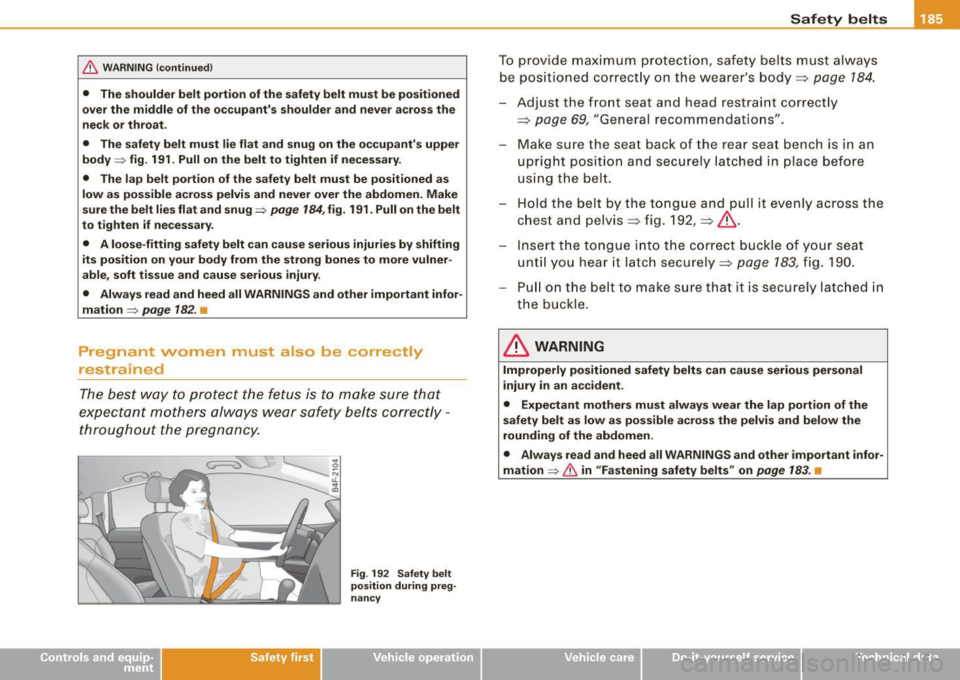
Pregnant women must also be correctly
restrained
The best way to protect the fetus is to make sure that
expectant mothers always wear safety belts correctly -
throughout the pregnancy.
Safety first
Fig. 192 Safety belt
position during preg
nancy
Safety belts
To provide maximum protection, safety belts must always
be positioned correctly on the wearer's body~
page 7 84.
-Adjust the front seat and head restrain t correctly
~ page 69, "General recommendations".
- Make sure the seat back of the rear seat bench is in an
upright position and securely latched in place before
using the belt.
- Hold the belt by the tongue and pull it evenly across the
chest and pelvis~ fig. 192,
~ &.
- Insert the tongue into the correct buckle of your seat
until you hear it latch securely~
page 183, fig. 190.
- Pull on the belt to make sure that it is securely latched in
the buckle.
& WARNING
Improperly positioned safety belts can cause serious personal
injury in an accident.
• Expectant mothers must always wear the lap portion of the
safety belt as low as possible across the pelvis and below the
rounding of the abdomen.
• Always read and heed all WARNINGS and other important infor
mation
=> & in "Fastening safety belts" on page 183. •
Vehicle care I I irechnical data
Page 225 of 360

Child Safety -
--------------------''----
& WARNING (continued )
• If you must install a booster seat on the front passenger seat
because of exceptional c ircumstances the PASSENGER AIR BAG
OFF light must come on and stay on , whenever the ignition is
switched on.
• If the PASSENGER AIR BAG OFF light does not come on and stay
on , perform the checks described
=> page 199 , "Monitoring the
Advanced A irbag System ".
• Take the ch ild restraint off the front passenger seat and install
it properly at one of the rear seat positions if the PASSENGER AIR
BAG OFF light does not stay on wheneve r the ignition is switched
on .
• Always read and heed all WARNINGS whenever using a child
restrained in a vehicle is being used=>
page 179, "Safety belts",
=> page 188, "Airbag system " and => page 213 , "Important things
to know ".•
Installing a child safety seat
Securing a child safety seat using a safety
belt
S a fety belt s fo r the rear seats and the front passen ger 's
sea t can be l ocked with t he convert ib le lock ing retra cto r
t o prope rly s ecure child saf ety s ea ts .
The s afe ty bel ts e merge ncy lo cking re trac to rs fo r th e rea r sea ts
safety belts and for the front pass enger's seat safety belt have a
c o nve rtible loc king re tr ac tor fo r child r estrai nts. The sa fe ty b elt
must be loc ked so that be lt webbin g cannot unr eel. The re trac tor
c an be activa te d to lock the safety be lt and prevent the safet y belt
w ebbi ng fr om l oos en ing up dur in g n orm al dr ivi ng . A chi ld sa fety
seat can only be properly insta lled when t he safety be lt is locked so
th at th e child and chil d sa fet y seat will sta y in p lace .
Controls and equip ment Safety first Vehicle operation A
lways remember: Even though your vehic le is equipped with an
A dva nce d Airb ag sys tem, all chi ld re n, e sp ec ially those 12 yea rs a nd
youn ger, should a lways ride in the back seat prop erly restrained for
t hei r age and weigh t.
& WARNING
Improperly installed child safety seats increase the risk of serious
personal injury and death in a collision .
• Always make sure that the safety belt retractor is locked when
installing a child safety seat . An unlocked safety belt retractor
cannot hold the child safety seat in place during normal driving or
in a crash .
• Always buckle the child safety seat firmly in place even if a
child is not sitting in it . A loose child safety seat can fly around
during a sudden stop or in a collision .
• Always make sure that the rear seat backrest to which the
center rear safety belt is attached is securely latched whenever
the rear center safety belt is being used to secure a child restraint.
• If the backrest is not securely latched , the child and the child
restraint will be thrown forward together with the backrest and
will strike parts of the vehicle interior. The child can be seriously injured or killed.
• Never install rearward -facing child safety seats or infant
carriers on the front passenger seat . A child will be seriously
injured and can be killed when the passenger airbag inflates.
• The inflating airbag will hit the child safety seat or infant
carrier with great force and will smash the child safety seat and
child against the backrest , center armrest , door or roof .
• Always install rearward -facing child safety seats or infant
c arriers on the rear seat .
• Forward-facing child safety seats or infant carriers installed on
the front passenger's seat may interfere with the deployment of
the airbag and cause serious injury to the child . ..
Vehicle care Do-it-yourself service Technical data
Page 227 of 360

Child Safety -
--------------------''---
& WARNING (continued)
• Make sure that the PASSENGER AIR BAG OFF light comes on
and stays on all the time whenever the ignition is switched on.
• If the PASSENGER AIR BAG OFF light does not come on and stay
on, immediately install the rearward-facing child safety seat in a
rear seating position and have the airbag system inspected by
your authorized Audi dealer. •
Activating the convertible locking retractor
Use the convertible locking retractor to secure a child
restraint.
Always heed the child safety seat manufacturer 's instruc
tions when installing a child restraint in your vehicle. To
activate the convertible locking retractor:
- Place the child restraint on a seat, preferably on the rear
seat.
- Slowly pull the belt
all the way out.
- Route it around or through the child restraint belt path
=>& .
- Push the child safety seat down with your full weight to
get the safety belt really tight .
- Insert the belt tongue into the buckle for that seating
position.
- Gu ide the safety belt back into the retractor until the belt
lies flat and snug on the child safety seat.
Controls and equip
ment Safety first Vehicle operation
- You should
hear a "clicking" noise as the belt winds back
into the inertia reel. Test the convertible locking retractor
by pul ling on the belt. You should no longer be able to
pull the belt out of the retractor. The convertible locking
retractor is now activated .
- Make sure that the red release button is facing away from
the child restraint so that it can be unbuckled quickly.
- Pull on the belt to make sure the safety belt is properly
tight and fastened so that the seat cannot move forward
or sideways more than one inch (2.5 cm).
& WARNING
Using the wrong child restraint or an improperly installed child
restraint can cause serious personal injury or death in a crash.
• Always make sure that the safety belt retractor is locked when
installing a child safety seat. An unlocked safety belt retractor
cannot hold the child safety seat in place during normal driving or
in a crash.
• Always buckle the child safety seat firmly in place even if a
child is not sitting in it. A loose child safety seat can fly around
during a sudden stop or in a crash.
• Always make sure the seat backrest to which the child restraint
is installed is in an upright position and securely latched into place
and cannot fold forward. Otherwise, the seat back with the child
safety seat attached to it could fly forward in the event of an acci
dent or other emergency situation.
• Always read and heed all WARNINGS whenever using a child
restrained in a vehicle is being used=>
page 213. Special precau
tions apply when installing a child safety seat on the front
passenger seat=>
page 190, "Child restraints on the front seat -
some important things to know". •
Vehicle care Do-it-yourself service Technical data
Page 229 of 360

_____________________________________________ C_ h _ il_d _S_ a _ fe_t---= y'----"'
LATCH Lovver anchorages and tether
for children
Child Restraint System anchors and how are
they related to child safety
T o pr ovide a simpler and more practicable way to attach the child
r es traint o n the vehicle sea t, Fe deral reg ulati ons requ ire spec ial
lower anchorages in vehicles and devices on new chi ld restraints to
at tach to the veh icle an ch orag es.
T he combin ation of the tether anchora ges and the lower anchor
age s is now generally ca lled the
LATCH system fo r "L owe r Anchor
ages and Tethers for Children."
F orward -facing ch ild restraints manufactured after September 1,
1 999, ar e re qu ired by U. S. fe der al r eg ulatio ns to comp ly with new
child head movem ent performance requirements. Thes e new
pe rf ormanc e re qu ireme nts m ake a tethe r nec essa ry on mo st new
child seats.
I nsta lling a chi ld rest raint that require s a top tethe r without one can
se rious ly im pa ir the pe rf or mance o f th e ch ild rest raint a nd i ts ab ility
to protect t he child in a co llision . Instal ling a child restraint that
r e quir es a t op tet her with ou t th e to p te th er m ay be a v io la tio n of
state law.
Ch ild r estrain t ma nufact urer s offer LA TCH lo wer anc horages on
their child seats with hook -on or push -on connectors attached to
adjustab le strap s.
I n addition to the L ATCH lowe r anc horages, th ese c hild restra int
systems usually require the use of tether straps to he lp keep the
c hi ld restrai nt fi rm ly in place.
_& WARNING
Improper installation of child restraints will increase the risk of
injury and death in a crash .
Controls and equip ment Safety first Vehicle operation
& WARNING
(continued )
• Always follow the instructions provided by the manufacturer of
the child restraint you intend to install in your vehicle .
• Never install a child restraint without a properly attached top
tether strap if the child restraint manufacture r's instructions
require the top tether strap to be used .
• Improper use of child restraint LATCH lower anchorage points
can lead to injury in a collision. The LATCH lower anchorage points
are designed to withstand only those loads imposed by correctly
fitted child restraints .
• Never mount two child restraint systems on one LATCH lower
anchorage point.
• Never secure or attach any luggage or other item to the LATCH
lower anchorages.
rn Tips
I n Canad a, th e ter ms "to p t eth er" wi th "lowe r uni versa l an chorages"
(or "lower universal anchorage bars") are used to d escribe the
sys te m.
• I n other countries, the term "ISOFIX" is used to describe the
lo we r anc horages . •
Vehicle care Do-it-yourself service Technical data