brake fluid AUDI A5 COUPE 2010 User Guide
[x] Cancel search | Manufacturer: AUDI, Model Year: 2010, Model line: A5 COUPE, Model: AUDI A5 COUPE 2010Pages: 360, PDF Size: 84.39 MB
Page 274 of 360
-Checking and filling
---=---------------
& W
ARNING (continued )
-First, fully apply the park ing brake, move selector lever of
automatic transmission to "P " (Park ); put manual transmission
in Neutral.
- Alway s use extreme c aution to prevent clothing , jewel ry , or
long hair from gettin g caught in the radiator fan , V-belts or
other moving parts , or from contacting hot parts. Tie back hair
before starting , and do not wear clothing that will hang or
droop into the engine .
• Minimize exposure to emission and chemi cal hazard s
=> &.
& WARNING
Californ ia Proposition 65 Warning :
• Engine exhaust , some of its constituents , and certa in vehicle
component s contain or emit chemicals known to the State of Cali
fornia to cause cancer and birth defe cts and reproductive h arm . In
addition, certain fluid s contained in vehicles and certain products
of component wear contain or emit chem icals known to the State
of California to cause cancer and birth defects or other reproduc
tive harm.
• Battery posts , terminals and related ac cessories contain lead
and lead compounds , chem icals known to the State of California
to cause cancer and reproductive harms. Wash hand s after
handling .
0 Note
When adding fluids, always make sure that the y are poured into the
proper container or filler opening, otherwise serious damage to
vehicle systems will occur .
<£' For the sake of the environment
To detect leaks in t ime, inspect th e ve hicle floor pan from unde r
neath regularly. If you see spots from oil or other vehic le fluids, have
you r ve hicle i nsp ected by a n authori zed Audi dealer .•
Engine compartment
Engine compartment
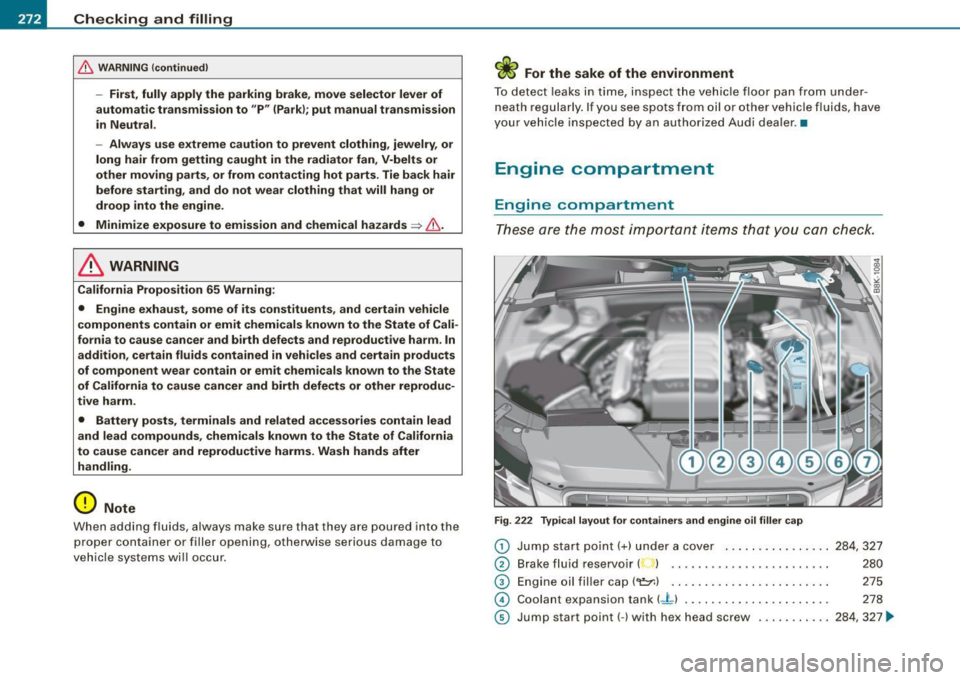
Thes e are the most impor tant items tha t yo u can check .
Fig. 22 2 Typic al l ayout for containe rs and engine oil filler cap
G) Jump start poin t(+ ) under a cover ..... .... .... ... 28 4, 327
® Brake fluid reservoir I l . . . . . . . . . . . . . . . . . . . . . . . . 280
© E ngine oil fi ller cap ("1:::r.l . . . . . . . . . . . . . . . . . . . . . . . . 275
0 Coolant expansion tank (-L l . . . . . . . . . . . . . . . . . . . . . . 278
© Jump sta rt point( -) with hex head screw ........ ... 28 4, 327 ~
Page 282 of 360

•---=C:.:h..:. e=-= c..:.k :..:.in :..:.:= g:.....= a..:.n :.:d::....:. f.:.:il .:.:li ..:.n :..::g~ --------------------------------------------
0 Not e
• Coolant pollutes the environment and cou ld cause an engine
fire. Excess coolant will be forced out through the pressure relief
valve in the cap when the engine becomes hot.
• If, in an emergency, only water can be added, the correct ratio
between water and antifreeze ~
page 277 must be restored as soon
as possible .
ci> For the sake of the environment
Dra ined coolant should not be reused . Always dispose of used
coolant whi le observing all environmental regulations. •
Radiator fan
The radiator fan switches on automatically by itself.
The rad iator fan is driven by the eng ine v ia the V-be lt . The v iscous
clutch regulates the speed of the fan according to the tempera ture
of the coo lant .
An auxiliary electric radiator fan * swi tches on and off depending on
coo lant temperature and other vehicle operating conditions.
After you switch the engine off, the auxiliary fan can continue running for up to 10 minut es -even with th e igni tion o ff. It can even
switch o n again later by itself~ & , if
• the temperature of the engine coo lant rises due to the heat
bui ld -up from the engine in the engine compartment, o r
• the engine compartment heats up because the vehic le is parked
in intense sun light.
& WARNING
• To reduce the ri sk of per sonal injury never tou ch the radiator
f a n.
& W AR N ING (continu ed )
• The auxiliary e le ctri c fan i s temperature controlled and can
s w itch on suddenly even when the engine is not running .
• The auxiliary radiator fan swit ches on automatically when the
engine coolant reache s a ce rtain temperature and will con tinue to
run until the coolant t emperatur e drop s. •
Brake fluid
Checking brake fluid level
Th e brake fluid level c an be checked with a quick glance.
Fig . 22 6 En gin e
co mp art m ent : B ra ke
fl uid re servoir
Befo re yo u c heck anything in th e en gin e compar tme nt,
always read and heed all WARNINGS~ & in "Working in
the eng ine compartment" on
page 271 .
Read the brake fl uid level from the bra ke fluid reservoir
~ fig . 226. T he b rake fluid leve l must be betwee n the
" M IN " and "MAX" markings.
The brake fluid reservoir is located at the rear partition of the engine
compartment on the left side~
page 272 . .,_
Page 283 of 360
_____________________________________________ C_h_ e_ c_k _in ~ g_ a_n _d_ f_il _li _n ~g __ _
•
The fluid level may drop slightly after some time due to the auto
m atic adjustment of the brake pads. This is not cause for alarm .
If the brake fluid level fal ls
considerably below the "MIN" mark , the
brake warning/indicator light (U.S. models :
BRAKE, Canadian models:
{(j))) will come on=> page 16 and => page 29. Do not continue to
operate the vehic le. The complete brake system should be thor
oughly checked by an author ized Audi dealer or qualified workshop
and the cause corrected . If the brake fluid level is too low, the brak e
warning/ind ica tor light will illuminate. Contact an authorized Audi
dea ler
immediatel y.
[ i J Tip s
The brake fluid reservoir is located underneath the cover. •
Changing brake fluid
Have the brake fluid changed by an experienced techni
cian.
Brake fluid absorbs moisture from the air . If th e water content in the
brake fluid is too h igh, corrosion in the brake system may result
after a period of time. The boi ling point of the brake fluid will also
decrease considerably and decrease braking performance .
Therefore , the brake fluid must be changed
ev ery tw o ye ars. Always
use new brake fluid which conforms to Federa l Motor Veh ic le Stan
dard "FMVSS 116 DOT 4".
T he brake fluid res ervoir can b e difficul t to reach, therefore, we
recommend that you have the brake fluid changed by your autho
rized
Audi de ale r. Your dealer has the correct tools, the right brake
fluid and the know -how to do this fo r you .
& WARNING
• Brake f luid i s poi sonou s. It mu st b e stored on ly in the clo sed
o riginal cont aine r out of the r eac h of childr en!
& WARN ING (c ontinued )
• Brake f ailur e can re sult fr om old or inappropriate bra ke fluid .
Ob se rve these p recauti ons:
- Use on ly brake fl uid that meet s SAE specification
J 17 03 and
c on fo rm s to Feder al Mot or Vehicle Sta ndard 11 6. Always c heck
with your authorized Audi de ale r to m ake sur e you are u sing
th e c orre ct b rake flu id . T he cor re ct t ype of br ake fluid is als o
indi cated on the brake fluid r eservoir.
- The br ake f luid mu st be ne w. H eavy u se of the b rake s can
c au se a vapor lock if the brake fluid i s left in the system to o
long. Thi s c an seriou sly affe ct the effi ciency of the brake s as
well as your safety . This could re sult in an a ccid ent .
0 Note
Brake fluid will damage the paint of your vehicle .
ffi For the sake of the environment
Because of the problem of proper disposal of brake fluid as well as
the special too ls required and the necessary expertise, we recom
mend that you have the brake fluid changed by your authorized Audi
dea ler .•
Battery
General information
Under normal operat ing conditions, the battery in your Audi does
not need any maintenance. With
high outside temperatures or long
daily drives we recommend that you have the electrolyte level
checked by an authorized Audi dealer or qualified workshop. The
e lectrolyte level should a lso be checked each time the battery is
charged
=> page 284 . ~
Vehicle care I t •
Page 300 of 360
-~_T_ ir_e_ s_ a_ n_d _ w_ h_ e_e _l_s _________________________________________________ _
Tire pr essure
Inco rrect tire pressure causes prematu re wear and can cau se
sudden tire blow-out. For this reason, tire pressure must be checked
at least once a month
~ page 293 .
Driving style
Dr iv ing fa st around curves, heavy acceleration and hard brak ing
increase tire wear.
Rotating tire s for more even wear
For all four t ires on your vehic le to have the same service life, we
recommend that the front and rea r tires are rotat ed acc ord ing to the
tire manufacturer 's suggested tire rotation intervals. Please
remembe r the f ollo wi ng :
• Tire rotat ion i nterva ls m ay d iffer from the vehic le serv ice inte r
vals outl ined in your Maintenance and Warranty Book let.
• The longer one tire is used in one location on the vehicle, t he
more it wears at certain points; the refo re, we recommend that you
f ollow the tire manu facturer's sug ges ted t ire rotat ion i nte rvals.
• Vehicles with fro nt-w hee l dr ive e xper ience more tread wear on
the front wheels compared to all -wheel drive (quattro®l .
• Please rotate tires as sh ow n~
page 297, fig. 232 .
• Extra care must be taken when rotating direction -specific tires
~ pag e 318 .
Wheel balancing
T he w heels o n new v ehic les are balanced. However, various s itua
tions during everyday driving can cause them to become unba l
anc ed, resu lti ng in vib rati ons yo u ca n usually feel thro ugh t he
steer ing whee l.
U nba la nce d w heels must be re ba lance d to avoid excessive wea r on
steering, suspension and tires. A whee l must a lso be reba lanced
when a new tire is installed.
Incorrect wheel alignment
Incorrect w hee l al ig nm ent ca n cause e xcess ive ti re wea r, impa iring
t h e s afety of th e veh ic le. If t ires show excessive wear, have the
w hee l a lig nme nt checke d by a n autho rize d Aud i deale r or qualifie d
wo rkshop.
All wheel drive
Vehic les with quattro® must always have tires of the same size,
co nstruct ion an d tread ty pe. For deta ils see ~
page 240.
& WARNING
Sudden tire failure can lead to loss of control , a crash and serious
personal injury !
• Never drive a vehicle when the tread on any tire is worn down
to the wear indicators.
• Worn tires are a safety hazard , they do not grip well on wet
roads and in crease your risk of "hydroplaning " and loss of control.
• Always keep chemicals that can cause tire damage , such as
grease, oil, gasoline and brake fluid away from tires .
• Tires age even if they are not being used and can fail suddenly ,
especially at high speeds. Tires that are more than 6 years old can
only be used in an emergency and then with special care and at
lower speeds .
• Never mount used tires on your vehicle if you are not sure of
their "previous history. " Old used tires may have been damaged
even though the damage cannot be seen that can lead to sudden
tire failure and loss of vehicle control . •
Page 343 of 360
__________________________________________________ C_o_ n _ s_u_ m_ e ___ r_l_ n _f_ o_ r _m...:....:.. a:.;..:. ti .... o:.. n ........ _lllllll
& WA RNIN G (continu ed )
• The engine compartment of any motor vehi cle i s a potentially
h az ardou s area. N ev er re ach into the are a arou nd or to uch the
r a di ator fan . It is temperature co ntrolled and can swi tc h o n
s uddenly -even wh en the engine i s off and the ignition key h as
been removed . The r adiator f an switches on autom atic all y w hen
the coolant reache s a certain temperature and will continue to run
until the coo lant t emper ature drop s.
• Alway s remov e th e ignition key befo re anyone get s under the
v ehi cle .
• Alway s s upport your vehi cle with safety sta nd s if it i s ne ces
sa ry to wor k unde rne ath the veh icle . The ja ck suppl ied with the
v ehic le i s not adequ ate for thi s purpo se and could coll ap se
c au sin g s eriou s per son al in jury .
• If you m ust w ork under neath the vehi cle with the wheel s on
the ground , alwa ys m ake sure the veh icle i s on l eve l ground , that
the wheels ar e always securely blocked and that the engine
ca nn ot be sta rted .
• Alway s mak e sure the tran sm iss ion selecto r leve r (automatic
tr ansmi ssion ) is in "P " (Park po sition ) or Neutr al (manu al tr ansmi s
s ion ) and th e park br ake i s firmly applied.
c£> For the sake of the environment
• Changing the engine settings w ill adverse ly affect emission
levels . This is detrimenta l to the environment and increases fuel
consumption.
• Always observe environmenta l regu lations when disposing of
old engine oil, used brake fluid, dirty engine coolant, spent batteries
or worn out tires.
• Undeployed airbag modules and pretens ioners might be classi
fied as Perchlorate Material -specia l handling may apply, see
www .dtsc .ca .gov/hazardouswaste/perchlorate. When the vehicle or
parts of the restraint system including airbag modules safety belts
with pretens ioners are scrapped, all applicable laws and regu la-
Controls and equip
ment Safety first Vehicle operation
tions must be observed. Your authorized Audi dealer is familiar with
these requirements and we rec
ommend that you have your dea ler
perform this service for you .•
Additional accessories ,
modifications and parts replacement
Addition al a ccessori es and parts
replacement
Always c onsul t an authorized Audi dealer before
purchasing accessories.
Your vehicle incorporates the latest safety design features ensuring a high standard of act ive and passive safe ty .
This safety could be compromised by non -approved changes to the
vehic le . F or this reason, if par ts have to be replaced, please observe
the following points when insta lling additiona l accessories:
Approved Audi accessories and genuine Audi parts are avai lable
from authorized Audi dealers.
These dealers also have the necessary facilities, tools and trained specialis ts to install the parts and accessories prope rly.
& WARNING
Using the wrong spare part s or u sing non-approved acce ssorie s
c an cause d am age to the vehi cle and seriou s pe rsonal injur y.
• Use onl y acc essorie s ex pres sly approved by Audi and g enuine
Audi spare p art s
• The se p art s and acce ssorie s have been spe cia lly de signed to
be used on you r vehi cle .
• Nev er in stall acc ess orie s s uch a s telep hone cra d le s or
be ver age holder s on airb ag cover s or within th e airbag deploy-
Vehicle care Do-it-yourself service Tec hn ica l da ta
Page 346 of 360
llffl __ A_l.:,. p _h_ a_ b_e _t _ic _ a_l _in _ d_e _x ____________________________________________ _
A Additives Side airbags ....... .... .... ...... 207
Engine oil 275 Side curtain airbags ....... .... ... 210
A/C mode ...... ...... .... ....... 95, 102 Adjusting Weight-sensing mat ..... .. .... ... 214
Accessories . . . . . . . . . . . . . . . . . . . . . . . . 341
Adaptive cruise control . . . . . . . . . . . . . . 118
Changing speed .. .... .... .... ... 121
Driver information .... .... ....... 124
Driver intervention prompt ..... ... 128
Driving in traffic .. .... .... ..... .. 119
Driving program .... .. ...... ..... 129
Error messages . . . . . . . . . . . . . . . . . . 127
Open road ..... .. .... .... ...... . 119
Override . . . . . . . . . . . . . . . . . . . . . . . . 119
Request for driver to assume control 119
Save speed . . . . . . . . . . . . . . . . . . . . . . 121
Setting distance . . . . . . . . . . . . . . . . . 123
Setting time interval .. .. .. .... .... 123
Settings .......... .... .......... 129
Special driving situations . ....... . 130
Status messages . . . . . . . . . . . . . . . . . 127
Switching on and off .. ... .... .... 120
System limits .. .... ...... ........ 130
Temporarily turning off .. ... ...... 122
Warning/indicator lights .......... 125
Adaptive dampers .. ...... .... .... .. 144
Adaptive light . . . . . . . . . . . . . . . . . . . . . . . 57
defective . . . . . . . . . . . . . . . . . . . . . . . . 36
Adding Engine coolant ... .... .... ....... 279
Engine oil ....................... 275
Windshield washer fluid .... .. .... 286
Additiona l accessories ............... 341 Steering column manually
......... 107 When
must the system be inspected? ...
Adjusting front seats .......... .... ... 69 199
Airbag All wheel drive
................ .... .. 240
Warning/indicator lights ... .... .... 14 Alloy wheels .
..... .. ........ .... ... 258
Airbag system .... ..... ... .... .. 188, 208 All-wheel drive
Advanced Airbag System .......... 192 Winter
tires 304
Advanced Airbag System components .. A
lternator
195 Malfunction
.. .. .. .... .... .... .... 29
Care .................. .... .... .. 202
Anti-freeze
Child restraints .................. 215
See Engine coolant system ...... .. 277
Children .. .... ...... ..... .... ... 214
Anti-glare inside day-night mirror . ..... 64
Components (front airbags) .. ... ... 195
Danger of fitting a child safety seat on the
front passenger seat . . . . . . . . . . . . 190
Disposal ... .. .... ...... .... ... .. 202 Anti
-lock brake system
How the ABS system works ... .. ... 238
Warning/indicator lights ... .. .... .. . 15
Anti-Slip Regulation System !ASR)
Front airbags .. ... ........... 192, 193 h k
How t e system wor s
How do the front airbags work? . . . . 197 236
How many airbags does my vehicle have? 195
How the Advanced Airbag System compo
nents work together . . . . . . . . . . . . . 196
Important safety instructions on the knee airbag system .... .... .... .... .. 206
Important things to know ... .... .. 188
Indicator light ... .. ........ ...... 199
Knee airbags .. ........... .... ... 204
Monitoring . . . . . . . . . . . . . . . . . . . . . . 199
PASSENGER AIR BAG OFF light ... .. 200
Repairs ..... .. ... ... .. .... ...... 202
Safety instructions ............... 201 Anti-theft systems
Electronic immobilizer ............. 41
Ashtray ...... .... .... ............... 87
ASR How the Anti-Slip Regu lation System
works ... ........ .... ... .... ... 236
Asterisk What does it mean when something is
marked with an asterisk? ........... 5
Audi braking guard .................. 132
Error messages .. ...... ...... .... 134
Settings ........................ 133
Page 347 of 360

______________________________________________ A_ l_,_ p _h_ a_ b_e _t_ic _ a _ l _in _ d_e _ x __ _
Status messages . . . . . . . . . . . . . . . . . 134
Switching on and off .. .... ...... .. 133
Audi drive se lect .. ...... .... ........ 144
Adaptive dampers .. ...... .... .... 144
Description ... ... .... .... ...... .. 144
Dynamic st eering .. ....... ...... .. 144
Se tting th e driving mode . ...... ... 145
Audi Service Repair Manuals and Literature
339
Auto Lock .......... ................. 42
Auto Safety Hotline ... ... ... .... .... . 177
Auto-Ch eck Contro l .... ... .. .... .... .. 27
Automatic belt retractor .......... .... 183
Automatic car wash
See Washing .. .... .... ... .... .... 253
Automatic climate control A/C mod e ..... .. .... .... ...... ... 95
Au tomatic climate control plus ....... .. 96
A/C mode . . . . . . . . . . . . . . . . . . . . . . . 102
See also Deluxe automatic climate control
plus ...... .. ..... ... ..... .. ..... 96
Automatic c limate control system ...... 90
See also Deluxe automatic climate
control ... .. .... .... ..... ...... . 90
Automatic driving light control ..... .. .. 53
Automatic Shift Lock (ASU .. ..... .... 150
Automatic transmission ...... ...... .. 147
6-speed automatic transmission . ... 147
Automatic Shift Lock (ASU ... . ..... 150
Driving .. .. .. ...... .......... ... 148
Dynamic shift program . ...... ... .. 151
Emergency release . . . . . . . . . . . . . . . 154
Fail -safe mode . ...... .... .. . ..... 153
Controls and equip
ment Safety first
Kick-down
.... ..... .. ..... .. . .... 151
Manual shif t program . ...... ...... 152
Selector lever ...... ........ .... .. 149
Shift buttons . ...... .... ... .. ... . 153
Steering wheel with tiptronic ....... 153
Automatic wip e/wash system ...... ... . 61
Average speed ........... .... .... .... 23
Avoid damaging the vehicle ........... 244
B
Battery . .... .... ...... ....... .... .. 281
Battery location inside the luggage
compartment .. . .. .. .... .... .... 282
Charging ............. .... ... .... 284
Important warnings when working on the
battery ..... .. .. .... .... .... ... 282
Jump starting ............. ... .... 326
Low ... .. .... .. . .. ... ....... .... 241
Replacing the battery ......... .... 285
State of charge . .............. .... 241
W inter operat ion . .... .... .... .... 281
Working on th e battery ...... .... .. 282
Battery voltage ..... ....... .... .... .. 35
Before driving ... ..... .. ... ... .. .... 169
Blended gasoline ... . .. ... ....... .... 265
Body cavity sealing ...... ...... ... .. . 258
Boost er seats .... .... .... ...... ... .. 221
Brake assist ..... .... .... .... .... ... 239
Brake booster .... .. .. ... ..... .. . .... 238
Brake fluid Changing the brake fluid .. .... .... 281
Checking the brake fluid level .. .... 280 Reservoir
.. .... .. .. ... .... .... ... 280
What is the correct brake fluid level? 280
What should I do if the brake fluid warning
light comes on? ..... .... .... .. . . 280
Brake system .... ... .... .... .... .... 280
Anti-lock brake system ............. 15
Brake fluid . ........... .... ....... 280
Brake fluid specifications for refill and
replacement . .... .... .... ...... . 281
Brake light defec tive ... ...... ... .. . 35
Brake pads ..... .. ...... ....... .. 244
Electromechanical parking brake .... 112
General information ...... .... ... . 237
How does moisture or road salt affect the
brak es? . ...... .. ...... .... .... . 237
Malfunc tion ... .. .. .. .... .... ..... 29
Warning/indicator lights .... ...... .. 16
Worn brake pads symbol .. ... .... .. 34
Braking guard
See Audi braking guard .... .... ... . 132
Break -in period ...... .... .. .. .... ... 243
Brake pads ... .... .... ........... 244
Tires ... ..................... .. .. 243
Bulbs .... .... ... ... ... .. ...... .... . 324
C
California Proposition 65 Warning ... .. 272
Battery specific ... .... .... .... ... . 283
Capaciti es .. ... .... .... .... .... ..... 337
Car care ... . .... .. .. .... .... .... .. . . 252
Inter ior .... ... .... .... ...... ..... 259
P lastic and vinyl ....... ......... .. 256
Weatherstrips ... .. .... .. . .... ... . 257
Vehicle operation Vehicle care Do-it-yourself service Technical data
Page 350 of 360

ffl Alphabetical index ----=------...:..:...::... ___________________________ _
Electronic immobilizer .... ...... ... 11, 41
Electronic power contro l
(EPC) warning/indicator light .. .... .. 13
Electronic stabilization program (ESP) How the system works . . . . . . . . . . . . 234
Warni ng/indicator lights ........... 13
Emergency braking .... ..... .. ...... 114
Emergency flasher . . . . . . . . . . . . . . . . . . . 57
Warning/indicator lights ........... 14
Emergency key . . . . . . . . . . . . . . . . . . . . . . 38
Starting engine .... ....... ........ 41
Emergency locking of the doors ........ 47
Emergency release Selector lever . . . . . . . . . . . . . . . . . . . . 154
E . mergency starting . . . . . . . . . . . . . . . . . 326
Emergency towing .................. 329
Emergency un locking
Ignition key ...... .... .... .... .... 40
Energy management ...... ... ... .... 241
Battery power . . . . . . . . . . . . . . . . . . . 242
Driver notification . . . . . . . . . . . . . . . . 242
Engine Compartmen t ........ ...... . .. .. 272
Coolant .. .... ..... ... ... .... .... 277
Hood ...... ........... ....... ... 270
Starting .................. ...... 108
Starting with jumper cables ....... 326
Stopping ....................... 109
Engine compartment Safety instructions . . . . . . . . . . . . . . . 271
Working the engine compartment .. 271
E . I ngme coo ant system .... ... ... .. ... 277
Adding coolant ... .... ...... ..... 279
Checking coo lant level .. .... .... .. 278
Check ing the engine coolant level .. 278
Malfunction ......... .... ......... 30
Radiator fan ...... .... .... .... ... 280
Engine coolant temper.ature
Temperature gauge ...... .... ..... . 8
Engine data .. ................ ...... 337
Engine hood Closing .. .... .... ... .. .... ...... 271
How to release the hood . . . . . . . . . . 270
Engine oil .......................... 273
Adding ......................... 275
Additives .. ....... .... ...... .... 275
Changing . .... .... .... .... .... .. 276
Check oil level ............. ...... 275
Consumption ... .. ............ ... 275
Oil consumption ................. 274
Oil grades ... .. ...... .... ... .. ... 273
Specification and viscosity ...... .. 273
Engine oil level ...................... 36
Engine oil pressure Malfunction .. .... ....... ......... 31
Engine oil sensor defective ............ 36
Engine speed limitation ............... 36
Environment Break -in period .... ........ ...... 243
Catalytic converter ........ ....... 244
Disposing of your vehicle battery ... 285
Driving at high speeds .... ... .. ... 246
Driving to minimize pollution and noise 245 Fuel ..
...... ... .. . ... .... .... ... 267
Fuel economy ... ....... .... ...... 245
Leaks under your vehicle ....... ... 271
Letting the vehicle stand and warm up ..
246
Proper disposal of drained brake fluid
281
Proper disposal of drained engine coolant ... .. ...... ... .. ... .... . 279
Proper disposal of drained engine oil ....
275 ,276
Recycling used engine oi l ...... ... 275
Unleaded fuel ........ .... .... ... 265
What should I do with an old battery?
285
Environmental note Rear window defogger .. ....... 95, 102
Roof rack ... ... .. .. .. .... .... .... 85
EPC See Electronic power control .... .... 13
ESP See Electronic stabi lization program
(ES P) ... ......... ... ............ 13
Event Data Recorder (EDR) ............ 234
Expansion tank ..................... 278
Eyeglasses compartment .............. 89
F
Fan
Deluxe automatic c limate control .... 93
Deluxe automatic climate control plus ...
100
Radiator ........ ... .. .... .... ... 280