brakes AUDI A5 COUPE 2010 User Guide
[x] Cancel search | Manufacturer: AUDI, Model Year: 2010, Model line: A5 COUPE, Model: AUDI A5 COUPE 2010Pages: 360, PDF Size: 84.39 MB
Page 132 of 360

• ..__A_ d_ a-'- p_t _iv _ e_ c_r _u _ i_s _e _ c_o_ n_t _r _o _l _____________________________________________ _
System limitations
Applies to veh icles: wi th a dapt ive cruise contro l
General information
Some driving situations which affect the function of the
radar sensor are described below.
When driving, the adaptive cruise con tro l is g overned by physical
and system -specified limits . Also, under certain circumstances, the
ACC system may react unexpectedly or late from the driver's point
of view. Therefore, always be attentive and intervene, if necessary:
• when driv ing around curves =>
page 130
• when vehicles in front are not in line with your vehicle
=>
page 131
• when other vehic les are changing lanes=> page 131
• when o ther vehicles a re di fficu lt to detec t=> pag e 131.
& WARNING
The radar sensor's vision can be reduced by rain, snow and heavy
spray . Th is can result in vehicles driv ing ahead being in adequate ly
detected or, in some circumstances, not detected at all. If ne ces
sary , take a ction yourself! •
Applies to vehi cles : w it h ad aptive crui se co ntrol
When driving around curves
k::;== ========= =,!
~
[J
Entering a curve
Fig. 13 5 Ve hicle
en teri ng a curv e
Fig . 13 6 Vehicle
le aving a curv e
When entering a curve , the adapt ive cruise control may react to a
vehicle in the next lane and apply the brakes in your vehicle
=> fig. 135. The braki ng act ion can be overridde n by depressing t he
acce lerator pedal.
Lea ving a curve
At the exit from very long curves the predictive lane reading can
cause the adaptive cru ise control to react to another vehicle in the
next lane and apply the brakes in your ve hicle => fig . 136. The
braking actio n can be overr idden by dep ressing the acce lerator
p edal. •
Page 134 of 360

-Adaptive
cruise contro l "----'-----------------
Fig. 141 Sheering o ut
and stationary vehicle
If a vehicle that has been detected by the ACC system turns off or
sheers out, and there is a stationary vehicle ahead of that vehicle,
the ACC system does not respond to the stationary vehicle
~ page 131, fig. 140 and~ fig. 141. •
Audi braking guard
Applies to vehicl es: wi th a dapt ive c ruise co ntrol
Description
Audi braking guard warns you of a threatening collision
with a vehicle ahead .
Fig. 142 Display in the
instrument cluster
The Audi braking guard is active from a speed of approx. 20 mph
(30 km /h) and works within the system limits~
page 130even when
the adaptive cruise control is deactivated .
A radar sensor is built into the front of the vehicle~
page 118,
fig. 122. The system is intended to measure the distance to reflec
tive surfaces. If a measurement is not possible, the system does not
respond.
When the measurement has taken place, the system can assess a hazardous situation, when a vehicle ahead suddenly brakes or when
your own vehicle is driving at high speed towards a much slower
vehicle ahead. As soon as the system assumes that a possible colli
sion with the vehicle ahead can only be avo ided by immediate all
out braking or by an avoiding maneuver, a warning appears.
The system has a pre-set response time to be able to warn in good
time. This system response time is automatically reduced if you acce lerate actively, for example to join a highway. Braking, trans
verse acceleration and the steering angle can lead to a reduced
system response time. The warning is deactivated if you begin to
overtake with full acceleration .
The system draws your attention to two different hazardous situa
tions:
Distance
The distance warning is issued in the event of inadequate distance
to the vehicle ahead a period of more than 5 seconds . If the distance
is less than 30 feet (9 meters) at 50 mph (80 km/h), for example, an
optical display is faded in on the instrument cluster~ fig. 142.
If the vehicle ahead brakes sharply, a collision cannot be avoided,
even in the case of an immediate response. In this case , increase the
distance to the vehicle ahead.
Speed
If there is a much slower vehicle ahead in your lane, or if the vehicle
ahead brakes sharply, the Audi braking guard calculates the point
from which a collision can only be avoided by all -out braking or by
~
Page 152 of 360
• ..__T_ r_a _n_ s_ m_ is_ s_i o _ n ______________________________________________________ _
Before you move the selector lever to R, press both the button in the
handle of the selector lever
and the brake pedal at the same time .
When the ignition is on , the backup lights illumina te when the
selector lever is moved into R.
N -N eutr al
The transmission is in neutral in this position. Shift to this position
for standing with the brakes applied=:>
page 150.
When the vehicle is stationary or at speeds below 3 mph (5 km/h) ,
you must always apply the footbrake before and while moving the lever out of
N .
D -N or mal pos itio n fo r d rivi ng forward
Posi tion Dis for normal city and highway driving . It ranges from zero
to top speed and all gears shift automatically, depending on engine load , driv ing spe ed and automa tically selected shift programs .
When the vehicle is s tationary or at speeds below 3 mph (5 km/h).
you must always apply the foot brake befo re and while moving the
lever to
D ou t of N.
In certain circumstances it may be advantageous to temporarily
switch to the manual shift program to manually select gear ratios to
match specific driving conditions=:>
page 152.
S -Sp o rt posit io n*
Select this pos ition for sportier performance. In this position, the
transmission will not upshift as soon , allowing the vehicle to use the
increased power available at higher engine speeds to achieve live
lier acceleration.
When the vehicle is stationary or at speeds below 3 mph (5 km/h) ,
you must always apply the foot brake befo re and while moving the
lever to
S out of N.
& WARNING
R ea d and foll ow all WARNIN GS =:> & in "Dri vin g th e a utom atic
tr an smi ssion " on
pag e 148.
0 Note
Coasting downhill with the transmission in N and the engine not
running will result in damage to the automa tic transmission and
possibly the catalytic converter. •
Applies t o ve hicl es: wit h automa tic trans mis si on
Automatic Shift Lock (ASL )
The Automatic Shift Lock safeguards you against acciden
tally shifting into a forward or the reverse gear and
causing the vehicle to move unintentionally.
F ig . 16 1 Shift gate:
se lector le ver loc k
posit ions a nd int erl ock
butt on hi gh ligh ted
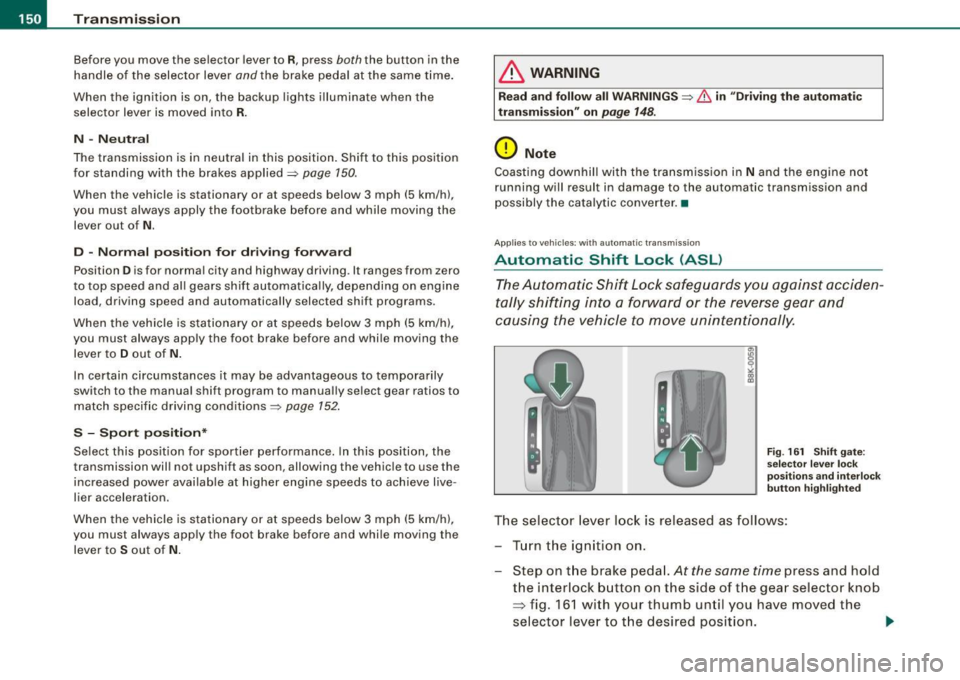
The selector lever l ock is released as follows :
Turn the ignit ion on .
Step on the brake peda l.
At the same time press and hold
the interlock button on the s ide of the gear selector knob
=> fig. 161 w ith your thumb until you have moved the
selector lever to t he desired position.
~
Page 237 of 360

The system operates across the entire speed range in combination
with the ABS system. If the Anti -Lock Brake System (ABS) ma lfunc
tions, the ESP wil l also shut down .
How the system works
The Anti -Lock Brake System (ABS), Electronic Differential Lock (EDU
and the Anti -Slip Regulation System (ASR) are integrated in the elec
tronic stabilization program. In addition to the data provided by
th ese functions, the ESP control unit requires additional measure
ment data provided by high performance sensors . The rotational
speed of the vehicle about its vertica l axis, vehicle acceleration in
the fore-and-aft and lateral directions , the brake pressure, and the
steering angle are all measured.
The direction in which the driver wishes to travel is determined with
the aid of the steering angle and vehicle speed and is continua lly
compared with the actual behavior of the vehicle. If the two do not
match, for example, when the vehicle starts hydrop laning on a wet
road, ESP will automatically brake the appropriate whee l to correct
the prob lem.
The vehicle is then stabi lized by the forces acting on the whee l
during braking. If the vehicle is
oversteering (the vehicle turns too
sharply and the rear wheels slide toward th e ou tside of a curve), the
brakes are main ly app lied on the wheel that is on the outside of the
curve . In the case of a vehicle that is
understeering (the vehicle does
not turn sharply enough and pushes out of a curve), the brakes are
applied as needed on the wheel that is on the inside of the curve or
additional ly on the other wheels. An acoustic signal indicates when
ESP brake app lication cuts in=>&.
T he system operates across the entire speed range in combination
with the ABS system =>
page 238. If the Anti-Lock Brake System
(ABS) malfunctions, the ESP will be out of action as well.
Activating
When you turn on the engine, ESP will automatica lly be activated
and will perform a se lf-test. As soon as the test is comp leted, the
system is in norma l operating mode.
Controls and equip
ment Safety first Vehicle operation
Intelligent technology
You
can activate a deactivated ESP or deactivated ESP/ASR if
required by pressing the::::>
page 234, fig. 215 ::::> page 234, fig. 214
button . When they are activated, the message
ESP /ASR on appears
briefly in the display .
Deactivating
The ESP should normally be activated al l the time. If necessary, you
can deactivate Anti -Slip Regu lation (ASR) or the Electronic Stabiliza
tion Program (ESP) by pressing the button=>
page 234, fig. 215.
• Deactivating ASR: Tap the button . In certain exceptional situa
tions (e .g. driving with tire chains), the Anti-Slip Regulation (ASR)
can be deactivated =>
page 236. The message ASR off appears in the
display as we ll.
• Deact ivating ESP/ASR Press the button for more than 3 seconds.
With the ESP/ASR deactivated, the indicator light comes on, see
=>
page 13. The message ESP switched off appears in the disp lay as
we ll.
& WARNING
The Electronic Stabilization Program is nevertheless subject to the
laws of physics . It is particularly important to pay attention to this
fact on wet and slippery roads. It is therefore important that you
always adapt your driving to the condition of the road and traffic
conditions. Do not allow the increased safety provided by the Elec
tronic Stabilization Program system to lull you into accepting
additional safety risks. •
Electronic differential lock (EDL)
---------
The electronic differential lock monitors the rotational
speed of the drive wheels.
General notes
The electronic differential lock (EDU helps the car to start moving,
acc elerate and c limb a gradient on surfaces providing poor or
Vehicle care Do-it-yourself service Technical data
Page 238 of 360

ll}JI Intelligent technology
---""'------------ ....::....:...:~---------------------------
almost no grip. Without EDL, this would be difficult, if not impos
sible.
How the system works
The EDL operates automatically. It monitors the rotational speed of
wheels with the help of the ABS sensors=:,
page 238 . If a noticeable
slip is detected at the wheels (e.g. on slippery ground on one side),
the spinning wheels are braked and power is transferred to the
other wheels. This is done up to a speed of about 60 mph (100 km/h).
Noises from the brake system signal that wheel spin is being
controlled.
Driving off
When driving off, always be sure to keep road conditions in mind as
you accelerate. If one drive wheel spins because it is on a surface
with less grip, apply
plenty of throttle until the car starts to move.
Overheating of brakes
To prevent the disc brake of the braked wheel from overheating if
subjected to excessive loads on this wheel, the EDL cuts out tempo rarily. The vehicle remains operational and behaves in the same way
as a vehicle without EDL.
As soon as the brake has cooled down, EDL switches on again auto
matically.
& WARNING
• When accelerating on slippery surfaces, such as on ice or snow,
always be careful when depressing the accelerator pedal. Even
with the EDL working, the drive wheels can spin and reduce your ability to control your car. Risk of crash!
• The increased safety afforded by EDL does not mean that you
can take safety risks. Always adapt your driving style to the road
conditions and traffic situation.
[ i] Tips
If a fault occurs in the ABS, the EDL is also not functioning . This is
indicated by the ABS warning light=:,
page 15. •
Anti-Slip Regulation System (ASR)
The Anti-Slip Regulation System prevents the driven
wheels from spinning when the car is accelerating.
General notes
The Anti-Slip Regulation System (ASR) is integrated in the electronic
stabilization program (ESP) . When the vehicle starts up and acceler
ates, the wheels are prevented from spinning by adjusting the
engine power to match the amount of grip available from the road
surface.
How the system works
ASR performs automatically , i.e. without the driver's intervention .
With the aid of the ABS sensors=:,
page 238, ASR monitors the
speed of the driven wheels. If the wheels start to spin, engine torque
is reduced automatically until the tires find enough grip to lock onto
the road surface. The system is active across the entire speed range.
The ASR works in conjunction with the ABS. If a malfunction should
occur in the ABS, the ASR will also be out of action.
Activating
The ESP is automatically activated when the engine is started and it
performs a self-test . You can activate a deactivated ASR if required
by pressing the=:,
page 234, fig. 215 button. When it is activated,
the message
ESP/ASR on appears briefly in the display.
Deactivating
You can deactivate the ASR if required by pressing the button (for
less than 3 seconds) =:,
page 234, fig. 215. With the ASR deactivated,
the ESP check light comes on, see=:,
page 13. The message ASR off ._
Page 239 of 360
•
appears in the display as well. The ASR can be deactivated at any
speed.
The ASR should normally be activated all the time . Only in certain
exceptional situations when some s lip is desirable does it make
sense to deactivate the ASR. Examples:
• when driving with tire chains
• when driving in deep snow or on loose ground and
• when rocking the vehicle loose after it has become stuck.
When the abnormal situation is over, you should activate the ASR
again.
& WARNING
The increased safety afforded by ASR does not mean that you can
take safety risks. Always adapt your driving style to the road
conditions and traffic situation.
[ i ] Tips
To ensure that the ASR works properly, al l four wheels must be fitted
with identical tires. Any differences in rol ling radius of the tires can
cause the system to reduce engine power when this is not desired.
See also :::::>
page 299, "New tires and rep lacing tires and wheels" .•
Braking
General information
What affects braking efficiency?
Operating conditions and driving habits
The brakes on today's automobiles are still subject to wear,
depending large ly on operating conditions and driving habits:::::>& .
On vehicles that are either driven mostly in stop-and-go city traffic
or are driven hard, the brake pads should be checked by your autho-
Intelligent technology
rized Audi dealer more often than specified in the Warranty & Main
tenance booklet.
Fai lure to have your brake pads inspected can
resu lt in reduced brake performance .
On steep slopes, you shou ld use the braking effect of the engine.
This way, you prevent unnecessary wear on the brake system. If you
must use your brakes, do not hold the brakes down continuous ly.
Pump the brakes at intervals.
Moisture or road salt
If you are driving faster than 31 mph (50 km/h) and the windshield
wipers are on, the brake pads will briefly touch the brake discs in
regular intervals so as to improve reaction time when braking on
wet surfaces. You , the driver, wil l not notice anything.
Under certain conditions, for example, when driving th rough water
or very heavy rain , or even after washing your vehicle , the braking
effect can be reduced due to moisture (or in freezing conditions ice)
on the brake pads. A few careful brake applications should dry off
the brake pads or remove any ice coatings .
The ef fectiveness of the brakes can be reduced when the vehicle is
driven on a salt -covered road and the brakes are not used . Here too ,
you should clean off accumulated sa lt coating from brake discs and
pads with a few carefu l applications of the brake:::::>&.
Corrosion
There may be a tendency for dirt to build up on the brake pads and
corrosion to form on the discs if the car is not drive n regularly or
only for short trips with litt le use of the brakes .
I f the brakes are not used frequently, or if corrosion has formed on
the discs, it is advisable to clean off the pads and discs by braking
firm ly a few times from a moderately high speed:::::>& .
Faults in the brake system
If you shou ld notice a sudden increase in brake pedal travel, then
one of the two brake circuits may have failed:::::>&. ..,
I t •
Page 240 of 360
ll}Jl __ ln_t _e_ ll-'"ig ...,_ e_ n_t _t_ e_ c_h _ n_o _ l_o _,.g= y,_ __________________________________________ _
Low brake fluid level
Ma lfu ncti ons can occ ur in th e brake system if the bra ke flu id leve l is
too low. The brake fluid leve l is monitored e lectronically.
Brake lining wear status Bra ke lining wear may be checked by visual inspection of the condi
t ion of the brake pa ds through the o pen in g s in t he wheel. If neces
sary, the wheel may be removed for this inspection=>
page 312,
" C hanging a whee l" .
& WARNING
• You should perform braking maneuver s for the purpose of
cleaning the brake system only if road cond itions permit . Other
road u sers must not be put at risk -you may cause an accident !
• Before des cending a steep grade , reduce speed and shift trans
mission into a lower gear or lower driving range. Do not ride the
brake s or hold the pedal down too long or too often . This could
c ause the brakes to get hot and diminish braking efficiency.
• Do not "ride the brakes " by resting your foot on the pedal when
you do not intend to brake. This may cause the brakes to overheat, p rem ature wear and in creased stopping distance .
• Under certain climatic and operating conditions such as
passing through water , driv ing in heavy rain or after washing the
vehicle , the effectiveness of the brakes can be reduced. In winter ,
ice can accumulate on the brake pads , linings , discs and drums.
Carefully apply brakes for a test. Brakes will dry and ice coatings
will be cleaned off afte r a few careful b rake appli cations .
• Driving for an extended period of time on salt -covered roads
without using your brakes can also affe ct braking effic ien cy. Clean
off accumulated salt coating from brake discs and pads with a few
careful brake applications .
• If you damage the front spoiler , or if you install a different
spoiler , be sure the air flow to the front brakes is not obstru cted .
Otherwise the brake system could overheat reducing the effe ctive
ness of the entire brake system .
& WARNING (continued )
• Failure of one brake circuit will impair the braking capability
resulting in an increased stopping distance . Avoid driv ing the
vehicle and have it towed to the nearest authorized Audi dealer or
qu alified workshop. •
Brake booster
The bra ke boos ter adds e xtra bra king pow er.
Th e brake boost er wo rks wit h vacuum p ressu re wh ich is created
only when the engine is running=>& .
& WARNING
• Never let the vehicle roll to a stop with the engine shut off.
• If the brake booster is not working , for e xample when towing
your vehicle, or because the brake booster has somehow been damaged , the brake pedal must be pressed considerably harder to
make up for the lack of booster assistance . •
Functioning of Anti-Lock Brake System (ABS}
A BS p revents t he wheels from lockin g up unde r braking.
The ABS co ntrib utes effectively to ve hic le c ont ro l since it preven ts
the whee ls from locking when the bra kes are app lied. Th is means
that the vehicle remains stee rable and is less l ikely to skid .
With ABS you do not need to
pump the brake. Just hold the brake
pedal down .
Ho wever , do not e xpect the AB S to sho rten braking d istance under
all circumstances. When driving o n grave l or on newly fallen snow
o n t op of icy su rfaces, b raking distance may be even lo nger, there
f ore, unde r these circumsta nces, it is especially impo rtan t th at you
drive slow ly and with great ca re. ._
Page 246 of 360
___ D_ r_ iv_ i_ n-' g"'""'- a_ n_d_ e_ n _ v_i_r _ o _n_ m_ e_ n_t _____________________________________________ _
New brake pads
Remember that new brake pads do not have a full braking
effect during the first 250 miles (400 kilometers) after they
are installed .
New brake pads have to be "burnished in" before they have optimal
grab =>& .
During the break -in period, you shou ld avoid putting severe loads
on the brakes . Severe loads include, for examp le, sudden hard
braking, in particular at very high speeds or, for example, on moun
tain passes .
& WARNING
New brake pad s don' t have the b est sto ppin g powe r and mu st b e
" brok en-in " during the initi al 100 to 15 0 mile s (150 t o 200 kil ome
t e rs) of n orm al cit y dri ving . You can co mpen sa te for thi s by
p re ss ing the brak e ped al mor e firmly . Th is also app lies la ter whe n
n ew pad s are in sta lled.
:J
Avoid damaging the vehicle
------------
When you are driving on poor roads , or over curbs, steep ramps ,
etc., make certain that low -lying parts such as spoilers and exhaust
system parts do not bottom out and get damaged.
This is especially true for vehicles with low -slung chassis (sports
chassis) * and fully loaded vehic les.
Driving through water on roads
Note the fo llowing to avoid vehicle damage when driving through
water , for example on flooded roads: • T
he water must not be any higher than the bottom of the vehicle
body .
• Do not drive faster than wa lking speed.
& WARNING
Aft er d riv in g throu gh water, m ud, s lus h, et c., the br akes ma y be
s low t o take eff ect beca use of w et br ake r otor s and p ad s. Dr y the
br ak es fir s t by br aking caref ully to r estor e th e full br aking effe ct.
0 Note
Vehicle components such as the engine, transmission, suspension
or e lectrica l system can be severe ly damaged by driving through
water .
[ i ] Tip s
• Check the depth of the water before d riving th rough it .
• Do not stop the vehic le, drive in reverse or switch the engine off
wh en driving through wat er.
• Keep in mind that oncoming vehicles may create waves that
raise the water level and make it too deep for your vehicle to drive
through safely.
• Avoid driving through salt water because it can cause
corrosion. •
Catalytic converter
It is very important that your emission control system
(catalytic converter) is functioning properly to ensure that
your vehicle is running in an environmentally s ound
manner.
- Always use lead -free gasoline ~ page 265, "F uel supply" . .,_
Page 247 of 360

-Neve r run the tank down a ll the way to empty .
- Never put too much motor oil in your engine=>
page 275,
"Adding engine oil 'l:::r.".
-Never try to push- or tow-start your vehic le .
The catalytic converter is an efficient "clean -up" device built into the
exhaust system of the vehicle. The cata lytic converter burns many
of the po llutants in the exhaust gas before they are released into the
atmosphere.
The exclusive use of un leaded fuel is critica lly important for the life
of the catalytic converter and proper functioning of the engine .
& WARNING
• Do not par k or operat e the vehicle in areas w here the ho t
ex haust sys te m m ay come in conta ct w ith d ry grass, bru sh , fu el
s pill or other mater ial which can cause a fire.
• Do not ap ply ad diti ona l u nd erc o ati ng or ru stpro ofing on o r
n ea r th e ex haust m an ifold, exhau st pipe s, ca talytic convert er or
h eat s hield s. Dur ing drivin g, the sub sta nce use d for und ercoa ting
c ould o verh eat and cause a fir e.
0 Note
• Be aware that just one tank filling with le aded fue l wil l a lready
seriously degrade the performance of the catalytic converter.
• Do not exceed the correct engine oil level
~ page 275.
• Do not drive until the fuel tank becomes completely empty. The
engine could misf ire. Unburned fuel could also get into the exhaust
system and this could cause the catalytic converter to overheat.
• Do not turn off the ignit ion whi le the vehicle is moving.
• Do not continue to operate your vehicle under these conditions,
as otherwise fuel can reach the cata lytic converter. This could result
in overheating of the converter, requiring its rep lacement .
Controls and equip
ment Safety first Vehicle operation
Dri
ving and environm ent
• To assure efficient operation of the Emission Control System:
- Have your vehic le maintained properly and i n accordance w ith
the service recommendations in your Warranty
& Maintenance
booklet .
- Lack of proper maintenance as wel l as improper use of the
vehic le wi ll impair the function of the em ission control system
and could lead to damage .
exhaust gas can have a sulfur-like exhaust gas smell under some
operating states . This depends on the su lfur content of the fuel
bei ng used. Using a different brand of fue l may help, or fil ling the
tank with lead-free super grade gasoline .
Operate your vehicle economically
and minimize pollution
General
Your personal style of driving will determine the economy
of your vehicle, as well as exhaust and noise levels .
Fuel economy, environmental impact, and wear on your engine,
brakes and tires largely depend on three factors:
• your persona l driving style
• operating conditions
• technica l limitations
If you anticipate what you need to do next and drive economica lly,
you can easily cut your fuel consumpt ion by 10-15 percent . This
section wil l give you some tips on how you can help the environ-
ment and your pocketbook . ...
Vehicle care Do-it-yourself service Technical data
Page 251 of 360

Trailer load d is trib ut ion
Be sure the load in the trailer is held securely in place to prevent it
from shifting forward, backward or sideways.
Ne ver allo w a passen ger to rid e i n a tr ailer => & in "Driving instruc
tions" on
page 249.
En gin e c ool ing syst em
Towing a trailer makes the engine work harder. It is important that
the cooling system 's performance is up to the additiona l load. Make
sure that the cooling system has enough flu id.
Ti re press ure
When towing a trailer, inflate the tires of your vehicle to the cold tire
pressure listed under "Full load" on the labe l located either on the
driver's side B-pillar (visible when the door is open} or inside the fuel
filler flap . Inflate trailer tires to trai ler and tire manufacturers' spec
ifications.
Ligh ts
The headlight settings should be checked with the trailer attached
before driving off . Check to make sure both vehicle and trailer lights
are working properly .
Safe ty c hain s
Be sure trailer safety chains are properly connected from the trailer
to the hitch on the vehicle. Leave enough slack in the chains to
permit turning corners. When you install safety chains, make sure
they will not drag on the road when you are driving.
The chains should cross under the trailer tongue to prevent it from dropping in case of separation from the hitch.
Controls and equip
ment Safety first Vehicle operation
Tr
aile r t owing
Driving instructions
Driving with a trailer always requires extra care and
consideration.
To obtain the best possible handling of veh icle and trailer,
please note t he following :
Do not tow a loaded trailer when your car itself is not
loaded .
- Be especia lly careful when passing other vehicles .
Observe speed l imits .
Do not drive at the maximum permissible speed.
Always apply brakes early.
Monitor the temperature gauge.
W eight distrib utio n
Towing a loaded trailer with an empty car results in a h ighly
unstable distribution of weight . If this cannot be avoided, drive at
very low speeds only to avoid the risk of losing steering control.
A "balanced" rig is easier to operate and control. This means that
t he tow vehicle should be loaded to the extent possible and permis
sible, while keeping the trailer as light as possib le under the circum
stances . Whenever possible, transfer some cargo to the luggage
compartment of the tow vehicle whi le observing tongue load
requirements and vehicle loading considerations.
S pee d
The higher the speed, the more difficu lt it becomes for the d river to
control the rig. Do not drive at the maximum permissible speed.
Reduce your speed even more if load, weather or wind conditions
are unfavorable -particularly when going downhill .
Reduce vehicle speed
i mmed iatel y if the trailer shows the slightest
sign of swaying .
Do not try to st op the swa ying b y accelerating.
Vehicle care Do-it-yourself service Technical data