height AUDI A5 COUPE 2010 User Guide
[x] Cancel search | Manufacturer: AUDI, Model Year: 2010, Model line: A5 COUPE, Model: AUDI A5 COUPE 2010Pages: 360, PDF Size: 84.39 MB
Page 186 of 360
___ S_a_ f_ e_ t-= y_ b_e_ l_ t _s _______________________________________________ _
-Insert t he tongue into the correct b uckle of y our seat
unt il you h ea r it la tc h securely~ fig. 190.
Pull on t he belt to make sure that it is securely latched in
the buckle.
Aut om ati c sa fe ty belt re tra cto rs
Eve ry safety be lt is equipped with an automatic belt retractor on the
shoulder belt. This feature locks the belt when the belt is pulled out
fast, during hard braking and in an accident. The belt may a lso lock
when you drive up or down a steep hill or through a sharp curve .
During normal driving the belt lets you move free ly.
Safety belt prete nsi oners
The safety belts are equipped with a be lt pretensioner that he lps to
tighten the sa fety be lt and remove slack when the pretensioner is
activated. The function of the pretensioner is monitored by a
warning light=>
page 14 .
Swit chable locking fe ature
Every safety belt except the one on the driver sea t is equipped with
a switchab le locking feature that
must be used when the safety belt
is used to a ttach a chi ld safe ty sea t. Be sure to read the important
information about this feature=>
page 223.
& WARNING
Improper ly positioned safet y belts can cause seriou s inj ury in an
accident =>
page 184 , "Safety belt po sitio n".
• Safet y belts offer opt imum protection on ly when the seat back
i s upright and belt s are properly po sition ed on t he bod y.
• Always make sure that the rear seat backrest to whi ch the
c enter r ear sa fet y belt i s atta ched i s sec ure ly lat ched whe nev er
the rear center saf ety belt i s being us ed. If the ba ckrest is not
s ecu rely lat ched, the pas senge r will mo ve fo rward with the back
rest dur ing sudden braking , in a sudden maneu ver and e spec iall y
in a cra sh.
& W AR N ING (continu ed )
• Never attach the safety belt to the buck le for anothe r seat .
Atta ch ing th e be lt to the wrong buckle will reduce safety belt
e ffe ctivenes s and can ca use seriou s per son al injur y.
• A p assenger who i s not prope rly re str ained can be s eriousl y
injured by the saf ety belt it self wh en it m ove s from the stronger
p art s of the body into criti ca l area s like the abd omen .
• Alway s lock the convert ible lo ck ing retractor when you are
s ecu ring a ch ild safety se at in the v ehi cle
=> page 2 25. •
Safety belt position
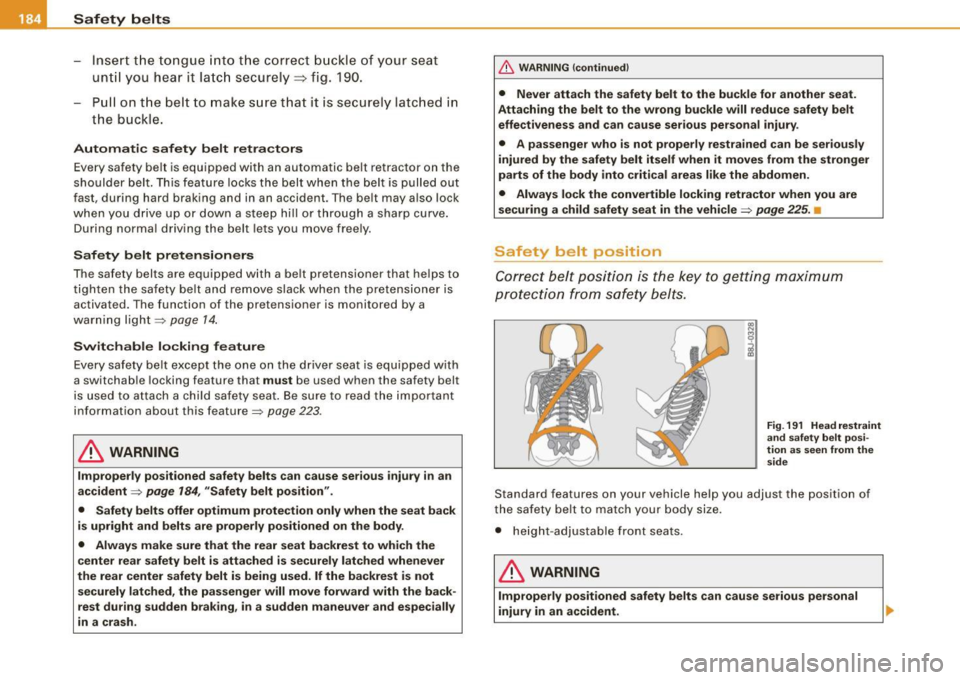
Correct belt posi ti o n is the key to getting maximum
protecti on f rom safety be lts.
Fig . 191 He ad r est ra in t
an d sa fe ty b elt p osi
tion a s seen from th e
sid e
Standard features on your vehicle help you adjust the position of
the safety belt to match your body size .
• height -adjustable front seats.
& WARNING
Improperly posit ioned safety belts can cau se seriou s pe rsonal
injury in an a ccident .
Page 206 of 360

___ A_ ir_b _a_ g;:::;_ s--:.. y_s _t _e _m _________________________________________________ _
& WARNING
Changing the vehicle's su spension includ ing use of un approved
tire -rim combinations can change Advanced Airbag performance
and increase the ris k of serious personal injury in a crash .
• Never install suspen sion component s that do not have the
same performance chara cteristics as the components or iginally
installed on your vehicle.
• Never use tire-r im comb inations that have not been approved
by Audi.
& WARNING
Items stored between the safety belt bu ckle and the center
c onsole can cause the sensors in the buc kle to send the wrong
information to the electroni c control module and prevent the
Advanced Airbag System from working properly .
• Alway s make sure that nothing can interfere with the safety
belt buckles and that they are not obstructed .
<£> For the sake of the environment
Undeployed airbag modules and pretensioners might be classified
as Perchlora te Mater ial -specia l handling may a pply, see
www.dtsc.ca.gov/hazardouswaste/perchlorate. When the vehicle or
par ts o f the res traint system inclu ding airbag modules sa fe ty be lts
with pretensioners are scrapped, a ll applicable laws and regu la
tions mu st be o bserved. You r aut hor ize d Au di d eale r is fami liar with
these requirements and we recommend that you have your dea ler
perform this service for you. •
Knee airbags
Applies to vehicles: with knee air bags
Description of knee airbags
The airbag system c an provide supplemental pr otection
to pr operly res traine d fron t sea t occupan ts .
....
! 00 m
F ig . 19 8 Drive r's kne e
airba g
The knee a irbag for the driver is located in the instrument panel
underneath the stee ring wheel => fig. 19 8, the knee air bag for the
passeng er is at about the same height in th e instrument pane l
underneath the glove compartment .
Th e kn ee ai rbag offers addi tional pr otec tion to the d river's a nd
passenger 's knees and upper and lower thigh a reas as a supple
me nt to t he sa fety be lts .
I f the front airbags deploy , th e knee airbags also deploy in frontal
collisions above a certain severity=>
page 197, "M ore important
things to know about front airbags".
Besides their normal safety function, safety belts wor k to help keep
th e dri ver o r fr on t passeng er in pos itio n in case of a fro ntal col lis io n
so that the airbags can provide protection .
T he airbag system is not a substitute for your safety belt . Rathe r, it
is part of the overall occupant restra int system in your vehicle .
A lwa ys remember that the airbag system can only help to protect .,,_
Page 223 of 360
& WARNING !continued)
• Always follow the manufacturer's instructions provided with
the child safety seat or infant carrier.
• Always move the front passenger seat into the rearmost posi
tion of the passenger seat's fore and aft adjustment range, and as
far away from the airbag as possible before installing the child
restraint.
• Always make sure that nothing prevents the front passenger's
seat from being moved to the rearmost position in its fore and aft
adjustment range .
• Always make sure the backrest is in an upright position .
• Make sure that the PASSENGER AIR BAG OFF light comes on
and stays on all the time whenever the ignition is switched on.
• If the light does not stay on, perform the checks~
page 199,
uMonitoring the Advanced Airbag System ".
• Take the child restraint off the front passenger seat and install
it properly at one of the rear seat positions if the PASSENGER AIR
BAG OFF light does not stay on whenever the ignition is switched
on. •
Safety first
Child Safety
Booster seats and safety be lts
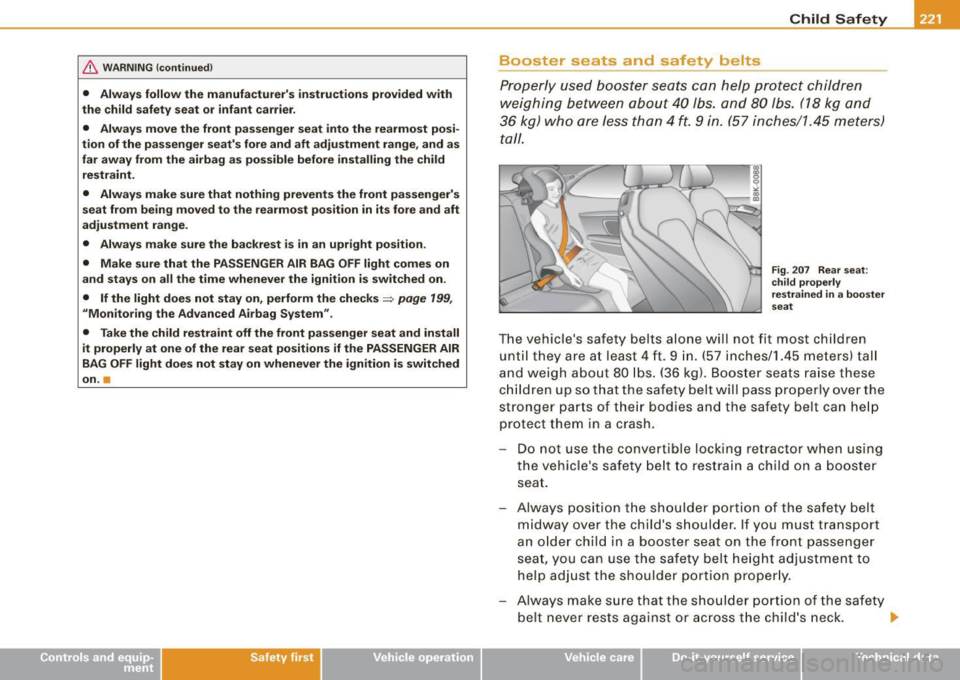
Properly used booster seats can help protect children
weighing between about 40 lbs. and 80 lbs. (18 kg and
36 kg) who are less than 4
ft. 9 in. (57 inches/1.45 meters)
tall.
Fig . 207 Rear seat :
child properly
restrained in a booster
seat
The vehicle 's safety belts alone will not fit most children
until they are at least 4 ft. 9 in. (57 inches/1.45 meters) tall
and weigh about 80 lbs. (36 kg). Booster seats raise these
children up so that the safety belt will pass properly over the
stronger parts of their bodies and the safety belt can help
protect them in a crash.
- Do not use the convertible locking retractor when using
the vehicle 's safety belt to restrain a child on a booster
seat.
- Always position the shoulder portion of the safety belt midway over the child's shoulder. If you must transport
an older child in a booster seat on the front passenger
seat , you can use the safety belt height adjustment to
help adjust the shoulder portion properly.
- Always make sure that the shoulder portion of the safety
belt never rests against or across the child's neck.
I)),
Vehicle care I I irechnical data
Page 290 of 360

-~_T_ ir_e_ s_ a_ n_d _ w_ h_ e_e _l_s _________________________________________________ _
& WARNING (continued)
crashes and serious personal injuries . Have worn or damaged tires
replaced immediately.
• Tires age even if they are not being used and can fail suddenly,
especially at high speeds. Tires that are more than 6 years old can
only be used in an emergency and then with special care and at
low speed.
Glossary of tire and loading terminology
Accessory weight
means the combined weight (in excess of those standard items
which may be replaced) of automatic transmission, power steering,
power brakes, power windows, power seats, radio, and heater, to
the extent that these items are available as factory-installed equip
ment (whether installed or not).
Aspect ratio means the ratio of the height to the width of the tire in percent.
Numb ers of 55 or lower indicate a low sidewall for improved
steering response and better overall handling on dry pavement.
Bead
means the part of the tire that is made of steel wires, wrapped or reinforced by ply cords and that is shaped to fit the rim.
Bead separation means a breakdown of the bond between components in the bead.
Cord
means the strands forming the plies in the tire.
& WARNING (continued)
• Never mount used tires on your vehicle if you are not sure of
their "previous history." Old used tires may have been damaged
even though the damage cannot be seen that can lead to sudden
tire failure and loss of vehicle control.
• If you notice unusual vibration or if the vehicle pulls to one side
when driving, always stop as soon as it is safe to do so and check
the wheels and tires for damage . •
Cold tire inflation pressure
means the tire pressure recommended by the vehicle manufacturer
for a tire of a designated size that has not been driven for more than
a couple of miles (kilometers) at low speeds in the three hour period
before the tire pressure is measured or adjusted.
Curb weight means the weight of a motor vehicle with standard equipment
including the maximum capacity of fuel, oil, and coolant, air condi
tioning and additional weight of optional equipment.
Extra load tire
means a tire design to operate at higher loads and at higher infla
tion pressures than the corresponding standard tire. Extra load tires
may be identified as "XL",
"xi", "EXTRA LOAD", or "RF" on the side
wall.
Gross Axle Weight Rating ("GAWR")
means the load-carrying capacity of a single axle system, measured
at the tire -ground interfaces.
Gross Vehicle Weight Rating ("GVWR"l
means the maximum total loaded weight of the vehicle.
Page 301 of 360
__________________________________________________ T_ ir_e _ s_ a_ n _ d_ w_ h_ e_ e_ls _ ____. ffllll
New tires and replacing tires and wheels
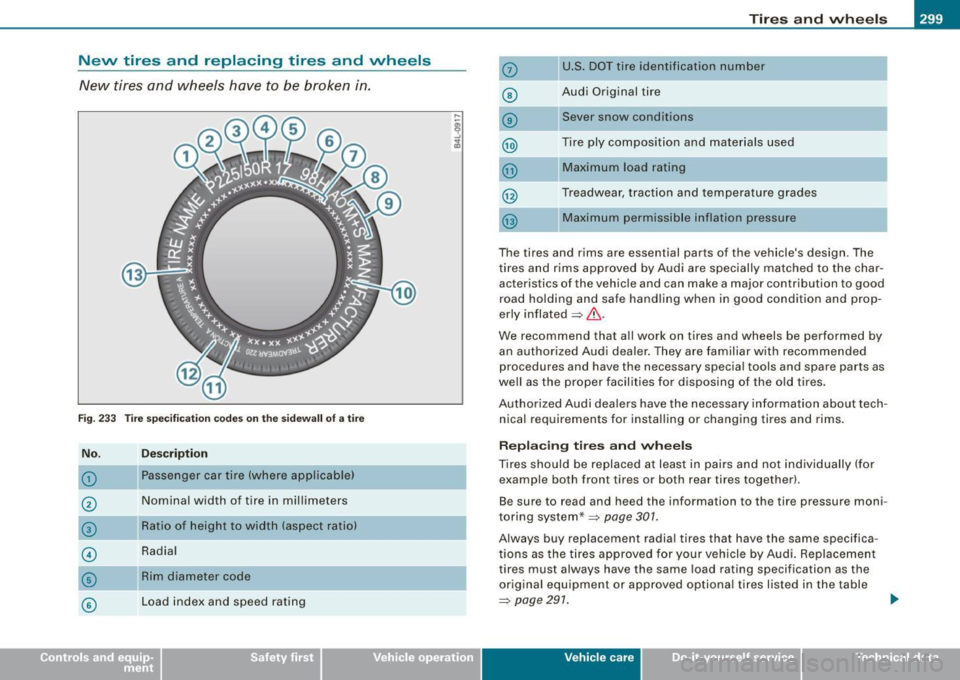
New tires and wheels have to be broken in.
Fig. 233 Tire specification codes on the sidewall of a tire
No.
G)
@
©
©
©
©
Description
Passenger car tire (where applicable)
Nominal width of tire in millimeters
Ratio of height to width (aspect ratio)
Radial
Rim diameter code
Load index and speed rating
0
©
U.S. DOT tire identificat ion number
Audi Original tire
Sever snow condit ions
Tire ply composition and materials used
@ Maximum load rating
@ Treadwear, traction and temperature grades
@ Maximum permissible inflation pressure
The tires and rims are essential parts of the vehicle's design . The
tires and rims approved by Audi are specially matched to the char
acteristics of the vehicle and can make a major contribution to good
road holding and safe handling when in good condition and prop
erly inflated
=> & .
We recommend that all work on tires and wheels be performed by
an authorized Audi dealer. They are familiar with recommended
procedures and have the necessary special tools and spare parts as
well as the proper facilities for disposing of the old tires.
Authorized Audi dealers have the necessary information about tech
nical requirements for installing or changing tires and rims.
Replacing tires and wheels
Tires should be replaced at least in pairs and not individually (for
example both front tires or both rear tires together).
Be sure to read and heed the information to the tire pressure moni
toring system* =>
page 301.
Always buy replacement radial tires that have the same specifica
tions as the tires approved for your vehicle by Audi. Replacement
tires must always have the same load rating specification as the
original equipment or approved optional tires listed in the table
=> page 291. ~
Vehic le care I I irechnical data
Page 302 of 360
-~_T_ ir_e_ s_ a_ n_d _ w_ h_ e_e _l_s _________________________________________________ _
Audi-approved specification tires are specially matched to your
vehicle and its load limits, and can contribute to the important road
holding, driving characteristics, and safety of the vehicle . The table
(~ page 291) lists specifications of the tires approved for the Audi
models covered by your Owner's Literature.
The tire pressure label (On USA vehicles, the tire pressure label is located on the driver's side 8 -p illar. On Canada vehicles, the tire
pressure label is located either on the driver's side B-pillar or inside
t he fue l filler flap)( ~
page 291, fig. 230) lists the specifications of
the origina l equipment tires instal led on your vehicle at the time it
was manufactured.
Federal law requires tire manufacturers to place standardized infor
mation on the sidewa ll of all tires~
page 299, fig. 233 . This informa
tion identif ies and describes the fundamenta l characteristics, the
quality grade of the tire and a lso provides a tire identification
number for safety standard certificat ion and in case of a recall.
Tir e s pec ifica tio ns
Knowledge of tire specifications makes it easier to choose the
correct tires . Radial tires have the tire specifications marked on the
sidewa ll, for example:
P255 / 3 5 R19 96V XL
This contains the fo llowing information:
P Indicates the tire is for passenger cars (where applicable)
25 5 Nominal tire width in mm of the tire from sidewall edge to side -
wa ll edge. In general, the larger the number, the wider the t ire
3 5 Height/width ratio in percent (aspect ratio)
R T ire construction: Radial
19 Rim diameter code (in inches)
96 Load rating code
Y Speed rating letter code
XL (or "xi", "EXTRA LOAD", or "RF" Indicates that the tire is a"Rein
forced" or an "Extra Load" tire
M+ S (or "M/S") Indicates that the t ire has some mud and snow capa-
bility
The ti res cou ld also have the information of direction of rotation
~ page 287.
T ire m anuf acturing d ate
The manufacturing date is a lso indicated on the tire sidewa ll
(possibly on ly on the
inner side of the wheel) :
"DOT ... 2209 ... " means, for example, that the tire was produced in
the 22nd week of 2009.
S pe ed ra ting
permissible road speeds~
& in "Winter tires" on page 304.
P up to 93 mph (150 km/h)
Q up to 99 mph ( 158 km/h)
R up to 106 mph (170 km/h)
s up to 110 mph (180 km/hl
T up
to 118 mph (190 km/h)
u up to 124 mph (200 km/h)
H up to 130 mph (210 km/h)
V up to 149 mph (240
km/hJ31
z over 149 mph (240 km/h)31
w up to 168 mph (270 km/h)31
y up to 186 mph (298 km/hJ31
Your vehicle is norma lly factory equipped w ith tires, which possess
excellent driving characteristics and give your Audi optimum
driving comfort. An e lectronic speed limiter ~
page 23will normally .,,_
31 For tires with a maximum speed capability over 149 mph (240 km/h), t ire
manufacturers sometimes use the letters "ZR."
Page 308 of 360
-~_T_ ir_e_ s_ a_ n_d _ w_ h_ e_e _l_s _________________________________________________ _
& WARN ING (continued )
• Always maintain the correct tightening torque for the wheel
bolt s to reduce the risk of a wheel loss . If the tightening torque of
the wheel bolts is too low, they can loo sen and come out when the
vehicle is moving . If the tightening torque is too high , the wheel
bolts and threads can be d amaged and the wheel can be come
loose .
0 Note
The specified torque for the whee l bo lts is 90 ft lbs . (120 Nm) with a
tolerance of ± 7,4 ft lbs .(± 10 Nml. Torque wheel bo lts diagona lly.
Af te r cha ng ing a whe el, the torque mus t be checked as so on as
possible with a torque wrench -preferably by an authorized Audi
dea ler o r qua lified w orksh op.•
Low as pect rat io tires
Yo ur Audi is fac tory-equipped with l ow aspec t ratio tires . Thes e tires
have been thorough ly tested and been selected specifically for your
m odel f or their superb pe rformance, r oad feel and hand ling under
a variety of driving conditions . Ask your authorized Audi dealer for
m ore deta ils .
T he low aspec t rat io of these ti res is indicated by a nu meral o f
55 or
less
in the tire's si ze designation. The numeral represents the ratio
o f the tire's sid ewa ll heig ht in relat ion t o it s tread w idth express ed
in percentage. Conventiona l tires have a height/width ratio of 60 or
m ore .
The performance of low -aspect -ratio tires is particularly sensitive to
improper inflation pressure . It is therefore important that low
aspect ratio tires are inflated to the specified pres sure and that the
i nflation pressure is regularly checked and maintained . Tire pres
sures should be checked at least once a month and alway s before a
long trip ~
page 293, "Checking tire pr essure".
What you can do to avoid tire and rim damage
Lo w aspec t r ati o t ir es ca n be da maged more easi ly by impact wi th
potholes, curbs, gullies or ridges on the road, particularly if the tire
i s un derinflate d.
In order to minimize t he occurrence o f impac t damage to the t ires
of your vehicle , we recommend that you observe the following
p recau tions:
• Always ma intain recommended inflation pressures . Check your
t ire pressure every 2,000 miles (3,000 k m) and ad d air i f neces sa ry .
• D rive careful ly on roads with potholes, deep gullies or ridges.
Th e impa ct from driving throug h or over such o bstacles can
damage your tires. Impact with a curb may also cause damage to
you r ti res .
• After any impact, immediately inspect your tires or have them
inspected by the neares t autho rize d Audi deale r. R eplace a
damaged tire as soon as possib le.
• I nspect you r tir es eve ry 2 ,0 0 0 m iles (3 ,000 k m) for damage a nd
wear. Damage is not always easy to see. Damage can lead to loss of
a ir and under infla tion , wh ic h co ul d even tually cause tire fa ilu re . If
you believe t hat a tire may have been damaged , rep lace the tire as
soon as p ossi ble.
• T hese tires may wear more quickly than others .
• Please also re member th at, wh ile t hese tir es de liver respo nsive
handling, they may ride less comfortably and make more noise than
ot her c hoic es.
Reduced performance in winter /cold season
conditions
A ll tires are designed for certain purposes. The low aspect ra tio,
u ltra high per form ance t ires or ig ina lly ins tal led on yo ur ve hicle are
intended for maximum dry and wet road performance and hand ling.
Th ey a re not su itab le f or cold, sn owy or ic y weathe r co nd ition s. If
you drive under those c ircumstances, you should equip your vehic le
wi th all -season o r wi nter ti re s, w hic h offe r bett er trac tion und er
ti-
Page 339 of 360

___________________________________________________ D_a_ t_ a __ PII
Data
App lies to v ehicles : with 2.0 lite r 4-cy l. engine
211 hp, 2.0 liter 4-cyl. engine
En gin e data
Maximum output SAE net
Maximum torque SAE net
No _ of cylinders
Displacement
Stroke
Bore
Compression ratio
Fuel
Dim ension s (app rox.)
Length (with licence plate bracket)
Width (with outside mirrors fo lded)
Height (unloaded)
Turning circle diameter (curb to curb)
Ca pac ities (a pprox.)
F u el t ank
-Total capacity
- Reserve (of total capacity)
Wind shi eld and he adli ght * was her fluid container
E ngine oil
with filter change hp@rpm
lb-ft@ rpm
CID (cm
3
)
in (mm)
in (mm)
211 @ 4300 -6000
258
@ 1500 -4200
4
1 21 (1984)
3.65 (92.8)
3.25 (82.5)
9.6 : 1
Premium unleaded (91 AKI) Recommended for maximum engine performance. Fur
ther details =>
page 265, "Gasoline"
in (mm)
in (mm)
in (mm)
ft (ml
182.0 (4625)
73.0 (185 4)
54.0 (1372)
37 .4 (11.4)
gal Oiters)
gal (liters)
quarts (liters)
quarts (liters) 16.9 (64.0)
2.1 (8)
4 .8 (4_5)
4 .9 (4 .6)
•
Controls and equip
ment Safety first Vehicle operation
Vehicle care Do-it-yourself service Tec hn ica l da ta
Page 340 of 360
llftl __ D_a_ t_ a ___________________________________________________ _
Applies to vehicles : wit h 3.2 li ter 6-c yl. en gine
265 hp , 3.2 liter 6-cyl. engine
Engine data
Max imum output SAE net
Maximum torque SAE net
No . of cy lin ders
Di spl ac eme nt
Stroke
Bo re
Comp ress ion rati o
Fuel
Dimensions (appro x.)
Lengt h (with licence plate brac ket)
Width (wit h ou ts ide mirrors folded)
Height (un loaded)
T urn ing c ircle diameter (curb to curb)
Capacities {approx .)
Fuel tank
-To tal capacity
- Rese rve (of total capacity)
Windshield and headlight* washer fluid container
Engine oil
with filter cha n ge h
p@ rpm
lb-ft@ rpm
CID (cm
3 )
in (mm)
in (m m) 265 @6500
243 @ 3000-5000
6 195 (3197)
3 .65 (92 .8)
3 .37 (85 .5)
1 2 .5: 1
Premium unleaded {91 AKll Recommended for maximum engine performance . Fur
t her deta ils =:>
pag e 265, "Gasoli ne"
i n (m m)
in (m m)
in (mm)
ft ( ml 1
82 .0 ( 4625)
73.0 (1854)
5 4 .0 ( 1372)
37 .4 (11.4 )
g al (l iters)
gal (li ters)
qua rts (liters)
q ua rts (l ite rs) 1
6.9 (64 .0)
2 .1 (8)
4. 8 ( 4.5)
6 .6 (6.2)
•
Page 355 of 360
Alphabetical index -
-------------=----
Reset button ... ...... .. ... ... . .. .. .. 11
Retractor ................. ......... 183
Rims Cast al loy ..... .. .... .... ..... .. . 258
Replacing ... .... ..... .. .... .... . 301
Roof luggage rack
Mounting points .................. 85
Roof rack ........... ...... .... .... .. 84
Roof load ...... ...... ...... ...... 85
See also Roof luggage rack ... .... .. 84
s
SA FE ... .... .... .... .... ... .... .... . 11
Safe driving hab its .. .... .... ... .... . 168
Safe ty belt position . . . . . . . . . . . . . . . . . . 184
Safety belts worn by p regnant women ..
185
Safety belt pretensioner ... .... .... ... 186
Service and disposal .............. 187
Saf ety b elt warning light .... .... .. 14,179
Safety belts . . . . . . . . . . . . . . . . . . . . . . . . 183
Cleaning ..... .... .... ........... 263
Danger to passengers who do not wear a
safe ty belt . .... .... ..... .. ... .. 181
Fastening ... .... .... .... ... .... . 183
Improperly worn ..... .... ........ 186
Not worn . . . . . . . . . . . . . . . . . . . . . . . . 181
Safety belt position ...... .... ..... 184
Safety instructions . ......... .... . 182
Securing child s afety seats ........ 223
Special considerations for pregnant women ....... .... .... ......... 185
Unfastening ..... ... ..... ...... .. 186
Controls and equip
ment Safety first
Warning
/indicator light .... ........ 179
Why YOU MUSTwearthem ... .... . 179
Worn properly ..... .... .... .... .. 182
Safety compliance sticker . .... ... .... 334
Safety equipment .... .... ..... .. .... 168
Safe ty fea tures for occupant restraint and
protection ... .. ........ .... ... . 168
Safety guidelines Seat adjustment ... ...... ... ... ... . 69
Saf ety instructions
Engin e compartm ent . .... .... ..... 271
for sid e curtain airbags . .......... . 211
for using child safety seats ....... .. 216
for using safety be lts .... .......... 182
Moni toring the Advanced Airbag System
201
Seat adjustment Driver's seat ........ ...... ... .... . 69
Easy entry function ........... ... .. 74
Easy entry manual function .. ..... .. 72
For -and -aft manua lly ..... ..... ... .. 71
Front passenger's seat .. .... ..... .. 70
Front seats ...... .. .. .... .... .... . 69
Head restraints ... ..... ... ..... .. . 173
Manual .. ...... .... ... .. ..... ... . 70
Power ....... .. .... .... .... .... .. 72
Seat back angle manually ........ ... 71
Seat height manually . ........ .... . 71
Seat belt s
See Safety belts
Seat heating 179
Front seats ...... .. .. .... .... .... 105
Seat memory ...... .. ... ... ..... .... . 74 Seating capacity
.... ..... .. . .... .. . . 179
Seating position Driver ......... ....... .. .. .... ... 170
Front passenger . ...... .. . .... .. .. 171
How to adjust the front seats ... .... 171
Incorr ect seat position .... .... .... 173
Occupan ts ... ... .. .... ...... .... . 170
Rear passengers . ...... .. . .... .. .. 172
Seats Number of seats .... .... .. .... .... 179
Se lect ive unlock feature ...... .... ..... 43
S elector le ve r .. .. .... ..... .. .... .... 149
Emergency release ...... .... ..... 154
Service and disposal
Safety belt pretensioner . ...... .... 187
Service interval display ... .... .... ... .. 21
S erv ice pos ition for w indsh ield wipers . .. 62
Servotronic Power steering .. ...... ....... .... 239
SET button . ...... .. .... .... ..... .. ... 9
Shift buttons ..... .. .... .... .... .... 153
Side airbags Description . ...... .... ....... .... 207
How they work .. ...... .... ... .. .. 208
Side assist Activating and deactivating .... .... 135
Description . ..................... 135
Informational and alert stage signals 137
Messages in instrument cluster display .
142
MMI settings ............... ...... 141
Operation .... .... ... ... ... .. .... 137
Vehicle operation Vehicle care Do-it-yourself service Technical data