oil AUDI A5 COUPE 2010 Owner's Manual
[x] Cancel search | Manufacturer: AUDI, Model Year: 2010, Model line: A5 COUPE, Model: AUDI A5 COUPE 2010Pages: 360, PDF Size: 84.39 MB
Page 264 of 360
___ C_ le_ a _ n_i_n ~g _ a_ n_ d __ p_r _o _t _e _c_ t_ i_o _n ___________________________________________ _
Mor e stubborn dirt
- More stubborn dirt can be removed using a cloth satu
rated with a mild soap solution (2 tablespoons m ild
liquid soap) .
- Never allow the soap solut ion to saturate the leathe r, and
make certain that no water soaks into the seams.
- Wipe off the soap solu tion with a soft , dry clot h.
Cleaning spots
- Remove fresh water-ba sed spots (su ch as coffee, tea,
juices, b lo od) with an a bsorbent c loth or paper towel.
- Remove fresh
grease or oil-ba sed spots (such as butter,
mayonnaise, chocolate) with an absorbent cloth or paper
towel, or use the cleaner from the leather care kit if t he
s pot has not yet pene trate d in to the surface of the
l eather.
- Use an oil/g rease d issolv ing spray, if
oil /grease spots
have dried on.
- Remove specific kinds of spo ts (ballpoint pen, fe lt
marker, fingernai l po lish, water -based paint, shoe polish,
etc.) with a spot remover specifically formu lated for
leather.
Leather care
- Every hal f year us e an approve d leather car e product
(available from your authorized Audi deale r) to care for
the leather .
- App ly the pr odu ct very sparingly .
Wipe it off wit h a damp cloth.
If you have any questions about c leaning and ca ring for the leather
in yo ur vehicle, it is best to co ntac t your authorized Audi dea ler, who
wi ll be glad to he lp you and tell you about our ful l range of lea ther
ca re products, such as:
• L eather clean ing and care kit
• Creams to care for co lo red leather
• Spot removers for ba llpoint pens , shoe polish , etc .
• Oil/grease d isso lving spray
• N ew and upcoming products.
& WARNING
Alway s read and heed all WARNINGS and other information
=> page 252 .
0 Note
• Never use chemical so lvents (e .g . ligh ter fluid , turpentine) ,
waxes, shoe polish or simi lar products on the leather surfaces in
your Audi .
• T o avoid damage, have stubborn stains rem oved by a co mmer
cia l cleaning specialis t.•
Applies to ve hicles: w ith A lcan tara ® upho ls tery
Cleaning Alcantara ® (synthetic suede)
Removing dust and dirt
- Mois te n a clot h, squeeze out excess water and w ipe down
t h e seat surfaces.
Removing stains
- Mois ten a clo th wit h lukewarm water or wi th diluted
ethyl (rubbing) alcohol.
Page 265 of 360

_____________________________________________ C_ l_ e _a_ n_ in_ g_a _ n_d_ p_ r_ o_ t _e_ c_t _io _ n __ lffllll
•
- Dab at the stain. Start at the outside and work inwards.
- Once the stain is no longer v isible, use a soft dry cloth or
tissue to soak up the moisture.
Do not use lea ther cleaning produc ts on Alcantara®.
You may use a suitable shampoo for removing dust and dirt.
Dust and grit in the pores and seams can scratch and damage the
surface. If the car is left standing in the sun for long periods, the
Alcantara® should be protected against direct sunlight to prevent it
from fading. Slight color variations will develop in normal use and are not an indication of material deterioration.
0 Note
• Never use chemical solvents (e.g. lighter fluid, turpentine),
waxes , shoe polish or similar products on Alcantara ® surfaces.
• To avoid damage, have stubborn stains removed by a commer
cial cleaning specialist.
• Do not use brushes, stiff sponges or similarly abrasive cleaning
aids. •
Safety belts
Only well-maintained safety belts work reliably when
needed.
- Keep belts clean.
- For cleaning, use a mild soap and water solution . Let
belts dry thoroughly and away from direct sunlight.
- Do not allow inertia reel safety belts to retract before
they are completely dry.
- Check the condition of your safety belts
regularly.
Heavily soiled safety belts may not retract properly .
& WARNING
Damaged safety belts can break in a crash.
• Anything that might damage your safety belts could mean that
you and your passengers would not be adequately protected in an
accident.
• Safety belt performance depends on correct installation. Never
remove belts from the vehicle to clean them .
• Do not use chemical cleaning agents, bleach or dyes. They have
corrosive properties which weaken the webbing.
• When cleaning your safety belts, inspect them for damage. If
you discover damage, see your authorized Audi dealer.
• Always read and heed all WARNINGS and other information
=> page 252. •
Engine compartment
Be especially careful when cleaning the engine comport
ment.
Always switch off the ignition before cleaning the engine => &.
Plenum panel
Remove leaves from the plenum panel in front of the windshield
under the engine hood. This prevents the water drain holes from
becoming blocked, and it prevents debris from entering the vehicle
interior through the heating and ventilation ducts .
Corrosion protection
The engine compartment and transmission have been corrosion
protected at the factory.
Good anti-corrosion treatment is very important, particularly in the
winter. If the vehicle is frequently driven on salt treated roads, the .,_
Vehicle care I t •
Page 274 of 360
-Checking and filling
---=---------------
& W
ARNING (continued )
-First, fully apply the park ing brake, move selector lever of
automatic transmission to "P " (Park ); put manual transmission
in Neutral.
- Alway s use extreme c aution to prevent clothing , jewel ry , or
long hair from gettin g caught in the radiator fan , V-belts or
other moving parts , or from contacting hot parts. Tie back hair
before starting , and do not wear clothing that will hang or
droop into the engine .
• Minimize exposure to emission and chemi cal hazard s
=> &.
& WARNING
Californ ia Proposition 65 Warning :
• Engine exhaust , some of its constituents , and certa in vehicle
component s contain or emit chemicals known to the State of Cali
fornia to cause cancer and birth defe cts and reproductive h arm . In
addition, certain fluid s contained in vehicles and certain products
of component wear contain or emit chem icals known to the State
of California to cause cancer and birth defects or other reproduc
tive harm.
• Battery posts , terminals and related ac cessories contain lead
and lead compounds , chem icals known to the State of California
to cause cancer and reproductive harms. Wash hand s after
handling .
0 Note
When adding fluids, always make sure that the y are poured into the
proper container or filler opening, otherwise serious damage to
vehicle systems will occur .
<£' For the sake of the environment
To detect leaks in t ime, inspect th e ve hicle floor pan from unde r
neath regularly. If you see spots from oil or other vehic le fluids, have
you r ve hicle i nsp ected by a n authori zed Audi dealer .•
Engine compartment
Engine compartment
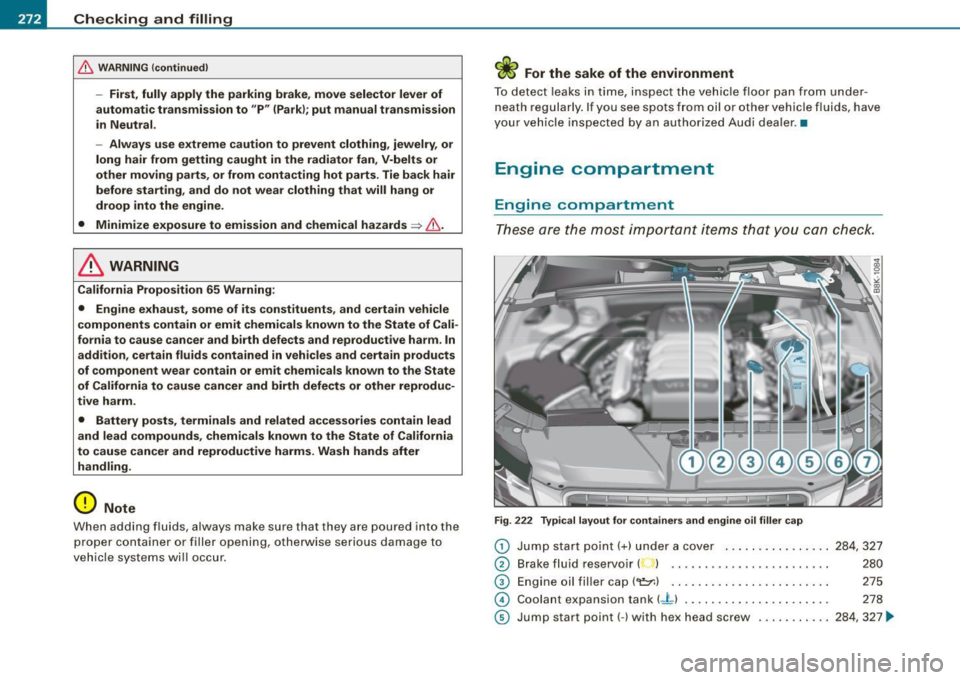
Thes e are the most impor tant items tha t yo u can check .
Fig. 22 2 Typic al l ayout for containe rs and engine oil filler cap
G) Jump start poin t(+ ) under a cover ..... .... .... ... 28 4, 327
® Brake fluid reservoir I l . . . . . . . . . . . . . . . . . . . . . . . . 280
© E ngine oil fi ller cap ("1:::r.l . . . . . . . . . . . . . . . . . . . . . . . . 275
0 Coolant expansion tank (-L l . . . . . . . . . . . . . . . . . . . . . . 278
© Jump sta rt point( -) with hex head screw ........ ... 28 4, 327 ~
Page 275 of 360
Checkin g and fillin g -
--------------~-
•
© Windshield/headlight * washer container (~ l . . . . . . . 286
0 Power steering reservoir . . . . . . . . . . . . . . . . . . . . . . . . . 239
The position of the engine oi l filling hole=> fig. 222 (item
@l can
differ depending on the engine design .
& WARNING
Befo re you che ck a nythin g in the en gin e com partment , always
read and h eed all WARNING S
=> & in "Workin g in th e e ngine
co mp artm ent " o n
page 271. •
Engine oil
Engine oil specifications
The engine oil used in your Audi needs the right kind of
oil.
T he engine in your Audi is a sophisticated power plant that was built
to exacti ng specifications . This engine needs the right kind of
engine oil that meets specifications regarding qua lity and viscosity
so that it can run smoothly and reliably. Choosing the right oil and
changing oil within the time and mileage intervals printed in your
vehicle's Warranty
& Maintenance booklet matters a lot more today
than it did years ago. Audi has developed a spec ial quality standard
for engine oi l that will help assure tha t your vehicle's engine will get
the lubr ication it needs for proper operation .
Modern engine lubrication has taken a quantum leap in the last few
years . Many synthe tic oi ls availab le today provide better engine
lubrication that can outlast traditional pet roleum-based oils ,
making them a smart choice for use throughout the life of your Audi.
Whether you use synthet ic or petroleum -based engine oil, the oi l
that you use must conform to Audi's oi l quality standard VW 502 00
to help keep your veh ic le's engine running smoothly and help prevent the formation of harmful deposits
, sometimes called
"sludge", that over time can lead to expensive repairs.
At the time of printing, engine oi ls avai lable in the U .S . and Canada
that meet the exacting specifications of Audi oil standard VW 502 00 are synthetic engine oils. This does not mean, however, that every
synthetic engine oil will meet Audi oil standard VW 502 00 . So
a lways be sure that you use an approved oi l.
To help prevent the formation of harmful deposits use only oil with
the fo llowing specifications printed on the oil container:
Audi oil sta ndard VW 502 0 0
Oil container labels may carry th e specification singly or in combi
nation with o ther designa tions and oil quality standards.
Visc osit y
Engine oils are graded according to their viscosity . The proper
v iscosity grade oi l for your engine depends on c limactic or seasona l
conditions where you drive. You can use oil wi th a viscosi ty grade of
SAE 5W40 across al l temperature ranges for normal driving condi
tions .
Howeve r, if engine oil viscosity grade SAE 5W40 is not available, you
can a lso use viscosity grade SAE 5W-30 or SAE 0W -40 as long as it
meets Audi oil qua lity standard VW 502 00 specifications.
Because engine o il that meets the Audi o il standard may not be
avai lable everywhere when you n eed it, we strongly recommend
that you a lways carry with you an extra quart (liter) of o il that
express ly conforms to the VW 502 00 specification, in case you have
to top off the oil while on the road .
Only if the level of the oil is at or below the minimum mark - and no
oi l that expressly conforms to Audi oil standard VW 502 00 specifi
cations is availab le - may you top o ff with a high qua lity engine oil,
preferably synthetic -based, that meets ACEA A3, ACEA A5 or
ACEA 85 or API SL specifications, but even then, on ly in viscosity
grades SAE 5W -40, SAE 5W -30, or SAE 0W -40. However, during the
en tire time between oil change intervals, never top off with more _,.
Vehicle care I t •
Page 276 of 360

-~_C_ h_e _c _ k_ i_n ...:::g::;...._ a_n_ d_ f_ i_ll _in -'g:::;.._ ___________________________________________ _
than a total of 0.5 qt/liter engine oil that does not conform to Audi
oi l specification VW 502 00.
For more information about engine oi l that has been approved for
your vehicle, please contact e ither your authorized Audi dealer or
Aud i Custo mer Relations at 1 (800) 822 -2834 or visit our web site at
www.audiusa.com or www.audicanada.ca. Here you will a lso find a
current list of o ils (manufacture rs, brand names etc.) that con form
to Audi oi l standard VW 502 00.
Changing the engine oil
The engine oil and oil fil ter must be changed according to the
mi leage (kilometers) and time intervals specified in your vehicle's
Warranty & Maintenance booklet. Do not exceed these intervals -
harmful deposits from old engine oil can reduce engine perfor
mance a nd can lead to expens ive eng ine repairs.
Changing the oil at the recommended intervals is so very important because the lubricating properties of oi l decrease gradual ly during
normal vehicle use. If you are not sure when you have your oil
changed, ask your authorized Audi Service Adviso r.
Under some circumstances the engine oil should even be changed more frequently . Change oil more often if you drive mostly short
distances, ope rate the vehicle in dusty areas or m ostly under stop
and -go traffic cond itions, or when you use your vehicle where
temperatu res stay below freezing point for long per iods.
Detergent additives in the oil will make fresh oil look dark after the
engine has been running for a short time. This is normal and is not
a reason to change the oi l more o ften than recommended.
Dam age or malfunctions d ue to la ck of ma inten ance
It is essential that you change your oi l a t the recommended in terva ls
using on ly engine oil that complies with Audi oil standard
VW 502 00. Your Limited New Vehicle Warranty does not cover
damag e or ma lfunctions due to failure to follow recommended
maintenance and use requirements as set forth in the Audi Owner's
Manual and War ranty & Mai ntenance booklet. Your dealer wi ll have
to deny warranty coverage unless you present to the dealer proof in the form of Service or Repair Orders that all schedu
led maintenance
was performed in a timely manner. •
Engine oil consumption
The e ngine in your vehicle depends on an adequate
amount o f oil to lubricate and cool all of its moving parts.
In order to provide effective lubrica tion and coo ling of in terna l
engine components, all interna l combustion engines consume a
cer tain amoun t of oil. Oi l consump tion varies from e ngine to engine
and may change significantly over the life of the engine. Typical ly,
engi nes w ith a specified break -in p eriod (see =>
page 243) consume
more o il during the break- in period than they consume after oil
consump tion has stabi lized .
Under normal conditions, the ra te of oil consumpt ion depends on
the quality and viscosity of the oil, the R PM (revolutions per minute)
at which the engine is operated, the ambient temperature and road
conditions. Further factors are the amount of oil di lution from water
con densa tion or fue l residue and the oxi dation leve l of t he oi l. As
any engine is subject to wear as mileage builds up, the oil consump
tion may increase over time until replacemen t of wo rn components
may become necessary.
With all these variables coming into play, no standard rate of oi l
consumptio n can be establ ished o r speci fied. There is no alternat ive
to regular and frequent checking of the oil level, see
Note .
If the yel low engine oil l evel warn ing sy mbol in t he instrumen t
cluster ._ lights up, you should check the oil level as soon as
p ossible :::::>
page 275. Top off the o il at your earliest conven ience
=>
page 275.
& WARNING
Befo re you che ck anything in the engine compartment , always
read and heed all WARNINGS
:::::> & in "Working in the engine
c ompartment " on
page 271 .
Page 277 of 360
![AUDI A5 COUPE 2010 Owners Manual Checking and filling -
-----------------=-----==-----...J
0 Note
Driving with an insufficient oil level is likely to cause severe damage
to the engine.
[ i] Tips
• The oil pressu](/img/6/57582/w960_57582-276.png "AUDI A5 COUPE 2010 Owners Manual Checking and filling -
-----------------=-----==-----...J
0 Note
Driving with an insufficient oil level is likely to cause severe damage
to the engine.
[ i] Tips
• The oil pressu")
Checking and filling -
-----------------=-----==-----...J
0 Note
Driving with an insufficient oil level is likely to cause severe damage
to the engine.
[ i] Tips
• The oil pressure warning display~ is not an indicator of the oil
level. Do not rely on it. Instead, check the oil level in your engine at
regular intervals, preferably each time you refuel, and always before
going on a long trip.
• If you have the impression your engine consumes excessive
amounts of oil, we recommend that you consult an authorized Audi
dealer to have the cause of your concern properly diagnosed. Keep
in mind that the accurate measurement of oil consumption requires
great care and may take some time. An authorized Audi dealer has
instructions about how to measure oil consumption accurately. •
Checking the engine oil level
Read oil level
Fig. 223 MMI Display;
Oil level indicator
Select: Function button [CARI> Oil level.
- Park your vehicle so that it is horizontally level. Shut
the engine off when it is at operating temperature.
Wait approx. two minutes. Read the oil level in the MMI* Display=> fig. 223. Add
engine oil if the bar of the oil level indicator is near "Min"
=>
page 275
Depending on the way the vehicle is driven and the operating condi
tions, oil consumption can be up to a 1/2 quart per 600 miles (0.5
liter per 1000 kml. Consumption may be higher within the first 3000
miles (5000 kml.
[ i] Tips
The oil level indicator in the MMI* Display is only an information
display. If the oil level is too low, a minimum oil warning appears in
the instrument cluster. Add oil
=> page 275. If the hood has been
opened, the current oil level is shown in the instrument cluster the
next time the ignition is switched on. •
Adding engine oil ~
Fig. 224 Engine
compartment; Oil filler
cap location
Before you check anything in the engine compartment,
always read and heed all WARNINGS=> & in "Working in
the engine compartment" on
page 271. .,,_
Vehicle care I I irechnical data
Page 278 of 360
-L-___:C::..:....: h:..:e :...:c :..: k..:..: i..:..n :.;;g~ a::..:n..:.. d~ f:...:. i.:.:.11 .:.:.in ..:..g~ ___________________________________________ _
-Unscrew the cap~ to the engine oil filling hole
=>
page 275, fig. 224.
Carefully top off with the appropriate oil in 0.5 liter doses.
- Screw the cap back on the filling hole and close the
engine hood.
- Check the oil level again after two minutes=>
page 275.
-Top off the oil again, if necessary.
& WARNING
• While topping off, the oil must not come in contact with hot
engine parts -fire hazard!
• The oil filler cap must be properly secured to prevent oil from
being sprayed on the hot engine and exhaust system when the
engine is running -fire hazard!
• If your skin has come in contact with the engine oil, you must
subsequently cleanse it thoroughly.
0 Note
• Check the oil level using the radio or MMI*. If the message Please
reduce oil level appears, contact your authorized Audi dealer or
other qualified workshop to have excess oil extracted if necessary.
• Audi does not recommend the use of oil additives. They may
damage the engine and adversely affect your New Vehicle Warranty.
'i> For the sake of the environment
• Under no circumstances can the oil come in contact with the
sewage network or the soil.
• Observe and follow legal regulations when disposing of empty
oil containers. •
Changing the engine oil
We recommend that have your oil changed by an autho
rized Audi dealer or a qualified service station.
Before you check anything in the engine compartment, always read
and heed all WARNINGS=>
& in "Working in the engine compart
ment" on
page 271.
The engine oil must be changed according to the intervals specified
in your Warranty
& Maintenance booklet. This is very important
because the lubricating properties of oil diminish gradually during
normal vehicle use.
Under some circumstances the engine oil should be changed more
frequently. Change oil more often if you drive mostly short
distances, operate the vehicle in dusty areas or under predomi
nantly stop-and-go traffic conditions, or have your vehicle where
temperatures remain below freezing for extended periods.
Detergent additives in the oil will make fresh oil look dark after the
engine has been running for a short time. This is normal and is not
a reason to change the oil more often than recommended.
Because of the problem of proper disposal, along with the special
tools and necessary expertise required, we strongly recommend
that you have your oil changed by an authorized Audi dealer or a
qualified service station .
If you choose to change your oil yourself, please note the following
important information:
& WARNING
To reduce the risk of personal injury if you must change the engine
oil in your vehicle yourself:
• Wear eye protection.
• To reduce the risk of burns from hot engine oil, let the engine
cool down to the touch.
~
Page 279 of 360
___________________________________________ C_ h_e _c_ k_ i_n _g _ a_n _d_ f_il _li _n _g __ fflllll
•
& WARNING (continued)
• When removing the oil drain plug with your fingers, stay as far
away as possible. Always keep your forearm parallel to the ground
to help prevent hot oil from running down your arm.
• Drain the oil into a container designed for this purpose, one
large enough to hold at least the total amount of oil
in your engine.
• Engine oil is poisonous. Keep it well out of the reach of children.
• Continuous contact with used engine oil is harmful to your
skin. Always protect your skin by washing oil off thoroughly with
soap and water.
0 Note
Never mix oil additives with your engine oil. These additives can
damage your engine and adversely affect your Audi Limited New
Vehicle Warranty.
<£> For the sake of the environment
• Before changing your oil, first make sure you know where you
can properly dispose of the used oil.
• Always dispose of used engine oil properly. Do not dump it on
garden soil, wooded areas, into open streams or down sewage
drains.
• Recycle used engine oil by taking it to a used engine oil collec
tion facility in your area, or contact a service station. •
Engine cooling system
Coolant
The engine coolant performs two functions: it keeps the
engine from overheating and it protects the engine from
freezing in the winter.
The cooling system is sealed and generally requires little attention.
The cooling system has been filled at the factory with a permanent
coolant which does not need to be changed. The coolant consists of
a mixture of water and the manufacturer's glycol -basedcoolant
additive G12++ antifreeze with anti corrosion additives (50% for USA
models; 60% for Canadian models). This mixture both assures the
necessary frost protection and protects metal components in the
engine's cooling system from corrosion and scaling. It also raises
the boiling point of the coolant.
Do not reduce the concentration of the coolant in the summer by
adding plain water.
The proportion of coolant additive must be at
least 50% but not more than 60%
to maintain antifree ze protection
and cooling efficiency. If the coolant frost protection is too low, the
coolant could freeze and damage the vehicle heating and engine
cooling system.
For year-round driving, antifreeze is added at the factory for temper
atures down to:
• -31 °F
! -35 °ci usA
• - 40°F ( - 40°CJ Canada.
You can mix the G12++ coolant additive with other additives (G12 +
or G12) . Always check with your authorized Audi dealer .
& WARNING
Before you check anything in the engine compartment, always
read and heed all WARNINGS
~ & in "Working in the engine
compartment" on
page 271.
Vehicle care I t •
Page 289 of 360
________________________________________________ T_ i _r_e _s_ a_n_ d_ w_ h_ e_e _ l_s __ lll
•
Tires and wheels
Tires
General notes
Tires may be the least appreciated and most abused parts
of a motor vehicle.
Tires may be the least appreciated and most abused parts of a
motor vehicle. Tires are, however, one of the most important parts
of a vehicle, particularly considering the comparative ly sma ll patch
of rubber on each tire that assures that all- important contact
between you, your vehicle and the road .
Maintaining the correct tire pressure, making sure that your vehicle
and its tires do not have to carry more weight than they can safely
handle, avoiding damage from road hazards and regu lar ly
inspecting tires for damage inc luding cuts , slashes irregular wear
and overa ll condition are the most important things that you can do
to help avoid sudden tire failure including tread separation and
b lowouts .
Avoiding dama ge
If you have to drive over a curb or similar obstacle, drive very slow ly
and as close as possible at a right angle to the curb.
A lways keep chemica ls includ ing grease, oil, gasoline and brake
f luid off the tires.
I nspec t the tires regularly for damage (cuts, cracks or blis ters, etc.l.
Remove any foreign bodies embedded in the treads.
Storing tires
Mark tires when you remove them to indicate the direction of rota
tion . This ensu res you to be ab le to mount them correctly when you
reinstal l them. When removed, the wheels or tires shou
ld be stored in a coo l, dry
and preferably dark place.
St ore t ires in a vertical posit ion if they a re not mounted on rims, in
a horizontal position if they are mounted on rims.
New tire s
New tires have to be broken in~&.
The tread dep th of new tires may va ry, according to the type and
make of tire and the tread pattern.
Hidden d ama ge
Damage to tires and rims is often not readily visible. If you notice
unusua l vibration or the vehicle pul ls to one side, this may indicate
that one of the tires has been damaged . The tires must be checked
immed iately by an authorized Audi dealer or qualified workshop .
Unidire ction al tir es
A unidirectio nal tire can be iden tif ied by arrows on the s idewa ll, that
point in the direction the tire is designed to rotate. You must follow
the specified direction of ro tation . This is necessary so that these
tires can deve lop their optimum characteristics regarding grip, road
noise, wear and hydroplaning resistance . For more information
~ page 318.
in. WARNING
Ne w tire s or tire s that are old , worn or damaged cann ot pro vide
m aximum cont rol and braking ability.
• New tires tend to b e slippery and mu st also be broken-in . To
redu ce the ri sk of lo sin g control , a colli sion and seriou s per sonal
inj uries , dri ve wi th spe cia l c are for t he first 350 m iles ( 560 km l.
• Driving with worn or damaged t ire s can lead to lo ss of co ntrol ,
s udd en tire failure , in clu ding a blowout a nd sudden deflation , .,,_
Vehicle care
I t •
Page 290 of 360

-~_T_ ir_e_ s_ a_ n_d _ w_ h_ e_e _l_s _________________________________________________ _
& WARNING (continued)
crashes and serious personal injuries . Have worn or damaged tires
replaced immediately.
• Tires age even if they are not being used and can fail suddenly,
especially at high speeds. Tires that are more than 6 years old can
only be used in an emergency and then with special care and at
low speed.
Glossary of tire and loading terminology
Accessory weight
means the combined weight (in excess of those standard items
which may be replaced) of automatic transmission, power steering,
power brakes, power windows, power seats, radio, and heater, to
the extent that these items are available as factory-installed equip
ment (whether installed or not).
Aspect ratio means the ratio of the height to the width of the tire in percent.
Numb ers of 55 or lower indicate a low sidewall for improved
steering response and better overall handling on dry pavement.
Bead
means the part of the tire that is made of steel wires, wrapped or reinforced by ply cords and that is shaped to fit the rim.
Bead separation means a breakdown of the bond between components in the bead.
Cord
means the strands forming the plies in the tire.
& WARNING (continued)
• Never mount used tires on your vehicle if you are not sure of
their "previous history." Old used tires may have been damaged
even though the damage cannot be seen that can lead to sudden
tire failure and loss of vehicle control.
• If you notice unusual vibration or if the vehicle pulls to one side
when driving, always stop as soon as it is safe to do so and check
the wheels and tires for damage . •
Cold tire inflation pressure
means the tire pressure recommended by the vehicle manufacturer
for a tire of a designated size that has not been driven for more than
a couple of miles (kilometers) at low speeds in the three hour period
before the tire pressure is measured or adjusted.
Curb weight means the weight of a motor vehicle with standard equipment
including the maximum capacity of fuel, oil, and coolant, air condi
tioning and additional weight of optional equipment.
Extra load tire
means a tire design to operate at higher loads and at higher infla
tion pressures than the corresponding standard tire. Extra load tires
may be identified as "XL",
"xi", "EXTRA LOAD", or "RF" on the side
wall.
Gross Axle Weight Rating ("GAWR")
means the load-carrying capacity of a single axle system, measured
at the tire -ground interfaces.
Gross Vehicle Weight Rating ("GVWR"l
means the maximum total loaded weight of the vehicle.