oil AUDI A5 COUPE 2010 Owner's Guide
[x] Cancel search | Manufacturer: AUDI, Model Year: 2010, Model line: A5 COUPE, Model: AUDI A5 COUPE 2010Pages: 360, PDF Size: 84.39 MB
Page 297 of 360
________________________________________________ T.:......... ir--=e :....:s:......: a--=n..:.. d.::..:..... w..:....:.... h :....:..:e:....:e:..: 1-=s :..._ __
•
& WARNING (continu ed )
• Incorrect tire pressure and /or under inflation can cause
in creased tire wear and can affect the handling of the vehicle and
stopping ability .
• Incorrect t ire pressures and /o r underinflat ion can also lead to
sudden tire failure, including a blowout and sudden deflation,
causing lo ss of vehicle control .
• The driver is respon sible for the correct tire pressures for all
tires on the vehicle. The applicable pre ssure values are located on
a sticker on the driver 's side 8-pillar or on the inside of the fuel
filler flap .
• Only when all tires on the vehicle are filled to the correct pres
sure , the tire pressure monitoring system * can work correctly .
• The use of incorrect tire pressure values can lead to accidents
or other damage . Therefore it is essential that the driver observe
the specified tire pressure value s for the tires and the correct pres
sures for the function of the tire pressure monitoring system *.
• Always inflate tires to the re commended and correct tire pres
sure before driving off .
• Driving with underinflated tires bend more , letting them get
too hot resulting in tread separation , sudden tire failure and loss
of control.
• Ex cessive speed and /overloading can cause heat build-up ,
s udden tire failure and lo ss of control .
• If the tire pres sure is too low or too high , the t ires will wear
prematurely and the vehicle will not handle well .
• If the tire is not flat and you do not have to change a wheel
immediately , drive at reduced speed to the nearest service station
to check the t ire pressure and add air as required.
0 Note
Dr iving wi thout valve stem caps ca n cause damage to t he tire
valves. To prevent this, always make sure that factory instal led va lve
stem caps o n all wheels are sec urely mou nted on the va lve .
c£> For the sake of the environment
Underi nflate d tir es w ill a lso inc rease the fue l consu mptio n.•
Tires and vehicle load limits
There are li m its to the a mou nt o f load or weig ht th at any ve hic le and
any tire can carry . A vehicle that is overloaded wil l not handle wel l
and is more diff icu lt to stop . Overload ing ca n no t only lead to loss
of vehic le control, but can also damage important parts of the
ve hicle a nd can lead to sud den tire failu re, i nclu di ng a bl owou t and
sudden deflat ion that can cause the vehic le to crash.
Your safety an d that of your passengers also depends on ma kin g
su re tha t load l imits are not exceeded . Vehicle load includes eve ry
body and everything in and on the vehic le. These load limits are
t echnica lly re ferred to as the ve hicle's
Gross Vehicle Weight Rating
("GVWR"l.
The "GVWR" in clu de s th e we ig ht of t he basi c veh ic le, all fac tory
insta lled accessories, a ful l tank of fuel, oil, coolant and other fluids
plus m aximu m load. The maxi mum l oad inc lude s the n umber of
passen gers that the vehicle is intended to carry !"seating capacity")
with an assumed weight of 150 lbs . (68 kg) for each passenger at a
designated seating position and the total weight of any lugga ge in
the vehicle. If you tow a trailer, the weight of the trailer hitch and the
to ngue we ig ht of th e loaded tra iler must b e included as par t of th e
vehic le load.
The
Gross Axle Weight Rating ("GAWR") is the m aximum loa d th at
can be applied at each of the vehicle's two ax les. _,,,
Vehicle care I t •
Page 300 of 360
-~_T_ ir_e_ s_ a_ n_d _ w_ h_ e_e _l_s _________________________________________________ _
Tire pr essure
Inco rrect tire pressure causes prematu re wear and can cau se
sudden tire blow-out. For this reason, tire pressure must be checked
at least once a month
~ page 293 .
Driving style
Dr iv ing fa st around curves, heavy acceleration and hard brak ing
increase tire wear.
Rotating tire s for more even wear
For all four t ires on your vehic le to have the same service life, we
recommend that the front and rea r tires are rotat ed acc ord ing to the
tire manufacturer 's suggested tire rotation intervals. Please
remembe r the f ollo wi ng :
• Tire rotat ion i nterva ls m ay d iffer from the vehic le serv ice inte r
vals outl ined in your Maintenance and Warranty Book let.
• The longer one tire is used in one location on the vehicle, t he
more it wears at certain points; the refo re, we recommend that you
f ollow the tire manu facturer's sug ges ted t ire rotat ion i nte rvals.
• Vehicles with fro nt-w hee l dr ive e xper ience more tread wear on
the front wheels compared to all -wheel drive (quattro®l .
• Please rotate tires as sh ow n~
page 297, fig. 232 .
• Extra care must be taken when rotating direction -specific tires
~ pag e 318 .
Wheel balancing
T he w heels o n new v ehic les are balanced. However, various s itua
tions during everyday driving can cause them to become unba l
anc ed, resu lti ng in vib rati ons yo u ca n usually feel thro ugh t he
steer ing whee l.
U nba la nce d w heels must be re ba lance d to avoid excessive wea r on
steering, suspension and tires. A whee l must a lso be reba lanced
when a new tire is installed.
Incorrect wheel alignment
Incorrect w hee l al ig nm ent ca n cause e xcess ive ti re wea r, impa iring
t h e s afety of th e veh ic le. If t ires show excessive wear, have the
w hee l a lig nme nt checke d by a n autho rize d Aud i deale r or qualifie d
wo rkshop.
All wheel drive
Vehic les with quattro® must always have tires of the same size,
co nstruct ion an d tread ty pe. For deta ils see ~
page 240.
& WARNING
Sudden tire failure can lead to loss of control , a crash and serious
personal injury !
• Never drive a vehicle when the tread on any tire is worn down
to the wear indicators.
• Worn tires are a safety hazard , they do not grip well on wet
roads and in crease your risk of "hydroplaning " and loss of control.
• Always keep chemicals that can cause tire damage , such as
grease, oil, gasoline and brake fluid away from tires .
• Tires age even if they are not being used and can fail suddenly ,
especially at high speeds. Tires that are more than 6 years old can
only be used in an emergency and then with special care and at
lower speeds .
• Never mount used tires on your vehicle if you are not sure of
their "previous history. " Old used tires may have been damaged
even though the damage cannot be seen that can lead to sudden
tire failure and loss of vehicle control . •
Page 307 of 360
__________________________________________________ T_ ir_e_ s_ a_ n_d _ w_ h_ e_ e_l_s __ _
•
ffi For the sake of the environment
Use summe r tires whe n weather co nditio ns perm it. Th ey are
quieter, do not wear as quic kly and reduce fue l consumption. •
Snow chains
Snow cha ins may be fitted only to the front wheels, and only to
certa in t ire s izes. Ask your author ized Aud i dea ler on wh ic h tir e
s izes snow chains can be used .
The snow c hai ns mu st have low -pro file l inks and must n ot be thicker
than 0.53 inch (13 .5 mm), including the loc k.
R emove wheel cente r covers a nd trim di scs bef ore p utting snow
c h ains on you r ve hicle=:>
0 . For sa fety reasons cove r caps must
then be fitted o ver the wheel bo lts . These a re avai lable fr om autho
r iz ed Au di deale rs.
& WARNING
Using the wrong snow chains for your vehicle or installing them
incorrectly can increase the risk of loss of control leading to
serious per sonal injury.
• Snow chains are available in different sizes. Always make sure
to follow the instructions provided by the snow chain manufac
turer.
• When driving with snow chains never drive faster than the
speed permitted for your specific snow chains.
• Always observe local regulations .
0 Note
• Remove snow chains before driving on roads not covered with
s no w to avoid da mag ing tires a nd wea ring the s now cha ins down
unnecessari ly. •
Snow chains, which come into direct contact with the wheel rim,
can s cratch or damage i t. Therefo re, ma ke s ure t hat the sn ow cha ins
are suitably covered . Check the pos itio n of the snow c hains after
driv ing a few ya rds a nd co rrec t if necessa ry . Fo llow the i nstr uct ions
from the snow chain manufacturer when doing so.
[ i ] Tips
W here snow cha ins are manda tory on certa in roads, t his no rmally
a lso a ppl ies to ve hic les with all wheel d rive. •
Wheel bolts
Wheel bol ts mus t alw ays be ti ght en ed to the corr ec t
t orque .
The de sign of whee l bolts i s matched t o the fac to ry ins tal led rims. I f
d ifferent rims are fitted, the correct wh eel bo lts with the ri ght l ength
and c orrectly s haped bo lt head s mus t be use d. T his ensu res that
w hee ls are fitted securely and that the brake sys tem func tio ns
co rrectly.
I n certa in c ircumsta nces, you may not use w heel bo lts fr om a
different vehicle -even if it is the same model=:>
page 341.
& WARNING
Improperly tightened or mainta ined wheel bolts can become loose
causing loss of control , a collision and serious personal injury .
• Always keep the wheel bolts and the threads in the wheel hubs
clean so the wheel bolts can turn easily and be properly tightened.
• Never grease or oil the wheel bolts and the threads in the wheel
hubs . They can become loose while driving if greased or oiled ,
even if tightened to the specified torque .
• Only use wheel bolts that belong to the rim being installed .
• Never use different wheels bolt s on your vehicle.
Vehicle care
I t •
Page 322 of 360
lllffl!l.,___F_ u_ s_ e_s _ a_n _ d_ b_ u_lb _ s _______________________________________________ _
Fuses and bulbs
Fuses
Replacing a fuse
A problem in the electrical system may be caused by a
blown fuse.
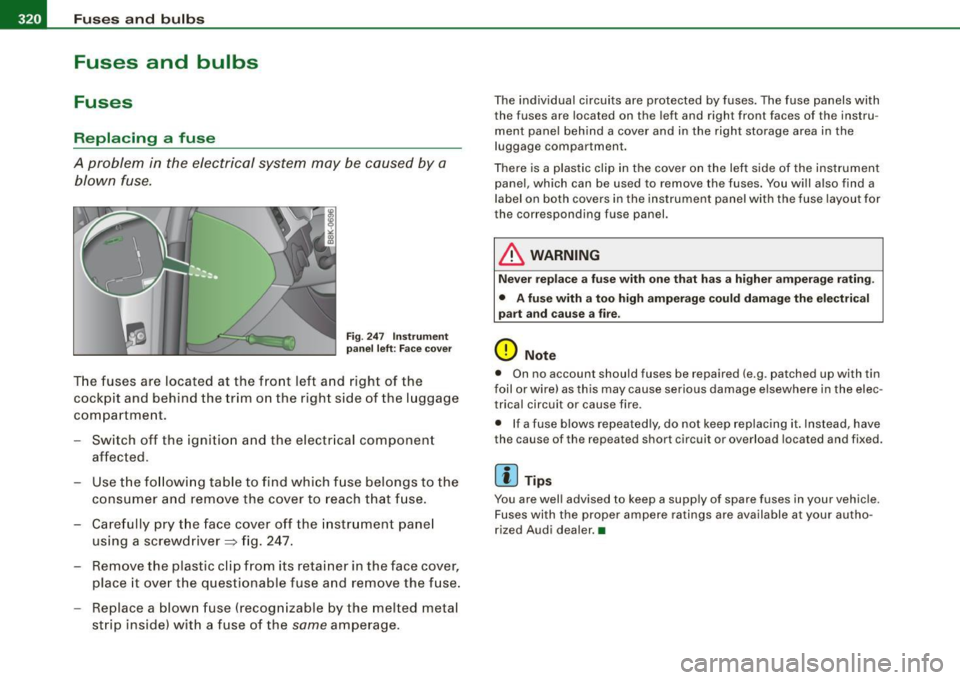
F ig . 247 Ins trume nt
pa nel l eft: Face c ov er
T he fuses are located at the front left and right of the
cockpit and behind the trim on the right side of the luggage
compartment .
- Switch off the ignitio n and the e lectr ica l component
affected.
- Use t he fo llow ing tab le to find which f use belongs to the
consumer and remove the cover to reach that f use.
- Care fully pry t he face cover off the instrument pane l
using a screwdriver =:> fig. 247 .
Remove the plastic cl ip from its retainer in the face cover,
place it over the questionable fuse and remove the fuse.
Replace a blown fuse (recogn izable by the melted metal
strip inside) with a fuse of the
same amperage .
The individual circuits are protected by fuses. The fuse panels with
the fuses are located on the left and right front faces of the instru
ment pane l beh ind a cover and in the right storage area in the
luggage compartment.
There is a plastic clip in the cover on the lef t side of the instrument
panel, which can be used to remove the fuses. You w ill also find a
l abel on both covers in the ins trument panel with the fuse layout for
the corresponding fuse panel.
& WARNING
Nev er rep lace a fu se with one t hat h as a higher amper age r ating .
• A fuse with a too high amperage co uld damage the electric al
part and cau se a fir e.
0 Note
• On no account should fuses be repaired (e.g . patched up with tin
foil or wire) as this may cause serious damage elsewhere in the elec
trical circuit or cause fire .
• If a fuse blows repeated ly, do not keep replacing it . Instead, have
the cause of the repeated short circuit or overload located and fixed.
[ i ] Tip s
You are well advised to keep a supply of spare fuses in your vehic le.
Fuses wi th the proper ampere ratings are available at your autho
rized Audi dealer. •
Page 334 of 360

-Emergency situations PW:f..._--=---=----------------
& WARNING
• To reduce the risk of serious injury and vehicle damage .
- Always lift the vehicle only at the special workshop hoist and
floor jack lift points illustrated~ page
331, fig. 257 and
~ page 331, fig. 258.
- Failure to lift the vehicle at these points could cause the
vehicle to tilt or fall from a lift if there is a change in vehicle
weight distribution and balance. This might happen, for
example, when heavy components such as the engine block or
transmission are removed.
• When removing heavy components like these, anchor vehicle
to hoist or add corresponding weights to maintain the center of
gravity. Otherwise, the vehicle might tilt or slip off the hoist,
causing serious personal injury.
0 Note
• Be aware of the following points before lifting the vehicle:
- The vehicle should never be lifted or jacked up from under
neath the engine oil pan, the transmission housing, the front or
rear axle or the body side members . This could lead to serious
damage.
- To avoid damage to the underbody or chassis frame, a rubber
pad must be inserted between the floor jack and the lift points.
- Before driving over a workshop hoist, check that the vehicle
weight does not exceed the permissible lifting capacity of the hoist .
- Before driving over a workshop hoist, ensure that there is sufficient clearance between the hoist and low parts of the
vehicle. •
Page 337 of 360
General information -
----------------
left door jamb. It shows the month and year of production and the
vehicle identification number of your vehicle (perforation) as well as
the Gross Vehicle Weight Rating (GVWR) and the Gross Axle Weight
Rating (GAWR).
The high voltage warning label
is located on the lock carrier.
The spark ignition system complies with the Canadian
standard ICES-002. •
Applies to vehicles: with MMI
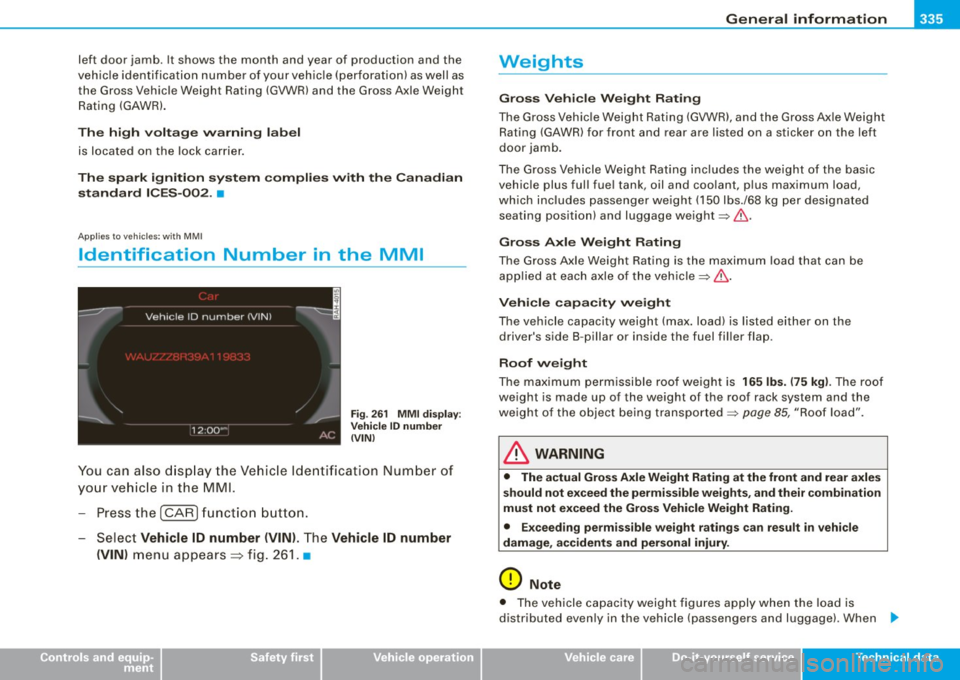
Identification Number in the MMI
Fig. 261 MMI display:
Vehicle ID number
(VIN)
You can also display the Vehicle Identification Number of
your vehicle in the MMI.
- Press the
I CAR) function button.
- Select
Vehicle ID number (VIN). The Vehicle ID number
(VIN)
menu appears =:> fig. 261. •
Controls and equip
ment Safety first Vehicle operation
Weights
Gross Vehicle Weight Rating
The Gross Vehicle
Weight Rating (GVWR), and the Gross Axle Weight
Rating (GAWR) for front and rear are listed on a sticker on the left
door jamb.
The Gross Vehicle Weight Rating includes the weight of the basic
vehicle plus full fuel tank, oil and coolant, plus maximum load,
which includes passenger weight (150 lbs./68 kg per designated
seating position) and luggage weight:::::,&.
Gross Axle Weight Rating
The Gross Axle Weight Rating is the maximum load that can be
applied at each axle of the vehicle:::::,.&,.
Vehicle capacity weight
The vehicle capacity weight (max. load) is listed either on the
driver's side B -pillar or inside the fuel filler flap.
Roof weight
The maximum permissible roof weight is 165 lbs. (75 kg). The roof
weight is made up of the weight of the roof rack system and the
weight of the object being transported:::::,
page 85, "Roof load".
& WARNING
• The actual Gross Axle Weight Rating at the front and rear axles
should not exceed the permissible weights, and their combination
must not exceed the Gross Vehicle Weight Rating.
• Exceeding permissible weight ratings can result in vehicle
damage, accidents and personal injury.
0 Note
• The vehicle capacity weight figures apply when the load is
distributed evenly in the vehicle (passengers and luggage) . When _,,
Vehicle care Do-it-yourself service Tec hn ica l da ta
Page 338 of 360
___ G_ e_n_ e_ r_ a _l _i_n _f _o _ r_ m_ a_ t_ i_ o _ n ________________________________________________ _
transporting a heavy load in the luggage compartment, carry the
load as near to the rear ax le as possible so that the vehic le's
handling is not impaired.
• Do not exceed the maximum perm issib le axle loads or the
maximum gross vehic le weight. Always remember that the vehic le's
handling wil l be affected by the extra load. Therefore , adjust your
speed according ly.
• Always o bserve local regulati ons .•
Dimensions
The s peci fica tions refer to t he basic mode l. Differences may occur
depending on the mode l type and options ordered, for examp le, tire
s izes .
0 Note
When driv ing up steep ramps, on rough roads, over curbs, etc . it is
important to remember that some parts of your vehicle, such as
spoilers or exhaust system components, may be c lose to the
ground . Be carefu l not to damage t hem. •
Page 339 of 360

___________________________________________________ D_a_ t_ a __ PII
Data
App lies to v ehicles : with 2.0 lite r 4-cy l. engine
211 hp, 2.0 liter 4-cyl. engine
En gin e data
Maximum output SAE net
Maximum torque SAE net
No _ of cylinders
Displacement
Stroke
Bore
Compression ratio
Fuel
Dim ension s (app rox.)
Length (with licence plate bracket)
Width (with outside mirrors fo lded)
Height (unloaded)
Turning circle diameter (curb to curb)
Ca pac ities (a pprox.)
F u el t ank
-Total capacity
- Reserve (of total capacity)
Wind shi eld and he adli ght * was her fluid container
E ngine oil
with filter change hp@rpm
lb-ft@ rpm
CID (cm
3
)
in (mm)
in (mm)
211 @ 4300 -6000
258
@ 1500 -4200
4
1 21 (1984)
3.65 (92.8)
3.25 (82.5)
9.6 : 1
Premium unleaded (91 AKI) Recommended for maximum engine performance. Fur
ther details =>
page 265, "Gasoline"
in (mm)
in (mm)
in (mm)
ft (ml
182.0 (4625)
73.0 (185 4)
54.0 (1372)
37 .4 (11.4)
gal Oiters)
gal (liters)
quarts (liters)
quarts (liters) 16.9 (64.0)
2.1 (8)
4 .8 (4_5)
4 .9 (4 .6)
•
Controls and equip
ment Safety first Vehicle operation
Vehicle care Do-it-yourself service Tec hn ica l da ta
Page 340 of 360
llftl __ D_a_ t_ a ___________________________________________________ _
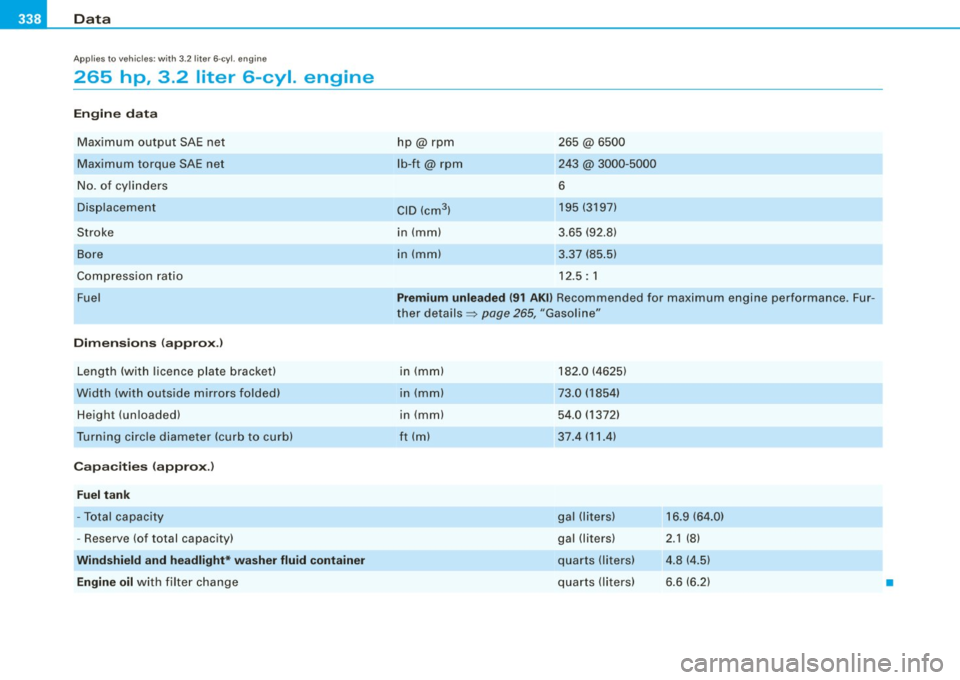
Applies to vehicles : wit h 3.2 li ter 6-c yl. en gine
265 hp , 3.2 liter 6-cyl. engine
Engine data
Max imum output SAE net
Maximum torque SAE net
No . of cy lin ders
Di spl ac eme nt
Stroke
Bo re
Comp ress ion rati o
Fuel
Dimensions (appro x.)
Lengt h (with licence plate brac ket)
Width (wit h ou ts ide mirrors folded)
Height (un loaded)
T urn ing c ircle diameter (curb to curb)
Capacities {approx .)
Fuel tank
-To tal capacity
- Rese rve (of total capacity)
Windshield and headlight* washer fluid container
Engine oil
with filter cha n ge h
p@ rpm
lb-ft@ rpm
CID (cm
3 )
in (mm)
in (m m) 265 @6500
243 @ 3000-5000
6 195 (3197)
3 .65 (92 .8)
3 .37 (85 .5)
1 2 .5: 1
Premium unleaded {91 AKll Recommended for maximum engine performance . Fur
t her deta ils =:>
pag e 265, "Gasoli ne"
i n (m m)
in (m m)
in (mm)
ft ( ml 1
82 .0 ( 4625)
73.0 (1854)
5 4 .0 ( 1372)
37 .4 (11.4 )
g al (l iters)
gal (li ters)
qua rts (liters)
q ua rts (l ite rs) 1
6.9 (64 .0)
2 .1 (8)
4. 8 ( 4.5)
6 .6 (6.2)
•
Page 342 of 360
___ C_ o_n_ s_ u_m _ e_ r_ ln_ f_ o _r _m _ a_ t_ i_o _n ______________________________________________ _
reliability. For detailed vehicle maintenance consult your Warranty &
Maintenance book let.
Und er di ffi cult ope rating cond ition s, for example at extremely low
outside temperatures, in very dusty regions, when towing a trailer
very frequen tly, etc., some service work shou ld be performed
between the intervals specified. This applies particularly to:
• oil changes, and
• cleaning or replacing the air filter.
sion standards are maintained, thus minimizing adverse effects on
the environment. •
Important considerations for you and your
vehicle
The increasing use of electronics, sophisticated fuel injection and
emission control systems, and the general ly increasing technical
complexity of today's automobi les, have steadi ly reduced the scope
of maintenance and repa irs which can be carried out by vehicle
owners.
Al so, sa fety a nd e nvironment al concerns p lace very strict
limi ts on the na ture of repairs a nd adjustments to engine and trans
mission parts which an owner can perform.
Maintenance, adjustments and repairs usually require special tools,
testing dev ices and other equipment ava ilable to specially trained
workshop personnel in order to assure proper performance, reli
ability and safety of the vehicle and its many systems.
Improper maintenance, adjustments and repairs can impair the
ope ration and re liability of your vehic le and even void your vehic le
warranty. Therefore, proof of servicing in accordance with the main
tenance schedu le may be a condition for upholding a pos sible
warranty claim made within the warranty period. Above all, operational safety can be adversely affected, creating
unnecessary r isks for you and your passengers .
If in doubt about any servicing, have it done by your authorized Audi
dea ler or any other properly equipped and qualified workshop. We
strongly urge you to give your authorized Audi dealer the opportu
nity to perform all scheduled maintenance and necessary repairs.
Your dealer has the fac ilities, origina l parts and trained spec ial ists
to keep your vehicle running proper ly.
P e rforming limited maint ena nce your self
The following pages describe a lim ited number of procedures which
can be performed on your vehicle wi th ordinary too ls, should the
need arise and trained personnel be unavai lab le. Before performing
any of these procedures, a lways thoroughly read all of the appli
cable text and carefu lly follow the instructions given. Always rigor
ously observe the
WARNINGS provide d.
Before you che ck anything in th e eng ine compartment , always read
and heed all WARNINGS~
& and~ & in "Working in the engine
compartment" on
page 271.
& WARNING
• Serio us per sonal injur y may oc cur a s a re sult of improperly
performed maintenan ce , adjustment s or repair s.
• Alway s be e xtremely careful when working on the vehi cle .
Alway s follow commonly accepted s afety pra ctice s and general
c ommon sen se . Ne ver ri sk p ers onal injury .
• Do not attempt any of the maintenan ce , check s or repair s
de scr ibed on the follo wing page s if you are not full y familia r with
the se or other procedure s with respect t o the vehicle , or are uncer
tain ho w to pr oceed .
• Do not do any work without the proper tool s and equ ipment .
Ha ve the ne cessa ry work done by your authorized Audi deale r or
another properly equipped and qu alified work shop .
~