seats AUDI A5 COUPE 2010 Workshop Manual
[x] Cancel search | Manufacturer: AUDI, Model Year: 2010, Model line: A5 COUPE, Model: AUDI A5 COUPE 2010Pages: 360, PDF Size: 84.39 MB
Page 224 of 360
-Child Safety P'll:f _______________ _
-Always make sure that the chi ld can pr operly wear t he
lap por tion of the be lt low acr oss the thighs or pelvis and
never over the stomach or abdomen.
Children up to at least 8 years old (over 40 lbs . or 18 kg) are best
protected in child safety seats designed for their age and weight.
Exper ts say that the ske le tal s tructure, particu lar ly the pe lvis, of
these children is not fully deve loped, and they must not use the
vehic le safety belts without a suitab le chi ld rest raint.
Children who are at least 4 ft. 9 in. (57 inches/1.45 meters) tall can
generally use the vehic le 's three point lap and shou lder belts . Never
use the lap belt portion of the vehic le's safety belt a lone to restrain
any chi ld, regardless of how big the child is. Always remember that
children do not have the pronounce d pelvic struc ture required for
the proper function of lap be lt portion of the vehicle's three point
lap and shou lder belts. The child' s safety abs olutely requires that a
lap belt portion of the safety belt be fastened snugly and as low as
possible aro und the pelv is. Never let the lap be lt portion of the
safety be lt pass over the child 's stomach or abdomen .
It is usua lly best to put thes e chi ldren in appropriate booster seats .
Be sure the booster seat me ets all app licable safety standards.
Booster seats raise the seating pos ition of the child and reposition
both the lap and s hou lder par ts of t he safety belt so that they pass
across the child's body in the right places. The routing of the belt
over the child's body is very important for the child 's protection,
whether or not a booster seat is used. Children age 12 and under must a lways ride in the rear seat.
In a crash, air bags must inflate wi th in a b link of an eye and with
considerab le force . In order to do its job, the airbag needs room to
inf la te so tha t it will be there to pr otec t the occ upant as the occu
pant moves forward in to the airbag .
A vehicle occupant who is out of position and too close to the airbag ge ts in t he way of an inflating a irbag. When an occupant is too
close, he or she will be struck vio lent ly and will receive serious or
poss ibly even fatal inju ry. I
n order for the airbag to offer protection, it is important that all
v eh ic le occupan ts, espec ially any c hildren, who mus t be in the fron t
seat because of exceptiona l circumstances, be properly restrained
and as far away fro m the airbag as possible . By keepi ng room
between the child's body and the front of the passenger compart
ment, the ai rbag can inflate comp lete ly and provide s upplemental
p rotectio n in ce rtai n fr ontal collis ions .
& WARNING
Not u sing a booster seat , using the booster seat improperly , incor
rectly installing a boo ster seat or using the vehicle safety belt
improperly in creases the risk of serious personal injury and death
in a collision or other emergency situation . To help reduce the risk
of serious personal injury and /or death :
• Alway s make sure to position the shoulder portion of the three
point belt over the middle of child's shoulder .
• Never let the shoulder portion of the belt rest against or acro ss
the ne ck, fa ce , c hin , or throat of the child .
• Alway s make sure the lap belt portion of the three -point belt is
worn snug and pa sses as low a s po ssible across the child' s pel vis .
Never let the belt pass over the soft abdomen.
• Failure to properly route s afety belts over a ch ild's body will
cau se severe injurie s in an accident or other emergency situation
~ page 179 .
• Children on the front seat of any car , even with Advanced
Airb ags , c an be seriou sly injured or even killed when an airbag
inflate s.
• Never let a child stand or kneel on any seat .
• Never let a child ride in the cargo a rea of you r veh icle .
• Always remember that a child leaning forward, sitting s ide
ways or out of po sition in any way during an accid ent can be
s tru ck by a deploying airbag . This will result in serious personal
injury or death . ...,
Page 225 of 360

Child Safety -
--------------------''----
& WARNING (continued )
• If you must install a booster seat on the front passenger seat
because of exceptional c ircumstances the PASSENGER AIR BAG
OFF light must come on and stay on , whenever the ignition is
switched on.
• If the PASSENGER AIR BAG OFF light does not come on and stay
on , perform the checks described
=> page 199 , "Monitoring the
Advanced A irbag System ".
• Take the ch ild restraint off the front passenger seat and install
it properly at one of the rear seat positions if the PASSENGER AIR
BAG OFF light does not stay on wheneve r the ignition is switched
on .
• Always read and heed all WARNINGS whenever using a child
restrained in a vehicle is being used=>
page 179, "Safety belts",
=> page 188, "Airbag system " and => page 213 , "Important things
to know ".•
Installing a child safety seat
Securing a child safety seat using a safety
belt
S a fety belt s fo r the rear seats and the front passen ger 's
sea t can be l ocked with t he convert ib le lock ing retra cto r
t o prope rly s ecure child saf ety s ea ts .
The s afe ty bel ts e merge ncy lo cking re trac to rs fo r th e rea r sea ts
safety belts and for the front pass enger's seat safety belt have a
c o nve rtible loc king re tr ac tor fo r child r estrai nts. The sa fe ty b elt
must be loc ked so that be lt webbin g cannot unr eel. The re trac tor
c an be activa te d to lock the safety be lt and prevent the safet y belt
w ebbi ng fr om l oos en ing up dur in g n orm al dr ivi ng . A chi ld sa fety
seat can only be properly insta lled when t he safety be lt is locked so
th at th e child and chil d sa fet y seat will sta y in p lace .
Controls and equip ment Safety first Vehicle operation A
lways remember: Even though your vehic le is equipped with an
A dva nce d Airb ag sys tem, all chi ld re n, e sp ec ially those 12 yea rs a nd
youn ger, should a lways ride in the back seat prop erly restrained for
t hei r age and weigh t.
& WARNING
Improperly installed child safety seats increase the risk of serious
personal injury and death in a collision .
• Always make sure that the safety belt retractor is locked when
installing a child safety seat . An unlocked safety belt retractor
cannot hold the child safety seat in place during normal driving or
in a crash .
• Always buckle the child safety seat firmly in place even if a
child is not sitting in it . A loose child safety seat can fly around
during a sudden stop or in a collision .
• Always make sure that the rear seat backrest to which the
center rear safety belt is attached is securely latched whenever
the rear center safety belt is being used to secure a child restraint.
• If the backrest is not securely latched , the child and the child
restraint will be thrown forward together with the backrest and
will strike parts of the vehicle interior. The child can be seriously injured or killed.
• Never install rearward -facing child safety seats or infant
carriers on the front passenger seat . A child will be seriously
injured and can be killed when the passenger airbag inflates.
• The inflating airbag will hit the child safety seat or infant
carrier with great force and will smash the child safety seat and
child against the backrest , center armrest , door or roof .
• Always install rearward -facing child safety seats or infant
c arriers on the rear seat .
• Forward-facing child safety seats or infant carriers installed on
the front passenger's seat may interfere with the deployment of
the airbag and cause serious injury to the child . ..
Vehicle care Do-it-yourself service Technical data
Page 228 of 360
___ C_h_ i_ ld _ S_ a_ f_ e_ t_y ____________________________________________ _
Deactivating the convertible locking retractor
The convertible locking retractor for child restraints will
be deactivated automatically when the belt is wound all the way back into the retractor.
- Press the red button on the safety belt buckle . The belt
tongue w ill pop out of the buckle.
- Guide the safety belt all the way back into its stowed position .
Always let the safety belt retract completely into its stowed position.
The safety belt can now be used as an ordinary safety belt without
the conv ertible locking retractor for child restraints.
If the convertible locking retractor should be activated inadvert
ently, the safety belt must be unfastened and guided completely back into its stowed position to deactivate this feature. If the
convertible locking retractor is not deactivated , the safety belt will
gradually become tighter and uncomfortable to wear.
& WARNING
Improperly installed child safety seats increase the risk of serious
personal injury and death in a collision.
• Never unfasten the safety belt to deactivate the convertible
locking retractor for child restraints while the vehicle is moving .
You would not be restrained and could be seriously injured in an
accident .
• Always read and heed all WARNINGS whenever using a child
restrained in a vehicle is being used=:>
page 213. Special precau
tions apply when installing a child safety seat on the front
passenger seat=:>
page 190, "Child restraints on the front seat -
some important things to know". •
Page 229 of 360

_____________________________________________ C_ h _ il_d _S_ a _ fe_t---= y'----"'
LATCH Lovver anchorages and tether
for children
Child Restraint System anchors and how are
they related to child safety
T o pr ovide a simpler and more practicable way to attach the child
r es traint o n the vehicle sea t, Fe deral reg ulati ons requ ire spec ial
lower anchorages in vehicles and devices on new chi ld restraints to
at tach to the veh icle an ch orag es.
T he combin ation of the tether anchora ges and the lower anchor
age s is now generally ca lled the
LATCH system fo r "L owe r Anchor
ages and Tethers for Children."
F orward -facing ch ild restraints manufactured after September 1,
1 999, ar e re qu ired by U. S. fe der al r eg ulatio ns to comp ly with new
child head movem ent performance requirements. Thes e new
pe rf ormanc e re qu ireme nts m ake a tethe r nec essa ry on mo st new
child seats.
I nsta lling a chi ld rest raint that require s a top tethe r without one can
se rious ly im pa ir the pe rf or mance o f th e ch ild rest raint a nd i ts ab ility
to protect t he child in a co llision . Instal ling a child restraint that
r e quir es a t op tet her with ou t th e to p te th er m ay be a v io la tio n of
state law.
Ch ild r estrain t ma nufact urer s offer LA TCH lo wer anc horages on
their child seats with hook -on or push -on connectors attached to
adjustab le strap s.
I n addition to the L ATCH lowe r anc horages, th ese c hild restra int
systems usually require the use of tether straps to he lp keep the
c hi ld restrai nt fi rm ly in place.
_& WARNING
Improper installation of child restraints will increase the risk of
injury and death in a crash .
Controls and equip ment Safety first Vehicle operation
& WARNING
(continued )
• Always follow the instructions provided by the manufacturer of
the child restraint you intend to install in your vehicle .
• Never install a child restraint without a properly attached top
tether strap if the child restraint manufacture r's instructions
require the top tether strap to be used .
• Improper use of child restraint LATCH lower anchorage points
can lead to injury in a collision. The LATCH lower anchorage points
are designed to withstand only those loads imposed by correctly
fitted child restraints .
• Never mount two child restraint systems on one LATCH lower
anchorage point.
• Never secure or attach any luggage or other item to the LATCH
lower anchorages.
rn Tips
I n Canad a, th e ter ms "to p t eth er" wi th "lowe r uni versa l an chorages"
(or "lower universal anchorage bars") are used to d escribe the
sys te m.
• I n other countries, the term "ISOFIX" is used to describe the
lo we r anc horages . •
Vehicle care Do-it-yourself service Technical data
Page 231 of 360

_______________________________________________ C_h _ i_ld _ S_ a_ f_ e_ t..,:c y __ lJIIII
& WARNING (continued)
• Always carefully follow the child restraints manufacturer's
instructions for proper installation of the child restraint and
proper use of the lower anchorages or safety belts in your vehicle.
• Never secure or attach any luggage or other items to the
LATCH
lower anchorages.
• Always read and heed the important information about child
restraints in this chapter and WARNINGS
~ page 213, "Child
Safety". •
Installing a child restraint with LATCH lower
anchorages
Whenever you install a child restraint always follow the
child restraint manufacturer's instructions.
Mounting
Fig . 211 Lower
anchorages: proper
mounting
- Make sure the seat back of the rear seat bench is in the
upright position and securely latched in place.
Controls and equip
ment Safety first
Vehicle operation
-Attach both hook-on connectors with the spring catch
release on the child safety seat onto the LATCH lower
anchorage so that the connectors lock into place
=> fig. 211.
-Pull on the connector attachments to make sure they are
properly attached to the LATCH lower anchorage.
- Pull straps tight following the child restraint manufac
turer's instructions.
Releasing
- Loosen the tension on the straps following the child
restraint manufacturer's instructions.
- Depress the spring catches to release the anchorage
hooks from the lower anchorages.
Remember: Use tether straps to help keep the child restraint firmly
in place .
& WARNING
Improper use of the LATCH system can increase the risk of serious
personal injury and death in an accident.
• These anchors were developed only for child safety seats using
the "LATCH" system.
• Never attach other child safety seats, belts or other objects to
these anchors.
• Always make sure that you hear a click when latching the seat
in place . If you do not hear a click the seat is not secure and could
fly forward and hit the interior of the vehicle, or be ejected from
the vehicle.
l)l,
Vehicle care Do-it-yourself service Technical data
Page 232 of 360
-Child Safety
---------..!...--------------------------------------
& WARNING
Improper installation of child restraints will increase the risk of
injury in an accident .
• Always follow the child restraint system manufacturer' s
instruction s for proper installation of the child restraint system
and proper use of tether straps as well as the lower anchorages or
safety belt s in your vehicle.
• Always read and heed the important inform ation and WARN
INGS about child safety and the installation of child restraint
systems ~
page 213 , "Child Safety ".•
Tether anchors and tether straps
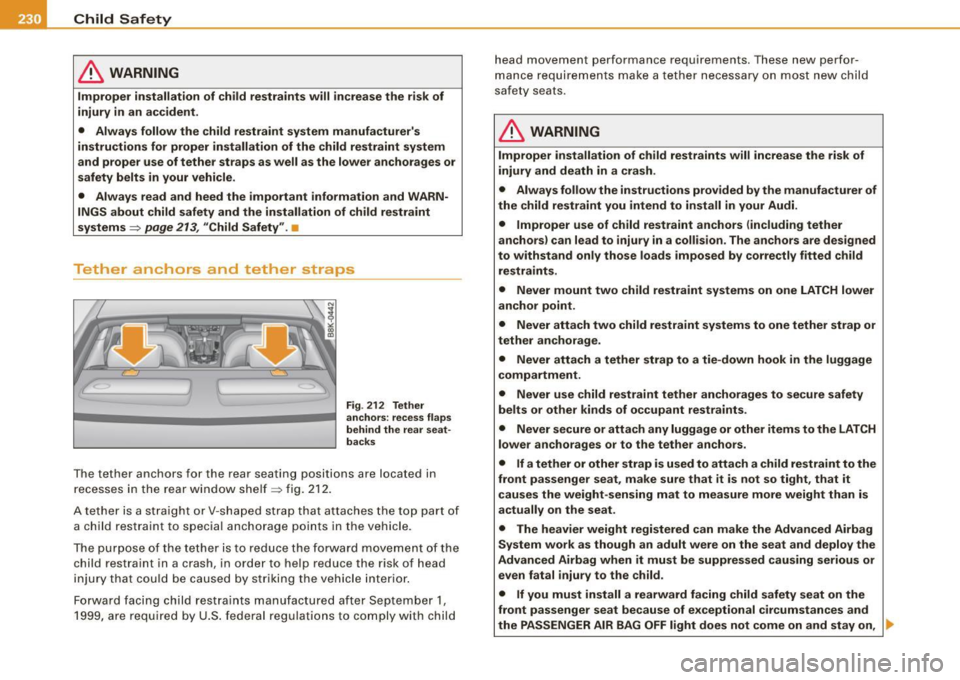
Fig . 212 Tether
anchors : re ce ss flaps
behind the rear se at
ba cks
T he tether anchors for the rear seating positions are located in
r eces ses i n the rear windo w shelf ~ fig. 2 12 .
A tether is a s traight or V -sha ped strap that attaches the top part o f
a ch ild restraint to specia l anchorage points in the vehicle .
The purp ose of th e tether is to redu ce th e forward move ment of th e
child restraint in a crash, in order to help reduce the risk of head
injury that co uld be cause d by strik ing the vehicle in te rio r.
Fo rwa rd facin g child rest ra ints manu factured after Septe mber 1,
1 999, are re q uir ed by U .S . federa l reg ulation s to comp ly wit h ch ild head movement performance requirements
. T hese new perfor
m ance req uir ements make a te th er neces sary on most new child
safety seats .
& WARNING
Improper installation of child restraints will increase the risk of
injury and death in a crash .
• Always follow the instructions prov ided by the manufacturer of
the child restraint you intend to install in your Audi .
• Improper use of child restraint anchors (including tether
anchors ) can lead to injury in a collision . The anchors are designed
to withstand only those loads imposed by correctly fitted child
restraints .
• Never mount two child restraint systems on one LATCH lower
anchor point .
• Never attach two child restraint systems to one tether strap or
tether anchorage.
• Never attach a tether strap to a tie -down hook in the luggage
compartment .
• Never use child restraint tether anchorages to secure safety
belts or other kinds of occupant restraints .
• Never secure or attach any luggage or other items to the LATCH
lower anchorages or to the tether anchors .
• If a tether or other strap is u sed to attach a child restraint to the
front passenger seat, make sure that it is not so tight, that it
causes the weight -sensing mat to measure more weight than is
actually on the seat .
• The heavier weight registered can make the Advanced Airbag
System work as though an adult were on the seat and deploy the
Advanced Airbag when it must be suppressed causing serious or even fatal injury to the child .
• If you must install a rearward facing child safety seat on the
front passenger seat because of exceptional circumstances and
the PASSENGER AIR BAG OFF light does not come on and stay on, .,
Page 233 of 360
& WARN ING !continue d)
immediate ly install the rear-f acing child safety se at in a re ar
s eating position and h ave the airb ag sy stem in spected b y your
Audi dealer . •
Installing the upper tether strap on the
anchorage
(
Installing th e teth er strap
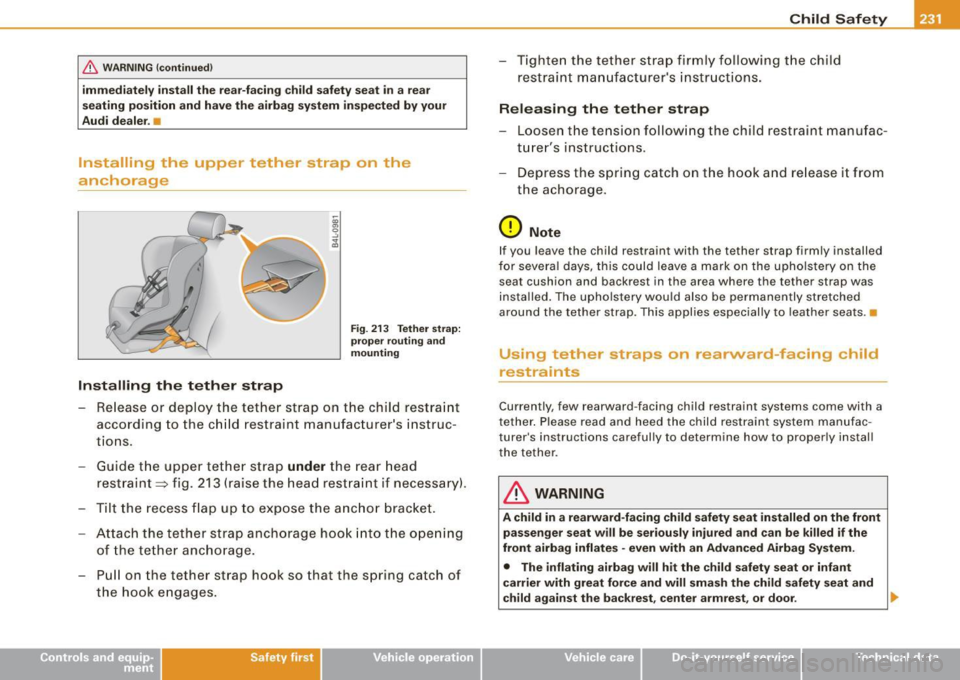
Fi g. 21 3 Teth er st rap:
p ro per r outing and
mount in g
- Release or deploy the tether strap on t he child restra int
according to the ch ild restraint manufacturer 's instruc
tions .
- Guide the upper tether strap
under the rear head
restraint ::::;, fig. 213 (raise the head restra int if necessary).
- Tilt th e recess flap up to expose the a nch or bracket .
- Attach the tether strap anchorage hoo k into the opening
of the tethe r ancho rage.
- Pull on the tether strap hook so that the spr ing catch of
the hook e ngages.
Safety first
Chil d Safety
- Tighte n the tether stra p firmly f ollo wing t he ch ild
restraint man ufacturer 's instr uctions .
Releasing th e te th er strap
- Loosen the tension follow ing the ch ild restra int manufac
t ur er's instructions.
- Dep ress the spring catch on the hook and re lease it from
the achorage.
0 Note
I f you leave the child restra int wi th the tether strap firmly installed
for severa l days, this could leave a mark on the upholstery on the
sea t cushion and backrest in the area where the tether strap was
installed . The upholstery would also be permanently stretched
around the tether strap. This applies especially to leather seats .•
Using tether straps on rearward-facing child
restraints
Currently, few rearward -facing child restraint systems come with a
tether . Please read and heed the child restraint system manufac
turer's instructions carefully to determine how to properly install
the tether .
& WARNING
A child in a rearward -facing child safety seat in stalled on the front
pa ssenge r seat w ill be seriously in jure d and can be killed if the
front airbag inflates -even with an Adv anced Airbag System.
• The inflating air bag will hit the ch ild safety se at or infant
c a rrier with great forc e and will sma sh the child safet y se at and
c hild ag ain st the b ackre st, c ent er armre st, o r door . •
Vehicle care I I irechnical data
Page 244 of 360

llffl __ ln_ t _e_ ll-'"ig ...,_ e_ n_t _t_ e_ c_ h _ n_o _ l_o _,.g= y,_ __________________________________________ _
Take into consideration that when you unlock your vehicle, some
convenience functions, such as the remote key or power seat
adjustment, may not be available. The convenience functions will be
available again when you turn on the ignition and start the engine.
With the engine turned off
If you listen to the radio, for example, with the engine turned off or
use other MMI functions, the battery is being discharged .
If starting capability is jeopardized due to energy consumption, the
following warning appears in the MMI display :
Please start engine, otherwise system will switch off in
3 minutes.
The warning indicates that the system will be turned off automati
cally after 3 minutes. If you wish to continue using the functions,
you have to start the engine .
With the engine running
Although electrical energy is generated when the vehicle is being
driven, the battery can become discharged. This happens mostly
when little energy is being generated and a great deal consumed and the battery's state of charge is not optimal.
To bring the energy balance back into equilibrium, consumers
which require especially large amounts of energy are temporarily
cut back or switched off. Heating systems in particular require a
great deal of energy. If you notice, for example, that the heated
seats* or the heated rear window are not heating, they have been
temporarily cut back or switched off. These systems will be available
again as soon as the energy balance has been restored.
You will also notice that engine idle speed has been increased
slightly . This is normal and not a cause for concern. By increasing
engine idle speed the additional energy required is generated and
the battery is charged.
Driver not ification in the instrument cluster
d isplay
If battery power drops into the range where it can limit the ability of
the engine to start, this is shown in the instrument cluster display
with the following driver message:
'-' Low battery charge: battery will be charged while driving
This notification reminds you that the starting capability of the
engine may be limited. As soon as you start driving again, the
battery will be recharged and the notification will go out.
Driver notification appears and goes out again
If this driver notification appears after the ignition is turned on or
while driving and it goes out again after a while, the battery has
been adequately recharged.
Driver notification appears and does not go out again
If this driver notification appears after the ignition is turned on or
while driving and does not go out again, the battery's state of
charge is not in the optimal range . Starting ability is restricted . Have
the battery checked as soon as possible by an authorized Audi
dealer or qualified workshop. •
Page 261 of 360
_____________________________________________ C_ l_ e _a_ n_ in_ g_a _ n_d_ p_ r_ o_ t _e_ c_t _io _ n __ lfll
•
& WA RNIN G (continu ed )
• Do not apply additi onal undercoating or ru stproofing on or
ne ar the exhau st manifold , ex haust p ipe s, cat alytic con verter or
heat shields . While driving, the s ub stan ce used for under coating
c ould overhe at and cau se a fire.
• Alway s read a nd heed all WARNINGS and other information
=> page 2 52 . •
Care of interior
A pp lies to veh ic le s: wit h MMI
MMI display
-Cle a n the MMI display with a soft c lean clo th and an LCD
cleane r.
The MM I disp lay can be c leaned with a professionally ava ilable "LCD
cleaner" . Th e cloth should be s lightly dampened with the c leaning
fluid to clean the display.
0 Note
To avoid scratching the MMI display, you should never c lean it dry .•
A pplies to veh ic les : wit h MMI
MMI terminal
- First clean t he MMI terminal with a brush to remove dust
f rom the housing .
- Th en wipe the MMI terminal with a clean, soft, s lig htly
d a mp cloth.
The MM I terminal should be c leaned with a brush first so that no
dirt is trapped between the buttons and the housing . We recom
mend giving the MMI terminal a fina l wipe with a c loth moistened
with wa ter and dish washing detergent .
0 Note
To prevent damage, make sure that no f luid ever gets into the MM I
terminal. •
Aluminum trim
Use only neutral -pH products to remove spo ts and deposits from
a luminum surfaces . Chrome care products and alka line cleaners
wi ll attack aluminum surfaces and can damage them over time .
& WARNING
Alway s re ad and heed all WARNING S and other information
=> page 252.•
Fabrics and fabric coverings
Fabrics and fabric coverings (e .g . seats, door trim pane ls, etc.l
shou ld be c leaned at regular intervals with a vacuum cleaner . T his
removes surface dirt partic les which could become embedded in
the fabric through use . Steam cleaners should not be used, because
the steam tends to push the dirt deeper into the fabric and lock it
there.
Normal cleaning
Generally, we recommend using a soft sponge or a lint -free
microfiber c loth to the clean fabric . Brushes should on ly be used for
carpets and floor mats , since other fabric surfaces could be harmed
by b rushes. .,,
Vehicle care I t •
Page 263 of 360
_______________________________________________ C_l_e _a_ n_ in _____ g ___ a_n_ d ___ p_r _o _t_ e_ c_ t _i _o _ n __ _
•
The intensity of the color determines the visual characteristics and
appearance . If the surface of the leathe r has a typica l natura l loo k,
then the leather is a nappa leather that has been left in a re latively
natural condition . This leather offers particu lar ly good comfort and
breathes well. Fine veins , closed grains, insect bites, skin folds, and
subt le variations in color remain visible . These characte ristics
demonstrate that the material is natu ral.
Natura l nappa lea ther is not covered by a color finish. It is therefore
more sensitive to soi ling and wear, which is something you need to
consider if children, anima ls or other factors m ight prove to be
particula rly ha rd on the leather.
By contrast, leather types that are covered by a colored finish layer
are more durable. This has a positive effect on the leather's resis
tance to wear and so iling in daily use. On the other hand, the typica l
characteristics of natural leather are barely or not apparent .
However, this does not mean that the leather itself is of inferior
quality.
C are and handling
Because of the exclusive nature of the types of leather that Audi
uses and the ir unique properties (such as sensitivity to oi ls, grease,
soiling, etc.I, you will need to be somewhat careful with these
lea thers, a nd a certain type o f care is requ ired . For example, dark
clothing materials can discolor leather seats (especial ly if such
cloth ing is damp and wa s not dyed correctly). Dust and dirt particles
in pores, folds, and seams can have an abrasive effect and can
damage the leather surface as we ll as weaken seams .
The leather shou ld be c leaned regularly as needed . Af ter having
been used for a relative ly long time, your leather seats will acquire
a rich a ged finish. This is a cha racteristic of natural leather and a
sign of true qua lity.
I n orde r to mai ntain the value of this natura l p roduct over the life of
your vehic le, you should fo llow the recommendations below :
0 Note
• To keep your leather from bleaching out, do not allow it to be
exposed to bright sun light for long periods of time . If you have to
leave the vehicle parked outside for long periods, cover the lea ther
to protect it from direct exposure to sunlight.
• Sharp objects on c lothing, such as zippers, rivets or sharp p ieces
on belts can leave permanent scratches or sc rape marks on the
su rface of the leather.
[ i ] Tips
• After each t ime you clean the leather and a t regular i ntervals, use
a leather preservative cream that contains UV-blockers and that
wo rks int o the leathe r. This cream wil l n ou rish and moistur ize the
leather, helping it to breathe and stay supple . It a lso helps to build
up a protec tive coating on the surface .
• Clean the leather every 2 - 3 months, and c lean any areas that get
s o iled .
• Remove fresh marks made by bal lpoint pens, ink, lipstick, shoe
polish, etc . as soon as poss ible.
• P reserve the co lor of the leather as needed by using a special
colored leather ca re cream to touch up areas o f uneven colo r. •
A pp lies to ve hic les : w it h na tu ra l lea ther
Cleaning and caring for leather upholstery
and trim
N atural leather requires special care and attenti on .
Normal cleaning
- C lean so iled areas with a slig htly mo is tened cotto n or
woole n cloth .
Vehicle care I t •