brake AUDI A5 COUPE 2010 Repair Manual
[x] Cancel search | Manufacturer: AUDI, Model Year: 2010, Model line: A5 COUPE, Model: AUDI A5 COUPE 2010Pages: 360, PDF Size: 84.39 MB
Page 254 of 360
-Cleaning and prot ection
P'tr:1-~--------------
Cleaning and protection
General information
Regular ca re p rese rves vehicle value .
Any automobile is exposed to industrial fumes, corrosive road salt ,
muddy dog feet, e tc. A wel l cared fo r Audi can look l ike new many
years after purchase . Regu lar and correct care will contribute to
maintaining the beauty and va lue of your Audi .
Fu rthe rmo re , g ood care ma y be a conditi on for sub sta ntiating a
warr anty cla im should corro sion damage or paint defect s occur .
Your authorized Audi dealer has a var iety of dedi cat ed vehicle -care
product s
and can advise which ones to use for cleaning the exterior
and interio r of your vehicle.
Whether you use products recommended by Audi or other commer
cially availab le cleaning agen ts, please make su re you apply them
correctly .
& WARNING
• Cleaning agents m ay be poi sonou s. Keep them out of the re ach
of childr en.
• Heed all cau tion label s.
• Alway s read direction s on the container before u sing any
produ ct. Follo w the dire ction s carefull y.
• Most chemi cal cle aner s are concentr ated and h ave to be
d iluted .
• Use spot remo ving fl uid s onl y
in well ventila ted are as.
• Do not use gasoline , kero sene , diesel fuel , nail poli sh remover
or other vol atil e fluid s. They may be to xic , fl ammab le or h azardou s
in other wa ys. Do not wa sh , wax or dry the vehicle w ith the igni
tion on or the engine ru nning .
& WARNING (continued )
• Do not clean the unders ide s of cha ssi s, fenders , wheel cover s,
et c. without pr ote cting y our hands and arm s. You may cut your self
on sh arp-edged metal part s.
• Moisture and i ce on brakes may impair br aking eff icien cy
~ page 237, "General information ". Test the brake s carefully each
time you wash the vehicle .
'£> For the sake of the environment
Select only environmenta lly friend ly c leaning products. Leftover
clean ing products should not disposed of in the household waste .•
Care of exterior
Washing
F requent washing protects the vehicle.
The best protection against environmental influences is frequent
washing a nd waxing. How often this is required depends on :
• How much the vehicle is used
• Where the vehic le is pa rked (garage, in the open under trees,
etc.I
• The seasonal and weather cond itions
• Environmental influences
The longer bird dropp ings, insects, tree resin, road and industrial
grime, tar, soot, road salt and other materials remain on the vehicle
b ody, the more lasting their destructive effects will be. High temper
atures caused by exposure to intense sunlight intensify the corro -
sive effect, particularly when humidity is high as wel l. .,
Page 260 of 360
___ C_ le_ a _ n_i_n ~g _ a_ n_ d __ p_r _o _t _e _c_ t_ i_o _n ___________________________________________ _
Cast (light) alloy wheels
Cast (light) alloy w heels require special care.
- Wash the wheels with a sponge or hose brush every
o th er week .
- For deep cleaning afte rwards, use only a dedicated
acid
free
cast a lloy wheel c leaner.
- Rub a coat of
liquid wa x onto the rims every t hree month.
Be sure to reac h and treat all parts of the rim.
To preserve the decorative appearance of the cast alloy wheels,
some special care is necessary. In add ition to road dirt and salt,
brake dust is also corrosive . If left on for too long, brake dust can
cause p itting.
Use on ly spec ial
acid -free cleaners formu lated for a lloy rims . Safe
products are available at your authorized Audi dealer. Never leave
t he cleaner on the rims longer than specif ied on the label. If not
rinsed off promptly, the acid contained in some cleaners can attack
t he threads on t he wheel bolts.
Never use abrasive or metal po lishing c leaning agents . If the protec
t ive coating has been chipped, e.g . by kicked up road dirt, touch it
up as soon as possible.
& WARNING
• Moi sture and ice on b rake s ma y affe ct b raking effi cienc y
=> page 23 7, " General information ". Te st the brakes carefully ea ch
t ime you wa sh the vehi cle .
• Always read and heed all WARNINGS and other informat ion
=> page 25 2. •
Body cavity sealing
T he body c avity se aling does n ot need to be c hecked .
All body cavities which could be affected by corrosion have been
th or ough ly pro tected at the factory .
T his sealing does not require any inspection or additional treat
ment . If any wax should seep out of the cavity when the ambient
temperature is high, it can be removed with a p lastic scraper and a
suitable solvent.
& WARNING
Solvent s can be dangerou s.
• Ben zine is flamm able and to xic . If you use benzine for removing
the wax , keep sparks , flame and lighted cigarettes away . Never
dump benz ine on the ground , into open streams or do wn se w age
drains .
• Be sure to observe all safet y and env ironmental regulations .
Follow all in stru ctions on the conta iner .
• Alway s read and heed all WARNINGS and other info rm ation
=> page 2 52 . •
Chassis
Have the underc oating checked for damage from time to
time.
T he lower body shell of your Audi is also thoroughly protected
against corrosion.
Any damage to the undercoating ca used by r oad ha zards shou ld be
repaired promp tly .
& WARNING
Too much undercoating in the wrong pla ces can cause a fire .
Page 273 of 360
Checking and filling IJI
--------------~-
•
Closing the engine hood
-Pull the hood down until the pressure from the struts is
reduced .
- Let the hood
drop down and latch in place. Do not try to
push it shut;
it may fail to engage => &.
& WARNING
A hood that is not completely latched could fly up and block your
view while driving.
• When you close the engine hood, check it to make sure the
safety catch has properly engaged. The hood should be flush with
the surrounding vehicle body parts.
• If you notice while driving that the hood is not secured prop
erly, stop at once and close it. •
Working in the engine compartment
Be especially careful whenever you work in the engine
compartment.
Whenever you must perform any work in the engine compartment,
for example checking and filling different fluids, there is a risk of injury, burns and accidents. To prevent personal injury always
observe the following WARNINGS. The engine compartment of any
vehicle is a hazardous area
~ & .
& WARNING
To help avoid injury, before you check anything under the hood :
• Turn off the engine.
• Remove the ignition key.
• Apply the parking brake .
& WARNING (continued)
• Move selector lever of automatic transmission to "P" (Park);
put manual transmission in Neutral .
• Always let the engine cool down. Hot components will burn
skin on contact.
• To reduce the risk of being burned, never open the hood if you
see or hear steam or coolant escaping from the engine compart
ment. Wait until no steam or coolant can be seen or heard before
carefully opening the hood .
• Keep children away from the engine compartment.
• Never spill fluids on hot engine components . They can cause a
fire.
• Never touch the radiator fan. The auxiliary electric fan is
temperature controlled and can switch on suddenly.
• Never open the coolant reservoir cap when the engine is still
warm. The coolant system is pressurized and hot coolant could
spray out.
• Protect your face, hands and arm from steam or hot engine
coolant by placing a thick rag over the cap when you open the
coolant reservoir.
• If work on the fuel system or the electrical system is necessary:
- Always disconnect the battery.
- Never smoke or work near heaters or open flames. Fluids in
the engine compartment could start a fire .
- Keep an approved fire extinguisher immediately available.
• To avoid electrical shock and personal injury while the engine
is running or being started, never touch :
- Ignition cables
- Other components of the high voltage electronic ignition
system.
• If you must perform a check or repair with the engine running: ..,
Vehicle care
I t •
Page 274 of 360
-Checking and filling
---=---------------
& W
ARNING (continued )
-First, fully apply the park ing brake, move selector lever of
automatic transmission to "P " (Park ); put manual transmission
in Neutral.
- Alway s use extreme c aution to prevent clothing , jewel ry , or
long hair from gettin g caught in the radiator fan , V-belts or
other moving parts , or from contacting hot parts. Tie back hair
before starting , and do not wear clothing that will hang or
droop into the engine .
• Minimize exposure to emission and chemi cal hazard s
=> &.
& WARNING
Californ ia Proposition 65 Warning :
• Engine exhaust , some of its constituents , and certa in vehicle
component s contain or emit chemicals known to the State of Cali
fornia to cause cancer and birth defe cts and reproductive h arm . In
addition, certain fluid s contained in vehicles and certain products
of component wear contain or emit chem icals known to the State
of California to cause cancer and birth defects or other reproduc
tive harm.
• Battery posts , terminals and related ac cessories contain lead
and lead compounds , chem icals known to the State of California
to cause cancer and reproductive harms. Wash hand s after
handling .
0 Note
When adding fluids, always make sure that the y are poured into the
proper container or filler opening, otherwise serious damage to
vehicle systems will occur .
<£' For the sake of the environment
To detect leaks in t ime, inspect th e ve hicle floor pan from unde r
neath regularly. If you see spots from oil or other vehic le fluids, have
you r ve hicle i nsp ected by a n authori zed Audi dealer .•
Engine compartment
Engine compartment
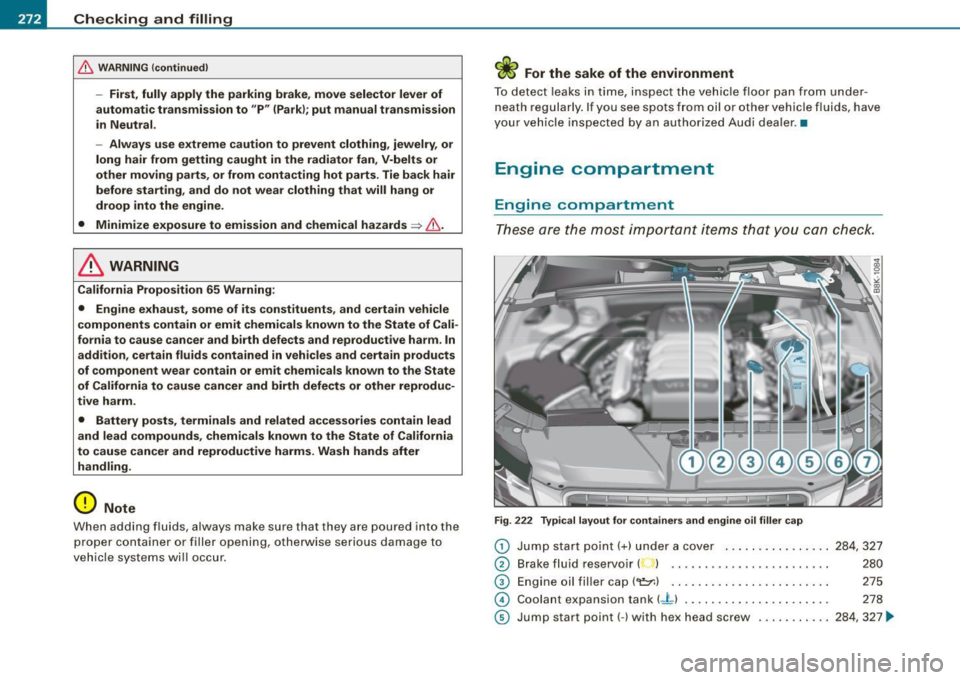
Thes e are the most impor tant items tha t yo u can check .
Fig. 22 2 Typic al l ayout for containe rs and engine oil filler cap
G) Jump start poin t(+ ) under a cover ..... .... .... ... 28 4, 327
® Brake fluid reservoir I l . . . . . . . . . . . . . . . . . . . . . . . . 280
© E ngine oil fi ller cap ("1:::r.l . . . . . . . . . . . . . . . . . . . . . . . . 275
0 Coolant expansion tank (-L l . . . . . . . . . . . . . . . . . . . . . . 278
© Jump sta rt point( -) with hex head screw ........ ... 28 4, 327 ~
Page 282 of 360

•---=C:.:h..:. e=-= c..:.k :..:.in :..:.:= g:.....= a..:.n :.:d::....:. f.:.:il .:.:li ..:.n :..::g~ --------------------------------------------
0 Not e
• Coolant pollutes the environment and cou ld cause an engine
fire. Excess coolant will be forced out through the pressure relief
valve in the cap when the engine becomes hot.
• If, in an emergency, only water can be added, the correct ratio
between water and antifreeze ~
page 277 must be restored as soon
as possible .
ci> For the sake of the environment
Dra ined coolant should not be reused . Always dispose of used
coolant whi le observing all environmental regulations. •
Radiator fan
The radiator fan switches on automatically by itself.
The rad iator fan is driven by the eng ine v ia the V-be lt . The v iscous
clutch regulates the speed of the fan according to the tempera ture
of the coo lant .
An auxiliary electric radiator fan * swi tches on and off depending on
coo lant temperature and other vehicle operating conditions.
After you switch the engine off, the auxiliary fan can continue running for up to 10 minut es -even with th e igni tion o ff. It can even
switch o n again later by itself~ & , if
• the temperature of the engine coo lant rises due to the heat
bui ld -up from the engine in the engine compartment, o r
• the engine compartment heats up because the vehic le is parked
in intense sun light.
& WARNING
• To reduce the ri sk of per sonal injury never tou ch the radiator
f a n.
& W AR N ING (continu ed )
• The auxiliary e le ctri c fan i s temperature controlled and can
s w itch on suddenly even when the engine is not running .
• The auxiliary radiator fan swit ches on automatically when the
engine coolant reache s a ce rtain temperature and will con tinue to
run until the coolant t emperatur e drop s. •
Brake fluid
Checking brake fluid level
Th e brake fluid level c an be checked with a quick glance.
Fig . 22 6 En gin e
co mp art m ent : B ra ke
fl uid re servoir
Befo re yo u c heck anything in th e en gin e compar tme nt,
always read and heed all WARNINGS~ & in "Working in
the eng ine compartment" on
page 271 .
Read the brake fl uid level from the bra ke fluid reservoir
~ fig . 226. T he b rake fluid leve l must be betwee n the
" M IN " and "MAX" markings.
The brake fluid reservoir is located at the rear partition of the engine
compartment on the left side~
page 272 . .,_
Page 283 of 360
_____________________________________________ C_h_ e_ c_k _in ~ g_ a_n _d_ f_il _li _n ~g __ _
•
The fluid level may drop slightly after some time due to the auto
m atic adjustment of the brake pads. This is not cause for alarm .
If the brake fluid level fal ls
considerably below the "MIN" mark , the
brake warning/indicator light (U.S. models :
BRAKE, Canadian models:
{(j))) will come on=> page 16 and => page 29. Do not continue to
operate the vehic le. The complete brake system should be thor
oughly checked by an author ized Audi dealer or qualified workshop
and the cause corrected . If the brake fluid level is too low, the brak e
warning/ind ica tor light will illuminate. Contact an authorized Audi
dea ler
immediatel y.
[ i J Tip s
The brake fluid reservoir is located underneath the cover. •
Changing brake fluid
Have the brake fluid changed by an experienced techni
cian.
Brake fluid absorbs moisture from the air . If th e water content in the
brake fluid is too h igh, corrosion in the brake system may result
after a period of time. The boi ling point of the brake fluid will also
decrease considerably and decrease braking performance .
Therefore , the brake fluid must be changed
ev ery tw o ye ars. Always
use new brake fluid which conforms to Federa l Motor Veh ic le Stan
dard "FMVSS 116 DOT 4".
T he brake fluid res ervoir can b e difficul t to reach, therefore, we
recommend that you have the brake fluid changed by your autho
rized
Audi de ale r. Your dealer has the correct tools, the right brake
fluid and the know -how to do this fo r you .
& WARNING
• Brake f luid i s poi sonou s. It mu st b e stored on ly in the clo sed
o riginal cont aine r out of the r eac h of childr en!
& WARN ING (c ontinued )
• Brake f ailur e can re sult fr om old or inappropriate bra ke fluid .
Ob se rve these p recauti ons:
- Use on ly brake fl uid that meet s SAE specification
J 17 03 and
c on fo rm s to Feder al Mot or Vehicle Sta ndard 11 6. Always c heck
with your authorized Audi de ale r to m ake sur e you are u sing
th e c orre ct b rake flu id . T he cor re ct t ype of br ake fluid is als o
indi cated on the brake fluid r eservoir.
- The br ake f luid mu st be ne w. H eavy u se of the b rake s can
c au se a vapor lock if the brake fluid i s left in the system to o
long. Thi s c an seriou sly affe ct the effi ciency of the brake s as
well as your safety . This could re sult in an a ccid ent .
0 Note
Brake fluid will damage the paint of your vehicle .
ffi For the sake of the environment
Because of the problem of proper disposal of brake fluid as well as
the special too ls required and the necessary expertise, we recom
mend that you have the brake fluid changed by your authorized Audi
dea ler .•
Battery
General information
Under normal operat ing conditions, the battery in your Audi does
not need any maintenance. With
high outside temperatures or long
daily drives we recommend that you have the electrolyte level
checked by an authorized Audi dealer or qualified workshop. The
e lectrolyte level should a lso be checked each time the battery is
charged
=> page 284 . ~
Vehicle care I t •
Page 289 of 360
________________________________________________ T_ i _r_e _s_ a_n_ d_ w_ h_ e_e _ l_s __ lll
•
Tires and wheels
Tires
General notes
Tires may be the least appreciated and most abused parts
of a motor vehicle.
Tires may be the least appreciated and most abused parts of a
motor vehicle. Tires are, however, one of the most important parts
of a vehicle, particularly considering the comparative ly sma ll patch
of rubber on each tire that assures that all- important contact
between you, your vehicle and the road .
Maintaining the correct tire pressure, making sure that your vehicle
and its tires do not have to carry more weight than they can safely
handle, avoiding damage from road hazards and regu lar ly
inspecting tires for damage inc luding cuts , slashes irregular wear
and overa ll condition are the most important things that you can do
to help avoid sudden tire failure including tread separation and
b lowouts .
Avoiding dama ge
If you have to drive over a curb or similar obstacle, drive very slow ly
and as close as possible at a right angle to the curb.
A lways keep chemica ls includ ing grease, oil, gasoline and brake
f luid off the tires.
I nspec t the tires regularly for damage (cuts, cracks or blis ters, etc.l.
Remove any foreign bodies embedded in the treads.
Storing tires
Mark tires when you remove them to indicate the direction of rota
tion . This ensu res you to be ab le to mount them correctly when you
reinstal l them. When removed, the wheels or tires shou
ld be stored in a coo l, dry
and preferably dark place.
St ore t ires in a vertical posit ion if they a re not mounted on rims, in
a horizontal position if they are mounted on rims.
New tire s
New tires have to be broken in~&.
The tread dep th of new tires may va ry, according to the type and
make of tire and the tread pattern.
Hidden d ama ge
Damage to tires and rims is often not readily visible. If you notice
unusua l vibration or the vehicle pul ls to one side, this may indicate
that one of the tires has been damaged . The tires must be checked
immed iately by an authorized Audi dealer or qualified workshop .
Unidire ction al tir es
A unidirectio nal tire can be iden tif ied by arrows on the s idewa ll, that
point in the direction the tire is designed to rotate. You must follow
the specified direction of ro tation . This is necessary so that these
tires can deve lop their optimum characteristics regarding grip, road
noise, wear and hydroplaning resistance . For more information
~ page 318.
in. WARNING
Ne w tire s or tire s that are old , worn or damaged cann ot pro vide
m aximum cont rol and braking ability.
• New tires tend to b e slippery and mu st also be broken-in . To
redu ce the ri sk of lo sin g control , a colli sion and seriou s per sonal
inj uries , dri ve wi th spe cia l c are for t he first 350 m iles ( 560 km l.
• Driving with worn or damaged t ire s can lead to lo ss of co ntrol ,
s udd en tire failure , in clu ding a blowout a nd sudden deflation , .,,_
Vehicle care
I t •
Page 290 of 360

-~_T_ ir_e_ s_ a_ n_d _ w_ h_ e_e _l_s _________________________________________________ _
& WARNING (continued)
crashes and serious personal injuries . Have worn or damaged tires
replaced immediately.
• Tires age even if they are not being used and can fail suddenly,
especially at high speeds. Tires that are more than 6 years old can
only be used in an emergency and then with special care and at
low speed.
Glossary of tire and loading terminology
Accessory weight
means the combined weight (in excess of those standard items
which may be replaced) of automatic transmission, power steering,
power brakes, power windows, power seats, radio, and heater, to
the extent that these items are available as factory-installed equip
ment (whether installed or not).
Aspect ratio means the ratio of the height to the width of the tire in percent.
Numb ers of 55 or lower indicate a low sidewall for improved
steering response and better overall handling on dry pavement.
Bead
means the part of the tire that is made of steel wires, wrapped or reinforced by ply cords and that is shaped to fit the rim.
Bead separation means a breakdown of the bond between components in the bead.
Cord
means the strands forming the plies in the tire.
& WARNING (continued)
• Never mount used tires on your vehicle if you are not sure of
their "previous history." Old used tires may have been damaged
even though the damage cannot be seen that can lead to sudden
tire failure and loss of vehicle control.
• If you notice unusual vibration or if the vehicle pulls to one side
when driving, always stop as soon as it is safe to do so and check
the wheels and tires for damage . •
Cold tire inflation pressure
means the tire pressure recommended by the vehicle manufacturer
for a tire of a designated size that has not been driven for more than
a couple of miles (kilometers) at low speeds in the three hour period
before the tire pressure is measured or adjusted.
Curb weight means the weight of a motor vehicle with standard equipment
including the maximum capacity of fuel, oil, and coolant, air condi
tioning and additional weight of optional equipment.
Extra load tire
means a tire design to operate at higher loads and at higher infla
tion pressures than the corresponding standard tire. Extra load tires
may be identified as "XL",
"xi", "EXTRA LOAD", or "RF" on the side
wall.
Gross Axle Weight Rating ("GAWR")
means the load-carrying capacity of a single axle system, measured
at the tire -ground interfaces.
Gross Vehicle Weight Rating ("GVWR"l
means the maximum total loaded weight of the vehicle.
Page 291 of 360

________________________________________________ T_ i _r_e _s_ a_n_ d_ w_ h_ e_e _ l_s __ lR
•
Groove
means the space between two adjacent tread ribs.
L oad ra ting (code)
means the maximum load that a tire is rated to carry for a given
inflation pressure. You may not find this information on all tires
because it is not required by law.
M ax im um l oad ra tin g
means the load rating for a tire at the maximum permissib le infla
tion pressure for that tire.
Ma ximum l oaded v ehi cle weigh t
means the sum of:
(a) Curb weight
(b) Accessory weight
(c) Vehic le capacity weight, and
(ct) Production options weight
M ax im um (p er mi ssibl e) infl ati on pr essur e
means the maximum cold inflation pressure to wh ich a tire may be
inflated. Also ca lled "maximum inflation pressure."
Normal occ upa nt wei ght
means 150 lbs. (68 kilograms) times the number of occupants
seated in the vehicle up to the to tal seating capacity of your vehicle.
O ccupant di stributi on
means distribution of occupants in a vehicle .
Outer di am eter
means the overall diameter of an inflated new tire.
O ve rall wi dth
means the linear distance between the exteriors of the sidewa lls of
an inflated tire, includ ing elevations due to labeling, decorations, or
protective bands or ribs.
Pl y
means a layer of rubber -coated para lle l cords.
P rodu ction opt io ns wei ght
means the combined weight of those installed regular production
options weighing over 5 lbs . (2.3 kg) in excess of those standard
i t ems wh ich they replace, not previously considered in curb weigh t
or accessory weight, including heavy duty brakes, ride levelers, roof
rack, heavy duty battery, and specia l trim .
Radi al p ly tire
means a pneumatic tire in which the ply cords that extend to the
beads are laid at substantially 90 degrees to the centerline of the
tread .
Reco mm ended infl ati on pr essu re
see => page 288, "Cold tire inflation pressure".
Rein force d tir e
means a tire des ign to operate at higher loads and at higher infla
tion pressures than the corresponding standard tire. Reinforced
t ires may be identi fied as "XL", "x i", "EXTRA LOAD", or "RF" on the
sidewall.
R im
means a metal support for a tire or a tire and tube assembly upon
wh ich the t ire beads are seated.
Rim di amet er
means nominal diameter of the bead seat. If you change your whee l
size, you wi ll have to purchase new tires to match the new rim diam
eter .
Rim siz e de sig nation
means rim diameter and width.
Rim wid th
means nominal distance between rim flanges.
Vehicle care I t •
Page 298 of 360
-~_T_ i_ r _e _s _ a _ n_d _ w_ h_e_ e_ l _s _____________________________________________ _
The Gross Vehicle Weight Rating and the Gross Axle Weight Rating
are listed on the safe ty comp liance st icker labe l located either on
the driver's s ide B -p illa r or on the inside of the fue l fi ller f lap. Aud i
has 4 seating positi ons, 2 in the front and 2 i n the rear f or total
seating capacity of 4. Each seat ing position has a seat belt
=> page 179, "Safety belts".
T he fact t hat there is a n up per l im it to your ve hicle's Gross Vehic le
Weight Rating means that the total we ight of whatever is being
carried in the vehic le (i nclu ding the we igh t of a traile r hitch and th e
tongue weight of the loaded trailer) is limited. The more passengers
in the ve hic le o r passen gers w ho are heavier tha n the standa rd
weights assumed mean that less weight can be carried as lug gage .
The ti re p ressu re labe l o n yo ur A udi a lso list s the maxi mum
comb ined we ight of a ll o f th e occupa nts a nd luggage o r ot her cargo
that the vehicle can carry. For the location of the la bel=>
page 291,
fig . 229.
& WARNING
Overloading a vehicle can cause loss of vehicle control , a crash or
other accident, serious personal injury , and even death.
• Carrying more weight than your vehicle was designed to carry
will prevent the vehicle from handling properly and increase the
ri sk of the loss of vehicle control.
• The brakes on a vehicle that has been overloaded may not be
able to stop the vehicle with in a safe distance .
• Tires on a vehicle that has been overloaded can fail suddenly ,
in cluding a blowout and sudden deflation , causing loss of control
and a crash .
• Always make sure that the total load being transported -
including the weight of a trailer hitch and the tongue weight of a
loaded trailer -does not make the vehi cle heavier than the
vehicle's Gross Vehicle Weight Rating. •
Determining correct load limit
Use the example below to calculate the
total weight of the passengers and luggage or other things that you plan to
transport so that you can make sure that
your vehicle will not be overloaded.
Steps for Determining Correct Load Limit
1. Locate the statement "THE COMBINED
WEIGHT OF OCCUPANTS AND CARGO
SHOULD NEVER EXCEED XXX KG OR XXX
LBS "on your vehicle's pla card (tire infla
tion pressure label)=> page 291, fig. 229.
2. Determine the combined weight of the driver and passengers that will be riding in your vehicle.
3. Subtract the combined weight of the driver and passengers from
"XXX" kilo
grams or
"XXX" pounds shown on the
sticker =>
page 291, fig. 229. ~