wheel AUDI A5 COUPE 2010 Repair Manual
[x] Cancel search | Manufacturer: AUDI, Model Year: 2010, Model line: A5 COUPE, Model: AUDI A5 COUPE 2010Pages: 360, PDF Size: 84.39 MB
Page 307 of 360
__________________________________________________ T_ ir_e_ s_ a_ n_d _ w_ h_ e_ e_l_s __ _
•
ffi For the sake of the environment
Use summe r tires whe n weather co nditio ns perm it. Th ey are
quieter, do not wear as quic kly and reduce fue l consumption. •
Snow chains
Snow cha ins may be fitted only to the front wheels, and only to
certa in t ire s izes. Ask your author ized Aud i dea ler on wh ic h tir e
s izes snow chains can be used .
The snow c hai ns mu st have low -pro file l inks and must n ot be thicker
than 0.53 inch (13 .5 mm), including the loc k.
R emove wheel cente r covers a nd trim di scs bef ore p utting snow
c h ains on you r ve hicle=:>
0 . For sa fety reasons cove r caps must
then be fitted o ver the wheel bo lts . These a re avai lable fr om autho
r iz ed Au di deale rs.
& WARNING
Using the wrong snow chains for your vehicle or installing them
incorrectly can increase the risk of loss of control leading to
serious per sonal injury.
• Snow chains are available in different sizes. Always make sure
to follow the instructions provided by the snow chain manufac
turer.
• When driving with snow chains never drive faster than the
speed permitted for your specific snow chains.
• Always observe local regulations .
0 Note
• Remove snow chains before driving on roads not covered with
s no w to avoid da mag ing tires a nd wea ring the s now cha ins down
unnecessari ly. •
Snow chains, which come into direct contact with the wheel rim,
can s cratch or damage i t. Therefo re, ma ke s ure t hat the sn ow cha ins
are suitably covered . Check the pos itio n of the snow c hains after
driv ing a few ya rds a nd co rrec t if necessa ry . Fo llow the i nstr uct ions
from the snow chain manufacturer when doing so.
[ i ] Tips
W here snow cha ins are manda tory on certa in roads, t his no rmally
a lso a ppl ies to ve hic les with all wheel d rive. •
Wheel bolts
Wheel bol ts mus t alw ays be ti ght en ed to the corr ec t
t orque .
The de sign of whee l bolts i s matched t o the fac to ry ins tal led rims. I f
d ifferent rims are fitted, the correct wh eel bo lts with the ri ght l ength
and c orrectly s haped bo lt head s mus t be use d. T his ensu res that
w hee ls are fitted securely and that the brake sys tem func tio ns
co rrectly.
I n certa in c ircumsta nces, you may not use w heel bo lts fr om a
different vehicle -even if it is the same model=:>
page 341.
& WARNING
Improperly tightened or mainta ined wheel bolts can become loose
causing loss of control , a collision and serious personal injury .
• Always keep the wheel bolts and the threads in the wheel hubs
clean so the wheel bolts can turn easily and be properly tightened.
• Never grease or oil the wheel bolts and the threads in the wheel
hubs . They can become loose while driving if greased or oiled ,
even if tightened to the specified torque .
• Only use wheel bolts that belong to the rim being installed .
• Never use different wheels bolt s on your vehicle.
Vehicle care
I t •
Page 308 of 360
-~_T_ ir_e_ s_ a_ n_d _ w_ h_ e_e _l_s _________________________________________________ _
& WARN ING (continued )
• Always maintain the correct tightening torque for the wheel
bolt s to reduce the risk of a wheel loss . If the tightening torque of
the wheel bolts is too low, they can loo sen and come out when the
vehicle is moving . If the tightening torque is too high , the wheel
bolts and threads can be d amaged and the wheel can be come
loose .
0 Note
The specified torque for the whee l bo lts is 90 ft lbs . (120 Nm) with a
tolerance of ± 7,4 ft lbs .(± 10 Nml. Torque wheel bo lts diagona lly.
Af te r cha ng ing a whe el, the torque mus t be checked as so on as
possible with a torque wrench -preferably by an authorized Audi
dea ler o r qua lified w orksh op.•
Low as pect rat io tires
Yo ur Audi is fac tory-equipped with l ow aspec t ratio tires . Thes e tires
have been thorough ly tested and been selected specifically for your
m odel f or their superb pe rformance, r oad feel and hand ling under
a variety of driving conditions . Ask your authorized Audi dealer for
m ore deta ils .
T he low aspec t rat io of these ti res is indicated by a nu meral o f
55 or
less
in the tire's si ze designation. The numeral represents the ratio
o f the tire's sid ewa ll heig ht in relat ion t o it s tread w idth express ed
in percentage. Conventiona l tires have a height/width ratio of 60 or
m ore .
The performance of low -aspect -ratio tires is particularly sensitive to
improper inflation pressure . It is therefore important that low
aspect ratio tires are inflated to the specified pres sure and that the
i nflation pressure is regularly checked and maintained . Tire pres
sures should be checked at least once a month and alway s before a
long trip ~
page 293, "Checking tire pr essure".
What you can do to avoid tire and rim damage
Lo w aspec t r ati o t ir es ca n be da maged more easi ly by impact wi th
potholes, curbs, gullies or ridges on the road, particularly if the tire
i s un derinflate d.
In order to minimize t he occurrence o f impac t damage to the t ires
of your vehicle , we recommend that you observe the following
p recau tions:
• Always ma intain recommended inflation pressures . Check your
t ire pressure every 2,000 miles (3,000 k m) and ad d air i f neces sa ry .
• D rive careful ly on roads with potholes, deep gullies or ridges.
Th e impa ct from driving throug h or over such o bstacles can
damage your tires. Impact with a curb may also cause damage to
you r ti res .
• After any impact, immediately inspect your tires or have them
inspected by the neares t autho rize d Audi deale r. R eplace a
damaged tire as soon as possib le.
• I nspect you r tir es eve ry 2 ,0 0 0 m iles (3 ,000 k m) for damage a nd
wear. Damage is not always easy to see. Damage can lead to loss of
a ir and under infla tion , wh ic h co ul d even tually cause tire fa ilu re . If
you believe t hat a tire may have been damaged , rep lace the tire as
soon as p ossi ble.
• T hese tires may wear more quickly than others .
• Please also re member th at, wh ile t hese tir es de liver respo nsive
handling, they may ride less comfortably and make more noise than
ot her c hoic es.
Reduced performance in winter /cold season
conditions
A ll tires are designed for certain purposes. The low aspect ra tio,
u ltra high per form ance t ires or ig ina lly ins tal led on yo ur ve hicle are
intended for maximum dry and wet road performance and hand ling.
Th ey a re not su itab le f or cold, sn owy or ic y weathe r co nd ition s. If
you drive under those c ircumstances, you should equip your vehic le
wi th all -season o r wi nter ti re s, w hic h offe r bett er trac tion und er
ti-
Page 309 of 360

________________________________________________ T_ i _r_e _s_ a_n_ d_ w_ h_ e_e _ l_s __ PII
•
those conditions . We suggest you use the recommended snow or
a ll- season tires specified for your vehicle, or their equivalent .
Refer to=>
page 304for more detailed informa tion regarding winter
tires .•
Tire pressure monitoring system
Ap plies to v ehicles : w it h tir e p ressure monit orin g system
General notes ..J
Each tire, including the spare (if provided), should be checked
month ly when cold and inflated to the inflation pressure recom
mended by the vehicle manufacturer on the vehicle placard or tire
inflation pressure label. (If your vehicle has tires of a different size
than the size indicated on the vehicle placard or tire inflation pres
sure label, you should determine the proper tire inflation pressure
for those tires).
As an added safety feature, your vehicle has been equipped with a
tire pressure monitoring system (TPMS) that illuminates a low tire pressure tellta le when one or more o f your tires is significantly
under-inflated . Accordingly, when the low tire pressure te llta le i llu
minates, you should stop and check your tires as soon as poss ible,
and inflate them to the proper pressure. Driving on a significantly
under -inflated tire causes the tire to overheat and can lead to tire
failure. Under-inflation also reduces fue l efficiency and tire tread
life, and may affect the vehicle's handling and stopping ability.
Please note tha t the TPMS is not a substitute for proper tire mainte
nance, and it is the driver's responsibility to maintain correct tire
pressure, even if under -inflation has not reached the level to trigger
il lumination of the TPMS low tire pressure te lltale.
Your vehicle has also been equipped with a TPMS malfunction indi
cator to indicate when the system is not operat ing proper ly. The
TPMS malfunction indicator is combined with the low tire pressure
tel ltale . When the system detects a ma lfunction, the te lltale w ill flash for approximately one minute and then remain continuously
il lum inated . This sequence will continue upon subsequent veh ic le
start-ups as long as the malfunc tion exists .
When the ma lfunction indicator is illuminated, the system may not
be able to detect or signal low tire pressu re as intended . TPMS
malfunctions may occur for a variety of reasons, including the
insta llation of replacement or alternate tires or wheels on the
vehic le that prevent the TPMS from functioning properly . A lways
check the TPMS malfunction tellta le after replacing one or more
tires or wheels on your vehicle to ensure that the replacement or
a lterna te tires and wheels allow the TPMS to continue to function
properly. •
Applies to v ehic les : w it h tire pr ess u re mon itori ng syste m
Tire pressure indicator appears
The tire pressure indicator in the instrument cluster
informs you if the tire pressure is too low or if there is a
system malfunction.
Vehicle care I t •
Fig . 23 4 D ispla y:
u n derin flat ion wa rnin g ....
Page 311 of 360

__________________________________________________ T_ ir_e _ s_ a_ n _ d_ w_ h_ e_ e_ls _ ____. 1'111
• To ensure a proper TPMS function use AUDI Original Tires which
are marked with "AO" or "RO" on the tire sidewall. =:>
page 299.
• The tire pressure monitoring system on your Audi was calibrated
using tires with the "AO" or "RO" identification. We recommend
using these tires.•
Applies 10 vehicles: with tire pressure monitor ing sys tem
Reset tire pressure monitoring system
If the tire pressure is adjusted, wheels are rotated or
changed, the TPMS must be reset via radio or MM/ *.
-Turn on the ignition.
Fig . 236 Car: Tire pres
sure monitoring
system
Select: the I CAR I function key> Tire pressure monitoring
> Store now.
[ i] Tips
Before resetting the TPMS, the current pressures of all four tires
must correspond to the specified values. Adjust the tire pressure
and reset the pressure in the tire pressure monitoring system
according to the load you are carrying =:>
page 291 . •
Vehic le care I I irechnical data
Page 312 of 360
lllffll.,___W_ h_ a _ t_d_ o_ l _d _o_ n_ o_ vv_ ? ______________________________________________ _
What do I do now?
Trunk escape handle
In case of an emergency, the rear lid can be opened from
the inside using the trunk escape handle.
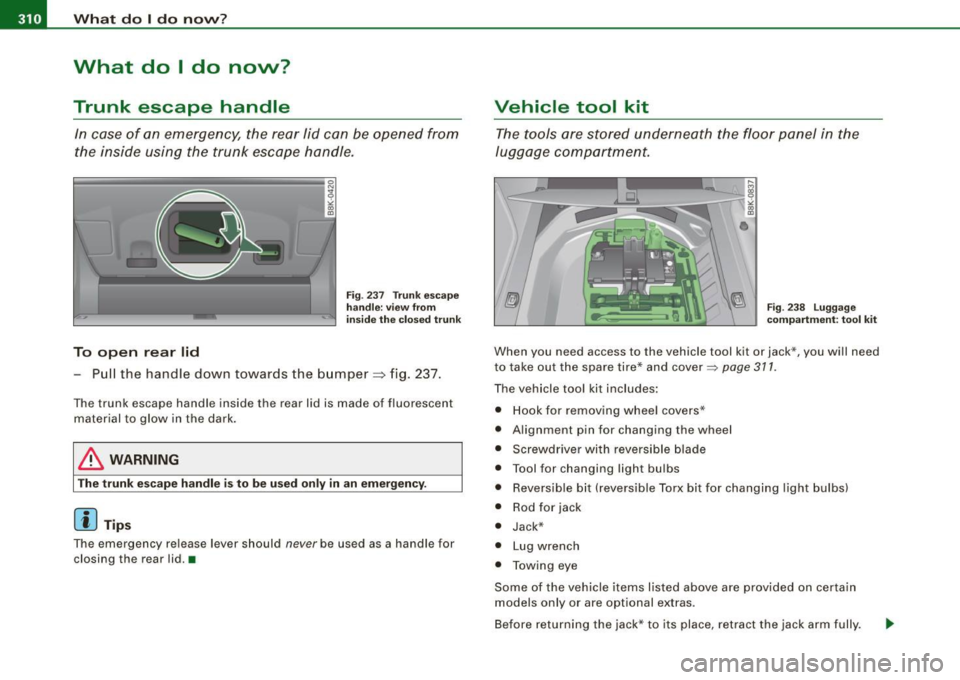
To open re ar lid
Fig . 237 Trunk escape
ha ndl e: view from
i ns ide the c lose d t run k
- Pull the hand le down towards the bumper~ fig. 237.
The trunk escape handle inside the rear lid is made of fluorescent
material to glow in the dark.
& WARNING
T he t runk e scape handl e is to be used only in an em er gen cy .
[ i ] Tip s
The emergency re lease lever should never be used as a handle for
closing the rear lid.•
Vehicle tool kit
The tools are stored underneath the floor panel in the
luggage compartment.
Fig. 238 Lu ggage
co mpartm ent : to ol ki t
When you need access to the vehicle tool kit or jack *, you will need
to take out the spare tire* and cover~
page 311 .
The vehicle tool kit includes:
• Hook for removing wheel covers *
• Alignment pin for changing the wheel
• Screwdriver wi th reversible blade
• Tool for changing light bu lbs
• Reversible b it (reversible Torx bit for changing light bulbs)
• Rod for jack
• Jack ·*
• Lug wrench
• Towing eye
Some of the vehicle items listed above are provided on certain
models only or are optional extras.
Before returning the jack * to its place, retract the jack arm fully .
Page 313 of 360

What do I do now? -
------------------
& WARNING
• Never use the screw driver hex head to tighten wheel bolts ,
si nce the bolts cannot attain the necessary tightening torque if
you u se the hex head , potentially causing an accident.
• The factory -supplied ja ck is intended only for your vehicle
model. Under no circumstances should it be used to lift heavy
vehicles or other loads ; you risk injuring yourself .
• Never start the engine when the vehicle is raised , which could
cau se an accident.
• Support the vehicle securely with appropriate stands if work is
to be performed underneath the vehi cle ; otherwise , there is a
potential ris k for injury . •
Ap plies to vehicles : w it h sp ac e-sa ving spare t ire
Space-saving spare tire (compact
spare tire)*
The spare tire/ wheel is located in the luggage compar t
ment u nder the cargo fl oo r cover. It is intended for s hort
te rm use onl y.
Fig . 2 39 Sp are tire
Removing the spare tire
Lift t he ca rgo floor by the p las tic ha ndle => fig. 239 .
Hook the han dle int o the lugg age compartment w eat he r
str ip.
Tu rn t he l arge screw => fig . 23 9 counte r-cloc kwis e.
Take out t he spa re tir e.
Unh ook the ca rgo floor befo re c losing the rear lid.
Securing the replaced tire
P lac e th e w heel with tir e in th e spare wheel well an d
sec ure t he whee l wi th the la rg e scr ew .
Unh ook the c argo floor bef or e c losing the re ar lid.
Using the spare tire (compact spare tire )
The compact spare tire is only intended fo r em ergencies until you
ca n r each a repa ir shop . Rep la ce it as quick ly as possible with a stan
dard whee l and tire.
T here are some restric tions on the use of the compact spa re tire .
The compact spare tire has been designed specifically for your type of vehic le. It must not be swapped with a compact spare tire from
another type of vehicle .
Snow chains
For technical reasons , the use of snow chains on th e compact spare
t ir e is
not permitted.
If you do have to drive with snow cha ins and a front t ire fails, mou nt
the spar e wheel with tir e instead of a rear tire. Install the snow
chains o n th e rear tire a nd use it to replace the defec tive fro nt tire . ._
Vehicle care Do-it-yourself service irechnical data
Page 314 of 360

-What do I do now?
...__ ______________
_
& WARNING
• Never use the spare tire if it is damaged or if it is worn down to
the tread wear indicators.
• If the spare tire is more than 6 years old, use it only in an emer
gency and with extreme caution and careful driving.
• The spare tire is intended only for temporary and short-term
use. It should be replaced as soon as possible with the normal
wheel and tire.
• After mounting the compact spare tire, the tire pressure must
be checked as soon as possible. The tire pressure of the compact
spare tire must be 4.2 bar; otherwise, you risk having an accident.
• Do not drive faster than 50 mph (80 km/h) . You risk having an
accident.
• Avoid full-throttle acceleration, heavy braking, and fast
cornering. You risk having an accident.
• Never drive using more than one spare wheel and tire. You risk
having an accident.
• Normal summer or winter tires must not be mounted on the
compact spare wheel rim.
• For technical reasons, the use of tire chains on the spare tire is
not permitted. If it is necessary to drive with tire chains, the spare
wheel must be mounted on the front axle in the event of a flat in a rear tire . The newly available front wheel must then be installed in
place of the rear wheel with the flat tire. Installing the tire chain
before mounting the wheel and tire is recommended.
• Loose items in the passenger compartment can cause serious
personal injury during hard braking or in an accident.
- Never store the inflatable spare tire or jack and tools in the
passenger compartment .
- Always store all jacking equipment, tools, and the inflatable spare tire in the luggage compartment.
- Tighten the knurled retaining screw for the inflatable spare
tire securely. •
Changing a wheel
Before changing a wheel
Observe the following precautions for your own and your
passenger's safety when changing a wheel.
After you experience a tire failure, pull the car well away
from moving traffic and try to reach level ground before
you stop :::;. & .
All passengers should leave the car and move to a safe
location (for instance, behind the guardrail) :::;,& .
- Engage the parking brake to prevent your vehicle from
rol ling unintentionally :::;.& .
Shift into 1st gear on vehicles with manual transmission,
or move the selector lever to the P position on vehicles
w ith automatic transm ission* .
If you are towing a trailer: unh itch the trailer from your
vehicle.
Take the jack :::;.
page 310 and the spare tire~ page 311
out of the luggage compartment.
& WARNING
You or your passengers could be injured while changing a wheel if
you do not follow these safety precautions:
• If you have a flat tire, move a safe distance off the road. Turn off
the engine, turn the emergency flashers on and use other warning
devices to alert other motorists.
• Make sure that passengers wait in a safe place away from the
vehicle and well away from the road and traffic.
~
Page 315 of 360

What do I do now? -__________________ __;__:....:....:..:: ___ J?rll
•
& WARNING (continued)
• To help prevent the vehicle from moving suddenly and possibly
slipping off the jack, always fully set the parking brake and block
the wheel diagonally opposite the wheel being changed with the
folding chocks or other objects. When one front wheel is lifted off
the ground, placing the Automatic Transmission in "P" (Park) will
not prevent the vehicle from moving.
• Before you change a wheel, be sure the ground is level and firm.
If necessary, use a sturdy board under the jack.
• After installing the inflatable spare tire, make sure that you
replace the flat tire/wheel in its storage area properly and tighten
the knurled retaining screw securely.
0 Note
If you are changing the wheel on a steep incline, use a rock or
similar object to block the opposite wheel to prevent the vehicle
from moving.
[ i] Tips
Obey all laws.•
Changing a wheel
When you change a wheel, follow the sequence described
below step-by-step and in exactly that order.
1. Remove the decorative wheel cover*. For more details
see also =>
page 314, "Decorative wheel covers".
2. Loosen the
wheel bolts=> page 315.
3. Locate the proper mounting point for the jack and align
the jack below that point=>
page 315.
4. Lift the car with the jack=> page 315.
5. Remove the wheel with the flat tire and then install the
spare tire=> page 317.
6. Tighten all wheel bolts lightly.
7.
Lower the vehicle with the jack.
8. Use the wheel bolt wrench and
firmly tighten all wheel
bolts in a crisscross pattern=>
page 315.
9. Replace the decorative wheel cover*.
_& WARNING
Always read and follow all WARNINGS and information => & in
"Raising the vehicle" on
page 315 and => page 318. •
After changing a wheel
A wheel change is not complete without the doing the
following.
- Store and secure the wheel you replaced in the spare
wheel well.
- Replace the tools and the jack in their proper location.
- Check the
tire pressure of the spare tire as soon as
possible.
- As soon as possible, have the
tightening torques on all
wheel bolts checked with a torque wrench. The correct
tightening torque is 90 ft lbs. (120 Nml.
- Have the flat tire
replaced as soon as possible.
Do-it-yourself service
Page 316 of 360
11111...__W_ h_ a _ t_d_ o_ l _d _o_ n_ o_ vv_ ? ______________________________________________ _
[ i J Tips
• If you notice that the wheel bolts are corroded and difficult to
turn while changing a tire, they should be replaced before you check
the tightening torque.
• Drive at reduced speed until you have the tightening torques
checked.a
A pplies to vehi cles : wi th dec orative wheel cove rs
Decorative wheel covers
The decorative wheel covers must be removed first to
access the wheel bolts.
Removing
Fig . 240 Changing a
wheel: removing the
wheel cover
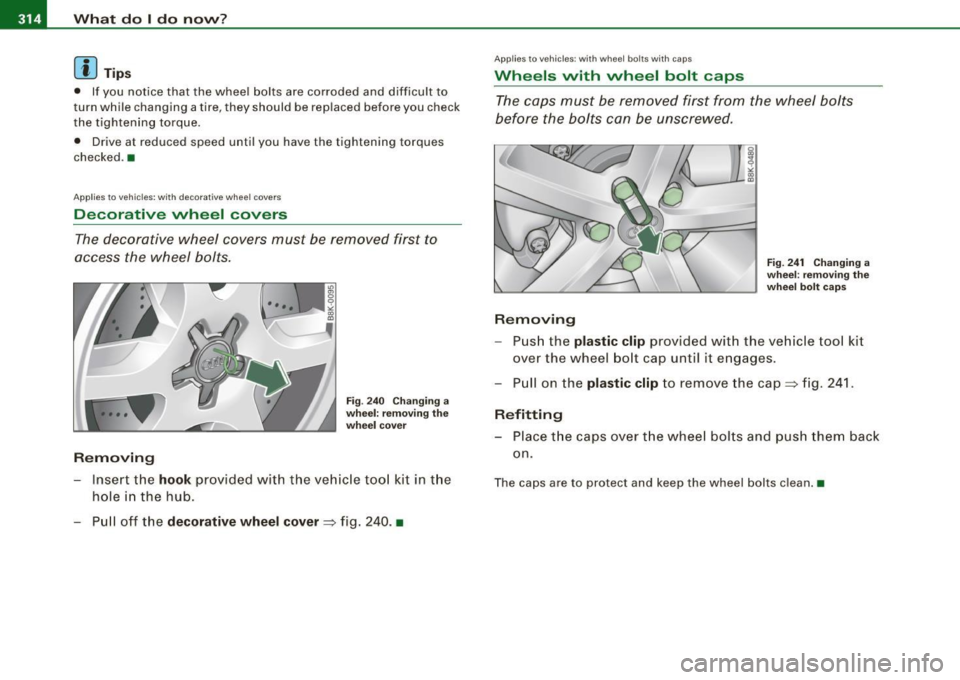
- Insert the hook provided with the vehicle tool kit in the
hole in the hub.
- Pull off the decorative wheel cover=> fig. 240. •
Applies to vehi cle s: wit h whee l bolts with cap s
Wheels with wheel bolt caps
The cops must be removed first from the wheel bolts
before the bolts can be unscrewed.
Removing
Fig. 241 Changing a
wheel: removing the
wheel bolt caps
-Push the plastic clip provided with the vehicle tool kit
over the wheel bolt cap until it engages.
- Pull on the plastic clip to remove the cap=> fig. 241 .
Refitting
-Place the caps over the wheel bolts and push them back
on.
The caps are to protect and keep the wheel bolts clean. •
Page 317 of 360

What do I do now ? 1111
------------------
Loosening and tightening the wheel bolts
The wheel bolts must be loosened before raising the
vehicle .
Loosening
Fig . 242 C han ging a
wh eel: l oose ning th e
whee l bolts
- Install the wheel bolt wren ch over the w heel bol t an d
push it d own as far as i t will go.
Take tight hold of the
end o f the w rench ha ndle and turn
the wheel bolts
c ounter- clockwi se about one single turn
in the di rection of arrow=::, fig . 242.
Tightening
- Install the wheel bolt wren ch over the w heel bolt and
push it down as far as it will go.
- Take tight hold of the
end of the wrench han dle and turn
each wheel bolt
clockwise until it is seated .
& WARNING
• Do not use for ce or hu rry when ch ang ing a whee l - you can
ca use th e vehicle t o slip off th e jack a nd cause ser ious p erso nal
inj urie s.
& W ARNING (continued )
• Do n ot loo sen the wh eel bolt s more than one turn before y ou
rais e the vehicle with the jack . - You ri sk an injur y.
[ i ] Tip s
• Never use the hexagona l socket in the handle of the screwdriver
to loosen or tighten the wheel bolts .
• If a wheel bolt is
very tight, you may find it easier to loosen by
carefully pushing down on the end of the whee l bolt wrench with
one foot only . As you do so , hold on to the car to keep your balance
and take care not to slip. •
Raising the vehicle
The vehicle must be lifted with the jack first before the
wheel can be removed .
Vehicle care
Fig. 243 Cha nging a
w he el: m oun ting
poi nts for the jack ..
Do-it-yourself service irechnical data