belt AUDI A5 COUPE 2011 User Guide
[x] Cancel search | Manufacturer: AUDI, Model Year: 2011, Model line: A5 COUPE, Model: AUDI A5 COUPE 2011Pages: 362, PDF Size: 84.88 MB
Page 88 of 362
Seats and storage Unlocking and tipping seatback forward
- When you pull the release lever~ page 85, fig. 83 in the
direction of the arrow, the safety knob©~
page 85,
fig. 84 pops out far enough for the red marking on knob to
be visible.
- Tilt the seatback forward.
Raising the seatback
-Raise the seatback until it is securely latched~& . When
you can no longer see the red mark on the safety knob©
~ page 85, fig. 84, the seat is latched.
The correctly latched seatback (basic position) can be locked and
unlocked with the mechanical key . This prevents any entry from the
vehicle interior into the luggage compartment.
Enlarging the cargo capacity of the luggage compartment is only
possible when the seatback has not been locked with the mechanical
key.
& WARNING
• The backrest must always be securely latched so that the safety
belt of the center seating position can work properly to help
protect the occupant.
• The backrest must be securely latched in position so that no
items contained in the luggage compartment can slide forward
upon sudden braking.
• Always check whether the latch is fully engaged by pulling the
seatback forward.
• Never allow safety belts to become damaged by being caught
in door or seat hardware.
• Torn or frayed safety belts can tear and damaged belt hardware
can break in a crash. Inspect the belts periodically. Belts showing
& WARNING (continued)
damage to webbing, bindings, buckles, or retractors must be
replaced.
0 Note
• If you move the front seat back when the rear seat backrest is
folded forward, you cou ld damage the head restraints on the rear
seat.
• Slide the be lt guide on the outs ide safety be lt all the way up
before folding the backrest back forward. Make sure the seat belt is
not pinched or damaged when the rear seat backrest if folded back.
Other objects should be removed from the rear seat bench to protect
the seatback from damage. •
Applie s to v eh icl es: wi th fol ding rear se a tback
Locking the seatback
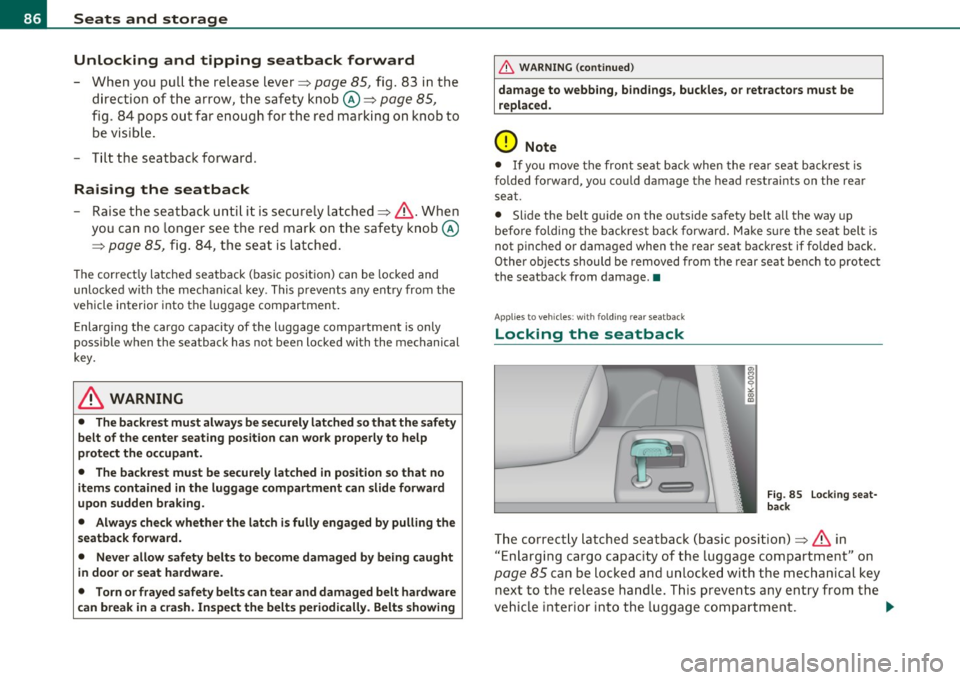
~. Fig. SS Locking seat
back
The correctly latched seatback (basic position) ~ & in
"Enlarging cargo capacity of the luggage compartment" on
page 85 can be locked and unlocked with the mechanical key
next to the release handle. This prevents any entry from the
vehicle interior into the luggage compartment.
Page 90 of 362
Seats and storage
-Close the rear lid .
_6 WARNING
Objects must only be tran sported in th e ski sack s ince the ski sack
can be secured. Indi vidual objects ca nnot be secured . There is a
ri sk of injur y.
[I] Tips
• You can open the pass-thro ugh from the luggage compartment.
Push the release button down and push the cover forward .
• T he pass- through can be locked and unlocked with the vehicle
mechanical key=>
page 87, fig. 86 . •
App lies to vehicles : w ith ski s ac k
Securing the ski sack
The ski sack must be secured in the luggage compart
ment .
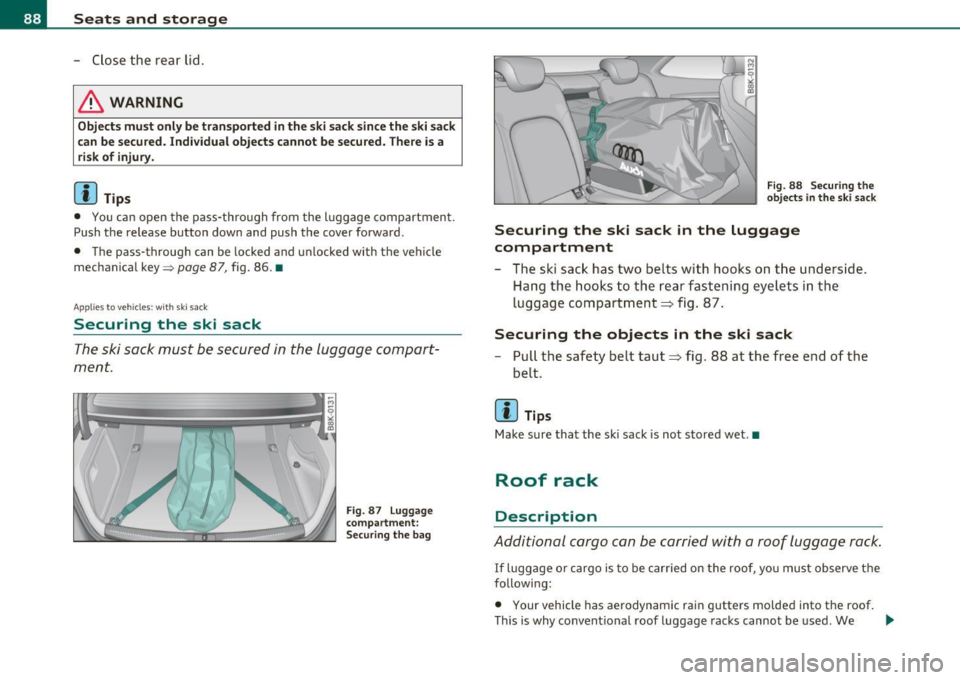
Fig. 87 L uggage
co mpa rt m ent :
Secu ring th e b ag Fig. 8
8 Securing the
o bjects in the s ki sack
Securing the ski sack in the luggage
compartment
- The ski sack has two be lts with hooks on the unders ide .
Hang the hooks to the rear fastening eyelets in the
luggag e compar tm ent => fig . 87.
Securing the objects in the ski sack
- Pull the safety belt taut::::> fig. 88 at the free e nd of the
belt.
[I] Tips
Make sure that the sk i sack is not stored wet .•
Roof rack
Description
Additional cargo can be carried with a roof luggage rack .
If luggage or cargo is to be carried on the roof, you must observe the
following:
• Your vehicle has aerodynam ic rai n gutters molded into the roof.
T his is why co nvent ional roof luggage racks cannot be used . We .._
Page 120 of 362

_____ o_ n_ t_h _e_ r_o _a _ d ________________________________________________ _
When stopping at a traffic signal or stopping in city traffic on vehicles
with an automatic transmission, the parking brake can be applied.
The vehicle does not have to be held with the footbrake . The parking
brake eliminates the tendency to creep with a drive range engaged.
As soon as you drive
off as usual, the parking brake is released auto
matically and the vehicle starts to move.
Starting on slopes
When starting on inclines, the starting assist prevents the vehicle
from unintentionally rolling back. The braking force of the parking
brake is not released until sufficient driving force has been built up at
the wheels .
[I) Tips
For safety reasons, the parking brake is released automatically only
when the driver 's safety belt is engaged in the buckle. •
Starting off with a trailer
To prevent rolling back unintentionally on an incline, do
the following:
- Keep the switch pulled and depress the accelerator. The
parking brake stays applied and prevents the vehicle from
rolling backward.
- You can release the switch once you are sure that you are
developing enough driving force at the wheels by
depressing the accelerator.
Depending on the weight of the rig (vehicle and trailer) and the
severity of the incline, you may roll backwards as you start. You can
prevent rolling backwards by holding the parking brake switch pulled
out and accelerating -just as you would when starting on a hill with a
conventional hand brake. •
Emergency braking
In the event that the conventional brake system fails or
locks.
- In an emergency, pull the switch and continue to pull it to
slow your vehicle down with the parking brake .
- As soon as you release the switch or accelerate, the
braking process stops.
If you pull the switch and hold it above a speed of about 5 mph (8
km/h), the emergency braking function is initiated. The vehicle is
braked at all four wheels by activating the hydraulic brake system.
The brake performance is similar to making an emergency stop:::>& .
In order not to activate the emergency braking by mistake, an audible
warning tone (buzzer) sounds when the switch is pulled. As soon as
the switch is released, or the accelerator pedal is depressed, emer
gency braking stops.
& WARNING
Emergency braking should only be used in an emergency, when
the normal foot brake has failed or the brake pedal is obstructed.
Using the parking brake to perform emergency braking will slow
your vehicle down as if you had made a full brake application. The laws of physics cannot be suspended even with ESP and its associ
ated components (ABS, ASR, EDS). In corners and when road or
weather conditions are bad, a full brake application can cause the
vehicle to skid or the rear end to break away· risking an accident. •
Driver messages in the instrument cluster
Warning Vehicle incline is excessive
This message appears when the parking brake is applied on an incline
that exceeds about 30%. ._
Page 121 of 362
_________________________________________________ O_ n_ t_ h_ e_ r _o_ a_d _--J_
In this case the braking power of the parking brake may not be
adequate
to prevent the vehicle from rolling unintentionally.
Please release parking brake
Please note that for safety reasons the parking brake is released auto
matically only if the driver's seat belt is fully engaged in the buckle.
To release the parking brake press the brake pedal
This driver message appears when the switch to release the parking
brake was pressed. The parking brake can only be released if you step
on the brake pedal and at the same time press the switch or you auto
matically release the parking brake with the starting assist
=>
page 117 .
' Parking brake!
This driver message appears together with the yellow , symbol
when there is a parking brak e malfunction.
Malfunction starting assist
Th is dr iver message appears if there is a starting assist malfunction.
The automatic release of the parking brake when starting is malfunc
tioning. You have to release the parking brake manually by pressing
the switch. Have the problem corrected by an authorized Audi
dealer. •
Contro ls a nd e quip
m en t Vehicle
OP-eration
Cruise control
Switching on
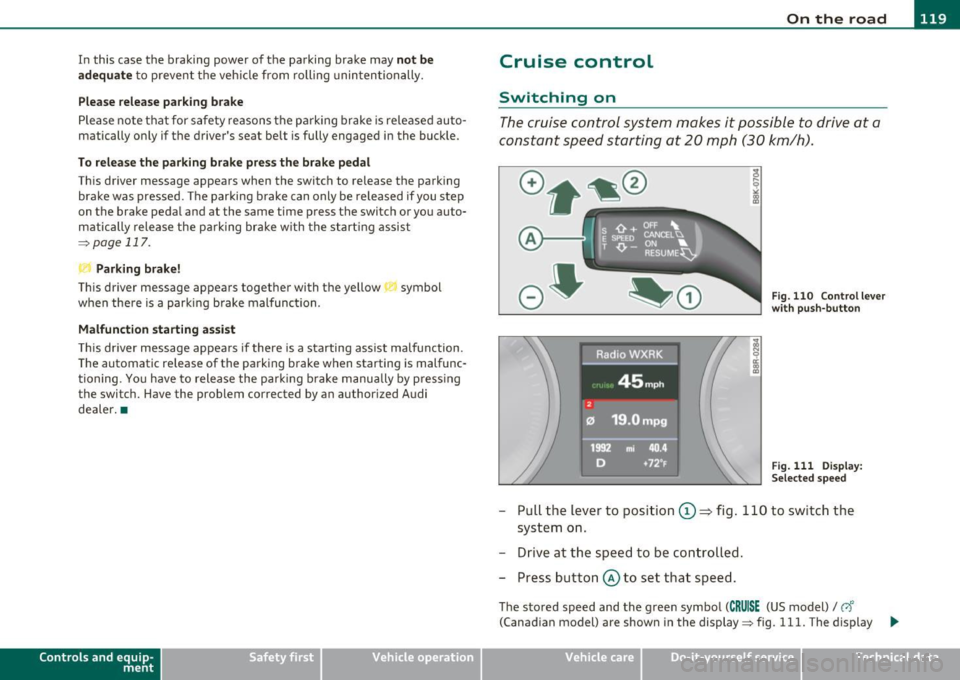
The cruise control system makes it possible to drive at a
constant speed starting at 20 mph (30 km/h).
A,.....__
Fig. 110 Control lever
with push-button
Fig. 111 Display:
Selected speed
- Pull the lever to position ©==> fig . 110 to switch the
system on.
- Drive at the speed to be controlled.
- Press button @ to set that speed.
The stored speed and the green symbol (CRUISE (US model)/ 0'
(Canadian model) are shown in the display => fig. 111. The display _.,
Vehicle care Do-it-yourselt service iTechnical data
Page 172 of 362
........ _D_ r_iv _i_ n .... g=-- S_ a_f _e _Ly :,.._ ______________________________________________ _
Driving Safely
General notes
Safe driving habits
Please remember -safety first!
Th is chapter contains important information, t ips, instructions and
warnings that you need to read an d observe fo r you r own safe ty, the
safety of you r passengers and others . We have summarized here
w hat you need to know about sa fety belts, airbags, child restra ints as
we ll as child safety . You r safety is for us
priority number 1. Always
observe the information and warnings in this section -for your own
safety as well as t hat of your passengers.
The informat ion in this section applies to all mode l versions of yo ur
veh icle . Some of the fe atures des cribed in this se ctions m ay be st an
dard equ ipment on some models, or may be optional eq uipment on
others. If you a re not sure, ask your a uth o rized Audi dealer.
& WARNING
• Always make sure that you follow the instructions and heed
the WARNINGS in th is Manual. It is in your interest and in the
intere st of your passengers.
• Always keep the complete Owner's Literatu re in your Audi
when you lend or sell your vehicle so that this important informa
tion will always be available to the driver and passengers .
• Always keep the Owner's literature handy so that you can find
it easily if you have questions . •
Safety equipment
The safety features are part of the occupant restraint
s y stem and wor k together to he lp reduce the ris k of injury
in a wide variety of accident situations.
Your sa fety and t he safety o f yo ur passenge rs shou ld no t be left to
chance . Adva nces in technology have made a variety of features avai l
a b le to help re duce the risk of injury in an a cc ident . The fo llow ing is a
list of jus t a few of the safety features in your Audi:
• sophisticated safety belts for driver and a ll passenger seating
p osi tion s,
• belt force limiters for the seats,
• belt pr etensioners fo r th e sea ts,
• hea d restrain ts f or eac h se ating posi tion,
• front airbags,
• side airbags i n the fro nt s eats,
• side c urtain air bags,
• special LATCH anchorages for chi ld restraints,
• a djustable stee ring co lumn.
These ind ividual safety feat ures, can work together as a system to
he lp protec t you and yo ur passengers in a wide r ange of accide nts.
T hese feat ures ca nnot work as a system if they are not a lways
co rrect ly adjusted and correct ly used.
Safety is everybody' s responsibility! •
Page 173 of 362
Driving Safely ---------------------"~'---
Important things to do before driving
Safety is everybody's job! Vehicle and occupant safety
always depends on the informed and careful driver.
For your safety and the safety of your passengers, before
driving always:
- Make sure that all lights and signals are operating
correctly.
- Make sure that the tire pressure is correct.
- Make sure that all windows are clean and afford good visi-
bility to the outside.
- Secure all luggage and other items carefully::::>
page 93.
-Make sure that nothing can interfere with the pedals.
- Adjust front seat, head restraint and mirrors correctly for your height .
- Instruct passengers to adjust the head restraints according to their height.
- Make sure to use the right child restraint correctly to
protect children ::::,
page 215, "Child Safety".
- Sit properly in your seat and make sure that your passen gers do the same::::,
page 73, "General recommenda
tions".
- Fasten your safety belt and wear it properly. Also instruct
your passengers to fasten their safety belts properly
=:> page 181. •
Controls and equip
ment Safety first Vehicle operation
What impairs driving safety?
Safe driving is directly related to the condition of the
vehicle, the driver as well as the driver's ability to concen
trate on the road without being distracted .
The driver is responsible for the safety of the vehicle and all
of its occupants. If your ability to drive is impaired, safety
risks for everybody in the vehicle increase and you also
become a hazard to everyone else on the road::::,,& . There
fore:
Do not let yourself be distracted by passengers or by using
a cellular telephone.
NEVER drive when your driving ability is impaired (by
medications, alcohol, drugs, etc.).
- Observe all traffic laws, rules of the road and speed limits
and plain common sense .
- ALWAYS adjust your speed to road, traffic and weather
conditions.
- Take frequent breaks on long trips. Do not drive for more than two hours at a stretch.
- Do NOT drive when you are tired, under pressure or when
you are stressed .
& WARNING
Impaired driving safety increases the risk of serious personal
injury and death whenever a vehicle is being used.•
Vehicle care Do-it-yourself service Technical data
Page 174 of 362
-Driving
Safely ----------=-----------------
Proper occupant seating positions
Proper seating position for the driver
The proper driver seating position is important for safe,
relaxed driving.
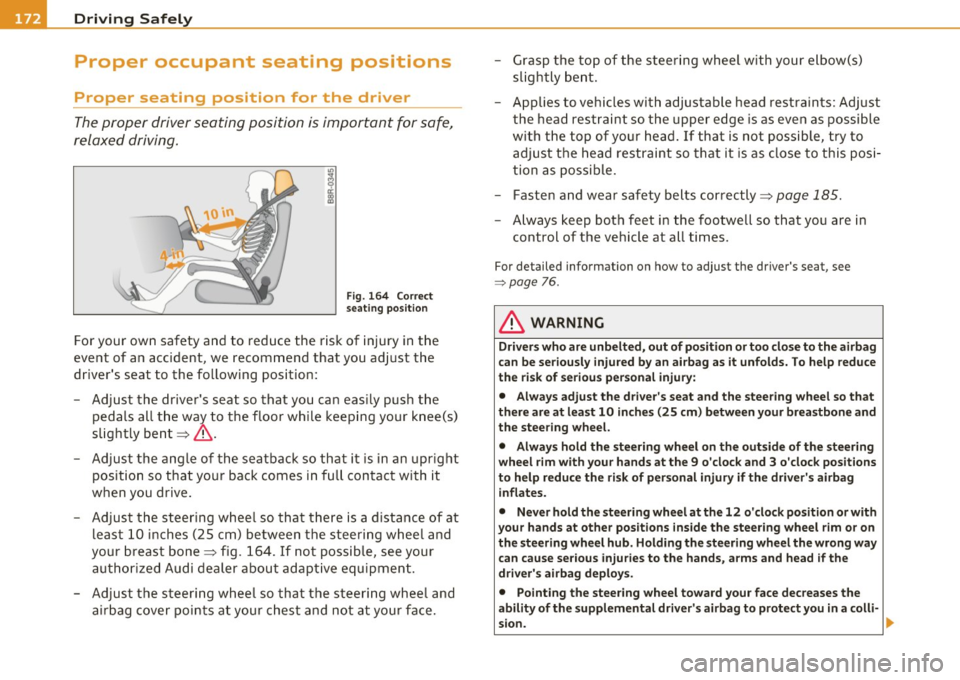
Fig. 164 Correct
seating position
For your own safety and to reduce the risk of injury in the
event of an accident, we recommend that you adjust the
driver's seat to the following position:
- Adjust the driver's seat so that you can easily push the
pedals all the way to the floor while keeping your knee(s)
slightly bent~& .
- Adjust the angle of the seatback so that it is in an upright
pos ition so that your back comes in full contact with it
when you drive.
- Adjust the steering wheel so that there is a distance of at least 10 inches (25 cm) between the steering wheel and
your breast bone~ fig . 164. If not possible, see your
authorized Audi dealer about adaptive equipment.
- Adjust the steering wheel so that the steering wheel and airbag cover points at your chest and not at your face. -
Grasp the top of the steering wheel with your elbow(s)
slightly bent.
- Applies to vehicles w ith adjustable head restraints: Adjust
the head restraint so the upper edge is as even as poss ible
with the top of your head. If that is not possible, try to
adjust the head restraint so that it is as close to this posi
tion as possible.
Fasten and wear safety belts correctly~
page 185.
-Always keep both feet in the footwell so that you are in
control of the vehicle at all t imes.
For de tailed inform ation on h ow to adju st the d river 's seat , see
~ page 76 .
& WARNING
Drivers who are unbelted, out of position or too close to the airbag
can be seriously injured by an airbag as it unfolds. To help reduce
the risk of serious personal injury:
• Always adjust the driver's seat and the steering wheel so that
there are at least 10 inches (25 cm) between your breastbone and
the steering wheel.
• Always hold the steering wheel on the outside of the steering
wheel rim with your hands at the 9 o'clock and 3 o'clock positions
to help reduce the risk of personal injury if the driver's airbag
inflates.
• Never hold the steering wheel at the 12 o'clock position or with
your hands at other positions inside the steering wheel rim or on
the steering wheel hub. Holding the steering wheel the wrong way
can cause serious injuries to the hands, arms and head if the
driver's airbag deploys.
• Pointing the steering wheel toward your face decreases the
ability of the supplemental driver's airbag to protect you in a colli·
sion. .,
Page 175 of 362
Driving Safely ---------------------" ~'---
& WARNING (continued)
• Always sit in an upright position and never lean against or
place any part of your body too close to the area where the airbags
are located.
• Before driving, always adjust the front seats and head
restraints properly and make sure that all passengers are properly
restrained.
• Never adjust the seats while the vehicle is moving. Your seat
may move unexpectedly and you could lose control of the vehicle.
• Never drive with the backrest reclined or tilted far back! The
farther the backrests are tilted back, the greater the risk of injury
due to incorrect positioning of the safety belt and improper
seating position.
• Children must always ride in child safety seats~
page 215.
Special precautions apply when installing a child safety seat on
the front passenger seat~
page 190. •
Proper seating position for the front
passenger
The proper front passenger seating position is important
for safe, relaxed driving .
For your own safety and to reduce the risk of injury in the
event of an accident, we recommend that you adjust the seat
for the front passenger to the following position:
- Move the front passenger seat back as far as possible.
There must be a minimum of 10 inches (25 cm) between
the breastbone and the instrument panel~&.
- Adjust the angle of the seatback so that it is in an upright
position and your back comes in full contact with it when
ever the vehicle is moving.
Controls and equip
ment Safety first Vehicle operation
-
Applies to vehicles with adjustable head restraints: Adjust
the head restraint so the upper edge is as even as possible
with the top of your head . If that is not possible, try to
adjust the head restraint so that it is as close to this posi
tion as possible.
- Keep both feet flat on the floor in front of the front
passenger seat.
- Fasten and wear safety belts correctly~
page 185.
For detailed information on how to adjust the front passenger's seat,
see ~
page 73.
& WARNING
Front seat passengers who are unbelted, out of position or too
close to the airbag can be seriously injured or killed by the airbag
as it unfolds. To help reduce the risk of serious personal injury:
• Passengers must always sit in an upright position and never
lean against or place any part of their body too close to the area
where the airbags are located.
• Passengers who are unbelted, out of position or too close to
the airbag can be seriously injured by an airbag as it unfolds with great force in the blink of an eye.
• Always make sure that there are at least 10 inches (25 cm)
between the front passenger's breastbone and the instrument
panel.
• Each passenger must always sit on a seat of their own and
properly fasten and wear the safety belt belonging to that seat.
• Before driving, always adjust the front passenger seat and
head restraint properly.
• Always keep your feet on the floor in front of the seat. Never
rest them on the seat, instrument panel, out of the window, etc.
The airbag system and safety belt will not be able to protect you
properly and can even increase the risk of injury in a crash. .,
Vehicle care Do-it-yourself service Technical data
Page 176 of 362
1111....__D_ r_iv _i_ n_, g=-- S_ a _ f_e _,Ly _ ______________________________________________ _
& WARNING (continued)
• Never drive with the backrest reclined or tilted far back! The
farther the backrests are tilted back, the greater the risk of injury due to incorrect positioning of the safety belt and improper
seating position.
• Children must always ride in child safety seats~
page 215.
Special precautions apply when installing a child safety seat on
the front passenger seat~
page 190. •
Proper seating positions for passengers in
rear seats
Rear seat passengers must sit upright with both feet on
the floor consistent with their physical size and be prop
erly restrained whenever the vehicle is in use.
To reduce the risk of injury caused by an incorrect seating
position in the event of a sudden braking maneuver or an
accident , your passengers on the rear bench seat must
always observe the following :
- Make sure that the seatback is securely latched in the
upright position ~
page 84.
-Keep both feet flat in the footwell in front of the rear seat.
- Fasten and wear safety belts properly~
page 185.
-Make sure that children are always properly restrained in a
child restraint that is appropriate for their size and age
~page 215.
& WARNING
Passengers who are improperly seated on the rear seat can be seri
ously injured in a crash.
& WARNING (continued)
• Each passenger must always sit on a seat of their own and
properly fasten and wear the safety belt belonging to that seat.
• Safety belts only offer maximum protection when the seatback
is securely latched in the upright position and the safety belts are
properly positioned on the body. By not sitting upright, a rear seat
passenger increases the risk of personal injury from improperly
positioned safety belts!
• Always adjust the head restraint properly so that it can give
maximum protection. •
Proper adjustment of head restraints
Correctly adjusted head restraints are an important part
of your vehicle 's occupant restraint system and can help
to reduce the risk of injuries in accident situations .
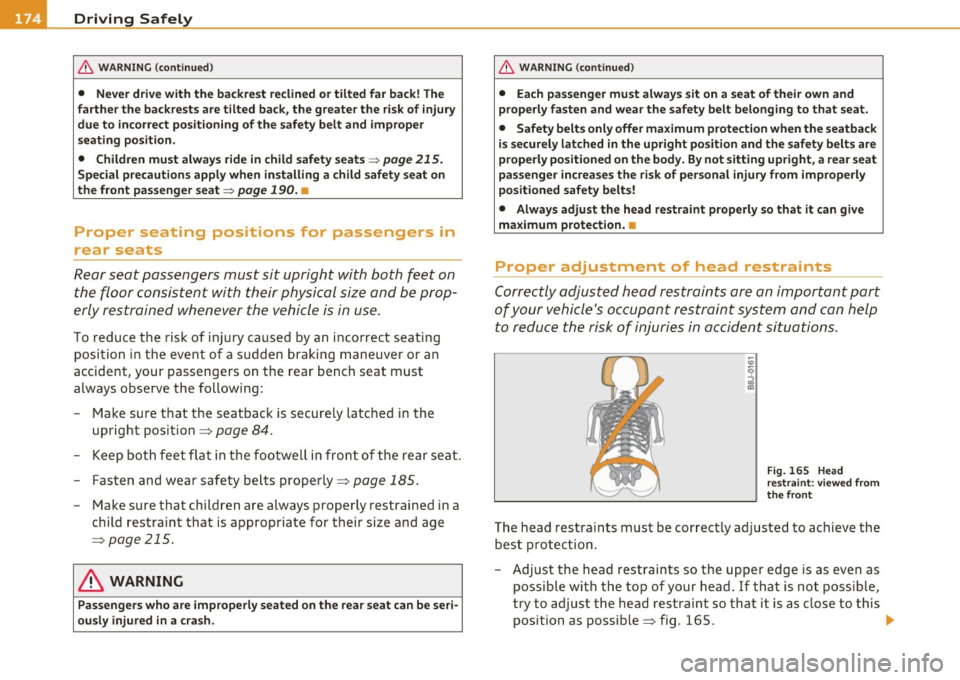
Fig. 165 Head
restraint: viewed from
the front
The head restraints must be correctly adjusted to achieve the
best protection.
- Adjust the head restraints so the upper edge is as even as
possible with the top of your head. If that is not possible,
try to adjust the head restraint so that it is as close to this
position as possible~ fig . 165. .,
Page 177 of 362
Driving Safely ---------------------"~'---
Adjusting head restraints=> page 80.
& WARNING
Driving without head rest raints or with head restraint s that are
not properl y adju sted increa se s the risk of seriou s or fatal neck
injury dramatically. To help reduce the risk of injur y:
• Always drive w ith the head restraints in place and properly
adjusted.
• Every person in the vehicle must have a prope rly adju sted head
restraint.
• Always make sure each person in the vehicle properly ad justs
their head restraint. Adju st the head restraints so the upper edge
i s as even a s pos sible with th e top of your head . If that is not
possible, try to adjust the head re straint so that it is as close to
this position as po ssible.
• Never attempt to adjust head restraint while driving. If you
have driven off and must adjust the driver headrest for any reason ,
first stop the vehicle safely before attempting to adju st the head
restraint.
• Children must alwa ys be properly restrained in a child re straint
that is appropriate for their age and size =>
page 215 . •
Examples of improper seating positions
The occupant res traint sy stem can o nly redu ce the risk of
injury i f veh icle occup ants are pr operly sea ted .
Im proper seati ng positio ns can caus e ser ious inju ry o r death .
Safety belts can on ly work w hen t hey are pro perly posi tio ned
on t he body. Impro per sea tin g posit io ns re duce the effect ive
ness of safety belts and w ill even increase the risk of i nju ry
and deat h by moving the s afety belt to crit ic a l areas of the
body. Imp roper seati ng positions also increase the r is k of
serious inju ry and death when an airbag deploys an d str ikes
Controls and equip
ment Safety first Vehicle operation
an occ
upan t who is not in th e proper s eati ng pos ition . A
d river is respons ib le f or t he safe ty o f all vehic le occu pants
a nd especial ly for children . Therefore:
- Never allow anyone to a ssum e an in correc t sea ting pos i-
t ion whe n the v ehic le is bei ng us ed::::;, &.
The follow ing b ulletins list only some sample positions that will
increase the risk of serious in ju ry and death. O ur hope is that these
examples will ma ke you more awa re of seat ing posi tions t hat are
dangero us.
Therefore, whenever the vehicle is moving :
• never stand up in the vehicle
• never stand on the seats
• never knee l on t he se ats
• never ride with the seatback reclined
• never lie down on the rear sea t
• never le an up agains t th e ins tru ment panel
• never sit on the edge of the seat
• neve r sit s ideways
• never lean o ut the win dow
• never put your feet out the window
• never p ut yo ur feet on the ins trumen t panel
• never rest your feet on the seat c ush ion or back of the seat
• never ride in the footwell
• never ride in the cargo area
& WARNING
Improper seating position s in crease the ri sk of seriou s personal
injury and death whenever a vehicle is being used. _,.
Vehicle care Do-it-yourself service Technical data